> [!NOTE] > **๐Ÿ“Œ Early release (2026)** > > Co-Labs shipped with the **2026** MLSysBook refresh. Lab notebooks, WASM builds, and scoring flows are **actively iterated** as we refine the hands-on curriculum. > > **Feedback** โ€” [GitHub issues](https://github.com/harvard-edge/cs249r_book/issues) or pull requests. > > [![dev branch](https://img.shields.io/badge/branch-dev-orange?logo=git&logoColor=white)](https://github.com/harvard-edge/cs249r_book/tree/dev) [![live site](https://img.shields.io/badge/live_site-mlsysbook.ai-blue?logo=safari&logoColor=white)](https://mlsysbook.ai)

Co-Labs

34 Interactive Labs Powered by MLSysยทIM
Predict โ†’ Discover โ†’ Explain
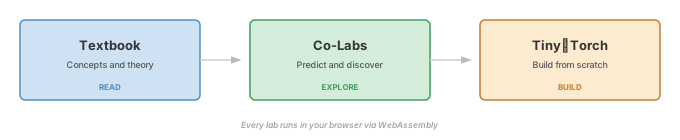
--- ## What Are Co-Labs? Co-Labs are interactive [Marimo](https://marimo.io) notebooks that bridge the gap between **reading about ML systems** (the textbook) and **building them from scratch** (TinyTorch). Every lab runs in your browser via WebAssembly โ€” no installation required.

Textbook to Co-Labs to TinyTorch learning flow

## How Labs Work Each lab follows a consistent structure: 1. **Briefing** โ€” Learning objectives, prerequisites, and the core question 2. **Parts Aโ€“E** โ€” Tabbed explorations, each with a prediction lock, interactive instruments, and a reveal 3. **Synthesis** โ€” Key takeaways, textbook connections, and a pointer to the next lab Every prediction is structured (radio buttons or numeric entry, never free text). You predict first, then explore the instruments to discover whether you were right. The gap between prediction and reality is the learning moment. ## Lab Inventory ### Volume I: Foundations (17 labs ยท Single-machine ML systems)
# Slug Title
00 lab_00_introduction The Architect's Portal (orientation)
01 lab_01_ml_intro The AI Triad
02 lab_02_ml_systems The Iron Law
03 lab_03_ml_workflow The Silent Degradation Loop
04 lab_04_data_engr The Data Gravity Trap
05 lab_05_nn_compute The Activation Tax
06 lab_06_nn_arch The Quadratic Wall
07 lab_07_ml_frameworks The Kernel Fusion Dividend
08 lab_08_model_train The Training Memory Budget
09 lab_09_data_selection The Data Selection Tradeoff
10 lab_10_model_compress The Compression Frontier
11 lab_11_hw_accel The Roofline
12 lab_12_perf_bench The Speedup Ceiling
13 lab_13_model_serving The Tail Latency Trap
14 lab_14_ml_ops The Silent Degradation Problem
15 lab_15_responsible_engr There Is No Free Fairness
16 lab_16_ml_conclusion The Architect's Audit (capstone)
### Volume II: At Scale (16 labs ยท Distributed ML systems)
# Slug Title
01 lab_01_introduction The Scale Illusion
02 lab_02_compute_infra The Compute Infrastructure Wall
03 lab_03_communication Network Fabric Design
04 lab_04_data_storage The Data Pipeline Wall
05 lab_05_dist_train The Parallelism Puzzle
06 lab_06_collective_communication Collective Communication
07 lab_07_fault_tolerance When Failure Is Routine
08 lab_08_fleet_orch The Scheduling Trap
09 lab_09_perf_engineering The Optimization Trap
10 lab_10_inference The Inference Economy
11 lab_11_edge_intelligence The Edge Thermodynamics Lab
12 lab_12_ops_scale The Silent Fleet
13 lab_13_security_privacy The Price of Privacy
14 lab_14_robust_ai The Robustness Budget
15 lab_15_sustainable_ai The Carbon Budget
16 lab_16_responsible_ai The Fairness Budget
17 lab_17_fleet_synthesis The Fleet Synthesis (capstone)
## The Design Ledger Every lab saves your predictions and design decisions to the **Design Ledger** โ€” an IndexedDB-backed persistence layer in your browser, with a local file fallback when running outside WebAssembly. Later labs read earlier decisions: Lab 08's training memory budget builds on Lab 05's activation analysis, which builds on Lab 01's magnitude calibration. The capstone labs synthesize your full Design Ledger into a portfolio. ## Running Labs ### In the Browser (Recommended) Visit the [Co-Labs site](https://mlsysbook.ai/labs/) and click any lab. They run via Marimo + WebAssembly with zero setup. ### Locally ```bash git clone https://github.com/harvard-edge/cs249r_book.git cd cs249r_book python3 -m pip install -r labs/requirements.txt python3 -m pip install -e mlsysim cd labs marimo run vol1/lab_01_ml_intro.py ``` ## Development See [PROTOCOL.md](PROTOCOL.md) for the lab development specification and [TEMPLATE.md](TEMPLATE.md) for the cell architecture and quality checklist. ### Running Tests ```bash pytest tests/test_static.py -v ``` --- ## Related Resources
Resource Description
Textbook ML Systems principles and practices
TinyTorch Build your own ML framework from scratch
Discussions Ask questions, share feedback
--- ## Contributors Thanks to these wonderful people who helped build the labs! **Legend:** ๐Ÿชฒ Bug Hunter ยท โšก Code Warrior ยท ๐Ÿ“š Documentation Hero ยท ๐ŸŽจ Design Artist ยท ๐Ÿง  Idea Generator ยท ๐Ÿ”Ž Code Reviewer ยท ๐Ÿงช Test Engineer ยท ๐Ÿ› ๏ธ Tool Builder
Rocky
Rocky

๐Ÿชฒ ๐Ÿง‘โ€๐Ÿ’ป ๐ŸŽจ โœ๏ธ ๐Ÿงช
Farhan Asghar
Farhan Asghar

๐Ÿชฒ ๐Ÿง‘โ€๐Ÿ’ป ๐ŸŽจ โœ๏ธ
Vijay Janapa Reddi
Vijay Janapa Reddi

๐Ÿง‘โ€๐Ÿ’ป ๐ŸŽจ โœ๏ธ
Peter Koellner
Peter Koellner

๐Ÿชฒ ๐Ÿง‘โ€๐Ÿ’ป
Salman Chishti
Salman Chishti

๐Ÿง‘โ€๐Ÿ’ป
Pratham Chaudhary
Pratham Chaudhary

๐Ÿง‘โ€๐Ÿ’ป
**Recognize a contributor:** Comment on any issue or PR: ```text @all-contributors please add @username for code, tutorial, test, or doc ``` ---
Predict. Discover. Explain.