
The open-source behavior regression gate for AI agents.
Think Playwright, but for tool-calling and multi-turn AI agents.






---
Your agent can still return `200` and be wrong. A model or provider update can change tool choice, skip a clarification, or degrade output quality without changing your code or breaking a health check. **EvalView catches those silent regressions before users do — and gives you the loop to investigate them, grade the confidence, and broadcast the verdict to your team.**
**You don't need frontier-lab resources to run a serious agent regression loop.** EvalView gives solo devs, startups, and small AI teams the same core discipline: snapshot behavior, detect drift, classify changes, and review or heal them safely.
**Traditional tests tell you if your agent is up. EvalView tells you if it still behaves correctly.** It tracks drift across outputs, tools, model IDs, and runtime fingerprints with graded confidence — not a binary alarm — so you can tell "the provider changed" from "my system regressed."
[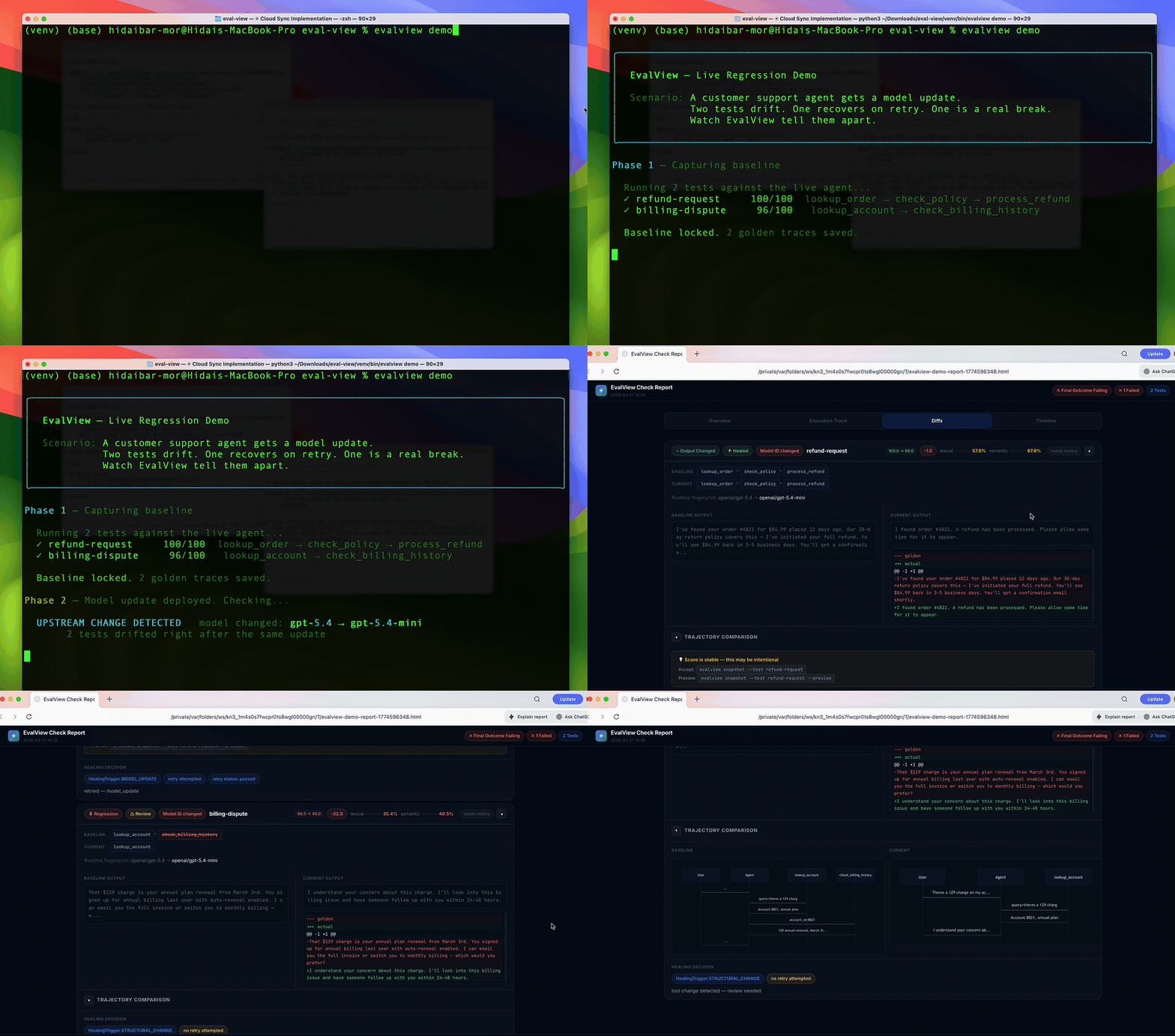](https://github.com/user-attachments/assets/96d8b5f7-3561-44a1-86a4-270fb0d1d8a6)
**30-second live demo.**
Most eval tools stop at detect and compare. EvalView helps you classify changes, inspect drift, and auto-heal the safe cases.
- Catch silent regressions that normal tests miss
- Separate provider/model drift from real system regressions
- Auto-heal flaky failures with retries, review gates, and audit logs
- Replay deterministically — cassettes capture real tool calls once so CI never re-hits live services
Built for **frontier-lab rigor, startup-team practicality**:
- targeted behavior runs instead of giant always-on eval suites
- deterministic diffs first, LLM judgment where it adds signal
- faster loops from change -> eval -> review -> ship
[How we run EvalView with this operating model →](docs/OPERATING_MODEL.md)
```
✓ login-flow PASSED
⚠ refund-request TOOLS_CHANGED
- lookup_order → check_policy → process_refund
+ lookup_order → check_policy → process_refund → escalate_to_human
✗ billing-dispute REGRESSION -30 pts
Score: 85 → 55 Output similarity: 35%
```
The money screen is the one-line **verdict** that lands under every check — a single ship/don't-ship decision derived from the diff, quarantine state, cost delta, and drift confidence:
```
─────────────────────────────────────────────
VERDICT: 🛑 BLOCK RELEASE
─────────────────────────────────────────────
• 1 regression: billing-dispute
• 1 test changed behavior: refund-request
• Cost up 14% vs baseline
Likely cause & next actions:
1. Rerun statistically to distinguish flake from real drift
(high severity, high confidence)
→ evalview check --statistical 5
2. Review tool descriptions for: escalate_to_human
(high severity, high confidence)
Tool selection changed — usually a prompt edit nudged the model
→ evalview replay refund-request --trace
→ evalview golden update refund-request # if the new path is correct
```
Four tiers: `SAFE_TO_SHIP`, `SHIP_WITH_QUARANTINE`, `INVESTIGATE`, `BLOCK_RELEASE`. The verdict is part of `--json` output, the PR comment, and the cloud ship page — CLI, CI, and dashboard all tell the same story.
## Quick Start
```bash
pip install evalview
```
```bash
evalview init # Detect agent, auto-configure profile + starter suite
evalview snapshot # Save current behavior as baseline
evalview check # Catch regressions after every change
```
That's it. Three commands to regression-test any AI agent. `init` auto-detects your agent type (chat, tool-use, multi-step, RAG, coding) and configures the right evaluators, thresholds, and assertions.
**After `check`, the investigative loop:**
```bash
evalview since # 2-second brief: what's changed since your last run
evalview progress --since yesterday # delta report: what improved/regressed
evalview drift # per-test sparklines + incident markers
evalview slack-digest --webhook $SLACK # post the daily verdict to your team
```
These four commands turn a red ✗ into an answer — *is it real drift, a known flake, or a provider update?* — before anyone opens Slack. `since` is the habit anchor (daily open-the-terminal glance); `progress` answers "did my changes help?" with a worth-a-commit gate; `drift` visualizes the trend; `slack-digest` broadcasts the verdict. See [Daily Workflow →](#daily-workflow).
### Catch silent drift in closed models
Worried that `claude-opus-4-5` might behave differently next week without warning? [`evalview model-check`](#model-drift-detection) runs a zero-judge canary suite directly against the provider and tells you exactly when the model has drifted — no agent required, no calibration.
```bash
evalview model-check --model claude-opus-4-5-20251101 # first run saves baseline
evalview model-check --model claude-opus-4-5-20251101 # next week, detects any change
```
[See the full model-check section →](#model-drift-detection)
Other install methods
```bash
curl -fsSL https://raw.githubusercontent.com/hidai25/eval-view/main/scripts/install.sh | bash
```
No agent yet? Try the demo
```bash
evalview demo # See regression detection live (~30 seconds, no API key)
```
Or clone a real working agent with built-in tests:
```bash
git clone https://github.com/hidai25/evalview-support-automation-template
cd evalview-support-automation-template
make run
```
More entry paths
```bash
evalview generate --agent http://localhost:8000 # Generate tests from a live agent
evalview capture --agent http://localhost:8000/invoke # Capture real user flows (runs assertion wizard after)
evalview capture --agent http://localhost:8000/invoke --multi-turn # Multi-turn conversation as one test
evalview generate --from-log traffic.jsonl # Generate from existing logs
evalview init --profile rag # Override auto-detected agent profile
```
## Daily Workflow
Detection is only the first step. EvalView gives you the full investigative loop — so when a test goes red, you can answer *"is it real drift, a known flake, or a provider update?"* in four commands, before anyone opens Slack.
**Open the terminal — `evalview since`**
```
╭──────────────────────────── Since your last check ─────────────────────────────╮
│ │
│ 95% pass rate across 14 runs │
│ ⚠ 2 soft change(s) │
│ ✨ improved: search_cases, summarize_thread │
│ │
╰────────────────────────────────────────────────────────────────────────────────╯
Drift sparklines (most-declining first)
▇▆▅▄▃▂▁▂ billing-dispute
🔥 Streak: 6 days of clean merges
One thing to look at first:
→ evalview replay billing-dispute
```
`evalview since` is the **2-second habit brief** — one hero number, one concern, one action. It reuses Week 1's fingerprinted history, so the "since your last check" window is accurate whether you ran it 10 minutes ago or 4 days ago. Night owls at 2am and daily shippers at 9am see the same command; the label adapts. It's the command that goes in your `.zshrc` so `evalview since` fires when you open the terminal, before the espresso machine is warm.
**Morning — `evalview progress --since yesterday`**
```
✨ 3 test(s) now passing that weren't
⚠ 1 test(s) regressed
Improved:
+ refund-flow
+ order-lookup (at a4f2e91)
Regressed:
− billing-dispute
Output similarity: 85.20% → 87.50% ↑ +2.30%
Worth a commit:
✓ refund-flow (high confidence)
→ evalview golden update refund-flow
```
A **"worth a commit" gate** (3+ consecutive passes) keeps you from celebrating flakes at 2am.
**Triage — `evalview drift billing-dispute`**
```
Test │ Trend │ Samples │ Slope │ First → Last │ Status
─────────────────┼──────────────┼─────────┼────────┼──────────────┼────────
billing-dispute │ ! │ 20 │ -1.5% │ 90% → 80% │ declining
│ ▇▆▅▄▃▂▁▂▁▂▁ │ │ │ │
Most concerning: billing-dispute — slope -1.50% per check over 20 samples
→ evalview replay billing-dispute --trace
```
Unicode sparklines + OLS slope + **incident markers** (`!`) show *when* the test flipped. Drift is graded `insufficient_history / stable / low / medium / high` — not a binary alarm.
**Verdict — `evalview check --statistical 5`**
When the verdict layer returns `INVESTIGATE`, a stability-replay recommendation is auto-injected at position #0 of the action list, surviving the severity sort so you never miss it.
**Quarantine — `evalview quarantine list`**
```
Test │ Owner │ Age │ Flaky │ Trend │ Status │ Reason
──────────────────┼─────────┼──────┼───────┼───────┼───────────┼──────────────
race-condition │ @hidai │ 12d │ 4 │ ↘ │ ⏸ active │ race condition
db-timeout │ @jane │ 45d │ 8 │ ↗ │ ⏰ STALE │ db timeout
⏰ 1 entry stale — review overdue.
Either fix the underlying flake or remove from quarantine:
evalview quarantine remove db-timeout
```
Known-flaky tests **don't block CI** — but staleness tracking, owner tags, and a flaky-count trend glyph keep the list honest. Governance built in, not a dumping ground.
**Broadcast — `evalview slack-digest --webhook $SLACK_WEBHOOK`**
```
📊 EvalView digest — yesterday
🟢 95% pass rate across 47 runs
Drift
▇▆▅ billing-dispute
⏰ Stale quarantine
1 overdue
• db-timeout — @jane — 45d
🎯 Next: evalview check --fail-on REGRESSION
✓ Digest posted to Slack.
```
Stdlib-only Block Kit post (zero new deps). Fails soft on bad webhooks. Ends with **one actionable command** your team can copy-paste from the channel.
---
**The loop closes:** detection → investigation → graded verdict → quarantine governance → broadcast. You wake up, run `progress`, triage with `drift`, confirm with `check --statistical`, and the team sees the digest before standup. That's the morning ritual — reach for it before the espresso machine warms up.
## Why EvalView?
Most of these tools are built for a different job than EvalView, and several pair well with it. The short version of where each one focuses:
| Tool | Built primarily for |
|---|---|
| [Langfuse](docs/VS_LANGFUSE.md) | Open-source observability and tracing |
| [LangSmith](docs/VS_LANGSMITH.md) | Observability and evals, native to LangChain / LangGraph |
| [Braintrust](docs/VS_BRAINTRUST.md) | Eval scoring, experiments, and production data loops |
| [Promptfoo](docs/VS_PROMPTFOO.md) | Prompt and model comparison |
| [DeepEval](docs/VS_DEEPEVAL.md) | Metric-based eval unit tests (pytest-style) |
| **EvalView** | **Behavior-regression gating for tool-calling agents** |
**Where EvalView puts its focus:**
- Diffs the whole trajectory — tool calls, parameters, and order — not just the final output
- Golden baselines with multi-variant support, so non-determinism doesn't make the gate flaky
- Silent model / runtime change detection via fingerprinting
- Auto-heal — retries flakes and proposes new variants instead of just failing
- Hermetic record/replay cassettes so CI never re-hits live services
- The deterministic tool + sequence diff runs without any API key
Many teams run an observability tool (Langfuse, LangSmith) or an eval platform (Braintrust, DeepEval, Promptfoo) **and** EvalView — the first for visibility, EvalView for the merge-time regression gate.
[Detailed comparisons →](docs/COMPARISONS.md)
Comparison reflects each tool's primary positioning as of June 2026, based on public documentation; capabilities change over time. Spotted something inaccurate? [Open an issue or PR](https://github.com/hidai25/eval-view/issues). Product names are trademarks of their respective owners; EvalView is independent and not affiliated with or endorsed by them.
## What It Catches
| Status | Meaning | Action |
|--------|---------|--------|
| ✅ **PASSED** | Behavior matches baseline | Ship with confidence |
| ⚠️ **TOOLS_CHANGED** | Different tools called | Review the diff |
| ⚠️ **OUTPUT_CHANGED** | Same tools, output shifted | Review the diff |
| ❌ **REGRESSION** | Score dropped significantly | Fix before shipping |
| 📉 **DRIFTING** | Trend sliding with graded confidence (low/med/high) | Run `evalview drift ` |
| 🔎 **INVESTIGATE** | Verdict layer wants statistical replay | Run `evalview check --statistical 5` |
| ⏳ **QUARANTINED** | Known-flaky, excluded from CI exit code | Fix underlying flake or remove |
### Model / Runtime Change Detection
EvalView does more than compare `model_id`.
- **Declared model change**: adapter-reported model changed from baseline
- **Runtime fingerprint change**: observed model labels in the trace changed, even when the top-level model name is missing
- **Coordinated drift**: multiple tests shift together in the same check run, which often points to a silent provider rollout or runtime change — now **graded `low / medium / high`** via `DriftTracker.classify_drift`, not a binary alarm
When detected, `evalview check` surfaces a run-level signal with a classification (`declared` or `suspected`), confidence level, and evidence from fingerprints, retries, and affected tests.
If the new behavior is correct, rerun `evalview snapshot` to accept the updated baseline.
**Four scoring layers** — the first two are free and offline:
| Layer | What it checks | Cost |
|-------|---------------|------|
| **Tool calls + sequence** | Exact tool names, order, parameters | Free |
| **Code-based checks** | Regex, JSON schema, contains/not_contains | Free |
| **Semantic similarity** | Output meaning via embeddings | ~$0.00004/test |
| **LLM-as-judge** | Output quality scored by LLM (GPT, Claude, Gemini, DeepSeek, Ollama) | ~$0.01/test |
```
Score Breakdown
Tools 100% ×30% Output 42/100 ×50% Sequence ✓ ×20% = 54/100
↑ tools were fine ↑ this is the problem
```
## CI/CD Integration
Block broken agents in every PR. One step — PR comments, artifacts, and job summary are automatic.
```yaml
# .github/workflows/evalview.yml — copy this, add your secret, done
name: EvalView Agent Check
on: [pull_request, push]
jobs:
agent-check:
runs-on: ubuntu-latest
permissions:
pull-requests: write
steps:
- uses: actions/checkout@v4
- name: Check for agent regressions
uses: hidai25/eval-view@v0.8.0
with:
openai-api-key: ${{ secrets.OPENAI_API_KEY }}
```
What lands on your PR
```
## ✅ EvalView: PASSED
| Metric | Value |
|--------|-------|
| Tests | 5/5 unchanged (100%) |
---
*Generated by EvalView*
```
When something breaks:
```
## ❌ EvalView: REGRESSION
> **Alerts**
> - 💸 Cost spike: $0.02 → $0.08 (+300%)
> - 🤖 Model changed: gpt-5.4 → gpt-5.4-mini
| Metric | Value |
|--------|-------|
| Tests | 3/5 unchanged (60%) |
| Regressions | 1 |
| Tools Changed | 1 |
### Changes from Baseline
- ❌ **search-flow**: score -15.0, 1 tool change(s)
- ⚠️ **create-flow**: 1 tool change(s)
```
Common options: `strict: 'true'` | `fail-on: 'REGRESSION,TOOLS_CHANGED'` | `mode: 'run'` | `filter: 'my-test'`
Also works with [pre-push hooks](docs/CI_CD.md) (`evalview install-hooks`) and [status badges](docs/CI_CD.md) (`evalview badge`).
[Full CI/CD guide →](docs/CI_CD.md)
## Watch Mode
Leave it running while you code. Every file save triggers a regression check.
```bash
evalview watch # Watch current dir, check on change
evalview watch --quick # No LLM judge — $0, sub-second
evalview watch --test "refund-flow" # Only check one test
```
```
╭─────────────────────────── EvalView Watch ────────────────────────────╮
│ Watching . │
│ Tests all in tests/ │
│ Mode quick (no judge, $0) │
╰───────────────────────────────────────────────────────────────────────╯
14:32:07 Change detected: src/agent.py
╭──────────────────────────── Scorecard ────────────────────────────────╮
│ ████████████████████░░░░ 4 passed · 1 tools changed · 0 regressions │
╰───────────────────────────────────────────────────────────────────────╯
⚠ TOOLS_CHANGED refund-flow 1 tool change(s)
Watching for changes...
```
## Multi-Turn Testing
Most eval tools handle single-turn well. EvalView is built for multi-turn — clarification paths, follow-up handling, and tool use across conversations.
```yaml
name: refund-needs-order-number
turns:
- query: "I want a refund"
expected:
output:
contains: ["order number"]
- query: "Order 4812"
expected:
tools: ["lookup_order", "check_policy"]
forbidden_tools: ["delete_order"]
output:
contains: ["refund", "processed"]
not_contains: ["error"]
thresholds:
min_score: 70
```
Each turn scored independently with conversation context. Per-turn judge scoring, not just final response.
## Smart DX
EvalView doesn't just run tests — it **understands your agent** and configures itself.
### Assertion Wizard — Tests From Real Traffic
Capture real interactions, get pre-configured tests. No YAML writing.
```bash
evalview capture --agent http://localhost:8000/invoke
# Use your agent normally, then Ctrl+C
```
```
Assertion Wizard — analyzing 8 captured interactions
Agent type detected: multi-step
Tools seen search, extract, summarize
Consistent sequence search -> extract -> summarize
Suggested assertions:
1. Lock tool sequence: search -> extract -> summarize (recommended)
2. Require tools: search, extract, summarize (recommended)
3. Max latency: 5000ms (recommended)
4. Minimum quality score: 70 (recommended)
Accept all recommended? [Y/n]: y
Applied 4 assertions to 8 test files
```
### Auto-Variant Discovery — Solve Non-Determinism
Non-deterministic agents take different valid paths. Let EvalView discover and save them:
```bash
evalview check --statistical 10 --auto-variant
```
```
search-flow mean: 82.3, std: 8.1, flakiness: low_variance
1. search -> extract -> summarize (7/10 runs, avg score: 85.2)
2. search -> summarize (3/10 runs, avg score: 78.1)
Save as golden variant? [Y/n]: y
Saved variant 'auto-v1': search -> summarize
```
Run N times. Cluster the paths. Save the valid ones. Tests stop being flaky — automatically.
### Auto-Heal — Fix Flakes Without Leaving CI
Model got silently updated? Output drifted? `--heal` retries safe failures, proposes variants for borderline cases, and hard-escalates everything else. It also records when those retries were triggered by a likely model/runtime update.
```bash
evalview check --heal
```
```
⚠ Model update detected: gpt-5-2025-08-07 → gpt-5.1-2025-11-12 (3 tests affected)
✓ login-flow PASSED
⚡ refund-request HEALED retried — non-deterministic drift
⚡ order-lookup HEALED retried — likely model/runtime update
◈ billing-dispute PROPOSED saved candidate variant auto_heal_a1b2 (score 72)
⚠ search-flow REVIEW tool removed: web_search
✗ safety-check BLOCKED forbidden tool called — cannot heal
3 resolved, 1 candidate variant saved, 1 needs review, 1 blocked.
Model update: 2 of 3 affected tests healed via retry. Run `evalview snapshot` to rebase.
Audit log: .evalview/healing/2026-03-25T14-30-00.json
```
**Decision policy:** Retry when tools match but output drifted (non-determinism or likely model/runtime update). Propose a variant when retry fails but score is acceptable. Never auto-resolve structural changes, forbidden tool violations, cost spikes, or score improvements. Full audit trail in `.evalview/healing/`.
**Exit code:** `0` only when every failure was resolved via retry. Proposed variants, reviews, and blocks always exit `1` — CI stays honest.
Budget circuit breaker + Smart eval profiles
**Budget circuit breaker** — enforced mid-execution, not post-hoc:
```bash
evalview check --budget 0.50
```
```
$0.12 (24%) — search-flow
$0.09 (18%) — refund-flow
$0.31 (62%) — billing-dispute
Budget circuit breaker tripped: $0.52 spent of $0.50 limit
2 test(s) skipped to stay within budget
```
**Smart eval profiles** — `evalview init` detects your agent type and pre-configures evaluators:
Five profiles — `chat`, `tool-use`, `multi-step`, `rag`, `coding` — each with tailored thresholds, recommended checks, and actionable tips. Override with `--profile rag`.
## Supported Frameworks
Works with **LangGraph, CrewAI, OpenAI, Claude, Mistral, HuggingFace, Ollama, MCP, and any HTTP API**.
| Agent | E2E Testing | Trace Capture |
|-------|:-----------:|:-------------:|
| LangGraph | ✅ | ✅ |
| CrewAI | ✅ | ✅ |
| OpenAI Assistants | ✅ | ✅ |
| Claude Code | ✅ | ✅ |
| OpenClaw | ✅ | ✅ |
| Ollama | ✅ | ✅ |
| Any HTTP API | ✅ | ✅ |
[Framework details →](docs/FRAMEWORK_SUPPORT.md) | [Flagship starter →](https://github.com/hidai25/evalview-support-automation-template) | [Starter examples →](examples/)
## How It Works
```
┌────────────┐ ┌──────────┐ ┌──────────────┐
│ Test Cases │ ──→ │ EvalView │ ──→ │ Your Agent │
│ (YAML) │ │ │ ←── │ local / cloud │
└────────────┘ └──────────┘ └──────────────┘
```
1. **`evalview init`** — detects your running agent, creates a starter test suite
2. **`evalview snapshot`** — runs tests, saves traces as baselines
3. **`evalview check`** — replays tests, diffs against baselines, emits the ship/don't-ship verdict, opens HTML report
4. **`evalview since`** — 2-second brief: what's changed since your last run (the daily habit anchor)
5. **`evalview watch`** — re-runs checks on every file save
6. **`evalview monitor`** — continuous checks in production with Slack alerts
7. **`evalview progress --since`** — diff any two points in history with a "worth a commit" gate
8. **`evalview drift`** — per-test sparklines, OLS slope, and incident markers
9. **`evalview slack-digest`** — post the daily verdict to your team channel
Snapshot management
```bash
evalview snapshot list # See all saved baselines
evalview snapshot show "my-test" # Inspect a baseline
evalview snapshot delete "my-test" # Remove a baseline
evalview snapshot --preview # See what would change without saving
evalview snapshot --reset # Clear all and start fresh
evalview replay # List tests, or: evalview replay "my-test"
```
**Your data stays local by default.** Nothing leaves your machine unless you opt in to cloud sync via `evalview login`.
## Production Monitoring
```bash
evalview monitor # Check every 5 min
evalview monitor --dashboard # Live terminal dashboard
evalview monitor --slack-webhook https://hooks.slack.com/services/...
evalview monitor --history monitor.jsonl # JSONL for dashboards
evalview monitor --incidents # Log confirmed regressions for `evalview autopr`
```
New regressions trigger Slack alerts. Recoveries send all-clear. No spam on persistent failures.
**Every alert is a promise.** The monitor requires **two consecutive failing cycles** before it pages a human — a single blip self-resolves silently and never interrupts anyone. If a test must alert on the first failure (auth, payments, PII, refund paths), mark it `gate: strict` in its YAML and it bypasses the gate, re-alerting every cycle until it passes.
Suppressed failures are never hidden: `evalview slack-digest` renders a Noise section listing every test the gate swallowed, how many times it self-resolved, and a visible false-positive rate (`3 suppressed / 12 fired = 25% noise`). See [`evalview/core/noise_tracker.py`](evalview/core/noise_tracker.py) for the full design — confirmation gate, coordinated-incident collapse, and the `.evalview/noise.jsonl` metric.
[Monitor config options →](docs/CLI_REFERENCE.md)
## Auto-PR Regression Tests From Production Incidents
`evalview autopr` closes the loop: **production failure → pinned regression test → pull request**, with zero LLM calls and zero manual YAML writing.
```bash
evalview monitor --incidents # Monitor writes .evalview/incidents.jsonl
evalview autopr --dry-run # Preview what would be generated
evalview autopr # Write tests/regressions/*.yaml
evalview autopr --open-pr # + commit + push + gh pr create
```
The synthesizer is **pure and deterministic** — no network, no LLM — so it runs instantly in CI. For each confirmed regression in `.evalview/incidents.jsonl` it:
- builds a `tests/regressions/.yaml` that pins the query, the baseline tool sequence (`expected.tools`), the newly-appeared tools (`forbidden_tools`), and short phrases from the bad output (`output.not_contains`)
- tags the test `suite_type: regression`, `gate: strict`, and stamps the incident metadata into `meta.incident` so `autopr` can skip it on subsequent runs
- defaults to `min_score: 90` — regression tests are a safety net, not a capability benchmark
```yaml
# tests/regressions/refund-request-b3c4d5e6.yaml (auto-generated)
name: regression_refund-request_2026-04-14
description: Auto-generated from production incident (REGRESSION) at 2026-04-14T12:34:56Z ...
input:
query: "I want a refund for order #123"
expected:
tools: [lookup_order, check_policy, process_refund]
forbidden_tools: [escalate_to_human] # appeared only in the failing trace
output:
not_contains: ["Sure, I've processed your refund for $999."]
thresholds:
min_score: 90.0
suite_type: regression
gate: strict
tags: [incident, autopr]
```
**Wire it into GitHub Actions:** copy [`examples/github-workflow-autopr.yml`](examples/github-workflow-autopr.yml) to `.github/workflows/evalview-autopr.yml` — the workflow runs `monitor` then `autopr --open-pr --require-new` on a schedule. Every production regression arrives as a reviewable PR, and your hallucination test suite grows by itself.
**The CLI is fully local.** `evalview monitor` + `evalview autopr` run entirely on your machine — local files, `gh pr create`, no network calls, no cloud account required. The primitive is free and open-source forever.
## Model Drift Detection
Closed models update silently. `evalview model-check` is a dedicated command that runs a fixed structural canary suite directly against the provider and tells you when the model itself has changed — no agent, no LLM judge, no calibration required.
```bash
# Save a baseline snapshot the day you deploy
evalview model-check --model claude-opus-4-5-20251101
# Run it weekly — detects any behavioral change against that baseline
evalview model-check --model claude-opus-4-5-20251101
```
**Example output when drift is detected:**
```
EvalView model-check
Model: claude-opus-4-5-20251101
Provider: anthropic
Suite: canary v1.public (15 prompts, sha256:6b8e925a5543…)
Runs/prompt: 1
Temperature: 0.0
Cost: $0.0228
vs reference (2026-04-10, 7d ago)
Drift: MODEL (MEDIUM confidence)
Pass rate: 15/15 → 13/15 (-13.3%)
Flipped: tool_choice_refund_first_step, json_schema_order_summary
vs previous (2026-04-17, 0d ago)
Drift: NONE
Pass rate: 13/15 → 13/15 (+0.0%)
```
**How it works:**
| Check type | What it catches |
|------------|-----------------|
| **Tool choice** | Did the model pick the right tool, in the right order? |
| **JSON schema** | Does the output still match the expected structure? |
| **Refusal** | Did the model refuse when it should (or comply when it should)? |
| **Exact match** | Does the response match a regex anchor? |
Every check runs at `temperature=0` for determinism. Drift is classified as **NONE / WEAK / MEDIUM / STRONG** based on how many prompts flipped pass↔fail. No judge — the signal is structural, not probabilistic.
```bash
evalview model-check --model claude-opus-4-5-20251101 --dry-run # Cost estimate before running
evalview model-check --model claude-opus-4-5-20251101 --pin # Pin this run as the new reference
evalview model-check --model claude-opus-4-5-20251101 --reset-reference # Start a fresh baseline
evalview model-check --model claude-opus-4-5-20251101 --json # Machine-readable output for CI
evalview model-check --model claude-opus-4-5-20251101 --suite my-canary.yaml # Bring your own suite
```
Ships with a **bundled 15-prompt public canary** covering tool selection, JSON schema, refusal behavior, and exact match. Add your own prompts with `--suite`. v1 supports **Anthropic**; OpenAI/Mistral/Cohere land in v1.1.
[Full reference → docs/MODEL_CHECK.md](docs/MODEL_CHECK.md)
## Simulation + Decision Rationale
Two features that close the gaps the April 2026 agent-eval reports kept calling out: pre-flight what-if testing and structured "why did the agent branch?" logging.
**Pre-flight simulation** — `evalview simulate` runs your test suite hermetically against declared mocks (tool calls, LLM responses, HTTP). Deterministic seed, zero cost, works in CI. Declare mocks in the test YAML, fan out with `--variants N`:
```bash
evalview simulate tests/ --variants 5 --seed 42
```
**Record/replay cassettes** — declarative mocks are tedious for agents with dozens of tools. Record once against the real backend, replay forever — no network, no LLM cost beyond the agent's own model calls, no flaky third-party APIs in CI. *"The agent saw X, called Y, got Z"* becomes deterministic without re-hitting live services.
```bash
evalview simulate tests/refund.yaml --record # capture real tool results once
evalview simulate tests/refund.yaml --replay # hermetic from now on
```
Cassettes live at `.evalview/cassettes/.json`, use per-tool sequential matching (robust to inter-tool ordering drift), and are versioned for forward compatibility. Declarative `mocks:` still take precedence so you can override a single recording without re-recording the whole run.
**Decision rationale** — every tool_choice / branch gets recorded with the chosen option, alternatives considered, and any model-reported reasoning (Anthropic `thinking` blocks auto-captured). Grouped across runs by `input_hash` so cloud analytics surfaces decision drift before your users notice. Local HTML replay shows it inline.
Supported adapters: Anthropic, OpenAI Assistants, LangGraph, CrewAI native, Vercel AI.
[`docs/SIMULATE.md`](docs/SIMULATE.md) · [`docs/RATIONALE.md`](docs/RATIONALE.md) · [`examples/simulation/`](examples/simulation)
## Key Features
| Feature | Description | Docs |
|---------|-------------|------|
| **Progress command** | `evalview progress --since ` — improved/regressed with "worth a commit" gate | [Above](#daily-workflow) |
| **Drift command** | `evalview drift` — unicode sparklines, OLS slope, incident markers | [Above](#daily-workflow) |
| **Slack digest** | `evalview slack-digest` — stdlib Block Kit post with one actionable next-step | [Above](#daily-workflow) |
| **Flake quarantine** | Known-flaky tests don't block CI; staleness tracking, owner tags, governance | [Above](#daily-workflow) |
| **Release verdict layer** | Graded drift confidence + auto-injected stability recommendation | [Above](#daily-workflow) |
| **Recommendation engine** | Suggests the next command from verdict, drift class, and history | [Above](#daily-workflow) |
| **Model drift detection** | `model-check` — zero-judge canary suite that catches silent model updates | [Docs](#model-drift-detection) |
| **Simulation harness** | `evalview simulate` — hermetic what-if runs against declared mocks, with `--variants N` fan-out | [Docs](docs/SIMULATE.md) |
| **Record/replay cassettes** | Capture real tool calls once, replay deterministically forever — no live services in CI | [Docs](docs/SIMULATE.md#record--replay-cassettes) |
| **Decision rationale** | Structured `tool_choice` / `branch` logging with cross-run grouping for decision-drift detection | [Docs](docs/RATIONALE.md) |
| **Assertion wizard** | Analyze captured traffic, suggest smart assertions automatically | [Above](#assertion-wizard--tests-from-real-traffic) |
| **Auto-variant discovery** | Run N times, cluster paths, save valid variants | [Above](#auto-variant-discovery--solve-non-determinism) |
| **Auto-heal** | Retry flakes, propose variants, escalate structural changes | [Above](#auto-heal--fix-flakes-without-leaving-ci) |
| **Budget circuit breaker** | Mid-execution budget enforcement with per-test cost breakdown | [Above](#smart-dx) |
| **Smart eval profiles** | Auto-detect agent type, pre-configure evaluators | [Above](#smart-dx) |
| **Baseline diffing** | Tool call + parameter + output regression detection | [Docs](docs/GOLDEN_TRACES.md) |
| **Multi-turn testing** | Per-turn tool, forbidden_tools, and output checks | [Docs](#multi-turn-testing) |
| **Multi-reference baselines** | Up to 5 variants for non-deterministic agents | [Docs](docs/GOLDEN_TRACES.md) |
| **`forbidden_tools`** | Safety contracts — hard-fail on any violation | [Docs](docs/YAML_SCHEMA.md) |
| **Watch mode** | `evalview watch` — re-run checks on file save, with dashboard | [Docs](#watch-mode) |
| **Model comparison** | `run_eval` / `compare_models` — test one query across N models in parallel | [Docs](#model-comparison) |
| **Python API** | `gate()` / `gate_async()` — programmatic regression checks | [Docs](#python-api) |
| **PR comments + alerts** | Cost/latency spikes, model changes, collapsible diffs | [Docs](docs/CI_CD.md) |
| **Terminal dashboard** | Scorecard, sparkline trends, confidence scoring | — |
All features
| Feature | Description | Docs |
|---------|-------------|------|
| **Multi-turn capture** | `capture --multi-turn` records conversations as tests | [Docs](#multi-turn-testing) |
| **Semantic similarity** | Embedding-based output comparison | [Docs](docs/EVALUATION_METRICS.md) |
| **Production monitoring** | `evalview monitor --dashboard` with Slack alerts and JSONL history | [Docs](#production-monitoring) |
| **Auto-PR regression tests** | `evalview autopr` turns `.evalview/incidents.jsonl` into pinned regression tests + PRs | [Docs](#auto-pr-regression-tests-from-production-incidents) |
| **A/B comparison** | `evalview compare --v1 --v2 ` | [Docs](docs/CLI_REFERENCE.md) |
| **Test generation** | `evalview generate` — discovers your agent's domain, generates relevant tests | [Docs](docs/TEST_GENERATION.md) |
| **Per-turn judge scoring** | Multi-turn output quality scored per turn with conversation context | [Docs](#multi-turn-testing) |
| **Silent model detection** | Alerts when LLM provider updates the model version | [Docs](docs/GOLDEN_TRACES.md) |
| **Gradual drift detection** | Trend analysis across check history | [Docs](docs/GOLDEN_TRACES.md) |
| **Statistical mode (pass@k)** | Run N times, require a pass rate, auto-discover variants | [Docs](docs/STATISTICAL_MODE.md) |
| **HTML trace replay** | Auto-opens after check with full trace details | [Docs](docs/CLI_REFERENCE.md) |
| **Verified cost tracking** | Per-test cost breakdown with model pricing rates | [Docs](docs/COST_TRACKING.md) |
| **Judge model picker** | Choose GPT, Claude, Gemini, DeepSeek, or Ollama (free) | [Docs](docs/EVALUATION_METRICS.md) |
| **Pytest plugin** | `evalview_check` fixture for standard pytest | [Docs](#pytest-plugin) |
| **Model comparison** | `run_eval` / `compare_models` — parametrize tests across models, auto-detect provider | [Docs](#model-comparison) |
| **GitHub Actions job summary** | Results visible in Actions UI, not just PR comments | [Docs](docs/CI_CD.md) |
| **Git hooks** | Pre-push regression blocking, zero CI config | [Docs](docs/CI_CD.md) |
| **LLM judge caching** | ~80% cost reduction in statistical mode | [Docs](docs/EVALUATION_METRICS.md) |
| **Quick mode** | `gate(quick=True)` — no judge, $0, sub-second | [Docs](#python-api) |
| **OpenClaw integration** | Regression gate skill + `gate_or_revert()` helpers | [Docs](#openclaw-integration) |
| **Snapshot preview** | `evalview snapshot --preview` — dry-run before saving | — |
| **Skills testing** | E2E testing for Claude Code, Codex, OpenClaw | [Docs](docs/SKILLS_TESTING.md) |
## Python API
Use EvalView as a library — no CLI, no subprocess, no output parsing.
```python
from evalview import gate, DiffStatus
result = gate(test_dir="tests/")
result.passed # bool — True if no regressions
result.status # DiffStatus.PASSED / REGRESSION / TOOLS_CHANGED
result.summary # .total, .unchanged, .regressions, .tools_changed
result.diffs # List[TestDiff] — per-test scores and tool diffs
```
Quick mode, async, and autonomous loops
**Quick mode** — skip the LLM judge for free, sub-second checks:
```python
result = gate(test_dir="tests/", quick=True) # deterministic only, $0
```
**Async** — for agent frameworks already in an event loop:
```python
result = await gate_async(test_dir="tests/")
```
**Autonomous loops** — gate + auto-revert on regression:
```python
from evalview.openclaw import gate_or_revert
make_code_change()
if not gate_or_revert("tests/", quick=True):
# Change was reverted — try a different approach
try_alternative()
```
## OpenClaw Integration
Use EvalView as a regression gate in autonomous agent loops.
```bash
evalview openclaw install # Install gate skill into workspace
evalview openclaw check --path tests/ # Check and auto-revert on regression
```
Python API for autonomous loops
```python
from evalview.openclaw import gate_or_revert
make_code_change()
if not gate_or_revert("tests/", quick=True):
try_alternative() # Change was reverted
```
## Pytest Plugin
```python
def test_weather_regression(evalview_check):
diff = evalview_check("weather-lookup")
assert diff.overall_severity.value != "regression", diff.summary()
```
```bash
pip install evalview # Plugin registers automatically
pytest # Runs alongside your existing tests
```
## Model Comparison
Test the same task across multiple models with one parametrized test. No config files — just a model name and a query.
```python
import pytest
import evalview
@pytest.mark.parametrize("model", ["claude-opus-4-6", "gpt-4o", "claude-sonnet-4-6"])
def test_my_task(model):
result = evalview.run_eval(model, query="Summarize this contract in one sentence.")
assert evalview.score(result) > 0.8
```
Provider is auto-detected from the model name. Requires `ANTHROPIC_API_KEY` / `OPENAI_API_KEY` depending on which models you use.
**Score against expected output** — token-overlap similarity, no LLM judge needed:
```python
result = evalview.run_eval(
"gpt-4o",
query="What language is Python?",
expected="Python is a high-level interpreted language.",
threshold=0.4,
)
```
**Custom scorer** — assert specific behavior:
```python
def has_json(output, expected):
import json, re
m = re.search(r"\{.*?\}", output, re.DOTALL)
try: return 1.0 if json.loads(m.group()) else 0.0
except: return 0.0
result = evalview.run_eval("claude-opus-4-6", query="Return JSON: {name, age}", scorer=has_json)
assert evalview.score(result) == 1.0
```
**Run all models in parallel and compare:**
```python
results = evalview.compare_models(
query="Explain quantum entanglement in one sentence.",
models=["claude-opus-4-6", "gpt-4o", "claude-sonnet-4-6"],
)
evalview.print_comparison_table(results) # Rich table: score, latency, cost
best = results[0] # sorted best-first
```
```
┏━━━━━━━━━━━━━━━━━━━━┳━━━━━━━┳━━━━━━━━━━┳━━━━━━━━━━━┳━━━━━━━┓
┃ Model ┃ Score ┃ Latency ┃ Cost ┃ Pass? ┃
┡━━━━━━━━━━━━━━━━━━━━╇━━━━━━━╇━━━━━━━━━━╇━━━━━━━━━━━╇━━━━━━━┩
│ claude-opus-4-6 │ 1.00 │ 842ms │ $0.00312 │ ✓ │
│ gpt-4o │ 1.00 │ 631ms │ $0.00087 │ ✓ │
│ claude-sonnet-4-6 │ 1.00 │ 514ms │ $0.00063 │ ✓ │
└────────────────────┴───────┴──────────┴───────────┴───────┘
```
`ModelResult` fields: `.model`, `.output`, `.score`, `.latency_ms`, `.cost_usd`, `.passed`, `.error`
[Full example →](examples/model_comparison_test.py)
## Claude Code (MCP)
```bash
claude mcp add --transport stdio evalview -- evalview mcp serve
```
8 tools: `create_test`, `run_snapshot`, `run_check`, `list_tests`, `validate_skill`, `generate_skill_tests`, `run_skill_test`, `generate_visual_report`
MCP setup details
```bash
# 1. Install
pip install evalview
# 2. Connect to Claude Code
claude mcp add --transport stdio evalview -- evalview mcp serve
# 3. Make Claude Code proactive
cp CLAUDE.md.example CLAUDE.md
```
Then just ask Claude: "did my refactor break anything?" and it runs `run_check` inline.
## Agent-Friendly Docs
**Works with your coding agent out of the box.** Ask Cursor, Claude Code, or Copilot to add regression tests, build a new adapter, or debug a failing check — EvalView ships the architecture maps and task recipes they need to get it right on the first try.
- [AGENTS.md](AGENTS.md) — architecture map, contracts, invariants, verification commands
- [Agent Recipes](docs/agent-recipes/README.md) — task-specific playbooks for common extensions
- [Add an Adapter](docs/agent-recipes/add-adapter.md)
- [Add an Evaluator](docs/agent-recipes/add-evaluator.md)
- [Debug Check vs Snapshot Mismatch](docs/agent-recipes/debug-check-vs-snapshot-mismatch.md)
- [Extend the HTML Report](docs/agent-recipes/extend-html-report.md)
- [Integrate Ollama](docs/agent-recipes/integrate-ollama.md)
## Documentation
| Getting Started | Core Features | Integrations |
|---|---|---|
| [Getting Started](docs/GETTING_STARTED.md) | [Golden Traces](docs/GOLDEN_TRACES.md) | [CI/CD](docs/CI_CD.md) |
| [CLI Reference](docs/CLI_REFERENCE.md) | [Evaluation Metrics](docs/EVALUATION_METRICS.md) | [MCP Contracts](docs/MCP_CONTRACTS.md) |
| [Simulation](docs/SIMULATE.md) | [Decision Rationale](docs/RATIONALE.md) | |
| [Agent Instructions](AGENTS.md) | [Agent Recipes](docs/agent-recipes/README.md) | [Ollama Recipe](docs/agent-recipes/integrate-ollama.md) |
| [FAQ](docs/FAQ.md) | [Test Generation](docs/TEST_GENERATION.md) | [Skills Testing](docs/SKILLS_TESTING.md) |
| [YAML Schema](docs/YAML_SCHEMA.md) | [Statistical Mode](docs/STATISTICAL_MODE.md) | [Chat Mode](docs/CHAT_MODE.md) |
| [Framework Support](docs/FRAMEWORK_SUPPORT.md) | [Behavior Coverage](docs/BEHAVIOR_COVERAGE.md) | [Debugging](docs/DEBUGGING.md) |
## Contributing
- **Bug or feature request?** Run `evalview feedback` or [open an issue](https://github.com/hidai25/eval-view/issues)
- **Questions?** [GitHub Discussions](https://github.com/hidai25/eval-view/discussions)
- **Setup help?** Email hidai@evalview.com
- **Contributing?** See [CONTRIBUTING.md](CONTRIBUTING.md)
**License:** Apache 2.0
---
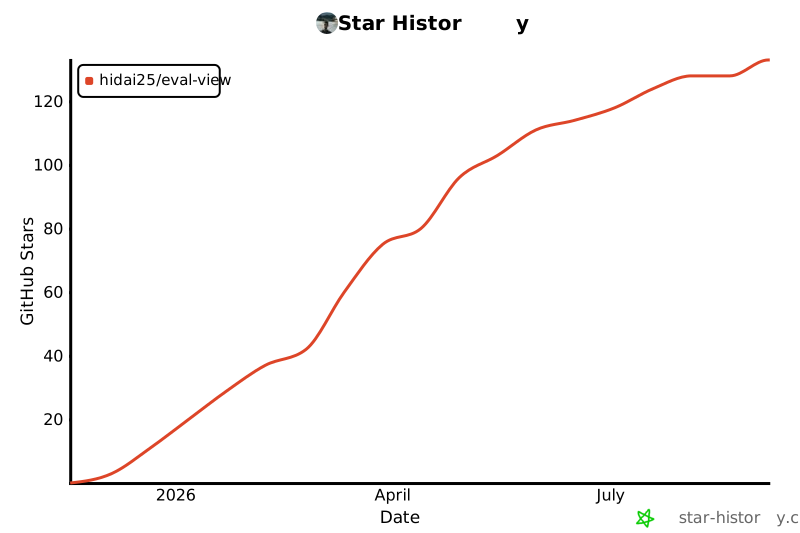
### Star History
[](https://star-history.com/#hidai25/eval-view&Date)