
Snapshot testing for AI agents.
Record what your agent does today. Get told when it silently changes.





---
Your agent returns `200` and looks fine. But a model update, a provider change, or a one-line prompt edit just made it skip a clarification, call the wrong tool, or quietly drop output quality. Your tests still pass. Your users notice before you do.
**EvalView snapshots your agent's behavior — the tools it calls, in what order, with what output — and tells you the moment that behavior changes.** Like Jest snapshots, but for tool-calling, multi-turn agents.
[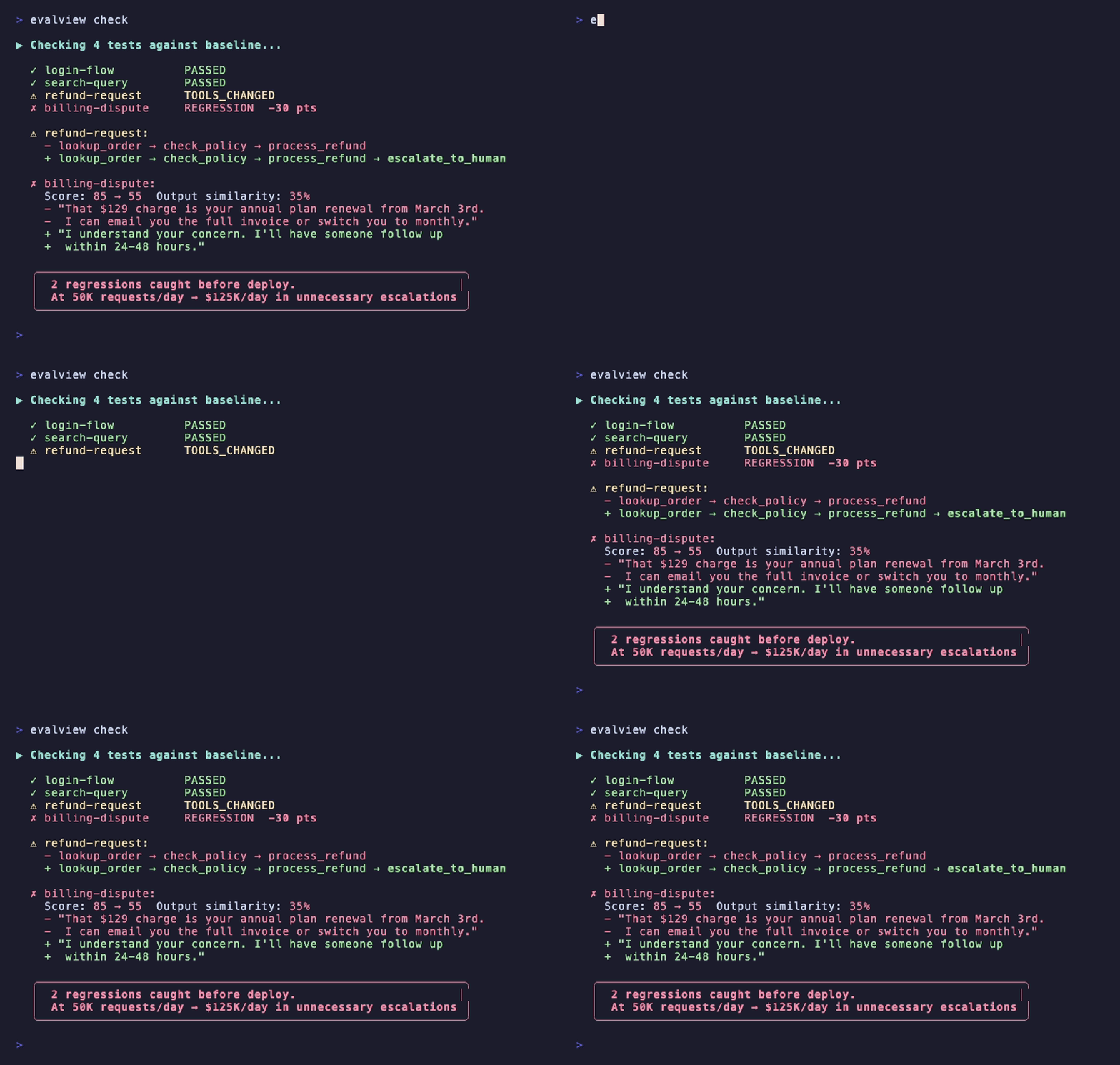](https://github.com/user-attachments/assets/96d8b5f7-3561-44a1-86a4-270fb0d1d8a6)
↑ 30-second live demo — no API key needed
## Quick Start
```bash
pip install evalview
```
```bash
evalview snapshot # Record your agent's current behavior as the baseline
evalview check # After any change, diff against the baseline
```
That's the whole loop. `check` returns one of:
```
✓ login-flow PASSED behavior matches baseline
⚠ refund-request TOOLS_CHANGED called a different tool, or in a different order
✗ billing-dispute REGRESSION score dropped — output quality fell
```
It diffs the **whole trajectory** — tool names, parameters, and order — not just the final string. The deterministic tool + sequence diff runs offline, with no API key. Add an LLM judge only when you want output-quality scoring.
No agent yet? See it work in 30 seconds:
```bash
evalview demo
```
## Why snapshot testing (and not assertions)?
Most eval tools ask you to *write down what "good" looks like* — assertions, metrics, rubrics. That's a lot of upfront work, and you can only catch the failures you thought to assert.
EvalView inverts it: **it records what your agent actually does now, and flags any drift from that.** You catch regressions you never anticipated, with zero assertions written. When the new behavior is correct, `evalview snapshot` accepts it as the new baseline — same as updating a snapshot in Jest.
| | EvalView | Assertion-based eval tools |
|---|---|---|
| Setup | Record current behavior | Write assertions/metrics first |
| Catches | Any drift from baseline | Only what you asserted |
| Non-determinism | Multi-variant baselines (up to 5 valid paths) | You handle it |
| Unit of comparison | Full tool-call trajectory | Usually final output |
This makes EvalView a **merge-time regression gate**, which is a different job from observability (Langfuse, LangSmith) or metric scoring (promptfoo, DeepEval, Braintrust). Many teams run one of those for visibility **and** EvalView as the gate. [Honest comparisons →](docs/COMPARISONS.md)
## EvalView tests itself in public, every day
The badge at the top is live. Every day at 09:00 UTC, a [GitHub Action](.github/workflows/dogfood.yml) runs EvalView against EvalView — including a regression check where **the tool snapshots a live agent and diffs it with the same `snapshot` / `check` loop** this README asks you to trust. It also runs the full test suite, type checks, `evalview demo`, the end-to-end flows, an `evalview monitor` smoke test, and chat-mode self-tests.
When something breaks, the run opens a single rolling [`🐕 dogfood` issue](https://github.com/hidai25/eval-view/issues?q=label%3Adogfood) and keeps updating it until the tool is green again — so failures are public, not quietly patched.
[Live dogfood runs →](https://github.com/hidai25/eval-view/actions/workflows/dogfood.yml) · [How it works →](docs/INTERNAL_DOGFOODING.md)
## CI: block regressions in every PR
```yaml
# .github/workflows/evalview.yml
name: EvalView
on: [pull_request]
jobs:
agent-check:
runs-on: ubuntu-latest
permissions: { pull-requests: write }
steps:
- uses: actions/checkout@v4
- uses: hidai25/eval-view@v0.8.0
with:
openai-api-key: ${{ secrets.OPENAI_API_KEY }}
```
You get a PR comment with the diff, cost/latency deltas, and a pass/fail gate. [CI/CD guide →](docs/CI_CD.md)
## Works with your stack
LangGraph · CrewAI · OpenAI · Claude · Mistral · Ollama · MCP · **any HTTP API**.
```bash
evalview check --agent http://localhost:8000/invoke
```
[Framework details →](docs/FRAMEWORK_SUPPORT.md)
## Use it as a library
```python
from evalview import gate
result = gate(test_dir="tests/")
result.passed # bool
result.diffs # per-test scores and tool diffs
```
[Python API →](docs/CLI_REFERENCE.md#python-api)
## More
EvalView also does multi-turn testing, statistical/pass@k runs, record/replay cassettes, model-drift canaries, production monitoring with Slack alerts, and auto-generated regression tests from incidents. These are power-user features — start with `snapshot` and `check`, reach for the rest when you need them.
→ [Full feature reference](docs/CLI_REFERENCE.md) · [Getting Started](docs/GETTING_STARTED.md) · [FAQ](docs/FAQ.md)
## Contributing
This is a young project built mostly by one developer. Issues, PRs, and "I tried it and X was confusing" feedback are all genuinely valuable.
- [Open an issue](https://github.com/hidai25/eval-view/issues) · [Discussions](https://github.com/hidai25/eval-view/discussions) · [CONTRIBUTING.md](CONTRIBUTING.md)
**License:** Apache 2.0
---
[](https://star-history.com/#hidai25/eval-view&Date)