# Mazeppa
[](https://github.com/hirrolot/mazeppa/actions)
Supercompilation [^turchin-concept] is a deep program transformation technique that symbolically evaluates a given program, with run-time values as unknowns. In doing so, it discovers execution patterns of the program and synthesizes them into standalone functions; the result is a more efficient residual program. In terms of transformational power, supercompilation subsumes both deforestation [^deforestation] and partial evaluation [^partial-evaluation], and even exhibits certain capabilities of automated theorem proving.
_Mazeppa_ is a modern supercompiler intended to be a compilation target for call-by-value functional languages. Having prior supercompilers diligently compared and revised, Mazeppa
- Provides the full set of primitive data types for efficient computation.
- Translates to native machine code through GNU C11.
- Supports manual control of function unfolding.
- Is fully transparent in terms of what decisions it takes during transformation.
- Is designed with efficiency in mind from the very beginning.
## Installation
First, prepare the OCaml system on your machine:
```
$ bash -c "sh <(curl -fsSL https://raw.githubusercontent.com/ocaml/opam/master/shell/install.sh)"
$ opam init --auto-setup
```
Then install Mazeppa as an `opam` package:
```
$ opam install mazeppa
```
Type `mazeppa --help` to confirm the installation.
Alternatively, you can clone the repository and install Mazeppa manually:
```
$ git clone https://github.com/hirrolot/mazeppa.git
$ cd mazeppa
$ ./scripts/install.sh
```
Building with Flambda
[Flambda] is a powerful program inliner and specializer for OCaml. If you build Mazeppa with an Flambda-enabled OCaml compiler, you may see much better performance. To set it up:
[Flambda]: https://ocaml.org/manual/latest/flambda.html
```
$ opam switch create 5.2.0+flambda ocaml-variants.5.2.0+options ocaml-option-flambda
$ eval $(opam env --switch=5.2.0+flambda)
```
(You may use a different version instead of `5.2.0` if you wish.)
To check if Flambda was successfully enabled, run:
```
$ ocamlopt -config | grep flambda
```
## Hacking
You can play with Mazeppa without actually installing it. Having OCaml installed and the repository cloned (as above), run the following command from the root directory:
```
$ ./scripts/play.sh
```
(Graphviz is required: `sudo apt install graphviz`.)
This will launch Mazeppa with `--inspect` on `playground/main.mz` and visualize the process graph in `target/graph.svg`. The latter can be viewed in VS Code by the [Svg Preview] extension.
[Svg Preview]: https://marketplace.visualstudio.com/items?itemName=SimonSiefke.svg-preview
`./scripts/play.sh` will automatically recompile the sources in OCaml, if anything is changed.
## Supercompilation by example
The best way to understand how supercompilation works is by example. Consider the following function that takes a list and computes a sum of its squared elements:
[[`examples/sum-squares/main.mz`](examples/sum-squares/main.mz)]
```
main(xs) := sum(mapSq(xs));
sum(xs) := match xs {
Nil() -> 0i32,
Cons(x, xs) -> +(x, sum(xs))
};
mapSq(xs) := match xs {
Nil() -> Nil(),
Cons(x, xs) -> Cons(*(x, x), mapSq(xs))
};
```
This program is written in the idiomatic, _listful_ functional style. Every function does only one thing, and does it well. However, there is a serious problem here: `mapSq` essentially constructs a list that will be immediately deconstructed by `sum`, meaning that we 1) we need to allocate extra memory for the intermediate list, and 2) we need two passes of computation instead of one. The solution to this problem is called _deforestation_ [^deforestation], which is a special case of supercompilation.
Let us see what Mazeppa does with this program:
```
$ mkdir sum-squares
$ cd sum-squares
# Copy-paste the program above.
$ nano main.mz
$ mazeppa run --inspect
```
The `--inspect` flag tells Mazeppa to give a detailed report on the transformation process. The `sum-squares/target/` directory will contain the following files:
```
target
├── graph.dot
├── nodes.json
├── output.mz
└── program.json
```
- `graph.dot` contains the complete _process graph_ for our program. You can obtain a picture of the graph by running `dot -Tsvg target/graph.dot > target/graph.svg`.
- `nodes.json` contains the _content_ of all nodes in the graph. Without this file, you would not be able to understand much from the graph alone.
- `program.json` contains the initial program in _Mazeppa IR_: our supercompiler works with this particular representation instead of the original program.
- `output.mz` contains the final residual program.
`output.mz` will contain the following code:
[[`examples/sum-squares/target/output.mz`](examples/sum-squares/target/output.mz)]
```
main(xs) := f0(xs);
f0(xs) :=
match xs {
Cons(x, xs') -> +(*(x, x), f0(xs')),
Nil() -> 0i32
};
```
The supercompiler has successfully merged `sum` and `mapSq` into a single function, `f0`! Unlike the original program, `f0` works in a single pass, without having to allocate any extra memory.
How did the supercompiler got to this point? Let us see the generated process graph:
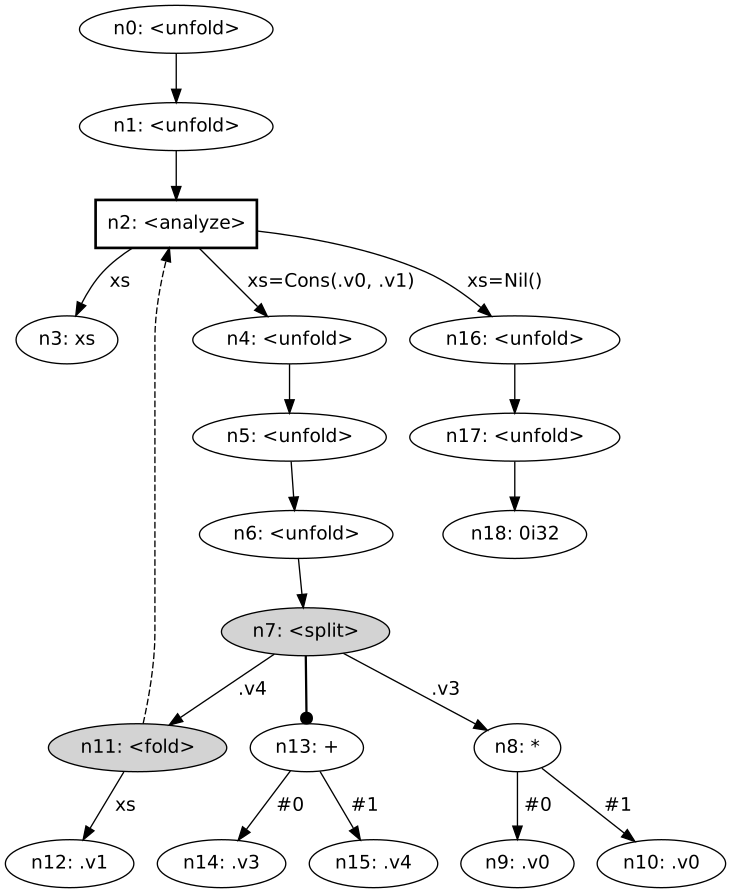
For reference, `nodes.json` contains the following data in JSON:
```json
[
[ "n0", "main(xs)" ],
[ "n1", "sum(mapSq(xs))" ],
[ "n2", "sum(.g1(xs))" ],
[ "n3", "xs" ],
[ "n4", "sum(Cons(*(.v0, .v0), mapSq(.v1)))" ],
[ "n5", ".g0(Cons(*(.v0, .v0), mapSq(.v1)))" ],
[ "n6", "+(*(.v0, .v0), sum(mapSq(.v1)))" ],
[ "n7", "+(*(.v0, .v0), sum(.g1(.v1)))" ],
[ "n8", "*(.v0, .v0)" ],
[ "n9", ".v0" ],
[ "n10", ".v0" ],
[ "n11", "sum(.g1(.v1))" ],
[ "n12", ".v1" ],
[ "n13", "+(.v3, .v4)" ],
[ "n14", ".v3" ],
[ "n15", ".v4" ],
[ "n16", "sum(Nil())" ],
[ "n17", ".g0(Nil())" ],
[ "n18", "0i32" ]
]
```
(We will not need to inspect `program.json` for this tiny example, but feel free to look at it: it is not too complicated.)
The supercompiler starts with node `n0` containing `main(xs)`. After two steps of function unfolding, we reach node `n2` containing `sum(.g1(xs))`, where `.g1` is the IR function that corresponds to our `mapSq`. At this point, we have no other choice than to _analyze_ the call `.g1(xs)` by conjecturing what values `xs` might take at run-time. Since our `mapSq` only accepts the constructors `Nil` and `Cons`, it is sufficient to consider the cases `xs=Cons(.v0, .v1)` and `xs=Nil()` only.
Node `n4` is what happens after we substitute `Cons(.v0, .v1)` for `xs`, where `.v0` and `.v1` are fresh variables. After three more function unfoldings, we arrive at `n7`. This is the first time we have to _split_ the call `+(*(.v0, .v0), sum(.g1(.v1)))` into `.v3=*(.v0, .v0)` (`n8`) and `.v4=sum(.g1(.v1))` (`n11`) and proceed supercompiling `+(.v3, .v4)` (`n13`); the reason for doing so is that a previous node (`n2`) is structurally embedded in `n7`, so supercompilation might otherwise continue forever. Now, what happens with `sum(.g1(.v1))` (`n11`)? We have seen it earlier! Recall that `n2` contains `sum(.g1(xs))`, which is just a renaming of `sum(.g1(.v1))`; so we decide to _fold_ `n11` into `n2`, because it makes no sense to supercompile the same thing twice. The other branches of `n7`, namely `n13` and `n8`, are _decomposed_, meaning that we simply proceed transforming their arguments.
As for the other branch of `n2`, `sum(Nil())` (`n16`), it is enough to merely unfold this call to `0i32` (`n18`).
After the process graph is completed, residualization converts it to a final program. During this stage, dynamic execution patterns become functions -- node `n2` now becomes the function `f0`, inasmuch as some other node (`n11`) points to it. In any residual program, there will be exactly as many functions as there are nodes with incoming dashed lines, plus `main`.
In summary, supercompilation consists of 1) unfolding function definitions, 2) analyzing calls that pattern-match an unknown variable, 3) breaking down computation into smaller parts, 4) folding repeated computations, and 5) decomposing calls that cannot be unfolded, such as `+(.v3, .v4)` (`n13`) in our example. The whole supercompilation process is guaranteed to terminate, because when some computation is becoming dangerously bigger and bigger, we break it down into subproblems and solve them in isolation.
There are a plenty of other interesting examples of deforestation in the [`examples/`](examples/) folder, including tree-like data structures. In fact, we have reimplemented all samples from the previous work on higher-order call-by-value supercompilation by Peter A. Jonsson and Johan Nordlander [^CbV-supercomp] [^CbV-supercomp-next]; in all cases, Mazeppa has performed similarly or better.
## Specializing the power function
Now consider another example, this time involving partial evaluation:
[[`examples/power-sq/main.mz`](examples/power-sq/main.mz)]
```
main(a) := powerSq(a, 7u8);
powerSq(a, x) := match =(x, 0u8) {
T() -> 1i32,
F() -> match =(%(x, 2u8), 0u8) {
T() -> square(powerSq(a, /(x, 2u8))),
F() -> *(a, powerSq(a, -(x, 1u8)))
}
};
square(a) := *(a, a);
```
`powerSq` implements the well-known [exponentiation-by-squaring] algorithm. The source program is inefficient: `powerSq` recursively examines its parameter `x`, although in our case it is explicitly set to the constant `7u8` up in `main`. Running Mazeppa on `main(a)` will yield the following residual program:
[exponentiation-by-squaring]: https://en.wikipedia.org/wiki/Exponentiation_by_squaring
[[`examples/power-sq/target/output.mz`](examples/power-sq/target/output.mz)]
```
main(a) :=
let v0 := *(a, *(a, a));
*(a, *(v0, v0));
```
The whole `powerSq` function has been eliminated, thus achieving the effect of partial evaluation. (If we consider `powerSq` to be an interpreter for a program `x` and input data `a`, then it is the first Futamura projection: specializing an interpreter to obtain an efficient target program.) Also, notice how the supercompiler has managed to _share_ the argument `*(a, *(a, a))` twice, so that it is not recomputed each time anew. The residual program indeed reflects exponentiation by squaring.
## Synthesizing the KMP algorithm
Let us go beyond deforestation and partial evaluation. Consider a function `matches(p, s)` of two strings `p` and `s`, which returns `T()` if `s` contains `p` and `F()` otherwise. The naive implementation in Mazeppa would be the following, where `p` is specialized to `"aab"` represented as a list of characters:
[[`examples/kmp-test/main.mz`](examples/kmp-test/main.mz)]
```
main(s) := matches(Cons('a', Cons('a', Cons('b', Nil()))), s);
matches(p, s) := go(p, s, p, s);
go(pp, ss, op, os) := match pp {
Nil() -> T(),
Cons(p, pp) -> goFirst(p, pp, ss, op, os)
};
goFirst(p, pp, ss, op, os) := match ss {
Nil() -> F(),
Cons(s, ss) -> match =(p, s) {
T() -> go(pp, ss, op, os),
F() -> failover(op, os)
}
};
failover(op, os) := match os {
Nil() -> F(),
Cons(_s, ss) -> matches(op, ss)
};
```
(Here we represent strings as lists of characters for simplicity, but do not worry, Mazeppa provides built-in strings as well.)
The algorithm is correct but inefficient. Consider what happens when `"aa"` is successfully matched, but `'b'` is not: the algorithm will start matching `"aab"` once again from the second character of `s`, which is already known to be `'a'`! The DFA built by the [Knuth-Morris-Pratt algorithm (KMP)] [^kmp] is one way to fix the issue.
[Knuth-Morris-Pratt algorithm (KMP)]: https://en.wikipedia.org/wiki/Knuth%E2%80%93Morris%E2%80%93Pratt_algorithm
By running Mazeppa on the above sample, we can obtain an efficient string matching algorithm for `p="aab"` that reflects KMP in action:
[[`examples/kmp-test/target/output.mz`](examples/kmp-test/target/output.mz)]
```
main(s) := f0(s);
f0(s) :=
match s {
Cons(s', ss) -> f1(s', ss),
Nil() -> F()
};
f1(s, ss) :=
match =(97u8, s) {
F() -> f0(ss),
T() ->
match ss {
Cons(s', ss') -> f2(s', ss'),
Nil() -> F()
}
};
f2(s, ss) :=
match =(97u8, s) {
F() -> f1(s, ss),
T() ->
match ss {
Cons(s', ss') ->
match =(98u8, s') {
F() -> f2(s', ss'),
T() -> T()
},
Nil() -> F()
}
};
```
The naive algorithm that we wrote has been automatically transformed into a well-known efficient version! While the naive algorithm has complexity _O(|p| * |s|)_, the specialized one is _O(|s|)_.
Synthesizing KMP is a standard example that showcases the transformational power of supercompilation with respect to other techniques [^perfect-process-tree] [^positive-supercomp]. Obtaining the optimized algorithm either by partial evaluation or deforestation is not possible without changing the source definition of `matches` in a particular way [^partial-evaluation-matches-1] [^partial-evaluation-matches-2].
## Metasystem transition
[Valentin Turchin], the inventor of supercompilation, describes the concept of [_metasystem transition_] in the following way [^turchin-mst-scp] [^turchin-transformation] [^turchin-dialogue]:
[Valentin Turchin]: https://en.wikipedia.org/wiki/Valentin_Turchin
[_metasystem transition_]: http://pespmc1.vub.ac.be/MST.html
> Consider a system _S_ of any kind. Suppose that there is a way to make some number of copies from it, possibly with variations. Suppose that these systems are united into a new system _S'_ which has the systems of the _S_ type as its subsystems, and includes also an additional mechanism which controls the behavior and production of the _S_-subsystems. Then we call _S'_ a metasystem with respect to _S_, and the creation of _S'_ a metasystem transition. As a result of consecutive metasystem transitions a multilevel structure of control arises, which allows complicated forms of behavior.
Thus, supercompilation can be readily seen as a particular type of metasystem transition: having an object program, the supercompiler controls and supervises it. However, we can go further and perform _any_ number of metasystem transitions within the realm of the object program itself, as the next example demonstrates.
We will be using the code from [`examples/lambda-calculus/`](examples/lambda-calculus/). Below is a standard [normalization-by-evaluation] procedure for obtaining beta normal forms of untyped lambda calculus terms:
[normalization-by-evaluation]: https://davidchristiansen.dk/tutorials/nbe/
```
normalize(lvl, env, t) := quote(lvl, eval(env, t));
normalizeAt(lvl, env, t) := normalize(+(lvl, 1u64), Cons(vvar(lvl), env), t);
vvar(lvl) := Neutral(NVar(lvl));
eval(env, t) := match t {
Var(idx) -> indexEnv(env, idx),
Lam(body) -> Closure(env, body),
Appl(m, n) ->
let mVal := eval(env, m);
let nVal := eval(env, n);
match mVal {
Closure(env, body) -> eval(Cons(nVal, env), body),
Neutral(nt) -> Neutral(NAppl(nt, nVal))
}
};
quote(lvl, v) := match v {
Closure(env, body) -> Lam(normalizeAt(lvl, env, body)),
Neutral(nt) -> quoteNeutral(lvl, nt)
};
quoteNeutral(lvl, nt) := match nt {
NVar(var) -> Var(-(-(lvl, var), 1u64)),
NAppl(nt, nVal) -> Appl(quoteNeutral(lvl, nt), quote(lvl, nVal))
};
indexEnv(env, idx) := match env {
Nil() -> Panic(++("the variable is unbound: ", string(idx))),
Cons(value, xs) -> match =(idx, 0u64) {
T() -> value,
F() -> indexEnv(xs, -(idx, 1u64))
}
};
```
(`eval`/`quote` are sometimes called `reflect`/`reify`.)
This is essentially a big-step machine for efficient capture-avoiding substitution: instead of rebuilding terms on each beta reduction, we maintain an _environment_ of values. `eval` projects a term to the "semantic domain", while `quote` does the opposite; `normalize` is simply the composition of `quote` and `eval`. To avoid bothering with naming issues, we put De Bruijn _indices_ in the `Var` constructor and De Bruijn _levels_ in `NVar`; the latter is converted into the former in `quoteNeutral`.
Now let us compute something with this machine:
```
main() := normalize(0u64, Nil(), example());
example() := Appl(Appl(mul(), two()), three());
two() := Lam(Lam(Appl(Var(1u64), Appl(Var(1u64), Var(0u64)))));
three() := Lam(Lam(Appl(Var(1u64), Appl(Var(1u64), Appl(Var(1u64),
Var(0u64))))));
mul() := Lam(Lam(Lam(Lam(Appl(
Appl(Var(3u64), Appl(Var(2u64), Var(1u64))),
Var(0u64))))));
```
The body of `main` computes the normal form of the lambda term `example()` that multiplies [Church numerals] `two()` and `three()`.
[Church numerals]: https://en.wikipedia.org/wiki/Church_encoding#Church_numerals
By supercompiling `main()`, we obtain the Church numeral of 6:
[[`examples/lambda-calculus/target/output.mz`](examples/lambda-calculus/target/output.mz)]
```
main() := Lam(
Lam(
Appl(
Var(1u64),
Appl(
Var(1u64),
Appl(
Var(1u64),
Appl(Var(1u64), Appl(Var(1u64), Appl(Var(1u64), Var(0u64))))
)))));
```
The lambda calculus interpreter has been completely annihilated!
In this example, we have just seen a two-level _metasystem stairway_ (in Turchin's terminology [^turchin-metavariables]): on level 0, we have Mazeppa transforming the object program, while on level 1, we have the object program normalizing lambda calculus terms. In principle, there can be an arbitrary number of interpretation levels, and Mazeppa can be used to collapse them all. This general behaviour of supercompilation was first explored by Turchin himself in [^turchin-concept], where he was able to supercompile two interpretable programs, one Fortran-like and one in Lisp, to obtain a speedup factor of 40 in both cases.
Related examples: [imperative abstract machine](examples/imp/), [self-interpreter](examples/self-interpreter/).
## Restricting supercompilation
In retrospect, the major problem that prevented widespread adoption of supercompilation is its unpredictability -- the dark side of its power. To get a sense of what it means, consider how can we solve any SAT problem ["on the fly"]:
["on the fly"]: https://hirrolot.github.io/posts/sat-supercompilation.html
[[`examples/sat-solver/main.mz`](examples/sat-solver/main.mz)]
```
main(a, b, c, d, e, f, g) := solve(formula(a, b, c, d, e, f, g));
formula(a, b, c, d, e, f, g) :=
and(or(Var(a), or(Not(b), or(Not(c), F()))),
and(or(Not(f), or(Var(e), or(Not(g), F()))),
and(or(Var(e), or(Not(g), or(Var(f), F()))),
and(or(Not(g), or(Var(c), or(Var(d), F()))),
and(or(Var(a), or(Not(b), or(Not(c), F()))),
and(or(Not(f), or(Not(e), or(Var(g), F()))),
and(or(Var(a), or(Var(a), or(Var(c), F()))),
and(or(Not(g), or(Not(d), or(Not(b), F()))),
T()))))))));
or(x, rest) := match x {
Var(x) -> If(x, T(), rest),
Not(x) -> If(x, rest, T())
};
and(clause, rest) := match clause {
If(x, m, n) -> If(x, and(m, rest), and(n, rest)),
T() -> rest,
F() -> F()
};
solve(formula) := match formula {
If(x, m, n) -> analyze(x, m, n),
T() -> T(),
F() -> F()
};
analyze(x, m, n) := match x {
T() -> solve(m),
F() -> solve(n)
};
```
There are two things wrong with this perfectly correct code: 1) the supercompiler will expand the formula in exponential space, and 2) the supercompiler will try to solve the expanded formula in exponential time. Sometimes, we just do not want to take supercompilation too literally and evaluate everything at compile-time.
However, despair not: we provide a partial solution to this problem. Let us first consider how to postpone solving the formula until run-time, to prevent the supercompiler from acting as a solver. It turns out that the only thing we need to change is to annotate the function `formula` with `@extract` as follows:
```
@extract
formula(a, b, c, d, e, f, g) :=
// Everything is the same.
```
When Mazeppa sees `solve(formula(a, b, c, d, e, f, g))`, it extracts the call to `formula` to a fresh variable `.v0` and supercompiles the extracted call and `solve(.v0)` in isolation; the latter call will merely reproduce the original definition of `solve` modulo variable naming, inasmuch as there is nothing specific in `.v0` to consider for optimization.
However, supercompiling the call to `formula` will still result in an exponential blowup. Let us examine why this happens. Our original formula only consists of calls to `or` and `and`; while the definition of `or` does not look too dangerous, `and` propagates the potentially massive `rest` parameter to _both_ branches of the generated `If` expression, thus triggering the blowup as time goes on. So let us proceed and mark `and` with `@extract` as well:
```
@extract
and(clause, rest) := match clause {
// Everything is the same.
};
```
That is it! When `and` is to be transformed, Mazeppa will immediately extract the call out of its surrounding context and supercompile it in isolation. By adding two annotations at appropriate places, we have solved both the problem of code blowup and exponential running time of supercompilation. In general, whenever Mazeppa sees `ctx[f(t1, ..., tN)]`, where `f` is marked `@extract` and `ctx[.]` is a non-empty surrounding context with `.` in a _redex position_, it will plug a fresh variable `v` into `ctx` and proceed transforming the following nodes separately: `f(t1, ..., tN)` and `ctx[v]`.
Of course, `@extract` is only a partial solution to the general problem of unpredictability: ultimately, these annotations need to be injected either by a frontend or human being. Having thought about and experimented a lot with this problem, our current intuition is that there is a whole missing theory of how to differentiate between supercompiling a program with a real potential for optimization, such as a metasystem stairway, and supercompiling a program that just causes the supercompiler to analyze an unreasonably huge space of execution states without doing any "meaningful" work. Existing approaches such as [^supercomp-code-explosion] employ savings calculation to speculatively determine whether it is more beneficial to supercompile the expression in whole or in parts, which unfortunately prohibits any interesting metasystem transitions from being optimized away.
For now, let us conclude that it is better to have `@extract` annotations than not to have them, but for supercompilation to have practical relevance, we need a more intelligent solution.
## Lazy evaluation
Mazeppa employs an interesting design choice to have eager functions and lazy constructors. The following example, where `magic(1u32, 1u32)` generates Fibonacci numbers, was [adopted from Haskell]:
[adopted from Haskell]: https://wiki.haskell.org/Haskell/Lazy_evaluation
[[`examples/lazy-fibonacci/main.mz`](examples/lazy-fibonacci/main.mz)]
```
main() := getIt(magic(1u32, 1u32), 3u64);
magic(m, n) := match =(m, 0u32) {
T() -> Nil(),
F() -> Cons(m, magic(n, +(m, n)))
};
getIt(xs, n) := match xs {
Nil() -> Panic("undefined"),
Cons(x, xs) -> match =(n, 1u64) {
T() -> x,
F() -> getIt(xs, -(n, 1u64))
}
};
```
If constructors were eager, `magic(1u32, 1u32)` would never terminate. However, `Cons` does not evaluate its arguments! Since `getIt` only consumes a finite portion of the infinite list, the program terminates and prints `2u32`:
```
$ mazeppa eval
2u32
```
Lazy constructors enable effortless deforestation, as discussed [below].
[below]: #technical-decisions
## Mazeppa as a library
After installing Mazeppa via `opam` or `./scripts/install.sh`, it is available as an OCaml library!
Set up a new Dune project as follows:
```
$ dune init project my_compiler
```
Add `mazeppa` as a third-party library into your `bin/dune`:
```
(executable
(public_name my_compiler)
(name main)
(libraries my_compiler mazeppa))
```
Paste the following code into `bin/main.ml` (this is [`examples/sum-squares/main.mz`](examples/sum-squares/main.mz) encoded in OCaml):
```ocaml
open Mazeppa
let input : Raw_program.t =
let sym = Symbol.of_string in
let open Raw_term in
let open Checked_oint in
[ [], sym "main", [ sym "xs" ], call ("sum", [ call ("mapSq", [ var "xs" ]) ])
; ( []
, sym "sum"
, [ sym "xs" ]
, Match
( var "xs"
, [ (sym "Nil", []), int (I32 (I32.of_int_exn 0))
; ( (sym "Cons", [ sym "x"; sym "xs" ])
, call ("+", [ var "x"; call ("sum", [ var "xs" ]) ]) )
] ) )
; ( []
, sym "mapSq"
, [ sym "xs" ]
, Match
( var "xs"
, [ (sym "Nil", []), call ("Nil", [])
; ( (sym "Cons", [ sym "x"; sym "xs" ])
, call
( "Cons"
, [ call ("*", [ var "x"; var "x" ]); call ("mapSq", [ var "xs" ]) ] ) )
] ) )
]
;;
let () =
try
let output = Mazeppa.supercompile input in
Printf.printf "%s\n" (Raw_program.show output)
with
| Mazeppa.Panic msg ->
Printf.eprintf "Something went wrong: %s\n" msg;
exit 1
;;
```
Run `dune exec my_compiler` to see the desired residual program:
```
[([], "main", ["xs"], (Raw_term.Call ("f0", [(Raw_term.Var "xs")])));
([], "f0", ["xs"],
(Raw_term.Match ((Raw_term.Var "xs"),
[(("Cons", ["x"; "xs'"]),
(Raw_term.Call ("+",
[(Raw_term.Call ("*", [(Raw_term.Var "x"); (Raw_term.Var "x")]));
(Raw_term.Call ("f0", [(Raw_term.Var "xs'")]))]
)));
(("Nil", []), (Raw_term.Const (Const.Int (Checked_oint.I32 0))))]
)))
]
```
You can call Mazeppa as many times as you want, including in parallel. Note that we expose a limited interface to the supercompiler; in particular, there is no way to inspect what it does in the process (i.e., `--inspect`).
Besides supercompilation, we also provide a built-in evaluator:
```ocaml
val eval : Raw_program.t -> Raw_term.t
```
It can only be called on programs whose `main` functions do not accept parameters. Unlike `supercompile`, it produces an evaluated term of type `Raw_term.t` and can possibly diverge.
See other API functions and their documentation in [`lib/mazeppa.mli`](lib/mazeppa.mli).
## Translation to C
Suppose that `main.mz` contains a slightly modified version of the lazy Fibonacci example:
```
main(n) := getIt(magic(1u32, 1u32), n);
magic(m, n) := match =(m, 0u32) {
T() -> Nil(),
F() -> Cons(m, magic(n, +(m, n)))
};
getIt(xs, n) := match xs {
Nil() -> Panic("undefined"),
Cons(x, xs) -> match =(n, 1u64) {
T() -> x,
F() -> getIt(xs, -(n, 1u64))
}
};
```
The following command translates it to C11 with GNU extensions (i.e., `-std=gnu11`):
```
$ cat main.mz | mazeppa translate --language C --entry fib
```
Show the output
```c
#include "mazeppa.h"
MZ_ENUM_USER_TAGS(op_Cons, op_Nil);
static mz_Value op_main(mz_ArgsPtr args);
static mz_Value op_magic(mz_ArgsPtr args);
static mz_Value op_getIt(mz_ArgsPtr args);
static mz_Value thunk_0(mz_EnvPtr env) {
mz_Value var_m = (env)[0];
mz_Value var_n = (env)[1];
return ({
struct mz_value args[2];
(args)[0] = var_n;
(args)[1] = MZ_OP2(var_m, add, var_n);
op_magic(args);
});
}
static mz_Value op_main(mz_ArgsPtr args) {
mz_Value var_n = (args)[0];
return ({
struct mz_value args[2];
(args)[0] = ({
struct mz_value args[2];
(args)[0] = MZ_INT(U, 32, UINT32_C(1));
(args)[1] = MZ_INT(U, 32, UINT32_C(1));
op_magic(args);
});
(args)[1] = var_n;
op_getIt(args);
});
}
static mz_Value op_magic(mz_ArgsPtr args) {
mz_Value var_m = (args)[0];
mz_Value var_n = (args)[1];
return ({
struct mz_value tmp = MZ_OP2(var_m, equal, MZ_INT(U, 32, UINT32_C(0)));
switch ((tmp).tag) {
case op_T: {
tmp = MZ_EMPTY_DATA(op_Nil);
break;
}
case op_F: {
tmp = MZ_DATA(op_Cons, 2, MZ_SIMPLE_THUNK(var_m), MZ_THUNK(thunk_0, 2, var_m, var_n));
break;
}
default: MZ_UNEXPECTED_TAG((tmp).tag);
}
tmp;
});
}
static mz_Value op_getIt(mz_ArgsPtr args) {
mz_Value var_xs = (args)[0];
mz_Value var_n = (args)[1];
return ({
struct mz_value tmp = var_xs;
switch ((tmp).tag) {
case op_Nil: {
tmp = mz_panic(MZ_STRING("undefined"));
break;
}
case op_Cons: {
mz_Value var_x = ((tmp).payload)[0];
mz_Value var_xs$ = ((tmp).payload)[1];
tmp = ({
struct mz_value tmp = MZ_OP2(var_n, equal, MZ_INT(U, 64, UINT64_C(1)));
switch ((tmp).tag) {
case op_T: {
tmp = mz_force(var_x);
break;
}
case op_F: {
tmp = ({
struct mz_value args[2];
(args)[0] = mz_force(var_xs$);
(args)[1] = MZ_OP2(var_n, sub, MZ_INT(U, 64, UINT64_C(1)));
op_getIt(args);
});
break;
}
default: MZ_UNEXPECTED_TAG((tmp).tag);
}
tmp;
});
break;
}
default: MZ_UNEXPECTED_TAG((tmp).tag);
}
tmp;
});
}
extern mz_Value fib(mz_Value var_n) {
return MZ_CALL_MAIN(var_n);
}
```
The `translate` command requires both `--language `, which is the target language for translation, and `--entry`, which is the name of an external symbol that will correspond to your `main` function. The input Mazeppa program comes from `stdin` (`cat main.mz` in our example); the output GNU11 program is written to `stdout`.
Let us advance further and compile the output program to an object file. First, copy [`c/deps/sds.c`](c/deps/sds.c), [`c/deps/sds.h`](c/deps/sds.h), and [`c/deps/sdsalloc.h`](c/deps/sdsalloc.h) to your current directory; second, install [Boehm GC] on your computer:
[Boehm GC]: https://hboehm.info/gc/
```
$ sudo apt install libgc-dev -y
```
then execute the following command:
```
$ cat main.mz \
| mazeppa translate --language C --entry fib --dump-header-to . \
| gcc -c -o program.o -std=gnu11 -xc -
```
The `--dump-header-to` option writes the content of [`mazeppa.h`](c/mazeppa.h) to a specified location; this is needed for the output program to compile. The `gcc` command accepts the output program from `stdin` and produces `program.o`.
Now what is left is to actually invoke the generated `fib` function. Create `main.c` with the following content:
```c
#include "mazeppa.h"
extern mz_Value fib(mz_Value n);
int main(void) {
// Always initialize Boehm GC before invoking Mazeppa code.
GC_INIT();
mz_Value v = fib(MZ_INT(U, 64, 10));
printf("fib(10) = %" PRIu32 "\n", MZ_GET(U32, v));
}
```
This "driver" program just invokes `fib` with a Mazeppa integer (`MZ_INT`) and prints the result. You can use any functionality from `mazeppa.h`, provided that it is not prefixed with `mz_priv_` or `MZ_PRIV_`.
To bring all the pieces together:
```
$ gcc main.c program.o sds.c -lgc -std=gnu11
```
`./a.out` prints `fib(10) = 55` and exits, as expected.
### FFI
See [`test-c-codegen/ffi/`](test-c-codegen/ffi/).
## Usage considerations
- Follow the instructions from the [installation section](#installation) to build Mazeppa with an Flambda-enabled OCaml compiler.
- Forget about `--inspect` in a real environment: use it only for debugging purposes.
- Refrain from CPU-intensive computations: termination checking makes them extremely slow. Use `@extract` (as [shown above](#restricting-supercompilation)) to control whether to continue supercompilation or extract the redex.
- Supercompiling a whole user program is not a good idea. Instead, consider supercompiling separate modules and then linking them together (the exact way you do so depends on your situation).
- Although Mazeppa is itself not parallel, supercompiling separate modules can be done in parallel.
- It is _much_ better if recursive functions reduce at least one argument structurally, just as in total functional programming. Otherwise, termination checking might not work well.
- An integer _x_ is embedded in integer _y_ of the same type iff _x <= y_.
- A string _s1_ is embedded in _s2_ iff _set(s1) = set(s2) /\ length(s1) <= length(s2)_, where _set(s)_ is the set of all characters in _s_. This relation is borrowed from [^termination-combinators]; for the proof that this is a well-quasi order, see theorem 3.2 from the same paper. All of the following sequences are well-formed according to this relation:
- `"abc"`, `"ac"`, `"a"`
- `"a"`, `"b"`, `"c"`
- `"c"`, `"b"`, `"a"`
- `"aa"`, `"ccc"`, `"bbbbaa"`, `"ca"`
## Technical decisions
Mazeppa employs several interesting design choices (ranked by importance):
- **First-order code.** Max Bolingbroke and Simon Peyton Jones [^supercomp-by-eval] report that for one example, their higher-order supercompiler for a subset of Haskell spent 42% of execution time on managing names and renaming. While it is true that simplistic evaluation models, such as normalization of lambda terms, permit us to avoid significant overhead of capture avoidance, supercompilation is more complicated. For instance, besides doing symbolic computation, supercompilation needs to analyze previously computed results to make informed decisions about further transformation: consider term instance tests, homeomorphic embedding tests, most specific generalizations, etc. Introducing higher-order functions inevitably complicates all these analyses, making supercompilation slower, more memory-consuming, and harder to reason about. In Mazeppa, we stick with the philosophy of gradual improvements: instead of trying to handle many fancy features at the same time, we 1) fix the _core_ language for convenient manipulation by a machine, 2) perform as many metasystem transitions as necessary to make the core language better for human.
- **Lazy constructors.** It is a well-known observation that call-by-value languages are not very amenable to deforestation -- additional analyses [^CbV-supercomp] [^CbV-supercomp-next] are required. However, if constructors do not evaluate their arguments, deforestation _just works_. Turchin made it work by normal-order transformation of a call-by-value language, but the result is that residual code may terminate more often. In Mazeppa, we have call-by-value functions and call-by-name (call-by-need) constructors, which 1) makes deforestation possible and 2) preserves the original semantics of code.
- Incidentally, lazy constructors are also adopted by eager functional languages outside of supercompilation. See [_"Why is Idris 2 so much faster than Idris 1?"_](https://www.type-driven.org.uk/edwinb/why-is-idris-2-so-much-faster-than-idris-1.html) and _"CONS Should Not Evaluate its Arguments"_ [^cons-lazy-alloc].
- **Term-free process graphs.** In Mazeppa, process graphs do not contain any references to supervised terms: residualization can work without them. As a result, OCaml's garbage collector can eagerly deallocate terms that were used during construction of a subgraph. In addition ot that, this policy has several other important advantages: 1) the graph structure is still available for inspection with `--inspect`, 2) when it is drawn, it only reveals information about the _decisions_ the supercompiler has taken, which makes it much easier analyze by a human being. Several existing supercompilers refrain from full-fledged process graphs as well (e.g., Neil Mitchell's Supero [^mitchell-supero] and the aforementioned [^supercomp-by-eval]), but as a result, 1) they are less capable of inspection by a user, 2) the algorithms become cluttered with code generation details.
- **Two-dimensional configuration analysis.** Usually a supercompiler keeps a "history" of a subset of all ancestors while handling a node; if this node is determined to be a version of one of its ancestors, it is good time to break the term into smaller parts to guarantee termination. In Mazeppa, we keep two separate data structures instead: the one containing a subset of all node's ancestors and the one containing a subset of all fully transformed nodes. The former data structure is used to guarantee termination, while the latter is used to enhance _sharing of functions_ in residualized code. Specifically, if the current node is a renaming of some previously transformed node, we fold the current node into this previous node, which will look like a horizontal edge in the process graph. This way, Mazeppa performs both _vertical_ and _horizontal_ analysis of configurations, which makes residual code more compact and supercompilation more efficient.
- **Function productivity analysis.** When an inner function call pattern-matches an unknown value, two dangerous situations happen at the same time: 1) supercompilation reproduces the exact structure of the pattern-matching function, 2) supercompilation pushes the whole surrounding context to all the branches of this function. Without further control, this situation can lead to significant explosion in code size, sometimes even causing a supercompiler not to terminate in a reasonable amount of time. To ameliorate, Mazeppa duplicates the context iff this inner call produces a _definite top-level value_ from _at least one_ exit point, because if it does, great chances that this value can be deconstructed by subsequent pattern matching. Otherwise, Mazeppa extracts the inner call and transforms it in isolation -- just as if it was manually marked with `@extract`. Furthermore, if the context is actually duplicated, the following rule applies to all the branches: if the branch produces a definite top-level value from _all_ exit points, it is transformed in the context as usual; otherwise, the branch is extracted from the context and transformed in isolation. In practice, this analysis prevents a huge amount of pointless specializations, thereby compactifying residual program size and making supercompilation much more predictable.
- We perform productivity analysis strictly _before_ supercompilation takes place. Our algorithm launches a global procedure for all f- and g-rules synthesized from the source program, and has linear time complexity.
- An emergent effect is that after extracting all these pattern-matching calls, horizontal configuration analysis is able to fold repeated computations more aggressively.
- **Smart histories.** Instead of blindly comparing a current node to all of its ancestors, we employ a more fine-grained control. Our technique can be described as follows: 1) global nodes (the ones that analyze a neutral value) are compared with global nodes only, 2) local nodes (the ones that reduce linearly in a single step) are compared with local nodes only up to the latest global node, but not including it, and 3) trivial nodes (the ones that break down terms into smaller components) are not compared with anything else. Besides a more economic approach to termination checking, this scheme allows Mazeppa to discover more optimization opportunities; see the examples from [^metric-space], sections 4.6 and 4.7. Termination is guaranteed by the fact that homeomorphic embedding is still tested on all potentially infinite subsequences of global and local configurations, and there cannot exist an infinite sequence of trivial terms only.
- **Redex signatures.** The whistle is only tested on terms with equal _redex signatures_. A redex signature is a pair of 1) a function's symbol and 2) a list of _value categories_ for each argument. A value category is a sort of metainformation about an argument, which can be either 1) `VConst` for such values as `42i32` or `"hello world"`, 2) `VNeutral` for such values as `x` or `+(x, x)`, or 3) `VCCall(c)` for constructor calls such as `Foo(a, b, c)`. The whistle is still tested on all potentially infinite sequences of terms, because any infinite sequence must contain at least one infinite subsequence of terms with the same redex signature. This strategy prevents over-generalization in certain cases, such as:
- [Redex operators](examples/check-redex-ops/main.mz): during execution, node `f(A())` is homeomorphically embedded into `f(g(B(A())))`; however, since the redex operators are different (`f` and `g`), Mazeppa continues reduction and reaches the ideal result.
- [Redex signatures](examples/check-redex-sigs/main.mz): although `f(A(Good()))` is embedded into `f(f(f(B(A(Good())))))` and the redex operator is `f` in both cases, Mazeppa does not over-generalize because these two terms have different value categories in their redex signatures: in the first case, `f` is called on `A(...)`, while in the second case, it is called on `B(...)`. Just as in the previous example, Mazeppa reaches the ideal result of supercompilation solely by reduction.
- **Optimized homeomorphic embedding.** Over the decades, homeomorphic embedding has gained reputation for being an excellent technique for online termination checking of symbolic methods [^homeomorphic-embedding]. Unfortunately, mainly due to the non-linear control flow when coupling and diving apply at the same time, it can be inexcusably expensive to compute. What is even worse, is that it is re-executed for all qualifying parent nodes whenever a new term is added to the history, which progressively slows down supercompilation as the history grows: going as far as [consuming most] of the supercompilation time! To cope with that, we maintain two separate caches that can be described as follows:
- **Global cache:** an [ephemeron] from term addresses to integers denoting their sizes. Consider two terms, _t1_ and _t2_; if the size of _t1_ is equal to the size of _t2_, _t1_ can only be embedded into _t2_ by coupling. On the other hand, if the size of _t1_ is smaller or equal to the size of _t2_, both diving and coupling may take place. Otherwise, _t1_ is a bigger term which cannot be embedded into _t2_ by no means. Whenever there is a choice to dive or/and couple, we query the cache and decide what to do; this technique can rule out many redundant control flow paths. The idea is borrowed from [^supercomp-code-explosion], section 6.3.
- Note that deriving the value address is a constant-time [perfect hash function], so the cache penalty should be pretty low. Since it is ephemeral, it also does not induce memory leaks.
- **Local cache:** a [hash table] from addresses of terms _(t1, t2)_ to booleans denoting results of their comparison. This cache makes homeomorphic embedding to have _O(size(t1) * size(t2))_ worst-case time complexity by not recomputing physically equal terms. Unlike the global cache, the local cache only exists during a single comparison.
[consuming most]: https://github.com/hirrolot/mazeppa/issues/4#issuecomment-2260440382
[ephemeron]: https://ocaml.org/manual/latest/api/Ephemeron.html
[perfect hash function]: https://en.wikipedia.org/wiki/Perfect_hash_function#Memory_address_identity
[hash table]: https://ocaml.org/manual/latest/api/Hashtbl.html
- **Hash consing.** The performance of our homeomorphic embedding caches depends on how many terms are _shared_. We therefore employ hash consing as follows: if the new term _t_ is structurally equal to some existing term _s_, the latter is reused. To avoid memory leaks, we employ a global [ephemeron] holding weak pointers to terms. Besides improved supercompilation times due to memoization, hash consing also [reduces memory consumption].
[reduces memory consumption]: https://github.com/hirrolot/mazeppa/issues/4#issuecomment-2282772940
- **Normalization during unfolding.** When a function call is unfolded, we instantiate the parameters and normalize the body as much as possible. To see why, consider the factorial function `f(n)`; with simple unfolding, we would trap in an unpleasant situation where `f(1u32)` is embedded into `*(1u32, f(-(1u32, 1u32)))`, causing over-generalization. In reality, Mazeppa would unfold `f(1u32)` to `*(1u32, f(0u32))`, making the latter a candidate for further unfolding. This approach was suggested in [^supercomp-code-explosion], section 4.5. Its other merits are: 1) less work for future driving steps, 2) less "banal" computation in process graphs, 3) reduced amount of expensive homeomorphic embedding tests.
- Besides folding constants, we also perform algebraic simplification such as _+(t, 0), +(0, t) -> t_, _-(t, 0) -> t_, _*(t, 0), *(0, t) -> 0_, etc.
- After implementing redex signatures, `*(1u32, f(-(1u32, 1u32)))` is no longer checked against `f(1u32)` because of different redex operators. However, other advantages of normalization still hold.
- **Implementation in OCaml.** Mazeppa is implemented in OCaml using a combination of functional and imperative programming styles. Exceptions are used for control flow, mutability inside functions is common. Although we do not have a similar supercompiler written in e.g. Haskell or Rust for comparison, we believe that it is OCaml that gave us a working implementation without having to quarrel with the language and never finishing work.
While most of the above is not particularly novel, we believe that the combination of these features makes Mazeppa a more practical alternative than its predecessors.
## Language definition
### Lexical structure
A _symbol_ `` is a sequence of letters (`a`, _..._, `z` and `A`, _..._, `Z`) and digits (`0`, _..._, `9`), followed by an optional question mark (`?`), followed by an optional sequence of `'` characters. The underscore character (`_`) may be the first character of a symbol, which may informally indicate that the value or function being defined is not used; otherwise, the first character must be a letter. The following sequences of characters are also permitted as symbols: `~`, `#`, `+`, `-`, `*`, `/`, `%`, `|`, `&`, `^`, `<<`, `>>`, `=`, `!=`, `>`, `>=`, `<`, `<=`, `++`. The following are _reserved words_ that may **not** be used as symbols: `match`, `let`, `call`.
There are four classes of _unsigned integer constants_:
- Binary: `0b` (`0B`) followed by a non-empty sequence of binary digits `0` and `1`.
- Octal: `0o` (`0O`) followed by a non-empty sequence of octal digits `0`, _..._, `7`.
- Decimal: a non-empty sequence of decimal digits `0`, _..._, `9`.
- Hexadecimal: `0x` (`0X`) followed by a non-empty sequence of decimal digits `0`, _..._, `9` and letters `a`, _..._, `f` (`A`, _..._, `F`).
Notes:
- For convenience of reading, each unsigned integer constant may contain underscore characters (`_`) except for the first position in the sequence of digits.
- For each unsigned integer constant, there is a _negated integer constant_ formed by the negation character (`-`) placed right before the sequence of digits and underscore characters.
- For each unsigned and negated integer constant, there is a _typed integer constant_ `` produced by appending an integer type `` (`u8`, `u16`, `u32`, `u64`, `u128`, `i8`, `i16`, `i32`, `i64`, `i128`) right after the original integer constant. For instance, the constants `123i8`, `123u16`, and `123i32` all belong to the set ``.
A _string constant_ `` is a sequence, between double quotes (`"`), of zero or more printable characters (we refer to printable characters as those numbered 33-126 in the ASCII character set), spaces, or _string escape sequences_:
| Escape sequence | Meaning |
|----------|----------|
| `\f` | Form feed (ASCII 12) |
| `\n` | Line feed (ASCII 10) |
| `\r` | Carriage return (ASCII 13) |
| `\t` | Horizontal tab (ASCII 9) |
| `\v` | Vertical tab (ASCII 11) |
| `\xhh` | ASCII code in hexadecimal |
| `\"` | `"` |
| `\\` | `\` |
where `h` is either `0`, _..._, `9` or `a`, _..._, `f` or `A`, _..._, `F`.
A _character constant_ `` is either a sole character enclosed in single quotes (`'`) or a _character escape sequence_ enclosed in single quotes. The character escape sequence is the same as for strings, except that `\"` is replaced by `\'`.
There are no other constants in Mazeppa.
A _comment_ `` is any sequence of characters after `//`, which is terminated by a newline character. (We only allow single-line comments for simplicity.)
### Surface syntax
The entry point `` is defined by the following rules:
- `` `` `(` ``, _..._, `` `)` `:=` `` `;` ``
- `` ``
- (Empty string.)
where `` is a whitespace-separated sequence of _function attributes_ (the same attribute can occur multiple times). Right now, the only allowed function attribute is `@extract`.
`` is defined as follows:
- `` (a variable)
- `` (a constant)
- `` `(` ``, _..._, `` `)` (a function call)
- `match` `` `{` ``, _..._, `` `}` (pattern matching)
- `let` `` `:=` `` `;` `` (a let-binding)
- `let` `` `:=` `` `;` `` (a pattern let-binding)
- `` `` (a comment)
The rest of the auxiliary rules are ``: either `` or `` or ``, ``: `` `->` ``, and ``: `` `(` ``, _..._, `` `)`.
In Mazeppa, primitive operations employ the same syntax as that of ordinary function calls. To distinguish between the two, we define `` and `` to be the following sets of symbols:
- `` is one of ``, ``.
- `` is one of ``, ``, ``.
`` has the following subclasses:
- `` is one of `~`, `#`, `string`, ``.
- `` is one of `length`, `string`.
`` has the following subclasses:
- `` is one of `+`, `-`, `*`, `/`, `%`, `|`, `&`, `^`, `<<`, `>>`.
- `` is one of `=`, `!=`, `>`, `>=`, `<`, `<=`.
- `` is one of `++`, `get`.
### Restrictions
- **Per-program:**
1. No symbol can be called with a different number of arguments.
1. No constructor symbol _X_ can be called with _N_ arguments but matched with _M_ arguments, where _N != M_.
1. If some function is defined with _N_ parameters, it must be called with exactly _N_ arguments.
1. No two functions can define the same symbol.
- **Per-function:**
1. No function can redefine a primitive operator from either `` or ``.
1. A function must define a symbol starting with a lowercase letter.
1. No duplicate symbols can occur among function parameters.
1. Every free variable inside the body must be bound in the parameter list.
- **Per-term:**
1. The sequence of cases in `match { ... }` must not be empty.
1. No duplicate constructors can occur among case patterns in `match { ... }`.
1. No duplicate symbols can occur among pattern parameters.
1. No let-binding can bind either `` or ``.
1. `Panic` accepts only one argument; `T` and `F` accept no arguments.
If a program, function, or term conforms to these restrictions, we call it _well-formed_.
### Desugaring
| Original form | Desugared form | Notes |
|----------|----------|----------|
| `// ...` `rest` | `rest` | `rest` is in `` or `` |
| `let p := t; u` | `match t { p -> u }` | `p` is in `` |
| `c` | _ASCII(c)_ | `c` is in `` |
where _ASCII(c)_ is an appropriate `u8` integer constant, according to the ASCII table; for instance, _ASCII(`'a'`)_ is `97u8`.
### Evaluation
Suppose that _t_ is a well-formed term closed under environment _env_ (defined below) and _program_ is a well-formed program. Then the evaluation of _t_ is governed by the following big-step environment machine:
- `eval(env, x) = eval({ }, env(x))`
- `eval(env, const) = const`, where `const` is in ``.
- `eval(env, f(t1, ..., tN)) =`
- `t1Val ^= eval(env, t1)`
- _..._
- `tNVal ^= eval(env, tN)`
- `eval({ x1 -> t1Val, ..., xN -> tNVal }, body)`, where `f(x1, ..., xN) := body;` is in _program_.
- `eval(env, C(t1, ..., tN)) = C(t1[env], ..., tN[env])`, where `C` starts with an uppercase letter.
- `eval(env, op(t)) =`
- `tVal ^= eval(env, t)`
- `evalOp1(op, tVal)`, where `op` is in ``.
- `eval(env, op(t1, t2)) =`
- `t1Val ^= eval(env, t1)`
- `t2Val ^= eval(env, t2)`
- `evalOp2(t1Val, op, t2Val)`, where `op` is in ``.
- `eval(env, match t { p1 -> t1, ..., pN -> tN }) =`
- `Ci(s1, ..., sN) ^= eval(env, t)`
- `eval(env', tI)`, where
- `Ci(x1, ..., xN) -> tI` is among the rules in `match t { ... }`, and
- `env'` is `env[x1 -> s1, ..., xN -> sN]`.
- `eval(env, let x := t; u) =`
- `tVal ^= eval(env, t)`
- `eval(env[x -> tVal], u)`
Notation:
- `env` is a _total environment_ over _t_, whose general form is `{ x1 -> t1, ..., xN -> tN }`. Each `tI` term must be closed and well-formed; this property is preserved by `eval`.
- `env(x)` is `tI`, where `x -> tI` is in `env`.
- `env[x1 -> t1, ..., xN -> tN]` is the environment `env` extended with new bindings `x1 -> t1`, _..._, `xN -> tN`. If some `xI` is already bound in `env`, it is rebound.
- `t[env]` denotes a _simultaneous substitution_ of all free variables in `t` by their bound values in `env`.
- `tVal ^= eval(env, t)` evaluates `t` under `env`; then:
- If it is `Panic(t')`, the result of the _whole_ evaluation rule is `Panic(t')`.
- Otherwise, `tVal` is available for the next clauses.
(Note that `eval` is a partial function, so evaluation of _t_ can "get stuck" without a superimposed type system.)
In what follows, 1) signed integers are represented in two's complement notation, 2) _panic_ denotes `Panic(s)`, where `s` is some (possibly varying) implementation-defined string constant.
`evalOp1` takes care of the unary operators for primitive types (`x` is in ``, `s` is in ``):
- `evalOp1(~, x)` is the bitwise negation of `x` of the same type.
- `evalOp1(string, x)` is the string representation of `x` (in decimal).
- `evalOp1(ty, x)`, where `ty` is in ``, is `x` converted to an integer of type `ty`.
- If `x` is not in the range of `ty`, the result is _panic_.
- `evalOp1(#, x)`, where `x` is a `u8` integer, is a string containing only the ASCII character of `x`.
- If `x` is not printable, the result takes the form `"\xhh"`.
- `evalOp1(length, s)` is a `u64` integer denoting the length of `s`.
- `evalOp1(string, s)` is `s`.
Likewise, `evalOp2` takes care of the binary operators for primitive types:
- `evalOp2(x, op, y)`, where `x` and `y` have the same integer type and `op` is in ``, performs a corresponding arithmetic operation on `x` and `y`, yielding a value of the same type as that of `x` and `y`.
- If the value is not representable in that type, the result is _panic_.
- `evalOp2(x, op, y)`, where `x` and `y` have the same integer type and `op` is in ``, performs a corresponding comparison operation on `x` and `y`, yielding either `T()` or `F()`.
- `evalOp2(s1, op, s2)`, where `s1` and `s2` are strings and `op` is in ``, performs a corresponding lexicographical comparison on `s1` and `s2`, yielding either `T()` or `F()`.
- `evalOp2(s1, ++, s2)` is the concatenation of `s1` and `s2`.
- `evalOp2(s, get, idx)`, where `idx` is a `u64` integer, is the `idx`-th character (of type `u8`) of `s`.
- If `idx` is out of bounds, the result is _panic_.
The definition of `eval` is now complete.
## Release procedure
1. Update the `version` field in `dune-project` and `bin/main.ml`.
1. Type `dune build` to generate `mazeppa.opam`.
1. Update `CHANGELOG.md`.
1. Release the project in [GitHub Releases].
1. Generate a source code archive and include it in the release:
`git archive HEAD -o mazeppa-...tar.gz`
1. Type `git pull && opam publish`.
1. Specify the correct archive URL and checksums (by running `md5sum` and `sha512sum` on the archive).
[GitHub Releases]: https://github.com/hirrolot/mazeppa/releases
On the stability of source code archives
Including the output of `git archive` is needed because GitHub does not guarantee [stability of source code archives]. With a static asset, we will always get the same checksum, which is crucial for packaging.
[stability of source code archives]: https://github.blog/open-source/git/update-on-the-future-stability-of-source-code-archives-and-hashes/
## FAQ
### Is Mazeppa production-ready?
Not yet, we need to battle-test Mazeppa on some actual programming language. Our long-term goal is to [find suitable heuristics] to profitably supercompile _any_ source file under 10'000 LoC (in Mazeppa).
[find suitable heuristics]: https://github.com/hirrolot/mazeppa/issues/2
### How can I execute programs in Mazeppa?
For debugging and other purposes, we provide a built-in [definitional interpreter] that can execute Mazeppa programs. You can launch it by typing `mazeppa eval` (make sure that your `main` function does not accept parameters). For the purpose of real execution, we recommend [translating Mazeppa to C] and then compiling C to machine code, as shown above.
[definitional interpreter]: lib/evaluator.ml
[translating Mazeppa to C]: #translation-to-c
### How can I perform I/O in Mazeppa?
Since Mazeppa is a purely functional language, the only way to implement I/O is as in Haskell [^awkward-squad]: having a pure program that performs computation and a dirty runtime that performs side effects issued by the program. There are no plans to introduce direct I/O into Mazeppa: it will only make everything more complicated.
### Will Mazeppa have a type system?
No, we do not think that a type system is necessary at this point. It is the responsibility of a front-end compiler to ensure that programs do not "go wrong".
### Where can I learn more about supercompilation?
For the English audience, the following paper presents a decent introduction into supercompilation:
- [_"Supercompilation: Ideas and Methods"_](https://themonadreader.wordpress.com/wp-content/uploads/2014/04/super-final.pdf) [^supercomp-ideas-and-methods]
However, the following papers in Russian describe a supercompilation model that is closer the majority of existing supercompilers, including Mazeppa:
- [_"Supercompilation: main principles and basic concepts"_](https://keldysh.ru/papers/2018/prep2018_111.pdf) [^supercomp-main-principles]
- [_"Supercompilation: homeomorphic embedding, call-by-name, partial
evaluation"_](https://keldysh.ru/papers/2018/prep2018_209.pdf) [^supercomp-homeomorphic]
Mazeppa itself is inspired by this excellent paper (in English):
- _"A Roadmap to Metacomputation by Supercompilation"_ [^metacomp-by-supercomp]
Finally, the international META workshops are great collections of articles about supercompilation and adjacent fields:
- [META 2008](http://meta2008.pereslavl.ru/), [META 2010](http://meta2010.pereslavl.ru/), [META 2012](http://meta2012.pereslavl.ru/), [META 2014](http://meta2014.pereslavl.ru/), [META 2016](http://meta2016.pereslavl.ru/)
### How do I contribute?
Just fork the repository, work in your own branch, and submit a pull request. Prefer rebasing when introducing changes to keep the commit history as clean as possible.
## References
[^turchin-concept]: Valentin F. Turchin. 1986. The concept of a supercompiler. ACM Trans. Program. Lang. Syst. 8, 3 (July 1986), 292–325. https://doi.org/10.1145/5956.5957
[^deforestation]: Philip Wadler. 1988. Deforestation: transforming programs to eliminate trees. Theor. Comput. Sci. 73, 2 (June 22, 1990), 231–248. https://doi.org/10.1016/0304-3975(90)90147-A
[^partial-evaluation]: Futamura, Y. (1983). Partial computation of programs. In: Goto, E., Furukawa, K., Nakajima, R., Nakata, I., Yonezawa, A. (eds) RIMS Symposia on Software Science and Engineering. Lecture Notes in Computer Science, vol 147. Springer, Berlin, Heidelberg. https://doi.org/10.1007/3-540-11980-9_13
[^CbV-supercomp]: Peter A. Jonsson and Johan Nordlander. 2009. Positive supercompilation for a higher order call-by-value language. SIGPLAN Not. 44, 1 (January 2009), 277–288. https://doi.org/10.1145/1594834.1480916
[^CbV-supercomp-next]: Jonsson, Peter & Nordlander, Johan. (2010). Strengthening supercompilation for call-by-value languages.
[^kmp]: D. E. Knuth, J. H. Morris, and V. R. Pratt. Fast pattern matching in strings. SIAM Journal on Computing, 6:page 323 (1977).
[^perfect-process-tree]: Glück, R., Klimov, A.V. (1993). Occam's razor in metacomputation: the notion of a perfect process tree. In: Cousot, P., Falaschi, M., Filé, G., Rauzy, A. (eds) Static Analysis. WSA 1993. Lecture Notes in Computer Science, vol 724. Springer, Berlin, Heidelberg. https://doi.org/10.1007/3-540-57264-3_34
[^positive-supercomp]: Sørensen MH, Glück R, Jones ND. A positive supercompiler. Journal of Functional Programming. 1996;6(6):811-838. doi:10.1017/S0956796800002008
[^partial-evaluation-matches-1]: Consel, Charles, and Olivier Danvy. "Partial evaluation of pattern matching in strings." Information Processing Letters 30.2 (1989): 79-86.
[^partial-evaluation-matches-2]: Jones, Neil & Gomard, Carsten & Sestoft, Peter. (1993). Partial Evaluation and Automatic Program Generation.
[^turchin-mst-scp]: Turchin, V.F. (1996). Metacomputation: Metasystem transitions plus supercompilation. In: Danvy, O., Glück, R., Thiemann, P. (eds) Partial Evaluation. Lecture Notes in Computer Science, vol 1110. Springer, Berlin, Heidelberg. https://doi.org/10.1007/3-540-61580-6_24
[^turchin-transformation]: Turchin, Valentin F. "Program transformation with metasystem transitions." Journal of Functional Programming 3.3 (1993): 283-313.
[^turchin-dialogue]: Turchin, Valentin F.. “A dialogue on Metasystem transition.” World Futures 45 (1995): 5-57.
[^turchin-metavariables]: Turchin, V., and A. Nemytykh. Metavariables: Their implementation and use in Program Transformation. CCNY Technical Report CSc TR-95-012, 1995.
[^termination-combinators]: Bolingbroke, Maximilian, Simon Peyton Jones, and Dimitrios Vytiniotis. "Termination combinators forever." Proceedings of the 4th ACM symposium on Haskell. 2011.
[^supercomp-by-eval]: Maximilian Bolingbroke and Simon Peyton Jones. 2010. Supercompilation by evaluation. In Proceedings of the third ACM Haskell symposium on Haskell (Haskell '10). Association for Computing Machinery, New York, NY, USA, 135–146. https://doi.org/10.1145/1863523.1863540
[^cons-lazy-alloc]: Friedman, Daniel P. and David S. Wise. “CONS Should Not Evaluate its Arguments.” International Colloquium on Automata, Languages and Programming (1976).
[^mitchell-supero]: Mitchell, Neil. “Rethinking supercompilation.” ACM SIGPLAN International Conference on Functional Programming (2010).
[^metric-space]: Sørensen, M.H.B. (1998). Convergence of program transformers in the metric space of trees. In: Jeuring, J. (eds) Mathematics of Program Construction. MPC 1998. Lecture Notes in Computer Science, vol 1422. Springer, Berlin, Heidelberg. https://doi.org/10.1007/BFb0054297
[^homeomorphic-embedding]: Leuschel, Michael. "Homeomorphic embedding for online termination of symbolic methods." The essence of computation: complexity, analysis, transformation (2002): 379-403.
[^supercomp-code-explosion]: Jonsson, Peter & Nordlander, Johan. (2011). Taming code explosion in supercompilation. PERM'11 - Proceedings of the 20th ACM SIGPLAN Workshop on Partial Evaluation and Program Manipulation. 33-42. 10.1145/1929501.1929507.
[^awkward-squad]: Peyton Jones, Simon. (2002). Tackling the Awkward Squad: monadic input/output, concurrency, exceptions, and foreign-language calls in Haskell.
[^supercomp-ideas-and-methods]: Klyuchnikov, Ilya, and Dimitur Krustev. "Supercompilation: Ideas and methods." The Monad. Reader Issue 23 (2014): 17.
[^supercomp-main-principles]: Klimov, Andrei & Romanenko, Sergei. (2018). Supercompilation: main principles and basic concepts. Keldysh Institute Preprints. 1-36. 10.20948/prepr-2018-111.
[^supercomp-homeomorphic]: Romanenko, Sergei. (2018). Supercompilation: homeomorphic embedding, call-by-name, partial evaluation. Keldysh Institute Preprints. 1-32. 10.20948/prepr-2018-209.
[^metacomp-by-supercomp]: Robert Glück and Morten Heine Sørensen. 1996. A Roadmap to Metacomputation by Supercompilation. In Selected Papers from the International Seminar on Partial Evaluation. Springer-Verlag, Berlin, Heidelberg, 137–160. https://dl.acm.org/doi/10.5555/647372.724040