dsh-kimicode-swarm — batch parallel subagent scheduling for DeepSeek Harness





English · 简体中文
---
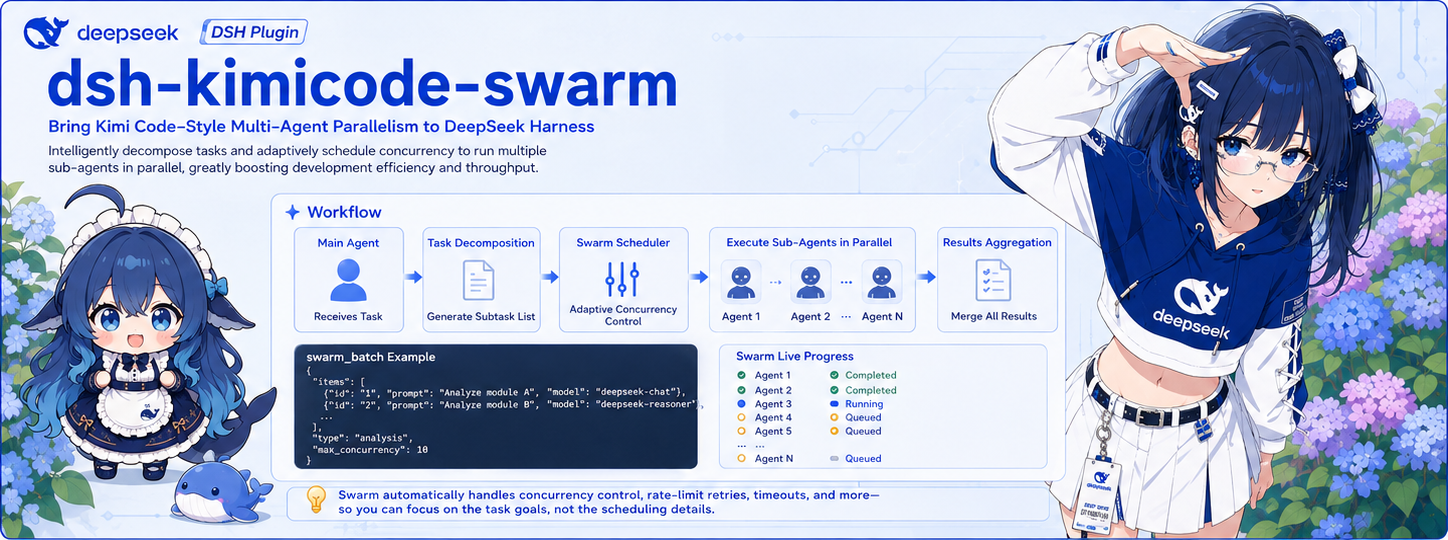
A port of **Kimi Code Swarm mode** (master/worker parallel multi-agent) into DeepSeek Harness:
the main agent splits a task into independent subtasks, `swarm_batch` dispatches them in one
batch, the subagents run in parallel, and the results are aggregated — up to **4.5x end-to-end
efficiency gain** in the official benchmarks. **In-chat live progress rows**: one status line per
subagent (queued / running / completed), lighting up one by one like Kimi's TUI.
## Features
- **`swarm_batch` tool**: `prompt_template` + `items` generate subtasks in bulk (up to 128
items), each item may carry its own `model` / `type`; `resume_agent_ids` resumes unfinished
work.
- **Adaptive scheduling** (aligned with the Kimi SubagentBatch contract): 5 concurrent launches
up front, then +1 every 700ms; exponential backoff on rate limits (3s/6s/12s…) with adaptive
capacity shrink/recovery; user cancellation preserves completed results; a per-task timeout
fails only that task.
- **`/swarm ` command**: one-shot Swarm mode — explore the task boundary, split it into
subtasks, dispatch the batch, summarize, and exit the mode automatically (mirrors Kimi's
task-triggered semantics).
- **In-chat live progress**: the host broadcasts full-snapshot progress frames over an SSE
route (`/swarm-events`); the browser subscribes via a same-origin EventSource and renders
per-subagent status rows — pulsing blue dot while running, gray while queued, green when done.
- **Three-level model assignment**: per-item / batch explicit `model` > settings mapping table
(matched by type) > inherit the caller's model (default, left to the agent).
## Architecture
```
┌─ host half (node process, src/index.ts) ────────────────────────┐
│ swarm_batch tool (ctx.tools.register) │
│ ├─ argument normalization (core/normalize.ts): template fill │
│ │ / model resolution / dedup │
│ ├─ SwarmScheduler (core/scheduler.ts): two-phase adaptive │
│ │ concurrency │
│ │ └─ onProgress callback: full snapshot per status change │
│ ├─ ctx.subagents.start(): real subagent launch (inherits the │
│ │ caller's model when none is resolved) │
│ └─ progress.ts: createProgressBroadcaster → SSE frames on │
│ /swarm-events (SWARM_PROGRESS_ROUTE) │
│ /swarm command (ctx.commands.register): one-shot swarm mode │
│ settings namespace + system-prompt announcement │
└──────────────────────────────────────────────────────────────────┘
│ SSE (event: progress, JSON snapshot)
┌─ browser half (Web GUI, src/client/) ──────────────────────────┐
│ index.ts: same-origin EventSource on /swarm-events │
│ progress-store.ts: module-level store, snapshots keyed by │
│ callId │
│ SwarmCard.tsx: tool.call.toolview keyed view │
│ ├─ running: one live status row per subagent │
│ │ (queued/running/completed) │
│ └─ settled: results panel (expandable rows, from │
│ presentationMeta) │
│ SwarmSettingsCard.tsx: settings card (model mapping table, │
│ model catalog pulled live) │
└──────────────────────────────────────────────────────────────────┘
```
Key design decisions:
- **Scheduler decoupled from the runtime**: `core/` is pure logic (SpawnFn and a clock are
injected; tests drive it with fakes) and does not depend on host types (framework-free, in
the style of dsh-task-board).
- **Progress rides a dedicated SSE route, not session events**: rc.8 rejects
out-of-vocabulary session events on read, so `swarm/progress` can no longer ride the session
log. Progress is display-only: the host broadcasts full-snapshot frames over `/swarm-events`
and the browser subscribes with a same-origin EventSource — zero host changes, and the
session log stays clean.
- **Model assignment defaults back to the LLM**: omit `model` to inherit the caller's model
and let the agent assign per difficulty; an explicit model always wins.
## Install
Published to **npm** (`dsh-kimicode-swarm`) — one line into any DSH profile:
```bash
dsh plugin --profile web add dsh-kimicode-swarm
# equivalent to:
pnpm add dsh-kimicode-swarm
```
Or install from GitHub / locally:
```bash
pnpm add github:hongyue0721/dsh-kimicode-swarm # or
pnpm add file:/path/to/dsh-kimicode-swarm
```
Restart `dsh web` after installing; the `swarm_batch` tool and `/swarm` command appear in
**new sessions**.
## Usage
**Let the agent work**: just describe the task — the agent decides whether a parallel batch is
worth it; or explicitly ask to "dispatch with swarm".
**Quick command**:
```
/swarm review these three modules and suggest fixes
```
**Model assignment**: by default subagents inherit the caller's model; to pin a model per
task, write `{ "item": "...", "model": "deepseek-v4-pro" }` for an item, or pass a batch-level
`model` field.
**`swarm_batch` parameters** (model-facing contract):
| Parameter | Description |
|---|---|
| `description` | Short description of the whole swarm (required) |
| `subagent_type` | Subagent type for new spawns (default `coder`) |
| `model` | Batch-level model override (takes precedence over the mapping table) |
| `prompt_template` | Required when `items` is given; must contain the `{{item}}` placeholder |
| `items` | 2..128 entries; `string` or `{ item, model?, type? }` |
| `resume_agent_ids` | `agent_id -> prompt` map for resuming unfinished work (launched before new spawns) |
## Configuration
The settings-page card is currently unavailable (see below); configure via the profile
patch's entry config or the `swarm:` section of `~/.dsh/settings.yaml`:
```yaml
swarm:
enabled: true
announceToAgent: true
modelMappingEnabled: false
modelMapping:
- type: explore
provider: deepseek-official
model: deepseek-v3
```
## Known limitations
- **Settings card blocked by the host whitelist**: `dsh-host-apiproxy` hard-codes
`WEB_SETTINGS_NAMESPACES`; a plugin-registered settings namespace is always
`settings-not-exposed` to the config client (the official notes list "plugin-declared
exposure" as deferred work — a known family-wide issue). The card code is complete and
renders nothing in the unavailable state; GUI editing will be enabled once the host opens
up.
- Subagents do not stream intermediate tokens while running (`subagents.start` resolves with
the final result); the progress rows show each subagent's launch/settle status, not
token-level streaming.
- No file locking: multi-subagent write conflicts are avoided by task decomposition (same as
the original).
## Development
```sh
pnpm install
pnpm typecheck # tsc --noEmit
pnpm test # vitest (48 tests: scheduler ramp/rate-limit/cancel/timeout/capacity-recovery + normalization + progress + render round-trip + store lifecycle)
pnpm build # lib/ (host half) + lib/client.js (browser half)
```
Architecture and design details: [docs/architecture.md](docs/architecture.md).
Feedback / issues: [Issues](https://github.com/hongyue0721/dsh-kimicode-swarm/issues)
## License
[MIT](./LICENSE)