[toc]
> * 编程竞赛和商业竞赛的区别:中间结果不重要 by 楼天城
> * 可以采用hold的策略
### 设计模式
#### High-Level Thoughts
* [The Rise of Worse is Better by Richard P. Gabriel](https://dreamsongs.com/RiseOfWorseIsBetter.html)
* MIT/Stanford style of design
* Correctness = Consistency = Completeness > Simplicity
* The worse-is-better philosophy
* Simplicity > Correctness > Completeness > Consistency
* It is more important for the implementation to be simple than the interface
* e.g. 讨论 OS 中 PC loser-ing problem 的解决
* The PC loser-ing problem occurs when a user program invokes a system routine to perform a lengthy operation that might have significant state, such as IO buffers. If an interrupt occurs during the operation, the state of the user program must be saved. Because the invocation of the system routine is usually a single instruction, the PC of the user program does not adequately capture the state of the process. The system routine must either back out or press forward. The right thing is to back out and restore the user program PC to the instruction that invoked the system routine so that resumption of the user program after the interrupt, for example, re-enters the system routine. It is called *PC loser-ing* because the PC is being coerced into *loser mode*, where *loser* is the affectionate name for *user* at MIT.
* unix的方案:抛出错误码,用户重试
* implementation simplicity was more important than interface simplicity.
* C is a programming language designed for writing Unix, and it was designed using the New Jersey approach. C is therefore a language for which it is easy to write a decent compiler, and it requires the programmer to write text that is easy for the compiler to interpret. Some have called C a fancy assembly language
* A further benefit of the worse-is-better philosophy is that the programmer is conditioned to **sacrifice some safety, convenience, and hassle to get good performance and modest resource use**. Programs written using the New Jersey approach will work well both in small machines and large ones, and the code will be portable because it is written on top of a virus.
* The lesson to be learned from this is that it is often undesirable to go for the right thing first. It is better to get half of the right thing available so that it spreads like a virus.
#### refactoring.guru
https://refactoring.guru/ Design Patterns
* Creational Patterns
* [prototype](https://refactoring.guru/design-patterns/prototype): 由对象创建同类对象
* The **Concrete Prototype** class implements the cloning method. In addition to copying the original object’s data to the clone, this method may also handle some edge cases of the cloning process related to cloning linked objects, untangling recursive dependencies, etc.
* 一个用处:register一些通用的subclass instance
* 实现细节:CopyFrom() 和 New() 方法
* Structural Patterns
* Behavioral Patterns
* [visitor](https://refactoring.guru/design-patterns/visitor): 让 server 接受 client 作为输入
* *Visitor lets you define a new operation without changing the classes of the elements on which it operates.*
* visitor and double dispatch
* ```java
// Client code
foreach (Node node in graph)
node.accept(exportVisitor)
// City
class City is
method accept(Visitor v) is
v.doForCity(this)
// ...
// Industry
class Industry is
method accept(Visitor v) is
v.doForIndustry(this)
// ...
```
#### Others
* IOC(Inversion of Control,控制反转): 面向对象编程中的一种设计原则,可以用来减低计算机代码之间的耦合度。其中最常见的方式叫做依赖注入(Dependency Injection,简称DI),还有一种方式叫“依赖查找”(Dependency Lookup)
* 依赖注入和依赖查找,两者的区别在于,前者是被动的接收对象,在类A的实例创建过程中即创建了依赖的B对象,通过类型或名称来判断将不同的对象注入到不同的属性中,而后者是主动索取相应类型的对象,获得依赖对象的时间也可以在代码中自由控制。
### 《剑指offer——名企面试官精讲典型编程题》,何海涛,电子工业出版社,2017
动态规划与分治的区别:前者自底向上,后者自顶向下
#### chpt1 面试的流程
* 电话面试:说细节,大胆pardon
* 远程桌面面试:编程习惯,调试能力
* 现场面试:准备几个问题
* 行为面试->技术面试->应聘者提问
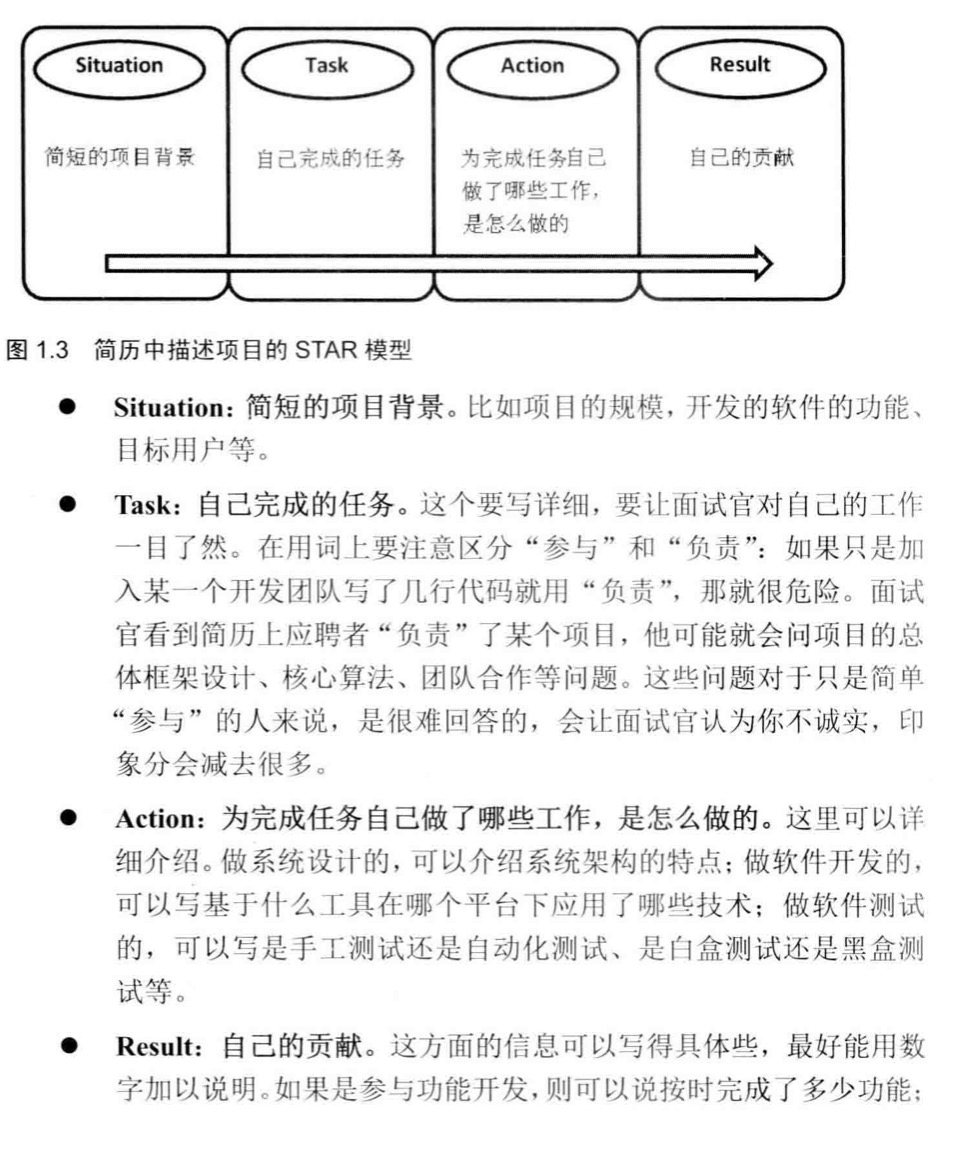
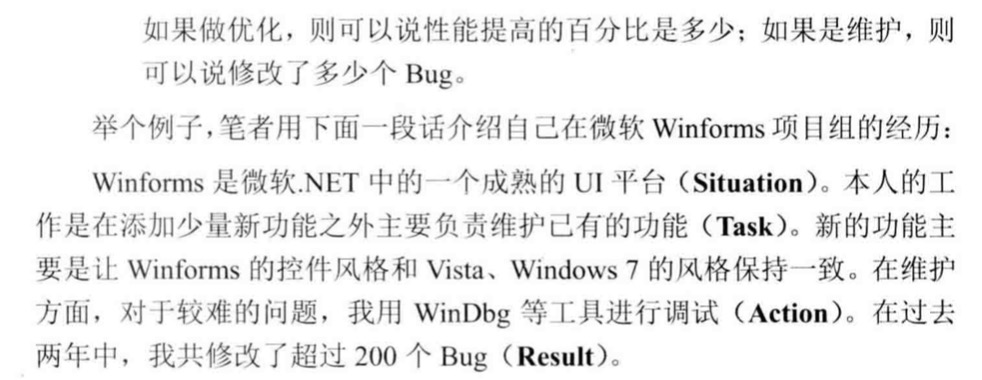 * 技能:了解、熟悉、精通
* 常考点:链表、二叉树、快排
* 细节:空指针空字符串(nullptr)、错误处理、溢出
* C语言的整型溢出问题,[很好的文章](https://coolshell.cn/articles/11466.html/comment-page-1#comments)
#### chpt2 面试需要的基础知识
* C++:面向对象的特性、构造函数、析构函数、动态绑定、内存管理
* e.g. 空类1字节
* 软件工程:常见的设计模式、UML图
* C#
* struct和class中成员默认都是private,struct和class区别在于struct定义的是值类型,在栈上分配内存;而class定义的是引用类型,在堆上分配内存。
* C#的垃圾回收机制:Finalizer写法同C++,但是在运行时(CLR)进行垃圾回收时调用,调用时机不确定
* 静态构造函数
* 反射和应用程序域(p31)
* 数据结构
* 数组
* 可以用数组做简单的Hash表,见本书第50题“第一个只出现一次的字符”
* STL的vector,[动态扩容](https://www.cnblogs.com/zxiner/p/7197327.html),容量翻倍,可以用reserve()预留容量
##### 1.赋值运算符函数
* 经典解法:考虑[返回引用](https://bbs.csdn.net/topics/100000589?depth_1-utm_source=distribute.pc_relevant.none-task&utm_source=distribute.pc_relevant.none-task)、连续赋值、等号两边相同的情形
```c++
CMyString& CMyString::operator=(const CMyString &str){
if(this==&str)
return *this;
delete []m_pData;
m_pData = new char[strlen(str.m_pData)+1];
strcpy(m_pData, str.m_pData);
return *this;
}
```
* 考虑异常安全性:上面的解法在new分配之前先delete,违背了Exception Safety原则,我们需要保证分配内存失败时原先的实例不会被修改,因此可以先复制,或者创造临时实例。(临时实例利用了if语句,在if的大括号外会自动析构)
```c++
CMyString& CMyString::operator=(const CMyString &str){
if(this!=&str){
CMyString strTemp(str);
swap(m_pData,strTemp.m_pData);
}
return *this;
}
```
##### 2.实现Singleton模式
* 思考路径(C#):静态实例->多线程加同步锁->加同步锁前后两次判断实例是否存在->静态构造函数->实现按需创造实例(利用私有嵌套类型的特性)
* [C++的单例模式总结,全面的长文分析](https://www.cnblogs.com/sunchaothu/p/10389842.html#223--%E6%9C%80%E6%8E%A8%E8%8D%90%E7%9A%84%E6%87%92%E6%B1%89%E5%BC%8F%E5%8D%95%E4%BE%8Bmagic-static-%E5%B1%80%E9%83%A8%E9%9D%99%E6%80%81%E5%8F%98%E9%87%8F)
* C++11有专门的线程安全机制
> If control enters the declaration concurrently while the variable is being initialized, the concurrent execution shall wait for completion of the initialization.
如果当变量在初始化的时候,并发同时进入声明语句,并发线程将会阻塞等待初始化结束。
##### 3.[数组中重复的数字](https://leetcode-cn.com/problems/shu-zu-zhong-zhong-fu-de-shu-zi-lcof/submissions/)
* 我的解法,思路见注释
```c++
int findRepeatNumber(vector& nums) {
//时间复杂度O(n),空间复杂度O(1)
int save=-1; int i=nums[0];
while(1){
if(nums[i]==-1)return i; //用nums[i]保存是否遍历到i,如果nums[i]=-1说明找到了重复的元素
if(nums[i]==save) return save; //前后两次相邻跳转重复的情形
if(nums[i]==i){
nums[i]=-1;
while(nums[i]==-1) i=(++i)%nums.size(); //避免死循环的情形,以nums.size()为模循环递增下标
}
else{
save=nums[i];
nums[i]=-1;
i=save;
}
}
}
```
* 标答很巧妙,从头开始,对于下标和元素不等的不断进行置换,相等的则保持不变
##### 4.[二维数组中的查找](https://leetcode-cn.com/problems/er-wei-shu-zu-zhong-de-cha-zhao-lcof/)
* [leetcode 240.](https://leetcode-cn.com/problems/search-a-2d-matrix-ii)
* 关键在于起点的选取,从左下角或者右上角开始
##### 7. [重建二叉树](https://leetcode-cn.com/problems/zhong-jian-er-cha-shu-lcof/)
* [leetcode 105.](https://leetcode-cn.com/problems/construct-binary-tree-from-preorder-and-inorder-traversal/)
* 找到中间节点,递归
##### 11.[旋转数组的最小数字](https://leetcode-cn.com/problems/xuan-zhuan-shu-zu-de-zui-xiao-shu-zi-lcof/)
* [leetcode 154.](https://leetcode-cn.com/problems/find-minimum-in-rotated-sorted-array-ii)
* 如果有重复数字,则难以判断mid是在左边还是右边,r-=1是解决这一问题的关键代码
```c++
int findMin(vector& numbers) {
//if(numbers.size()==0)return -1;
int l=0,r=numbers.size()-1;
int mid;
while(lnumbers[r]) l=mid;
else if(numbers[mid]>=1);`
* 位运算优先级很低,n&1应该打括号
* 复习[运算符优先级](https://baike.baidu.com/item/%E8%BF%90%E7%AE%97%E7%AC%A6%E4%BC%98%E5%85%88%E7%BA%A7/4752611?fr=aladdin#4)
* 基本的优先级需要记住:
* 指针最优,单目运算优于双目运算,如正负号。
* 先算术运算,后移位运算,最后位运算。1 << 3 + 2 & 7等价于 (1 << (3 + 2))&7,逻辑运算最后结合。
#### chpt3 高质量的代码
##### 18.[删除链表的节点](https://leetcode-cn.com/problems/shan-chu-lian-biao-de-jie-dian-lcof/)
* [leetcode 203.](https://leetcode-cn.com/problems/remove-linked-list-elements/)
* 直接遍历,也可以用sentinel node简化操作(在LRU cache也有应用)
```c++
class Solution {
public:
ListNode* deleteNode(ListNode* head, int val) {
if(head==NULL)return NULL;
if(head->val==val)return head->next;
ListNode *p=head;
while(p->next){
if(p->next->val==val){
p->next=p->next->next;
break;
}
p=p->next;
}
return head;
}
};
```
##### 19. [正则表达式匹配](https://leetcode-cn.com/problems/zheng-ze-biao-da-shi-pi-pei-lcof/)
* [leetcode 10.](https://leetcode-cn.com/problems/regular-expression-matching)
* 和0072.Edit-Space类似
$$
d[i][j]=\begin{cases}
d[i-1][j-1]& p[j]='.'\\
s[i] == p[j]\quad \&\& \quad d[i - 1][j - 1] & p[j]=a\\
d[i][j - 2]\quad ||\quad d[i-1][j] & p[j-1:j]='.*'\\
d[i][j - 2]\quad ||\quad (d[i-1][j]\quad \&\&\quad s[i]==p[j-1]) & p[j-1:j]='a*'
\end{cases}
\notag
$$
##### 20.[表示数值的字符串](https://leetcode-cn.com/problems/biao-shi-shu-zhi-de-zi-fu-chuan-lcof)
* [leetcode 65.](https://leetcode-cn.com/problems/valid-number/)
* 书上的代码结构很简洁,值得学习
```c++
int pointer;
bool isNumber(string s) {
if(s=="")return -1;
scanSpace(s);
bool numeric=scanInteger(s);
if(s[pointer]=='.'){
++pointer;
numeric=scanUnsignedInteger(s)||numeric;
//用||因为整数、小数部分有一即可
}
if(s[pointer]=='e'||s[pointer]=='E'){
++pointer;
numeric=numeric&&scanInteger(s);
}
scanSpace(s);
return numeric&&s[pointer]=='\0';
}
```
* 也可以用有限状态机来做
##### 24.[翻转链表](https://leetcode-cn.com/problems/fan-zhuan-lian-biao-lcof/)
* [leetcode 206.](https://leetcode-cn.com/problems/reverse-linked-list/)
```c++
ListNode* reverseList(ListNode* head) {
if(!head||!head->next) return head;
ListNode *p=head,*q=head->next;
p->next=NULL;
ListNode* temp;
while(q!=NULL){
temp=q->next;
q->next=p;
p=q;
q=temp;
}
return p;
}
```
##### 25.[合并两个排序的链表](https://leetcode-cn.com/problems/he-bing-liang-ge-pai-xu-de-lian-biao-lcof/)
* [leetcode 21.](https://leetcode-cn.com/problems/merge-two-sorted-lists),经典题,引入一个头节点
* 代码模版:
```c++
ListNode*head=new ListNode(0);
ListNode*p=head;
...
return head->next;
```
##### 28.[对称的二叉树](https://leetcode-cn.com/problems/symmetric-tree)
* [leetcode 101.](https://leetcode-cn.com/problems/symmetric-tree)
* 递归
```c++
bool isSymmetric(TreeNode* root) {
if(!root)return 1;
else return isSymmetric1(root->left,root->right);
}
bool isSymmetric1(TreeNode* a,TreeNode* b) {
if(!(a||b))return 1;
else if(!(a&&b))return 0;
else return a->val==b->val&&isSymmetric1(a->left,b->right)&&isSymmetric1(a->right,b->left);
}
```
##### 29.[顺时针打印矩阵](https://leetcode-cn.com/problems/shun-shi-zhen-da-yin-ju-zhen-lcof/)
* [leetcode 54.](https://leetcode-cn.com/problems/spiral-matrix)
* 最简洁的写法
```c++
vector spiralOrder(vector>& matrix) {
vectorret;
int m=matrix.size();
if(!m)return ret;
int n=matrix[0].size();
int b=0,t=m-1,l=0,r=n-1;
while(1){
for(int j=l;j<=r;j++)ret.push_back(matrix[b][j]);
if(++b>t)break;
for(int i=b;i<=t;i++)ret.push_back(matrix[i][r]);
if(--r=l;j--)ret.push_back(matrix[t][j]);
if(--t=b;i--)ret.push_back(matrix[i][l]);
if(++l>r)break;
}
return ret;
}
```
#### chpt4 解决面试题的思路
解决复杂问题的三种方法:画图、举例、分解
##### 30.[包含min函数的栈](https://leetcode-cn.com/problems/bao-han-minhan-shu-de-zhan-lcof/)
* [leetcode 155.](https://leetcode-cn.com/problems/min-stack)
* 用另一个栈记录min的变化值
##### 32.从上到下打印二叉树
* [32-I,直接存](https://leetcode-cn.com/problems/cong-shang-dao-xia-da-yin-er-cha-shu-lcof/):队列
* [32-II,按层保存](https://leetcode-cn.com/problems/cong-shang-dao-xia-da-yin-er-cha-shu-lcof): [leetcode 102.](https://leetcode-cn.com/problems/binary-tree-level-order-traversal/),队列,设变量curNum和nextNum分别保存本层和下层的数的个数
* [32-III,锯齿形](https://leetcode-cn.com/problems/cong-shang-dao-xia-da-yin-er-cha-shu-iii-lcof/): [leetcode 103.](https://leetcode-cn.com/problems/binary-tree-zigzag-level-order-traversal/),在102的基础上保存层数的奇偶性
* 引申:[关于vector的内存释放问题](https://www.cnblogs.com/jiayouwyhit/p/3878047.html)
* 方法一:clear
* 方法二:`vector().swap(nums);`
* 方法三:利用代码块和临时变量
`
{
vector tmp = curLevel;
curLevel.swap(tmp);
}
`
* clear虽然不会deallocate释放空间,但是会destroy执行析构函数,所以可以用同一个空间构造节点,如果swap了就要重新分配空间再构造节点。由于本题是对同一个vector的重复利用,可以直接用clear();,空间复杂度是单层最大节点数。
* 如果要每次都释放空间,也可以用`res.emplace_back(std::move(curLevel))`,涉及[emplace_back](https://www.cnblogs.com/ChrisCoder/p/9919646.html), [std::move](https://blog.csdn.net/p942005405/article/details/84644069/), [左值、右值引用](https://blog.csdn.net/p942005405/article/details/84644101), [这是一篇有关类定义的总结](https://blog.csdn.net/zzhongcy/article/details/86747794)
##### 33.[二叉搜索树的后序遍历序列](https://leetcode-cn.com/problems/er-cha-sou-suo-shu-de-hou-xu-bian-li-xu-lie-lcof/)
* 法1:递归子树,直观的思路
* 法2:参照leetcode84,利用单调栈,[一篇很好的文章](https://blog.csdn.net/lucky52529/article/details/89155694)(有小错,修正版见我的[leetcode题解](https://github.com/huangrt01/CS-Notes))
##### 35.[复杂链表的复制](https://leetcode-cn.com/problems/fu-za-lian-biao-de-fu-zhi-lcof/)
* [leetcode 138.](https://leetcode-cn.com/problems/copy-list-with-random-pointer/)
* 思路值得学习,在原链表的主线上复制节点,进行删改操作。
##### 36.[二叉搜索树与双向链表](https://leetcode-cn.com/problems/er-cha-sou-suo-shu-yu-shuang-xiang-lian-biao-lcof/)
* [leetcode 426.](https://leetcode-cn.com/problems/convert-binary-search-tree-to-sorted-doubly-linked-list/)
* 方法一:二叉搜索树特性,中序遍历的递归/非递归实现,用nonlocal last记录上一次遍历的末尾节点
* 方法二:用flag指示返回最左/最右节点,递归后序遍历操作
```c++
Node *treeToDoublyList(Node *root)
{
root = treeToDoublyList(root, 0);
if (root == NULL)
return NULL;
Node *p = root;
while (p->right) p = p->right;
p->right = root;
root->left = p;
return root;
}
Node *treeToDoublyList(Node *root, int flag)
{ //flag=0:left, flag=1:right
if (root == NULL)
return NULL;
Node *l = treeToDoublyList(root->left, 1);
Node *r = treeToDoublyList(root->right, 0);
root->left = l;
root->right = r;
if (l)
l->right = root;
if (r)
r->left = root;
Node *p = root;
if (!flag) while (p->left) p = p->left;
else while (p->right) p = p->right;
return p;
}
```
##### 37.[序列化二叉树](https://leetcode-cn.com/problems/xu-lie-hua-er-cha-shu-lcof/)
* [leetcode 297.](https://leetcode-cn.com/problems/serialize-and-deserialize-binary-tree/)
* 思路上可以使用DFS或者BFS
* C++具体实现,利用stringstream
```c++
class Codec {
public:
// Encodes a tree to a single string.
string serialize(TreeNode* root) {
if(root==NULL)return "";
ostringstream ostr;
queueq;
TreeNode*temp;
q.push(root);
int curNum=1;
while(!q.empty()){
temp=q.front();
q.pop();
if(!temp){
if(curNum) ostr<<"null,";
}
else {
ostr<val<<",";
curNum--;
q.push(temp->left);
if(temp->left)curNum++;
q.push(temp->right);
if(temp->right)curNum++;
}
}
return ostr.str();
}
// Decodes your encoded data to tree.
TreeNode* deserialize(string data) {
if(data=="")return NULL;
istringstream istr(data);
queueq;
TreeNode* root=new TreeNode;
TreeNode **number=new TreeNode*;
if(ReadStream (istr,number)){
root=number[0];
if(!root)return NULL;
q.push(root);
}
else return NULL;
TreeNode *temp;
while(!q.empty()){
temp=q.front();
q.pop();
if(!temp)continue;
if(ReadStream(istr,number)){
temp->left=number[0];
q.push(temp->left);
}
else break;
if(ReadStream(istr,number)){
temp->right=number[0];
q.push(temp->right);
}
else break;
}
return root;
}
bool ReadStream(istringstream &istr,TreeNode **number){
string s;
if(getline(istr,s,',')){
if(s=="null")number[0]=NULL;
else number[0]=new TreeNode(stoi(s));
return 1;
}
return 0;
}
};
```
##### 38.[字符串的排列](https://leetcode-cn.com/problems/zi-fu-chuan-de-pai-lie-lcof/)
* 回溯法,注意judge函数:排除重复的情形
* 全排列的应用:针对按一定要求摆放数字的问题,比如八皇后问题、正方体顶点和问题
```c++
class Solution {
public:
vectorres;
vector permutation(string s) {
int cursor=0;
permutation(s,cursor);
return res;
}
void permutation(string &s,int cursor){
if(cursor==s.size()-1){
res.push_back(s);
}
else{
for(int i=cursor;i, greater> hi;`
```c++
min.push_back(num);
push_heap(min.begin(),min.end(),greater());
```
* 字节后端开发终面:变式题,在本题基础上增加erase功能,需要把堆改成BST(即set),保证删除性能
* 技能:了解、熟悉、精通
* 常考点:链表、二叉树、快排
* 细节:空指针空字符串(nullptr)、错误处理、溢出
* C语言的整型溢出问题,[很好的文章](https://coolshell.cn/articles/11466.html/comment-page-1#comments)
#### chpt2 面试需要的基础知识
* C++:面向对象的特性、构造函数、析构函数、动态绑定、内存管理
* e.g. 空类1字节
* 软件工程:常见的设计模式、UML图
* C#
* struct和class中成员默认都是private,struct和class区别在于struct定义的是值类型,在栈上分配内存;而class定义的是引用类型,在堆上分配内存。
* C#的垃圾回收机制:Finalizer写法同C++,但是在运行时(CLR)进行垃圾回收时调用,调用时机不确定
* 静态构造函数
* 反射和应用程序域(p31)
* 数据结构
* 数组
* 可以用数组做简单的Hash表,见本书第50题“第一个只出现一次的字符”
* STL的vector,[动态扩容](https://www.cnblogs.com/zxiner/p/7197327.html),容量翻倍,可以用reserve()预留容量
##### 1.赋值运算符函数
* 经典解法:考虑[返回引用](https://bbs.csdn.net/topics/100000589?depth_1-utm_source=distribute.pc_relevant.none-task&utm_source=distribute.pc_relevant.none-task)、连续赋值、等号两边相同的情形
```c++
CMyString& CMyString::operator=(const CMyString &str){
if(this==&str)
return *this;
delete []m_pData;
m_pData = new char[strlen(str.m_pData)+1];
strcpy(m_pData, str.m_pData);
return *this;
}
```
* 考虑异常安全性:上面的解法在new分配之前先delete,违背了Exception Safety原则,我们需要保证分配内存失败时原先的实例不会被修改,因此可以先复制,或者创造临时实例。(临时实例利用了if语句,在if的大括号外会自动析构)
```c++
CMyString& CMyString::operator=(const CMyString &str){
if(this!=&str){
CMyString strTemp(str);
swap(m_pData,strTemp.m_pData);
}
return *this;
}
```
##### 2.实现Singleton模式
* 思考路径(C#):静态实例->多线程加同步锁->加同步锁前后两次判断实例是否存在->静态构造函数->实现按需创造实例(利用私有嵌套类型的特性)
* [C++的单例模式总结,全面的长文分析](https://www.cnblogs.com/sunchaothu/p/10389842.html#223--%E6%9C%80%E6%8E%A8%E8%8D%90%E7%9A%84%E6%87%92%E6%B1%89%E5%BC%8F%E5%8D%95%E4%BE%8Bmagic-static-%E5%B1%80%E9%83%A8%E9%9D%99%E6%80%81%E5%8F%98%E9%87%8F)
* C++11有专门的线程安全机制
> If control enters the declaration concurrently while the variable is being initialized, the concurrent execution shall wait for completion of the initialization.
如果当变量在初始化的时候,并发同时进入声明语句,并发线程将会阻塞等待初始化结束。
##### 3.[数组中重复的数字](https://leetcode-cn.com/problems/shu-zu-zhong-zhong-fu-de-shu-zi-lcof/submissions/)
* 我的解法,思路见注释
```c++
int findRepeatNumber(vector& nums) {
//时间复杂度O(n),空间复杂度O(1)
int save=-1; int i=nums[0];
while(1){
if(nums[i]==-1)return i; //用nums[i]保存是否遍历到i,如果nums[i]=-1说明找到了重复的元素
if(nums[i]==save) return save; //前后两次相邻跳转重复的情形
if(nums[i]==i){
nums[i]=-1;
while(nums[i]==-1) i=(++i)%nums.size(); //避免死循环的情形,以nums.size()为模循环递增下标
}
else{
save=nums[i];
nums[i]=-1;
i=save;
}
}
}
```
* 标答很巧妙,从头开始,对于下标和元素不等的不断进行置换,相等的则保持不变
##### 4.[二维数组中的查找](https://leetcode-cn.com/problems/er-wei-shu-zu-zhong-de-cha-zhao-lcof/)
* [leetcode 240.](https://leetcode-cn.com/problems/search-a-2d-matrix-ii)
* 关键在于起点的选取,从左下角或者右上角开始
##### 7. [重建二叉树](https://leetcode-cn.com/problems/zhong-jian-er-cha-shu-lcof/)
* [leetcode 105.](https://leetcode-cn.com/problems/construct-binary-tree-from-preorder-and-inorder-traversal/)
* 找到中间节点,递归
##### 11.[旋转数组的最小数字](https://leetcode-cn.com/problems/xuan-zhuan-shu-zu-de-zui-xiao-shu-zi-lcof/)
* [leetcode 154.](https://leetcode-cn.com/problems/find-minimum-in-rotated-sorted-array-ii)
* 如果有重复数字,则难以判断mid是在左边还是右边,r-=1是解决这一问题的关键代码
```c++
int findMin(vector& numbers) {
//if(numbers.size()==0)return -1;
int l=0,r=numbers.size()-1;
int mid;
while(lnumbers[r]) l=mid;
else if(numbers[mid]>=1);`
* 位运算优先级很低,n&1应该打括号
* 复习[运算符优先级](https://baike.baidu.com/item/%E8%BF%90%E7%AE%97%E7%AC%A6%E4%BC%98%E5%85%88%E7%BA%A7/4752611?fr=aladdin#4)
* 基本的优先级需要记住:
* 指针最优,单目运算优于双目运算,如正负号。
* 先算术运算,后移位运算,最后位运算。1 << 3 + 2 & 7等价于 (1 << (3 + 2))&7,逻辑运算最后结合。
#### chpt3 高质量的代码
##### 18.[删除链表的节点](https://leetcode-cn.com/problems/shan-chu-lian-biao-de-jie-dian-lcof/)
* [leetcode 203.](https://leetcode-cn.com/problems/remove-linked-list-elements/)
* 直接遍历,也可以用sentinel node简化操作(在LRU cache也有应用)
```c++
class Solution {
public:
ListNode* deleteNode(ListNode* head, int val) {
if(head==NULL)return NULL;
if(head->val==val)return head->next;
ListNode *p=head;
while(p->next){
if(p->next->val==val){
p->next=p->next->next;
break;
}
p=p->next;
}
return head;
}
};
```
##### 19. [正则表达式匹配](https://leetcode-cn.com/problems/zheng-ze-biao-da-shi-pi-pei-lcof/)
* [leetcode 10.](https://leetcode-cn.com/problems/regular-expression-matching)
* 和0072.Edit-Space类似
$$
d[i][j]=\begin{cases}
d[i-1][j-1]& p[j]='.'\\
s[i] == p[j]\quad \&\& \quad d[i - 1][j - 1] & p[j]=a\\
d[i][j - 2]\quad ||\quad d[i-1][j] & p[j-1:j]='.*'\\
d[i][j - 2]\quad ||\quad (d[i-1][j]\quad \&\&\quad s[i]==p[j-1]) & p[j-1:j]='a*'
\end{cases}
\notag
$$
##### 20.[表示数值的字符串](https://leetcode-cn.com/problems/biao-shi-shu-zhi-de-zi-fu-chuan-lcof)
* [leetcode 65.](https://leetcode-cn.com/problems/valid-number/)
* 书上的代码结构很简洁,值得学习
```c++
int pointer;
bool isNumber(string s) {
if(s=="")return -1;
scanSpace(s);
bool numeric=scanInteger(s);
if(s[pointer]=='.'){
++pointer;
numeric=scanUnsignedInteger(s)||numeric;
//用||因为整数、小数部分有一即可
}
if(s[pointer]=='e'||s[pointer]=='E'){
++pointer;
numeric=numeric&&scanInteger(s);
}
scanSpace(s);
return numeric&&s[pointer]=='\0';
}
```
* 也可以用有限状态机来做
##### 24.[翻转链表](https://leetcode-cn.com/problems/fan-zhuan-lian-biao-lcof/)
* [leetcode 206.](https://leetcode-cn.com/problems/reverse-linked-list/)
```c++
ListNode* reverseList(ListNode* head) {
if(!head||!head->next) return head;
ListNode *p=head,*q=head->next;
p->next=NULL;
ListNode* temp;
while(q!=NULL){
temp=q->next;
q->next=p;
p=q;
q=temp;
}
return p;
}
```
##### 25.[合并两个排序的链表](https://leetcode-cn.com/problems/he-bing-liang-ge-pai-xu-de-lian-biao-lcof/)
* [leetcode 21.](https://leetcode-cn.com/problems/merge-two-sorted-lists),经典题,引入一个头节点
* 代码模版:
```c++
ListNode*head=new ListNode(0);
ListNode*p=head;
...
return head->next;
```
##### 28.[对称的二叉树](https://leetcode-cn.com/problems/symmetric-tree)
* [leetcode 101.](https://leetcode-cn.com/problems/symmetric-tree)
* 递归
```c++
bool isSymmetric(TreeNode* root) {
if(!root)return 1;
else return isSymmetric1(root->left,root->right);
}
bool isSymmetric1(TreeNode* a,TreeNode* b) {
if(!(a||b))return 1;
else if(!(a&&b))return 0;
else return a->val==b->val&&isSymmetric1(a->left,b->right)&&isSymmetric1(a->right,b->left);
}
```
##### 29.[顺时针打印矩阵](https://leetcode-cn.com/problems/shun-shi-zhen-da-yin-ju-zhen-lcof/)
* [leetcode 54.](https://leetcode-cn.com/problems/spiral-matrix)
* 最简洁的写法
```c++
vector spiralOrder(vector>& matrix) {
vectorret;
int m=matrix.size();
if(!m)return ret;
int n=matrix[0].size();
int b=0,t=m-1,l=0,r=n-1;
while(1){
for(int j=l;j<=r;j++)ret.push_back(matrix[b][j]);
if(++b>t)break;
for(int i=b;i<=t;i++)ret.push_back(matrix[i][r]);
if(--r=l;j--)ret.push_back(matrix[t][j]);
if(--t=b;i--)ret.push_back(matrix[i][l]);
if(++l>r)break;
}
return ret;
}
```
#### chpt4 解决面试题的思路
解决复杂问题的三种方法:画图、举例、分解
##### 30.[包含min函数的栈](https://leetcode-cn.com/problems/bao-han-minhan-shu-de-zhan-lcof/)
* [leetcode 155.](https://leetcode-cn.com/problems/min-stack)
* 用另一个栈记录min的变化值
##### 32.从上到下打印二叉树
* [32-I,直接存](https://leetcode-cn.com/problems/cong-shang-dao-xia-da-yin-er-cha-shu-lcof/):队列
* [32-II,按层保存](https://leetcode-cn.com/problems/cong-shang-dao-xia-da-yin-er-cha-shu-lcof): [leetcode 102.](https://leetcode-cn.com/problems/binary-tree-level-order-traversal/),队列,设变量curNum和nextNum分别保存本层和下层的数的个数
* [32-III,锯齿形](https://leetcode-cn.com/problems/cong-shang-dao-xia-da-yin-er-cha-shu-iii-lcof/): [leetcode 103.](https://leetcode-cn.com/problems/binary-tree-zigzag-level-order-traversal/),在102的基础上保存层数的奇偶性
* 引申:[关于vector的内存释放问题](https://www.cnblogs.com/jiayouwyhit/p/3878047.html)
* 方法一:clear
* 方法二:`vector().swap(nums);`
* 方法三:利用代码块和临时变量
`
{
vector tmp = curLevel;
curLevel.swap(tmp);
}
`
* clear虽然不会deallocate释放空间,但是会destroy执行析构函数,所以可以用同一个空间构造节点,如果swap了就要重新分配空间再构造节点。由于本题是对同一个vector的重复利用,可以直接用clear();,空间复杂度是单层最大节点数。
* 如果要每次都释放空间,也可以用`res.emplace_back(std::move(curLevel))`,涉及[emplace_back](https://www.cnblogs.com/ChrisCoder/p/9919646.html), [std::move](https://blog.csdn.net/p942005405/article/details/84644069/), [左值、右值引用](https://blog.csdn.net/p942005405/article/details/84644101), [这是一篇有关类定义的总结](https://blog.csdn.net/zzhongcy/article/details/86747794)
##### 33.[二叉搜索树的后序遍历序列](https://leetcode-cn.com/problems/er-cha-sou-suo-shu-de-hou-xu-bian-li-xu-lie-lcof/)
* 法1:递归子树,直观的思路
* 法2:参照leetcode84,利用单调栈,[一篇很好的文章](https://blog.csdn.net/lucky52529/article/details/89155694)(有小错,修正版见我的[leetcode题解](https://github.com/huangrt01/CS-Notes))
##### 35.[复杂链表的复制](https://leetcode-cn.com/problems/fu-za-lian-biao-de-fu-zhi-lcof/)
* [leetcode 138.](https://leetcode-cn.com/problems/copy-list-with-random-pointer/)
* 思路值得学习,在原链表的主线上复制节点,进行删改操作。
##### 36.[二叉搜索树与双向链表](https://leetcode-cn.com/problems/er-cha-sou-suo-shu-yu-shuang-xiang-lian-biao-lcof/)
* [leetcode 426.](https://leetcode-cn.com/problems/convert-binary-search-tree-to-sorted-doubly-linked-list/)
* 方法一:二叉搜索树特性,中序遍历的递归/非递归实现,用nonlocal last记录上一次遍历的末尾节点
* 方法二:用flag指示返回最左/最右节点,递归后序遍历操作
```c++
Node *treeToDoublyList(Node *root)
{
root = treeToDoublyList(root, 0);
if (root == NULL)
return NULL;
Node *p = root;
while (p->right) p = p->right;
p->right = root;
root->left = p;
return root;
}
Node *treeToDoublyList(Node *root, int flag)
{ //flag=0:left, flag=1:right
if (root == NULL)
return NULL;
Node *l = treeToDoublyList(root->left, 1);
Node *r = treeToDoublyList(root->right, 0);
root->left = l;
root->right = r;
if (l)
l->right = root;
if (r)
r->left = root;
Node *p = root;
if (!flag) while (p->left) p = p->left;
else while (p->right) p = p->right;
return p;
}
```
##### 37.[序列化二叉树](https://leetcode-cn.com/problems/xu-lie-hua-er-cha-shu-lcof/)
* [leetcode 297.](https://leetcode-cn.com/problems/serialize-and-deserialize-binary-tree/)
* 思路上可以使用DFS或者BFS
* C++具体实现,利用stringstream
```c++
class Codec {
public:
// Encodes a tree to a single string.
string serialize(TreeNode* root) {
if(root==NULL)return "";
ostringstream ostr;
queueq;
TreeNode*temp;
q.push(root);
int curNum=1;
while(!q.empty()){
temp=q.front();
q.pop();
if(!temp){
if(curNum) ostr<<"null,";
}
else {
ostr<val<<",";
curNum--;
q.push(temp->left);
if(temp->left)curNum++;
q.push(temp->right);
if(temp->right)curNum++;
}
}
return ostr.str();
}
// Decodes your encoded data to tree.
TreeNode* deserialize(string data) {
if(data=="")return NULL;
istringstream istr(data);
queueq;
TreeNode* root=new TreeNode;
TreeNode **number=new TreeNode*;
if(ReadStream (istr,number)){
root=number[0];
if(!root)return NULL;
q.push(root);
}
else return NULL;
TreeNode *temp;
while(!q.empty()){
temp=q.front();
q.pop();
if(!temp)continue;
if(ReadStream(istr,number)){
temp->left=number[0];
q.push(temp->left);
}
else break;
if(ReadStream(istr,number)){
temp->right=number[0];
q.push(temp->right);
}
else break;
}
return root;
}
bool ReadStream(istringstream &istr,TreeNode **number){
string s;
if(getline(istr,s,',')){
if(s=="null")number[0]=NULL;
else number[0]=new TreeNode(stoi(s));
return 1;
}
return 0;
}
};
```
##### 38.[字符串的排列](https://leetcode-cn.com/problems/zi-fu-chuan-de-pai-lie-lcof/)
* 回溯法,注意judge函数:排除重复的情形
* 全排列的应用:针对按一定要求摆放数字的问题,比如八皇后问题、正方体顶点和问题
```c++
class Solution {
public:
vectorres;
vector permutation(string s) {
int cursor=0;
permutation(s,cursor);
return res;
}
void permutation(string &s,int cursor){
if(cursor==s.size()-1){
res.push_back(s);
}
else{
for(int i=cursor;i, greater> hi;`
```c++
min.push_back(num);
push_heap(min.begin(),min.end(),greater());
```
* 字节后端开发终面:变式题,在本题基础上增加erase功能,需要把堆改成BST(即set),保证删除性能