TinyBERT
========
TinyBERT is 7.5x smaller and 9.4x faster on inference than BERT-base and achieves competitive performances in the tasks of natural language understanding. It performs a novel transformer distillation at both the pre-training and task-specific learning stages. The overview of TinyBERT learning is illustrated as follows:
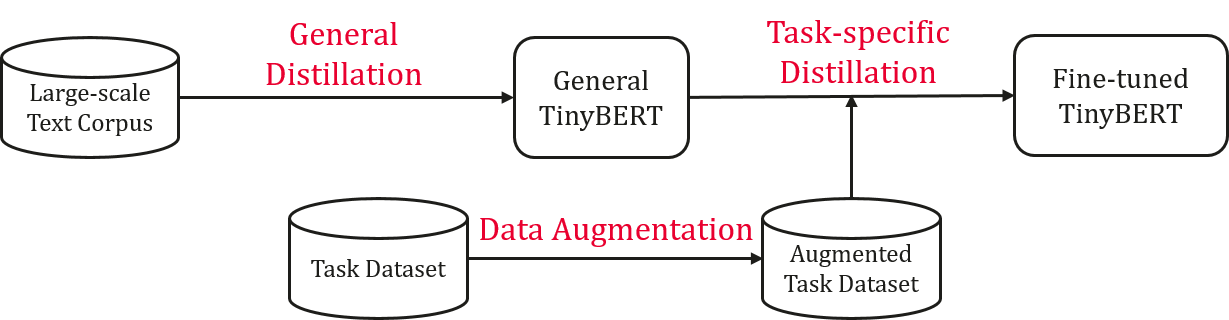
For more details about the techniques of TinyBERT, refer to our paper:
[TinyBERT: Distilling BERT for Natural Language Understanding](https://arxiv.org/abs/1909.10351)
Release Notes
=============
First version: 2019/11/26
Add Chinese General_TinyBERT: 2021.7.27
Installation
============
Run command below to install the environment(**using python3**)
```bash
pip install -r requirements.txt
```
General Distillation
====================
In general distillation, we use the original BERT-base without fine-tuning as the teacher and a large-scale text corpus as the learning data. By performing the Transformer distillation on the text from general domain, we obtain a general TinyBERT which provides a good initialization for the task-specific distillation.
General distillation has two steps: (1) generate the corpus of json format; (2) run the transformer distillation;
Step 1: use `pregenerate_training_data.py` to produce the corpus of json format
```
# ${BERT_BASE_DIR}$ includes the BERT-base teacher model.
python pregenerate_training_data.py --train_corpus ${CORPUS_RAW} \
--bert_model ${BERT_BASE_DIR}$ \
--reduce_memory --do_lower_case \
--epochs_to_generate 3 \
--output_dir ${CORPUS_JSON_DIR}$
```
Step 2: use `general_distill.py` to run the general distillation
```
# ${STUDENT_CONFIG_DIR}$ includes the config file of student_model.
python general_distill.py --pregenerated_data ${CORPUS_JSON}$ \
--teacher_model ${BERT_BASE}$ \
--student_model ${STUDENT_CONFIG_DIR}$ \
--reduce_memory --do_lower_case \
--train_batch_size 256 \
--output_dir ${GENERAL_TINYBERT_DIR}$
```
We also provide the models of general TinyBERT here and users can skip the general distillation.
=================1st version to reproduce our results in the paper ===========================
[General_TinyBERT(4layer-312dim)](https://drive.google.com/uc?export=download&id=1dDigD7QBv1BmE6pWU71pFYPgovvEqOOj)
[General_TinyBERT(6layer-768dim)](https://drive.google.com/uc?export=download&id=1wXWR00EHK-Eb7pbyw0VP234i2JTnjJ-x)
=================2nd version (2019/11/18) trained with more (book+wiki) and no `[MASK]` corpus =======
[General_TinyBERT_v2(4layer-312dim)](https://drive.google.com/open?id=1PhI73thKoLU2iliasJmlQXBav3v33-8z)
[General_TinyBERT_v2(6layer-768dim)](https://drive.google.com/open?id=1r2bmEsQe4jUBrzJknnNaBJQDgiRKmQjF)
=================Chinese version trained with WIKI and NEWS corpus =======
[General_TinyBERT_zh(4layer-312dim)](https://huggingface.co/huawei-noah/TinyBERT_4L_zh/tree/main)
[General_TinyBERT_zh(6layer-768dim)](https://huggingface.co/huawei-noah/TinyBERT_6L_zh/tree/main)
Data Augmentation
=================
Data augmentation aims to expand the task-specific training set. Learning more task-related examples, the generalization capabilities of student model can be further improved. We combine a pre-trained language model BERT and GloVe embeddings to do word-level replacement for data augmentation.
Use `data_augmentation.py` to run data augmentation and the augmented dataset `train_aug.tsv` is automatically saved into the corresponding ${GLUE_DIR/TASK_NAME}$
```
python data_augmentation.py --pretrained_bert_model ${BERT_BASE_DIR}$ \
--glove_embs ${GLOVE_EMB}$ \
--glue_dir ${GLUE_DIR}$ \
--task_name ${TASK_NAME}$
```
Before running data augmentation of GLUE tasks you should download the [GLUE data](https://gluebenchmark.com/tasks) by running [this script](https://gist.github.com/W4ngatang/60c2bdb54d156a41194446737ce03e2e) and unpack it to some directory GLUE_DIR. And TASK_NAME can be one of CoLA, SST-2, MRPC, STS-B, QQP, MNLI, QNLI, RTE.
Task-specific Distillation
==========================
In the task-specific distillation, we re-perform the proposed Transformer distillation to further improve TinyBERT by focusing on learning the task-specific knowledge.
Task-specific distillation includes two steps: (1) intermediate layer distillation; (2) prediction layer distillation.
Step 1: use `task_distill.py` to run the intermediate layer distillation.
```
# ${FT_BERT_BASE_DIR}$ contains the fine-tuned BERT-base model.
python task_distill.py --teacher_model ${FT_BERT_BASE_DIR}$ \
--student_model ${GENERAL_TINYBERT_DIR}$ \
--data_dir ${TASK_DIR}$ \
--task_name ${TASK_NAME}$ \
--output_dir ${TMP_TINYBERT_DIR}$ \
--max_seq_length 128 \
--train_batch_size 32 \
--num_train_epochs 10 \
--aug_train \
--do_lower_case
```
Step 2: use `task_distill.py` to run the prediction layer distillation.
```
python task_distill.py --pred_distill \
--teacher_model ${FT_BERT_BASE_DIR}$ \
--student_model ${TMP_TINYBERT_DIR}$ \
--data_dir ${TASK_DIR}$ \
--task_name ${TASK_NAME}$ \
--output_dir ${TINYBERT_DIR}$ \
--aug_train \
--do_lower_case \
--learning_rate 3e-5 \
--num_train_epochs 3 \
--eval_step 100 \
--max_seq_length 128 \
--train_batch_size 32
```
We here also provide the distilled TinyBERT(both 4layer-312dim and 6layer-768dim) of all GLUE tasks for evaluation. Every task has its own folder where the corresponding model has been saved.
[TinyBERT(4layer-312dim)](https://drive.google.com/uc?export=download&id=1_sCARNCgOZZFiWTSgNbE7viW_G5vIXYg)
[TinyBERT(6layer-768dim)](https://drive.google.com/uc?export=download&id=1Vf0ZnMhtZFUE0XoD3hTXc6QtHwKr_PwS)
Evaluation
==========================
The `task_distill.py` also provide the evalution by running the following command:
```
${TINYBERT_DIR}$ includes the config file, student model and vocab file.
python task_distill.py --do_eval \
--student_model ${TINYBERT_DIR}$ \
--data_dir ${TASK_DIR}$ \
--task_name ${TASK_NAME}$ \
--output_dir ${OUTPUT_DIR}$ \
--do_lower_case \
--eval_batch_size 32 \
--max_seq_length 128
```
To Dos
=========================
* Evaluate TinyBERT on Chinese tasks.
* Tiny*: use NEZHA or ALBERT as the teacher in TinyBERT learning.
* Release better general TinyBERTs.