Mixture-of-Loops Transformer

What Should Be Passed as a Transformer Loops?

Lianghui Zhu1,2, Shijie Wang2,†, Xinggang Wang1,#, Jinze Bai2, Bo Wang3, Xiang Bai1 1 Huazhong University of Science & Technology, 2 ByteDance Seed, 3 University of Toronto (†) project lead, (#) corresponding author. Paper (PDF), Code (U-MoLT on BlaGPT)
# ## News * **` Nov. 26th, 2026`:** We released the *Mixture-of-Loops Transformer (MoLT)* paper ([PDF](Mixture-of-Loops%20Transformer.pdf)) and the initial minimal **U-MoLT** implementation on [BlaGPT](language_tasks/BlaGPT/README_UMOLT.md). ## TODO - [x] Release *Mixture-of-Loops Transformer (MoLT)* paper ([PDF](Mixture-of-Loops%20Transformer.pdf)). - [x] Release minimal [U-MoLT implementation on BlaGPT](language_tasks/BlaGPT/bla_gpt/u_molt.py) and paper Table 2 (26) config ([`umolt_s.json`](language_tasks/BlaGPT/configs/umolt_s.json)). - [x] Release fused [MoLA Triton kernel](libs/mola_triton/__init__.py) and [corresponding unit tests](language_tasks/BlaGPT/tests/test_mola_triton.py). - [ ] Release MoLT-R, MoLT-KV, and MoL-Hybrid decoding implementations. - [ ] Release full large-scale pretraining recipes (700M / 1.5B dense and 3B MoE) and Qwen3.5-0.8B-Base continued pretraining code. - [ ] Release arXiv preprint.
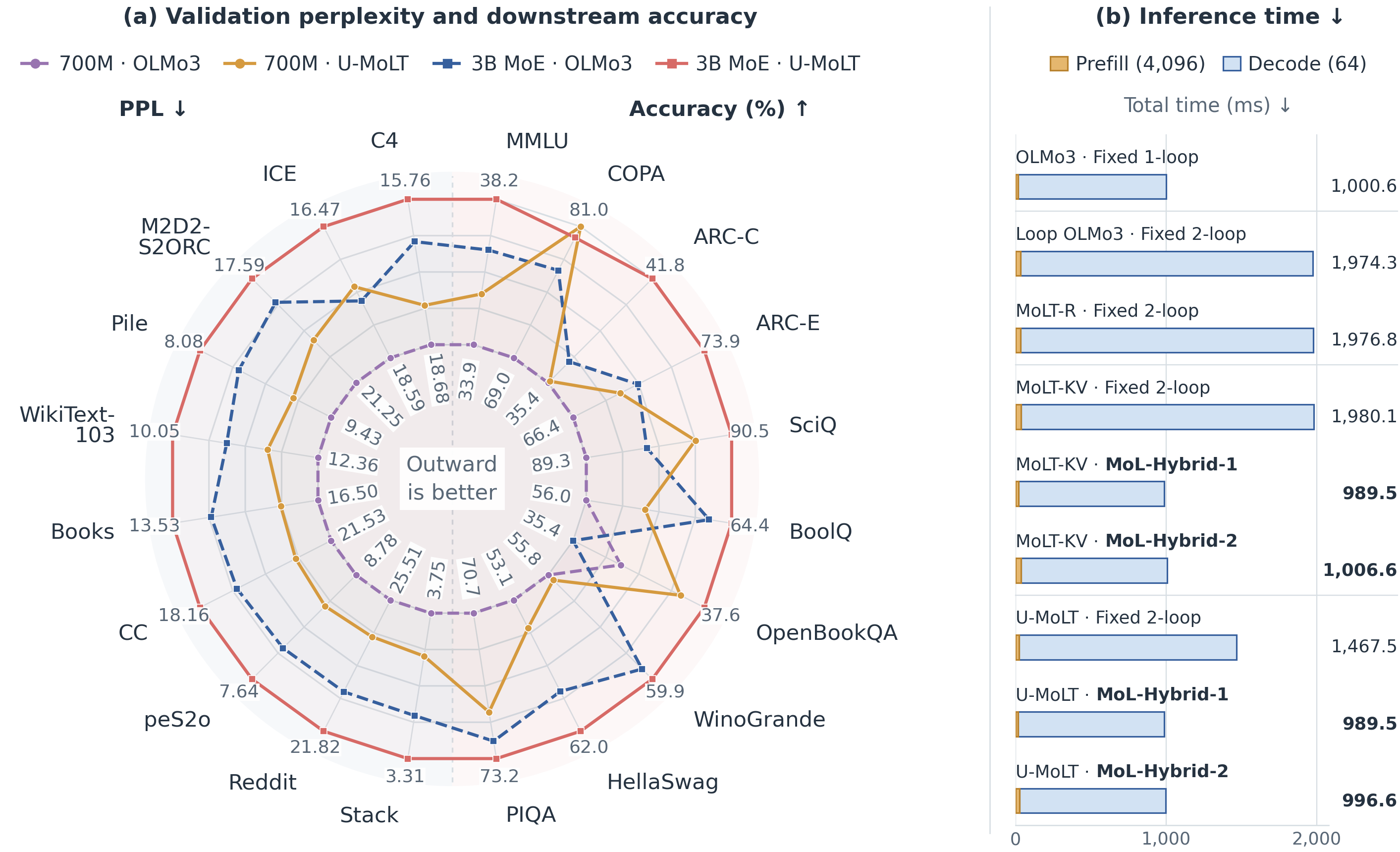
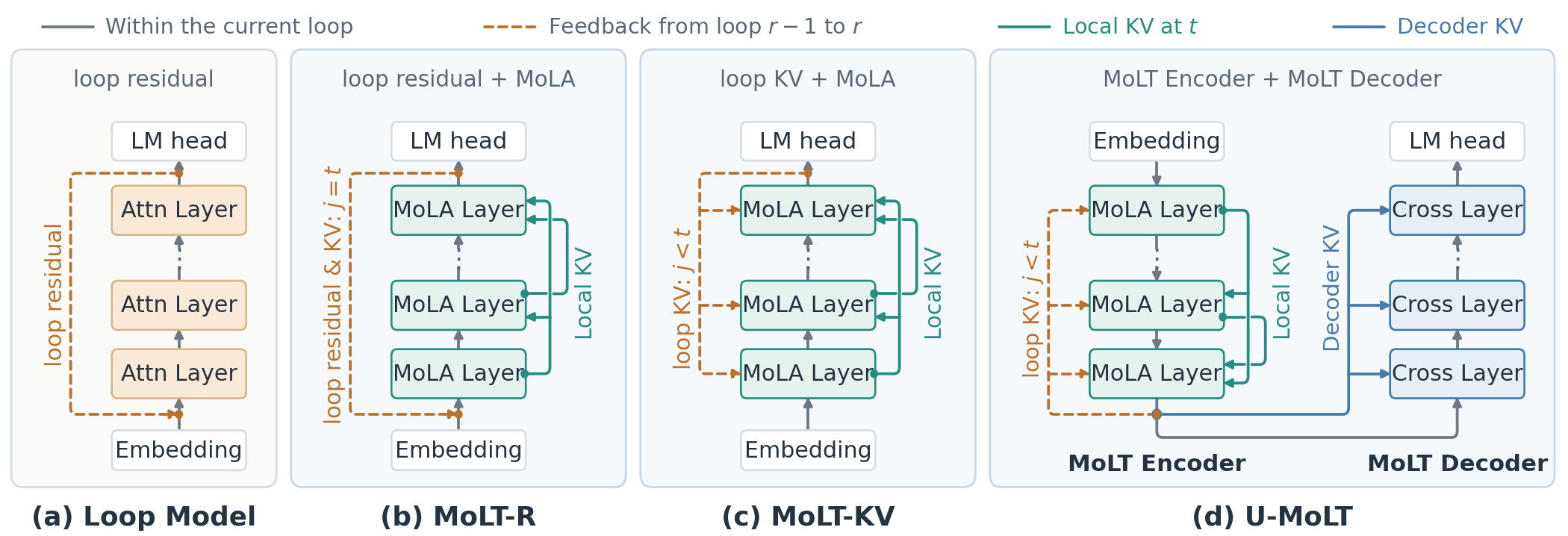
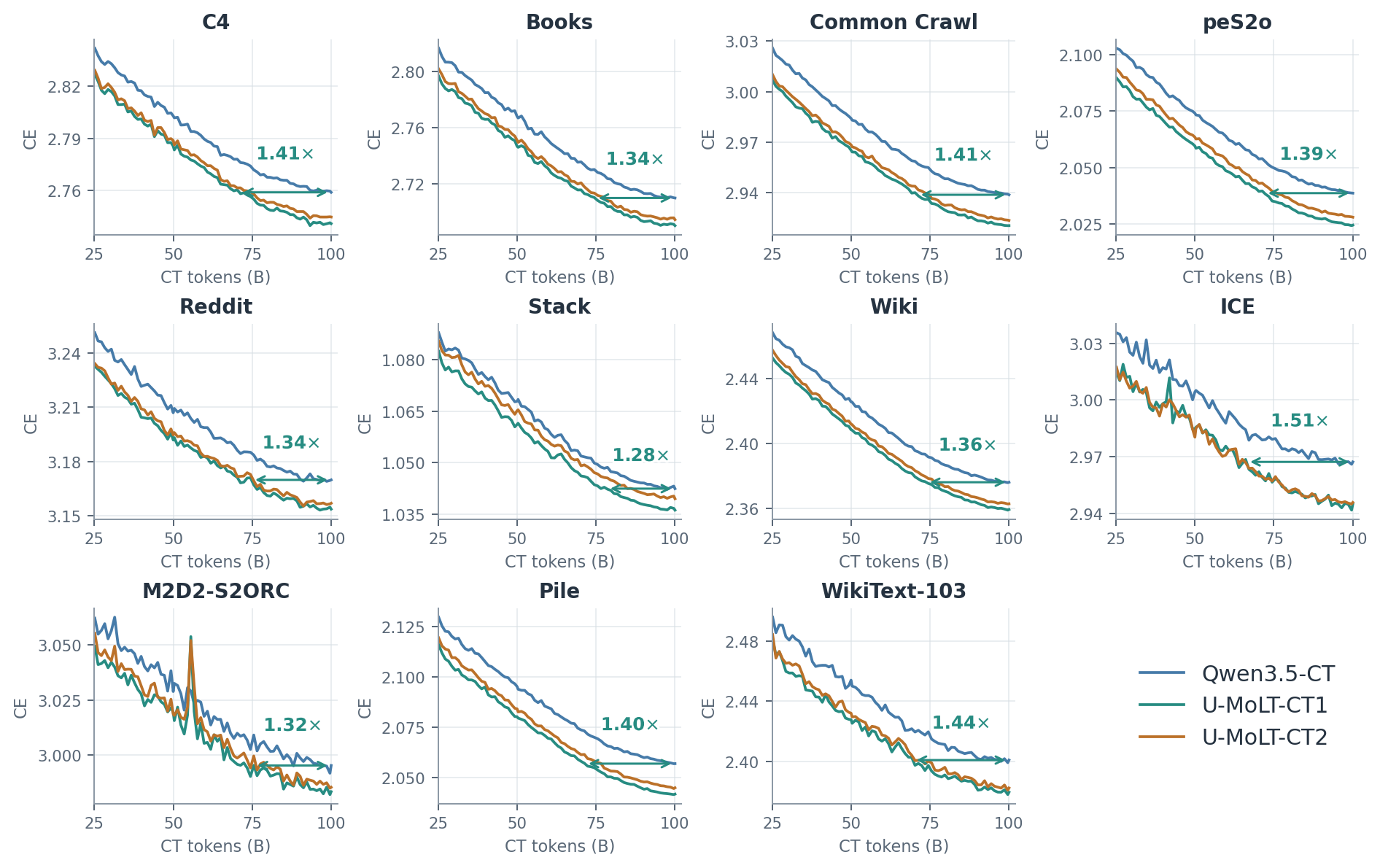
## Abstract Looped Transformers boost expressivity by reusing shared layers across loops, yet at the cost of efficiency. Pushing their expressivity–efficiency frontier requires rethinking the core mechanism connecting adjacent loops: *What should be passed as a Transformer loops?* We introduce **Mixture-of-Loops Transformer (MoLT)**, whose **Mixture-of-Loops Attention (MoLA)** uses keys and values (KV) as memory for selective reuse across depths and loops. Under loop residual, **MoLT-R** retains the residual stream and reads local KV across loops for expressivity. Under loop KV, **MoLT-KV** instead restarts from embeddings and reads current-loop local KV with preceding-loop memory KV at earlier positions for efficiency. MoLT-KV eliminates same-position cross-loop dependence and, paired with **loop forcing** for parallel training, unlocks single-traversal **Mixture-of-Loops (MoL) decoding** beyond the training loop horizon. To balance efficiency and quality, we introduce **U-shaped MoLT (U-MoLT)**, which separates memory construction from prediction readout and skips unused decoder traversals without changing predictions. In 400B-token pretraining, U-MoLT outperforms OLMo3 across 700M/1.5B dense and 3B MoE models, achieving **1.7× validation cross-entropy (CE) token efficiency** at 700M while improving 3B MoE 10-domain perplexity by **0.75** and 10-task accuracy by **2.1 percentage points**. In 100B-token continued pretraining of Qwen3.5-0.8B-Base, our U-MoLT adaptation lowers CE on all 11 domains over the matched baseline with **1.4× mean token efficiency**. At inference, U-MoLT with MoL-Hybrid-2 matches non-looped OLMo3 latency at **996.6 vs. 1,000.6 ms** on S-size (~113M) models.
## Overview & MoLT Family | Variant | Primary Focus | Mechanism & Layout | Inference Profile | Best Suited For | |:-------:|:-------------:|:----------------------:|:-----------------:|:---------------:| | **MoLT-R** | Maximum expressivity | Plain L-layer stack, loop residual, current- & preceding-loop local KV | Fixed N-loop (NL prefill, NL decode, N× persistent KV) | Expressivity-critical or deeper N-loop regimes with zero added parameters | | **MoLT-KV** | Plain-stack efficiency | Plain L-layer stack, embedding restart, loop KV (`j < t`), current-loop local KV | MoL-Hybrid, k ∈ {1, 2} (kL prefill, L decode, 1× persistent KV) | Generation-heavy workloads or plain backbones with less inductive bias | | **U-MoLT** | Balanced efficiency & quality | LE + LD split, loop KV encoder, cross-only decoder with per-layer KV | MoL-Hybrid, k ∈ {1, 2} (kLE prefill, L decode, 1× persistent KV) | General-purpose pure-attention LLMs needing matched prefill and decode cost | ### Attention Visibility Across Loops and Depths
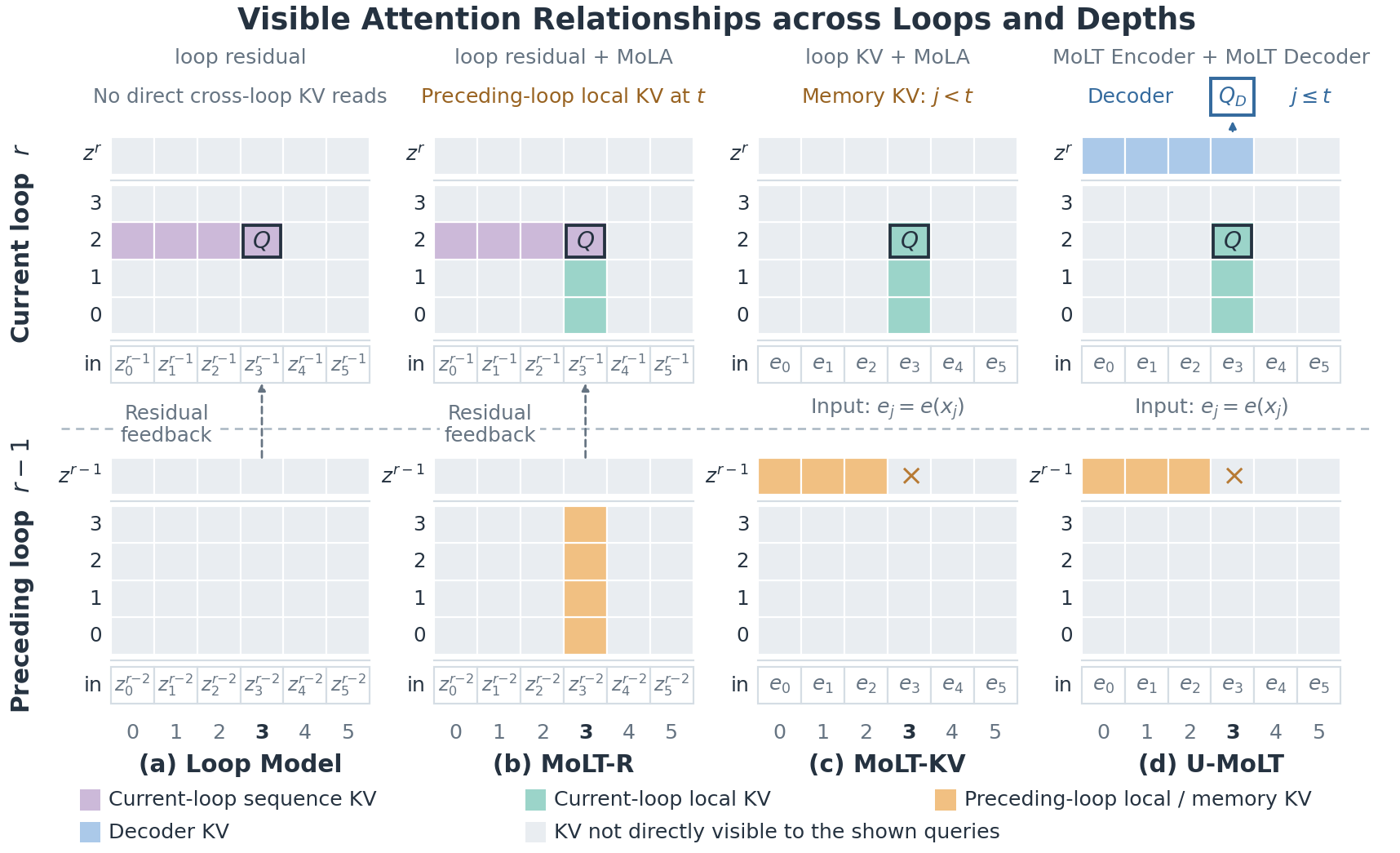
Comparison of visible KV relationships across loops and depths. **(a) Loop Model** carries prior computation only through the residual stream. **(b) MoLT-R** adds direct MoLA reads over current-loop and preceding-loop local KV at token t. **(c) MoLT-KV** restarts from token embeddings and reads strict-prefix memory KV (`j < t`) from loop r − 1 alongside current-loop local KV, eliminating same-position cross-loop dependence. **(d) U-MoLT** pairs a loop KV MoLT Encoder with a causal cross-only MoLT Decoder reading the normalized encoder output (`j <= t`). ### U-MoLT Architecture
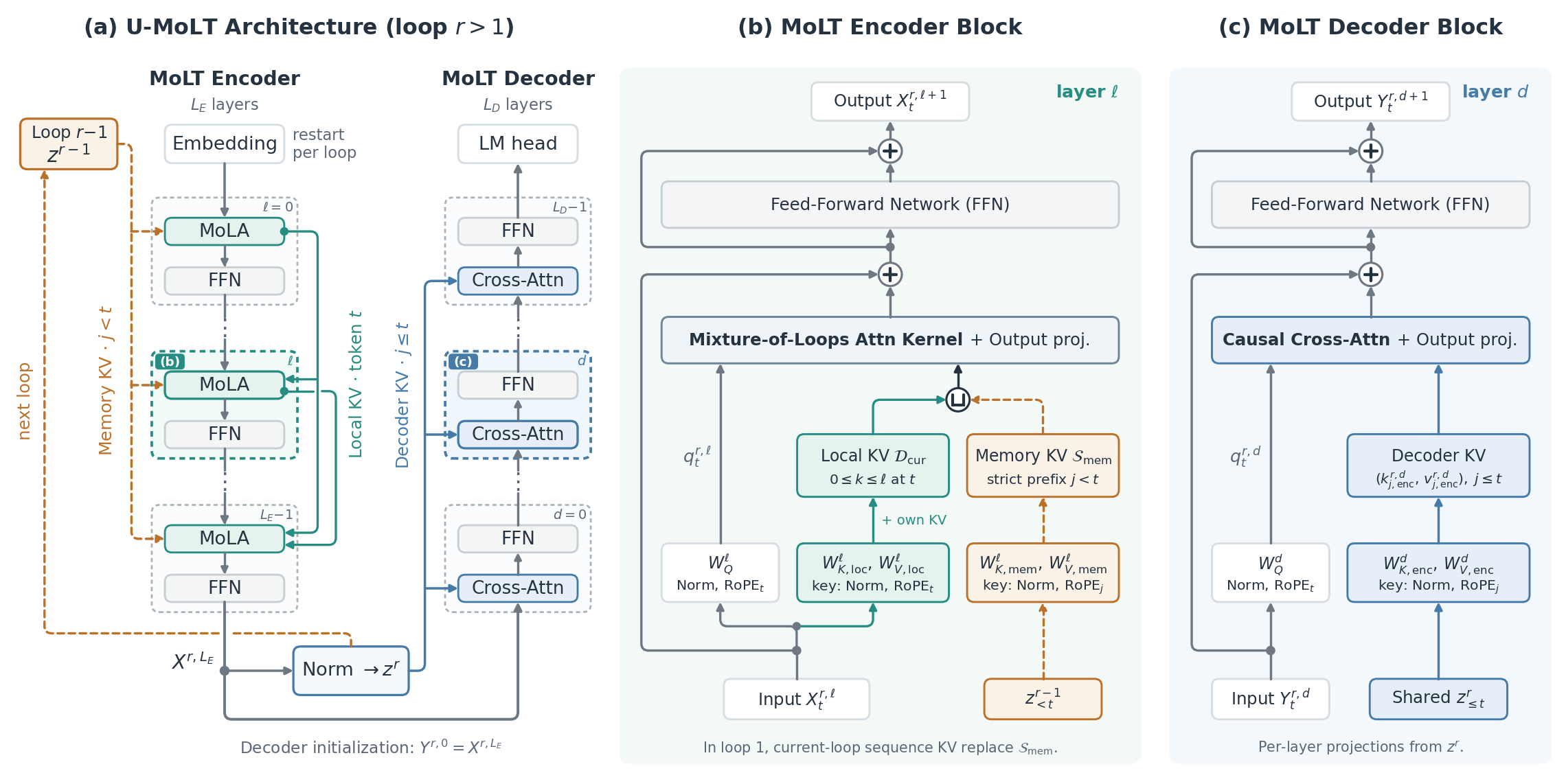
U-MoLT separates memory construction from prediction readout. **(a)** The downward **MoLT Encoder** restarts from token embeddings each loop, while the upward cross-only **MoLT Decoder** starts from the raw encoder output Xr,LE and attends causally to the normalized encoder output zr. **(b)** Each **MoLT Encoder** block jointly attends to current-loop local KV and strict-prefix memory KV (`j < t`) within a single softmax via MoLA. **(c)** Each **MoLT Decoder** block performs causal cross-attention (`j <= t`) with independent per-layer KV projections from zr, allowing intermediate-loop and non-final prompt decoder traversals to be skipped at inference without changing predictions. ## Results ### Downstream Performance (400B tokens, Accuracy %) | Model | PIQA | HellaSwag | WinoGrande | OpenBookQA | BoolQ | SciQ | ARC-E | ARC-C | COPA | MMLU | Avg. ↑ | |:-----:|:----:|:---------:|:----------:|:----------:|:-----:|:----:|:-----:|:-----:|:----:|:----:|:-----------:| | OLMo3-700M | 70.7 | 53.1 | 55.8 | 36.2 | 56.0 | 89.3 | 66.4 | 35.4 | 69.0 | 33.9 | 56.6 | | MoLT-R-700M | **72.5** | **55.8** | **58.0** | 36.2 | **62.0** | **92.5** | **69.6** | **38.1** | 73.0 | 34.3 | **59.2** | | U-MoLT-700M | 72.4 | 55.0 | 56.0 | **37.2** | 59.4 | 90.2 | 69.1 | 35.5 | **81.0** | **35.4** | 59.1 | | OLMo3-1.5B | 73.9 | 59.9 | 58.4 | 37.4 | 63.7 | 91.8 | **74.2** | 40.4 | 76.0 | 36.6 | 61.2 | | U-MoLT-1.5B | **74.8** | **61.8** | **59.0** | **39.0** | **65.7** | **93.0** | **74.2** | **42.1** | **79.0** | **37.0** | **62.6** | | OLMo3-3B MoE (660M active) | 72.9 | 59.3 | 59.5 | 35.4 | 63.1 | 89.8 | 70.1 | 36.7 | 77.0 | 36.7 | 60.1 | | U-MoLT-3B MoE (660M active) | **73.2** | **62.0** | **59.9** | **37.6** | **64.4** | **90.5** | **73.9** | **41.8** | **80.0** | **38.2** | **62.2** | ### Validation Perplexity across 10 Domains (400B tokens, Lower is Better) | Model | C4 | ICE | M2D2-S2ORC | Pile | WikiText-103 | Books | CC | peS2o | Reddit | Stack | Avg. ↓ | |:-----:|:--:|:---:|:----------:|:----:|:------------:|:-----:|:--:|:-----:|:------:|:-----:|:-----------:| | OLMo3-700M | 18.68 | 18.59 | 21.25 | 9.43 | 12.36 | 16.50 | 21.53 | 8.78 | 25.51 | 3.75 | 15.64 | | MoLT-R-700M | **17.82** | 17.59 | 19.77 | **9.04** | 11.70 | **15.63** | **20.53** | 8.47 | **24.26** | 3.63 | **14.84** | | U-MoLT-700M | 17.89 | **17.44** | **19.75** | **9.04** | **11.56** | 15.74 | 20.62 | **8.44** | 24.48 | **3.62** | 14.86 | | OLMo3-1.5B | 16.53 | 16.72 | 18.75 | 8.49 | 10.62 | 14.23 | 19.05 | 7.94 | 22.77 | 3.45 | 13.86 | | U-MoLT-1.5B | **15.81** | **15.52** | **17.77** | **8.11** | **9.92** | **13.50** | **18.16** | **7.63** | **21.71** | **3.34** | **13.15** | | OLMo3-3B MoE (660M active) | 16.61 | 17.67 | 18.42 | 8.48 | 10.91 | 14.32 | 19.11 | 7.98 | 22.93 | 3.44 | 13.99 | | U-MoLT-3B MoE (660M active) | **15.76** | **16.47** | **17.59** | **8.08** | **10.05** | **13.53** | **18.16** | **7.64** | **21.82** | **3.31** | **13.24** | ### Token Efficiency at 700M Scale (400B tokens)
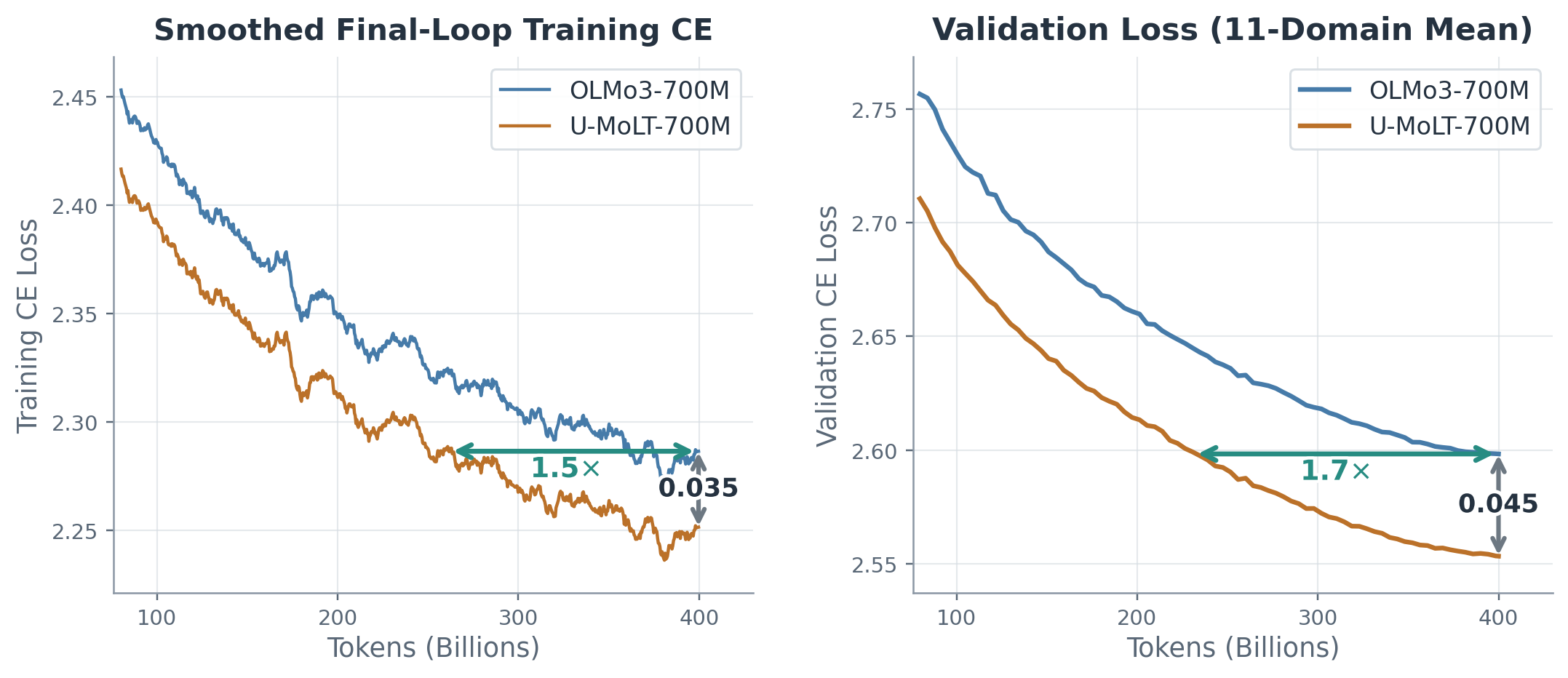
With only **+1.50%** additional parameters, U-MoLT-700M achieves a **1.5×** input-token speedup on smoothed final-loop training CE and a **1.7×** speedup on 11-domain mean validation CE (matching OLMo3's 400B loss at 232.8B tokens, i.e., 41.8% fewer tokens). ### Continued Pretraining on Qwen3.5-0.8B-Base (100B tokens, Validation CE ↓)
| Method | C4 | ICE | M2D2-S2ORC | Pile | WikiText-103 | Books | CC | peS2o | Reddit | Stack | Wiki | Avg. ↓ | |:------:|:--:|:---:|:----------:|:----:|:------------:|:-----:|:--:|:-----:|:------:|:-----:|:----:|:-----------:| | Qwen3.5-CT | 2.759 | 2.967 | 2.995 | 2.057 | 2.401 | 2.710 | 2.939 | 2.039 | 3.170 | 1.042 | 2.376 | 2.496 | | U-MoLT-CT1 | **2.741** | **2.945** | **2.983** | **2.042** | **2.380** | **2.690** | **2.920** | **2.025** | **3.154** | **1.036** | **2.359** | **2.480** | | U-MoLT-CT2 | 2.745 | 2.946 | 2.985 | 2.045 | 2.383 | 2.694 | 2.923 | 2.028 | 3.157 | 1.040 | 2.363 | 2.483 | ### Inference Latency (S-size ~113M, Prompt Prefill + 64 Decoding Steps, in seconds) | Method | Schedule | Prefill (128) | Decode (128) | Total (128) | Prefill (4,096) | Decode (4,096) | Total (4,096) | |:------:|:--------:|:-------------:|:------------:|:-----------:|:---------------:|:--------------:|:-------------:| | OLMo3 | Fixed 1-loop | 0.0129 | 0.9776 | 0.9905 | 0.0181 | 0.9825 | 1.0006 | | Loop OLMo3 | Fixed 2-loop | 0.0245 | 1.9617 | 1.9862 | 0.0347 | 1.9396 | 1.9743 | | MoLT-R | Fixed 2-loop | 0.0256 | 1.8707 | 1.8963 | 0.0356 | 1.9412 | 1.9768 | | MoLT-KV | Fixed 2-loop | 0.0297 | 1.8290 | 1.8587 | 0.0362 | 1.9439 | 1.9801 | | MoLT-KV | Mixture-of-Loops | 2.2539 | 0.9370 | 3.1909 | 72.8810 | 0.9592 | 73.8402 | | MoLT-KV | MoL-Hybrid-1 | 0.0161 | 0.9542 | 0.9703 | 0.0193 | 0.9702 | **0.9895** | | MoLT-KV | MoL-Hybrid-2 | 0.0328 | 0.9650 | 0.9978 | 0.0378 | 0.9688 | 1.0066 | | U-MoLT | Fixed 2-loop | 0.0242 | 1.4291 | 1.4533 | 0.0245 | 1.4430 | 1.4675 | | U-MoLT | Mixture-of-Loops | 1.4386 | 0.9509 | 2.3895 | 46.2151 | 0.9633 | 47.1784 | | U-MoLT | MoL-Hybrid-1 | 0.0182 | 0.9674 | 0.9856 | 0.0183 | 0.9712 | **0.9895** | | U-MoLT | MoL-Hybrid-2 | 0.0268 | 0.9675 | 0.9944 | 0.0265 | 0.9701 | 0.9966 | ## Installation The current release provides a minimal, self-contained **U-MoLT** implementation ported onto [BlaGPT](language_tasks/BlaGPT) with zero modifications to upstream BlaGPT files. Requirements for `u_molt.py` and BlaGPT's binary-shard training entry point: - [PyTorch](https://pytorch.org/) >= 2.2 - [coqpit](https://github.com/coqui-ai/Coqpit) == 0.0.17 - [NumPy](https://numpy.org/) ```sh cd language_tasks/BlaGPT python -m pip install -r requirements-umolt.txt ``` > **Note:** Preparing tokenized FineWeb shards using `language_tasks/BlaGPT/data/` may require additional dependencies listed in [`language_tasks/BlaGPT/requirements.txt`](language_tasks/BlaGPT/requirements.txt). ## Quick Start ### Direct PyTorch Usage (Unrolled & Recurrent Inference) Run from `language_tasks/BlaGPT`: ```python import torch from bla_gpt.u_molt import UMoLT, UMoLTConfig config = UMoLTConfig( vocab_size=128, hidden_size=64, num_heads=4, num_kv_heads=2, num_encoder_layers=2, num_decoder_layers=2, intermediate_size=128, block_size=64, sequence_length=64, ) model = UMoLT(config) tokens = torch.randint(0, config.vocab_size, (2, 17)) inputs, targets = tokens[:, :-1], tokens[:, 1:] logits, loss = model(inputs, targets) loss.backward() model.eval() with torch.no_grad(): # Fixed two-loop unrolling (parallel over the full prefix) full = model.forward_unrolled(inputs, num_loops=2) generated = model.generate(inputs[:1], 8, temperature=0, schedule="unrolled") # Token-ordered recurrence (single encoder + decoder traversal per token) recurrent_logits, state = model.forward_recurrent(inputs) next_token = torch.randint(0, config.vocab_size, (2, 1)) next_logits, state = model.recurrent_step(next_token, state) ``` ### Training U-MoLT on [BlaGPT](language_tasks/BlaGPT) Run from `language_tasks/BlaGPT` (requires CUDA/NCCL and tokenized FineWeb `.bin` shards configured in `configs/umolt_s.json`): ```sh cd language_tasks/BlaGPT torchrun --standalone --nproc_per_node=1 bla_gpt/train.py \ --model_name umolt \ --config configs/umolt_s.json \ --run_name umolt_s ``` [`configs/umolt_s.json`](language_tasks/BlaGPT/configs/umolt_s.json) reproduces paper **Table 2, method (26)**: S-size U-MoLT (6+6 layers, 768 hidden, 12/3 GQA, sparse Loop KV & MoLA at layers `[0, 2, 4]`, full current-loop cross-layer depth history, `detach_loop_memory=false`, 1:1 loop loss weights) trained on 3B tokens (`5,722` iterations, `batch_size=512`, Muon `lr=1e-3`, `seed=11`). Adjust `--nproc_per_node` (e.g. `8`) for multi-GPU training. ### Testing the Fused MoLA Triton Kernel ```sh cd language_tasks/BlaGPT python -m pytest tests/test_mola_triton.py ``` > **Note:** `mola_backend="auto"` (default) uses PyTorch FlashAttention + Triton ([`libs/mola_triton`](libs/mola_triton/__init__.py)) on supported NVIDIA GPUs (sm80+, BF16/FP16) for parallel encoder passes, and falls back to eager PyTorch on CPU, FP32, or token-ordered cached inference. See [`language_tasks/BlaGPT/README_UMOLT.md`](language_tasks/BlaGPT/README_UMOLT.md) for full implementation notes, API semantics, and multi-GPU constraints. ## Repository Structure ```text MoLT/ ├── Mixture-of-Loops Transformer.pdf # Paper PDF ├── assets/ # Figures for README ├── libs/ │ └── mola_triton/ │ └── __init__.py # Fused FlashAttention + Triton MoLA kernel └── language_tasks/ └── BlaGPT/ ├── README_UMOLT.md # Detailed U-MoLT implementation & usage guide ├── UMOLT_UPSTREAM.json # Pinned upstream BlaGPT commit metadata ├── requirements-umolt.txt # Minimal U-MoLT dependencies ├── bla_gpt/ │ └── u_molt.py # Self-contained U-MoLT model & BlaGPT registration ├── configs/ │ └── umolt_s.json # Paper Table 2 (26): 6+6 U-MoLT-S, sparse [0, 2, 4], Muon 3B └── tests/ └── test_mola_triton.py # CUDA unit tests for fused MoLA forward/backward & dispatch ``` ## Acknowledgement :heart: This project builds on [BlaGPT](https://github.com/erogol/BlaGPT), [OLMo](https://github.com/allenai/OLMo), [Qwen3](https://github.com/QwenLM/Qwen3), and our prior work [Mixture-of-Depths Attention (MoDA)](https://github.com/hustvl/MoDA) ([paper](https://arxiv.org/abs/2603.15619)). Thanks for their wonderful works. ## Citation If you find MoLT useful in your research or applications, please consider giving us a star :star: and citing it with the following BibTeX entry. ```bibtex @article{zhu2026molt, title = {Mixture-of-Loops Transformer}, author = {Zhu, Lianghui and Wang, Shijie and Wang, Xinggang and Bai, Jinze and Wang, Bo and Bai, Xiang}, year = {2026} } ```