SkillHub
An enterprise-grade, open-source agent skill registry — publish, discover, and manage reusable skill packages across your organization.
[](https://deepwiki.com/iflytek/skillhub)
[](https://zread.ai/iflytek/skillhub)
[](https://discord.gg/qHYvtDNPHS)
[](./LICENSE)
[](https://github.com/iflytek/skillhub/actions/workflows/publish-images.yml)
[](https://ghcr.io/iflytek/skillhub)
[](https://openjdk.org/projects/jdk/21/)
[](https://react.dev)
[English](./README.md) | [中文](./README_zh.md)
---
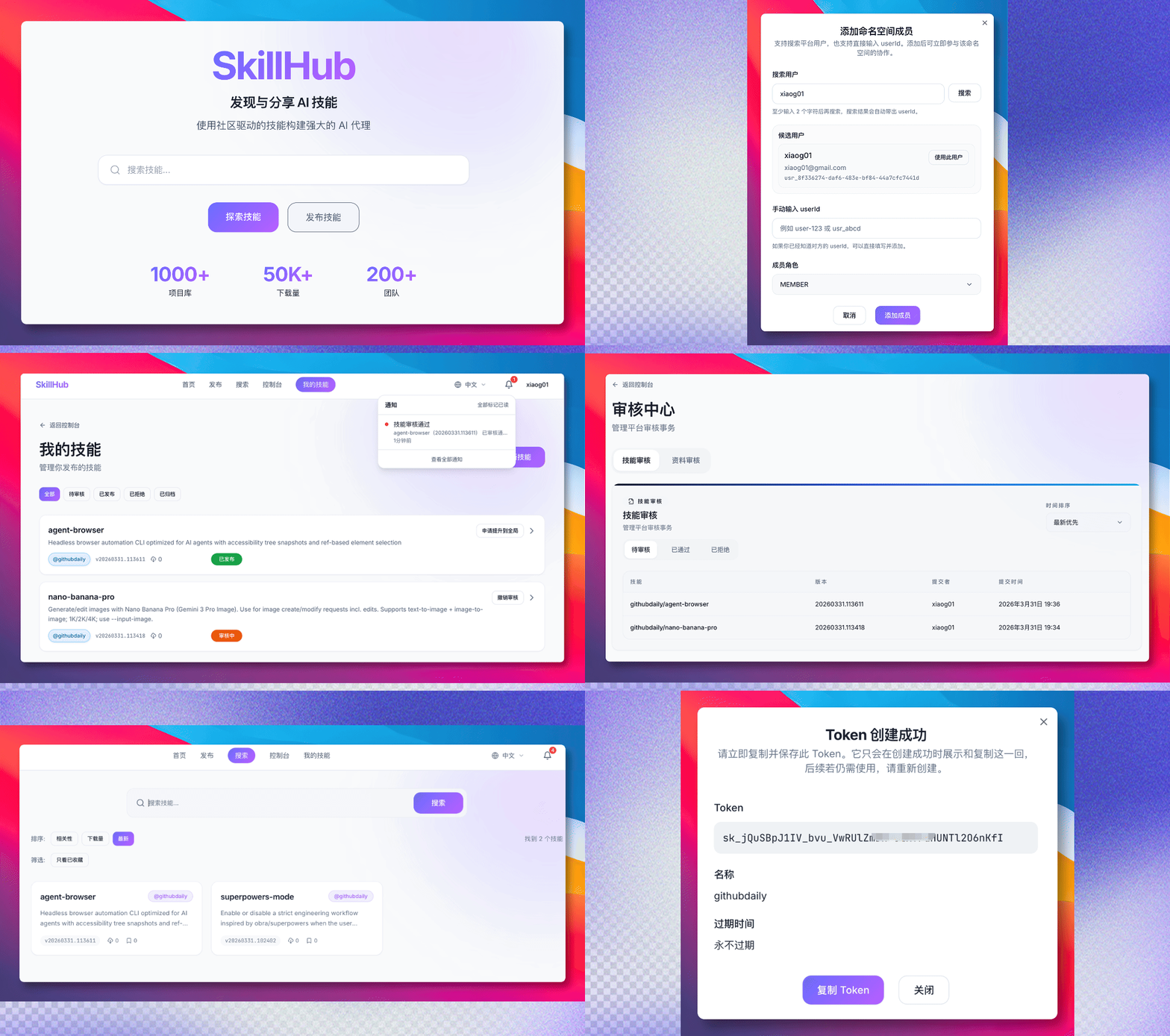
SkillHub is a self-hosted platform that gives teams a private,
governed place to share agent skills. Publish a skill package, push
it to a namespace, and let others find it through search or
install it via CLI. Built for on-premise deployment behind your
firewall, with the same polish you'd expect from a public registry.
## Documentation
- 📖 **[User Guide](https://iflytek.github.io/skillhub/)** — Skill publishing, search, CLI usage and other user guides
- 🛠️ **[Developer Docs](https://zread.ai/iflytek/skillhub)** — Architecture, API reference, local development, deployment and operations
## Highlights
- **Self-Hosted & Private** — Deploy on your own infrastructure.
Keep proprietary skills behind your firewall with full data
sovereignty. One `make dev-all` command to get running locally.
- **Publish & Version** — Upload agent skill packages with semantic
versioning, custom tags (`beta`, `stable`), and automatic
`latest` tracking.
- **Discover** — Full-text search with filters by namespace,
downloads, ratings, and recency. Visibility rules ensure
users only see what they're authorized to.
- **Team Namespaces** — Organize skills under team or global scopes.
Each namespace has its own members, roles (Owner / Admin /
Member), and publishing policies.
- **Review & Governance** — Team admins review within their namespace;
platform admins gate promotions to the global scope. Governance
actions are audit-logged for compliance.
- **Social Features** — Star skills, rate them, and track downloads.
Build a community around your organization's best practices.
- **Account Merging** — Consolidate multiple OAuth identities and
API tokens under a single user account.
- **API Token Management** — Generate scoped tokens for CLI and
programmatic access with prefix-based secure hashing.
- **CLI-First** — Native REST API plus a compatibility layer for
existing ClawHub-style registry clients. Native CLI APIs are the
primary supported path while protocol compatibility continues to
expand.
- **Pluggable Storage** — Local filesystem for development, S3 /
MinIO for production. Swap via config.
- **Internationalization** — Multi-language support with i18next.
## Quick Start
Start the full local stack with:
```bash
rm -rf /tmp/skillhub-runtime
curl -fsSL https://imageless.oss-cn-beijing.aliyuncs.com/runtime.sh | sh -s -- up
```
The default command pulls the `latest` stable release images. Use `--version edge` if you want the newest build from `main`.
**Configure public URL (recommended for production):**
```bash
curl -fsSL https://imageless.oss-cn-beijing.aliyuncs.com/runtime.sh | sh -s -- up --public-url https://skillhub.your-company.com
```
The `--public-url` parameter sets the public access URL for your SkillHub instance. This ensures:
- CLI install commands show the correct registry URL
- Agent setup instructions display the correct skill.md URL
- OAuth callbacks and device auth links work properly
**For users in China (Aliyun mirror):**
```bash
curl -fsSL https://imageless.oss-cn-beijing.aliyuncs.com/runtime.sh | sh -s -- up --aliyun --public-url https://skillhub.your-company.com --version latest
```
If deployment runs into problems, clear the existing runtime home and retry.
## SkillHub CLI
Install and manage Agent skills from the command line:
```bash
# Install CLI
npm install -g @astron-team/skillhub
# Or run directly
npx @astron-team/skillhub@latest version
# Login
skillhub login --token sk_xxx --registry https://skill.xfyun.cn
# Search and install skills
skillhub search pdf
skillhub install pdf-parser --agent codex
# List installed skills
skillhub list
```
📖 Full guide: [docs/skillhub/en/guide/cli.md](docs/skillhub/en/guide/cli.md)
### Prerequisites
- Docker & Docker Compose
### Local Development
```bash
make dev-all
```
> **For developers in China**: If Maven dependency download times out, configure Aliyun mirror. See [Local Development Guide](https://iflytek.github.io/skillhub/quickstart.html#本地开发) for details.
Then open:
- Web UI: `http://localhost:3000`
- Backend API: `http://localhost:8080`
By default, `make dev-all` starts the backend with the `local` profile.
In that mode, local development keeps the mock-auth users below and also
creates a password-based bootstrap admin account by default:
- `local-user` for normal publishing and namespace operations
- `local-admin` with `SUPER_ADMIN` for review and admin flows
Use them with the `X-Mock-User-Id` header in local development.
The local bootstrap admin is enabled by default in `application-local.yml`:
- username: `admin`
- password: `ChangeMe!2026`
- To disable it, set `BOOTSTRAP_ADMIN_ENABLED=false` before starting the backend.
Stop everything with:
```bash
make dev-all-down
```
Reset local dependencies and start from a clean slate with:
```bash
make dev-all-reset
```
Run `make help` to see all available commands.
Useful backend commands:
```bash
make test
make test-backend-app
make build-backend-app
```
Do not run `./mvnw -pl skillhub-app clean test` directly under `server/`.
`skillhub-app` depends on sibling modules in the same repo, and a standalone clean build
can fall back to stale artifacts from the local Maven repository, which surfaces misleading
`cannot find symbol` and signature-mismatch errors. Use `-am`, or the `make test-backend-app`
and `make build-backend-app` targets above.
For the full development workflow (local dev → staging → PR), see [docs/dev-workflow.md](docs/dev-workflow.md).
### API Contract Sync
OpenAPI types for the web client are checked into the repository.
When backend API contracts change, regenerate the SDK and commit the
updated generated file:
```bash
make generate-api
```
For a stricter end-to-end drift check, run:
```bash
./scripts/check-openapi-generated.sh
```
This starts local dependencies, boots the backend, regenerates the
frontend schema, and fails if the checked-in SDK is stale.
### Container Runtime
Published runtime images are built by GitHub Actions and pushed to GHCR.
This is the supported path for anyone who wants a ready-to-use local
environment without building the backend or frontend on their machine.
Published images target both `linux/amd64` and `linux/arm64`.
**Quick deployment with curl:**
```bash
# Default (GHCR images)
curl -fsSL https://imageless.oss-cn-beijing.aliyuncs.com/runtime.sh | sh -s -- up --public-url https://skillhub.your-company.com
# Aliyun mirror (recommended for users in China)
curl -fsSL https://imageless.oss-cn-beijing.aliyuncs.com/runtime.sh | sh -s -- up --aliyun --public-url https://skillhub.your-company.com --version latest
```
**Deployment parameters:**
| Parameter | Description | Example |
|-----------|-------------|---------|
| `--public-url ` | Public access URL (recommended) | `--public-url https://skill.example.com` |
| `--version ` | Specific image tag | `--version v0.2.0` |
| `--aliyun` | Use Aliyun mirror (China) | `--aliyun` |
| `--home ` | Runtime directory | `--home /opt/skillhub` |
| `--no-scanner` | Disable security scanner | `--no-scanner` |
> **Important**: Configure `--public-url` for production deployments to ensure CLI install commands and Agent setup instructions display the correct URLs.
**Manual deployment:**
1. Copy the runtime environment template.
2. Pick an image tag.
3. Start the stack with Docker Compose.
```bash
cp .env.release.example .env.release
```
Recommended image tags:
- `SKILLHUB_VERSION=latest` for the latest stable release (default)
- `SKILLHUB_VERSION=edge` for the latest `main` build
- `SKILLHUB_VERSION=vX.Y.Z` for a fixed release
Start the runtime:
```bash
make validate-release-config
docker compose --env-file .env.release -f compose.release.yml up -d
```
Then open:
- Web UI: `SKILLHUB_PUBLIC_BASE_URL` 对应的地址
- Backend API: `http://localhost:8080`
Stop it with:
```bash
docker compose --env-file .env.release -f compose.release.yml down
```
The runtime stack uses its own Compose project name, so it does not
collide with containers from `make dev-all`.
The production Compose stack now defaults to the `docker` profile only.
It does not enable local mock auth. The release template (`.env.release.example`)
enables the bootstrap admin by default, so zero-config quickstart via
`runtime.sh` works out of the box:
- username: `admin`
- password: `ChangeMe!2026`
Recommended production baseline:
- set `SKILLHUB_PUBLIC_BASE_URL` to the final HTTPS entrypoint
- keep PostgreSQL / Redis bound to `127.0.0.1`
- use external S3 / OSS via `SKILLHUB_STORAGE_S3_*`
- change `BOOTSTRAP_ADMIN_PASSWORD` to a strong password (`validate-release-config.sh` rejects the default `ChangeMe!2026`)
- rotate or disable the bootstrap admin after initial setup
- run `make validate-release-config` before `docker compose up -d`
If the GHCR package remains private, run `docker login ghcr.io` before
`docker compose up -d`.
### Upload Allowlist Override
Skill package upload validation uses the default extension allowlist from
[`SkillPackagePolicy.java`](./server/skillhub-domain/src/main/java/com/iflytek/skillhub/domain/skill/validation/SkillPackagePolicy.java).
`SkillPublishProperties` uses that same list by default for
`skillhub.publish.allowed-file-extensions`.
If you need to replace the default allowlist at runtime, set:
```bash
SKILLHUB_PUBLISH_ALLOWED_FILE_EXTENSIONS=.md,.json,.xsd,.xsl,.dtd,.docx,.xlsx,.pptx
```
Spring Boot binds this environment variable to
`skillhub.publish.allowed-file-extensions`. When set, it replaces the default
allowlist instead of appending to it.
### Monitoring
A Prometheus + Grafana monitoring stack lives under [`monitoring/`](./monitoring).
It scrapes the backend's Actuator Prometheus endpoint.
Start it with:
```bash
cd monitoring
docker compose -f docker-compose.monitoring.yml up -d
```
Then open:
- Prometheus: `http://localhost:9090`
- Grafana: `http://localhost:3001` (`admin` / `admin`)
By default Prometheus scrapes `http://host.docker.internal:8080/actuator/prometheus`,
so start the backend locally on port `8080` first.
## Kubernetes
Basic Kubernetes manifests are available under [`deploy/k8s/`](./deploy/k8s):
- `configmap.yaml`
- `secret.yaml.example`
- `backend-deployment.yaml`
- `frontend-deployment.yaml`
- `services.yaml`
- `ingress.yaml`
Apply them after creating your own secret:
```bash
kubectl apply -f deploy/k8s/configmap.yaml
kubectl apply -f deploy/k8s/secret.yaml
kubectl apply -f deploy/k8s/backend-deployment.yaml
kubectl apply -f deploy/k8s/frontend-deployment.yaml
kubectl apply -f deploy/k8s/services.yaml
kubectl apply -f deploy/k8s/ingress.yaml
```
## Smoke Test
A lightweight smoke test script is available at [`scripts/smoke-test.sh`](./scripts/smoke-test.sh).
Run it against a local backend:
```bash
./scripts/smoke-test.sh http://localhost:8080
```
## Architecture
```
┌─────────────┐ ┌─────────────┐ ┌──────────────┐
│ Web UI │ │ CLI Tools │ │ REST API │
│ (React 19) │ │ │ │ │
└──────┬──────┘ └──────┬──────┘ └──────┬───────┘
│ │ │
└───────────────────┼───────────────────┘
│
┌──────▼──────┐
│ Nginx │
└──────┬──────┘
│
┌──────▼──────┐
│ Spring Boot │ Auth · RBAC · Core Services
│ (Java 21) │ OAuth2 · API Tokens · Audit
└──────┬──────┘
│
┌────────────┼────────────┐
│ │ │
┌──────▼───┐ ┌─────▼────┐ ┌────▼────┐
│PostgreSQL│ │ Redis │ │ Storage │
│ 16 │ │ 7 │ │ S3/MinIO│
└──────────┘ └──────────┘ └─────────┘
```
**Backend (Spring Boot 3.2.3, Java 21):**
- Multi-module Maven project with clean architecture
- Modules: app, domain, auth, search, storage, infra
- PostgreSQL 16 with Flyway migrations
- Redis for session management
- S3/MinIO for skill package storage
**Frontend (React 19, TypeScript, Vite):**
- TanStack Router for routing
- TanStack Query for data fetching
- Tailwind CSS + Radix UI for styling
- OpenAPI TypeScript for type-safe API client
- i18next for internationalization
## Usage with Agent Platforms
SkillHub works as a skill registry backend for several agent platforms. Point any of the clients below at your SkillHub instance to publish, discover, and install skills.
### [OpenClaw](https://github.com/openclaw/openclaw)
[OpenClaw](https://github.com/openclaw/openclaw) is an open-source agent skill CLI. Configure it to use your SkillHub endpoint as the registry:
```bash
# Configure registry URL
export CLAWHUB_REGISTRY=https://skillhub.your-company.com
# Authenticate once if needed
clawhub login --token YOUR_API_TOKEN
# Search and install skills
npx clawhub search email
npx clawhub install my-skill
npx clawhub install my-namespace--my-skill
# Publish to global namespace
npx clawhub publish ./my-skill --slug my-skill --version 1.0.0
# Publish to a team namespace such as my-space
npx clawhub publish ./my-skill --slug my-space--my-skill --version 1.0.0
```
`my-space--my-skill` is the canonical compat slug. SkillHub parses it as
namespace `my-space` plus skill slug `my-skill`.
> 💡 **Tip**: The above commands are not only applicable to OpenClaw, but also to other CLI Coding Agents or Agent assistants by specifying the installation directory (`--dir`). For example: `npx clawhub --dir ~/.claude/skills install my-skill`
📖 **[Complete OpenClaw Integration Guide →](./docs/openclaw-integration.md)**
### [AstronClaw](https://agent.xfyun.cn/astron-claw)
[AstronClaw](https://agent.xfyun.cn/astron-claw) is a cloud AI assistant built on OpenClaw's core capabilities, providing 24/7 online service through enterprise platforms like WeChat Work, DingTalk, and Feishu. It features a built-in skill system with over 130 official skills. You can connect it to a self-hosted SkillHub registry to enable one-click skill installation, search repository, dialogue-based automatic installation, and even custom skills management within your organization.
### [Loomy](https://loomy.xunfei.cn/)
[Loomy](https://loomy.xunfei.cn/) is a desktop AI work partner focusing on real office scenarios. It integrates deeply with local files and system tools to build efficient automated workflows for individuals and small teams. By connecting Loomy to your SkillHub registry, you can easily discover and install organization-specific skills to enhance your local desktop automation and productivity.
### [astron-agent](https://github.com/iflytek/astron-agent)
[astron-agent](https://github.com/iflytek/astron-agent) is the iFlytek Astron agent framework. Skills stored in SkillHub can be referenced and loaded by astron-agent, enabling a governed, versioned skill lifecycle from development to production.
---
> 🌟 **Show & Tell** — Have you built something with SkillHub? We'd love to hear about it!
> Share your use case, integration, or deployment story in the
> [**Discussions → Show and Tell**](https://github.com/iflytek/skillhub/discussions/categories/show-and-tell) category.
## Contributing
Contributions are welcome. Please open an issue first to discuss
what you'd like to change.
- Contribution guide: [`CONTRIBUTING.md`](./CONTRIBUTING.md)
- Code of conduct: [`CODE_OF_CONDUCT.md`](./CODE_OF_CONDUCT.md)
## 📞 Support
- 💬 **Community Discussion**: [GitHub Discussions](https://github.com/iflytek/skillhub/discussions)
- 🐛 **Bug Reports**: [Issues](https://github.com/iflytek/skillhub/issues)
- 👾 **Discord**: [Join our Server](https://discord.gg/qHYvtDNPHS)
- 👥 **WeChat Work Group**:

## License
Apache License 2.0