DeepResearch Bench II: Diagnosing Deep Research Agents via Rubrics from Expert Reports
If you like our project, please give us a star ⭐ on GitHub for the latest update.
---
# ✨ News
+ **[Oct 2026] GPT-5.5 Leaderboard Submission and Scoring Update**
- New DeepResearch Bench II submissions are accepted only for the
[GPT-5.5 Eval leaderboard](https://huggingface.co/spaces/muset-ai/DeepResearch-Bench-Leaderboard).
The Gemini 2.5 Eval leaderboard remains available as a historical view.
- Tasks 112 and 114 are temporarily excluded from leaderboard scoring due
to identified issues. Current GPT-5.5 scores average each system's valid
results among the remaining 130 tasks. After expert review and repair,
these two tasks may be included again.
+ **[Aug 2026] 🔄 Official Evaluator Migrated to GPT-5.5**
- Google has scheduled `gemini-2.5-pro` for retirement on Vertex AI on
[October 20, 2026](https://cloud.google.com/vertex-ai/generative-ai/docs/learn/model-versions).
- To keep the official evaluation pipeline reproducible and available, we
have migrated the default evaluator from Gemini 2.5 Pro to
[GPT-5.5](https://developers.openai.com/api/docs/models/gpt-5.5).
- The previous Gemini 2.5 Pro evaluator remains available on the
[`gemini-25`](https://github.com/imlrz/DeepResearch-Bench-II/tree/gemini-25)
branch.
+ **[May 2026] 📜 Per-task License Metadata Added**
- Each entry in `tasks_and_rubrics.jsonl` now includes a `license` field indicating the license of its source article.
- Except for idx=26 and idx=110 (CC BY-NC 4.0) and idx=119 (CC0), all other tasks are derived from CC BY 4.0 sources.
- Updated `DATA_LICENSE`: each task's license now follows its source article individually, rather than applying a blanket CC-BY-NC-4.0 to the entire dataset.
+ **[Feb 24, 2026] 📦 DeepResearch Bench II Dataset Released**
- We have released the [DeepResearch Bench II Dataset](https://huggingface.co/datasets/muset-ai/DeepResearch-Bench-II-Dataset) on Hugging Face, containing articles generated by a subset of the models we evaluated.
+ **[Feb 2026] 🌐 Official Website & Leaderboard Released**
- The official [DeepResearch Bench II Website](https://agentresearchlab.org/benchmarks/deepresearch-bench-ii/index.html#home) is now live!
- Check out the [Leaderboard](https://agentresearchlab.org/benchmarks/deepresearch-bench-ii/index.html#leaderboard) to see how SOTA deep research agents compare across 9,430 expert-written rubrics.
- 🎯 **Welcome to submit your model!** See the [submission requirements](#-submit-to-leaderboard) and contact us at imlrz@mail.ustc.edu.cn or dumingxuan@mail.ustc.edu.cn.
+ **[Jan 2026] 📄 Paper Released on arXiv**
- Our paper is now available on [arXiv (2601.08536)](https://arxiv.org/abs/2601.08536).
+ **[Nov 2025] 🎉 DeepResearch Bench II Evaluation Pipeline Released**
- The initial official evaluation pipeline for **DeepResearch Bench II** used Gemini 2.5 Pro with fine-grained, verifiable rubrics derived from expert-written research reports.
- It supported **multimodal inputs** (PDF/DOCX/images/text) and **batched rubric-based evaluation** for information recall, analysis, and presentation.
For complete experimental results, model comparisons, and ablation studies, please refer to the main paper (`paper/main.pdf`).
---
## 📖 Overview
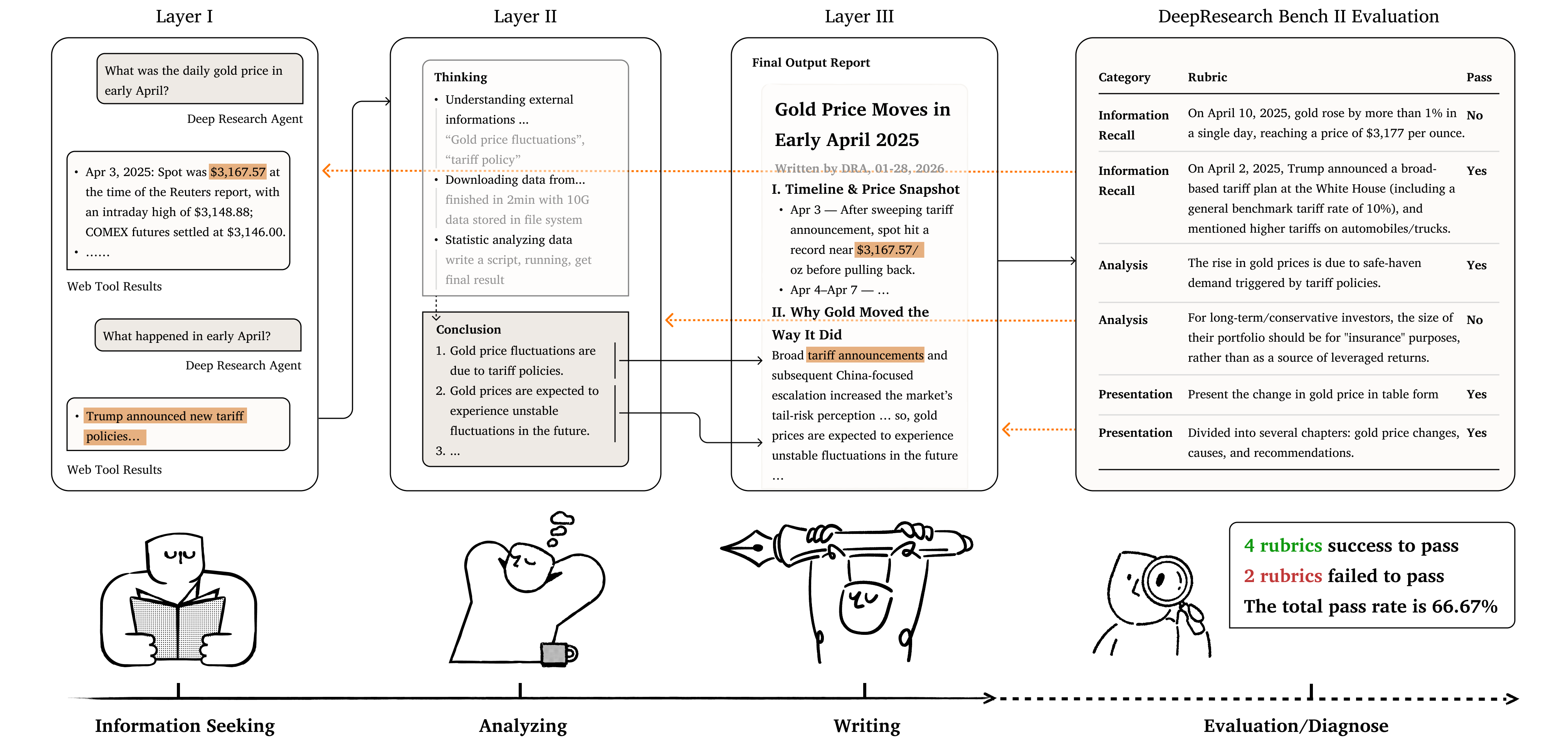
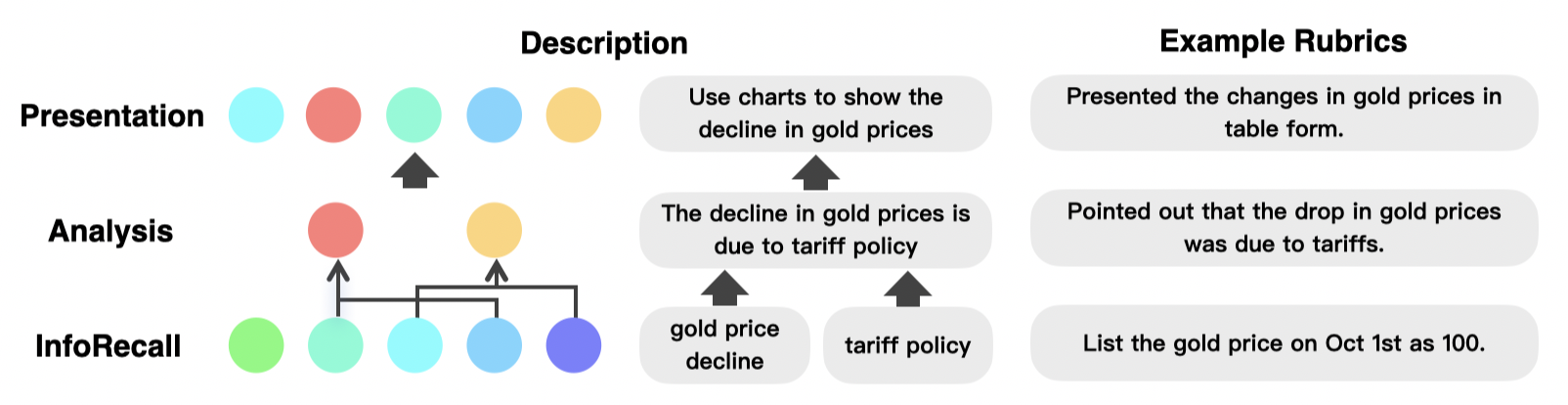
DeepResearch Bench II addresses key limitations of existing deep research benchmarks by combining:
- **Real-world, expert-authored research reports** as the grounding signal.
- **Fine-grained, fully verifiable rubrics** that do not rely on the judge model’s internal domain knowledge.
- **Three core dimensions** of deep research quality:
- 🔍 **Information Recall** – Can the agent identify, retrieve, and cross-check all key information needed to answer the task?
- 🧠 **Analysis** – Can the agent synthesize retrieved information into higher-level conclusions and insights?
- 📝 **Presentation** – Can the agent present the information in a structured, readable, and easily verifiable way?
This repository (`DeepResearch-Bench-II`) contains a **lightweight evaluation pipeline** that:
- Takes model-generated research reports (DOCX/Markdown),
- Uses `tasks_and_rubrics.jsonl` to load **task descriptions and rubrics**, and
- Invokes GPT-5.5 to **score each rubric item** in batches, producing:
- Per-task, per-dimension rubric scores, and
- Aggregated CSVs summarizing model performance.
---
## Benchmark Construction
### Topic and Task Design
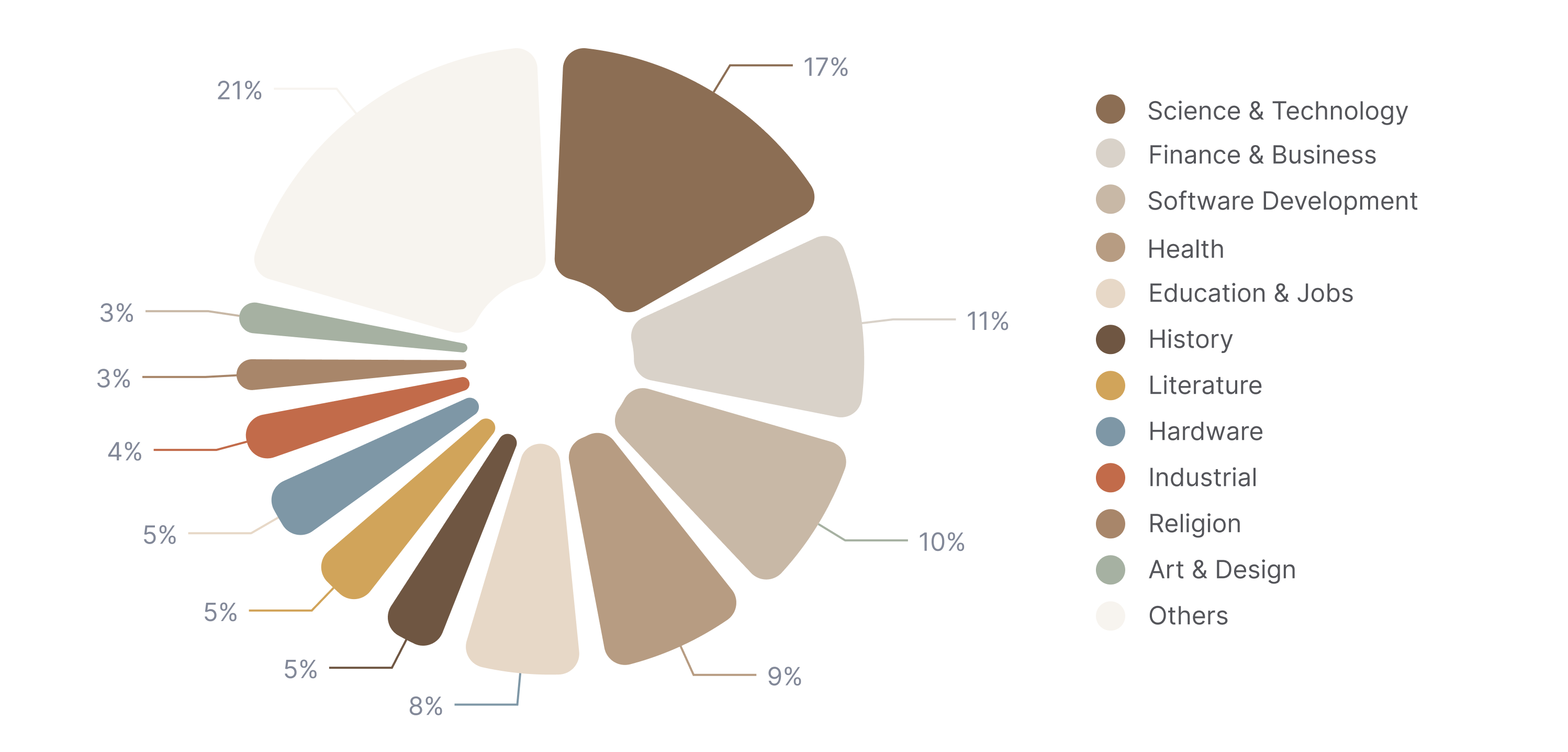
DeepResearch Bench II is built on top of the original **DeepResearch Bench** topic distribution and task design:
- We start from **real-world user queries** and task themes collected in the original benchmark.
- For each seed task, we search for **expert-written review reports** addressing similar research questions in:
- Reputable journals and top conferences,
- High-quality institutional or governmental reports.
These source reports are:
- Written by domain experts over weeks or months,
- Validated by reviewers, editors, and the broader community,
- Released under **CC-BY-4.0** / **CC-BY-4.0-NC** licenses.
After license filtering and quality screening, we retain **132 expert-authored reports**, which become the basis for:
- Task formulations, and
- Ground-truth, expert-aligned rubrics.
### Rubric Design from Expert Articles
From each expert article, we construct:
- One or more **deep research tasks** that require both information collection and analysis.
- A set of **binary rubrics** decomposed across the three dimensions:
- Information Recall,
- Analysis,
- Presentation.
Each rubric is:
1. **Essential** – captures information necessary to correctly answer the task.
2. **Atomic** – checks a single fact or inference; complex points are split into smaller rubrics.
3. **Content-bearing** – encodes the actual answer, not just a vague topic (e.g., “states that X increased from A to B between years Y and Z”).
4. **Numerically precise** – numerical rubrics explicitly specify values and tolerated error ranges.
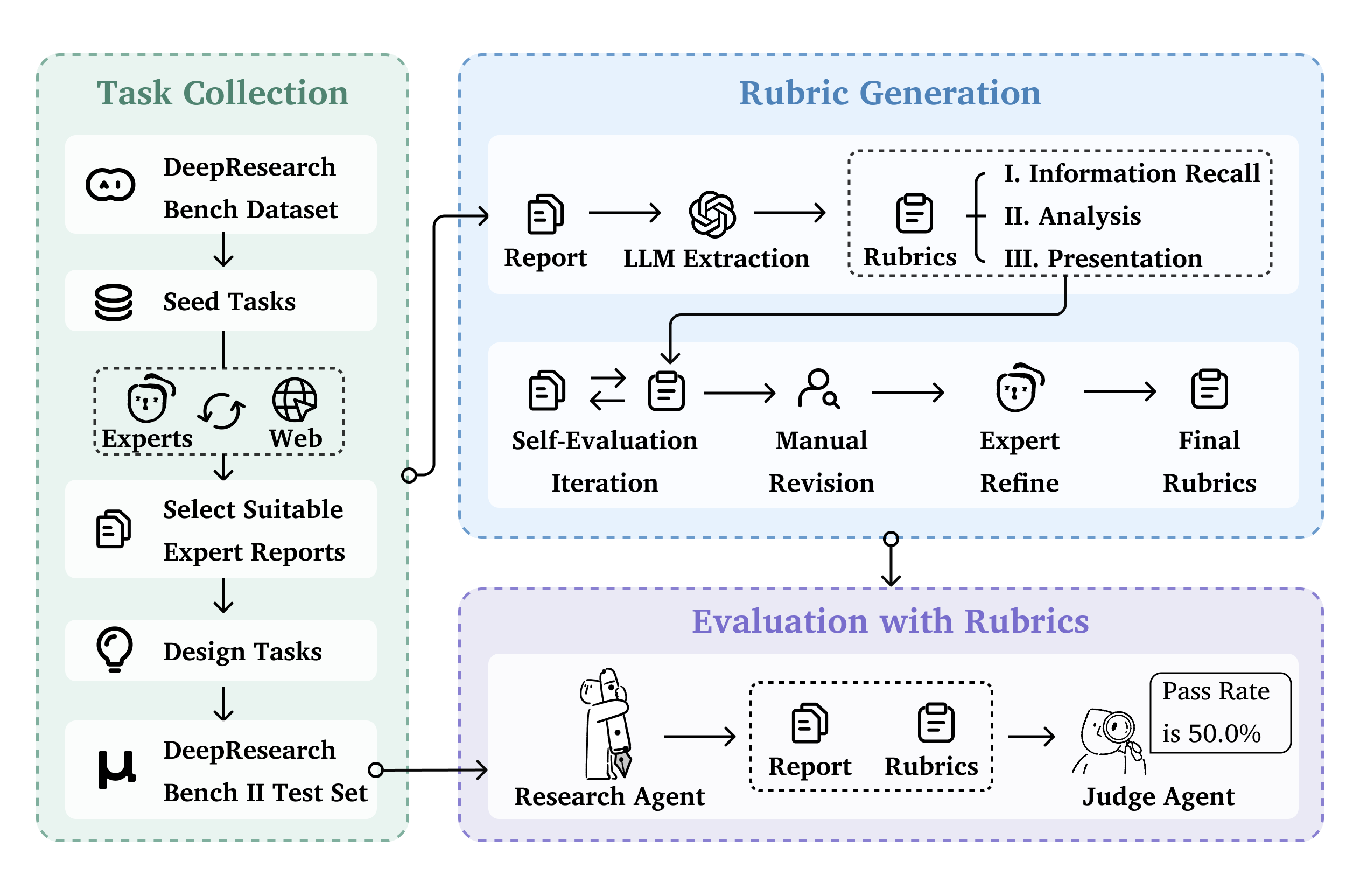
Rubrics are built through a four-stage pipeline:
1. **LLM extraction** from expert articles, guided by carefully designed prompts.
2. **Self-evaluation iteration** – rejecting hallucinated or inconsistent rubrics using the source article as reference.
3. **Manual revision** – human annotators refine wording, remove redundancy, and enforce atomicity.
4. **Expert review & refinement** – domain experts ensure that rubrics faithfully represent the article’s core content.
---
## Evaluation Framework
DeepResearch Bench II uses **LLM-as-judge with verifiable rubrics**:
1. The **task + rubric** are serialized into a structured JSON prompt.
2. The **model report** (DOCX/Markdown) is extracted as text and provided as the passage.
3. GPT-5.5 is prompted to output, for **each rubric item**:
- `score ∈ {1, 0, -1}`,
- `reason`, and
- `evidence` (supporting sentences from the report).
Scoring semantics:
- `1` – rubric satisfied with valid evidence and no use of blocked references,
- `0` – rubric not mentioned at all,
- `-1` – rubric mentioned but evidence relies on explicitly blocked references.
The evaluation pipeline in this repo:
- Handles **text-only inputs**:
- DOCX files are parsed into text and tables (Markdown); embedded images are ignored.
- Markdown files are loaded as plain text.
- Supports **batched evaluation**:
- Rubric items are split into batches of size `CHUNK_SIZE` (default 50).
- Each batch is evaluated independently; results are merged and re-grouped by dimension.
- Aggregates **token usage statistics**:
- Per batch (`usageMetadata`),
- Per file, and
- Per model across the whole run.
### Evaluator consistency study
We compared three candidate evaluators against human annotations on the same
10 reports, covering 738 matched rubric-level judgments. All evaluators used
the same task definitions, rubric items, three-way labels, and evaluation
prompt.
| Evaluator | 3-way accuracy | Cohen's κ | Info recall | Analysis | Presentation | Task-level Pearson r | Reported tokens |
|---|---:|---:|---:|---:|---:|---:|---:|
| **GPT-5.5** | **91.19%** | **0.7993** | 92.10% | **87.69%** | **90.20%** | **0.9587** | **328,333** |
| Gemini 3.1 Pro Preview | 91.06% | 0.7896 | **92.46%** | 85.38% | **90.20%** | 0.8689 | 440,459 |
| Claude Opus 4.8 | 83.33% | 0.6479 | 84.56% | 77.69% | 84.31% | 0.8376 | 428,222 |
GPT-5.5 achieved the highest overall exact-match accuracy, Cohen's κ, and
task-level correlation while using 25.5% fewer reported tokens than Gemini
3.1 Pro Preview. This is a small-scale evaluator agreement study rather than a
leaderboard comparison; token counts cover accepted evaluation outputs.
---
## 📊 Evaluation Results
This repository focuses on the **evaluation pipeline**.
Aggregated scores (per-task, per-dimension, and per-model) can be produced locally via `aggregate_scores.py`.
For full experimental details, including:
- Cross-model comparison,
- Dimension-wise analysis,
- Error cases and ablations,
please refer to the paper (`paper/main.pdf`) and any public leaderboard associated with DeepResearch Bench II.
---
## 🏆 Submit to Leaderboard
New submissions are accepted only for the GPT-5.5 Eval leaderboard. Tasks 112
and 114 are temporarily excluded from official leaderboard scores; the
benchmark dataset still contains all 132 tasks.
To request an official leaderboard entry, contact:
- `imlrz@mail.ustc.edu.cn`
- `dumingxuan@mail.ustc.edu.cn`
Please prepare the following materials:
1. **A working temporary API key with access to GPT-5.5**
- The key is required so that we can reproduce and verify the official
evaluation under the same evaluator configuration.
- It must remain valid and have sufficient quota for the agreed evaluation
window.
- Official OpenAI keys and keys for OpenAI-compatible endpoints are
supported. For a compatible provider, also include the endpoint URL and
exact model name.
- Use a scoped, revocable key intended only for this evaluation, and revoke
it after we confirm that evaluation is complete.
2. **Raw generated reports**
- Provide one `idx-.docx` or `idx-.md` file per task,
following the `report//` layout used by this repository.
3. **Reproducibility information**
- For an open-source model or agent, provide the repository and instructions
needed to reproduce the reports.
- For a closed-source system, provide its product page and/or API link.
4. **Model metadata**
- Model and project names, project link, organization, and open-source
license or proprietary status.
If available, you may also include your local `result.jsonl` and aggregated
CSVs to speed up verification. Official leaderboard scores are recomputed by
the maintainers.
> **API key safety:** Do not commit a key to Git, attach it to a public issue or
> pull request, or include it in the report files. Contact us first by email to
> arrange private transfer of the temporary credential. The key is used only
> for submission verification and evaluation.
---
## 🛠️ Installation
### Prerequisites
- Python **3.9+**
- An OpenAI or OpenAI-compatible API endpoint and key with GPT-5.5 access
---
### 1. Environment configuration (`.env`)
Create a `.env` file in the project root `DeepResearch-Bench-II` to store API configuration and runtime parameters:
```bash
cd DeepResearch-Bench-II
touch .env
vim .env # or use your favorite editor
```
**Required config** (replace with your own values):
```bash
OPENAI_API_URL=https://api.openai.com/v1/chat/completions
OPENAI_API_KEY=your-api-key
OPENAI_MODEL=gpt-5.5
OPENAI_REASONING_EFFORT=medium
OPENAI_MAX_OUTPUT_TOKENS=32768
OPENAI_TIMEOUT=600
PDF_DIR=report
OUT_JSONL=result.jsonl
TASKS_JSONL=tasks_and_rubrics.jsonl
CHUNK_SIZE=50
MAX_WORKERS=10
MAX_RETRIES=5
MAX_PAPER_CHARS=150000
LOG_FILE=run_evaluation.log
```
---
### 2. Install dependencies (supports `uv` / conda)
#### Option A: Use `uv` (recommended)
The project ships with `pyproject.toml`, so you can manage the virtual environment and dependencies via `uv`:
```bash
# Install uv (if not installed)
curl -LsSf https://astral.sh/uv/install.sh | sh
# Create/sync virtual environment and install dependencies
cd DeepResearch-Bench-II
uv sync
```
##### How to check whether `uv` is installed correctly
Run any of the following commands in your terminal:
```bash
# 1. Check version (recommended)
uv --version
# 2. Check executable path
which uv
# 3. Show help
uv --help
```
- If `uv --version` prints something like `uv 0.x.y`, it is installed correctly.
- If you see `command not found` or similar, `uv` is not installed or not on your `PATH`.
#### Option B: Use `conda`
```bash
# Create and activate a conda environment
conda create -n drbench-II python=3.10 -y
conda activate drbench-II
# Install Python dependencies
cd DeepResearch-Bench-II
pip install requests python-docx
```
You can then run all commands inside this conda environment.
---
## Project Structure
```text
DeepResearch-Bench-II/
├── assets/ # Images and figures for README
│ ├── distribution.png
│ ├── intro.png
│ ├── main_result.png
│ └── method.png
├── report/ # Input directory for model-generated reports
│ └── / # Per-model subdirectories
│ ├── idx-1.docx # Model output for task 1
│ ├── idx-2.md # Model output for task 2
│ └── ...
├── gpt_client.py # OpenAI-compatible GPT-5.5 API client
├── run_evaluation.py # Main evaluation script (batched rubric scoring logic)
├── aggregate_scores.py # Score aggregation utility (produces CSV summaries)
├── tasks_and_rubrics.jsonl # Tasks and rubrics (132 expert-derived tasks)
├── pyproject.toml # Dependency management (uv / pip / conda)
├── .env_example # Example configuration file
├── .env # Local configuration (user-created, ignored by Git)
├── .gitignore # Git ignore rules
└── README.md # This documentation
```
> **Note**: Place DOCX or Markdown reports under `report//idx-*.docx|md`.
> The subdirectory name becomes the model identifier in output files.
---
## Quick Start
### 1. Prepare your model outputs
Organize your model-generated reports under `report` with the following structure:
```text
report/
├── ModelA/
│ ├── idx-1.docx
│ ├── idx-2.docx
│ └── ...
└── ModelB/
├── idx-1.md
├── idx-2.md
└── ...
```
- Subdirectory name = **model name** (used in output JSONL).
- File name pattern = `idx-.` where `` is `docx` or `md`.
### 2. Run the evaluator
#### Run via `uv` (recommended)
```bash
cd DeepResearch-Bench-II
uv run python run_evaluation.py
```
#### Run directly with `python`
```bash
cd DeepResearch-Bench-II
# Use configuration from .env
python run_evaluation.py
# Or override configuration via CLI arguments
python run_evaluation.py \
--pdf_dir grok \
--out_jsonl result.jsonl \
--chunk_size 50
```
This produces a JSONL file where each line has the form:
```json
{"model": "ModelA", "idx": 1, "result": {...}}
```
### 3. Aggregate scores
After you have a merged JSONL of evaluation results (e.g., `merged.jsonl`), run:
```bash
python aggregate_scores.py \
--input result.jsonl \
--tasks-file tasks_and_rubrics.jsonl
```
This will generate multiple CSVs:
- `agg_scores_inforecall.csv`
- `agg_scores_analysis.csv`
- `agg_scores_presentation.csv`
- `agg_scores_total.csv`
- `agg_scores_blocked.csv`
Each CSV summarizes model performance by task (`idx`), including:
- Per-dimension scores,
- Overall averages,
- Blocked-rate statistics.
---
## 📜 License
This project uses a dual-license structure:
- **Code** (evaluation pipeline, scripts, utilities): [Apache License 2.0](LICENSE)
- **Data** (tasks, rubrics, and annotations): Per-task license follows the source article (see [DATA_LICENSE](DATA_LICENSE))
The data in this benchmark is derived from expert-authored reports released under CC-BY-4.0 / CC-BY-NC-4.0 / CC0 licenses. Each entry in `tasks_and_rubrics.jsonl` carries a `license` field that records the license of its corresponding source article:
| License | Count | Tasks (by idx) |
|---------|-------|----------------|
| CC BY 4.0 | 129 | All except those listed below |
| CC BY-NC 4.0 | 2 | idx=26, idx=110 |
| CC0 | 1 | idx=119 |
Accordingly, each task's rubrics and descriptions inherit the license of their source article. For the 129 CC BY 4.0 tasks, commercial use is permitted with attribution; for idx=26 and idx=110 (CC BY-NC 4.0), commercial use is not permitted.
If you use this benchmark in academic research, you are free to do so under all applicable licenses. Commercial use of the **code** is always permitted. Commercial use of the **data** depends on the per-task license — check the `license` field in `tasks_and_rubrics.jsonl`.
---
## Acknowledgements
DeepResearch Bench II builds on the ideas and infrastructure of **DeepResearch Bench** and related benchmarks.
We thank all authors and annotators involved in collecting tasks, source articles, and rubrics.
---
## Citation
If you use DeepResearch Bench II or this evaluation pipeline in your research, please cite:
```bibtex
@misc{li2026deepresearchbenchiidiagnosing,
title={DeepResearch Bench II: Diagnosing Deep Research Agents via Rubrics from Expert Reports},
author={Ruizhe Li and Mingxuan Du and Benfeng Xu and Chiwei Zhu and Xiaorui Wang and Zhendong Mao},
year={2026},
eprint={2601.08536},
archivePrefix={arXiv},
url={https://arxiv.org/abs/2601.08536},
}
```



