
📝Technical Report |🌐Project Page |🤗 Hugging Face| 🤖 ModelScope ## Table of Contents - [Introduction](#introduction) - [Updates](#updates) - [Key Features](#key-features) - [Evaluation](#evaluation) - [Speech Tokenizer](#speech-tokenizer) - [Speech Understanding](#speech-understanding) - [Speech Generation](#speech-generation) - [Speech Editing](#speech-editing) - [Model & Benchmark Downloads](#model--benchmark-downloads) - [Environment Preparation](#environment-preparation) - [Example Usage](#example-usage) - [SFT](#sft) - [Citation](#citation) - [Join Us](#join-us) ## Introduction Ming-UniAudio is a novel framework that unifies speech understanding, generation, and editing. Its core is a unified continuous speech tokenizer that effectively unifies semantic and acoustic features within an end-to-end model. We developed a speech language model that strikes a balance between generation and understanding capabilities based on the unified continuous audio tokenizer. Leveraging this foundational model, which exhibits robust performance in both domains, we further trained a dedicated speech editing model built upon [Ming-Lite-Omni](https://github.com/inclusionAI/Ming). Crucially, Ming-UniAudio is the first to enable universal, free-form speech editing guided solely by natural language instructions, handling complex semantic and acoustic modifications without manual region specification. - 🔥 First unified continuous speech tokenizer for both understanding and generation tasks: [MingTok-Audio](https://github.com/inclusionAI/MingTok-Audio) - 🔥 First Speech LLM with unifed continuous tokenizer for both understanding and generation: [Ming-UniAudio](https://huggingface.co/inclusionAI/Ming-UniAudio-16B-A3B) - 🔥 First universal free-form speech editing model for various semantic and acoustic editing task without any timestamp condition: [Ming-UniAudio-Edit](https://huggingface.co/inclusionAI/Ming-UniAudio-16B-A3B-Edit) - 🔥 First benchmark for free-form speech editing: [Ming-Freeform-Audio-Edit-Benchmark](https://huggingface.co/datasets/inclusionAI/Ming-Freeform-Audio-Edit-Benchmark)
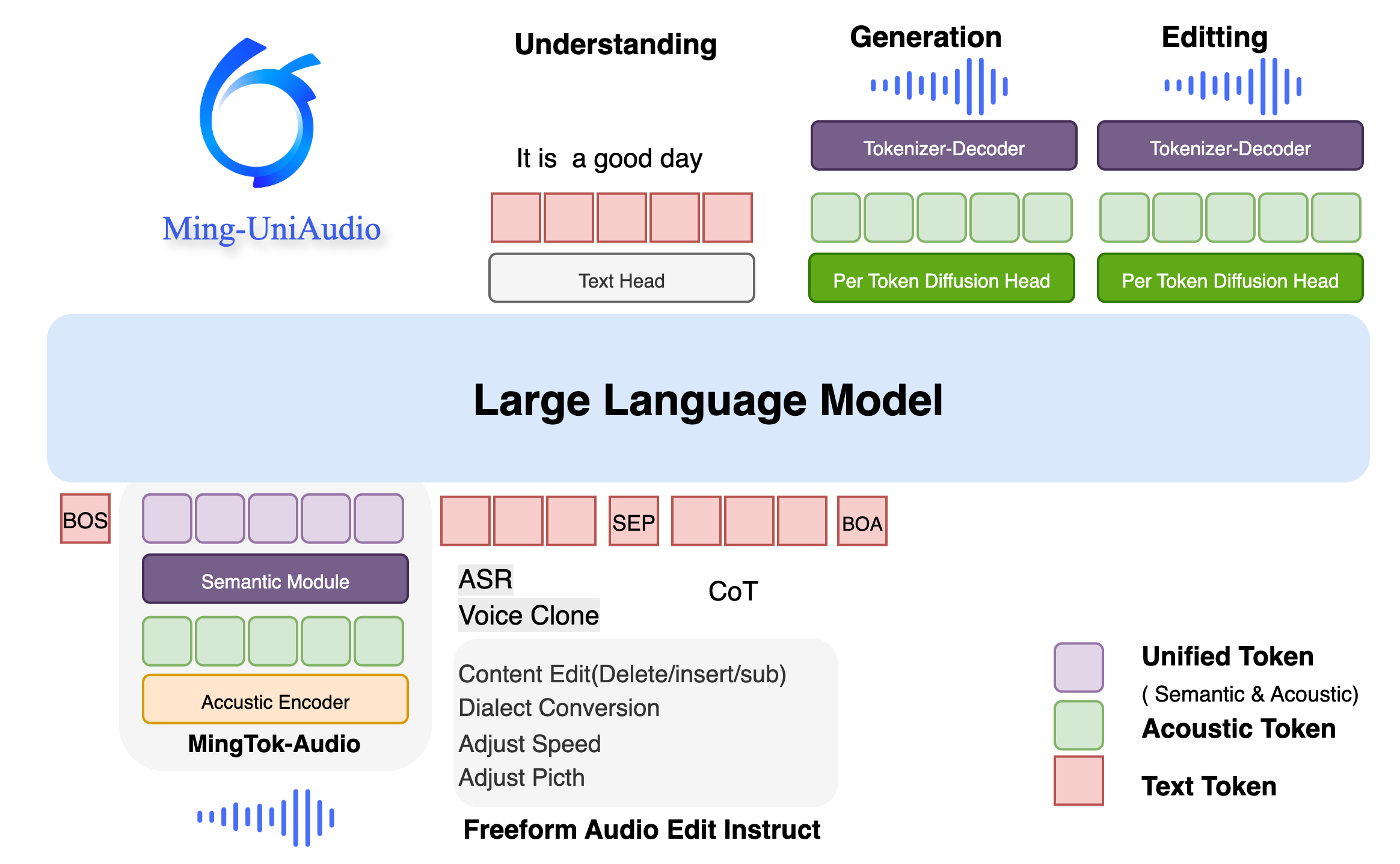
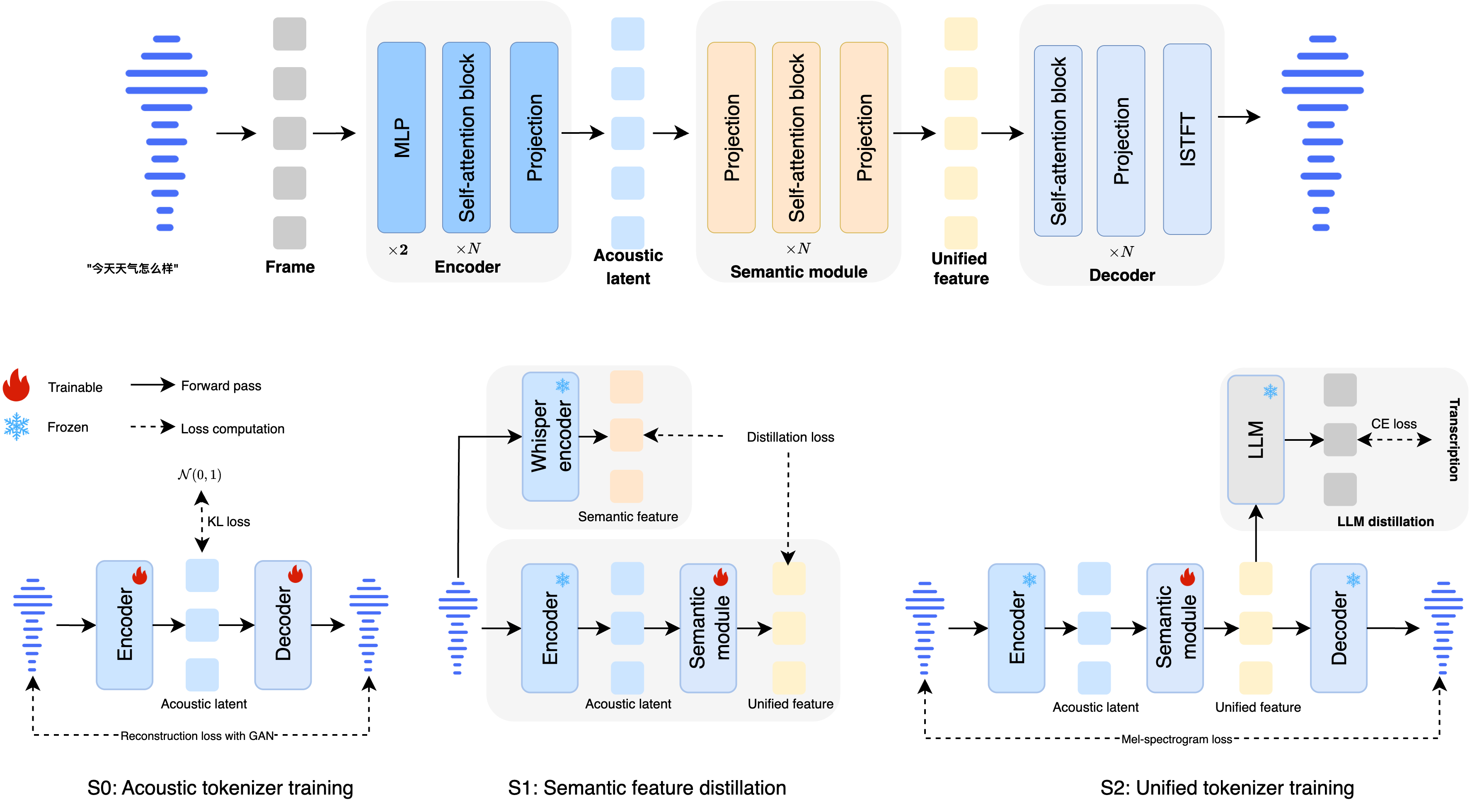
## Updates - [ ] Support VLLM Inference - [x] [Technical Report](https://arxiv.org/abs/2511.05516) - [x] [ASR & TTS SFT recipes](sft/README.md) - [x] Streaming TTS - [x] [Ming-UniAudio Blog](https://xqacmer.github.io/Ming-Unitok-Audio.github.io) ## Key Features Ming-UniAudio features key optimizations as follows, compared to other audio-assisted LLMs: - **Unified Continuous Speech Tokenizer**: Ming-UniAudio proposes a unified continuous speech tokenizer [MingTok-Audio](https://github.com/inclusionAI/MingTok-Audio) based on a VAE framework with a causal Transformer architecture, the first continuous speech tokenizer to effectively integrate semantic and acoustic features, and enables a closed-loop system with LLMs through hierarchical feature representations, makes it suitable for both understanding and generation tasks
- **Unified Speech Language Model for Generation and Understanding**: We pretrain an end-to-end unified speech language model with a single LLM backbone for both understanding and generation tasks, enhanced with a Diffusion Head to ensure high-quality speech synthesis. - **Instruction-Guided Free-Form Speech Editing**: We introduce the first instruction-guided, free-form speech editing framework that supports comprehensive semantic and acoustic edits without requiring explicit edit regions, along with [Ming-Freeform-Audio-Edit](https://github.com/inclusionAI/Ming-Freeform-Audio-Edit), the first open-source evaluation set for such tasks. ## Evaluation In various benchmark tests, Ming-UniAudio demonstrates highly competitive results compared to industry-leading models of similar scale. ### Speech Tokenizer
| System | FrameRate | SEED-ZH | SEED-EN | ||||
|---|---|---|---|---|---|---|---|
| PESQ↑ | SIM↑ | STOI↑ | PESQ↑ | SIM↑ | STOI↑ | ||
| MiMo-Audio-Tokenizer | 25 | 2.71 | 0.89 | 0.93 | 2.43 | 0.85 | 0.92 |
| GLM4-Voice-Tokenizer | 12.5 | 1.06 | 0.33 | 0.61 | 1.05 | 0.12 | 0.60 |
| Baichuan-Audio-Tokenizer | 12.5 | 1.84 | 0.78 | 0.86 | 1.62 | 0.69 | 0.85 |
| XY-Tokenizer | 12.5 | 2.27 | 0.77 | 0.90 | 2.14 | 0.82 | 0.90 |
| Mimi | 75 | 2.05 | 0.73 | 0.89 | 2.01 | 0.77 | 0.89 |
| XCodec2.0 | 50 | 2.19 | 0.80 | 0.92 | 2.37 | 0.82 | 0.93 |
| BigCodec | 80 | 2.26 | 0.81 | 0.92 | 2.22 | 0.80 | 0.91 |
| MingTok-Audio(ours) | 50 | 4.21 | 0.96 | 0.98 | 4.04 | 0.96 | 0.98 |
| Datasets | Model | Performance | ||||||
|---|---|---|---|---|---|---|---|---|
| aishell2-ios | LS-clean | Hunan | Minnan | Guangyue | Chuanyu | Shanghai | ||
| Understanding ASR | Kimi-Audio | 2.56 | 1.28 | 31.93 | 80.28 | 41.49 | 6.69 | 60.64 |
| Qwen2.5 Omni | 2.75 | 1.80 | 29.31 | 53.43 | 10.39 | 7.61 | 32.05 | |
| Qwen2 Audio | 2.92 | 1.60 | 25.88 | 123.78 | 7.59 | 7.77 | 31.73 | |
| Ming-UniAudio-16B-A3B(ours) | 2.84 | 1.62 | 9.80 | 16.50 | 5.51 | 5.46 | 14.65 | |
| Datasets | Model | Performance | |||
|---|---|---|---|---|---|
|
Speech-English WER | NE-WER | NE-FNR |
Dialogue-English WER | NE-WER | NE-FNR |
Speech-Mandarin WER | NE-WER | NE-FNR |
Dialogue-Mandarin WER | NE-WER | NE-FNR |
||
|
Understanding Context ASR |
Qwen2-Audio | 11.49 | 27.27 | 35.08 | 13.99 | 33.02 | 32.92 | 9.92 | 24.10 | 30.02 | 7.00 | 22.76 | 26.17 |
| Baichuan-Audio | 7.52 | 5.87 | 4.55 | 5.66 | 10.01 | 3.64 | 2.16 | 6.65 | 2.35 | 2.96 | 11.48 | 3.94 | |
| Kimi-Audio | 2.90 | 6.68 | 8.01 | 4.67 | 13.50 | 11.31 | 1.95 | 11.13 | 15.28 | 2.90 | 15.91 | 16.68 | |
| Baichuan-Omni-1.5 | 8.16 | 7.69 | 6.53 | 9.91 | 14.40 | 5.54 | 2.98 | 8.39 | 4.71 | 5.00 | 16.83 | 7.84 | |
| Qwen2.5-Omni-3B | 3.99 | 7.80 | 9.69 | 4.83 | 14.36 | 12.85 | 2.13 | 10.55 | 14.11 | 3.12 | 15.07 | 15.17 | |
| Qwen2.5-Omni-7B | 3.96 | 7.38 | 8.72 | 5.32 | 11.83 | 9.24 | 1.84 | 9.80 | 12.19 | 2.40 | 14.06 | 13.17 | |
| Ming-UniAudio-16B-A3B-Edit(ours) | 4.00 | 3.56 | 3.69 | 5.34 | 8.73 | 2.53 | 1.58 | 5.98 | 2.40 | 3.04 | 9.50 | 1.48 | |
| Datasets | Model | Performance | |||
|---|---|---|---|---|---|
| Seed-zh WER(%) | Seed-zh SIM | Seed-en WER(%) | Seed-en SIM | ||
| Generation | Seed-TTS | 1.12 | 0.80 | 2.25 | 0.76 |
| MiMo-Audio | 1.96 | - | 5.37 | - | |
| Qwen3-Omni-30B-A3B-Instruct | 1.07 | - | 1.39 | - | |
| Ming-Omni-Lite | 1.69 | 0.68 | 4.31 | 0.51 | |
| Ming-UniAudio-16B-A3B(ours) | 0.95 | 0.70 | 1.85 | 0.58 | |
| Datasets | Model | Performance | |||
|---|---|---|---|---|---|
|
Deletion-basic Deletion |
Ming-UniAudio-16B-A3B-Edit |
WER(%) zh | en 11.89 | 14.85 22.92 | 27.60 |
ACC zh | en 100 | 82.22 82.92 | 85 |
SIM zh | en 0.78 | 0.76 0.81 | 0.74 |
no-edit WER(%) zh | en 11.49 | 24.26 17.50 | 35.21 |
|
Insertion-basic Insertion |
Ming-UniAudio-16B-A3B-Edit |
WER(%) zh | en 3.42 | 6.63 3.89 | 7.592 |
ACC zh | en 80 | 71.43 79.31 | 62.31 |
SIM zh | en 0.83 | 0.79 0.83 | 0.79 |
no-edit WER(%) zh | en 3.52 | 17.70 4.10 | 18.84 |
|
Substitution-basic Substitution |
Ming-UniAudio-16B-A3B-Edit |
WER(%) zh | en 4.52 | 8.99 4.56 | 7.64 |
ACC zh | en 78.62 | 59.78 76.62 | 65.62 |
SIM zh | en 0.82 | 0.78 0.83 | 0.77 |
no-edit WER(%) zh | en 4.63 | 19.28 4.75 | 18.39 |
|
Dialect Conversion |
Ming-UniAudio-16B-A3B-Edit |
WER(%) 8.93 |
ACC 0.50 |
SIM 0.66 |
- |
|
Speed changing |
Ming-UniAudio-16B-A3B-Edit |
WER(%) zh | en 5.88 | 17.53 |
SIM zh | en 0.66 | 0.57 |
RDE(%) zh | en 6.36 | 5.92 |
- |
|
Pitch changing |
Ming-UniAudio-16B-A3B-Edit |
WER(%) zh | en 7.45 | 13.37 |
SIM zh | en 0.36 | 0.24 |
- | - |
|
Volume changing |
Ming-UniAudio-16B-A3B-Edit |
WER(%) zh | en 1.71 | 1.35 |
SIM zh | en 0.86 | 0.80 |
RAE(%) zh | en 14.9 | 11.7 |
- |
| Datasets | Model | Model Type | DNSMOS OVRL | DNSMOS SIG | DNSMOS BAK |
|---|---|---|---|---|---|
| Denoise | FullSubNet | specialized | 2.93 | 3.05 | 3.51 |
| Inter-Subnet | 2.98 | 3.17 | 3.15 | ||
| CDiffuSE | 2.84 | 3.37 | 3.52 | ||
| SGMSE | 3.11 | 3.47 | 3.41 | ||
| StoRM | 3.15 | 3.54 | 3.69 | ||
| GenSE | 3.43 | 3.65 | 4.18 | ||
| MiMo-Audio | general | 3.30 | 3.56 | 4.10 | |
| Ming-UniAudio-16B-A3B-Edit(ours) | 3.26 | 3.59 | 3.97 |