# Economic Clustering in the Tangle
# Abstract
**Economic Clustering (EC)** applies economic laws to **Distributed Ledger Technology (DLT)** in order to enable scalability in large networks. This document will limit the scope of Economic Clustering to the **Directed Acyclic Graph (DAG)** structure of the **IOTA Tangle**.
In DLT each node usually processes and stores a local copy of the entire ledger. Due to their global nature and increasing adoption, this approach will necessarily run into scaling issues. While memory is cheap, bandwidth and latency are the first expected to cause issues. Economic Clustering offers infinite scalability for the entire system while keeping the requirements for individual nodes low by splitting the global ledger into economically relevant clusters. The concept is backed by economic laws.
# Motivation
It is historically reasoned that in the real world economic factors outweight the Longest Chain Rule when it comes to DLT. Therefore it appears necessary to extend the purely technical formal model of consensus with economic incentives. While the Cumulative Weight Consensus Mechanism outlined in the IOTA whitepaper2 does provide a mathematically backed model for consensus on the Tangle, it does not provide a strategy to solve conflicts with economic behaviour. Economic Clustering will complement the formal mechanism with such a strategy. It is expected that both mechanisms will be applied in parallel and both of their relative relevances will sum up to 100%.
# Introduction
### Scalability in Real World Economics
Inspired by global real-world economy which does not suffer such limitations, EC tries to apply their concepts to DLT. The most important of these is the concept of **hierarchical locality**: the global economy (we will call it the **global level**) is a system composed of smaller national economies and the relations among them. Recursively, these national economies consist of many regional economies which are connected with each other. And once again, regional economies are a multitude of companies and individuals interacting with each-other within their regional economy. We will stop zooming in at this last level and consider it the **atomic level** (the elements of this level are the **atoms**) at which we cannot undertake further divisions.
It is important to note that the global level does not physically exist as a separate entity but is an abstract term describing the entire system. In fact, the system consists of billions of atoms interacting with each-other. While the global level is highly complex, no atom is fully aware of the entire picture but only follows their own self-interest and interacts mostly within a tiny horizon (for example a city) which we will call **cluster**. This is caused by the fact that the vast majority of economic activity is not relevant to an atom (you don't care whether someone on a distant continent is buying a coffee).
### Applying Locality to DLT
By splitting up the global ledger in smaller clusters, we can enable scalability while allowing the entire system to grow without limitations. Each node, representing an atom, can decide which cluster it considers economically relevant. It will then follow only the activity within the chosen cluster.
## Structure of EC
### Economic Cluster
An economic cluster is a set of nodes sharing the same ledger. Clusters are not compatible. One can only transact within a cluster. A real-world equivalent of an economic cluster is a currency. Within a nation a certain currency is accepted while other currencies must usually be exchanged to the national currency before use.
All tokens within an economic cluster are fungible and share the same value. This does not hold between tokens of different clusters. Just like different fiat currencies, they differ in value and the exchange rate is subject to market forces.
### Economic Actor
An economic actor is an entity operating within an economic cluster. Actors can be institutions, individuals or machines. An actor is relevant to us only if we care about how that actor sees the ledger.
We care directly if we depend on this actor. The value of our tokens only results from our ability to exchange these tokens for goods. If none of the actors we want to perform transactions with does recognize our tokens as valuable, these tokens are of no value to us either. For example, the supermarket around the corner would be directly relevant for us if we intend to buy groceries with our tokens there.
We care indirectly if an actor who is relevant to us heavily relies on another actor. For example, we might not plan to interact with the bank of our supermarket ourselves. However, that bank is certainly relevant to our supermarket and as such it is relevant to us as well, even though in a smaller degree.
# Implementation
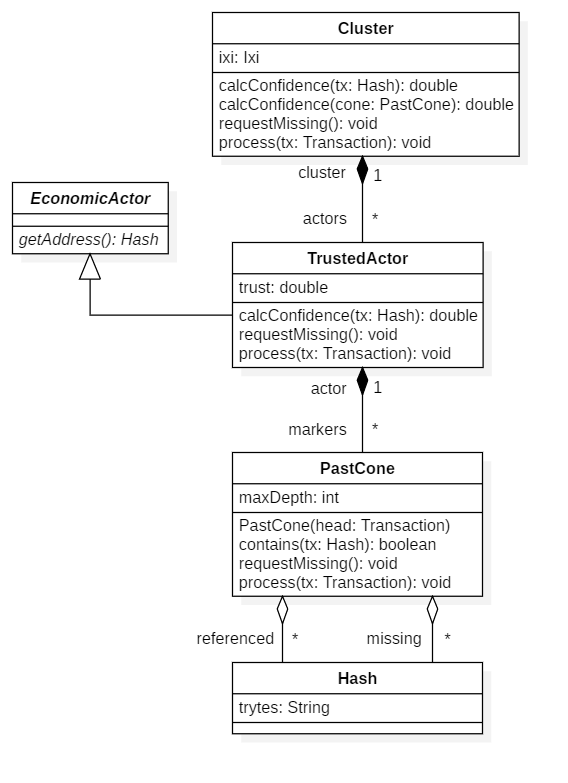 ## Terminology
### Span-Tangle
A span-tangle `span(T)` of a transaction `T` (or a set of transactions) is the Tangle derived by looking only at this transaction and its entire history (all directly or indirectly referenced transactions). All other transactions are not part of this sub-tangle:
```
span(T1, T2, ... Tn) = span(T1) ⋃ span(T2) ⋃ ... ⋃ span(Tn)
span(T) = T ⋃ span(T.branch, T.trunk) = T ⋃ span(T.branch) ⋃ span(T.trunk)
```
### Referenced Tangle
The tangle referenced by a transaction `T` contains exactly those transactions which are directly or indirectly referenced by `T`.
It does not contain `T` itself.
```
T ... transaction
referenced(T) ... tangle referenced by T
referenced(T) = span(T) ∖ T
= span(T.branch, T.trunk)
= span(T.branch) ⋃ span(T.trunk)
```
### Sub- and Super-Tangle
A sub-tangle S' of a tangle S is the span-tangle of a transaction T in S. Thus S' is a subset of S. S will be called the super-tangle of S'.
```
S ... tangle (super-tangle of S')
T∈S ... transaction in S
S' = span(T); S' ⊆ S ... (sub-tangle of S)
```
## Confidence Markers
### Issuing
Each economic actor regularly issues confidence markers to publish its current view of the ledger. These markers are signed
bundles and reference a tangle. Additionally, they specify a probability representing how confident the actor is that the
referenced tangle is confirmed. This confidence will be updated/overwritten whenever the actor issues a new marker
referencing the same tangle.
```
M ... marker bundle
M.tail ... tail of M, last transaction in the bundle
referenced(M) ... tangle referenced by the marker M
referenced(M) = referenced(M.tail)
= span(M.tail) ∖ M.tail
= span(M.tail.branch, M.tail.trunk)
= span(M.tail.branch) ⋃ span(M.tail.trunk)
```
### Markers Define Double Cones
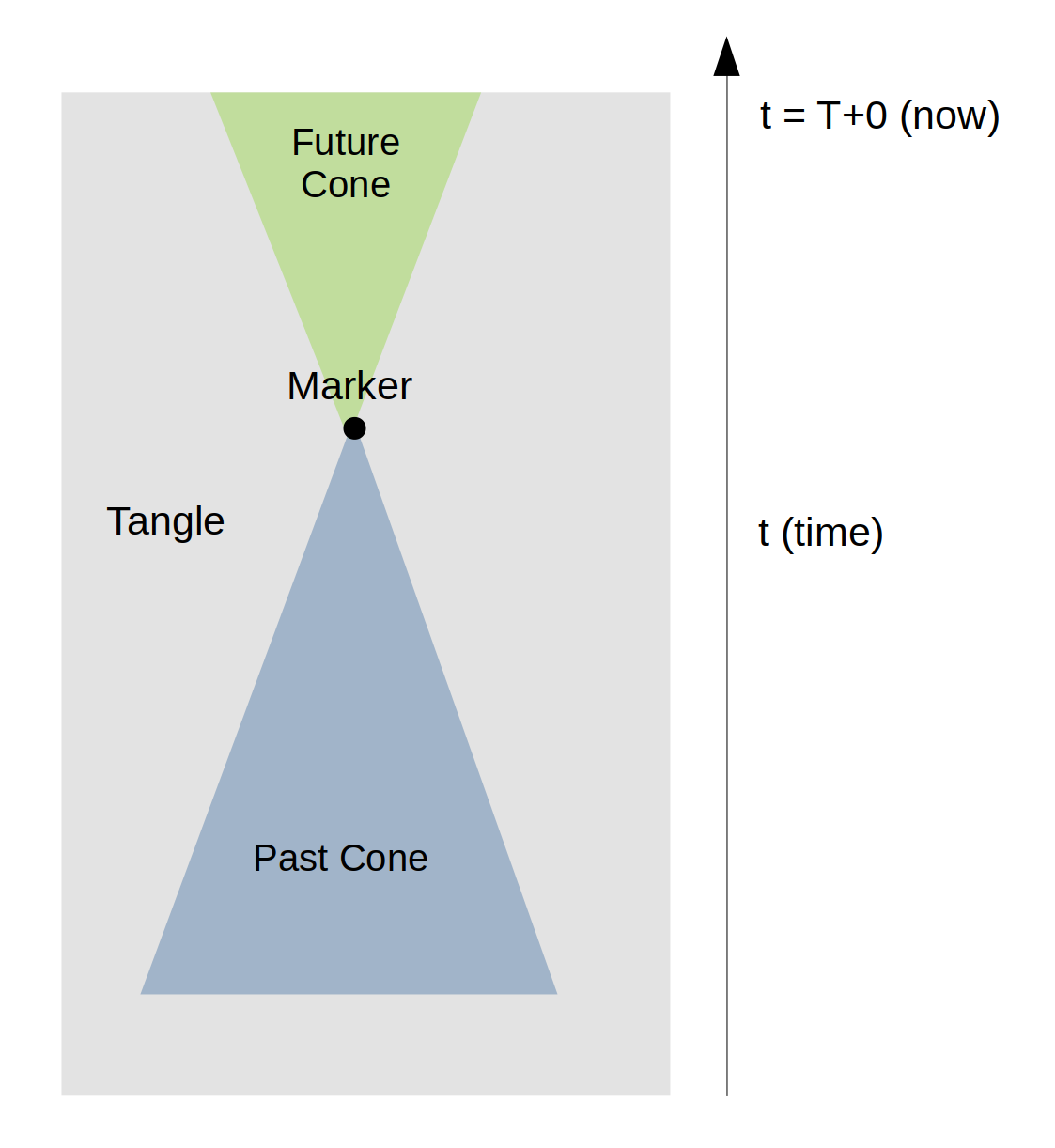
Each marker can be described by a double cone3 where the marker is the apex and both the past and the future of the marker span up the cones. The past consists of all transactions referenced by the marker while the future contains all transactions referencing the marker. This offers a unique view of the Tangle that only considers a subset of logically linked transactions.
Note that while the Tangle is theoretically infinite, each node can only process a certain amount of transactions. Therefore both cones of the marker will be limited to a certain depth. While the depth (or rather height) of the future is already limited due to our inability to see into the future, the depth of the past will be defined by technical limitations.
 ### Cones define Clusters
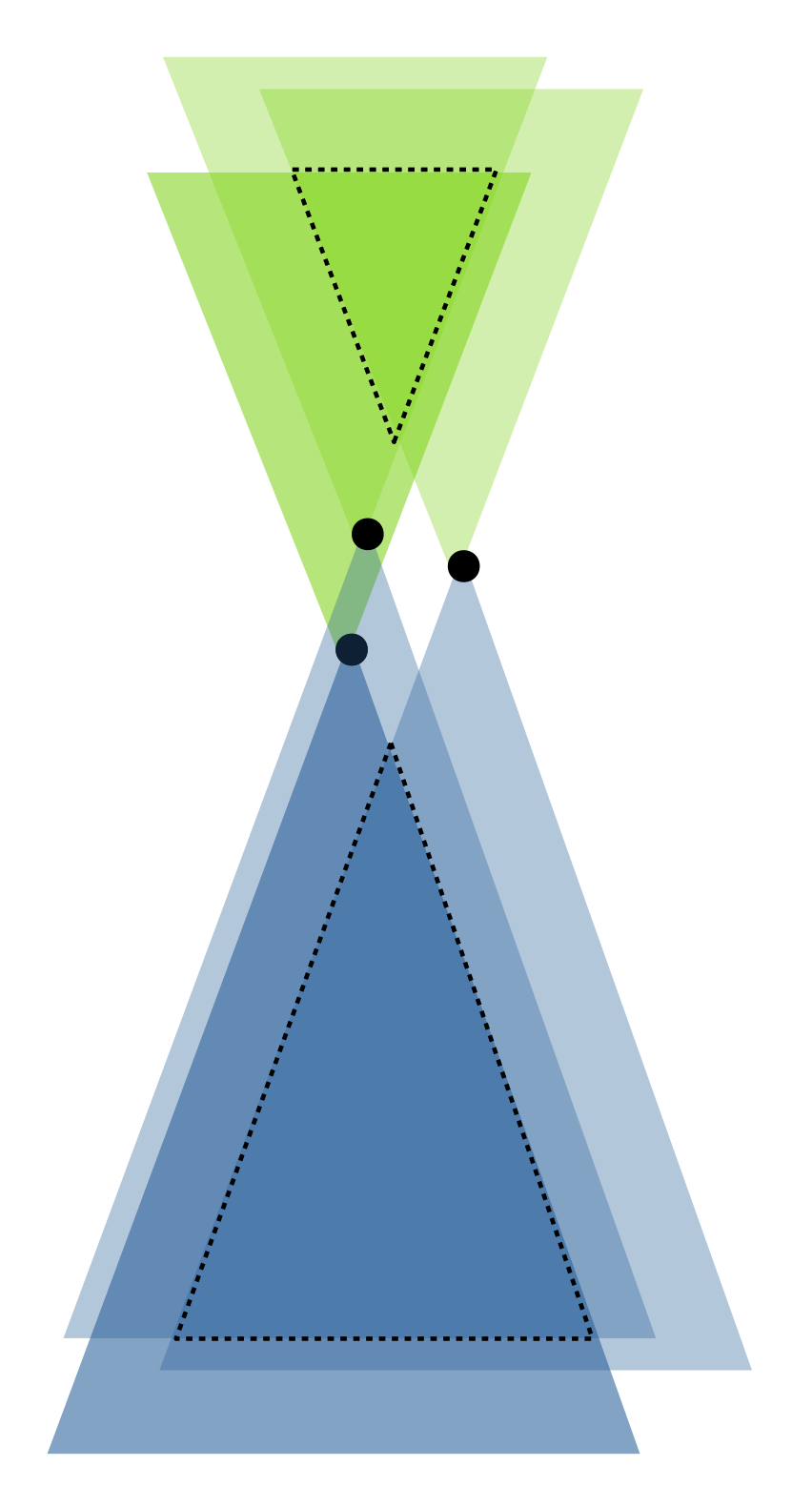
Following a cluster happens implicitly through its neighbors. Each node is aware of a certain set of markers. The union of all double cones of the markers in this set offers a unique view of the tangle - the **local tangle**. Each node actively requests and broadcasts transactions in this local tangle to improve its view. Transactions that are not part of the local tangle will not be broadcasted to neighbors. As a result, the local tangles of neighbors will have a strong overlap. When a new marker issued by a trusted entity is discovered in the local tangle, the local tangle will adjust dynamically to include that markers double cone.
Further, economic actors which are topologically nearby will have a lot of this overlap. A transaction in the cut of the past cones of markers issued by different economic actors will be referenced by each of these actors and thus will have a higher acceptance in the cluster. **It is important to note that this makes clusters fuzzy**: there is no clear logical boundary between two clusters. Clusters can overlap to any degree. A cluster's boundary must always be seen from a probabilistic point of view, analogous to wave functions in quantum physics.
 ### Tip Selection
To increase the chance of a transaction confirming in a cluster, the issuing node tries to place it so that it will likely be referenced by many actors in that cluster. It seeks for a spot in the Tangle that is most representative of the cluster. Due to the fuzzy nature of clusters, this is not a binary problem (is it representative?) but a probabilistic (how representative?). The most representative place for a cluster defined by a set of markers is the cut of their future cones. That is because that cut has the highest overlap with the local Tangle of all actors in the cluster.
As outlined in the IOTA whitepaper2, IOTA specifies a random walk on the Tangle as the reference method to select tips. Based on the assumption that most transactions will be using this method, it makes sense for any entity to comply, resulting in a fair and stable tip selection. Therefore we conclude that nodes will want to use a random walk to place their transactions into the mentioned future cut. This can be achieved by weighting the edges during the *Markov chain Monte Carlo* (MCMC) random walk based on the clustermrepresentativeness of the transactions they are leading to.3
### Inter-Cluster Exchange
Imagine two rather separate but not too distant clusters CX and CY. They might have a small overlap of 5% for example and be considered neighbors. A node can transfer value from CX to CY by submitting a transfer to a place that is representative in both clusters. Remember that clusters are fuzzy. These two clusters can be considered one single large cluster CXY. Therefore the node can apply the previously decribed tip selection to issue a transfer into the future cut of both clusters from where it can be referenced by the cluster CXY and therefore in fact by both clusters CX and CY.
We assume that the funds spent by the transfer are only known in CX but not in CY (otherwise it wouldn't be an inter-cluster exchange). Now because the balances do exist in CX, the transfer can confirm in CX. Be aware that the boundaries of CX and CY are fuzzy meaning that the transfer will also partially confirm in CY.
The confidence of that transfer in CY represents the probability of that transfer to confirm in that cluster - which will happen if more markers in CY reference that transactions until it becomes part of the past cut in CY and therefore part of CY itself.
The less distant CX and CY are:
* the higher is their overlap (larger future cut)
* the easier it is to insert a transfer that will be picked up in both clusters
* the higher the correlation of the transfer's confidences in both clusters
* the more likely is the inter-cluster exchange to be successful
This means that it is possible to transfer value between two adjasent clusers. If one wanted to transact to a distant cluster, one would have to hop over multiple intermediate clusters. The cost of doing this physically is proportional to the transfer distance. It manifests itself as the time required to perform all hops as well as the computational resources spent on attaching the transfer (tip selection and proof-of-work).
### Exchange Nodes
We assume that this cost will create an economical demand for exchange services which offer a virtual inter-cluster exchange as a service for a fee to monetarily cover these time and resource expenses. Note that this cost is not a technical part of the protocol, which will remain feeless, but compensates the exchanging node for the cost of providing the service.
Entities who have balances in distant clusters can offer an exchange service between these. Even though this service is provided by a third-party, practically no trust is required when realizing transacting through Flash Channels. A tiny micro-payment stream will flow from the sender to the service in the source cluster, another from the service to the receiver in the target cluster. If the exchanging node turned out to be malicious and would not transfer the balance to the other cluster but keep it, only an insignificantly low amount of tokens would have been stolen due to the time-continuous nature of Flash Channels.
### Pruning
Despite the fact that economic actors will only store the Tangle to a certain depth, they can validate balances based on known transactions which are already confirmed by the cluster. These transactions are at the bottom of the past cone. If the input balances of a transfer cannot be found in that past cone, the actor will depend on other actors in that cluster. Only if a sufficient amount of these can remember the input balances, will the actor assume that these balances do indeed exist. This means that balances will be lost if they are not moved within a reasonable amount of time. The exact time depends on the activity in the cluster and the memory resources of the actors therein. Clusters where balances are used as store of value (e.g. cluster-0) will provide a higher time frame before transactions are forgotten. On the other hand, local IoT ecosystems might assume that members actively utilize their balances and work with less value, therefore it is reasonable to use a lower timeframe that allows edge devices despite their constrains to participate as economic actors.
### Consensus
Economic actors publish such markers and adjust the probabilities depending on the markers issued by other actors within their cluster. This dynamic and probabilistic voting process goes on until the cluster comes to consensus. This happens when the vast economically relevant majority of the cluster approves a certain sub-tangle with 100% confidence each. In case a conflicting sub-tangle was previously marked with a non-zero confidence, the respective actor would overwrite that confidence with 0% because it is not compatible with the accepted sub-tangle and no longer likely to be accepted by the cluster.
### Confidence
Actors will be more confident in a tangle the more other actors are confident in that same tangle. Therefore their confidence levels of a certain tangle quickly moves into the same direction (0% or 100%) which allows the cluster to come to consensus on a shared ledger.
### Cryptography
Each actor can be identified by an IOTA address. The confidence markers are implemented with merkle trees. This allows actors to issue multiple markers to the same address without compromising security despite the one-timeliness of the underlying Lamport signature scheme while using its advantages to stay quantum-secure.
### Priority
Since each actor can issue multiple markers, we need to determine which marker has the priority for a transaction T for which we want to determine the confidence.
**Overwriting:** The index of each signature within the merkle tree can be derived. To allow overwriting, a marker with a higher index will have priority over all markers with a lower index referencing the same tangle.
**Locality:** Let `S` be the referenced tangle of a marker `M` and `S'` be the referenced tangle of a marker `M'`. `T` is an element of `S'` and `S'` is a sub-tangle of `S`. As the more specific marker, `M'` has priority over the more general marker `M` for `T`. On a side note, the confidence in `S` cannot be higher than that of `S'` because the former includes the latter and as such relies on its confidence.
```
=== GIVEN ===
M, M' ... markers
S = referenced(M) ... tangle (super-tangle of S')
S' = referenced(M') ... tangle (sub-tangle of S)
T∈S' ... transaction in S'
== THEN ===
priority(M', T) ≥ priority(M, T)
S' ⊆ S ⇒ confidence(M') ≥ confidence(M)
```
## Cluster Confidence
The confidence of a transaction specifies how likely we consider that transaction confirmed. It depends on the confidence and relevance of all actors within our cluster. As such it is just as subjective as in the real world. Let `T` be a transaction. Let `A` be an economic actor. `p(T)` describes our cluster confidence (the confidence we have in `T`). `p(T|A)` is the confidence the actor `A` has in `T`. `relevance(A)` is the relative relevance of actor A (subjectively). The sum of the relevance over all actors must equal 1.
```
=== GIVEN ===
Actors ... set of all economic actors
T ... transaction
Σ[∀A∈Actors] relevance(A) = 1
=== THEN ===
p(T) = Σ[∀A∈Actors] relevance(A) ⋅ p(T|A)
```
## Ledger Validation
### Definition
Ledger validation describes the problem of determining whether a tangle complies to certain validity rules in which case
it is called "valid". Validity is a necessary requirement for confirmation. While confirmation is the result of consensus
and describes the acceptance of a tangle, validity is a technical property which can be checked deterministically and
describes the absence of inconsistencies within the tangle.
**Note that ledger validation is only done by Economic Actors. Weaker devices rely on their results so they don't have to
do perform these heavy computations themselves.**
In invalid ledger will have a confidence of zero. If the smallest merge of two tangles is invalid (e.g. because both include a
spend of the same funds - a *double spend*), we define these tangles as *conflicting*. They cannot be merged without
additional transfers and therefore we assume that at most one of both will confirm. Based on the conflict relation we can
model the probability of a Tangle confirming. This is the basis to calculate the confidence.
### General Validity Rules
A tangle `S` is valid if all transfers within are valid. A transfer `T` is valid **in a tangle `S`** if:
* the signatures of all inputs in `T` are valid
* no tokens are created or destroyed by `T` (input value = output value)
* when combining all transfers **in `S`**, no address being used as input for `T` is left with a negative balance (inputs exist)
The first two conditions can be checked efficiently for each transfer once without the context of S (complexity `O(1)` for each new transfer). The third condition
on the other hand must be validated from scratch for each tangle S (complexity `O(S)` for each ledger validation). In practice we will
keep a snapshot of all balances from a certain point of history we consider confirmed with high probability. This reduces the complexity
from validating the entire ledger since genesis to validating only the new part of the ledger since that snapshot.
# References
* 1 ... [Economic Clustering and IOTA](https://medium.com/@comefrombeyond/economic-clustering-and-iota-d3a77388900) (Medium Article) by Come-from-Beyond on Jun 9, 2018
* 2 ... [The Tangle](https://assets.ctfassets.net/r1dr6vzfxhev/2t4uxvsIqk0EUau6g2sw0g/45eae33637ca92f85dd9f4a3a218e1ec/iota1_4_3.pdf) (IOTA Whitepaper) by Prof. Serguei Popov on Apr 30, 2018
* 3 ... [A scoop of tangle](https://www.twitch.tv/videos/394080103) (Twitch Video) by Paul Douglas on Mar 11, 2019
* 4 ... [Instant & Feeless - Flash Channels](https://blog.iota.org/instant-feeless-flash-channels-88572d9a4385) (Medium Post) by Lewis Freiberg on Sep 24, 2017