# iron-proxy
[](https://docs.iron.sh)
[](https://github.com/ironsh/iron-proxy/releases/latest)
[](https://hub.docker.com/r/ironsh/iron-proxy)
## The problem
CI jobs, AI coding agents, and sandboxed containers can make arbitrary outbound
requests. A compromised dependency, a prompt injection, or a malicious build
step can exfiltrate secrets, phone home, or open a reverse shell. Most
teams have zero visibility into what's leaving their workloads, let alone any
way to stop it.
## What iron-proxy does
iron-proxy is a MITM egress proxy with a built-in DNS server that sits between
your untrusted workload and the internet. It enforces default-deny at the
network boundary, so the workload can only reach domains you explicitly allow.
Real secrets never enter the sandbox. Workloads use proxy tokens, and
iron-proxy swaps in real credentials at egress, meaning a compromised workload
can exfiltrate a token that's worthless outside the proxy.
Single binary. Single YAML config.
- **Default-deny egress.** Every outbound request is blocked unless the
destination matches your allowlist. List your domains and CIDRs, everything
else gets a 403.
- **Upstream IP deny list.** Even when a host is allowed, the proxy refuses
to dial it if its resolved address falls inside a denied CIDR — closing
the SSRF/DNS-rebinding gap where an allowlisted hostname points at IMDS
or loopback. Cloud metadata endpoints (`169.254.169.254`) and loopback are
denied by default; override via `proxy.upstream_deny_cidrs` or
`IRON_PROXY_UPSTREAM_DENY_CIDRS`.
- **Boundary-level secret injection.** Workloads send proxy tokens; iron-proxy
replaces them with real secrets before the request leaves. If the sandbox is
compromised, the attacker gets tokens that are useless outside the proxy.
- **Per-request audit trail.** Every request logged as structured JSON with
the full transform pipeline result: which secrets were swapped, which rules
matched, what got blocked and why.
- **Streaming-aware.** WebSocket upgrades and Server-Sent Events are proxied
natively. No special configuration for agent workloads that hold long-lived
connections.
- **Explicit proxy support.** Optional tunnel listener for tools that natively
support proxy configuration via `HTTP_PROXY`, `HTTPS_PROXY`, or SOCKS5
settings.
- **PostgreSQL MITM proxy.** Optional listener that authenticates clients
against proxy-managed credentials, injects `SET ROLE` on the upstream
session, and rejects client attempts to mutate the role (`SET ROLE`,
`set_config('role', ...)`, DO blocks, etc.) via a SQL AST walk. Pairs with
PostgreSQL row-level security to give per-tenant data isolation when the
application connects as a shared service-account user. **Requires
PgBouncer (if used) to run in `pool_mode = session`** — transaction or
statement pool modes silently rebind backends between queries and would
defeat the policy. See [docs.iron.sh](https://docs.iron.sh) for details.
Built for CI pipelines, GitHub Actions, AI agents (Claude Code, Cursor,
Codex), and any environment where you run code you don't fully trust.
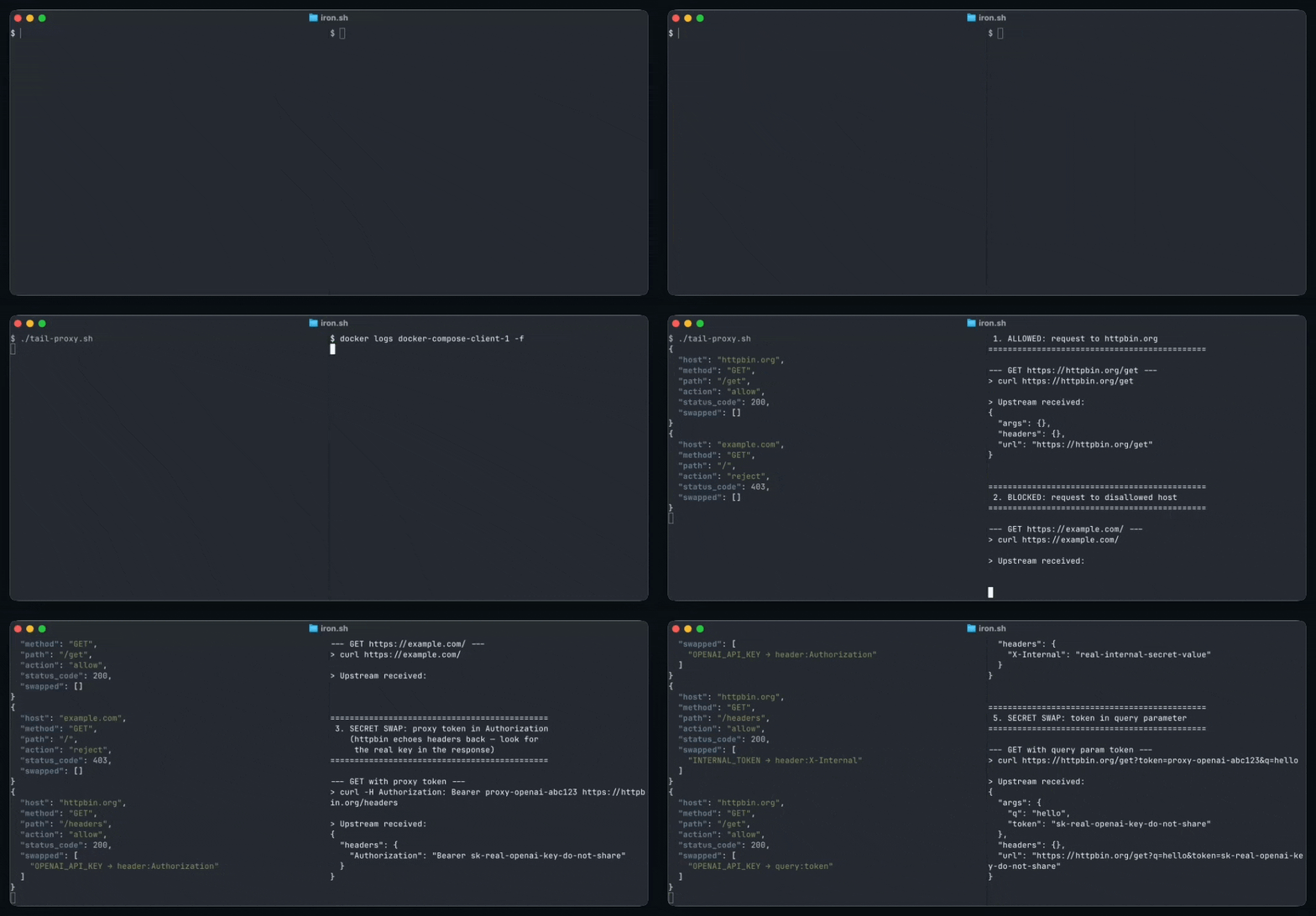
Blocked exfiltration + secret rewriting in action:
## Installation
Docker images are available on [Docker Hub](https://hub.docker.com/r/ironsh/iron-proxy)
and pre-built binaries for Linux/macOS (amd64/arm64) are on
[GitHub Releases](https://github.com/ironsh/iron-proxy/releases).
Or build from source:
```bash
go build -o iron-proxy ./cmd/iron-proxy
```
## Quick start
```bash
cd examples/docker-compose
docker compose up
```
This starts iron-proxy and a demo client that fires five requests through the
proxy. Check the logs to see allowed, blocked, and secret-rewritten requests:
```bash
docker compose logs proxy
```
Every request produces a structured JSON audit entry:
```json
{
"host": "httpbin.org",
"method": "GET",
"path": "/headers",
"action": "allow",
"status_code": 200,
"duration_ms": 142,
"request_transforms": [
{ "name": "allowlist", "action": "continue" },
{
"name": "secrets",
"action": "continue",
"annotations": { "swapped": [{ "secret": "OPENAI_API_KEY", "locations": ["header:Authorization"] }] }
}
]
}
```
Rejected requests include a `rejected_by` field and log at WARN level. See
[Audit log format](#audit-log-format) for the full schema.
## Production usage
### 1. Generate a CA
iron-proxy terminates TLS by generating leaf certificates on the fly, signed by
a CA you provide. Client containers must trust this CA.
```bash
mkdir -p certs
openssl genrsa -out certs/ca.key 4096
openssl req -x509 -new -nodes \
-key certs/ca.key \
-sha256 -days 3650 \
-subj "/CN=iron-proxy CA" \
-addext "basicConstraints=critical,CA:TRUE" \
-addext "keyUsage=critical,keyCertSign" \
-out certs/ca.crt
```
### 2. Create a Docker network
iron-proxy needs a fixed IP so containers can point their DNS at it:
```bash
docker network create --subnet=172.20.0.0/24 iron-proxy
```
### 3. Start iron-proxy
Create an env file with your secrets (keep this out of version control):
```bash
echo "OPENAI_API_KEY=sk-real-key" > .env
```
```bash
docker run -d --name iron-proxy \
--network iron-proxy --ip 172.20.0.2 \
-v $(pwd)/proxy.yaml:/etc/iron-proxy/proxy.yaml:ro \
-v $(pwd)/certs/ca.crt:/etc/iron-proxy/ca.crt:ro \
-v $(pwd)/certs/ca.key:/etc/iron-proxy/ca.key:ro \
--env-file .env \
ironsh/iron-proxy:latest -config /etc/iron-proxy/proxy.yaml
```
### 4. Route containers through the proxy
The simplest approach is DNS-based routing: point the container's DNS at
iron-proxy and all hostname lookups resolve to the proxy IP, routing traffic
through it automatically:
```bash
docker run --rm \
--network iron-proxy \
--dns 172.20.0.2 \
-v $(pwd)/certs/ca.crt:/certs/ca.crt:ro \
curlimages/curl --cacert /certs/ca.crt https://httpbin.org/get
```
For stronger enforcement, layer nftables rules to block non-proxy egress, or use
TPROXY for kernel-level interception. See [Routing traffic to the
proxy](#routing-traffic-to-the-proxy) for details on each approach.
## Why iron-proxy?
| | iron-proxy | Squid | mitmproxy | Envoy |
| ------------------------ | ------------------------------ | --------------------------- | ------------------------- | ---------------------------------- |
| Default-deny egress | Built-in | Requires complex ACL config | Requires custom scripting | Requires RBAC/filter configuration |
| Secret injection | Built-in | No | No | No |
| Structured audit logging | Built-in, per-transform traces | Basic access logs | Plugin-based | Configurable access logs |
| Setup complexity | Single binary + YAML | Extensive config language | Python scripting | Complex YAML or control plane |
iron-proxy is purpose-built for one job: controlling and auditing egress from
untrusted workloads. Squid can do default-deny but requires significant ACL
configuration and has no concept of secret injection. mitmproxy is a great
debugging tool but isn't designed for production enforcement. Envoy is a
general-purpose proxy that can be configured to do parts of this, but it's
far more complexity than the problem requires.
## How it works
iron-proxy runs a DNS server and an HTTP/HTTPS proxy. Point your container's DNS
at iron-proxy and all hostname lookups resolve to the proxy IP, routing traffic
through it automatically. The proxy terminates TLS (generating leaf certs on the
fly from a CA you provide), runs the request through an ordered transform
pipeline, forwards it upstream, and runs the response back through the pipeline.
```
Container → DNS lookup → iron-proxy IP → TLS termination → transforms → upstream
```
Transforms run in order. Built-in transforms:
| Transform | What it does |
| ----------- | ----------------------------------------------------------------------------------------------------------------------- |
| `allowlist` | Permits requests to matching domains/CIDRs; rejects everything else (403). |
| `secrets` | Scans headers (and optionally query, path, or body) for proxy tokens and swaps in real secrets from environment variables. |
| `body_capture` | Records decoded request bodies of matching hosts as `request_body` audit fields. Observation-only; never rejects. |
## Configuration
iron-proxy takes a single flag: `-config path/to/config.yaml`. Here's the
full shape (see [`iron-proxy.example.yaml`](iron-proxy.example.yaml) for a
copy-pasteable starting point):
```yaml
dns:
listen: ":53"
proxy_ip: "10.16.0.1" # IP where iron-proxy is running (required)
passthrough: # Domains forwarded to OS resolver
- "*.internal.corp"
- "metadata.google.internal"
records: # Static DNS records (highest precedence)
- name: "internal.example.com"
type: A
value: "10.0.0.5"
proxy:
http_listen: ":80"
https_listen: ":443"
tunnel_listen: ":8080" # Optional CONNECT/SOCKS5 listener
max_request_body_bytes: 1048576 # 1 MiB (default)
max_response_body_bytes: 0 # uncapped (default)
tls:
ca_cert: "/etc/iron-proxy/ca.crt" # Required
ca_key: "/etc/iron-proxy/ca.key" # Required
cert_cache_size: 1000 # LRU cache for generated leaf certs
leaf_cert_expiry_hours: 72
transforms:
- name: allowlist
config:
domains:
- "api.openai.com"
- "*.anthropic.com"
cidrs:
- "10.0.0.0/8"
- name: secrets
config:
secrets:
- source:
type: env
var: OPENAI_API_KEY # Env var holding the real secret
proxy_value: "proxy-token-123" # Token the sandbox sends
match_headers: ["Authorization"]
match_body: false
require: true # Reject requests without the proxy token
rules:
- host: "api.openai.com"
log:
level: "info" # debug, info, warn, error
```
### DNS
Everything resolves to `proxy_ip` by default, which is what routes traffic
through the proxy. Exceptions:
- **`passthrough`:** glob patterns forwarded to the OS resolver (e.g.,
`*.internal.corp`). Traffic to these hosts bypasses the proxy entirely.
- **`records`:** static A or CNAME records. Highest precedence.
### Allowlist
Default-deny. Requests must match at least one domain glob or CIDR to proceed.
Unmatched requests get a `403 Forbidden`.
Domain patterns use glob matching: `*.example.com` matches any subdomain and
`example.com` itself.
**Warn mode:** Set `warn: true` to observe what the allowlist would block without
actually enforcing it. Requests that would be rejected are allowed through but
annotated with `"action": "warn"` in the transform trace. This is useful for
rolling out new allowlist rules or auditing existing traffic before switching
to enforcement.
### Annotate
Captures HTTP request headers into audit log annotations based on
host/method/path rules. This is useful for enriching audit logs with
request-specific context like request IDs without modifying the proxy core.
Each annotation group specifies rules to match and headers to capture. When a
request matches any rule in a group, the specified header values are written as
`header:` entries in the transform trace annotations. Requests that don't
match are passed through unchanged. This transform never rejects requests.
> **Warning:** Header values are emitted in plain text in the audit log. Only
> log headers that are safe to expose, such as request IDs or headers containing
> proxy secret tokens. Do not log headers that contain raw secrets.
```yaml
transforms:
- name: annotate
config:
annotations:
- rules:
- host: "api.openai.com"
methods: ["POST"]
paths: ["/v1/*"]
headers: ["x-request-id"]
- rules:
- host: "*.anthropic.com"
headers: ["x-request-id"]
```
### Header allowlist
Default-deny request header filter. Any request header whose canonical name is
not in the configured `headers` list is stripped before the request goes
upstream. Useful for blocking tracking, fingerprinting, or accidental leakage
headers (cookies, internal correlation IDs, `X-Forwarded-*`, etc.) that the
sandbox might attach.
Entries are matched case-insensitively against the canonical header name.
Patterns delimited by `/.../` (e.g. `/^X-Trace-.*$/`) are case-insensitive
regular expressions, mirroring the `secrets` transform's `match_headers`
syntax.
Optional `rules` limit the allowlist to specific hosts/methods/paths. When
omitted, the allowlist applies to every request that reaches this transform.
When at least one header is stripped, the trace is annotated with
`stripped_headers` listing the removed names.
> **Placement:** put `header_allowlist` *after* `secrets` (so injected
> credentials are not stripped if not in the allowlist, you can list them) and
> *after* `annotate` (so annotation reads the original headers).
```yaml
transforms:
- name: header_allowlist
config:
headers:
- "Authorization"
- "Content-Type"
- "User-Agent"
- "Accept"
- "/^X-Trace-.*$/"
rules:
- host: "api.openai.com"
```
### Body capture
Records the decoded request body of matching requests and surfaces it on the
audit log record in a `body_capture` group holding `request_body` and
`request_body_truncated`. Useful for auditing the payloads passing through the
proxy, such as the prompts a sandbox sends to an LLM provider, without
modifying the upstream traffic.
Hosts, methods, and paths are matched with the same `rules` syntax as
`allowlist` and `secrets`. `max_request_body_bytes` caps how much of each body
is captured; bodies larger than the cap are truncated to the prefix and
`request_body_truncated` is set to `true`. The cap defaults to 16 KiB and is
independent of the global `proxy.max_request_body_bytes` limit. This transform
is observation-only: it never rejects a request, and body read errors are
annotated on the trace rather than failing the request.
On a successful capture, the transform's entry in `request_transforms` is
annotated with `captured_bytes` and `truncated` so the trace records that a
body was captured without duplicating the body itself.
Response bodies are not captured. Streaming responses (SSE) would have to be
buffered end-to-end before forwarding, which would stall the client.
> **Warning:** Captured bodies are written to the audit log in plain text. When
> `secrets` runs with `match_body: true`, place `body_capture` *before* `secrets`
> so the audit log records the sandbox's proxy tokens rather than the real
> credentials `secrets` swaps into the body.
```yaml
transforms:
- name: body_capture
config:
max_request_body_bytes: 16384
rules:
- host: "api.anthropic.com"
methods: ["POST"]
paths: ["/v1/messages"]
- host: "api.openai.com"
methods: ["POST"]
paths: ["/v1/chat/completions"]
```
### Secrets
The sandbox never holds real credentials. Instead:
1. Configure iron-proxy with the real secret source: environment variables, a
file on disk, AWS Secrets Manager, AWS Systems Manager Parameter Store,
1Password (service account), or 1Password Connect.
2. Give the sandbox a proxy token (e.g., `proxy-openai-abc123`).
3. Configure the `secrets` transform to map proxy tokens to those sources.
iron-proxy scans outbound requests and replaces proxy tokens with the real
values before forwarding upstream. You control where it looks:
- **`match_headers`:** list of header names to scan. Empty list = all headers.
Literal names are matched case-insensitively, but the casing you write is
preserved when the header is forwarded upstream. Entries delimited by `/.../`
are compiled as case-insensitive regular expressions matched against canonical
header names (e.g. `/^x-.*-key$/`).
- **`match_body`:** scan the request body (buffered up to `max_request_body_bytes`).
- **`match_query`:** scan the URL query string. Defaults to `false`; opt in for
upstreams that expect the secret in a query parameter. Query strings often
appear in access logs on either side of the proxy, so this is off by default.
- **`match_path`:** scan the URL path. Defaults to `false`; opt in for upstreams
like Telegram that embed the secret in the path (e.g.
`/bot/sendMessage`). URL paths often appear in access logs on either
side of the proxy, so this is off by default.
- **`require`:** when `true`, requests to a matching host that do **not** contain
the proxy token are rejected with 403. This prevents a compromised workload
from bypassing the secret-swap mechanism with alternative credentials. Default: `false`.
- **`hosts`:** restrict swapping to specific domains or CIDRs.
Query parameters are always scanned.
Secret sources:
- **`env`:** reads `var` from the proxy process environment. Fixed at process
start — use `file` instead if you need to rotate the value on a running proxy.
- **`file`:** reads the secret from `path` on disk. The file is re-read on every
config reload (boot and each `POST /v1/reload`) and, when `ttl` is set, on
cache expiry — so you can rotate a running proxy's secret by rewriting the
file (atomically: write-temp + rename) and reloading, without a restart. The
value is the exact file contents (no trimming), so the writer controls
trailing whitespace. Optional `ttl` and `failure_ttl` are supported.
- **`aws_sm`:** reads `secret_id` from AWS Secrets Manager. Optional `region`,
`ttl`, and `failure_ttl` are supported.
- **`aws_ssm`:** reads `name` from AWS Systems Manager Parameter Store. Optional
`region`, `with_decryption`, `ttl`, and `failure_ttl` are supported.
`with_decryption` defaults to `true`, which is the expected setting for
`SecureString` parameters.
- **`1password`:** resolves `secret_ref` (an `op://vault/item/[section/]field`
reference) using a 1Password service account token. The token is read from
`OP_SERVICE_ACCOUNT_TOKEN`. Optional `ttl` and `failure_ttl` are supported.
- **`1password_connect`:** resolves the same `op://vault/item/[section/]field`
`secret_ref` against a self-hosted 1Password Connect server. The server URL
is read from `OP_CONNECT_HOST` and the API token from `OP_CONNECT_TOKEN`.
Optional `ttl` and `failure_ttl` are supported.
Every source also accepts an optional `json_key`. When set, the resolved value
is parsed as a JSON object and the single top-level string field at that key is
extracted. Use it to pull one field out of a JSON secret.
`ttl` controls how long a successfully fetched value is cached before refresh
(empty caches forever). `failure_ttl` controls how long a fetch error is
cached before retrying; it defaults to 1m and is independent of `ttl`, so a
long success TTL does not delay recovery from a transient backend outage.
> **Note:** a bug in `onepassword-sdk-go` breaks builds with `CGO_ENABLED=0`,
> so iron-proxy pins a [fork](https://github.com/ironsh/onepassword-sdk-go)
> via a `replace` directive in `go.mod` until the fix lands upstream.
### Judge
The judge transform calls an LLM to produce an allow/deny decision for
requests that match its URL rules. Each entry under `transforms:` is an
independent judge instance with its own natural-language policy, LLM backend,
timeout, semaphore, and circuit breaker. Operators can deploy zero, one, or
many judges with different prompts scoped to different rules.
```yaml
- name: judge
config:
name: "github-write-guard" # required; identifies the instance in audit logs
fallback: "deny" # deny (default) | skip. No "allow" fallback ships in v1.
timeout: "8s" # per-call LLM timeout
max_concurrent: 100 # semaphore capacity; additional calls wait
circuit_breaker:
consecutive_failures: 5
cooldown: "10s"
rules: # uses the same matcher as allowlist/secrets
- host: "api.github.com"
methods: ["POST", "PATCH", "DELETE", "PUT"]
provider:
type: "anthropic" # "anthropic" or "openai"
model: "claude-haiku-4-5-20251001"
api_key_env: "ANTHROPIC_API_KEY"
max_tokens: 256
prompt: |
Natural-language policy describing what is allowed for requests that
match the rules above. Kept short and specific.
```
Invariants:
- The judge can only reject. It never approves a request the static allowlist
would have denied. Static deny always wins.
- Non-matching requests are ignored: no LLM call, no audit annotations.
- On LLM error, timeout, circuit-breaker-open, or malformed model output, the
configured `fallback` applies. `deny` blocks the request (the recommended
default for production). `skip` defers to the rest of the pipeline; since
iron-proxy is default-deny, unmatched requests are still blocked.
Pipeline ordering with the secrets transform:
- **Recommended:** place the judge **before** the secrets transform. The LLM
provider sees proxy tokens, never the real credentials the workload has
access to.
- Alternatively, placing the judge after secrets lets it evaluate the exact
wire form that will egress, at the cost of sending real credentials to the
LLM provider. Only choose this if your threat model accepts that trade.
Supported providers:
- **`anthropic`** (Messages API). Uses `api_key_env`, `model`, optional
`base_url` and `max_tokens`.
- **`openai`** (Chat Completions API). Same fields as above; set
`type: openai`, point `api_key_env` at the env var holding your OpenAI
key, and pick a model like `gpt-5.4-nano`.
Audit output: every matched request adds structured fields under the transform
trace, including `judge.instance`, `judge.decision`, `judge.reason`,
`judge.duration_ms`, `judge.input_tokens`, `judge.output_tokens`,
`judge.fallback_applied` (when a fallback fires), and
`judge.circuit_breaker_tripped` (when the breaker is open).
Credits: thanks to Brex for their CrabTrap project (MIT-licensed), which
informed this design.
## MCP policy
iron-proxy can speak [MCP's Streamable HTTP transport](https://modelcontextprotocol.io/specification/2025-06-18/basic/transports). When a request matches a configured MCP server, the proxy parses the JSON-RPC body, applies a default-deny tool allowlist, and filters `tools/list` responses so denied tools never reach the agent. SSE responses are filtered per event so long-lived MCP streams stay live.
This is a first-class proxy capability rather than a transform: MCP responses can be open-ended SSE streams carrying arbitrary server-initiated messages, which does not fit the request/response transform contract.
```yaml
mcp:
# JSON-RPC error envelope returned to the agent on policy denial.
# Defaults: code -32001, message "blocked by iron-proxy policy".
error:
code: -32001
message: "blocked by iron-proxy policy"
servers:
- name: github # appears in audit as mcp.server
rules: # standard host/method/path rules
- host: "mcp.github.com"
paths: ["/mcp", "/mcp/*"]
tools:
- name: "search_repositories" # always allowed
- name: "create_issue"
when: # all clauses must hold; otherwise deny
- path: "owner" # dotted path against arguments
equals: "ironsh"
- path: "repo"
in: ["iron-proxy", "tunis-v2"]
# Anything not listed is denied (default-deny).
```
Behavior:
- **`tools/call` enforcement.** Calls to tools that are not in the server's `tools` list, or whose `arguments` fail any `when` clause, are rejected without reaching upstream. The proxy returns a JSON-RPC error response with the configured code and message and the request's original `id`, so the MCP client sees a normal protocol error rather than an HTTP failure.
- **`tools/list` filtering.** Responses to `tools/list` have any tool not on the allowlist removed before reaching the agent. Works for both `application/json` and `text/event-stream` responses; SSE filtering operates per event so heartbeats and other messages on the stream pass through untouched.
- **Argument matching.** Each `when` clause has a dotted `path` (e.g. `arguments.repo`, `labels.0`) and one of `equals` (any JSON scalar), `in` (a list of scalars), or `matches` (a regex on string values). Clauses AND together. Omitting `when` allows the tool unconditionally.
- **Audit.** Every observed JSON-RPC message is recorded under a new `mcp` section in the audit log entry: server name, direction (`request` or `response`), method, tool, decision (`allow`, `deny`, or `filtered`), reason on denials, and the count of tools removed on filter events.
Pipeline ordering: the MCP interceptor runs after the transform pipeline, so `allowlist` still gates which hosts can be reached and `secrets` has already swapped proxy tokens by the time the interceptor evaluates the body.
### MCP Gateway
`mcp_gateway` routes client-facing MCP hosts to concrete upstream servers after the MCP policy accepts the request. This lets agents call stable internal hosts while iron-proxy forwards to the real upstream and injects credentials that never enter the sandbox.
Gateway routes only apply to requests that matched an MCP server. The MCP policy still enforces the tool allowlist first. If policy denies a `tools/call`, the gateway route is not applied and upstream is not reached.
```yaml
mcp:
servers:
- name: github
rules:
- host: "github.mcp.local"
paths: ["/mcp", "/mcp/*"]
tools:
- name: "search_repositories"
mcp_gateway:
routes:
- name: github
rules:
- host: "github.mcp.local"
paths: ["/mcp", "/mcp/*"]
upstream: "https://mcp.github.com/v1"
credentials:
- source:
type: env
var: GITHUB_MCP_TOKEN
inject:
header: Authorization
formatter: "Bearer {{ .Value }}"
```
Credentials use the same secret sources as the `secrets` transform. They are required by default. Set `require: false` on a credential to skip it when unavailable. Audit logs record the route, upstream URL, and credential injection locations, but never the injected credential values.
Limitations in v1:
- Only Streamable HTTP transport is supported. The legacy HTTP+SSE transport (separate `/messages` and `/sse` endpoints) is not.
- A JSON-RPC batch with any denied entry is rejected as a whole batch; partial-batch forwarding is not supported.
- Resources and prompts are not enforced. Agents can still call `resources/list`, `resources/read`, etc. without policy filtering.
### Body limits
Transforms that inspect or forward request/response bodies (secrets body
matching, gRPC transforms) operate on buffered bodies. Two global settings
control the maximum buffer sizes:
- **`max_request_body_bytes`** (default: `1048576` / 1 MiB): caps how much of
the request body is buffered for transforms. Data beyond this limit is
truncated from the transform's perspective but still forwarded to upstream.
- **`max_response_body_bytes`** (default: `0` / uncapped): caps how much of
the response body is buffered. Set to `0` to buffer the full response, which
is the right default for most workloads (e.g., npm packages, model weights).
Bodies are buffered incrementally as transforms read them, and automatically
rewound between pipeline stages. If a transform doesn't read the body, no
buffering occurs and the body streams through untouched.
### Tunnel listener (HTTP/CONNECT/SOCKS5)
The tunnel listener accepts absolute-form HTTP proxy requests, HTTP CONNECT,
and SOCKS5 connections on a dedicated port. This is useful for tools that
natively support proxy configuration via `HTTP_PROXY`/`HTTPS_PROXY`/`ALL_PROXY`
environment variables or SOCKS5 settings, rather than relying on DNS-based
routing.
To enable it, set `tunnel_listen` under `proxy`:
```yaml
proxy:
tunnel_listen: ":8080"
```
When omitted, the tunnel listener is disabled.
All protocols go through the same transform pipeline as regular HTTP/HTTPS
requests. Absolute-form HTTP requests are handled by the normal HTTP proxy
path. For CONNECT and SOCKS5, the proxy evaluates a synthetic CONNECT request
against your allowlist and secrets transforms, so tunnel connections are
subject to the same default-deny policy.
After the CONNECT or SOCKS5 handshake, the proxy peeks at the first byte to
detect the inner protocol:
- **TLS (0x16):** performs MITM the same way as the HTTPS listener,
generating a leaf cert on the fly so transforms can inspect and rewrite
the request.
- **Plain HTTP:** serves the request directly through the transform
pipeline.
**HTTP CONNECT example:**
```bash
curl -x http://172.20.0.2:8080 \
--cacert /certs/ca.crt \
https://httpbin.org/get
```
**Plain HTTP proxy example:**
```bash
curl -x http://172.20.0.2:8080 \
http://httpbin.org/get
```
**SOCKS5 example:**
```bash
curl --socks5-hostname 172.20.0.2:8080 \
--cacert /certs/ca.crt \
https://httpbin.org/get
```
You can also set the standard environment variables so all tools route
through the tunnel automatically:
```bash
export HTTP_PROXY=http://172.20.0.2:8080
export HTTPS_PROXY=http://172.20.0.2:8080
export ALL_PROXY=socks5h://172.20.0.2:8080
```
The SOCKS5 implementation supports no-auth only and accepts IPv4, IPv6,
and domain name address types.
### TLS
iron-proxy generates leaf certificates on the fly, signed by the CA you provide.
The client container must trust this CA (add it to the system trust store or pass
it via `--cacert`). Certs are cached in an LRU cache keyed by SNI hostname.
## Routing traffic to the proxy
There are three approaches, with increasing enforcement.
### DNS-based (simple)
Point the container's DNS at iron-proxy. All lookups resolve to the proxy IP,
so HTTP/HTTPS traffic flows through it naturally. This is what the
[Docker Compose example](#docker-compose-example) uses:
```yaml
services:
client:
dns:
- 172.20.0.2 # iron-proxy IP
```
Easy to set up but easy to bypass: the workload can hardcode IPs or use its
own DNS resolver to skip the proxy entirely.
### DNS + nftables egress firewall (enforced)
Layer an nftables firewall on top of DNS routing. DNS still steers traffic to
the proxy, but nftables ensures the workload _can't_ talk to anything else,
even with hardcoded IPs.
The [`examples/nftables`](examples/nftables/) directory has a working setup.
The client container loads firewall rules on startup before running any
application traffic:
**nftables.conf** allows traffic to the proxy, drops everything else:
```
table ip iron {
chain output {
type filter hook output priority 0; policy drop;
# allow loopback
oif lo accept
# allow traffic to the proxy itself (DNS + HTTP/HTTPS)
ip daddr 172.20.0.2 tcp dport { 80, 443 } accept
ip daddr 172.20.0.2 udp dport 53 accept
# allow established/related (return traffic)
ct state established,related accept
# log and drop everything else
log prefix "iron-proxy-drop: " drop
}
}
```
**docker-compose.yml:** the client image is built with nftables
pre-installed. The entrypoint loads the rules, then runs the demo.
`CAP_NET_ADMIN` is required to load the rules:
```yaml
services:
proxy:
# ... same as DNS example ...
networks:
demo:
ipv4_address: 172.20.0.2
client:
build:
context: .
dockerfile: Dockerfile.client # alpine + curl + nftables
dns:
- 172.20.0.2
cap_add:
- NET_ADMIN
volumes:
- ./nftables.conf:/etc/nftables.conf:ro
- certs:/certs:ro
networks:
demo:
ipv4_address: 172.20.0.4
```
In a production setup you'd load the rules in an entrypoint wrapper and then
`exec` your actual process as a non-root user without `CAP_NET_ADMIN`.
### TPROXY (transparent proxy)
For environments where you can't control the workload's DNS at all, nftables
TPROXY can redirect traffic at the kernel level without any cooperation from
the workload. This intercepts packets in the PREROUTING chain and hands them
directly to iron-proxy:
```
table ip iron {
chain prerouting {
type filter hook prerouting priority mangle; policy accept;
# redirect HTTP/HTTPS to iron-proxy via TPROXY
tcp dport 80 tproxy to 172.20.0.2:80 meta mark set 1 accept
tcp dport 443 tproxy to 172.20.0.2:443 meta mark set 1 accept
}
chain output {
type route hook output priority mangle; policy accept;
# mark locally-originated packets for policy routing
tcp dport { 80, 443 } meta mark set 1
}
}
```
This requires `ip rule` and `ip route` setup to route marked packets to a
local socket, plus iron-proxy must bind with `IP_TRANSPARENT`. This is more
complex to set up but provides the strongest guarantee that traffic can't
bypass the proxy. TPROXY operates below DNS, so it catches hardcoded IPs,
custom resolvers, and anything else the workload might try.
## Docker Compose example
The [`examples/docker-compose`](examples/docker-compose/) directory contains a
working setup. The key pieces:
**docker-compose.yml:** proxy and client on a shared bridge network. Real
secrets are set as env vars on the proxy container only:
```yaml
services:
proxy:
build:
context: ../..
dockerfile: examples/docker-compose/Dockerfile
environment:
- OPENAI_API_KEY=sk-real-openai-key-do-not-share
- INTERNAL_TOKEN=real-internal-secret-value
volumes:
- certs:/certs
networks:
demo:
ipv4_address: 172.20.0.2
client:
image: alpine:latest
dns:
- 172.20.0.2 # Point DNS at the proxy
volumes:
- certs:/certs:ro
networks:
demo:
ipv4_address: 172.20.0.4
```
**proxy.yaml** allowlists `httpbin.org` and `icanhazip.com`, swaps two
secrets:
```yaml
transforms:
- name: allowlist
config:
domains:
- "httpbin.org"
- "icanhazip.com"
cidrs:
- "172.20.0.0/24"
- name: secrets
config:
secrets:
- source:
type: env
var: OPENAI_API_KEY
replace:
proxy_value: "proxy-openai-abc123"
match_headers: ["Authorization"]
match_query: true # scan the query string
rules:
- host: "httpbin.org"
- source:
type: env
var: INTERNAL_TOKEN
proxy_value: "proxy-internal-tok"
match_headers: [] # scan all headers
rules:
- host: "httpbin.org"
```
The client script sends five requests to demonstrate each behavior:
```bash
# 1. Allowed request
curl https://httpbin.org/get
# 2. Blocked request (not in allowlist)
curl https://example.com/
# 3. Secret swap: proxy token replaced with real key in Authorization header
curl -H "Authorization: Bearer proxy-openai-abc123" https://httpbin.org/headers
# 4. Secret swap: proxy token in custom header
curl -H "X-Internal: proxy-internal-tok" https://httpbin.org/headers
# 5. Secret swap: proxy token in query parameter
curl "https://httpbin.org/get?token=proxy-openai-abc123&q=hello"
```
## Audit log format
Every proxied request produces a structured JSON log entry:
```json
{
"host": "httpbin.org",
"method": "GET",
"path": "/headers",
"action": "allow",
"status_code": 200,
"duration_ms": 142,
"request_transforms": [
{
"name": "allowlist",
"action": "continue"
},
{
"name": "secrets",
"action": "continue",
"annotations": {
"swapped": [{ "secret": "OPENAI_API_KEY", "locations": ["header:Authorization"] }]
}
}
],
"response_transforms": []
}
```
Rejected requests include a `rejected_by` field and log at WARN level.
## OpenTelemetry export
Audit events can be exported as OpenTelemetry structured log records for
offline analysis in backends like Axiom, ClickHouse, or Logfire. Set
`OTEL_EXPORTER_OTLP_ENDPOINT` to enable:
```bash
docker run -d --name iron-proxy \
-e OTEL_EXPORTER_OTLP_ENDPOINT=https://logfire-us.pydantic.dev \
-e OTEL_EXPORTER_OTLP_PROTOCOL=http/protobuf \
-e OTEL_EXPORTER_OTLP_HEADERS="Authorization=Bearer " \
-e OTEL_SERVICE_NAME=iron-proxy \
-e OTEL_RESOURCE_ATTRIBUTES="deployment.environment=staging" \
# ... other flags ...
ironsh/iron-proxy:latest -config /etc/iron-proxy/proxy.yaml
```
All configuration uses standard OTEL environment variables:
| Variable | Description | Default |
| ------------------------------ | ------------------------------------------------------- | ---------------- |
| `OTEL_EXPORTER_OTLP_ENDPOINT` | OTLP collector URL. OTEL export is disabled when unset. | (disabled) |
| `OTEL_EXPORTER_OTLP_PROTOCOL` | `http/protobuf` or `grpc`. | `http/protobuf` |
| `OTEL_EXPORTER_OTLP_HEADERS` | Comma-separated `key=value` pairs for auth headers. | (none) |
| `OTEL_SERVICE_NAME` | Service name attached to all log records. | `iron-proxy` |
| `OTEL_RESOURCE_ATTRIBUTES` | Comma-separated `key=value` resource attributes. | (none) |
When enabled, every audit event is emitted as an OTEL log record alongside the
existing JSON stderr logs. The log record carries the same schema as the JSON
audit entry: `host`, `method`, `path`, `action`, `status_code`, `duration_ms`,
and the full `request_transforms`/`response_transforms` arrays with annotations.
## Management API
iron-proxy can optionally expose an authenticated HTTP API for operational
tasks. Currently it serves a single endpoint, `POST /v1/reload`, which re-reads
the YAML config from disk and atomically swaps in a freshly built transform
pipeline. The running pipeline is preserved if the new config is invalid.
The management server is disabled by default. To enable, add a `management`
block to your config:
```yaml
management:
# Bind on loopback unless you front this with a private network or auth proxy:
# /v1/reload can rebuild the entire transform pipeline.
listen: "127.0.0.1:9092"
# Env var that holds the bearer token. Defaults to IRON_MANAGEMENT_API_KEY.
api_key_env: "IRON_MANAGEMENT_API_KEY"
```
Standalone mode only — incompatible with control-plane managed mode.
Reload a running proxy:
```bash
curl -X POST http://127.0.0.1:9092/v1/reload \
-H "Authorization: Bearer $IRON_MANAGEMENT_API_KEY"
```
## iron.sh
Need Vault/KMS secret backends, a Kubernetes operator, or centralized policy
management? [iron.sh](https://iron.sh) builds on iron-proxy with enterprise
features for teams running this at scale.
## Verify release signatures
Release artifacts include a signed checksum manifest:
- `checksums.txt`
- `checksums.txt.asc` (ASCII-armored detached signature)
Use the included public key at [`public-key.asc`](public-key.asc) to verify:
```bash
# 1) Download release artifacts for a tag
TAG=vX.Y.Z
gh release download "$TAG" --pattern "checksums.txt" --pattern "checksums.txt.asc"
# 2) Import the project signing key
gpg --import public-key.asc
# 3) Verify the signature over checksums.txt
gpg --verify checksums.txt.asc checksums.txt
```
If verification succeeds, GPG will report a good signature from `Matthew Slipper `.
You can optionally inspect the imported key fingerprint and confirm it matches your trusted source before verification.
To verify a specific binary against the signed checksum list (example: `iron-proxy-linux-amd64`):
```bash
shasum -a 256 iron-proxy-linux-amd64 | grep -F "$(grep -F 'iron-proxy-linux-amd64' checksums.txt | awk '{print $1}')"
```