
A calm home base for busy households.
Calendar, tasks, shopping, contacts, birthdays, routines, meals, rewards, and the everyday details that keep family life moving.
Product page • Quick Start • Documentation Wiki • Phone Sync • Wall Display • Roadmap






Self-hosted • Demo mode • Shared Home Display • CalDAV/CardDAV • Home Assistant • 24 languages • MIT licensed
---
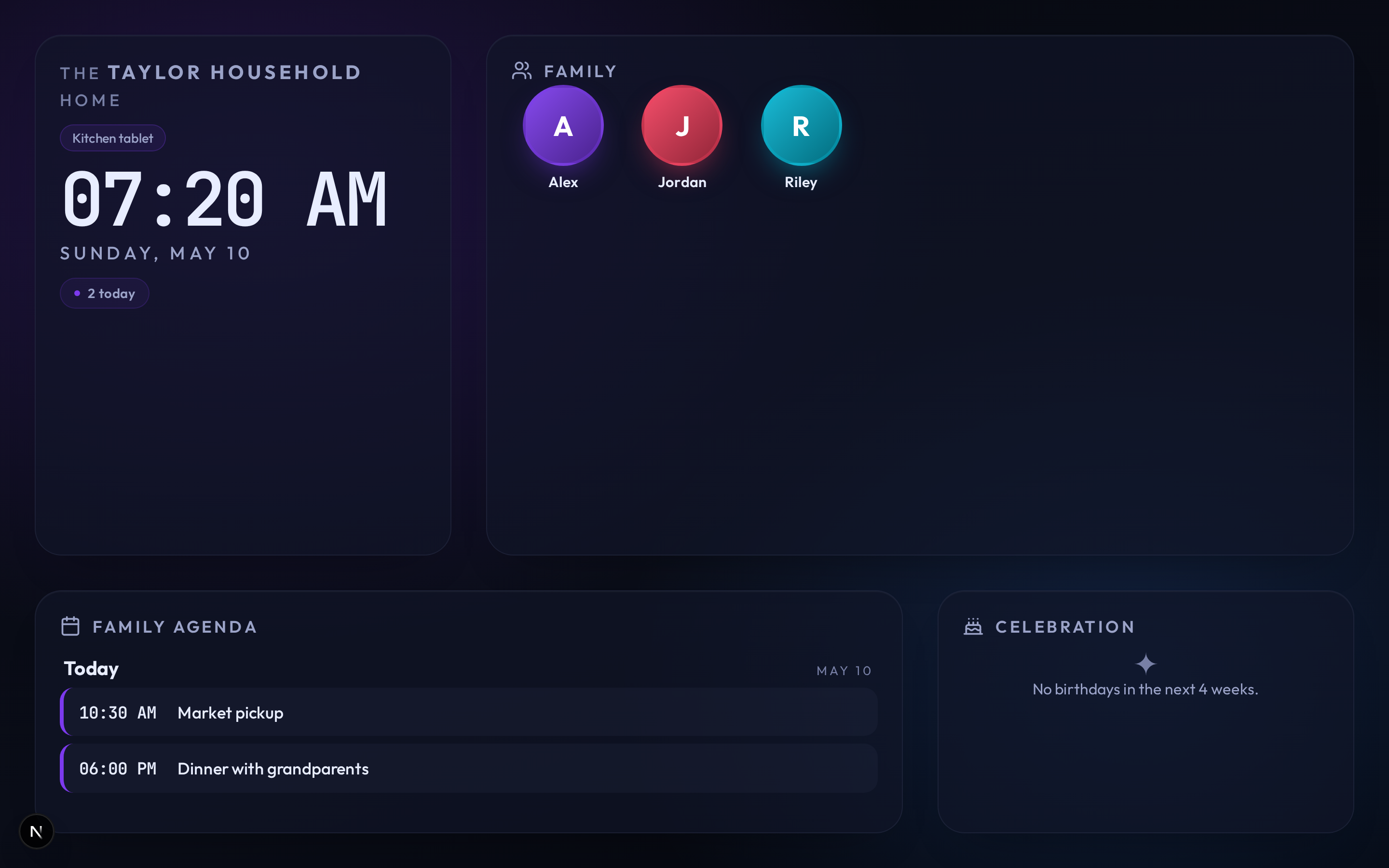
A read-only shared display for the day, agenda, and household context.
## Why Tribu? Family life usually ends up split across calendars, chats, notes, shopping apps, and memory. Tribu brings the daily moving parts into one self-hosted home base your family can actually use. - Plan the week without bouncing between apps. - Make tasks, routines, meals, school, gifts, and responsibilities visible. - Keep shopping lists, contacts, birthdays, rewards, and reminders close to the calendar. - Put a read-only family dashboard on a kitchen tablet or hallway display. - Sync calendars and contacts to phones with CalDAV and CardDAV. - Connect automations through Home Assistant, webhooks, and scoped API tokens. ## Best fit for ### Households that want less scattered planning Use Tribu when your family needs one shared place for appointments, chores, groceries, birthdays, school details, dinner plans, gifts, and the small reminders that otherwise live in someone's head. ### Self-hosters who want a useful product, not just a stack Tribu runs with Docker Compose, published GHCR images, PostgreSQL, Valkey, and clear operations docs. You keep the setup on hardware you control, but the product still focuses on the people using it every day. ## Product tour The README keeps one current visual proof asset: the Shared Home Display above. The broader workflow details live in the Wiki so setup and feature guides stay focused and current. | Workflow | Where to read more | |---|---| | Shared Home Display | [Pair a read-only kitchen tablet or wall screen](https://github.com/itsDNNS/tribu/wiki/Shared-Home-Display) | | Calendar, tasks, shopping, meals, recipes, school, gifts, rewards, contacts, and notifications | [Documentation Wiki](https://github.com/itsDNNS/tribu/wiki) | | Phone sync | [CalDAV and CardDAV setup](https://github.com/itsDNNS/tribu/wiki/Self-Hosting#phone-sync-caldav--carddav) | | Home Assistant and webhooks | [Home Assistant guide](https://github.com/itsDNNS/tribu/wiki/Home-Assistant) | ## What Tribu covers today | Household job | Shipped in Tribu | |---|---| | See the day | Dashboard, activity, birthdays, reminders, quick actions | | Plan the week | Calendar, recurring events, school timetables, meal plans | | Share responsibility | Tasks, assignees, priorities, due dates, recurrence, templates | | Shop and cook | Shopping lists, recipes, meal plans, ingredient handoff | | Remember people and dates | Contacts, birthdays, gifts, profile details | | Motivate routines | Rewards, earning rules, reward catalog, child progress | | Find things fast | Global search across household data | | Put it on a shared screen | Pairable Shared Home Display with read-only display tokens | | Keep phones connected | CalDAV and CardDAV sync for calendars and contacts | | Automate the household | Home Assistant package, webhooks, scoped API tokens | | Run it yourself | Docker Compose, GHCR images, backup docs, reverse proxy docs, MIT license | | Use it in your language | 24 UI languages | ## Phone Sync Tribu supports CalDAV and CardDAV for bidirectional phone sync, so calendars and contacts can work with mobile devices and DAV-compatible clients. **Works with:** - iPhone and iPad through the built-in Calendar and Contacts apps - Android through DAV-compatible clients such as DAVx5 - DAV servers and clients documented in the [Self-Hosting guide](https://github.com/itsDNNS/tribu/wiki/Self-Hosting#phone-sync-caldav--carddav) After setup, open **Settings -> Phone sync** in Tribu to copy the CalDAV and CardDAV URLs for each family. ## Shared Home Display Tribu can turn a kitchen tablet, hallway screen, or wall display into a shared family dashboard without signing in as a real person. A display is a device, not a fake family member. Admins pair a dedicated display device, the tablet receives a revocable read-only token, and `/display` shows selected household information without loading the normal app shell, profile flows, notifications center, settings, user IDs, emails, or calendar source URLs. [See the Shared Home Display setup guide](https://github.com/itsDNNS/tribu/wiki/Shared-Home-Display). ## Start in the way that fits you - **Feel the product first:** open Tribu and click **Try demo** on the login page for realistic sample data. - **Deploy in your stack:** use the Docker Compose quick start below or paste the stack into Portainer, Dockge, or Dockhand. - **Set up phone sync:** add the CalDAV and CardDAV URLs to iOS, iPadOS, Android, or a DAV-compatible client. - **Pair a shared display:** create a display under Admin -> Displays and open the pairing link on the tablet. - **Connect Home Assistant:** use the [Home Assistant guide](https://github.com/itsDNNS/tribu/wiki/Home-Assistant) for sensors, quick capture, webhooks, and dashboard examples. ## Quick Start Run Tribu with Docker Compose on a server, NAS, mini PC, or homelab box. ### Option A: stack UI Use this when you prefer Portainer, Dockge, Dockhand, or another stack editor. ```yaml name: tribu services: postgres: image: postgres:16-alpine container_name: tribu-postgres restart: unless-stopped environment: POSTGRES_DB: tribu POSTGRES_USER: tribu POSTGRES_PASSWORD: ${POSTGRES_PASSWORD} volumes: - tribu_pg_data:/var/lib/postgresql/data valkey: image: valkey/valkey:8-alpine container_name: tribu-valkey restart: unless-stopped backend: image: ghcr.io/itsdnns/tribu-backend:latest container_name: tribu-backend restart: unless-stopped environment: DATABASE_URL: postgresql://tribu:${POSTGRES_PASSWORD}@postgres:5432/tribu REDIS_URL: redis://valkey:6379/0 JWT_SECRET: ${JWT_SECRET} SECURE_COOKIES: ${SECURE_COOKIES:-false} JWT_EXPIRE_HOURS: ${JWT_EXPIRE_HOURS:-24} REFRESH_TOKEN_EXPIRE_DAYS: ${REFRESH_TOKEN_EXPIRE_DAYS:-30} TZ: ${TZ:-} depends_on: [postgres, valkey] ports: ["8000:8000"] volumes: - tribu_backups:/backups frontend: image: ghcr.io/itsdnns/tribu-frontend:latest container_name: tribu-frontend restart: unless-stopped depends_on: [backend] ports: ["3000:3000"] volumes: tribu_pg_data: tribu_backups: ``` Set the required secrets before deploying. The public Compose stack exposes only the frontend by default; the backend stays reachable to the frontend on the internal Docker network. Set `TZ` when you want family calendar times, task due dates, reminder windows, and quiet hours to use a local household timezone instead of UTC. Audit and technical session timestamps remain UTC. | Variable | Description | |---|---| | `JWT_SECRET` | Random 64-character hex string for JWT signing. Keep it stable in the persisted `.env` so routine updates do not end active sessions. | | `POSTGRES_PASSWORD` | Random 32-character hex string for the database. | | `TZ` | Optional IANA timezone for family calendar/task times and reminder windows, for example `Europe/Berlin`. If unset or invalid, Tribu falls back to UTC. Audit timestamps remain UTC. | | `CORS_ALLOWED_ORIGINS` | Optional comma-separated exact browser origins for deployments that call the backend directly. The default allows localhost development origins only. | | `CORS_ALLOW_LAN_ORIGINS` | Optional `true` to allow `192.168.x.x` browser origins when you deliberately expose the backend on a LAN. | | `TRUSTED_PROXY_CIDRS` | Optional comma-separated proxy CIDRs whose `X-Forwarded-For` header may be used for login/register rate-limit keys. Leave unset unless a trusted reverse proxy sits in front of the backend. | | `SUBSCRIPTIONS_ALLOW_PRIVATE_NETWORKS` | Optional `true` to let ICS calendar subscriptions fetch private/LAN feed URLs such as a self-hosted calendar server. Leave `false` unless you trust the feed targets. | Generate the values and write them into `.env`: ```bash python3 - <<'PY' from pathlib import Path import secrets env = Path(".env") text = env.read_text() text = text.replace("JWT_SECRET=", f"JWT_SECRET={secrets.token_hex(32)}", 1) text = text.replace("POSTGRES_PASSWORD=", f"POSTGRES_PASSWORD={secrets.token_hex(16)}", 1) env.write_text(text) PY ``` Deploy the stack, open [localhost:3000](http://localhost:3000), and register. The first user becomes the family admin. ### Option B: CLI ```bash mkdir tribu && cd tribu curl -LO https://raw.githubusercontent.com/itsDNNS/tribu/main/docker/docker-compose.yml curl -LO https://raw.githubusercontent.com/itsDNNS/tribu/main/docker/.env.example cp .env.example .env # Fill in JWT_SECRET and POSTGRES_PASSWORD docker compose up -d ``` For HTTPS, secure cookies, backups, updates, rollback, phone sync, and troubleshooting, use the [Self-Hosting guide](https://github.com/itsDNNS/tribu/wiki/Self-Hosting). ## Tech stack - **Frontend:** Next.js 16, React 19, Lucide Icons, CSS custom properties - **Backend:** FastAPI, SQLAlchemy, Python 3.13+ - **Database:** PostgreSQL 16 - **Cache:** Valkey 8 - **Deployment:** Docker Compose, multi-arch GHCR images for amd64 and arm64 ## Project signals - Versioned releases and release notes - Published frontend and backend container images - MIT license - Security policy and responsible disclosure path - Public roadmap, changelog, and Discussions - Wiki guides for self-hosting, backup and restore, Home Assistant, phone sync, shared display, SSO, and architecture ## Documentation Use the [GitHub Wiki](https://github.com/itsDNNS/tribu/wiki) as the primary documentation entry point for setup, self-hosting, operations, integrations, troubleshooting, roadmap, and release-oriented guides. | Need | Start here | |---|---| | Product overview | [Product page](https://itsdnns.github.io/tribu/) and this README | | Full docs | [Documentation Wiki](https://github.com/itsDNNS/tribu/wiki) | | Install and operate | [Self-Hosting](https://github.com/itsDNNS/tribu/wiki/Self-Hosting) | | Back up and restore | [Backup & Restore](https://github.com/itsDNNS/tribu/wiki/Backup-&-Restore) | | Shared display | [Shared Home Display](https://github.com/itsDNNS/tribu/wiki/Shared-Home-Display) | | Home Assistant | [Home Assistant](https://github.com/itsDNNS/tribu/wiki/Home-Assistant) | | Native app release readiness | [App repository release gate](https://github.com/itsDNNS/tribu-app/issues/14) and [backend/web ownership note](docs/native-app-release-readiness.md) | | Contribute | [Contributing](CONTRIBUTING.md) | | Security reports | [Security Policy](SECURITY.md) | | Releases | [Releases](https://github.com/itsDNNS/tribu/releases) | ## Support If Tribu helps your family stay organized, consider supporting development. If you are a self-hoster or contributor, starring the repo, opening issues, improving docs, joining Discussions, or contributing code all help make the project stronger too. - [Ko-fi](https://ko-fi.com/itsdnns) - [PayPal](https://paypal.me/itsDNNS) - [GitHub Sponsors](https://github.com/sponsors/itsDNNS) ## License Tribu is released under the **MIT License**. See [LICENSE](LICENSE) for the full text. ---Built with care by the itsDNNS family.