
Understand any codebase instantly.
System intelligence for humans and AI.
Ix parses your repository into a persistent system graph of symbols, calls, imports and relationships
so you and your coding agents can query structure instead of grepping and guessing.





Website ·
Discord ·
Sponsor
---
### Kartr
**[Kartr](https://www.ix-infra.com)** is an agent platform built on the same memory
engine we use for Ix, extended to the sources a codebase does not contain: docs and
files, email and calendar, meetings and notes, and team chat. Agents carry context
across all of them.
Kartr is in alpha and onboarding early users.

---
### Try Ix
```bash
curl -fsSL https://ix-infra.com/install.sh | sh # macOS / Linux
```
On Windows, use the PowerShell installer under [Install](#install).
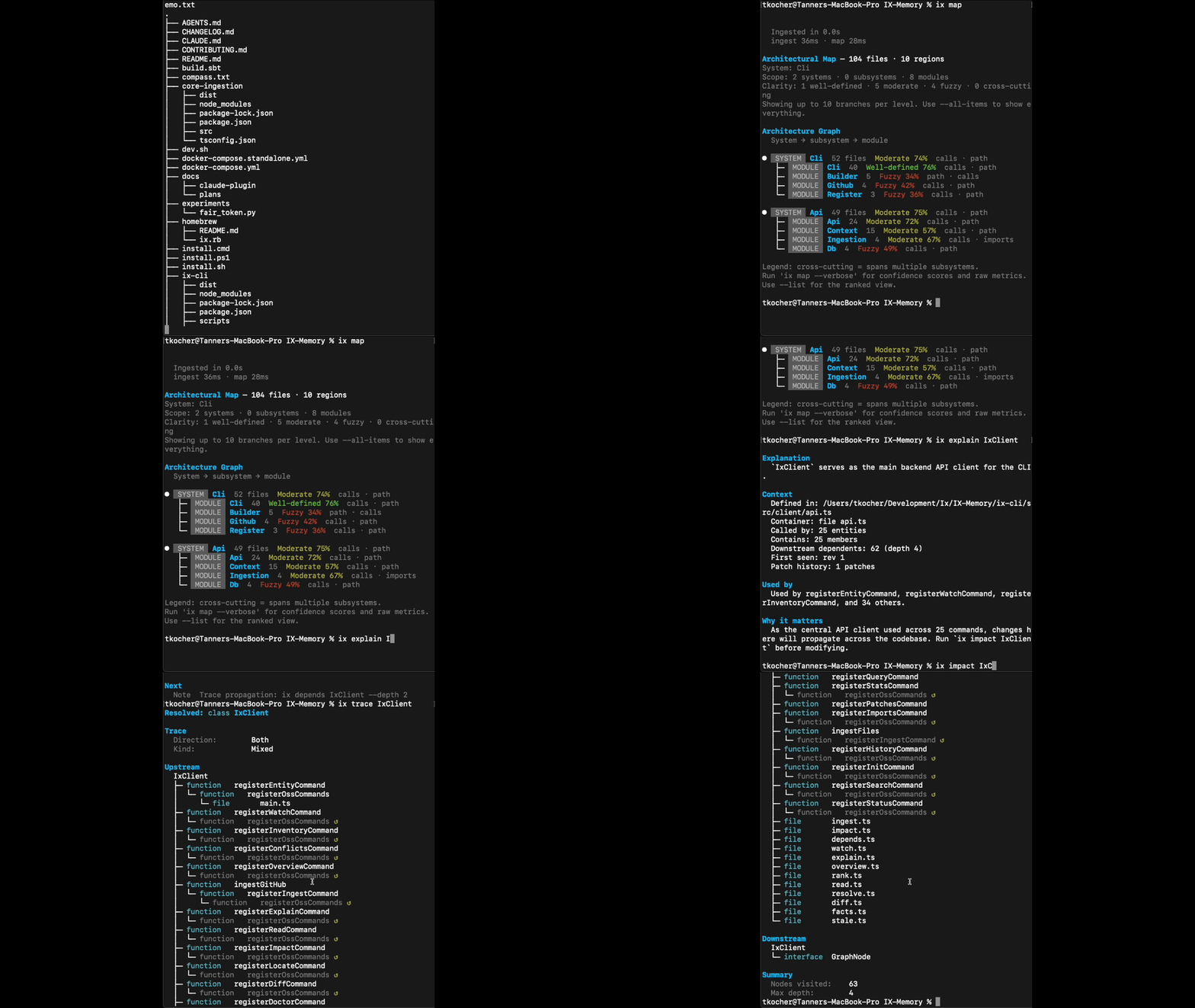
```bash
ix map . # build the graph for this repo
ix explain AuthService # what is this, and what does it touch?
ix trace user_login_flow # how does this actually flow?
ix impact verify_token # what breaks if I change this?
```
The graph lives on your machine and persists between sessions. Your agent navigates
it through [MCP](#integrations) instead of re-deriving your architecture
from whatever fits in a prompt.
---
### Why Ix
| | Without Ix | With Ix |
|---|---|---|
| **Finding things** | Search, read, search again | Query a structured graph |
| **Architecture** | Re-derived every session | Mapped once, kept |
| **Agent context** | Whole files pasted into the prompt | Bounded structural slices |
| **Between sessions** | Context is lost | The graph persists |
| **Relationships** | Inferred from fragments | Read from real edges |
---
### The model
**Map → Structure → Retrieve → Remember**
| Step | What happens |
|---|---|
| **Map** | `ix map .` parses the repo with tree-sitter and extracts symbols, calls and imports. |
| **Structure** | Those become nodes and edges in a graph of what calls, contains and imports what. |
| **Retrieve** | Commands return bounded answers about one symbol or flow, not whole files. |
| **Remember** | The graph is stored locally and survives between sessions and agent runs. |
---
### How it works
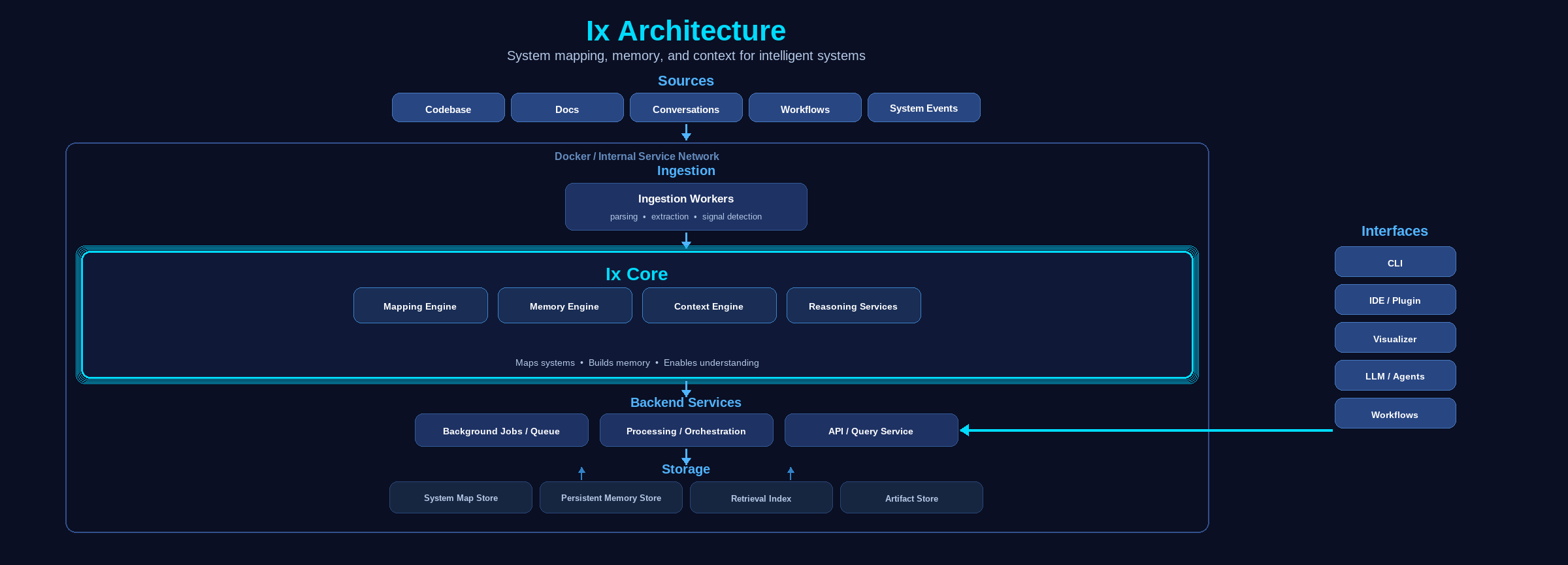
`ix map` parses your repository with tree-sitter, extracts symbols, calls and
imports, and persists them as a graph in a local backend: ArangoDB plus the memory
layer, run for you in Docker. Three clients read that graph: the `ix` CLI, the
`ix mcp` server your AI clients connect to, and Compass, the visualizer `ix view`
opens.
The backend ships as a released Docker image; it is not built from this repo. See
the [HTTP API reference](./docs/api/) for the endpoints all three clients share.
---
### Results
Across our own development work, querying the graph instead of feeding files into
the prompt cut token use by **30–99.7%**, varying widely with the task and the size
of the repo. These are internal measurements, not a published benchmark.
The mechanism is the plain part: `ix explain AuthService` returns that symbol and
its immediate relationships. Answering the same question by reading the file and
the files it imports costs far more, and costs it again next session.
---
### Integrations
Ix ships a stdio MCP server, so any MCP-capable client can use the same graph tools.
```bash
ix mcp install # detect installed clients and register `ix mcp` with each
ix mcp install --dry-run # show what would change, write nothing
ix mcp doctor # check each client's registration
```
`install` knows **Claude Code, Codex, Cursor, VS Code, Gemini CLI, OpenClaw and
opencode**. It writes through each client's own MCP command where one exists, and
never overwrites a server name it does not own. Pass `--force` to replace one, or
`--host ` to limit the run. Per-client write mechanics, repair and process
isolation are in [docs/mcp.md](./docs/mcp.md).
To register one client by hand:
```bash
codex mcp add ix-memory -- ix mcp
```
#### Agent skill
[`skills/ix/`](skills/ix/SKILL.md) teaches any LLM agent to drive the CLI. It follows the
[Claude Code skill format](https://code.claude.com/docs/en/skills) and the
[agents.md](https://agents.md) standard, so Claude Code, Codex, Cursor and any agent
that reads `~/.agents/skills` all load the same tree from their own skills directory.
```bash
bash scripts/install-skill.sh # deploy to every harness found (--dry-run to preview)
```
Then ask your agent: *"Set up Ix and map this repo."*
#### Native plugins
Optional per-client packages, if you prefer them to `ix mcp install`:
```bash
# Claude Code
/plugin marketplace add ix-infrastructure/ix-claude-plugin
/plugin install ix-memory
# Codex
curl -fsSL https://ix-infra.com/codex-install.sh | sh
# OpenClaw
openclaw plugins install ix-infrastructure/ix-openclaw-plugin
# Gemini
gemini extensions install https://github.com/ix-infrastructure/ix-gemini-plugin
# OpenCode
curl -fsSL https://raw.githubusercontent.com/ix-infrastructure/ix-opencode-plugin/main/install.sh | bash
# Cursor
curl -fsSL https://raw.githubusercontent.com/ix-infrastructure/ix-cursor-plugin/main/install.sh | bash
```
On Windows, the Codex, OpenCode and Cursor installers each have a PowerShell
version at the same URL, with `.ps1` in place of `.sh`:
```powershell
irm https://ix-infra.com/codex-install.ps1 | iex
```
---
### Install
**macOS / Linux**
```bash
curl -fsSL https://ix-infra.com/install.sh | sh
```
**Windows**: install Node.js 22+ and Docker Desktop first, then:
```powershell
irm https://ix-infra.com/install.ps1 | iex
```
Then map a repo and register your AI clients:
```bash
ix map .
ix mcp install
```
The installer checks for and installs anything missing: **Node.js 22+, Git, ripgrep**
(powers `ix text`), and **Docker + Docker Compose** for the local backend. All you need
beforehand is a terminal with `curl` or `wget`.
Platform notes and edge cases
Pre-built CLI packages are published for Apple Silicon macOS, Linux (x86-64 and
arm64) and Windows x86-64.
**Intel Macs** have no pre-built package. Install with Homebrew, which builds from
source:
```bash
brew tap ix-infrastructure/ix https://github.com/ix-infrastructure/Ix
brew install ix
```
For the full list, including the endpoints the installer reaches and the
directories it creates, see [docs/prerequisites.md](./docs/prerequisites.md).
**Upgrade**
```bash
ix upgrade --check # see whether an update is available
ix upgrade # upgrade the CLI, backend and components
```
**Uninstall**
```bash
curl -fsSL https://ix-infra.com/uninstall.sh | sh # macOS / Linux
```
```powershell
irm https://ix-infra.com/uninstall.ps1 | iex # Windows
```
This removes the CLI and the backend containers along with their data. To keep the
graph volume, set `IX_KEEP_DATA=1` for the script: `… | IX_KEEP_DATA=1 sh`, or
`$env:IX_KEEP_DATA = "1"` before the PowerShell line. If you installed with
Homebrew, run `brew uninstall ix` instead.
---
### Commands
Ix talks to a local backend, so start there if a command reports
`Ix backend not reachable`:
```bash
ix status # is the backend reachable?
ix docker start # start it (ArangoDB + memory layer)
ix doctor # server, database and graph integrity
```
Set `IX_DEBUG=1` for full stack traces on any error.
**Build the graph**
```bash
ix map . # map this repo
ix watch # re-map on change
ix reset --workspace # wipe this repo's graph (asks first)
ix reset # wipe every repo on the backend (--code keeps goals, plans and decisions)
```
**Understand**
```bash
ix search # find an entity by name
ix text # plain text search across the repo (ripgrep)
ix locate # jump to a definition
ix explain # what it is and what it touches
ix overview # one-shot structural summary
ix impact # blast radius of a change
ix read # read source, by symbol or path:line-range
```
**Explore**
```bash
ix trace # follow a flow up and down
ix callers # what calls this
ix callees # what this calls
ix depends # everything that depends on this, as a tree
ix imports # what this imports (ix imported-by for the reverse)
ix rank --by dependents --top 10 # find the load-bearing code
ix inventory --kind function # list components
ix history # how an entity changed
ix diff # compare two revisions
```
**Inspect the system**
```bash
ix view # open the Compass visualizer
ix subsystems # the architectural map saved by ix map
ix stats # graph statistics
ix smells # detect structural issues
```
Query commands take `--format text|json|llm`. Use `llm` when an agent reads the
output. It is token-minimal and newline-delimited
([spec](./docs/llm-format.md)). Use `json` when chaining commands.
Exhaustive references: **[commands](skills/ix/references/commands.md)** ·
**[flags](skills/ix/references/flags.md)** ·
**[output formats](skills/ix/references/output-formats.md)** ·
**[troubleshooting](skills/ix/references/troubleshooting.md)**
---
### Supported languages
Symbols, calls and imports are extracted across **27 languages**:
`JavaScript` `TypeScript` `Python` `Java` `C` `C++` `C#` `Go` `Ruby` `Rust` `PHP`
`Kotlin` `Swift` `Scala` `R` `SAS` `Elixir` `Haskell` `Zig` `Lua` `Bash`
`PowerShell` `HTML` `XML` `CSS` `HCL / Terraform` `Makefile`
CUDA (`.cu` / `.cuh`) is parsed with the C++ grammar, including kernel-launch
syntax (`kernel<<>>(args)`), so host-to-kernel calls appear in the
graph. Python stub files (`.pyi`) are parsed as Python.
Also recognized as config and data formats: `YAML` `JSON` `TOML` `SQL`
`Protocol Buffers` `Dockerfile` `Markdown` `LaTeX`
---
### Contributing
Issues and pull requests are welcome. See [CONTRIBUTING.md](CONTRIBUTING.md) for local
setup, and [SECURITY.md](SECURITY.md) to report a vulnerability.
Website ·
Discord ·
Sponsor
Licensed under Apache 2.0. ⭐ Star the repo if Ix is useful to you.