
English | 简体中文







InSARHub is a modular Python framework for automated InSAR and time-series processing.
The primary goal of this package is to provide a streamlined and user-friendly InSAR processing experience across multiple satellite products. InSARHub currently supports:
| Satellite | Product | Mode | Download | IFG Generation | Timeseries Analysis |
|-----------|---------|------|----------|----------------|---------------------|
| Sentinel-1 | SLC | Mixed¹ / Local / HPC / Docker | ✅ | ✅ | ✅ |
| Sentinel-1 | Burst | Local / HPC / Docker | ✅ | ✅ | ✅ |
| NISAR | GSLC | Local / HPC / Docker | ✅ | ✅ | ✅ |
> ¹ **Mixed** — process pipeline that mixed with cloud processing and local processing
## Table of Contents
- [Web UI](#web-ui)
- [Installation](#installation)
- [Requirements](#requirements)
- [Usage](#usage)
- [CLI](#cli)
- [Documentation](#documentation)
## Web UI
InSARHub includes a **self-hosted web interface** that covers the full InSAR workflow — from scene search and download through interferogram processing to time-series analysis.
```bash
insarhub-app
```
Open `http://localhost:8080` to access the UI.
All data stays on your machine — InSARHub runs a local FastAPI server and delivers a modern React frontend directly in your browser.
See the [Web UI documentation](https://jldz9.github.io/InSARHub/latest/quickstart/frontend/) for a full walkthrough.
### Search & Download
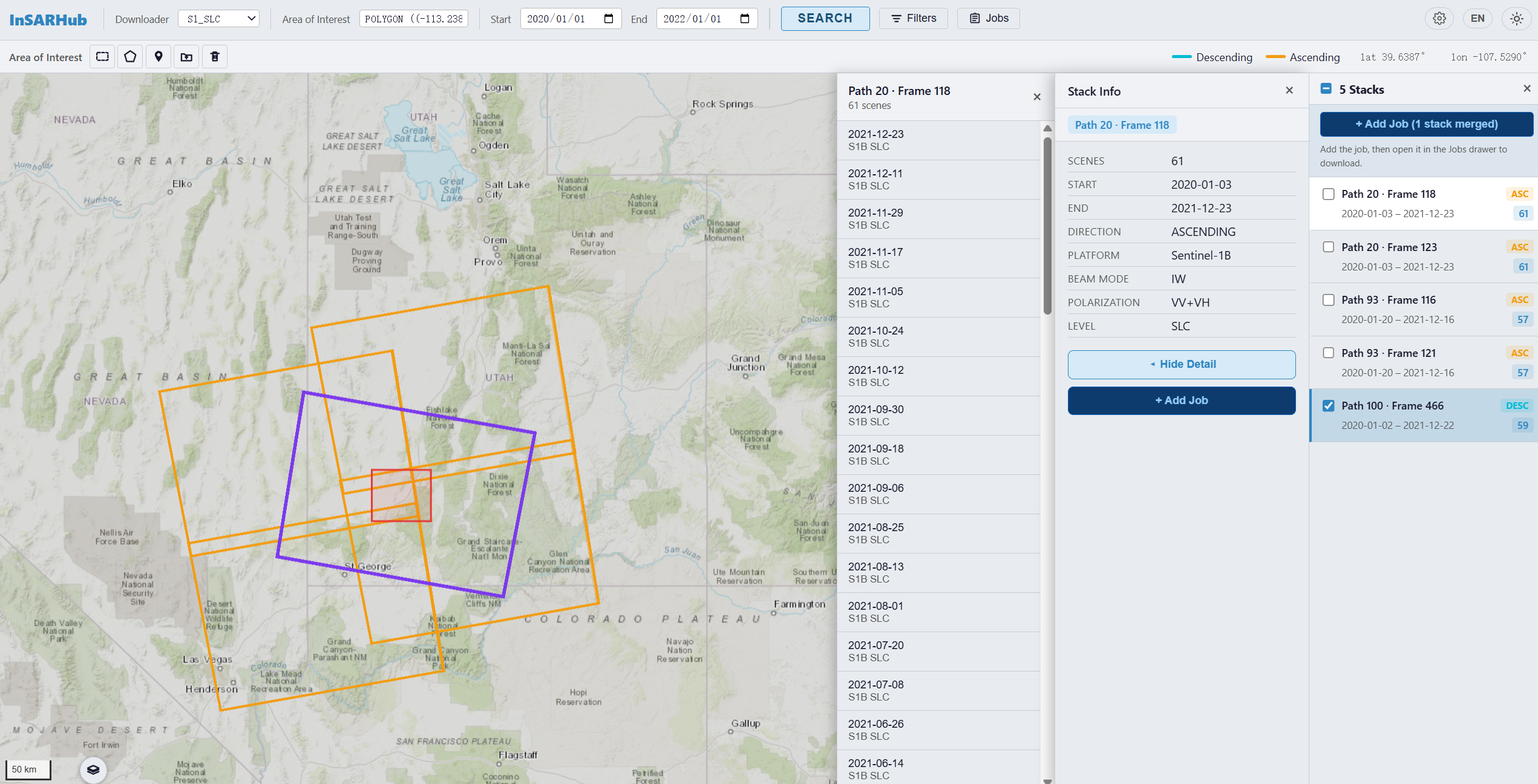
Draw an AOI on the interactive map, set a date range and orbit filters, and search ASF for Sentinel-1 SLC stacks. InSARHub groups results by track/frame and downloads scenes and precise orbit files automatically.
 ### Pair Selection & Quality Scoring
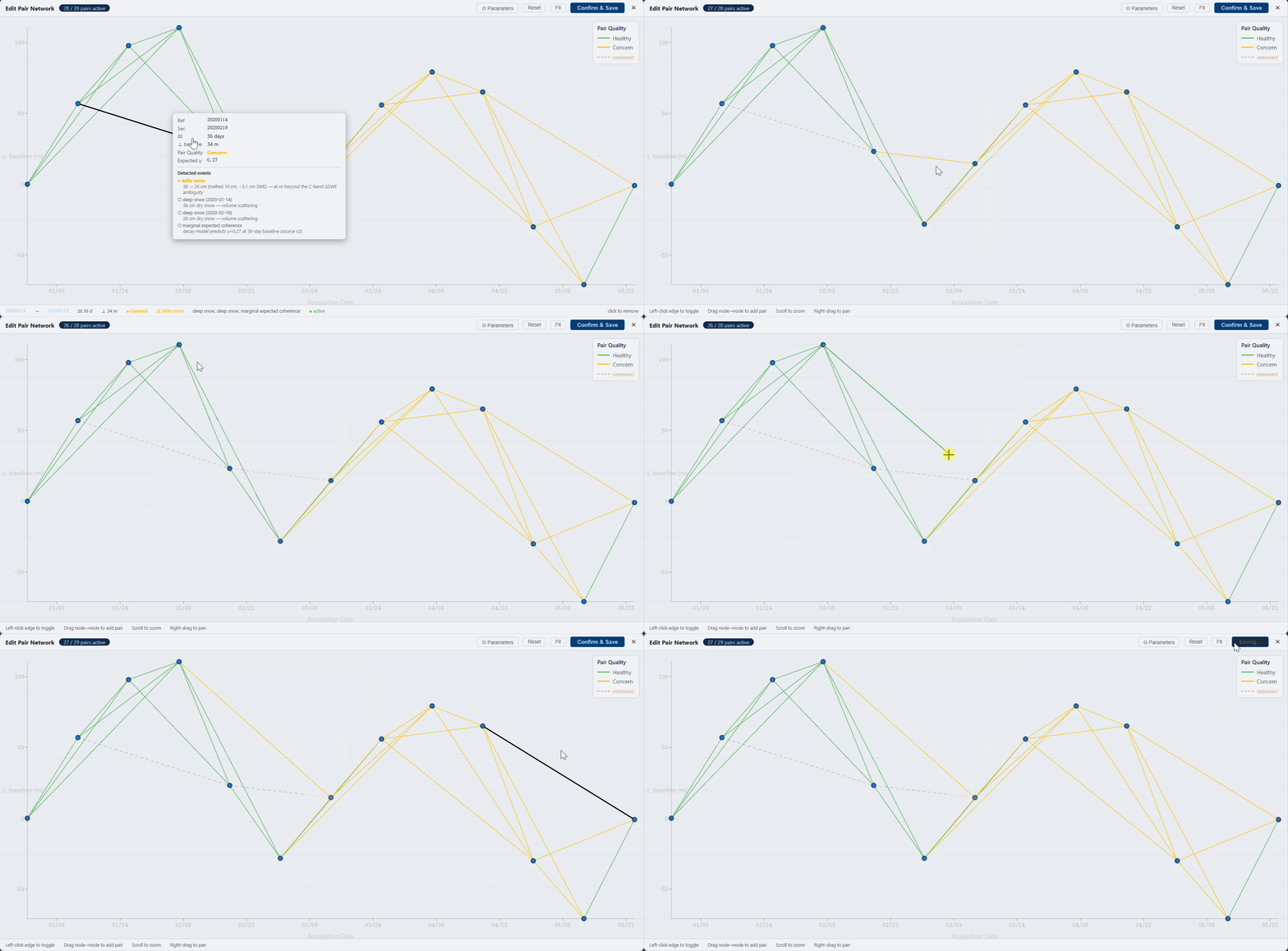
Build the interferogram network interactively. Pairs are colored by score so weak connections stand out immediately. Adjust temporal or perpendicular baseline limits and drag nodes/edges to refine the network live.
### Pair Selection & Quality Scoring
Build the interferogram network interactively. Pairs are colored by score so weak connections stand out immediately. Adjust temporal or perpendicular baseline limits and drag nodes/edges to refine the network live.
 ### Processor
Submit the selected pairs to a cloud or local InSAR engine, run them locally or via SLURM (or inside Docker), monitor job status, download results, and retry failed jobs from the same panel.
| Processor | Satellite / Product | Engine | Execution | Output |
|-----------|--------------------|--------|-----------|--------|
| `Hyp3_S1` | Sentinel-1 SLC | HyP3 (GAMMA, cloud) | Cloud | Geocoded interferograms |
| `ISCE2_S1` | Sentinel-1 SLC | ISCE2 `stackSentinel` | Local / HPC / Docker | Coregistered stack + interferograms |
| `GMTSAR_S1` | Sentinel-1 SLC | GMTSAR (`p2p_processing`) | Local / HPC / Docker | Geocoded interferograms + stack |
| `ISCE3_Burst` | Sentinel-1 Burst | ISCE3 + COMPASS | Local / HPC / Docker | Geocoded burst SLCs + interferograms |
| `ISCE3_NISAR` | NISAR GSLC | ISCE3 + dolphin | Local / HPC / Docker | Phase-linked interferograms |
### Analyzer
Run time-series analysis step by step. Edit the network post-ingest, inspect diagnostic overview layers, and export velocity and displacement maps when done. Each analyzer is matched to the processor that generated the interferograms.
| Analyzer | Compatible Processor | Method | Output |
|----------|---------------------|--------|--------|
| `Hyp3_Mintpy_SBAS` | `Hyp3_S1` | MintPy SBAS | Velocity + displacement time series |
| `ISCE2_Mintpy_SBAS` | `ISCE2_S1` | MintPy SBAS | Velocity + displacement time series |
| `GMTSAR_Mintpy_SBAS` | `GMTSAR_S1` | MintPy SBAS (`prep_gmtsar.py`) | Velocity + displacement time series |
| `GMTSAR_SBAS` | `GMTSAR_S1` | GMTSAR-native SBAS (`sbas` binary, no MintPy) | `disp_*.grd` + `vel.grd` |
| `ISCE3_Dolphin_S1_PL` | `ISCE3_Burst` | dolphin phase-linking | Cumulative displacement, velocity, residuals |
| `ISCE3_Dolphin_NISAR_PL` | `ISCE3_NISAR` | dolphin phase-linking (L-band wavelength from GSLC metadata) | Cumulative displacement, velocity, residuals |
### Results Viewer
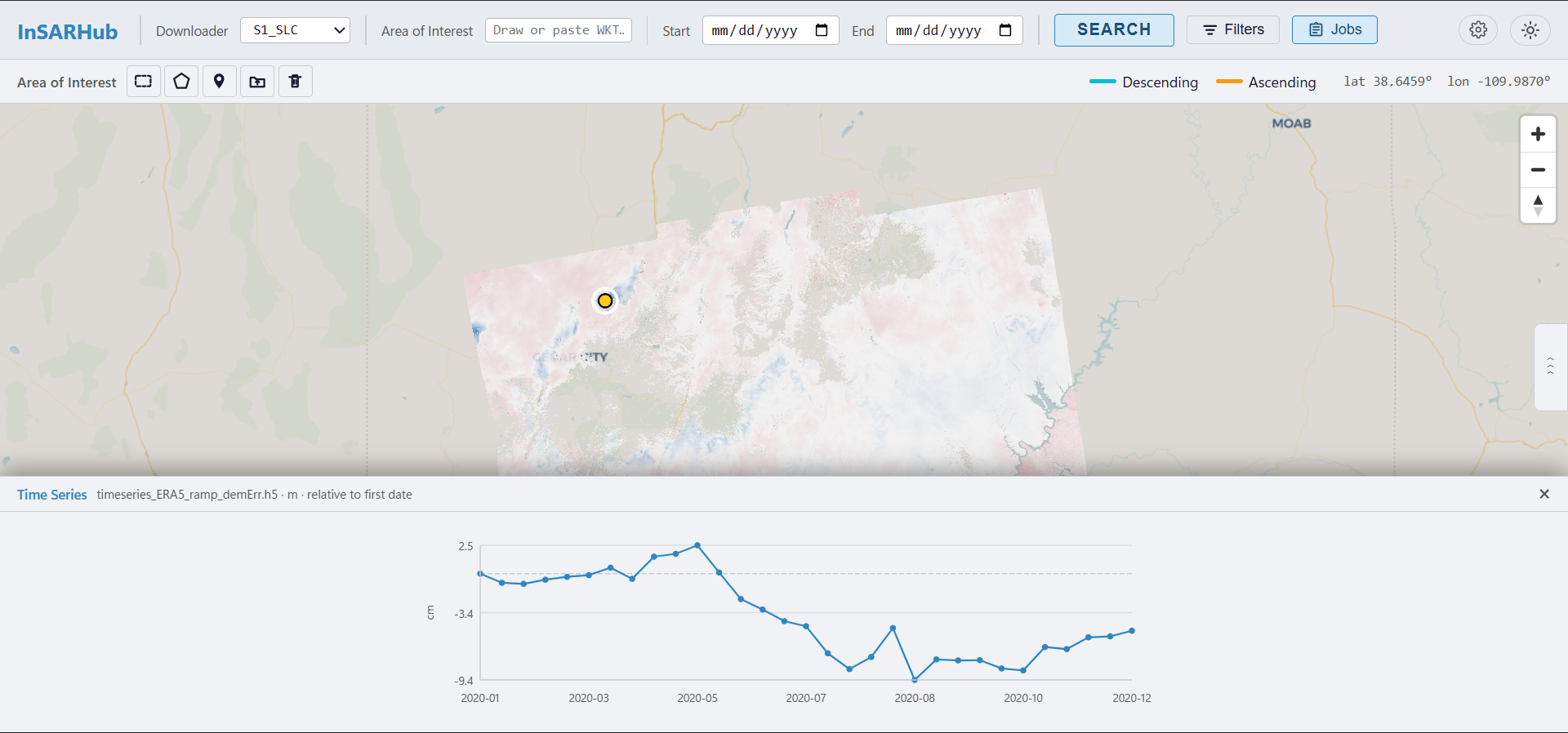
Overlay the LOS velocity map on the basemap and click any pixel to plot its full displacement time series.
### Processor
Submit the selected pairs to a cloud or local InSAR engine, run them locally or via SLURM (or inside Docker), monitor job status, download results, and retry failed jobs from the same panel.
| Processor | Satellite / Product | Engine | Execution | Output |
|-----------|--------------------|--------|-----------|--------|
| `Hyp3_S1` | Sentinel-1 SLC | HyP3 (GAMMA, cloud) | Cloud | Geocoded interferograms |
| `ISCE2_S1` | Sentinel-1 SLC | ISCE2 `stackSentinel` | Local / HPC / Docker | Coregistered stack + interferograms |
| `GMTSAR_S1` | Sentinel-1 SLC | GMTSAR (`p2p_processing`) | Local / HPC / Docker | Geocoded interferograms + stack |
| `ISCE3_Burst` | Sentinel-1 Burst | ISCE3 + COMPASS | Local / HPC / Docker | Geocoded burst SLCs + interferograms |
| `ISCE3_NISAR` | NISAR GSLC | ISCE3 + dolphin | Local / HPC / Docker | Phase-linked interferograms |
### Analyzer
Run time-series analysis step by step. Edit the network post-ingest, inspect diagnostic overview layers, and export velocity and displacement maps when done. Each analyzer is matched to the processor that generated the interferograms.
| Analyzer | Compatible Processor | Method | Output |
|----------|---------------------|--------|--------|
| `Hyp3_Mintpy_SBAS` | `Hyp3_S1` | MintPy SBAS | Velocity + displacement time series |
| `ISCE2_Mintpy_SBAS` | `ISCE2_S1` | MintPy SBAS | Velocity + displacement time series |
| `GMTSAR_Mintpy_SBAS` | `GMTSAR_S1` | MintPy SBAS (`prep_gmtsar.py`) | Velocity + displacement time series |
| `GMTSAR_SBAS` | `GMTSAR_S1` | GMTSAR-native SBAS (`sbas` binary, no MintPy) | `disp_*.grd` + `vel.grd` |
| `ISCE3_Dolphin_S1_PL` | `ISCE3_Burst` | dolphin phase-linking | Cumulative displacement, velocity, residuals |
| `ISCE3_Dolphin_NISAR_PL` | `ISCE3_NISAR` | dolphin phase-linking (L-band wavelength from GSLC metadata) | Cumulative displacement, velocity, residuals |
### Results Viewer
Overlay the LOS velocity map on the basemap and click any pixel to plot its full displacement time series.
 ---
## Installation
InSARHub can be installed using Conda:
```bash
conda install insarhub -c conda-forge
```
Pip:
```bash
conda install gdal -c conda-forge
pip install insarhub
```
From source:
```bash
git clone https://github.com/jldz9/InSARHub.git
cd InSARHub
conda env create -f environment.yml -n insarhub_dev
conda activate insarhub_dev
pip install -e .
```
The commands above install base InSARHub (HyP3 + MintPy). Local processing with **ISCE2**, **ISCE3 + dolphin**, or **GMTSAR** each needs its own toolchain added to the environment. See the [Installation guide](https://jldz9.github.io/InSARHub/latest/quickstart/install/) for the per-processor install steps.
### Run in a container
Skip installing the heavy SAR toolchains locally and run each processor/analyzer inside Docker instead. Install base InSARHub (Conda/pip above), then pass `--container` to any processor or analyzer command — InSARHub pulls the matching image and runs the step inside it, mounting your workdir automatically:
```bash
insarhub processor -N ISCE2_S1 -w /data/p100_f466 --bbox 33.0 38.0 -120.0 -115.0 submit --container
```
Prebuilt images (`ghcr.io/jldz9/insarhub-*:dev`):
| Image | Covers |
|-------|--------|
| `insarhub-base` | `Hyp3_S1` + `Hyp3_Mintpy_SBAS` (Sentinel-1 via HyP3) |
| `insarhub-isce2-mintpy` | `ISCE2_S1` + `ISCE2_Mintpy_SBAS` |
| `insarhub-gmtsar-mintpy` | `GMTSAR_S1` + GMTSAR analyzers |
| `insarhub-isce3-dolphin` | `ISCE3_Burst`, `ISCE3_NISAR` + `ISCE3_Dolphin_S1_PL`, `ISCE3_Dolphin_NISAR_PL` |
You can also run entirely inside a container instead of installing anything locally. See the [Container Execution guide](https://jldz9.github.io/InSARHub/latest/advanced/container/) for details, and the Dockerfiles under [`docker/`](docker/) to build your own.
## Requirements
- Python >=3.11,<3.13
- numpy <2.0
- proj >=9.4
- gdal >=3.8
- sqlite >=3.44
- mintpy
- asf_search
- colorama
- contextily
- dem_stitcher
- hyp3_sdk
- rasterio >=1.4
- sentineleof
- pyproj
- fastapi
- uvicorn
- python-multipart
## Usage
### Downloader:
```python
from insarhub import Downloader
```
- View available downloaders
```python
Downloader.available()
```
- Create downloader
```python
dl = Downloader.create('S1_SLC',
intersectsWith=[-113.05, 37.74, -112.68, 38.00],
start='2020-01-01',
end='2020-12-31',
relativeOrbit=100,
frame=466,
workdir='path/to/dir')
```
- Search
```python
results = dl.search()
```
- Filter
```python
filter_result = dl.filter(start='2020-02-01')
```
- Select interferogram pairs
```python
from insarhub.utils import plot_pair_network
pairs, baselines, scene_bperp = dl.select_pairs(dt_max=96, pb_max=150)
fig = plot_pair_network(pairs, baselines, scene_bperp)
fig.show()
```
- Download
```python
dl.download()
```
### Processor:
```python
from insarhub import Processor
```
- View available processors
```python
Processor.available()
```
See the [Processor table](#processor) above for the full list. Example workflows for two engines:
#### HyP3 (cloud)
```python
processor = Processor.create('Hyp3_S1', workdir='/your/work/path', pairs=pairs)
jobs = processor.submit()
jobs = processor.refresh()
processor.download()
```
#### ISCE2 (local / HPC)
Requires SLC `.SAFE` files already downloaded. Runs ISCE2 `stackSentinel` locally or submits each step to SLURM with `hpc_mode=True`.
```python
from insarhub.config import ISCE2_S1_Config
cfg = ISCE2_S1_Config(
workdir='/data/p100_f466',
bbox=[33.0, 38.0, -120.0, -115.0], # [S, N, W, E]
)
processor = Processor.create('ISCE2_S1', pairs=pairs, config=cfg)
processor.submit() # starts background execution
processor.refresh() # check step status
```
### Analyzer
```python
from insarhub import Analyzer
```
- View available analyzers
```python
Analyzer.available()
```
See the [Analyzer table](#analyzer) above for the full list. Example workflows:
#### HyP3 outputs
```python
analyzer = Analyzer.create('Hyp3_Mintpy_SBAS', workdir="/your/work/dir")
analyzer.prep_data() # unzip and clip HyP3 products
analyzer.run() # full MintPy SBAS pipeline
```
#### ISCE2 outputs
```python
analyzer = Analyzer.create('ISCE2_Mintpy_SBAS', workdir="/your/work/dir")
analyzer.prep_data() # auto-discover ISCE2 interferograms and geometry
analyzer.run() # full MintPy SBAS pipeline
```
## CLI
InSARHub includes a command-line interface for running the full pipeline without writing Python code, suitable for HPC batch jobs and scripted workflows.
```bash
insarhub [options]
```
### End-to-end example — HyP3 (cloud)
```bash
# Search scenes and select interferogram pairs
insarhub downloader -N S1_SLC \
--AOI -113.05 37.74 -112.68 38.00 \
--start 2020-01-01 --end 2020-12-31 \
--stacks 100:466 \
-w /data/bryce \
--select-pairs
# Submit pairs to HyP3 (auto-reads stack_p*_f*.json from workdir subfolders)
insarhub processor -N Hyp3_S1 -w /data/bryce submit
# Wait for jobs and download results automatically
insarhub processor -w /data/bryce watch
# Run MintPy time-series analysis
insarhub analyzer -N Hyp3_Mintpy_SBAS -w /data/bryce run
```
### End-to-end example — ISCE2 (local / HPC)
```bash
# Search and download SLC scenes + orbits
insarhub downloader -N S1_SLC \
--AOI -113.05 37.74 -112.68 38.00 \
--start 2020-01-01 --end 2020-12-31 \
--stacks 100:466 \
-w /data/p100_f466 \
--select-pairs --download --orbits
# Dry run to verify ISCE2 config before committing
insarhub processor -N ISCE2_S1 -w /data/p100_f466 \
--bbox 33.0 38.0 -120.0 -115.0 submit --dry-run
# Run ISCE2 stackSentinel locally (background) or on SLURM (--hpc_mode True)
insarhub processor -N ISCE2_S1 -w /data/p100_f466 \
--bbox 33.0 38.0 -120.0 -115.0 submit
# Monitor step progress
insarhub processor -N ISCE2_S1 -w /data/p100_f466 refresh
# Run MintPy time-series analysis on ISCE2 outputs
insarhub analyzer -N ISCE2_Mintpy_SBAS -w /data/p100_f466 run
```
### Commands
| Command | Description |
|---------|-------------|
| `insarhub downloader` | Search scenes, select interferogram pairs, and download data |
| `insarhub processor` | Submit and manage InSAR processing jobs |
| `insarhub analyzer` | Run time-series analysis on processed interferograms |
| `insarhub utils` | Helper utilities (pair selection, network plot, SLURM, ERA5, clip) |
Use `insarhub --help` for full option details, or see the [CLI Reference](https://jldz9.github.io/InSARHub/latest/advanced/cli_reference/).
## Documentation
[InSARHub documentation](https://jldz9.github.io/InSARHub/)
---
## Installation
InSARHub can be installed using Conda:
```bash
conda install insarhub -c conda-forge
```
Pip:
```bash
conda install gdal -c conda-forge
pip install insarhub
```
From source:
```bash
git clone https://github.com/jldz9/InSARHub.git
cd InSARHub
conda env create -f environment.yml -n insarhub_dev
conda activate insarhub_dev
pip install -e .
```
The commands above install base InSARHub (HyP3 + MintPy). Local processing with **ISCE2**, **ISCE3 + dolphin**, or **GMTSAR** each needs its own toolchain added to the environment. See the [Installation guide](https://jldz9.github.io/InSARHub/latest/quickstart/install/) for the per-processor install steps.
### Run in a container
Skip installing the heavy SAR toolchains locally and run each processor/analyzer inside Docker instead. Install base InSARHub (Conda/pip above), then pass `--container` to any processor or analyzer command — InSARHub pulls the matching image and runs the step inside it, mounting your workdir automatically:
```bash
insarhub processor -N ISCE2_S1 -w /data/p100_f466 --bbox 33.0 38.0 -120.0 -115.0 submit --container
```
Prebuilt images (`ghcr.io/jldz9/insarhub-*:dev`):
| Image | Covers |
|-------|--------|
| `insarhub-base` | `Hyp3_S1` + `Hyp3_Mintpy_SBAS` (Sentinel-1 via HyP3) |
| `insarhub-isce2-mintpy` | `ISCE2_S1` + `ISCE2_Mintpy_SBAS` |
| `insarhub-gmtsar-mintpy` | `GMTSAR_S1` + GMTSAR analyzers |
| `insarhub-isce3-dolphin` | `ISCE3_Burst`, `ISCE3_NISAR` + `ISCE3_Dolphin_S1_PL`, `ISCE3_Dolphin_NISAR_PL` |
You can also run entirely inside a container instead of installing anything locally. See the [Container Execution guide](https://jldz9.github.io/InSARHub/latest/advanced/container/) for details, and the Dockerfiles under [`docker/`](docker/) to build your own.
## Requirements
- Python >=3.11,<3.13
- numpy <2.0
- proj >=9.4
- gdal >=3.8
- sqlite >=3.44
- mintpy
- asf_search
- colorama
- contextily
- dem_stitcher
- hyp3_sdk
- rasterio >=1.4
- sentineleof
- pyproj
- fastapi
- uvicorn
- python-multipart
## Usage
### Downloader:
```python
from insarhub import Downloader
```
- View available downloaders
```python
Downloader.available()
```
- Create downloader
```python
dl = Downloader.create('S1_SLC',
intersectsWith=[-113.05, 37.74, -112.68, 38.00],
start='2020-01-01',
end='2020-12-31',
relativeOrbit=100,
frame=466,
workdir='path/to/dir')
```
- Search
```python
results = dl.search()
```
- Filter
```python
filter_result = dl.filter(start='2020-02-01')
```
- Select interferogram pairs
```python
from insarhub.utils import plot_pair_network
pairs, baselines, scene_bperp = dl.select_pairs(dt_max=96, pb_max=150)
fig = plot_pair_network(pairs, baselines, scene_bperp)
fig.show()
```
- Download
```python
dl.download()
```
### Processor:
```python
from insarhub import Processor
```
- View available processors
```python
Processor.available()
```
See the [Processor table](#processor) above for the full list. Example workflows for two engines:
#### HyP3 (cloud)
```python
processor = Processor.create('Hyp3_S1', workdir='/your/work/path', pairs=pairs)
jobs = processor.submit()
jobs = processor.refresh()
processor.download()
```
#### ISCE2 (local / HPC)
Requires SLC `.SAFE` files already downloaded. Runs ISCE2 `stackSentinel` locally or submits each step to SLURM with `hpc_mode=True`.
```python
from insarhub.config import ISCE2_S1_Config
cfg = ISCE2_S1_Config(
workdir='/data/p100_f466',
bbox=[33.0, 38.0, -120.0, -115.0], # [S, N, W, E]
)
processor = Processor.create('ISCE2_S1', pairs=pairs, config=cfg)
processor.submit() # starts background execution
processor.refresh() # check step status
```
### Analyzer
```python
from insarhub import Analyzer
```
- View available analyzers
```python
Analyzer.available()
```
See the [Analyzer table](#analyzer) above for the full list. Example workflows:
#### HyP3 outputs
```python
analyzer = Analyzer.create('Hyp3_Mintpy_SBAS', workdir="/your/work/dir")
analyzer.prep_data() # unzip and clip HyP3 products
analyzer.run() # full MintPy SBAS pipeline
```
#### ISCE2 outputs
```python
analyzer = Analyzer.create('ISCE2_Mintpy_SBAS', workdir="/your/work/dir")
analyzer.prep_data() # auto-discover ISCE2 interferograms and geometry
analyzer.run() # full MintPy SBAS pipeline
```
## CLI
InSARHub includes a command-line interface for running the full pipeline without writing Python code, suitable for HPC batch jobs and scripted workflows.
```bash
insarhub [options]
```
### End-to-end example — HyP3 (cloud)
```bash
# Search scenes and select interferogram pairs
insarhub downloader -N S1_SLC \
--AOI -113.05 37.74 -112.68 38.00 \
--start 2020-01-01 --end 2020-12-31 \
--stacks 100:466 \
-w /data/bryce \
--select-pairs
# Submit pairs to HyP3 (auto-reads stack_p*_f*.json from workdir subfolders)
insarhub processor -N Hyp3_S1 -w /data/bryce submit
# Wait for jobs and download results automatically
insarhub processor -w /data/bryce watch
# Run MintPy time-series analysis
insarhub analyzer -N Hyp3_Mintpy_SBAS -w /data/bryce run
```
### End-to-end example — ISCE2 (local / HPC)
```bash
# Search and download SLC scenes + orbits
insarhub downloader -N S1_SLC \
--AOI -113.05 37.74 -112.68 38.00 \
--start 2020-01-01 --end 2020-12-31 \
--stacks 100:466 \
-w /data/p100_f466 \
--select-pairs --download --orbits
# Dry run to verify ISCE2 config before committing
insarhub processor -N ISCE2_S1 -w /data/p100_f466 \
--bbox 33.0 38.0 -120.0 -115.0 submit --dry-run
# Run ISCE2 stackSentinel locally (background) or on SLURM (--hpc_mode True)
insarhub processor -N ISCE2_S1 -w /data/p100_f466 \
--bbox 33.0 38.0 -120.0 -115.0 submit
# Monitor step progress
insarhub processor -N ISCE2_S1 -w /data/p100_f466 refresh
# Run MintPy time-series analysis on ISCE2 outputs
insarhub analyzer -N ISCE2_Mintpy_SBAS -w /data/p100_f466 run
```
### Commands
| Command | Description |
|---------|-------------|
| `insarhub downloader` | Search scenes, select interferogram pairs, and download data |
| `insarhub processor` | Submit and manage InSAR processing jobs |
| `insarhub analyzer` | Run time-series analysis on processed interferograms |
| `insarhub utils` | Helper utilities (pair selection, network plot, SLURM, ERA5, clip) |
Use `insarhub --help` for full option details, or see the [CLI Reference](https://jldz9.github.io/InSARHub/latest/advanced/cli_reference/).
## Documentation
[InSARHub documentation](https://jldz9.github.io/InSARHub/)