# RobustMedSAM
**Degradation-Resilient Medical Image Segmentation via Robust Foundation Model Adaptation**
Jieru Li, Matthew Chen, Micky C. Nnamdi, J. Ben Tamo, Benoit L. Marteau, May D. Wang
*Georgia Institute of Technology*
> 🎉 **Accepted at the CVPR 2026 CV4Clinic Workshop (Oral).**
[](https://arxiv.org/abs/2604.09814v1)
[](https://openaccess.thecvf.com/content/CVPR2026W/CV4Clinic2026/html/Li_RobustMedSAM_Degradation-Resilient_Medical_Image_Segmentation_via_Robust_Foundation_Model_Adaptation_CVPRW_2026_paper.html)
[](https://github.com/jli2556/RobustMedSAM/releases/download/v1.0.0/robustmedsam_best.pth)
> Medical image segmentation models built on the Segment Anything Model (SAM)
> perform well on clean benchmarks but degrade under realistic image
> corruptions (noise, blur, motion artifacts, modality-specific distortions).
> RobustMedSAM observes that two needed capabilities live in *different* SAM
> modules — the **image encoder** preserves medical priors, while the **mask
> decoder** governs corruption robustness — and composes them via **module-wise
> checkpoint fusion**: initialize the image/prompt encoder from **MedSAM** and
> the mask decoder from **RobustSAM** (shared ViT-B), then fine-tune **only the
> mask decoder** with a clean–degraded consistency objective while keeping the
> rest frozen. On MedSegBench (35 datasets, 6 modalities, 12 corruption types),
> this improves degraded-image Dice from 0.613 to 0.719 (+0.106) over SAM.
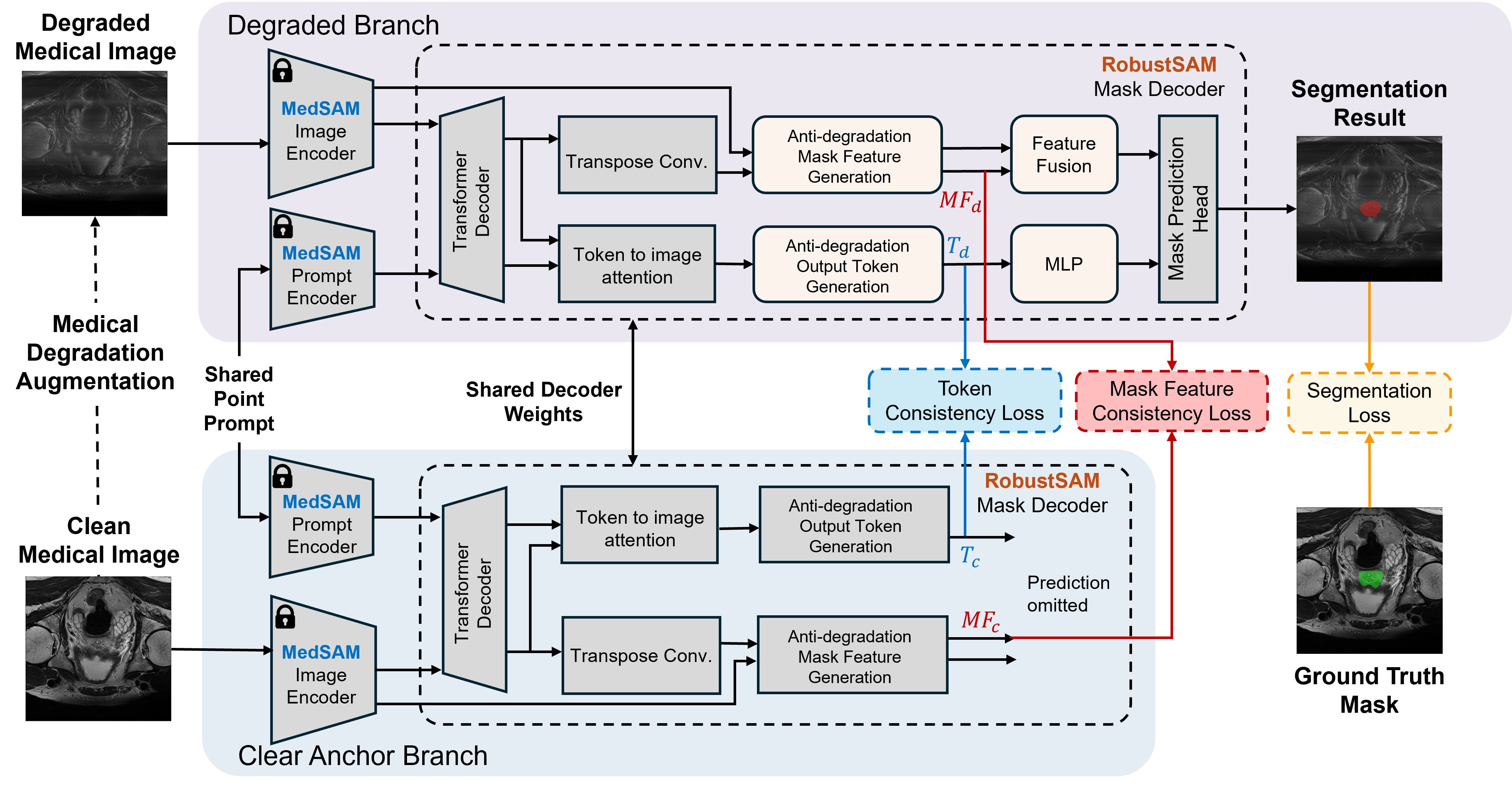
Overview of RobustMedSAM. Each medical image is paired with a degraded
counterpart via medical degradation augmentation. Both views share the frozen
MedSAM image and prompt encoders and are decoded by a shared robust decoder
initialized from RobustSAM. Finetuned modules are highlighted in color; frozen
modules are gray. At inference, RobustMedSAM needs only a single input image
with no clean reference.
---
## Method overview
RobustMedSAM has three parts (see the paper, Sec. 3):
1. **Module-wise mixed initialization.** `θ_encoder ← MedSAM`, `θ_prompt ← MedSAM`,
`θ_decoder ← RobustSAM`. Built with [`create_mixed_checkpoint.py`](create_mixed_checkpoint.py).
2. **Robustness-aware decoder fine-tuning.** Each clean image `x_c` is paired
with a degraded view `x_d = T(x_c)` sharing one ground-truth mask. Both views
share the frozen encoder/prompt-encoder; only the decoder is trained. The
loss combines:
- **Segmentation** (Dice + Focal) on the degraded branch,
- **Mask-feature consistency** (MSE between clean/degraded mask features),
- **Token consistency** (MSE between clean/degraded output tokens).
Implemented in [`engine.py`](engine.py) and [`loss.py`](loss.py) with weights
`focal=20, dice=1, token=2, embedding=100` (paper: α=20, β=1, λ₁=100, λ₂=2).
3. **(Optional) SVD-based encoder adaptation** — freeze the orthogonal bases of
encoder conv weights and train only the singular values (paper Sec. 3.4).
At inference, RobustMedSAM needs only a single input image (no clean reference).
---
## Setup
```bash
conda create -n robustmedsam python=3.10 -y
conda activate robustmedsam
# install torch matching your CUDA, e.g.:
pip install torch torchvision --index-url https://download.pytorch.org/whl/cu121
pip install -r requirements.txt
```
### Pretrained checkpoints (download separately)
The pretrained RobustMedSAM model used for inference is available in the
[v1.0.0 release](https://github.com/jli2556/RobustMedSAM/releases/tag/v1.0.0).
| Model | Download |
|-------|----------|
| RobustMedSAM ViT-B (`robustmedsam_best.pth`) | [Download weights](https://github.com/jli2556/RobustMedSAM/releases/download/v1.0.0/robustmedsam_best.pth) |
| MedSAM ViT-B (`medsam_vit_b.pth`) | https://github.com/bowang-lab/MedSAM |
| RobustSAM ViT-B (`robustsam_checkpoint_b.pth`) | https://huggingface.co/robustsam/robustsam |
Then build the RobustMedSAM initialization checkpoint:
```bash
python create_mixed_checkpoint.py \
--medsam medsam_vit_b.pth \
--robustsam robustsam_checkpoint_b.pth \
--output robustmedsam_init_b.pth
```
---
## Data preparation
RobustMedSAM trains on **[MedSegBench](https://medsegbench.github.io/)**
(35 datasets, 6 modalities). Export the images/masks to the layout below, then
synthesize the degraded views.
```
data/all_data//clear/*.jpg # clean medical images
data/all_data//masks/*.npy # instance masks (one .npy per image)
```
```bash
cd data
bash gen_data.sh # creates one folder per degradation next to `clear`
```
The 12 corruption types and their parameters are defined in
[`data/augment.py`](data/augment.py) and follow the degradation protocol in the
paper: Gaussian noise, Gaussian blur, contrast, brightness (modality-agnostic),
plus compression, color jitter, Poisson noise, speckle noise, salt-and-pepper
noise, Rician noise, Rayleigh noise, and step-motion (MRI) artifacts.
---
## Training
Fine-tune the mask decoder (DDP, ViT-B) starting from the mixed checkpoint:
```bash
python -m torch.distributed.launch train_ddp.py \
--multiprocessing-distributed \
--exp_name robustmedsam_vitb \
--model_size b \
--load_model robustmedsam_init_b.pth \
--data_dir data/all_data \
--epochs 10 --batch_size 4 --lr 1e-4 --num_points 3
```
Checkpoints are written to `checkpoints/_best.pth` and
`_last.pth`. Training settings match the paper: ViT-B backbone, frozen
encoder/prompt-encoder, Adam (lr 5e-4 in the paper; 1e-4 default here), 10
epochs, images resized to 512×512.
---
## Inference demo
```bash
# point prompts
python eval.py --model_size b --checkpoint_path checkpoints/robustmedsam_vitb_best.pth
# box prompts
python eval.py --bbox --model_size b --checkpoint_path checkpoints/robustmedsam_vitb_best.pth
```
Results are saved under `demo_result/`.
---
## Citation
```bibtex
@article{li2026robustmedsam,
title={RobustMedSAM: Degradation-Resilient Medical Image Segmentation via Robust Foundation Model Adaptation},
author={Li, Jieru and Chen, Matthew and Nnamdi, Micky C and Tamo, J Ben and Marteau, Benoit L and Wang, May D},
journal={arXiv preprint arXiv:2604.09814},
year={2026}
}
```
## Acknowledgements
RobustMedSAM builds on
[SAM](https://github.com/facebookresearch/segment-anything),
[MedSAM](https://github.com/bowang-lab/MedSAM), and
[RobustSAM](https://robustsam.github.io/) (CVPR 2024), and is evaluated on
[MedSegBench](https://medsegbench.github.io/). The
`robust_med_segment_anything/` package is adapted from RobustSAM/SAM; see
[LICENSE](LICENSE) for third-party notices.
## License
Released under the [MIT License](LICENSE).