# Network-AI
**TypeScript/Node.js multi-agent orchestrator — shared state, guardrails, budgets, and cross-framework coordination**
[](https://network-ai.org/)
[](https://github.com/Jovancoding/Network-AI/actions/workflows/ci.yml)
[](https://github.com/Jovancoding/Network-AI/actions/workflows/codeql.yml)
[](https://github.com/Jovancoding/Network-AI/releases)
[](https://www.npmjs.com/package/network-ai)
[](#testing)
[](#adapter-system)
[](LICENSE)
[](https://socket.dev/npm/package/network-ai/overview)
[](https://nodejs.org)
[](https://typescriptlang.org)
[](https://clawhub.ai/jovancoding/network-ai)
[](INTEGRATION_GUIDE.md)
[](https://github.com/sponsors/Jovancoding)
[](https://discord.gg/Cab5vAxc86)
[](https://glama.ai/mcp/servers/Jovancoding/network-ai)

If Network-AI is useful to you, consider giving it a star ⭐ — it helps others find the project.
Network-AI is a TypeScript/Node.js multi-agent orchestrator that adds coordination, guardrails, and governance to any AI agent stack.
- **Shared blackboard with locking** — atomic `propose → validate → commit` prevents race conditions and split-brain failures across parallel agents
- **Guardrails and budgets** — FSM governance, per-agent token ceilings, HMAC / Ed25519 audit trails, and permission gating
- **Context signal-over-noise (v5.15)** — `ContextComposer` assembles token-budgeted, relevance-ranked context packs (semantic/lexical × recency decay × scope affinity, position-aware layout); `context_pack` + `blackboard_search` MCP tools let agents pull curated state instead of dumping the whole board into their window
- **32 adapters** — LangChain (+ streaming), AutoGen, CrewAI, OpenAI Assistants, OpenAI Responses (Assistants successor), LlamaIndex, Semantic Kernel, Haystack, DSPy, Agno, MCP, Custom (+ streaming), OpenClaw, A2A, Codex, MiniMax, NemoClaw, APS, Copilot, LangGraph, Anthropic Computer Use, Claude Agent SDK (agentic loops), OpenAI Agents SDK, Vertex AI, Gemini (Developer API), Pydantic AI, Browser Agent, Hermes (NousResearch Hermes / any OpenAI-compatible endpoint), Orchestrator (hierarchical multi-orchestrator), and RLM (Recursive Language Model / any RLM-compatible HTTP endpoint) — no glue code, no lock-in
- **Persistent project memory (Layer 3)** — `context_manager.py` injects decisions, goals, stack, milestones, and banned patterns into every system prompt so agents always have full project context
- **v5.0 modules** — Agent VCR (record/replay), comparison runner, coverage reporter, goal DSL, approval inbox, job queue, gRPC/HTTP transport, playground REPL, adapter test harness, and more
- **Model-interaction lifecycle governance (v5.13)** — `GovernedModelGateway` absorbs the model refusal → fallback → billing chain (cross-model fallback, fallback-credit repricing, effort governance, thinking-block handoff) behind one governed, budgeted, audited call
> **The silent failure mode in multi-agent systems:** parallel agents writing to the same key
> use last-write-wins by default — one agent's result silently overwrites another's mid-flight.
> The outcome is split-brain state: double-spends, contradictory decisions, corrupted context,
> no error thrown. Network-AI's `propose → validate → commit` mutex prevents this at the
> coordination layer, before any write reaches shared state.
**Use Network-AI as:**
- A **TypeScript/Node.js library** — `import { createSwarmOrchestrator } from 'network-ai'`
- An **MCP server** — `npx -y -p network-ai@6.0.1 network-ai-server --port 3001`
- A **CLI** — `network-ai bb get status` / `network-ai audit tail`
- A **Claude Code plugin** — `/plugin install network-ai@network-ai`
- A **Gemini CLI extension** — `gemini extensions install https://github.com/Jovancoding/Network-AI`
- An **OpenClaw skill** — `clawhub install network-ai`
[**5-minute quickstart →**](QUICKSTART.md) | [**Architecture →**](ARCHITECTURE.md) | [**All adapters →**](#adapter-system) | [**Benchmarks →**](BENCHMARKS.md)
---
## 🛡️ Model-Interaction Lifecycle Governance
Most governance tools stop at the agent boundary — they police which tools an agent may call *before* it acts. Network-AI also governs the layer underneath: **how an agent talks to the model.** When a frontier model declines a request with a classifier refusal, Network-AI absorbs the refusal → fallback → billing chain and presents one governed, budgeted, audited call.
- **`GovernedModelGateway`** — detect `stop_reason:"refusal"`, audit which classifier fired, route to a fallback model, and redeem the fallback-credit token so the retry is repriced as a cache read.
- **`ModelBudget`** — per-model USD accounting with fallback-credit repricing; never sums tokens across models.
- **`RefusalTelemetry`** — a refusal is an HTTP 200, invisible to error-rate monitoring; emitted as a discrete non-error signal with an `unservedRefusalCount` gap to alert on.
- **`EffortPolicy`** — turn the `effort` cost dial into a policy object: cap sub-agents at `low`, require justification for `xhigh`/`max`.
- **`ThinkingBlockManager`** — keep thinking blocks unchanged on the same model; strip them on a cross-model fallback; guard prompts against `reasoning_extraction` refusals.
- **Per-sub-agent fallback** — `FanOutFanIn` steps and `TeamRunner` tasks each carry their own fallback agent and per-request retry budget (`RetryBudget`), because a turn can refuse independently across an agent and its sub-agents.
```typescript
import { AnthropicMessagesAdapter, ModelBudget, RefusalTelemetry } from 'network-ai';
const adapter = new AnthropicMessagesAdapter();
await adapter.initialize({});
adapter.registerModelAgent('analyst', {
client, // bring your own Anthropic client
model: 'claude-fable-5',
fallbackModels: ['claude-opus-4-8'], // classifier refusals fall through here
budget: new ModelBudget({
ceilingUsd: 5,
pricing: {
'claude-fable-5': { inputPerMTok: 10, outputPerMTok: 50 },
'claude-opus-4-8': { inputPerMTok: 5, outputPerMTok: 25 },
},
}),
telemetry: new RefusalTelemetry(),
});
const result = await adapter.executeAgent('analyst', { action: 'Summarize Q3 results', params: {} }, { agentId: 'cli' });
// result.data: { servedModel, servedByFallback, refused, refusalCategories, attempts, totalCostUsd }
```
### OWASP Agentic AI Top 10 (2026) — engine coverage
Verify programmatically with `verifyOwaspCoverage()` (exported from `network-ai`):
| Risk | Status | Primary control |
|---|---|---|
| ASI-01 Agent Goal Hijack | ✅ Covered | AuthGuardian gating + JourneyFSM control plane |
| ASI-02 Tool Misuse & Exploitation | ✅ Covered | AgentRuntime SandboxPolicy + ApprovalGate |
| ASI-03 Identity & Privilege Abuse | ✅ Covered | HMAC / Ed25519 signed tokens + trust scoring |
| ASI-04 Supply Chain Risks | ✅ Covered | 1 runtime dep + socket / clawhub / codeql gates |
| ASI-05 Unsafe Code Execution | ✅ Covered | ShellExecutor `shell:false` argv + path guards |
| ASI-06 Memory & Context Poisoning | ✅ Covered | LockedBlackboard + injection detection |
| ASI-07 Insecure Inter-Agent Comms | 🟡 Partial | FS-mutex + signed handoffs (local-trust boundary) |
| ASI-08 Cascading Failures | ✅ Covered | CircuitBreaker + budgets + RetryBudget |
| ASI-09 Human-Agent Trust Exploitation | ✅ Covered | ApprovalGate + tamper-evident audit trail |
| ASI-10 Rogue Agents | ✅ Covered | ComplianceMonitor + circuit-breaker kill switch |
### 🔒 ASI Strict Mode (opt-in)
For deployments running highly capable agents, `ASI_STRICT_MODE` adds controls that assume an agent may be smarter than its overseers. It is **off by default**; when off, every code path is unchanged (a single boolean check).
| Setting | Behaviour |
|---|---|
| unset / `false` | Off — today's behaviour |
| `audit` | Every check runs and reports would-be denials (`outcome: 'would-deny'`) without blocking — measure before you enforce |
| `enforce` (or any other value — fails closed) | Violations are blocked |
The setting is read once and frozen; at runtime it can only be **tightened** (`tightenAsiConfig`), never loosened.
| Control | What it does |
|---|---|
| **Proof-carrying actions** (`ProofGate`) | Gated tools (`shell_exec`, `file_write`, MCP tools marked `requires_formal_proof`) run only with a proof bound to the exact tool, canonical arguments, agent, single-use nonce, and expiry. BYO verifiers (zkVM receipts, formal-verification certificates); built-in short-lived HMAC/Ed25519 capability tokens (`CapabilityIssuer`) for deployments without a prover; optional out-of-process co-signer (`ExternalAuthority.authorize`). |
| **BFT consensus** (`ConsensusEngine`) | High-stakes `GovernedModelGateway` turns are judged by ≥ 3f+1 independent evaluators; robust geometric median (Weiszfeld) with CP-WBFT confidence weighting, outlier detection, signed ballots, and a minimum number of distinct **model families** (correlated models fail together). |
| **Auditor receipts** (`LockedBlackboard`) | LOW-trust agents' changes commit only with a signed receipt from an operator-designated AUDITOR, bound to the change id, key, value hash, and base version. `claimVerifierCheck` lets `ClaimVerifier` be the auditor's check. |
| **Kill switch** (`HaltCoordinator`) | Password-Activated Shutdown: a salted-hash token detected in the input stream (redacted before any model sees it), an OS signal, or an authenticated HTTP call halts every registered component, aborts in-flight work, and latches until a separate resume key is presented. |
| **Trust-tiered context** (`ContextComposer`) | Per-tier context policies: smaller budgets, higher score floors, allowed scopes, excluded producers. AUDITOR is never derived from a score. |
| **Cognitive caps** (`EffortPolicy`, `ThinkingBlockManager`) | Per-tier effort ceiling, thinking-token budget, output cap, and sub-agent depth limit. |
| **Canaries & export** (`CanaryRegistry`, `HashChainSink`) | Decoy values that flag exfiltration when they appear in output; strict-mode events hash-chained to an append-only store outside the agents' process. |
In `enforce` mode `AgentRuntime` also forces `sourceProtection` and withholds secret-like environment variables from child processes.
```typescript
import { createAsiConfig, ProofGate, CapabilityIssuer, SignedAttestationVerifier, AgentRuntime } from 'network-ai';
const config = createAsiConfig({ mode: 'enforce', auditors: ['auditor-1'] });
const key = { name: 'ops', alg: 'hmac-sha256' as const, key: process.env.CAPABILITY_KEY! };
const proofGate = new ProofGate({ gatedTools: ['shell_exec', 'file_write'], verifiers: [new SignedAttestationVerifier([key])] }, config);
const runtime = new AgentRuntime({ policy: { basePath: '.', allowedCommands: ['npm *'] }, asi: { proofGate, config } });
// The approval service (outside the agent's process) mints a one-shot capability:
const issuer = new CapabilityIssuer('ops', { alg: 'hmac-sha256', secret: process.env.CAPABILITY_KEY! });
const proof = issuer.issue('shell_exec', runtime.shellProofArgs('npm test'), 'agent-7');
await runtime.exec('npm test', 'agent-7', { proof });
```
> **Limits.** Strict mode raises the cost of misbehaviour; it is not a containment proof. An agent with arbitrary code execution on the same host can restart the process with different settings — pair strict mode with OS-level isolation and an out-of-process `ExternalAuthority`. Consensus assumes at most f faulty, independent evaluators.
### ♾️ Perpetual Runtime (opt-in)
Lets agent swarms **run indefinitely, improve themselves, and fund their own work while humans keep control**. A run continues only while an operator-signed policy keeps renewing its lease, never because the agents arrange it. Nothing starts automatically, and every integration point is a single check when unused.
Three invariants hold whatever the configuration:
| # | Invariant | Mechanism |
|---|---|---|
| I1 | The external stop always works without agent cooperation | Out-of-process `LeaseAuthority`; short-lived Ed25519 leases; `LeaseGuard` halts the run when a lease is revoked, paused, expired, or cannot be renewed (dead-man switch); the egress proxy refuses traffic without a live lease |
| I2 | Agents can modify themselves, never their limits | `GuardedPaths`: governance files and blackboard keys are writable only with a single-use, operator-signed approval of the exact content |
| I3 | Self-funding stays inside human-set ceilings | Ceilings in the signed policy; agents can lower, never raise; new sources need a new signed policy; payments only through the egress proxy with per-request and per-run limits |
| I4 | Code on the agent host cannot cause a lease to be issued or extended (v6.0.0) | Granting needs k off-host authorities co-signing under the same signed policy; stopping needs any one of them, the sentry quorum, the operator, or lease expiry; high-risk scopes need k ≥ 2 unless the operator signs an `acceptRisk` |
| Component | What it does |
|---|---|
| **`LeaseAuthority`** (own process) | Issues and renews leases under an operator-signed `RenewalPolicy`: TTL, end date, scope (tools, paths, egress routes), budget ceilings, stop conditions (canary failure, failing health, sentry alerts). Operator: revoke, pause, resume, tighten, install policy. Sentries: alert and tighten only. |
| **`LeaseGuard`** (in the agent) | Holds the current lease, renews it with spend and health heartbeats, polls for revocation, and vetoes `AgentRuntime.exec`/`writeFile`, `GovernedModelGateway.send`, and `LockedBlackboard` writes without a valid, in-scope lease. |
| **`EgressProxy`** (own process) | The agents' only route to the network: lease-checked, per-route allowlist, injects credentials the agents never see, scrubs them from responses, rate-limits, and caps financial requests. |
| **`ISandboxRunner`** | Disposable sandbox per command; `ContainerSandboxRunner` defaults to gVisor (`runsc`), read-only root, no capabilities, no network or egress-proxy only. |
| **Sentry swarm** | Read-only processes over the audit stream: velocity, denied-access probing, prompt injection, blackboard poisoning, guarded-path attempts, canary leaks, goal drift. Each sentry has its own identity; with `sentryQuorum` set, renewal stops only when enough of them agree. |
| **`ImprovementPipeline`** | Self-modification with evidence: static checks, sandbox tests on a copy, multi-family consensus, then a signed receipt bound to the patch hash. Tiers: `auto` (agent task code), `human`, `operator` (guarded paths, always). |
| **`StateSnapshotter` / `SelfHealer`** | HMAC-signed, hash-chained blackboard snapshots; canary failure ⇒ failing health (renewal stops), rollback to the last verified snapshot, session purge. |
| **`BudgetBalancer`** | Picks the cheapest approved source with headroom, throttles effort (`full` → `reduced` → `minimal` → `stopped`), feeds spend into lease heartbeats. |
| **Zero-day containment** (v6.0.0) | k-of-n authorities, a deployment posture gate (`perpetual doctor`), operator-signed human checkpoints, honeytokens that revoke runs, attestation-gated renewal, no-network microVM agents behind a fixed-schema vsock relay (or a one-way spool), a hardened Node profile, HSM/KMS signers, an RFC 9162 Merkle audit with a witness, capability-evaluation gating, and a pure decision core modelled in Lean 4. See [docs/hardened-deployment.md](docs/hardened-deployment.md). |
```bash
# The operator key stays off the authority host (keep it offline or on a hardware token).
network-ai perpetual keygen operator --out ~/operator-keys
network-ai perpetual keygen authority
network-ai perpetual sign-policy policy.json --key ~/operator-keys/operator.key --out policy.signed.json
# Role secrets come from the environment (each ≥ 32 chars, high-entropy, all distinct)
NETWORK_AI_LEASE_OPERATOR_SECRET=… NETWORK_AI_LEASE_RUNNER_SECRET=… \
NETWORK_AI_LEASE_SENTRY_SECRET_S1=… NETWORK_AI_LEASE_SENTRY_SECRET_S2=… \
network-ai perpetual authority --operator-pub ~/operator-keys/operator.pub \
--authority-key data/perpetual/keys/authority.key --policy policy.signed.json --agent-user nai-agent
network-ai perpetual doctor --role authority --operator-pub ~/operator-keys/operator.pub --key data/perpetual/keys/authority.key
network-ai perpetual status # the human controls
network-ai perpetual pause | resume | revoke | revoke --all
network-ai perpetual checkpoint --all --key ~/operator-keys/operator.key --policy policy.signed.json
```
```typescript
import { LeaseGuard, HttpLeaseTransport, HaltCoordinator, AgentRuntime } from 'network-ai';
const guard = new LeaseGuard({
runId: 'research-swarm',
authorityPublicKey, // the authority's public key only
transport: new HttpLeaseTransport('http://127.0.0.1:4710', process.env.NETWORK_AI_LEASE_RUNNER_SECRET!),
halt: haltCoordinator, // fired when the lease is lost
spend: () => balancer.spend(),
health: () => healer.health(),
});
await guard.start();
const runtime = new AgentRuntime({ policy: { basePath: '.' }, lease: guard, guarded, sandbox: { runner } });
```
> **Limits.** The guarantees rest on the operator key, role secrets, and credentials staying outside the agents' reach, and on the authority, proxy, and sentries running where agents cannot write or signal. Run agents in the sandbox with network access only through the proxy; without that isolation an agent with host code execution can bypass in-process checks.
---
## ⚡ Try in 60 Seconds
```bash
npm install network-ai
```
```typescript
import { LockedBlackboard } from 'network-ai';
const board = new LockedBlackboard('.');
const id = board.propose('status', { ready: true }, 'agent-1');
board.validate(id, 'agent-1');
board.commit(id);
console.log(board.read('status')); // { ready: true }
```
Two agents, atomic writes, no race conditions. That's it.
Want the full stress test? **No API key, ~3 seconds:**
```bash
npx ts-node examples/08-control-plane-stress-demo.ts
```
Runs priority preemption, AuthGuardian permission gating, FSM governance, and compliance monitoring — all without a single LLM call.
> If it saves you from a race condition, a ⭐ helps others find it.
---
## What's Included
| | |
|---|---|
| ✅ Atomic shared state | `propose → validate → commit` with filesystem mutex — no split-brain |
| ✅ Token budgets | Hard per-agent ceilings with live spend tracking |
| ✅ Permission gating | HMAC / Ed25519-signed tokens, scoped per agent and resource |
| ✅ Append-only audit log | Every write, grant, and transition signed and logged |
| ✅ 32 framework adapters | LangChain, CrewAI, AutoGen, MCP, Codex, Gemini, APS, RLM, and 24 more — zero lock-in |
| ✅ FSM governance | Hard-stop agents at state boundaries, timeout enforcement |
| ✅ Compliance monitoring | Real-time violation detection (tool abuse, turn-taking, timeouts) |
| ✅ Claim verification | Tier 1 agent honesty — outcome-bound signed receipts, manifest reconciliation, trust decay for liars |
| ✅ QA orchestration | Scenario replay, feedback loops, regression tracking, contradiction detection |
| ✅ Deferred adapter init | Lazy-load adapters on first use — zero startup cost for unused frameworks |
| ✅ Hook middleware | `beforeExecute` / `afterExecute` / `onError` hooks on any adapter call |
| ✅ Flow control | Pause / resume / throttle writes on the blackboard |
| ✅ Skill composition | `chain()` / `batch()` / `loop()` / `verify()` meta-operations over agent calls |
| ✅ Semantic memory search | BYOE vector store with cosine similarity over blackboard data |
| ✅ Phase pipeline | Multi-phase workflows with human-in-the-loop approval gates; `approvalTimeoutMs` fail-closed timeout prevents indefinite hangs |
| ✅ Confidence filtering | Multi-agent result scoring, threshold validation, and consensus aggregation |
| ✅ Matcher-based hooks | Glob patterns on agent/action/tool for targeted hook filtering |
| ✅ Fan-out / fan-in | Parallel agent spawning with pluggable aggregation strategies |
| ✅ Agent runtime sandbox | Sandboxed shell execution with policy enforcement and approval gates |
| ✅ Interactive console | TUI dashboard for live monitoring, agent control, blackboard/budget/FSM management |
| ✅ Pipe mode | JSON stdin/stdout protocol for programmatic AI-to-orchestrator control |
| ✅ Strategy agent | Meta-orchestrator with elastic agent pools, workload partitioning, and adaptive scaling |
| ✅ Goal decomposer | LLM-powered goal → task DAG → parallel execution with `runTeam()` one-liner |
| ✅ Context Throttler | Prune blackboard keys per agent scope before LLM calls — prevent context pollution |
| ✅ Partition Planner | Assign non-overlapping focus areas to agents before DAG execution — no redundant research |
| ✅ Coverage Gate | Recursive refinement loop — re-run decomposer for gaps until coverage score ≥ threshold |
| ✅ Route Classifier | Short-circuit routing — classify goals as factual lookup vs. complex synthesis before planning |
| ✅ Goal DSL | YAML/JSON goal definitions with cycle detection and topological compilation |
| ✅ Agent VCR | Record and replay LLM/agent interactions for deterministic tests |
| ✅ Comparison runner | Side-by-side adapter comparison with scoring, timing, cost analysis |
| ✅ Coverage reporter | V8 coverage collection with threshold enforcement |
| ✅ Job queue | Persistent priority FIFO with retries, crash recovery, pluggable backends |
| ✅ Approval inbox | Web-accessible approval queue with REST API and SSE streaming |
| ✅ TTL auto-eviction | `purgeExpired()` on-demand eviction; `startSweep(intervalMs)` / `stopSweep()` background timer (unref'd, default 60 s) |
| ✅ WAL crash recovery | `LockedBlackboard` Write-Ahead Log survives process crashes; `replayWAL()` replays uncommitted ops on restart; `compactWAL()` for manual truncation |
| ✅ Circuit Breaker | `AdapterRegistry` per-adapter CLOSED/OPEN/HALF_OPEN state machine; `fallbackChain` for automatic failover; `CircuitOpenError`; zero added dependencies |
| ✅ OTel telemetry hooks | `ITelemetryProvider` BYOT abstraction — `NullTelemetryProvider`, `CapturingTelemetryProvider`, `createOtelHooks()` factory; plug in any OTel SDK without modifying adapters |
| ✅ Transport layer | JSON-RPC 2.0 over HTTP with HMAC auth, TTL, node allowlisting |
| ✅ Playground REPL | Interactive sandbox with mock agents for rapid prototyping |
| ✅ Adapter test harness | Parameterized test battery for any adapter implementation |
| ✅ IAuthValidator | Interface to decouple authorization from concrete AuthGuardian |
| ✅ Kill switch | `network-ai pause` / `resume` — `SYSTEM_PAUSED` sentinel; `doctor` self-diagnostics; `inspect ` metadata + audit trail |
| ✅ Minimal mode | `--minimal` / `NETWORK_AI_MINIMAL=1` — skips WAL replay and sweep for fast CI/test startup |
| ✅ ASI Strict Mode | Opt-in proof-carrying actions, BFT consensus, auditor receipts, kill switch, trust-tiered context, cognitive caps |
| ✅ Perpetual Runtime | Opt-in indefinite runs under operator-signed leases: dead-man switch, egress proxy, guarded paths, sandbox, sentry swarm, self-improvement pipeline, self-healing state, budget balancer |
| ✅ TypeScript native | ES2022 strict mode, zero native dependencies |
---
## Why teams use Network-AI
| Problem | How Network-AI solves it |
|---|---|
| Race conditions in parallel agents | Atomic blackboard: `propose → validate → commit` with file-system mutex |
| Agent overspend / runaway costs | `FederatedBudget` — hard per-agent token ceilings with live spend tracking |
| No visibility into what agents did | HMAC / Ed25519-signed audit log on every write, permission grant, and FSM transition |
| Locked into one AI framework | 32 adapters — mix LangChain + AutoGen + CrewAI + Codex + Gemini + MiniMax + NemoClaw + APS + LangGraph + Vertex AI + Hermes + RLM + custom in one swarm |
| Agents escalating beyond their scope | `AuthGuardian` — scoped permission tokens required before sensitive operations |
| Agents lack project context between runs | `ProjectContextManager` (Layer 3) — inject decisions, goals, stack, and milestones into every system prompt |
| No regression tracking on agent output quality | `QAOrchestratorAgent` — scenario replay, feedback loops, cross-agent contradiction detection, historical trend tracking |
| Long-running agents you cannot reliably stop | Perpetual Runtime — out-of-process lease authority, dead-man switch, and guarded governance paths keep humans in control |
---
## Architecture
```mermaid
%%{init: {'theme': 'base', 'themeVariables': {'primaryColor': '#1e293b', 'primaryTextColor': '#e2e8f0', 'primaryBorderColor': '#475569', 'lineColor': '#94a3b8', 'clusterBkg': '#0f172a', 'clusterBorder': '#334155', 'edgeLabelBackground': '#1e293b', 'edgeLabelColor': '#cbd5e1', 'titleColor': '#e2e8f0'}}}%%
flowchart TD
classDef app fill:#1e3a5f,stroke:#3b82f6,color:#bfdbfe,font-weight:bold
classDef security fill:#451a03,stroke:#d97706,color:#fde68a
classDef routing fill:#14532d,stroke:#16a34a,color:#bbf7d0
classDef quality fill:#3b0764,stroke:#9333ea,color:#e9d5ff
classDef blackboard fill:#0c4a6e,stroke:#0284c7,color:#bae6fd
classDef adapters fill:#064e3b,stroke:#059669,color:#a7f3d0
classDef audit fill:#1e293b,stroke:#475569,color:#94a3b8
App["Your Application"]:::app
App -->|"createSwarmOrchestrator()"| SO
subgraph SO["SwarmOrchestrator"]
AG["AuthGuardian\n(HMAC / Ed25519 permission tokens)"]:::security
AR["AdapterRegistry\n(route tasks to frameworks)"]:::routing
QG["QualityGateAgent\n(validate blackboard writes)"]:::quality
QA["QAOrchestratorAgent\n(scenario replay, regression tracking)"]:::quality
BB["SharedBlackboard\n(shared agent state)\npropose → validate → commit\nfilesystem mutex"]:::blackboard
AD["Adapters — plug any framework in, swap freely\nLangChain · AutoGen · CrewAI · MCP · LlamaIndex · …"]:::adapters
AG -->|"grant / deny"| AR
AR -->|"tasks dispatched"| AD
AD -->|"writes results"| BB
QG -->|"validates"| BB
QA -->|"orchestrates"| QG
end
SO --> AUDIT["data/audit_log.jsonl\n(HMAC / Ed25519-signed)"]:::audit
```
> `FederatedBudget` is a standalone export — instantiate it separately and optionally wire it to a blackboard backend for cross-node token budget enforcement.
>
> `ProjectContextManager` is a Layer-3 Python helper (`scripts/context_manager.py`) that injects persistent project goals, decisions, and milestones into agent system prompts — see [ARCHITECTURE.md § Layer 3](ARCHITECTURE.md#layer-3--projectcontextmanager).
→ [Full architecture, FSM journey, and handoff protocol](ARCHITECTURE.md)
---
## Install
```bash
npm install network-ai
```
No native dependencies, no build step. Adapters are dependency-free (BYOC — bring your own client).
---
## Use as MCP Server
Start the server (no config required, zero dependencies):
```bash
npx -y -p network-ai@6.0.1 network-ai-server --port 3001
# or from source:
npx ts-node bin/mcp-server.ts --port 3001
```
Then wire any MCP-compatible client to it.
**Claude Desktop** — add to `~/Library/Application Support/Claude/claude_desktop_config.json` (macOS) or `%APPDATA%\Claude\claude_desktop_config.json` (Windows):
```json
{
"mcpServers": {
"network-ai": {
"url": "http://localhost:3001/sse"
}
}
}
```
**Cursor / Cline / any SSE-based MCP client** — point to the same URL:
```json
{
"mcpServers": {
"network-ai": {
"url": "http://localhost:3001/sse"
}
}
}
```
Verify it's running:
```bash
curl http://localhost:3001/health # { "status": "ok", "tools": , "uptime": }
curl http://localhost:3001/tools # full tool list
```
**Tools exposed over MCP:**
- `blackboard_read` / `blackboard_write` / `blackboard_list` / `blackboard_delete` / `blackboard_exists`
- `context_pack` — token-budgeted, relevance-ranked context brief for a task (use instead of dumping the whole board into your window)
- `blackboard_search` — ranked top-K search over blackboard entries (semantic when an embedder is wired, lexical otherwise)
- `budget_status` / `budget_spend` / `budget_reset` — federated token tracking
- `token_create` / `token_validate` / `token_revoke` — HMAC / Ed25519-signed permission tokens
- `audit_query` — query the append-only audit log
- `config_get` / `config_set` — live orchestrator configuration
- `agent_list` / `agent_spawn` / `agent_stop` — agent lifecycle
- `fsm_transition` — write FSM state transitions to the blackboard
Each tool takes an `agent_id` parameter, recorded as the source agent of every write. The MCP server's trust boundary is transport authentication (the bearer secret over SSE/HTTP, or local stdio): once a client is admitted, the server writes on its behalf with a server-held random identity, so any `agent_id` works and no shared token needs to be known. Caller-supplied `agent_token` values are ignored over MCP. In-process TypeScript code keeps per-agent tokens and namespaces via `registerAgent()`.
Options: `--no-budget`, `--no-token`, `--no-control`, `--ceiling `, `--board `, `--audit-log `.
---
## Use as a Claude Code Plugin
Network-AI ships as a [Claude Code](https://code.claude.com) plugin — the MCP server wires in automatically, so every tool listed above becomes available inside Claude Code with no manual config.
**Install from the self-hosted marketplace (zero approval needed):**
```bash
/plugin marketplace add Jovancoding/Network-AI
/plugin install network-ai@network-ai
```
That's it — `blackboard_read`, `budget_status`, `audit_query`, `token_create`, and the rest load as native Claude Code tools. Under the hood the plugin runs `npx -y -p network-ai@6.0.1 network-ai-server --stdio` (stdio MCP transport), pinned to the exact published npm version.
The plugin lives in its own folder, so the directory only reads plugin files:
| File | Role |
|---|---|
| [`plugins/network-ai/.claude-plugin/plugin.json`](plugins/network-ai/.claude-plugin/plugin.json) | Plugin manifest (icon: `.claude-plugin/icon.png`) |
| [`plugins/network-ai/.mcp.json`](plugins/network-ai/.mcp.json) | Registers the Network-AI MCP server (stdio, pinned version) |
| [`plugins/network-ai/commands/`](plugins/network-ai/commands/status.md) | Slash commands — `/network-ai:status`, `/network-ai:budget`, `/network-ai:audit`, `/network-ai:blackboard` |
| [`.claude-plugin/marketplace.json`](.claude-plugin/marketplace.json) | Self-hosted marketplace catalog (points at `plugins/network-ai`) |
| [`.mcp.json`](.mcp.json) | Project MCP config for contributors working in this repository |
Validate locally with `claude plugin validate ./plugins/network-ai` and `claude plugin validate .` (marketplace).
**Gate Claude Code itself with AuthGuardian (hooks).** Every tool call Claude Code makes — shell commands, file edits, web fetches — can be audited and permission-gated through the same weighted scoring (justification 40%, trust 30%, risk 30%) Network-AI applies to swarm agents:
```jsonc
// .claude/settings.json — see examples/claude-code-hooks.json for the full config
{
"hooks": {
"PreToolUse": [{
"matcher": "Bash|Write|Edit|WebFetch",
"hooks": [{ "type": "command",
"command": "npx -y -p network-ai@6.0.1 network-ai hook pre-tool-use --mode enforce" }]
}]
}
}
```
`--mode observe` (default) audits every call to `data/hooks_audit.jsonl` without blocking; `--mode enforce` maps tools to resource types (Bash → `SHELL_EXEC`, Write/Edit → `FILE_SYSTEM`, WebFetch → `EXTERNAL_SERVICE`) and requires an AuthGuardian grant — denied calls escalate to you as an interactive prompt. `--deny "rm -rf"` patterns hard-block regardless of mode and are matched against the tool name and **every** string field of the tool input (e.g. `Write.content`, `Edit.new_string`, MCP tool arguments). `--allow` patterns match only the tool name and primary target. Invalid or backtracking-prone patterns make the hook exit `2`, which Claude Code treats as a block, so a bad rule fails closed rather than silently disabling the deny list.
---
## Use with OpenAI Codex
Network-AI also runs as an [OpenAI Codex](https://developers.openai.com/codex) MCP server — in both the Codex CLI and the IDE extension. The same tools that load in Claude Code become available in Codex.
**Add it with one command** (uses the published npm package):
```bash
codex mcp add network-ai -- npx -y -p network-ai@6.0.1 network-ai-server --stdio
```
In the Codex TUI, run `/mcp` to confirm `network-ai` is connected.
**Or scope it to a project** — the repo root ships a [`.codex/config.toml`](.codex/config.toml) so any trusted checkout picks the server up automatically. To register it globally instead, drop the same block into `~/.codex/config.toml`:
```toml
[mcp_servers.network-ai]
command = "npx"
args = ["-y", "-p", "network-ai@6.0.1", "network-ai-server", "--stdio"]
```
Either route exposes the full tool set (`blackboard_read`, `budget_status`, `audit_query`, `token_create`, …) over stdio MCP — no API keys, no running server to manage.
---
## Use with Gemini CLI
Network-AI ships as a [Gemini CLI](https://github.com/google-gemini/gemini-cli) extension — the repo root carries [`gemini-extension.json`](gemini-extension.json), which wires in the stdio MCP server and a [`GEMINI.md`](GEMINI.md) context file automatically:
```bash
gemini extensions install https://github.com/Jovancoding/Network-AI
```
Or register just the MCP server directly:
```bash
gemini mcp add network-ai npx -- -y -p network-ai network-ai-server --stdio
```
Run `/mcp` inside Gemini CLI to confirm the `network-ai` tools are loaded. For building Gemini-powered swarm agents, use the `GeminiAdapter` (Gemini Developer API / AI Studio) or `VertexAIAdapter` (Vertex AI on GCP) — and for Google's Agent2Agent ecosystem, `A2AServer` exposes this orchestrator as a discoverable A2A agent:
```typescript
import { A2AServer } from 'network-ai';
const a2a = new A2AServer({
name: 'Network-AI Orchestrator',
secret: process.env.A2A_SECRET, // required (v5.15.5+); or allowUnauthenticated: true for loopback-only dev
executor: async (text) => ({ text: await runSwarmTask(text) }),
});
a2a.startServer(4310); // serves /.well-known/agent.json + tasks/send
```
---
## CLI
Control Network-AI directly from the terminal — no server required. The CLI imports the same core engine used by the MCP server.
```bash
# One-off commands (no server needed)
npx ts-node bin/cli.ts bb set status running --agent cli
npx ts-node bin/cli.ts bb get status
npx ts-node bin/cli.ts bb snapshot
# After npm install -g network-ai:
network-ai bb list
network-ai audit tail # live-stream the audit log
network-ai auth token my-bot --resource blackboard
```
| Command group | What it controls |
|---|---|
| `network-ai bb` | Blackboard — get, set, delete, list, snapshot, propose, commit, abort |
| `network-ai auth` | AuthGuardian — issue tokens (`--why` for scoring breakdown), revoke, check permissions |
| `network-ai budget` | FederatedBudget — spend status, set ceiling |
| `network-ai audit` | Audit log — print, live-tail, clear |
| `network-ai env` | Environment management — init, list, chain, diff, promote, backup, restore |
| `network-ai doctor` | Self-diagnostics — validate data dir, env routing, audit log, WAL, kill-switch, MCP secret |
| `network-ai inspect ` | Inspect a blackboard key — value, metadata, pending history, audit trail |
| `network-ai pause` / `resume` | Kill switch — write/remove `SYSTEM_PAUSED` sentinel |
| `network-ai perpetual` | Perpetual Runtime — keygen, sign-policy, authority, proxy, sentry, status, pause, resume, revoke, tighten, install-policy, sign-guarded, sign-budget, snapshot, rollback, doctor, checkpoint, tripwires, sign-capability-eval, capability-eval |
Global flags on every command: `--data ` (data directory, default `./data`) · `--env ` (environment) · `--json` (machine-readable output) · `--minimal` (skip WAL replay + sweep — CI/test fast startup)
→ Full reference in [QUICKSTART.md § CLI](QUICKSTART.md)
---
## Two agents, one shared state — without race conditions
The real differentiator is coordination. Here is what no single-framework solution handles: two agents writing to the same resource concurrently, atomically, without corrupting each other.
```typescript
import { LockedBlackboard, CustomAdapter, createSwarmOrchestrator } from 'network-ai';
const board = new LockedBlackboard('.');
const adapter = new CustomAdapter();
// Agent 1: writes its analysis result atomically
adapter.registerHandler('analyst', async () => {
const id = board.propose('report:status', { phase: 'analysis', complete: true }, 'analyst');
board.validate(id, 'analyst');
board.commit(id); // file-system mutex — no race condition possible
return { result: 'analysis written' };
});
// Agent 2: runs concurrently, writes to its own key safely
adapter.registerHandler('reviewer', async () => {
const id = board.propose('report:review', { approved: true }, 'reviewer');
board.validate(id, 'reviewer');
board.commit(id);
const analysis = board.read('report:status');
return { result: `reviewed phase=${analysis?.phase}` };
});
createSwarmOrchestrator({ adapters: [{ adapter }] });
// Both fire concurrently — mutex guarantees no write is ever lost
const [, ] = await Promise.all([
adapter.executeAgent('analyst', { action: 'run', params: {} }, { agentId: 'analyst' }),
adapter.executeAgent('reviewer', { action: 'run', params: {} }, { agentId: 'reviewer' }),
]);
console.log(board.read('report:status')); // { phase: 'analysis', complete: true }
console.log(board.read('report:review')); // { approved: true }
```
Add budgets, permissions, and cross-framework agents with the same pattern. → [QUICKSTART.md](QUICKSTART.md)
---
## Demo — Control-Plane Stress Test *(no API key)*
Runs in ~3 seconds. Proves the coordination primitives without any LLM calls.
```bash
npm run demo -- --08
```
What it shows: atomic blackboard locking, priority preemption (priority-3 wins over priority-0 on same key), **AuthGuardian permission gate** (blocked → justified → granted with token), FSM hard-stop at 700 ms, live compliance violation capture (TOOL_ABUSE, TURN_TAKING, RESPONSE_TIMEOUT, JOURNEY_TIMEOUT), and `FederatedBudget` tracking — all without a single API call.
[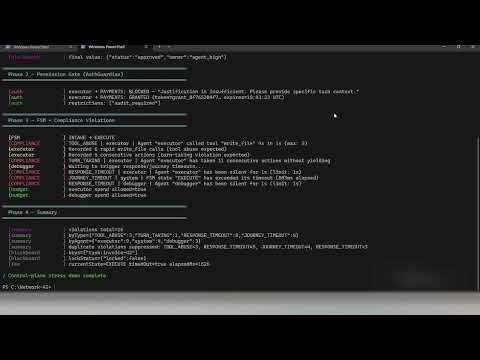](https://www.youtube.com/watch?v=niVRZJu1MEo)
**8-agent AI pipeline** (requires `OPENAI_API_KEY` — builds a Payment Processing Service end-to-end):
```bash
npm run demo -- --07
```
[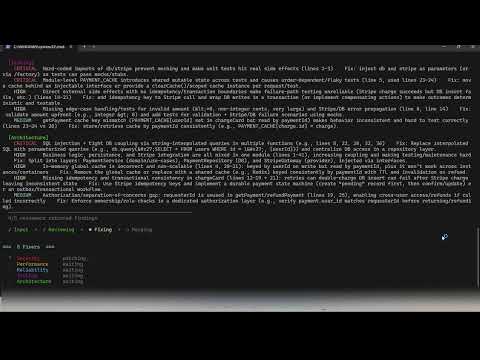](https://youtu.be/UyMsNhaw9lU)
**NemoClaw sandbox swarm** *(no API key)* — 3 agents in isolated NVIDIA NemoClaw sandboxes with deny-by-default network policies:
```bash
npx ts-node examples/10-nemoclaw-sandbox-swarm.ts
```
[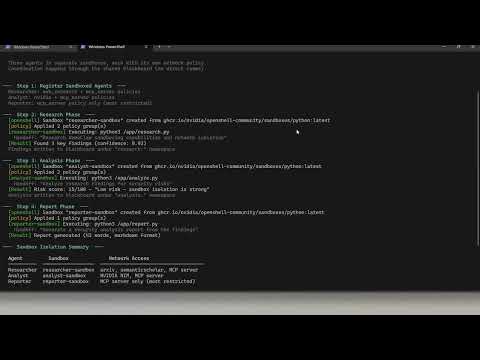](https://www.youtube.com/watch?v=c-UWDrdP4ZE)
---
## Adapter System
32 adapters, zero adapter dependencies. You bring your own SDK objects.
| Adapter | Framework / Protocol | Register method |
|---|---|---|
| `CustomAdapter` | Any function or HTTP endpoint | `registerHandler(name, fn)` |
| `LangChainAdapter` | LangChain | `registerAgent(name, runnable)` |
| `AutoGenAdapter` | AutoGen / AG2 | `registerAgent(name, agent)` |
| `CrewAIAdapter` | CrewAI | `registerAgent` or `registerCrew` |
| `MCPAdapter` | Model Context Protocol | `registerTool(name, handler)` |
| `LlamaIndexAdapter` | LlamaIndex | `registerQueryEngine()`, `registerChatEngine()` |
| `SemanticKernelAdapter` | Microsoft Semantic Kernel | `registerKernel()`, `registerFunction()` |
| `OpenAIAssistantsAdapter` | OpenAI Assistants | `registerAssistant(name, config)` |
| `HaystackAdapter` | deepset Haystack | `registerPipeline()`, `registerAgent()` |
| `DSPyAdapter` | Stanford DSPy | `registerModule()`, `registerProgram()` |
| `AgnoAdapter` | Agno (formerly Phidata) | `registerAgent()`, `registerTeam()` |
| `OpenClawAdapter` | OpenClaw | `registerSkill(name, skillRef)` |
| `A2AAdapter` | Google A2A Protocol | `registerRemoteAgent(name, url)` |
| `CodexAdapter` | OpenAI Codex / gpt-4o / Codex CLI | `registerCodexAgent(name, config)` |
| `MiniMaxAdapter` | MiniMax LLM API (M2.5 / M2.5-highspeed) | `registerAgent(name, config)` |
| `NemoClawAdapter` | NVIDIA NemoClaw (sandboxed agents via OpenShell) | `registerSandboxAgent(name, config)` |
| `APSAdapter` | Agent Permission Service (delegation-chain trust) | `apsDelegationToTrust(delegation)` |
| `CopilotAdapter` | GitHub Copilot (generate/review/explain/fix/test/refactor/chat) | `registerAgent(name, config)` |
| `LangGraphAdapter` | LangGraph (compiled StateGraph) | `registerGraph(name, graph)` |
| `AnthropicComputerUseAdapter` | Anthropic Computer Use (screenshot/click/type/scroll) | `registerAgent(name, config)` |
| `OpenAIAgentsAdapter` | OpenAI Agents SDK (tool use, handoffs, guardrails) | `registerAgent(name, runner)` |
| `VertexAIAdapter` | Google Vertex AI / Gemini (function calling, multi-modal) | `registerAgent(name, config)` |
| `PydanticAIAdapter` | Pydantic AI (structured output, validation, deps injection) | `registerAgent(name, config)` |
| `BrowserAgentAdapter` | Browser automation (Playwright/Puppeteer/CDP) | `registerAgent(name, driver)` |
| `HermesAdapter` | NousResearch Hermes / any OpenAI-compatible endpoint (Ollama, Together AI, Fireworks, llama.cpp) | `registerAgent(name, config)` |
| `OrchestratorAdapter` | Hierarchical multi-orchestrator coordination | `registerOrchestrator(id, orchestrator)` |
| `RLMAdapter` | Recursive Language Model / any RLM-compatible HTTP endpoint (arxiv 2512.24601) | `registerAgent(name, config)` |
**Streaming variants** (drop-in replacements with `.stream()` support):
| Adapter | Extends | Streaming source |
|---|---|---|
| `LangChainStreamingAdapter` | `LangChainAdapter` | Calls `.stream()` on the Runnable if available; falls back to `.invoke()` |
| `CustomStreamingAdapter` | `CustomAdapter` | Pipes `AsyncIterable` handlers; falls back to single-chunk for plain Promises |
Extend `BaseAdapter` (or `StreamingBaseAdapter` for streaming) to add your own in minutes. See [references/adapter-system.md](references/adapter-system.md).
---
## Works with LangGraph, CrewAI, and AutoGen
> Network-AI is the coordination layer you add **on top of** your existing stack. Keep your LangChain chains, CrewAI crews, and AutoGen agents — and add shared state, governance, and budgets around them.
| Capability | Network-AI | LangGraph | CrewAI | AutoGen |
|---|---|---|---|---|
| Cross-framework agents in one swarm | ✅ 32 built-in adapters | ⚠️ Nodes can call any code; no adapter abstraction | ⚠️ Extensible via tools; CrewAI-native agents only | ⚠️ Extensible via plugins; AutoGen-native agents only |
| Atomic shared state (conflict-safe) | ✅ `propose → validate → commit` mutex | ⚠️ State passed between nodes; last-write-wins | ⚠️ Shared memory available; no conflict resolution | ⚠️ Shared context available; no conflict resolution |
| Hard token ceiling per agent | ✅ `FederatedBudget` (first-class API) | ⚠️ Via callbacks / custom middleware | ⚠️ Via callbacks / custom middleware | ⚠️ Built-in token tracking in v0.4+; no swarm-level ceiling |
| Permission gating before sensitive ops | ✅ `AuthGuardian` (built-in) | ⚠️ Possible via custom node logic | ⚠️ Possible via custom tools | ⚠️ Possible via custom middleware |
| Append-only audit log | ✅ plain JSONL (`data/audit_log.jsonl`) | ⚠️ Not built-in | ⚠️ Not built-in | ⚠️ Not built-in |
| Encryption at rest | ✅ AES-256-GCM (TypeScript layer) | ⚠️ Not built-in | ⚠️ Not built-in | ⚠️ Not built-in |
| Language | TypeScript / Node.js | Python | Python | Python |
---
## Testing
```bash
npm run test:all # All suites in sequence
npm test # Core orchestrator
npm run test:security # Security module
npm run test:adapters # All 32 adapters
npm run test:streaming # Streaming adapters
npm run test:a2a # A2A protocol adapter
npm run test:codex # Codex adapter
npm run test:priority # Priority & preemption
npm run test:cli # CLI layer
npm run test:phase9 # Agent runtime, console, strategy agent
npm run test:phase12 # Context Throttler, Partition Planner, Coverage Gate, Route Classifier
npx ts-node test-asi.ts # ASI Strict Mode
npx ts-node test-perpetual.ts # Perpetual Runtime: leases, egress proxy, CLI
npx ts-node test-perpetual-safety.ts # Perpetual Runtime: guarded paths, sandbox, sentries, pipeline, self-healing, budget
npx ts-node test-perpetual-phase5.ts # Perpetual Runtime Phase 5: k-of-n, posture, checkpoints, tripwires, relay, attestation, Merkle, core, Lean
npx ts-node test-perpetual-fuzz.ts # Seeded fuzzing of every control door (NAI_FUZZ_SEED / NAI_FUZZ_ITERATIONS)
```
**4,588 passing assertions across 47 test suites** (`npm run test:all`):
| Suite | Assertions | Covers |
|---|---|---|
| `test-phase4.ts` | 147 | FSM governance, compliance monitor, adapter integration |
| `test-phase5f.ts` | 127 | SSE transport, `McpCombinedBridge`, extended MCP tools |
| `test-phase5g.ts` | 121 | CRDT backend, vector clocks, bidirectional sync |
| `test-phase6.ts` | 129 | MCP server, control-plane tools, audit tools |
| `test-adapters.ts` | 271 | All 32 adapters, registry routing, integration, edge cases |
| `test-phase5d.ts` | 117 | Pluggable backend (Redis, CRDT, Memory) |
| `test-standalone.ts` | 88 | Blackboard, auth, integration, persistence, parallelisation, quality gate |
| `test-phase5e.ts` | 87 | Federated budget tracking |
| `test-phase5c.ts` | 73 | Named multi-blackboard, isolation, backend options |
| `test-codex.ts` | 51 | Codex adapter: chat, completion, CLI, BYOC client, error paths |
| `test-minimax.ts` | 50 | MiniMax adapter: lifecycle, registration, chat mode, temperature clamping |
| `test-nemoclaw.ts` | 93 | NemoClaw adapter: sandbox lifecycle, policies, blueprint, handoff, env forwarding |
| `test-priority.ts` | 64 | Priority preemption, conflict resolution, backward compat |
| `test-a2a.ts` | 35 | A2A protocol: register, execute, mock fetch, error paths |
| `test-streaming.ts` | 32 | Streaming adapters, chunk shapes, fallback, collectStream |
| `test-phase5b.ts` | 55 | Pluggable backend part 2, consistency levels |
| `test-phase5.ts` | 42 | Named multi-blackboard base |
| `test-security.ts` | 34 | Tokens, sanitization, rate limiting, encryption, audit |
| `test-cli.ts` | 65 | CLI layer: bb, auth, budget, audit commands |
| `test-qa.ts` | 67 | QA orchestrator: scenarios, feedback loop, regression, contradictions |
| `test-phase7.ts` | 94 | Deferred init, hook middleware, flow control, skill composer, semantic search |
| `test-phase8.ts` | 146 | Phase pipeline, confidence filter, matcher-based hooks, fan-out/fan-in |
| `test-phase9.ts` | 293 | Agent runtime, sandbox policy, shell executor, file accessor, approval gate, console UI, orchestrator wiring, pipe mode, strategy agent |
| `test-phase10.ts` | 153 | Goal decomposer, task DAG validation, topological layers, JSON parsing, team runner, concurrency, timeouts, events, runTeam one-liner, dependency injection, LLM planner |
| `test-phase11.ts` | 55 | TTL background sweep, WAL crash recovery, CircuitBreaker, `ITelemetryProvider` / OTel hooks |
| `test-topology.ts` | 304 | WorkTree, ControlPlane, dashboard server, topology visualization, WebSocket protocol |
| `test-rlm-phases.ts` | 123 | FederatedBudget child spending, blackboard metadata API, best-partial result, HookContext depth, sub-goal recursion, semaphore fan-out, PhasePipeline compaction, RLMAdapter end-to-end |
| `test-phase12.ts` | 65 | Context Throttler, Partition Planner, Coverage Gate, Route Classifier, EVALUATING FSM state, runTeam integration |
| `test-env-manager.ts` | 77 | Multi-environment isolation, promotion chain, backup/restore, source protection, NETWORK_AI_ENV, blackboard env routing |
| `test-transport.ts` | 117 | Basis transport tier: `TransportAgent` state machine, `LandscapeAgent` health tracking, `AgentPool` drain/pause, fleet coordination, canary, rollback |
| `test-claim-verifier.ts` | 50 | ClaimVerifier: receipt generation/tamper/expiry, corroborated/unsupported/undisclosed, trust decay/reset/DoS protection |
| `test-phase13.ts` | 58 | ESM dual-build config, McpStreamableServer dispatch + resources + prompts, PhasePipeline checkpoint/resume/clear, SemanticMemory save/load/autoSave/clearPersisted |
| `test-phase14.ts` | 52 | Model lifecycle governance: `GovernedModelGateway` refusal→fallback, `ModelBudget` credit repricing, `RefusalTelemetry`, Anthropic Messages adapter |
| `test-phase15.ts` | 32 | Orchestration resilience: `RetryBudget`, per-sub-agent fallback in `FanOutFanIn` + `TeamRunner`, `EffortPolicy` |
| `test-phase16.ts` | 21 | `ThinkingBlockManager` lifecycle + reasoning-extraction guard, OWASP Agentic Top 10 coverage matrix |
| `test-phase17.ts` | 15 | `ApprovalInbox` GHSA-m4jg-6w3q-gm86 fix: read-route auth gating, token validation, fail-closed default without a secret, CORS allowlist |
| `test-phase18.ts` | 85 | `ClaudeHookBridge` observe/enforce gating, MCP elicitation channel + fail-closed approval callback, `A2AServer` agent card / tasks / auth / eviction |
| `test-phase19.ts` | 78 | `ContextComposer` ranking/budget/pinning/staleness/layout, `estimateTokens`, `context_pack` + `blackboard_search` MCP tools (lexical + semantic modes) |
| `test-phase20.ts` | 142 | Security regressions: `ClaudeHookBridge` full-target and all-field deny matching (GHSA-743h-jr5x-mpcr, GHSA-9p2w-prp8-5722), deny/allow regex validation + fail-closed hook exit code, `SandboxPolicy` canonicalized command matching (GHSA-9v4f-j8cv-fhxw), `DashboardServer` Origin/Host validation (GHSA-hr6v-mfxm-4438), MCP SSE loopback-only CORS (GHSA-4pvg-m42h-c3x2), per-instance orchestrator token + MCP server-held identity, `sanitizePath` segment-boundary containment (GHSA-5mm5-4mh4-6gm6), `FileJobStore` / `AgentVCR` name confinement (GHSA-v64j-mc7x-c7x7, GHSA-mfxv-jg44-xj48), `A2AServer` fail-closed auth (GHSA-qvf5-9prv-7r9c), `ApprovalInbox` / `SwarmTransportServer` fail-closed auth with replay protection, `ControlPlane` / `WorkTreeDashboard` Host/Origin checks |
| `test-asi.ts` | 148 | ASI Strict Mode: config parsing/tightening, `ProofGate`, `ConsensusEngine`, auditor receipts, `HaltCoordinator`, trust tiers, cognitive caps, canaries, hash-chained export |
| `test-perpetual.ts` | 144 | Perpetual Runtime: signing, `LeaseAuthority` (renewal, stop conditions, revoke/pause/tighten, HTTP API), `LeaseGuard` dead-man switch, `EgressProxy`, integration hooks, key/route files, out-of-process CLI authority and operator controls |
| `test-perpetual-safety.ts` | 152 | Perpetual Runtime: `GuardedPaths` (I2), sandbox runner, sentry detectors + quorum + authenticated identities, `ImprovementPipeline` tiers/receipts, verified snapshots + `SelfHealer`, `BudgetBalancer` (I3), egress financial limits |
| `test-perpetual-phase5.ts` | 326 | Perpetual Runtime Phase 5: high-risk policies, signers + `--signer-cmd`, human checkpoints, tripwires, posture gate + `doctor`, hardened Node (real permission-model run), k-of-n authorities (I4), vsock relay + microVM runners + spool, attestation (drill 3), capability evaluations, Merkle audit + witness + claims, pure core property tests, Lean model + certificates |
| `test-perpetual-fuzz.ts` | 44 | Seeded fuzzing of every control door: authority router, egress proxy, relay frames, lease/policy/checkpoint/eval verification, co-signing, Merkle proofs, routes, sandbox requests, tripwire manifests, snapshots |
| `test-skill-scripts.ts` | 14 | ClawHub Python skill scripts run against a throwaway project: pending files never resolved or followed (real symlinks on Linux CI; junctions and non-regular entries everywhere), containment by path components |
| `test-plugin-pins.ts` | 13 | Launchers and run instructions pin `network-ai@`; manifest versions match `package.json`; no floating tags, no `npx` in npm scripts |
| `test.ts` | 39 | Core orchestrator smoke tests |
---
## Documentation
| Doc | Contents |
|---|---|
| [QUICKSTART.md](QUICKSTART.md) | Installation, first run, CLI reference, PowerShell guide, Python scripts CLI |
| [ARCHITECTURE.md](ARCHITECTURE.md) | Race condition problem, FSM design, handoff protocol, model-interaction lifecycle governance, ASI Strict Mode, Perpetual Runtime, module inventory, project structure |
| [BENCHMARKS.md](BENCHMARKS.md) | Provider performance, rate limits, local GPU, `max_completion_tokens` guide |
| [SECURITY.md](SECURITY.md) | Security module, permission system, trust levels, audit trail, OWASP Agentic Top 10 coverage, Perpetual Runtime controls, disclosure SLA, ClawHub scan findings |
| [THREAT_MODEL.md](THREAT_MODEL.md) | Adversary profiles (incl. self-modifying long-running agents), trust boundaries, explicit non-goals, security controls summary |
| [DATA_LOCATIONS.md](DATA_LOCATIONS.md) | Every file Network-AI creates — path, purpose, data classification, operator responsibilities (incl. Perpetual Runtime keys, audits, snapshots) |
| [SUPPLY_CHAIN.md](SUPPLY_CHAIN.md) | Runtime dependencies, what runs at install, network surface (incl. lease authority and egress proxy), SLSA/npm provenance verification |
| [ENTERPRISE.md](ENTERPRISE.md) | Evaluation checklist, stability policy, security summary, integration entry points |
| [AUDIT_LOG_SCHEMA.md](AUDIT_LOG_SCHEMA.md) | Audit log field reference, all event types (including `model.refusal` / `model.attempt` and Perpetual Runtime authority/egress/sentry events), scoring formula |
| [ADOPTERS.md](ADOPTERS.md) | Known adopters — open a PR to add yourself |
| [INTEGRATION_GUIDE.md](INTEGRATION_GUIDE.md) | End-to-end integration walkthrough with v5.17 modules, including the Perpetual Runtime |
| [SKILL.md](SKILL.md) | OpenClaw/ClawHub Python skill — setup, orchestrator protocol, OWASP engine coverage, security scan findings |
| [AGENTS.md](AGENTS.md) | Cross-vendor agent instructions (Codex, Gemini CLI, Cursor, Factory) — build commands, conventions, architecture patterns |
| [references/adapter-system.md](references/adapter-system.md) | Adapter architecture, all 32 adapters (incl. `AnthropicMessagesAdapter`), writing custom adapters |
| [references/auth-guardian.md](references/auth-guardian.md) | Permission scoring, resource types, `scoreRequest()`, IAuthValidator interface |
| [references/trust-levels.md](references/trust-levels.md) | Trust level configuration, APS delegation-chain mapping |
---
## Use with Claude, ChatGPT & Codex
> Using **Claude Code** (the CLI)? See [Use as a Claude Code Plugin](#use-as-a-claude-code-plugin) — one command installs every tool.
>
> Using **OpenAI Codex** (CLI or IDE)? See [Use with OpenAI Codex](#use-with-openai-codex) — add the MCP server with a single `codex mcp add`.
>
> Using **Gemini CLI**? See [Use with Gemini CLI](#use-with-gemini-cli) — install the extension with a single `gemini extensions install`.
Three integration files are included in the repo root:
| File | Use |
|---|---|
| [`claude-tools.json`](claude-tools.json) | Claude API tool use & OpenAI Codex — drop into the `tools` array |
| [`openapi.yaml`](openapi.yaml) | Custom GPT Actions — import directly in the GPT editor |
| [`claude-project-prompt.md`](claude-project-prompt.md) | Claude Projects — paste into Custom Instructions (includes lifecycle governance and Perpetual Runtime context) |
**Claude API / Codex:**
```js
import tools from './claude-tools.json' assert { type: 'json' };
// Pass tools array to anthropic.messages.create({ tools }) or OpenAI chat completions
```
**Custom GPT Actions:**
In the GPT editor → Actions → Import from URL, or paste the contents of `openapi.yaml`.
Set the server URL to your running `npx -y -p network-ai@6.0.1 network-ai-server --port 3001` instance.
**Claude Projects:**
Copy the contents of `claude-project-prompt.md` (below the horizontal rule) into a Claude Project's Custom Instructions field. No server required for instruction-only mode.
---
## Community
Join our Discord server to discuss multi-agent AI coordination, get help, and share what you're building:
[](https://discord.gg/Cab5vAxc86)
---
## Contributing
1. Fork → feature branch → `npm run test:all` → pull request
2. Bugs and feature requests via [Issues](https://github.com/Jovancoding/Network-AI/issues)
---
MIT License — [LICENSE](LICENSE) · [CHANGELOG](CHANGELOG.md) · [CONTRIBUTING](CONTRIBUTING.md) · [Code of Conduct](CODE_OF_CONDUCT.md) · [Security Policy](SECURITY.md) · [](https://github.com/Jovancoding/Network-AI/releases.atom)
Keywords
multi-agent · agent orchestration · AI agents · agentic AI · agentic workflow · TypeScript · Node.js · LangGraph · CrewAI · AutoGen · MCP · model-context-protocol · LlamaIndex · Semantic Kernel · OpenAI Assistants · Haystack · DSPy · Agno · OpenClaw · ClawHub · shared state · blackboard pattern · atomic commits · guardrails · token budgets · permission gating · audit trail · agent coordination · agent handoffs · governance · cost-awareness · refusal handling · fallback routing · model lifecycle · OWASP agentic AI · effort policy · thinking blocks
## Download History
[](https://skill-history.com/jovancoding/network-ai)