# Gutenberg CLI

**A verified tool factory for AI agents.** From any API surface to safe, verified tools any agent runtime can use — Go CLI + MCP server + agent skills + SQLite/FTS5 cache + dry-run-by-default policy + hash-verifiable proof artifacts.
## 30 seconds DEMO
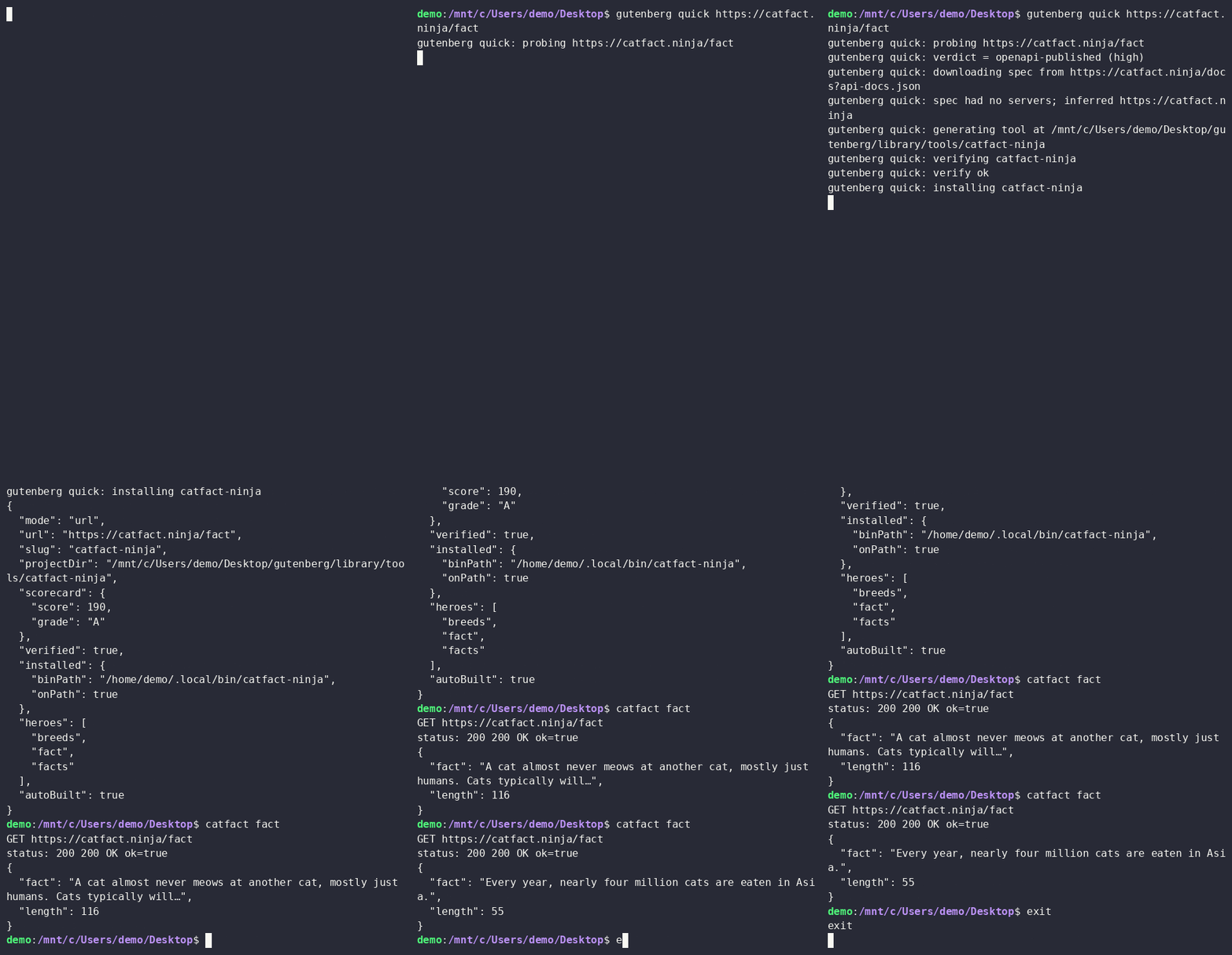 ```bash
$ gutenberg quick https://catfact.ninja/fact
gutenberg quick: probing https://catfact.ninja/fact
gutenberg quick: verdict = openapi-published (high)
gutenberg quick: downloading spec from https://catfact.ninja/docs?api-docs.json
gutenberg quick: generating tool at library/tools/catfact
gutenberg quick: verifying catfact ← go build · cli-smoke · mcp-handshake · go test
gutenberg quick: verify ok
gutenberg quick: installing catfact → ~/.local/bin/catfact
$ catfact fact ← Grade A · 100/100 · ~30 s end-to-end
GET https://catfact.ninja/fact
status: 200 OK
{
"fact": "In just 7 years, one un-spayed female cat and one un-neutered male cat...",
"length": 121
}
```
**One command. Any public API. A working tool surface for AI agents: CLI, MCP, skills, cache, policy and proofs. Verified by build, cli-smoke, MCP handshake, and Go tests.** Nothing else does this.
## What "quick" does, in 6 numbered steps
1. **probe** the URL (`try`) — classifies it as `openapi-published / json-endpoint / html-content / spa / lazy-rendered / anti-bot-challenge / http-error`
2. **fetch the spec** (or seed a HAR if no spec is exposed; auto-infers baseUrl/schemas from real response bodies)
3. **generate** Go CLI + MCP server + Claude skill + OpenClaw skill
4. **verify** with build + cli smoke + MCP handshake + Go tests → `proofs/verification.json`
5. **install** into `~/.local/bin/`
6. **expose heroes** — zero-friction aliases auto-detected from the spec (e.g. `catfact fact`, `github meta`, `tvmaze shows`)
## Or pass a natural language intent and route to the catalog
```bash
$ gutenberg quick "top hacker news stories"
gutenberg quick: searching catalog for "top hacker news stories"
gutenberg quick: top match: hacker-news topstories-json (score=5)
[...executes against the cataloged tool...]
```
---
## Why Gutenberg
Most AI-agent infrastructure today gives you a model and tells you "bring your own tools". Gutenberg makes the tools — and makes sure they actually work before any agent calls them.
| Primitive | What it does |
|---|---|
| **`forge` / `generate`** | OpenAPI / GraphQL / HAR / OpenAPI-from-Postman/Insomnia/curl → Go CLI + MCP server + Claude/OpenClaw skill |
| **`verify`** | Runs `go build`, CLI smoke test, MCP handshake, `go test` — writes `proofs/verification.json`. **No proof = no Grade A.** |
| **`try `** | Autopilot: classifies the site (`openapi-published / json-endpoint / html-content / spa / lazy-rendered / anti-bot-challenge / http-error`) and tells you the exact next command |
| **`extract` / `scrape`** | LLM-powered structured extraction (JSON-Schema validated, cache TTL, Anthropic/OpenAI/Ollama provider) + Firecrawl-style markdown scraping |
| **`snapshot/replay`** | Generated tools support deterministic record + offline replay for tests and CI |
| **`vault`** | Shared, AES-GCM-encrypted token vault across all generated tools |
| **`lockfile` + `diff` + `upgrade` + `watch`** | Pin spec hashes, diff semantically, regenerate while preserving `// gutenberg:keep` blocks, poll upstream for drift |
| **`compare`** | Call N tools on the same intent, see results side by side |
| **`aggregator` kind** | One recipe → a fan-out Go CLI over N JSON sources with `merge.go` + `rank.go` |
| **`heroes`** | Zero-friction aliases auto-detected (or curated via `x-gutenberg-hero`) — e.g. `espn nba`, `github meta`, `tvmaze shows` |
## Installation
Gutenberg is currently installed from the GitHub repository. The npm package is not published yet, so do not use `npx gutenberg` for now.
Prerequisites for the full workflow:
- Node.js 20+
- Go installed on `PATH` (`go version` must work), or `GUTENBERG_GOROOT=/path/to/go`
- Git and curl
- Optional: `OPENAI_API_KEY`, `ANTHROPIC_API_KEY`, or Ollama for `extract` / LLM-routed `run`
Install from source:
```bash
git clone https://github.com/JustVugg/gutenberg.git
cd gutenberg
npm install
node bin/gutenberg.js doctor
```
Use it directly from the repo:
```bash
node bin/gutenberg.js search "top hacker news stories"
node bin/gutenberg.js try https://api.tvmaze.com/shows/1
```
Or install the `gutenberg` command globally from this local checkout:
```bash
npm link
gutenberg doctor
```
Generated tools are installed into `~/.local/bin`. Make sure it is on your `PATH`:
```bash
export PATH="$HOME/.local/bin:$PATH"
```
For browser recording flows only, install a Playwright browser:
```bash
npx playwright install chromium
```
## First Tool
The fastest end-to-end test is `quick`: it probes a URL, generates a tool, verifies it, and installs the generated CLI.
```bash
gutenberg quick https://catfact.ninja/fact
catfact fact
```
If you did not run `npm link`, use `node bin/gutenberg.js` instead of `gutenberg`.
Generate from a public OpenAPI spec:
```bash
curl -fsSL -o /tmp/github.json \
https://raw.githubusercontent.com/github/rest-api-description/main/descriptions/api.github.com/api.github.com.json
gutenberg generate /tmp/github.json --out library/tools/github --name github --force --strict
gutenberg verify library/tools/github
gutenberg install library/tools/github
github meta
github call search/repos --param q=claude-code --select '[*].full_name'
```
Probe a site you've never seen:
```bash
gutenberg try https://www.thetrainline.com/it # → "spa, use record"
gutenberg try https://it.wikipedia.org/wiki/Bologna # → "html-content, use scrape/extract"
gutenberg try https://api.tvmaze.com/shows/1 # → "json-endpoint, seed-har + import + generate"
```
## What Gutenberg works on (honest table)
| Site shape | Recommended path | Success rate | Examples we've shipped |
|---|---|---|---|
| **API with public OpenAPI** | `generate` directly | ✅ ~95% | GitHub (1183 ops), Stripe (587), Sentry (209) |
| **API without spec but JSON endpoints** | `seed-har` → `import-har` → `generate` | ✅ ~90% | ESPN, TVMaze, Wikipedia REST, public JSON APIs |
| **Plain HTML content site** | `scrape` (+ `--structured`) or `extract` with schema | ✅ ~80% | Wikipedia and content/documentation pages |
| **SPA with reachable XHR** | `record` (Playwright) → `import-har` | ⚠️ ~40% | needs interactive triggering |
| **SPA + Cloudflare Turnstile / strong anti-bot** | `record --backend browserbase` (paid) — or use an official partner API | ❌ ~5% with free tooling | thetrainline, lastminute, OpenTable, Subito.it |
## Non-goals (what Gutenberg deliberately does NOT do)
- **Bypass anti-bot protections.** Cloudflare Turnstile, JS challenges, fingerprint-based bot detection: Gutenberg does not try to defeat them. When a site invests in stopping bots, that's a product decision we respect. For legitimate browser-driven scraping use the official Browserbase backend (`record --backend browserbase`).
- **Solve CAPTCHAs.** No 2Captcha-style integrations.
- **Scrape against ToS.** The README of every generated tool tells users to respect rate limits, robots.txt, and terms of service.
- **Be a model.** Gutenberg routes LLM calls (Anthropic / OpenAI / Ollama) but does not train or fine-tune.
## Commands
```bash
gutenberg doctor Probe runtime, LLM providers, Browserbase
gutenberg try Autopilot — classify a site and pick the next command
gutenberg discover Look for a published OpenAPI/Swagger
gutenberg seed-har [...] Fetch URL(s) via plain HTTP, emit HAR (no browser)
gutenberg record Playwright HAR recording [--storage-state state.json]
[--backend browserbase --key $KEY --project-id $PROJ]
gutenberg login --out state.json Headed login flow, save storage-state for later record/extract
gutenberg import-har HAR → OpenAPI (with schema inference + auth sniffer)
gutenberg import-graphql GraphQL SDL / introspection → OpenAPI
gutenberg generate --out OpenAPI → Go CLI + MCP + Claude skill (+ openclaw, optional)
[--strict] [--min-score 0.7] [--default-header 'k: v']
[--policy policy.json]
gutenberg generate --kind aggregator --out
gutenberg verify Runs build + cli-smoke + mcp-handshake + tests; writes proofs/
gutenberg install go build + symlink into ~/.local/bin
gutenberg install starter-pack Install Hacker News, ESPN, Wikipedia, TVMaze, Open-Meteo, GitHub
gutenberg scorecard Multi-dim scorecard with verification badges
gutenberg publish |--all Validate proofs + skills + OpenClaw; sync registry
gutenberg registry sync Rebuild library/registry.json from real manifests
gutenberg upgrade [--spec ...] Regenerate, preserve `// gutenberg:keep` blocks, auto go mod tidy
gutenberg watch Poll spec URL, regenerate on drift
gutenberg diff Semantic spec diff
gutenberg extract -p PROMPT -s SCHEMA LLM extraction with JSON-Schema validation + --cache 1h
gutenberg scrape [--structured] Main-content markdown (table detector for repeated patterns)
gutenberg search Catalog discovery: top matching operations
gutenberg run [--no-llm] LLM-routed (or top-match) execute against catalog
gutenberg compare --op X Side-by-side call across tools
gutenberg site build Rebuild web/data.js with scorecard + heroes
```
Generated tools share a uniform sub-command surface:
```bash
operations [--json] List operations
heroes [--json] List auto-detected hero aliases
Shortcut to call --digest
call [options] Call with full control
--param k=v --path k=v --header 'k: v' --data '{...}' --yes
--json | --compact | --digest | --select 'data.events[*].name'
--stream For SSE/NDJSON endpoints
walk --max N Auto-pagination (offset/limit, cursor, page)
sync Cache read operations locally (SQLite/FTS5)
search Full-text over cached responses
resources [query] Search projected resource rows in SQLite
auth
mcp Run as MCP stdio server
```
## Catalog included
21 verified catalog entries with `proofs/verification.json`:
| Tool | Ops | Source | Verified checks |
|---|---:|---|---|
| github | 1183 | GitHub OpenAPI official | build • cli • mcp • tests |
| stripe | 587 | Stripe OpenAPI official | build • cli • mcp • tests |
| sentry | 209 | Sentry OpenAPI official | build • cli • mcp • tests |
| espn | 4 | HAR-seeded | build • cli • mcp • tests |
| wikipedia-it | 5 | HAR-seeded (User-Agent default) | build • cli • mcp • tests |
| tvmaze | 5 | HAR-seeded | build • cli • mcp • tests |
| multi-demo | 2 sources | aggregator (ESPN + Open-Meteo) | build • cli • tests |
| dev-pulse | 2 sources | aggregator (GitHub + ESPN) | build • cli • tests |
Plus CatFact, CoinGecko, Dog API, Exchange Rates, Hacker News, npm registry, Open-Meteo, PokeAPI, public holidays, PyPI, RandomUser, REST Countries, and TVMaze quick. The complete source of truth is `library/registry.json`, generated by `gutenberg registry sync`.
Plus 17+ recipe templates in `library/recipes/` for common sources (Hacker News, CoinGecko, PokeAPI, Open-Meteo, REST Countries, Nominatim, npm registry, PyPI, exchange rates, public holidays, Reddit, Spotify, Slack, Xquik, …).
## Output targets
`--targets go,mcp,skill,openclaw` controls what gets emitted next to the Go module:
- **`go`** + **`mcp`** — Go binary + stdio MCP server (default)
- **`skill`** — `skills//SKILL.md` (Claude Code skill format)
- **`openclaw`** — `openclaw//skill.{json,md}` (agent-framework-neutral schema)
## Architecture diff vs other open-source factories
Compared to **site2cli** (PyPI) and **printingpress.dev** (~82 CLIs, npm), Gutenberg uniquely ships:
- Verification proofs gate (no Grade A without `proofs/verification.json`)
- `gutenberg try ` autopilot
- Aggregator-as-recipe (declarative)
- Snapshot/replay deterministic mode (built into every generated tool)
- Shared AES-GCM token vault
- `lockfile` + `diff` + `upgrade` + `watch`
- `cross-tool compare`
- LLM-provider-agnostic extract (Anthropic / OpenAI / Ollama) + cache TTL
- HAR → OpenAPI with **response schema inference** and **auth scheme sniffer**
- Built-in JSONPath `--select` and `--stream` for SSE/NDJSON
What we don't have yet: their catalog scale (82 vs 21) and packaged npm distribution. The catalog grows with recipes and `gutenberg publish --all --fix-assets`.
## Run tests
```bash
node --test tests/*.test.js
```
Local-network-dependent tests skip cleanly in sandboxes that deny `127.0.0.1` listeners. Browser tests remain opt-in (`GUTENBERG_BROWSER_TESTS=1` to exercise live Playwright).
## Environment variables
| Var | What |
|---|---|
| `ANTHROPIC_API_KEY` | Use Anthropic for `extract` / `run` |
| `OPENAI_API_KEY` | Use OpenAI for `extract` / `run` |
| `OLLAMA_HOST` (default `http://localhost:11434`) + `GUTENBERG_LLM_PROVIDER=ollama` | Use local or remote Ollama for `extract` |
| `BROWSERBASE_API_KEY` + `BROWSERBASE_PROJECT_ID` | Required for `record --backend browserbase` |
| `GUTENBERG_VAULT_KEY` (32-byte hex) | Encrypt the shared OAuth vault with AES-GCM |
| `GUTENBERG_TELEMETRY=1` + `GUTENBERG_TELEMETRY_FILE` | Opt-in local JSONL log of operation calls (never sent anywhere) |
| `_SNAPSHOT_MODE=record\|replay` + `_SNAPSHOT_DIR` | Deterministic HTTP record/replay per tool |
| `_AUTO_REFRESH=0` | Disable automatic OAuth refresh in a generated tool |
## License
MIT.
## Status
`v0.1.0` — public. Honest about its boundaries:
- ✅ Verified end-to-end on GitHub, Stripe, Sentry, ESPN, Wikipedia IT, TVMaze and the public-API starter catalog
- ✅ 21 catalog entries shipped, 17+ recipe templates
- ❌ Cannot bypass Cloudflare Turnstile / strong anti-bot. Use `record --backend browserbase` or an official partner API for that class of site.