> [!TIP]
> Check out [zeitgrep](https://github.com/kantord/zeitgrep), another search tool I am working on!
 SeaGOAT
A code search engine for the AI age. SeaGOAT is a local search tool that
leverages vector embeddings to enable you to search your codebase semantically.
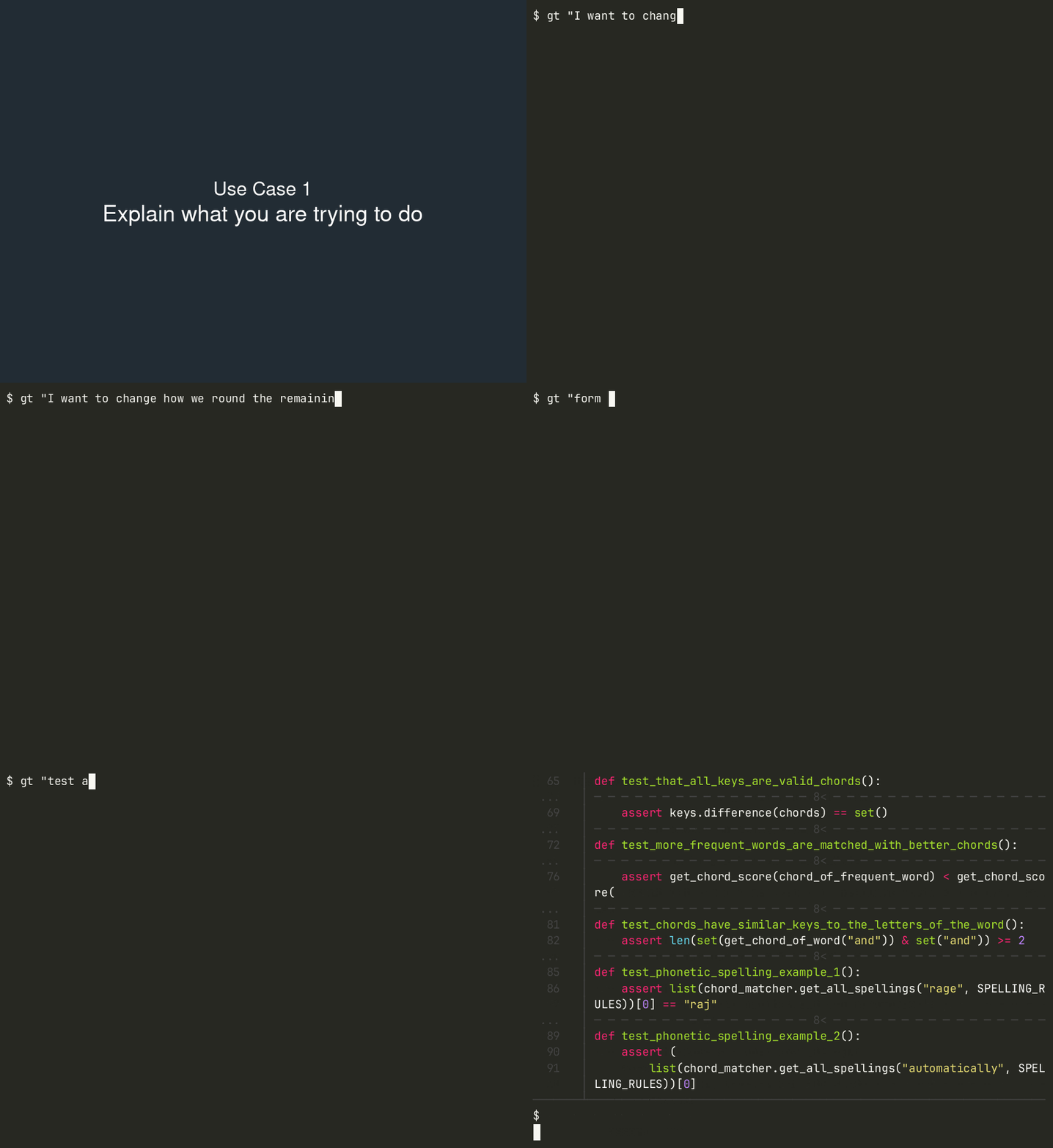
## Getting started
### Install SeaGOAT
In order to install SeaGOAT, you need to have the following
dependencies already installed on your computer:
- Python 3.11 or newer
- ripgrep
- [bat](https://github.com/sharkdp/bat) (**optional**, highly recommended)
When `bat` is [installed](https://github.com/sharkdp/bat#on-ubuntu-using-apt),
it is used to display results as long as color is enabled. When SeaGOAT is
used as part of a pipeline, a grep-line output format is used. When color is
enabled, but `bat` is not installed, SeaGOAT will highlight the output using
pygments. Using `bat` is recommended.
To install SeaGOAT using `pipx`, use the following command:
```bash
pipx install seagoat
```
### System requirements
#### Hardware
Should work on any decent laptop.
#### Operating system
SeaGOAT is designed to work on Linux (*tested* ✅),
macOS ([partly tested, **help**](https://github.com/kantord/SeaGOAT/issues/178) 🙏)
and Windows ([**help needed**](https://github.com/kantord/SeaGOAT/issues/179) 🙏).
### Start SeaGOAT server
In order to use SeaGOAT in your project, you have to start the SeaGOAT server
using the following command:
```bash
seagoat-server start /path/to/your/repo
```
### Search your repository
If you have the server running, you can simply use the
`gt` or `seagoat` command to query your repository. For example:
```bash
gt "Where are the numbers rounded"
```
You can also use
[Regular Expressions](https://en.wikipedia.org/wiki/Regular_expression)
in your queries, for example
```bash
gt "function calc_.* that deals with taxes"
```
### Stopping the server
You can stop the running server using the following command:
```bash
seagoat-server stop /path/to/your/repo
```
### Configuring SeaGOAT
SeaGOAT can be tailored to your needs through YAML configuration files,
either globally or project-specifically with a `.seagoat.yml` file.
For instance:
```yaml
# .seagoat.yml
server:
port: 31134 # Specify server port
```
[Check out the documentation](https://kantord.github.io/SeaGOAT/latest/configuration/)
for more details!
## Development
**Requirements**:
- [Poetry](https://python-poetry.org/)
- Python 3.11 or newer
- [ripgrep](https://github.com/BurntSushi/ripgrep)
### Install dependencies
After cloning the repository, install dependencies using the following command:
```bash
poetry install
```
### Running tests
#### Watch mode (recommended)
```bash
poetry run ptw
```
#### Test changed files
```bash
poetry run pytest . --testmon
```
#### Test all files
```bash
poetry run pytest .
```
### Manual testing
You can test any SeaGOAT command manually in your local development
environment. For example to test the development version of the
`seagoat-server` command, you can run:
```bash
poetry run seagoat-server start ~/path/an/example/repository
```
## FAQ
The points in this FAQ are indications of how SeaGOAT works, but are not
a legal contract. SeaGOAT is licensed under an open source license and if you
are in doubt about the privacy/safety/etc implications of SeaGOAT, you are
welcome to examine the source code,
[raise your concerns](https://github.com/kantord/SeaGOAT/issues/new),
or create a pull request to fix a problem.
### How does SeaGOAT work? Does it send my data to ChatGPT?
SeaGOAT does not rely on 3rd party APIs or any remote APIs and executes all
functionality locally using the SeaGOAT server that you are able to run on
your own machine.
Instead of relying on APIs or "connecting to ChatGPT", it uses the vector
database called ChromaDB, with a local vector embedding engine and
telemetry disabled by default.
Apart from that, SeaGOAT also uses ripgrep, a regular-expression based code
search engine in order to provider regular expression/keyword based matches
in addition to the "AI-based" matches.
While the current version of SeaGOAT does not send your data to remote
servers, it might be possible that in the future there will be **optional**
features that do so, if any further improvement can be gained from that.
### Why does SeaGOAT need a server?
SeaGOAT needs a server in order to provide a speedy response. SeaGOAT heavily
relies on vector embeddings and vector databases, which at the moment cannot
be replace with an architecture that processes files on the fly.
It's worth noting that *you are able to run SeaGOAT server entirely locally*,
and it works even if you don't have an internet connection. This use case
does not require you to share data with a remote server, you are able to use
your own SeaGOAT server locally, albeit it's also possible to run a SeaGOAT
server and allow other computers to connect to it, if you so wish.
### Does SeaGOAT create AI-derived work? Is SeaGOAT ethical?
If you are concerned about the ethical implications of using AI tools keep in
mind that SeaGOAT is not a code generator but a code search engine, therefore
it does not create AI derived work.
That being said, a language model *is* being used to generate vector
embeddings. At the moment SeaGOAT uses ChromaDB's default model for
calculating vector embeddings, and I am not aware of this being an ethical
concern.
### What programming languages are supported?
Currently SeaGOAT is hard coded to only process files in the following
formats:
- **Text Files** (`*.txt`)
- **Markdown** (`*.md`)
- **Python** (`*.py`)
- **C** (`*.c`, `*.h`)
- **C++** (`*.cpp`, `*.cc`, `*.cxx`, `*.hpp`)
- **TypeScript** (`*.ts`, `*.tsx`)
- **JavaScript** (`*.js`, `*.jsx`)
- **HTML** (`*.html`)
- **Go** (`*.go`)
- **Java** (`*.java`)
- **PHP** (`*.php`)
- **Ruby** (`*.rb`)
### Why is SeaGOAT processing files so slowly while barely using my CPU?
Since processing files for large repositories can take a long time, SeaGOAT
is **designed to allow you to use your computer while processing files**. It is
an intentional design choice to avoid blocking/slowing down your computer.
This design decision does not affect the performance of queries.
**By the way, you are able to use SeaGOAT to query your repository while
it's processing your files!** When you make a query, and the files are not
processed yet, you will receive a warning with an estimation of the accuracy
of your results. Also, regular expression/full text search based results
will be displayed from the very beginning!
### What character encodings are supported?
The preferred character encoding is UTF-8. Most other character encodings
should also work. Only text files are supported, SeaGOAT ignores binary files.
### Where does SeaGOAT store it's database/cache?
Where SeaGOAT stores databases and cache depends on your operating system.
For your convenience, you can use the `seagoat-server server-info`
command to find out where these files are stored on your system.
### Can I host SeaGOAT server on a different computer?
Yes, if you would like to use SeaGOAT without having to run the server on
the same computer, you can simply self-host SeaGOAT server on a different
computer or in the cloud, and
[configure](https://kantord.github.io/SeaGOAT/latest/configuration/)
the `seagoat`/`gt` command to connect to this remote server through the
internet.
Keep in mind that SeaGOAT itself does not enforce any security as it is
primarily designed to run locally. If you have private code that you do not
wish to leak, you will have to make sure that only trusted people have
access to the SeaGOAT server. This could be done by making it only available
through a VPN that only your teammates can access.
### Can I ignore files/directories?
SeaGOAT already ignores all files/directories ignored in your `.gitignore`.
If you wish to ignore additional files but keep them in git, you can use the
`ignorePatterns` attribute from the server configuration.
[Learn more](https://kantord.github.io/SeaGOAT/latest/configuration/)