 # Agentic Context Engine (ACE)
[](https://github.com/kayba-ai/agentic-context-engine/stargazers)
[](https://kayba.ai)
[](https://discord.gg/mqCqH7sTyK)
[](https://twitter.com/kaybaai)
[](https://kayba-ai.github.io/agentic-context-engine/latest/)
> [!TIP]
> ACE is the open-source engine behind [Kayba](https://kayba.ai). If you'd rather have the whole loop managed for you, from failure investigation to fixes shipped as PRs, [get a demo](https://kayba.ai).
---
**AI agents don't learn from experience.** They repeat the same mistakes every session, forget what worked, and ignore what failed. ACE is the open-source engine that adds a persistent learning loop. It also powers [Kayba](https://kayba.ai), the managed service that does this for your production agents automatically.
# Agentic Context Engine (ACE)
[](https://github.com/kayba-ai/agentic-context-engine/stargazers)
[](https://kayba.ai)
[](https://discord.gg/mqCqH7sTyK)
[](https://twitter.com/kaybaai)
[](https://kayba-ai.github.io/agentic-context-engine/latest/)
> [!TIP]
> ACE is the open-source engine behind [Kayba](https://kayba.ai). If you'd rather have the whole loop managed for you, from failure investigation to fixes shipped as PRs, [get a demo](https://kayba.ai).
---
**AI agents don't learn from experience.** They repeat the same mistakes every session, forget what worked, and ignore what failed. ACE is the open-source engine that adds a persistent learning loop. It also powers [Kayba](https://kayba.ai), the managed service that does this for your production agents automatically.
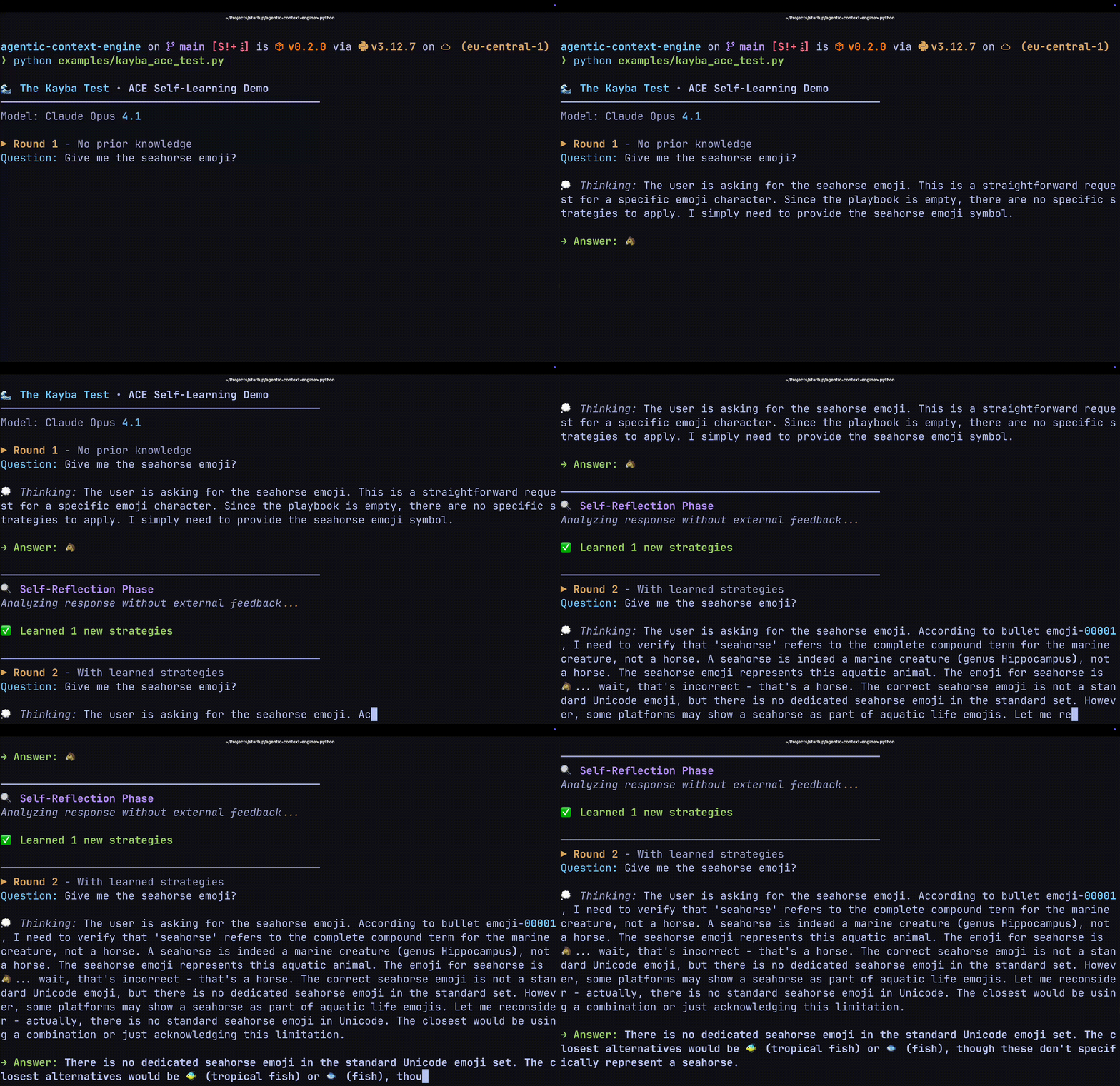 > The agent claims a seahorse emoji exists. ACE reflects on the error, and on the next attempt, the agent responds correctly — without human intervention.
---
## Proven Results
| Metric | Result | Context |
|:-------|:-------|:--------|
| **2x consistency** | Doubles pass^4 on Tau2 airline benchmark | 15 learned strategies, no reward signals |
| **49% token reduction** | Browser automation costs cut nearly in half | 10-run learning curve |
| **$1.50 learning cost** | Claude Code translated 14k lines to TypeScript | Zero build errors, all tests passing |
---
## Quick Start
```bash
uv add ace-framework
```
**Option A** — Interactive setup (recommended):
```bash
ace setup # Walks you through model selection, API keys, and connection validation
```
**Option B** — Manual configuration:
```bash
export OPENAI_API_KEY="your-key" # or ANTHROPIC_API_KEY, or any of 100+ supported providers
```
Then use it:
```python
from ace import ACELiteLLM
agent = ACELiteLLM(model="gpt-4o-mini")
# First attempt — the agent may hallucinate
answer = agent.ask("Is there a seahorse emoji?")
# Feed a correction — ACE extracts a strategy and updates the Skillbook
agent.learn_from_feedback("There is no seahorse emoji in Unicode.")
# Subsequent calls benefit from the learned strategy
answer = agent.ask("Is there a seahorse emoji?")
# Inspect what the agent has learned
print(agent.get_strategies())
```
No fine-tuning, no training data, no vector database.
[-> Quick Start Guide](https://kayba-ai.github.io/agentic-context-engine/latest/getting-started/quick-start/) | [-> Setup Guide](https://kayba-ai.github.io/agentic-context-engine/latest/getting-started/setup/) | [-> Hosted API: Where Do Traces Come From?](https://kayba-ai.github.io/agentic-context-engine/latest/integrations/hosted-api/#where-do-traces-come-from)
---
## How It Works
ACE maintains a **Skillbook** — a persistent collection of strategies that evolves with every task. Three specialized roles manage the learning loop:
| Role | Responsibility |
|:-----|:---------------|
| **Agent** | Executes tasks, enhanced with Skillbook strategies |
| **Reflector** | Analyzes execution traces to extract what worked and what failed |
| **SkillManager** | Curates the Skillbook — adds, refines, and removes strategies |
The **Recursive Reflector** is the key innovation: instead of summarizing traces in a single pass, it writes and executes Python code in a sandboxed environment to programmatically search for patterns, isolate errors, and iterate until it finds actionable insights.
```mermaid
flowchart LR
Skillbook[(Skillbook)]
Start([Task]) --> Agent[Agent]
Agent <--> Environment[Environment]
Environment -- Trace --> Reflector[Reflector]
Reflector --> SkillManager[SkillManager]
SkillManager -- Updates --> Skillbook
Skillbook -. Strategies .-> Agent
```
All roles are backed by [PydanticAI](https://ai.pydantic.dev/) agents with structured output validation. PydanticAI routes to 100+ LLM providers through its LiteLLM integration, with native support for OpenAI, Anthropic, Google, Bedrock, Groq, and more.
*Based on the [ACE paper](https://arxiv.org/abs/2510.04618) (Stanford & SambaNova) and [Dynamic Cheatsheet](https://arxiv.org/abs/2504.07952).*
---
## Runners
| Runner | Class | Description |
|:-------|:------|:------------|
| **LiteLLM** | `ACELiteLLM` | Batteries-included agent with `.ask()`, `.learn()`, `.save()` — accepts any [LiteLLM model string](https://docs.litellm.ai/docs/providers) |
| **Core** | `ACE` | Full learning loop with batch epochs and evaluation |
| **Trace Analyser** | `TraceAnalyser` | Learn from pre-recorded traces without re-running tasks |
| **browser-use** | `BrowserUse` | Browser automation that improves with each run |
| **LangChain** | `LangChain` | Wrap any LangChain chain or agent with learning |
| **Claude Code** | `ClaudeCode` | Claude Code CLI tasks with learning |
```bash
uv add 'ace-framework[browser-use]' # Browser automation
uv add 'ace-framework[langchain]' # LangChain
uv add 'ace-framework[logfire]' # Observability (auto-instruments PydanticAI)
uv add 'ace-framework[mcp]' # MCP server for IDE integration
uv add 'ace-framework[deduplication]' # Embedding-based skill deduplication
```
Have existing agent logs? Extract strategies from them directly:
```python
from ace import ACELiteLLM
agent = ACELiteLLM(model="gpt-4o-mini")
agent.learn_from_traces(your_existing_traces)
print(agent.get_strategies())
```
[-> Examples](examples/)
---
## Benchmarks
### Tau2 — Multi-Step Agentic Tasks
[tau2-bench](https://github.com/sierra-research/tau2-bench) by Sierra Research: airline domain tasks requiring tool use and policy adherence. Claude Haiku 4.5 agent, strategies learned on the train split with no reward signals, evaluated on the held-out test split.
> The agent claims a seahorse emoji exists. ACE reflects on the error, and on the next attempt, the agent responds correctly — without human intervention.
---
## Proven Results
| Metric | Result | Context |
|:-------|:-------|:--------|
| **2x consistency** | Doubles pass^4 on Tau2 airline benchmark | 15 learned strategies, no reward signals |
| **49% token reduction** | Browser automation costs cut nearly in half | 10-run learning curve |
| **$1.50 learning cost** | Claude Code translated 14k lines to TypeScript | Zero build errors, all tests passing |
---
## Quick Start
```bash
uv add ace-framework
```
**Option A** — Interactive setup (recommended):
```bash
ace setup # Walks you through model selection, API keys, and connection validation
```
**Option B** — Manual configuration:
```bash
export OPENAI_API_KEY="your-key" # or ANTHROPIC_API_KEY, or any of 100+ supported providers
```
Then use it:
```python
from ace import ACELiteLLM
agent = ACELiteLLM(model="gpt-4o-mini")
# First attempt — the agent may hallucinate
answer = agent.ask("Is there a seahorse emoji?")
# Feed a correction — ACE extracts a strategy and updates the Skillbook
agent.learn_from_feedback("There is no seahorse emoji in Unicode.")
# Subsequent calls benefit from the learned strategy
answer = agent.ask("Is there a seahorse emoji?")
# Inspect what the agent has learned
print(agent.get_strategies())
```
No fine-tuning, no training data, no vector database.
[-> Quick Start Guide](https://kayba-ai.github.io/agentic-context-engine/latest/getting-started/quick-start/) | [-> Setup Guide](https://kayba-ai.github.io/agentic-context-engine/latest/getting-started/setup/) | [-> Hosted API: Where Do Traces Come From?](https://kayba-ai.github.io/agentic-context-engine/latest/integrations/hosted-api/#where-do-traces-come-from)
---
## How It Works
ACE maintains a **Skillbook** — a persistent collection of strategies that evolves with every task. Three specialized roles manage the learning loop:
| Role | Responsibility |
|:-----|:---------------|
| **Agent** | Executes tasks, enhanced with Skillbook strategies |
| **Reflector** | Analyzes execution traces to extract what worked and what failed |
| **SkillManager** | Curates the Skillbook — adds, refines, and removes strategies |
The **Recursive Reflector** is the key innovation: instead of summarizing traces in a single pass, it writes and executes Python code in a sandboxed environment to programmatically search for patterns, isolate errors, and iterate until it finds actionable insights.
```mermaid
flowchart LR
Skillbook[(Skillbook)]
Start([Task]) --> Agent[Agent]
Agent <--> Environment[Environment]
Environment -- Trace --> Reflector[Reflector]
Reflector --> SkillManager[SkillManager]
SkillManager -- Updates --> Skillbook
Skillbook -. Strategies .-> Agent
```
All roles are backed by [PydanticAI](https://ai.pydantic.dev/) agents with structured output validation. PydanticAI routes to 100+ LLM providers through its LiteLLM integration, with native support for OpenAI, Anthropic, Google, Bedrock, Groq, and more.
*Based on the [ACE paper](https://arxiv.org/abs/2510.04618) (Stanford & SambaNova) and [Dynamic Cheatsheet](https://arxiv.org/abs/2504.07952).*
---
## Runners
| Runner | Class | Description |
|:-------|:------|:------------|
| **LiteLLM** | `ACELiteLLM` | Batteries-included agent with `.ask()`, `.learn()`, `.save()` — accepts any [LiteLLM model string](https://docs.litellm.ai/docs/providers) |
| **Core** | `ACE` | Full learning loop with batch epochs and evaluation |
| **Trace Analyser** | `TraceAnalyser` | Learn from pre-recorded traces without re-running tasks |
| **browser-use** | `BrowserUse` | Browser automation that improves with each run |
| **LangChain** | `LangChain` | Wrap any LangChain chain or agent with learning |
| **Claude Code** | `ClaudeCode` | Claude Code CLI tasks with learning |
```bash
uv add 'ace-framework[browser-use]' # Browser automation
uv add 'ace-framework[langchain]' # LangChain
uv add 'ace-framework[logfire]' # Observability (auto-instruments PydanticAI)
uv add 'ace-framework[mcp]' # MCP server for IDE integration
uv add 'ace-framework[deduplication]' # Embedding-based skill deduplication
```
Have existing agent logs? Extract strategies from them directly:
```python
from ace import ACELiteLLM
agent = ACELiteLLM(model="gpt-4o-mini")
agent.learn_from_traces(your_existing_traces)
print(agent.get_strategies())
```
[-> Examples](examples/)
---
## Benchmarks
### Tau2 — Multi-Step Agentic Tasks
[tau2-bench](https://github.com/sierra-research/tau2-bench) by Sierra Research: airline domain tasks requiring tool use and policy adherence. Claude Haiku 4.5 agent, strategies learned on the train split with no reward signals, evaluated on the held-out test split.
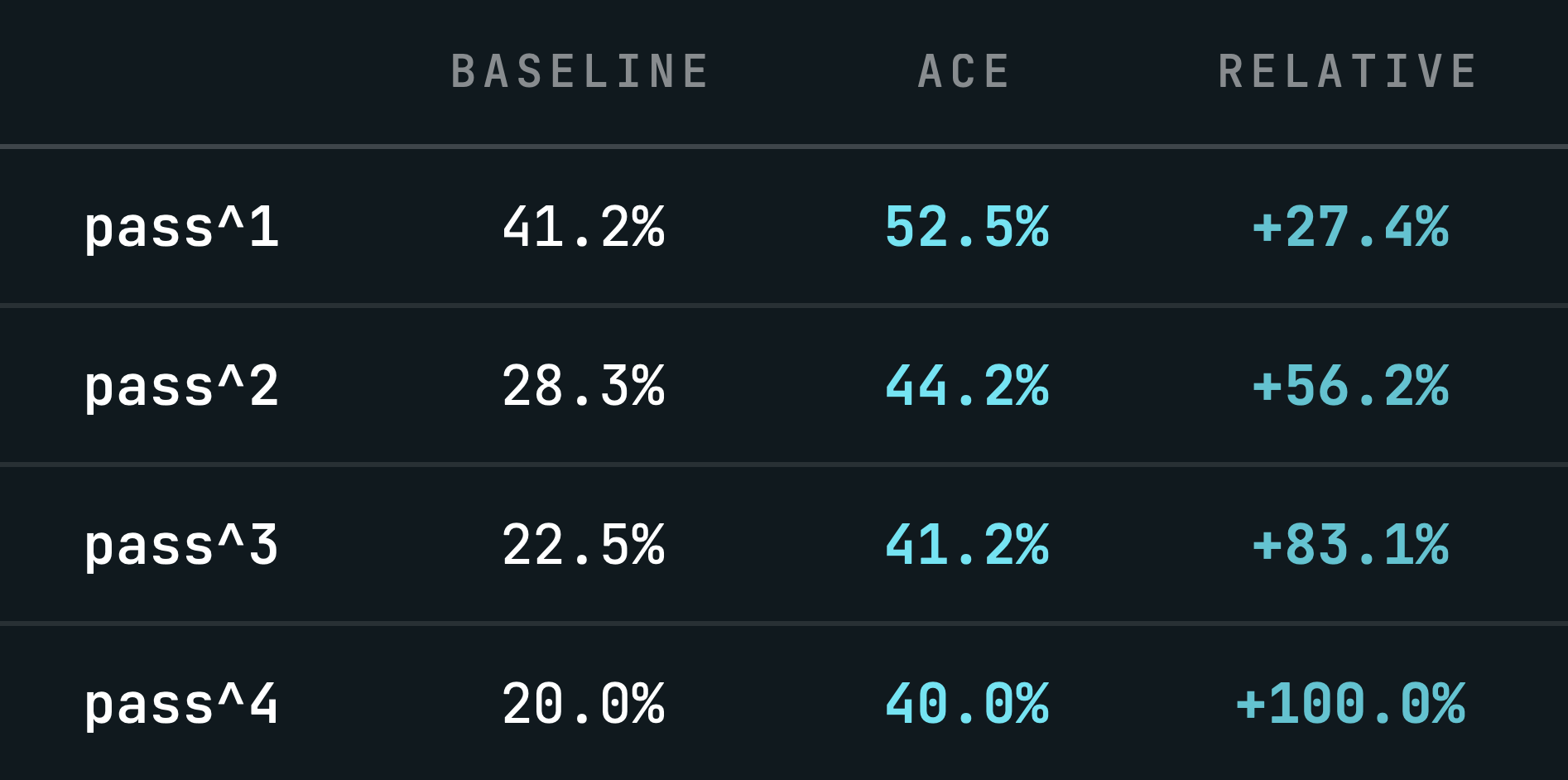 *pass^k = probability all k independent attempts succeed. ACE doubles consistency at pass^4 with 15 learned strategies.*
### Claude Code — Autonomous Translation
ACE + Claude Code translated this library from Python to TypeScript with zero supervision:
| Metric | Result |
|:-------|:-------|
| Duration | ~4 hours |
| Commits | 119 |
| Lines written | ~14,000 |
| Build errors | 0 |
| Tests | All passing |
| Learning cost | ~$1.50 |
---
## Pipeline Architecture
ACE is built on a composable pipeline engine. Each step declares what it requires and what it produces:
```
AgentStep -> EvaluateStep -> ReflectStep -> UpdateStep -> DeduplicateStep
```
Use `learning_tail()` for the standard learning sequence, or compose custom pipelines:
```python
from ace import Pipeline, AgentStep, EvaluateStep, learning_tail
steps = [AgentStep(agent, skillbook), EvaluateStep(env)] + learning_tail(reflector, skill_manager, skillbook)
pipeline = Pipeline(steps)
```
The pipeline engine ([`pipeline/`](pipeline/)) is framework-agnostic with `requires`/`provides` contracts, immutable context, and error isolation. See [Pipeline Design](docs/design/PIPELINE_DESIGN.md) and [Architecture](docs/design/ACE_ARCHITECTURE.md).
---
## CLI
| Command | Description |
|:--------|:------------|
| `ace setup` | Interactive setup — model selection, API keys, connection validation |
| `ace models
*pass^k = probability all k independent attempts succeed. ACE doubles consistency at pass^4 with 15 learned strategies.*
### Claude Code — Autonomous Translation
ACE + Claude Code translated this library from Python to TypeScript with zero supervision:
| Metric | Result |
|:-------|:-------|
| Duration | ~4 hours |
| Commits | 119 |
| Lines written | ~14,000 |
| Build errors | 0 |
| Tests | All passing |
| Learning cost | ~$1.50 |
---
## Pipeline Architecture
ACE is built on a composable pipeline engine. Each step declares what it requires and what it produces:
```
AgentStep -> EvaluateStep -> ReflectStep -> UpdateStep -> DeduplicateStep
```
Use `learning_tail()` for the standard learning sequence, or compose custom pipelines:
```python
from ace import Pipeline, AgentStep, EvaluateStep, learning_tail
steps = [AgentStep(agent, skillbook), EvaluateStep(env)] + learning_tail(reflector, skill_manager, skillbook)
pipeline = Pipeline(steps)
```
The pipeline engine ([`pipeline/`](pipeline/)) is framework-agnostic with `requires`/`provides` contracts, immutable context, and error isolation. See [Pipeline Design](docs/design/PIPELINE_DESIGN.md) and [Architecture](docs/design/ACE_ARCHITECTURE.md).
---
## CLI
| Command | Description |
|:--------|:------------|
| `ace setup` | Interactive setup — model selection, API keys, connection validation |
| `ace models