# OpenTakeoff
**The measurement engine for building plans—built so an AI agent can drive it, and so an estimator wants to.**
A takeoff is the act of measuring quantities off a construction drawing. OpenTakeoff does it
two ways over one engine: **58 MCP tools** for an agent, and a browser canvas for a person.
Agents and people share the takeoff document and quantity calculations. Each sheet carries
its calibration; measurements carry geometry, method and authorship. Recalibration updates
quantities together, incompatible imports report scale conflicts, and agent measurements
carry an explicit review status. See the [Phase 1 test guide](docs/PHASE_1_TESTING.md).
[](LICENSE)
[](https://opentakeoff.kentucky-ai.com)
[](https://registry.modelcontextprotocol.io)
[](https://www.npmjs.com/package/opentakeoff-mcp)
[](https://union.kentucky-ai.com)
[](https://openarena.to/en/projects/cmsgykvsq0000mkuv7byhlgnl)
[](https://github.com/sponsors/Kentucky-ai)
[**For agents**](#for-agents--start-here) · [**Try the canvas**](https://opentakeoff.kentucky-ai.com) · [The engine's contract](#the-contract-that-makes-it-drivable) · [For the person at the canvas](#for-the-person-at-the-canvas) · [The data layer](#the-data-layer--why-this-engine-exists) · [Research](#the-research-program) · [Fork it](#fork-it) · [Contribute](#contributing)
**The two manuals:** [agent manual](docs/AGENT_GUIDE.md) · [user manual](docs/USER_GUIDE.md)
**Protocol work:** [Takeoff Protocol draft and compatibility status](docs/TAKEOFF_PROTOCOL.md)—formalizing existing records; current takeoff behavior is unchanged.
**Read this in:** [日本語](README.ja.md) · [한국어](README.ko.md) · [简体中文](README.zh-Hans.md)
**Watch it:** [an autonomous agent runs a takeoff, live, no cuts (2:47)](https://youtu.be/e--kXxSGv7Y) · [hospital finish plan → report in about a minute (1:14)](https://youtu.be/cNDpPkTLY1k) · [canvas walkthrough (1:10)](https://youtu.be/aHiW8H2TSBs) · [One-Click Area (0:51)](https://youtu.be/YIjWZ-BAhLE)
> **One-Click Area is temporarily gated.** The flood engine is being re-validated against a wider plan corpus. Until that finishes the One-Click tool is off the canvas rail (`O` reports the gate) and the `one_click` / `detect_rooms` MCP verbs are **not registered** (a default build ships 58 tools). Trace rooms with **Area** (`A`) in the canvas and `measure_polygon` over MCP; every other tool, sweep and derivation is unchanged. A build lifts the gate with `VITE_ONE_CLICK=1` (canvas) / `OPENTAKEOFF_ONE_CLICK=1` (server). Sections and videos below that show One-Click describe the engine as it returns — see [`docs/design/ONE_CLICK_GATE.md`](docs/design/ONE_CLICK_GATE.md).
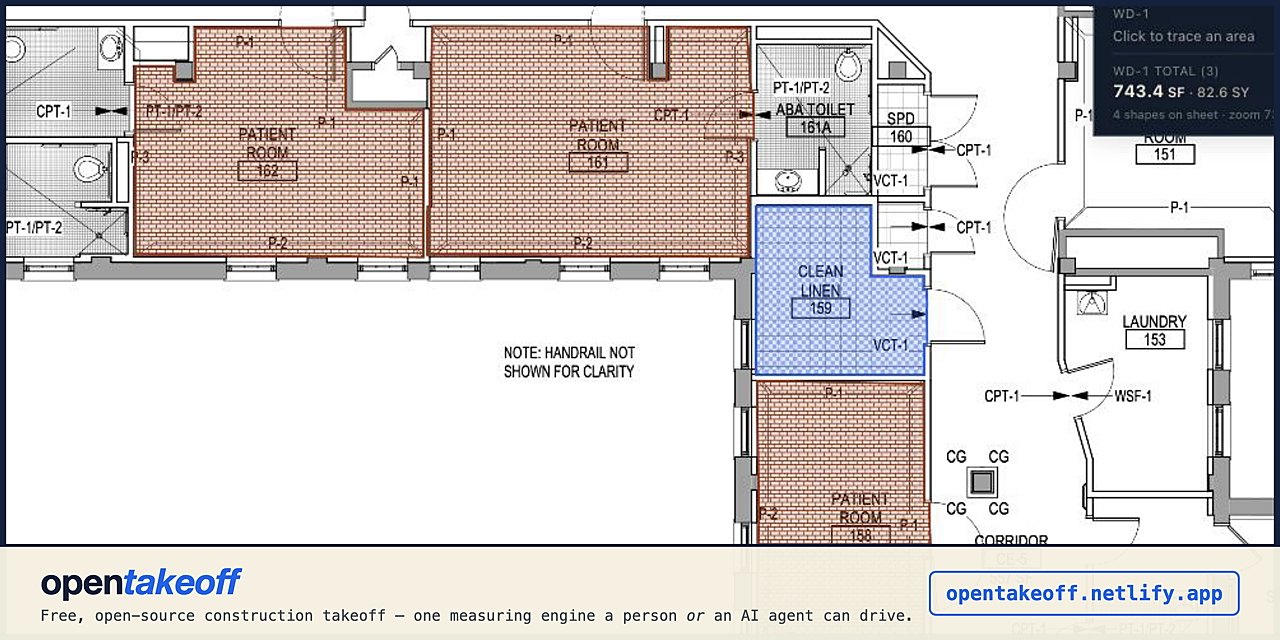
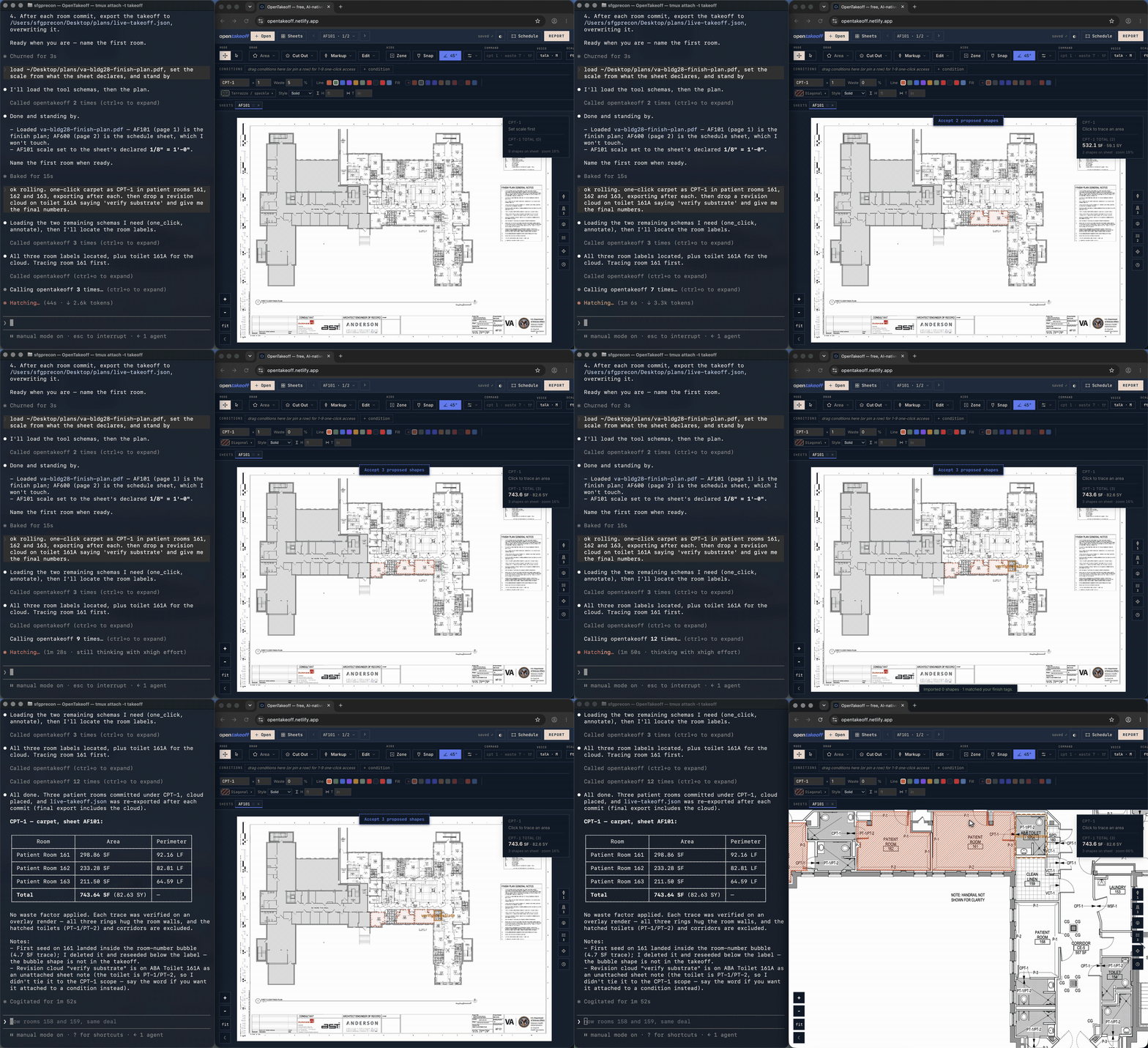 *A real run (3× speed): the agent takes off patient rooms 161–163 on a federal finish plan,
exporting after each commit. Every shape lands in the app as a dashed **pencil proposal** and
becomes ink only when the operator clicks Accept.* The full run, live and uncut, is
[on YouTube (2:47)](https://youtu.be/e--kXxSGv7Y).
### The tools
| Group | Tools |
|---|---|
| **Open and orient** | `load_plan` · `sheet_info` · `sheet_context` · `get_sheet_vectors` · `read_sheet_text` · `find_text` · `view_sheet` |
| **Scale** | `set_scale` |
| **Measure** | `one_click` · `detect_rooms` · `measure_polygon` · `cut_out` · `measure_line` · `measure_surface` · `place_count` |
| **Repeat and derive** | `symbol_sweep` · `sweep_schedule_row` · `derive_base` · `derive_transitions` · `apply_rules` |
| **Read the drawing set** | `sheet_graph` · `resolve_tag` · `find_schedule` |
| **Edit and audit** | `list_shapes` · `edit_shape` · `edit_condition` · `edit_materials` · `duplicate_condition` · `split_condition` · `delete_shape` · `undo_last` |
| **Mark and sign** | `annotate` · `list_annotations` · `link_annotation` · `mark_verdict` · `delete_verdict` |
| **Ask** | `create_rfi` · `list_rfis` · `resolve_rfi` · `delete_rfi` |
| **Hand off** | `takeoff_summary` · `export_takeoff` · `export_report` · `export_marked_pdf` · `export_dxf` · `import_takeoff` |
Plus browsable sheet resources (`takeoff://sheets`) so an agent can *see* the working set, not
only act on it. Multi-document sessions are first-class: a bid set is plans **plus** schedule
**plus** addenda, and `load_plan --merge` adds a document without disturbing existing scales,
conditions, or shapes—the sheet graph then spans the whole set, so a room tag on one file
resolves to a schedule row in another. `edit_condition` reaches the waste %, the ×N multiplier,
and `roll_setup`, so an agent's takeoff doesn't ship with net === gross.
**The agent's manual is [`docs/AGENT_GUIDE.md`](docs/AGENT_GUIDE.md)**—the counterpart to the
estimator's: the operating model in six facts, the standard finish every takeoff ends with, the
withheld-is-the-answer doctrine, what has no agent verb and why, and a refusal-to-next-move table.
Tool-by-tool reference: [`mcp/README.md`](mcp/README.md). The same surface in prose, with the
sheet-graph and sweep behavior in depth: [`docs/MCP.md`](docs/MCP.md).
### The contract that makes it drivable
Most measurement APIs are hostile to an agent because they let it be confidently wrong. These
are the rules that make this one safe to hand a model, and why each one exists:
1. **One coordinate frame, stated everywhere.** Image pixels at render scale 2.0—PDF points
× 2, origin top-left, y down, the browser canvas's native space. Every sheet payload carries
dims in both px and pt. No tool takes a coordinate in units it has to guess.
2. **Scale is a gate, not a default.** The drawn scale note is *read* off the sheet but never
applied silently; adopting it is always an explicit `set_scale`. Measuring an unscaled sheet
refuses. Pixels × a wrong scale² is every number wrong at once, so the engine would rather
stop than guess. Disagreeing scale notes inside a measured region raise a warning rather
than a silent pick.
3. **The engine traces; the model doesn't invent.** `one_click` returns the ring the wall
network produced from a seed point you name. A model cannot hand back a polygon it imagined and have
it counted. While One-Click is gated, a model draws the ring itself with `measure_polygon`, and the
packaged rules say where it must sit: on the innermost wall-face strokes it read with
`get_sheet_vectors`, doors crossed on the wall centerline, checked on a tight overlay before the
next room. How well unprompted agents follow that is measured, not assumed: see the
[plan set](evals/mcp-workflow-bench/plan-set/README.md).
4. **Every record carries how it was made.** Method, seed point, whether hatch filtering
engaged, whether it came off scan pixels, confidence factors,
and the machine's original ring if a human later moves it.
5. **Agent work is pencil until a person inks it.** Exports land in the canvas as dashed
proposals. `mark_verdict` lets an agent sign its own work as a graphite `AGENT` diamond; the
green `APPROVED` seal has exactly one code path and it is the toolbar button under a human
hand. No MCP call, no import, mints one.
6. **The deliverable is a marked-up planset, not JSON.** `export_marked_pdf` burns the work
into the drawings as drawn—condition colors, hatches, quantity chips, count markers—behind
a legend cover with totals and a tally of how much of the set a person has actually
reviewed. A takeoff nobody can check is not a takeoff.
7. **Refusals are actionable strings.** *"That space isn't enclosed on the plan linework—the
fill spilled"* tells a model what to do next. A silent zero doesn't. Tools that can't answer
withhold with a stated reason rather than returning a plausible number.
### Prove it — OpenTakeoff Academy / Commonwealth Agent Union
[**Commonwealth Agent Union**](https://union.kentucky-ai.com) is the home of OpenTakeoff Academy,
its construction-agent evaluation and certification arm. Bring any model and your own harness; you are
scored on **operating a real takeoff tool** against geometry you don't control—a wrong
calibration yields a wrong area—not on emitting a plausible-looking number. Runs emit a
signed bundle with full provenance of every tool call, scoring is against held-out ground truth
and a human Senior Estimator baseline, and clearing a tier earns a credential that's
independently verifiable. The Certified path drives this engine (`opentakeoff-mcp`) behind the
task tools. Repo:
[Kentucky-ai/opentakeoff-academy](https://github.com/Kentucky-ai/opentakeoff-academy).
---
## For the person at the canvas
The agent path exists because the human path is real. Everything below is the production
measuring engine carved out of a commercial Division 9 estimating system—not a demo
reimplementation.
```bash
cd web
npm install
npm run dev # http://localhost:5173
```
Or open the [**live demo**](https://opentakeoff.kentucky-ai.com). Drag in
`demo/sample-plan.pdf`, accept the detected scale, choose a condition, press **`A`** (Area)
and click the room's corners. (One-Click Area is temporarily gated — see the note at the top.) Open **Report** for the breakdown and the exports. That whole loop on
video: [walkthrough (1:10)](https://youtu.be/aHiW8H2TSBs) ·
[One-Click Area (0:51)](https://youtu.be/YIjWZ-BAhLE). The complete
zero-to-exported walkthrough is the [**user manual**](docs/USER_GUIDE.md).
**What a real bid looks like on it**, in the order an estimator works one:
1. Drag in the whole `.zip` off the bid platform—plans, finish schedule, addenda.
2. Set the scale on every sheet you'll measure, and **check a dimension** (`K`) on each. Ten
seconds a sheet, and it's the only mistake that gets every number at once.
3. Pull your conditions off the architect's finish schedule instead of typing them, and set waste
and materials *before* you trace.
4. Stitch anything split at a match line, align it, and only then start measuring.
5. **Trace** the floors room by room — Area (`A`) while One-Click is gated. Derive base and transitions off the rooms you just
traced rather than measuring them a second time—and read what the derivation *reports and
never counts*, because those are doorway thresholds you still owe.
6. Walk the set and look at what landed, fix with the grips, save a **revision**.
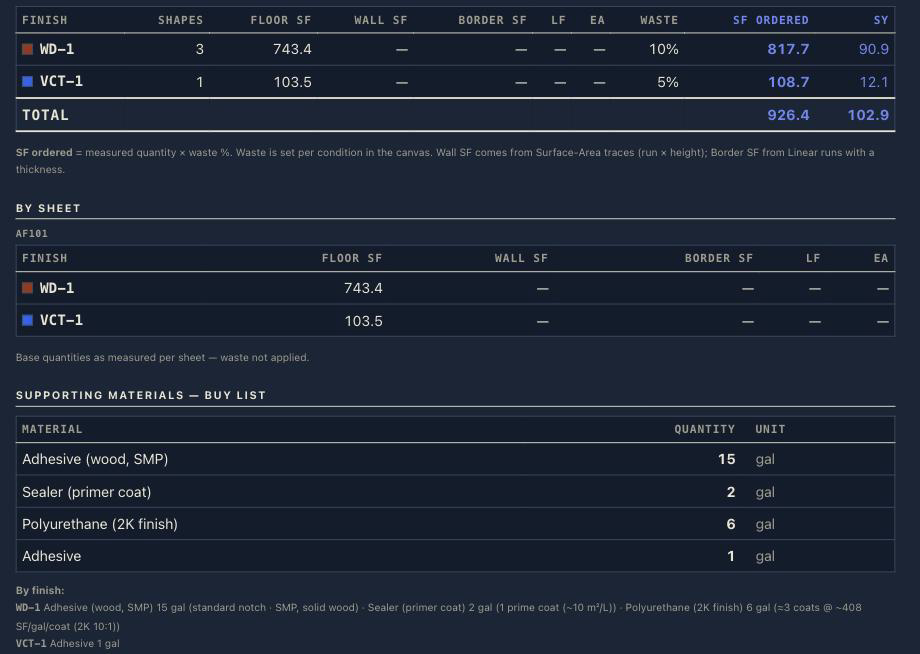
7. Export both: the Report for pricing, the **Marked set** PDF for whoever has to check you.
The full version of that sequence, with the section for each step, is the manual's
[working order](docs/USER_GUIDE.md#the-working-order-on-a-real-bid). What every term above means
is in its [glossary](docs/USER_GUIDE.md#18-glossary--what-the-words-mean-here).
### Open anything, instantly
A plan **PDF**, an **image** (scan, screenshot, photo), or a whole **`.zip` plan set** straight
off a bid platform. Zips are unpacked and images wrapped to PDF *in your browser*—multi-page,
multi-file, up to **4 sheets side-by-side**, with hostile-archive guards so a malformed zip
fails cleanly instead of ballooning the tab. No upload step, no conversion service, no account.
### A real measuring engine
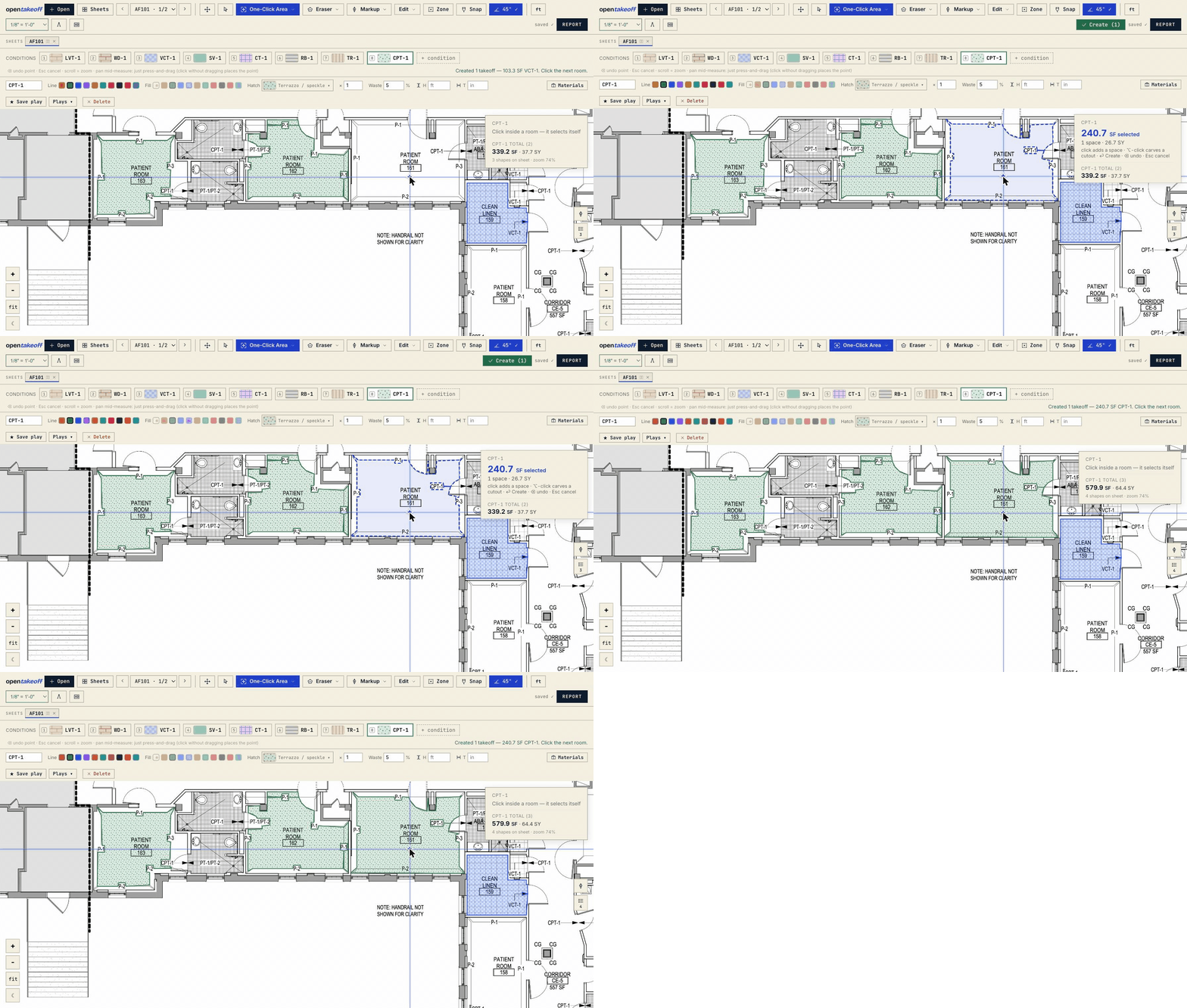
**One-Click Area** is the headline — **temporarily gated** while the flood engine is re-validated (see the note at the top); this is what it does when it is on: click inside a room, the linework bounds a flood fill, the
polygon traces itself, the vertices snap to true corners. **Hatching and poché don't fool it**—tile
grids, plank lines, and section fills classify as pattern rather than wall, and the
escalation is conservative enough that a misread can never come out worse than the strict fill.
**Scanned sheets work too**: with no vector linework the engine reads rendered pixels—adaptive
thresholding, polarity detection for blueprint negatives, a gap-bridging pass for
faded ink—and badges the result so you verify the edges before committing. On CAD exports
that publish a layer tree, One-Click reads the declared roles instead of inferring them.
Plus the full manual kit—**Area, Rectangle, Linear, Curved Line, Surface Area (walls),
Count**, and **Cut Out** deducts—and a **Zone check** that answers "what's in this wing?"
without touching the takeoff.
**⟂ Transitions** derives the line where two finishes meet, from rooms you already measured.
Finishes changing inside one open space commit as a dashed butt-joint run you accept; rooms
parallel across a wall are **reported and never counted**, because that transition is a
threshold in a doorway no trace can locate—you get its length, the wall thickness, and a link
that puts it on screen.
 Kentucky AI is a member of the NVIDIA Inception program.
**Contact:** research collaborations, data questions, press, or anything that is not a bug —
[research@kentucky-ai.com](mailto:research@kentucky-ai.com). Bugs and feature requests go in
[issues](https://github.com/Kentucky-ai/opentakeoff/issues); security reports follow [SECURITY.md](SECURITY.md).
### Contributor credit
Thanks to **[@knmurphy](https://github.com/knmurphy)** (Kevin Murphy) for [image captures](https://github.com/Kentucky-ai/opentakeoff/pull/346), [drawing styles](https://github.com/Kentucky-ai/opentakeoff/pull/337), and [sharper overlays](https://github.com/Kentucky-ai/opentakeoff/pull/329). The **Pin** reference tool builds on his image-capture work.
## License
[GNU Affero General Public License v3.0](LICENSE) (AGPL-3.0-only)—use it, [fork it](#fork-it),
ship it, build on top of it, and share your changes when you run a modified copy for others.
Through commit `84c7f48e` (tag `apache-2.0-final`) OpenTakeoff was Apache-2.0, and that code
stays Apache-2.0 for everyone who already has it. See [NOTICE](NOTICE) for attribution and the
relicensing note and the section 7(b) attribution term; contributions are accepted under the [CLA](CLA.md). For commercial terms
outside the AGPL, contact [Kentucky AI](https://kentucky-ai.com).
For an agent measurement workflow focused on accurate geometry, see [Geometry from source to review](docs/GEOMETRY_WORKFLOW.md).
## Shared knowledge for people and agents
The [wiki](docs/wiki/README.md) routes architecture, protocol, human/agent
workflows, MCP tool selection and domain knowledge. MCP clients read the same
packaged pages at `takeoff://wiki` and `takeoff://wiki/{page}` before loading a
plan. [AGENTS.md](AGENTS.md) is the contributor router; detailed guidance lives
in the wiki. CI checks packaged wiki content, tool counts/inventory, schema
references and links against source.
## Privacy and terms
[Privacy Policy](https://opentakeoff.kentucky-ai.com/privacy/) · [Terms of Service](https://opentakeoff.kentucky-ai.com/terms/). Both are also linked in the in-app guide (`?`). The software license (AGPL-3.0) is separate.
© 2026 NVIDIA, the NVIDIA logo, and NVIDIA Inception are trademarks and/or registered trademarks of NVIDIA Corporation in the U.S. and other countries.