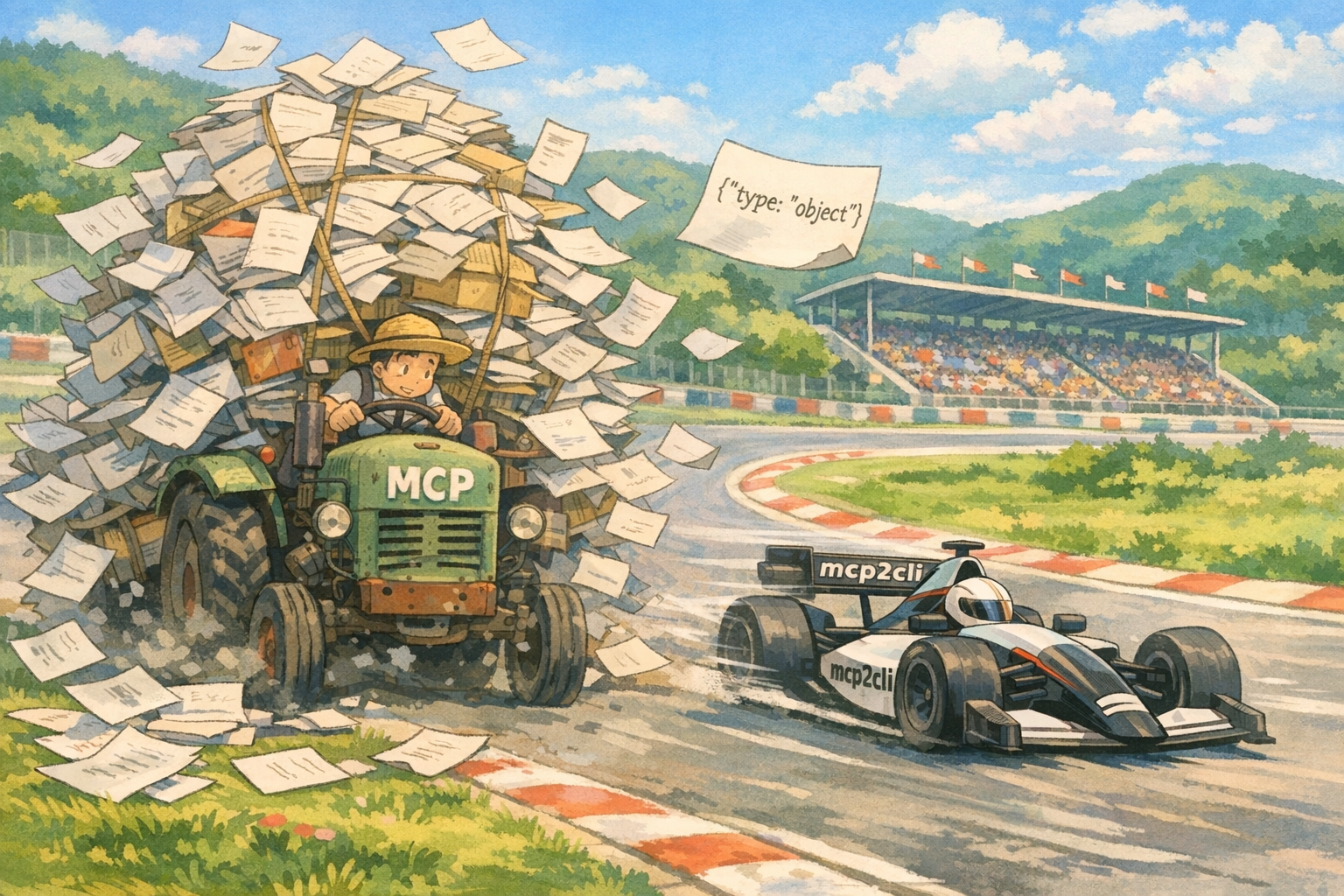
mcp2cli
Turn any MCP server, OpenAPI spec, or GraphQL endpoint into a CLI — at runtime, with zero codegen.
Save 96–99% of the tokens wasted on tool schemas every turn.
Read the full writeup →
## Install
```bash
# Run directly without installing
uvx mcp2cli --help
# Or install globally
uv tool install mcp2cli
```
## AI Agent Skill
mcp2cli ships with an installable [skill](https://skills.sh) that teaches AI coding agents (Claude Code, Cursor, Codex) how to use it. Once installed, your agent can discover and call any MCP server or OpenAPI endpoint — and even generate new skills from APIs.
```bash
npx skills add knowsuchagency/mcp2cli --skill mcp2cli
```
After installing, try prompts like:
- `mcp2cli --mcp https://mcp.example.com/sse` — interact with an MCP server
- `mcp2cli create a skill for https://api.example.com/openapi.json` — generate a skill from an API
## Usage
### MCP HTTP/SSE mode
```bash
# Connect to an MCP server over HTTP
mcp2cli --mcp https://mcp.example.com/sse --list
# Call a tool
mcp2cli --mcp https://mcp.example.com/sse search --query "test"
# With auth header
mcp2cli --mcp https://mcp.example.com/sse --auth-header "x-api-key:sk-..." \
query --sql "SELECT 1"
# Force a specific transport (skip streamable HTTP fallback dance)
mcp2cli --mcp https://mcp.example.com/sse --transport sse --list
# Search tools by name or description (case-insensitive substring match)
mcp2cli --mcp https://mcp.example.com/sse --search "task"
```
`--search` implies `--list` and works across all modes (`--mcp`, `--spec`, `--graphql`, `--mcp-stdio`).
### OAuth authentication
APIs that require OAuth are supported out of the box — across MCP, OpenAPI, and GraphQL modes.
mcp2cli handles token acquisition, caching, and refresh automatically.
```bash
# Authorization code + PKCE flow (opens browser for login)
mcp2cli --mcp https://mcp.example.com/sse --oauth --list
mcp2cli --spec https://api.example.com/openapi.json --oauth --list
mcp2cli --graphql https://api.example.com/graphql --oauth --list
# Client credentials flow (machine-to-machine, no browser)
mcp2cli --spec https://api.example.com/openapi.json \
--oauth-client-id "my-client-id" \
--oauth-client-secret "my-secret" \
list-pets
# With specific scopes
mcp2cli --graphql https://api.example.com/graphql --oauth --oauth-scope "read write" users
# Local spec file — use --base-url for OAuth discovery
mcp2cli --spec ./openapi.json --base-url https://api.example.com --oauth --list
```
Tokens are persisted in `~/.cache/mcp2cli/oauth/` so subsequent calls reuse existing tokens
and refresh automatically when they expire.
### Secrets from environment or files
Sensitive values (`--auth-header` values, `--oauth-client-id`, `--oauth-client-secret`) support
`env:` and `file:` prefixes to avoid passing secrets as CLI arguments (which are visible in
process listings):
```bash
# Read from environment variable
mcp2cli --mcp https://mcp.example.com/sse \
--auth-header "Authorization:env:MY_API_TOKEN" \
--list
# Read from file
mcp2cli --mcp https://mcp.example.com/sse \
--oauth-client-secret "file:/run/secrets/client_secret" \
--oauth-client-id "my-client-id" \
--list
# Works with secret managers that inject env vars
fnox exec -- mcp2cli --mcp https://mcp.example.com/sse \
--oauth-client-id "env:OAUTH_CLIENT_ID" \
--oauth-client-secret "env:OAUTH_CLIENT_SECRET" \
--list
```
### MCP stdio mode
```bash
# List tools from an MCP server
mcp2cli --mcp-stdio "npx @modelcontextprotocol/server-filesystem /tmp" --list
# Call a tool
mcp2cli --mcp-stdio "npx @modelcontextprotocol/server-filesystem /tmp" \
read-file --path /tmp/hello.txt
# Pass environment variables to the server process
mcp2cli --mcp-stdio "node server.js" --env API_KEY=sk-... --env DEBUG=1 \
search --query "test"
```
### OpenAPI mode
```bash
# List all commands from a remote spec
mcp2cli --spec https://petstore3.swagger.io/api/v3/openapi.json --list
# Call an endpoint
mcp2cli --spec ./openapi.json --base-url https://api.example.com list-pets --status available
# With auth
mcp2cli --spec ./spec.json --auth-header "Authorization:Bearer tok_..." create-item --name "Test"
# POST with JSON body from stdin
echo '{"name": "Fido", "tag": "dog"}' | mcp2cli --spec ./spec.json create-pet --stdin
# Local YAML spec
mcp2cli --spec ./api.yaml --base-url http://localhost:8000 --list
```
### GraphQL mode
```bash
# List all queries and mutations from a GraphQL endpoint
mcp2cli --graphql https://api.example.com/graphql --list
# Call a query
mcp2cli --graphql https://api.example.com/graphql users --limit 10
# Call a mutation
mcp2cli --graphql https://api.example.com/graphql create-user --name "Alice" --email "alice@example.com"
# Override auto-generated selection set fields
mcp2cli --graphql https://api.example.com/graphql users --fields "id name email"
# With auth
mcp2cli --graphql https://api.example.com/graphql --auth-header "Authorization:Bearer tok_..." users
```
mcp2cli introspects the endpoint, discovers queries and mutations, auto-generates selection sets, and constructs parameterized queries with proper variable declarations. No SDL parsing, no code generation — just point and run.
### Bake mode — save connection settings
Tired of repeating `--spec`/`--mcp`/`--mcp-stdio` plus auth flags on every invocation? Bake them into a named configuration:
```bash
# Create a baked tool from an OpenAPI spec
mcp2cli bake create petstore --spec https://api.example.com/spec.json \
--exclude "delete-*,update-*" --methods GET,POST --cache-ttl 7200
# Create a baked tool from an MCP stdio server
mcp2cli bake create mygit --mcp-stdio "npx @mcp/github" \
--include "search-*,list-*" --exclude "delete-*"
# Use a baked tool with @ prefix — no connection flags needed
mcp2cli @petstore --list
mcp2cli @petstore list-pets --limit 10
mcp2cli @mygit search-repos --query "rust"
# Manage baked tools
mcp2cli bake list # show all baked tools
mcp2cli bake show petstore # show config (secrets masked)
mcp2cli bake update petstore --cache-ttl 3600
mcp2cli bake remove petstore
mcp2cli bake install petstore # creates ~/.local/bin/petstore wrapper
mcp2cli bake install petstore --dir ./scripts/ # install wrapper to custom directory
```
Filtering options:
- `--include` — comma-separated glob patterns to whitelist tools (e.g. `"list-*,get-*"`)
- `--exclude` — comma-separated glob patterns to blacklist tools (e.g. `"delete-*"`)
- `--methods` — comma-separated HTTP methods to allow (e.g. `"GET,POST"`, OpenAPI only)
Configs are stored in `~/.config/mcp2cli/baked.json`. Override with `MCP2CLI_CONFIG_DIR`.
### Usage-aware tool ranking
mcp2cli tracks tool invocations locally and uses that data to rank `--list` output, reducing token costs for LLM agents working with large servers.
```bash
# Default --list: ~1,400 tokens for 96 tools
mcp2cli @myapi --list
# Top 10 most-used tools, names only: ~20 tokens
mcp2cli @myapi --list --top 10 --compact
# Sort by most recently used
mcp2cli @myapi --list --sort recent
# Alphabetical sort
mcp2cli @myapi --list --sort alpha
```
When usage data exists for a source, `--list` defaults to sorting by call frequency. Otherwise insertion order is preserved. Usage data is stored in `~/.cache/mcp2cli/usage.json`.
### JSON output
`--json` forces **valid JSON on stdout for every command**, in every mode. It is the
machine-readable counterpart to the human-formatted default output, designed for LLM
agents and scripts that need to parse results reliably.
```bash
# --list emits a JSON array of command objects (name, description, parameters, ...)
mcp2cli --mcp https://mcp.example.com/sse --list --json
mcp2cli --spec ./openapi.json --list --json
mcp2cli --graphql https://api.example.com/graphql --list --json
# --list --json --compact emits a JSON array of names only
mcp2cli --mcp https://mcp.example.com/sse --list --json --compact
# MCP tool calls emit the FULL CallToolResult envelope — including
# structuredContent and isError, not just the flattened text. This surfaces the
# machine-readable result that modern MCP tools put in structuredContent.
mcp2cli --mcp https://mcp.example.com/sse --json search --query "test"
# { "content": [...], "structuredContent": {...}, "isError": false }
# OpenAPI / GraphQL calls emit the response as JSON (non-JSON bodies become a JSON string)
mcp2cli --spec ./openapi.json --json list-pets
mcp2cli --graphql https://api.example.com/graphql --json users
```
`--json` takes precedence over `--raw` and `--toon` (both of which can produce
non-JSON), so it always wins — that is what makes it a reliable "force JSON" switch.
Indentation follows the usual rule: pretty on a TTY or with `--pretty`, compact when piped.
### Output control
```bash
# Pretty-print JSON (also auto-enabled for TTY)
mcp2cli --spec ./spec.json --pretty list-pets
# Raw response body (no JSON parsing)
mcp2cli --spec ./spec.json --raw get-data
# Truncate large responses to first N records
mcp2cli --spec ./spec.json list-records --head 5
# Pipe-friendly (compact JSON when not a TTY)
mcp2cli --spec ./spec.json list-pets | jq '.[] | .name'
# TOON output — token-efficient encoding for LLM consumption
# Best for large uniform arrays (40-60% fewer tokens than JSON)
mcp2cli --mcp https://mcp.example.com/sse --toon list-tags
```
### Caching
Specs and MCP tool lists are cached in `~/.cache/mcp2cli/` with a 1-hour TTL by default.
```bash
# Force refresh
mcp2cli --spec https://api.example.com/spec.json --refresh --list
# Custom TTL (seconds)
mcp2cli --spec https://api.example.com/spec.json --cache-ttl 86400 --list
# Custom cache key
mcp2cli --spec https://api.example.com/spec.json --cache-key my-api --list
# Override cache directory
MCP2CLI_CACHE_DIR=/tmp/my-cache mcp2cli --spec ./spec.json --list
```
Local file specs are never cached.
## CLI reference
```
mcp2cli [global options] [command options]
Source (mutually exclusive, one required):
--spec URL|FILE OpenAPI spec (JSON or YAML, local or remote)
--mcp URL MCP server URL (HTTP/SSE)
--mcp-stdio CMD MCP server command (stdio transport)
--graphql URL GraphQL endpoint URL
Options:
--auth-header K:V HTTP header (repeatable, value supports env:/file: prefixes)
--base-url URL Override base URL from spec
--transport TYPE MCP HTTP transport: auto|sse|streamable (default: auto)
--env KEY=VALUE Env var for MCP stdio server (repeatable)
--oauth Enable OAuth (authorization code + PKCE flow)
--oauth-client-id ID OAuth client ID (supports env:/file: prefixes)
--oauth-client-secret S OAuth client secret (supports env:/file: prefixes)
--oauth-scope SCOPE OAuth scope(s) to request
--cache-key KEY Custom cache key
--cache-ttl SECONDS Cache TTL (default: 3600)
--refresh Bypass cache
--list List available subcommands
--search PATTERN Search tools by name or description (implies --list)
--sort MODE Sort --list output: usage|recent|alpha|default
--top N Show only the top N tools in --list output
--compact Space-separated tool names only, no descriptions
--verbose Show full tool descriptions (unwrapped)
--fields FIELDS Override GraphQL selection set (e.g. "id name email")
--pretty Pretty-print JSON output
--raw Print raw response body
--json Force valid JSON output for every command (--list and tool
calls). MCP calls emit the full result envelope including
structuredContent. Takes precedence over --raw and --toon.
--toon Encode output as TOON (token-efficient for LLMs)
--head N Limit output to first N records (arrays)
--version Show version
Bake mode:
bake create NAME [opts] Save connection settings as a named tool
bake list List all baked tools
bake show NAME Show config (secrets masked)
bake update NAME [opts] Update a baked tool
bake remove NAME Delete a baked tool
bake install NAME Create ~/.local/bin wrapper script
@NAME [args] Run a baked tool (e.g. mcp2cli @petstore --list)
```
Subcommands and their flags are generated dynamically from the spec or MCP server tool definitions. Run ` --help` for details.
> For token savings analysis, architecture details, and comparison to Anthropic's Tool Search, see the **[full writeup on the OCAI blog](https://www.orangecountyai.com/blog/mcp2cli-one-cli-for-every-api-zero-wasted-tokens)**.
## Development
```bash
# Install with test + MCP deps
uv sync --extra test
# Run tests (96 tests covering OpenAPI, MCP stdio, MCP HTTP, caching, and token savings)
uv run pytest tests/ -v
# Run just the token savings tests
uv run pytest tests/test_token_savings.py -v -s
```
---
## License
[MIT](LICENSE)
---
mcp2cli builds on ideas from [CLIHub](https://kanyilmaz.me/2026/02/23/cli-vs-mcp.html) by Kagan Yilmaz (CLI-based tool access for token efficiency)