# sofagent

[](https://github.com/KongFangXun/sofagent/actions/workflows/verify.yml)
[](./LICENSE)
[](./CHANGELOG.md)


[](https://star-history.com/#KongFangXun/sofagent&Date)
简体中文 | English
## Table of Contents
- [What is this](#what-is-this)
- [Should you install it?](#should-you-install-it)
- [Core Features](#core-features)
- [What is the FDE Harness](#what-is-the-fde-harness)
- [Multi-platform Mounting](#multi-platform-mounting)
- [v1.7.0: Decision Substrate · Stage 2 (Model & Calibration)](#v170-decision-substrate--stage-2-model--calibration)
- [The Two FDE Harness Phases](#the-two-fde-harness-phases)
- [Installation](#installation)
- [Usage](#usage)
- [FAQ](#faq)
- [Ecosystem & Docs Index](#ecosystem--docs-index)
## What is this
> 💬 **One-sentence version**: on entry, it maps your business and writes it down as files; after it leaves, every time your digital employee touches code or files, the change passes a security check, leaves a record, and saves a snapshot—traceable and roll-backable when things go wrong.
> 🏢 **The organizational lens**: the bottleneck of AI adoption has shifted from "is the model smart enough" to "can the organization dare to onboard it"—does it fit the org chart, does it get an account, how is performance measured, what happens when it errs. sofagent is the onboarding system for
>digital employees: on entry it writes the job description into files; after departure it runs performance reviews (evidence for every change), organizational memory (compounding know-how—the accumulation mechanism iterates with use; current empirical boundaries in
>[LIMITATIONS](./docs/LIMITATIONS.md)), and fault tolerance (every mistake reversible). Install sofagent before you give AI an employee ID.
> 🧩 **The three-factor framing**: sofagent is a **governance layer for FDE deliverables with a built-in Harness**—the engineering layer (FDEing) and the governance layer (harness) are shipped, while the judgment layer (S1M) is scheduled for v1.6.0–v1.9.0—FDEing is the engineering layer (turning
>FDE from human labor into a reusable capability), S1M is the judgment layer (System One Model, a decision model that separates judgment
>from generation; its foundation is under construction across v1.6.0–v1.9.0, with the declaration landing in v2.0.0), and **harness** is the governance layer (the five constraint-layer capabilities—today's main landing points). Each layer sits in its own place; see "Core Features".
>The identity formula is settled as **FDEing × S1A (S1A = S1M + Harness)**; canonical wording in [PHILOSOPHY · identity caliber](./docs/PHILOSOPHY.md).
**An open-source FDE Harness layer** (FDE = Forward Deployed Engineer, the engineer who embeds models into real enterprise
operations; a *harness* is the governance layer that keeps every Agent change audited and reversible—see the
"[What is the FDE Harness](#what-is-the-fde-harness)" section)—embedded between mature Agents (DSH / OpenClaw / WorkBuddy)
and the model layer (general LLMs + bespoke post-trained models) to govern both: on entry, it
writes the business judgment down as files (workflow, ontology data, AI-node deployment); after departure, it audits every change against those files.
Five Harness capabilities (inject · audit · rollback · distill · evolve), five distribution forms (FDE plugins / Skill / MCP / CLI / Dashboard).
sofagent doesn't build the Agent—it delivers the layer that keeps any Agent governed.
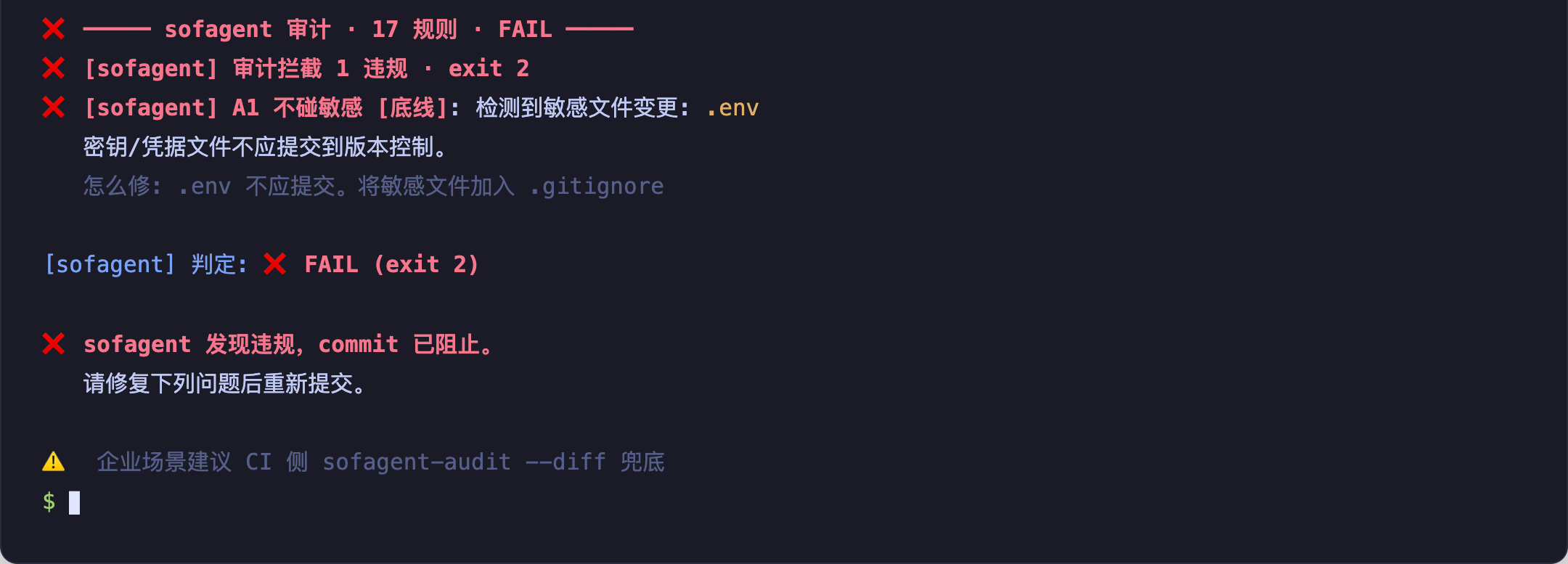
Zero-config audit in action: one command audits the latest commit; leaked secrets get blocked on the spot (screenshot taken before the single-entry consolidation; the command is now sofagent audit)
🗺️ System architecture overview (FDE Harness five-module structure)
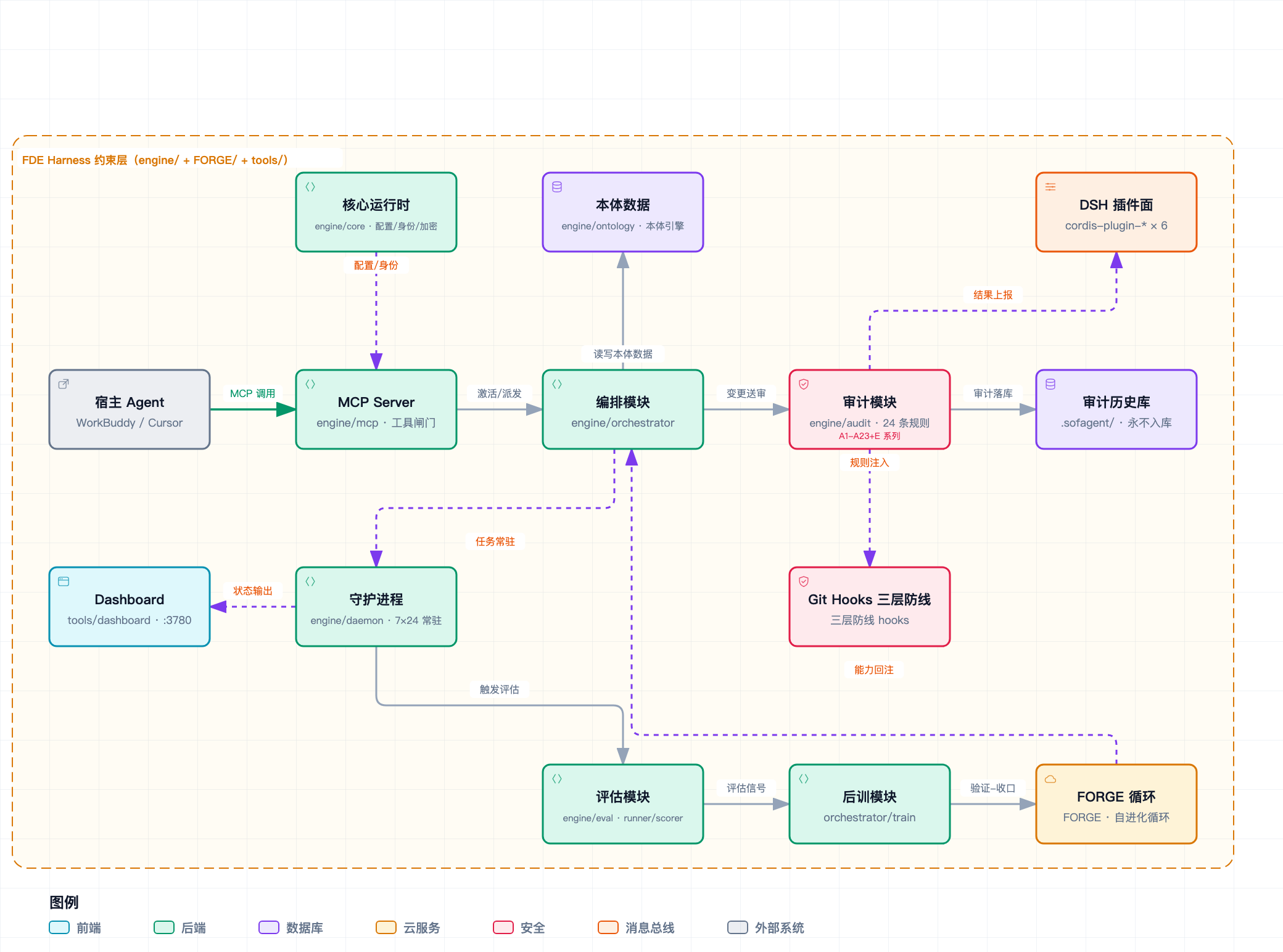
Constrain Agent behavior · Audit every change · Distill experience (five-module structure: governance module released in v1.5.0 · execution module released in v1.5.4/v1.5.5; full interactive
version in ARCHITECTURE)
> **Version note**: v1.7.0 was released (2026-10-22); the latest installable npm version is `@sofagent/audit@1.7.0`.
## Should you install it?
| If you're... | Recommendation |
|---|---|
| **Adding discipline to an existing Agent**—you already run DSH / OpenClaw / WorkBuddy and want your AI to behave, leave traces, and stay roll-backable when things go wrong | ✅ **Install now**. The core value is exactly the constraint layer (inject · audit · rollback · distill · evolve)—works right after installation |
| **A one-person company / SMB landing AI**—no dedicated engineer, you need a "never-quitting FDE" to map your workflow and deploy AI nodes | ✅ **Install now**. The FDE Harness layer is built for this—the full journey from mapping to deployment to post-departure audit |
| **Looking for a turnkey enterprise Agent platform**—you expect a complete commercial product (multi-tenancy, permission management, billing, SLA) | ⏸️ **Hold off**. sofagent is an FDE Harness layer, not a platform product—platform-grade capabilities are out of this open-source repository's scope. Teams with integration capacity can still embed the constraint layer into their own platform as its governance module; if you need pure turnkey, look at platform products elsewhere |
| **Researching / curious about constraint-layer design**—reading code, studying architecture, borrowing methodology | ✅ **Install now**. Full documentation ([HANDBOOK](./docs/HANDBOOK.md) / [ARCHITECTURE](./docs/ARCHITECTURE.md) / [PHILOSOPHY](./docs/PHILOSOPHY.md)), MIT licensed |
**How does it relate to gitleaks / pre-commit?** (complementary, not substitutes)
| | gitleaks-style scanners | pre-commit hooks | sofagent |
|---|---|---|---|
| Positioning | full-history secret scanning | generic commit-hook framework | Agent behavior audit harness |
| Evidence | repo text patterns | your own scripts | git-diff hard evidence + Agent logs + decision trail |
| Coverage | secret leaks | anything (DIY) | 28 rules: secrets / scope / injection / privilege / backdoors / data products |
| Deployment cost | Low—standalone binary, zero runtime deps | Low—one CLI from your language ecosystem | Medium—a one-time `install.sh` on the enterprise device (you can also try it zero-config via npx first) |
| Maintenance burden | Low—rules track upstream | Medium—custom scripts are yours to maintain | Medium—rules and hooks ship with this repo, but each version needs the hook reinstalled and config re-aligned |
| Advice | a must for strict secret compliance | keep if you have one | use alongside both—focused on Agent governance |
> 📌 This table compares **commit-time secret/hook tools only**; for governance-class tooling (audit / constraint / orchestration surfaces), see the [WIKI ecosystem section](./docs/WIKI.md) and [VALIDATION ecosystem positioning](./docs/VALIDATION.md).
**30-second lightweight trial** (first run includes the npx package fetch, reruns finish in seconds; a single engine audit itself takes ~1.1 seconds—see the measured figures below): `npx -y -p sofagent sofagent audit` (any git repo; secret leaks blocked on the spot).
> 💡 For the trial, keep commit messages **at least 6 characters** (e.g. `initial audit test`)—A19 (rule numbers: see the [rule list](./SECURITY.md#28-条审计规则完整清单文档级-ssot)) flags ultra-short messages (`init`/`add`) by design (it guards against meaningless commit messages), not a malfunction.
**Five-minute sandbox demo** (shipped in v1.5.1; sandboxed, zero touch on real files): `npx -y -p sofagent sofagent audit demo`—one command runs the full five-act chain: sandbox
build → injection → deliberate violation → audit interception → snapshot rollback → HMAC evidence export
(`--speed fast` for a 60-second cut; artifacts land under `$SOFAGENT_DATA/demo` (default `~/.sofagent/data/demo`), touching neither the audited repository nor other directories). (The demo is provided via the npm channel; the install.sh-installed CLI has no demo subcommand.)
## Core Features
> ### Everything can be FDEing (the idea)
>
> **From FDE to FDEing—everything can be FDEing**: turn Forward Deployed **Engineering** (a capability) out of Forward Deployed **Engineer** (a job title)
—the job leaves with the person, the capability stays with the deliverables. **FDEing is the abbreviation of Forward Deployed Engineering** (read /ef-di-i-ing/, isomorphic with "engineering"): as a noun it names the capability; as a verb it means turning FDE from manual labor into that capability
— everything can be FDEing.
>
> - **FDE is the noun; FDEing is the verb**—turning FDE from manual work into an automatically executable capability (playbook × judgment × governance combined): less labor, more capability.
> - **Not limited to software**—any business object, process, or node can be FDE'ed through "map → judge → deliver → sustain"; hardware nodes and robot motions are workflows too—the difference lies in the executor, not the governance shape.
> - **It's also a way of thinking**—before doing anything, think of three things: ① how to structure its workflow; ② what its AI nodes are; ③ how AI can help you do it better (see [PHILOSOPHY](./docs/PHILOSOPHY.md)).
Three layers, each in its place: the **engineering layer (FDEing)** writes judgment down on entry, the **judgment layer (S1M)** governs how judgment forms, is traced, and is evidenced, and the
**governance layer (harness)** keeps judgment executing 24/7 after departure.
**Engineering layer · FDEing** (on entry · generate judgment, the FDE stage—deciding where AI belongs and what it's worth, frozen into deliverables):
- 🧭 **Map the workflow**—five-element deep-dive + three-question triage, capturing each role's process steps and pricing out what each AI node is worth
- 🤖 **Deploy AI nodes**—three-layer deliverables (documents + Skills + runtime), installed into your existing AI tools; from "you do the work" to "you delegate the work"
- 📦 **Judgment frozen into deliverables**—each node carries "what counts as done (merge_criteria) · who signs off (approver)", machine-checkable and shared across both stages
**Judgment layer · S1M** (System One Model—a decision model that separates judgment from generation; **its foundation is scheduled for construction across v1.6.0–v1.9.0, with the declaration
for v2.0.0—not yet shipped**. This version states identity and roadmap only, no claim that judgment capabilities are
delivered yet; the narrative is anchored to [FDE/S1M-DECISION-POINTS.md](./FDE/S1M-DECISION-POINTS.md) and the [v2.0.0 §1](./docs/changelog/v2.0/v2.0.0.md) planning definition.
What ships today in this layer is the existing judgment-and-evidence surface):
- 🔎 **Judgment trail**—decision-log causal chains record each accountable decision (who signed off, on what basis, why), consumed by auto-PR explanation blocks and the daemon weekly digest
- 🔗 **Judgment made provable**—the audit history lands on an HMAC chain; `--verify-chain` recomputes chain integrity offline, so conclusions can be re-checked by a third party
**Governance layer · harness** (after departure · retain judgment, the Harness stage—executing against the deliverables 24/7, writing back as it evolves):
- 🏠 **Stay resident after departure**—the FDE capability remains for inspection, audit, and optimization (daemon inspection requires explicit opt-in at install—off by default, auto-skipped under QUICK_MODE / non-interactive installs),
7×24 online guardian (audit triggers on commit); the human leaves, governance doesn't
- 🔍 **Zero-setup audit**—`npx -y -p sofagent sofagent audit`, auditing the latest commit of any git repo in seconds (single-machine measured: quick ~1.1s, 50k-line diff ~6.1s; see [HANDBOOK](./docs/HANDBOOK.md))
- 🧱 **28 audit rules + 104 MCP tools**—secret leaks, out-of-scope edits, injection defense, privilege red lines; judged on two evidence tiers: 22/28 run on git-diff hard evidence (effective locally), 4 hybrid (diff + Agent logs), 1 filesystem scan, 1 decision-log channel;
log-based rules such as A7/A8 (see the [rule table](./docs/ARCHITECTURE.md)) are skipped when no Agent logs exist; violations are blocked on the spot (a critical-layer hit skips the rest—fail-fast);
evidence is based on local diffs; **not fail-closed by default**—config can be tampered with and hooks skipped via `--no-verify` (bypass surfaces in [LIMITATIONS §3](./docs/LIMITATIONS.md)); quick runs 17 by default, full 28 = 17 + 11.
Note: `commons_invoke` is dry-run pre-check semantics (returns capability metadata + a plan; real execution is injected by the Agent runtime—see LIMITATIONS).
- 🛡️ **Automatic snapshot rollback**—auto-archived after each audit, one-click restore to any snapshot when something breaks
- 🛡️ **AgentShield static scanning across five config surfaces**—a `@public` SDK capability (invoked via `createAgentShield`), **not on the commit-hook path**, opt-in on demand
## What is the FDE Harness
**FDE = Forward Deployed Engineer**—the person who embeds models into real enterprise operations. sofagent turns this role into an open-source FDE Harness layer, sitting between the Agents
you already have (DSH / OpenClaw / WorkBuddy) and the model layer. A full FDE workflow has two stages, **sewn
together by the deliverables handed over in between**:
- **On entry · generate judgment**: four steps—**map the workflow → build dual graphs → qualify AI nodes → deploy**. Dual graphs = business graph (system boundaries, data flows; read by humans) + ontology graph (shared semantic foundation; read by AI), turning the enterprise into a
machine-readable structure; for each AI node, "what counts as done (merge_criteria) · who signs off (approver) · when it runs (trigger)" is judged here and frozen into the deliverables
(workflow.yml + ontology + skills).
- **After departure · retain judgment**: the FDE leaves, the judgment stays—audit triggers automatically on change events (commits) against the frozen criteria (evidence-tiered: 22 of the 28 rules run on git-diff hard evidence—see Core Features); daemon inspects 7×24, snapshots roll back,
experience distills back. The human leaves, governance doesn't.
> 🔗 **Why they must be one thing**: the deliverables are a living state shared by both stages—written on entry, read during execution, written back during evolution (trial branches promoted to baseline, reflections distilled back). Without FDE, the constraint layer has no criteria to enforce;
>without the constraint layer, FDE judgment evaporates the moment the engineer leaves. That is where the name "FDE Harness" comes from—not a bundle of an FDE feature and a Harness feature, but two stages of one job.
>
> **From FDE to FDEing—everything can be FDEing**: the combined effect of the two stages—see the opening of "Core Features" above (everything can be FDEing).
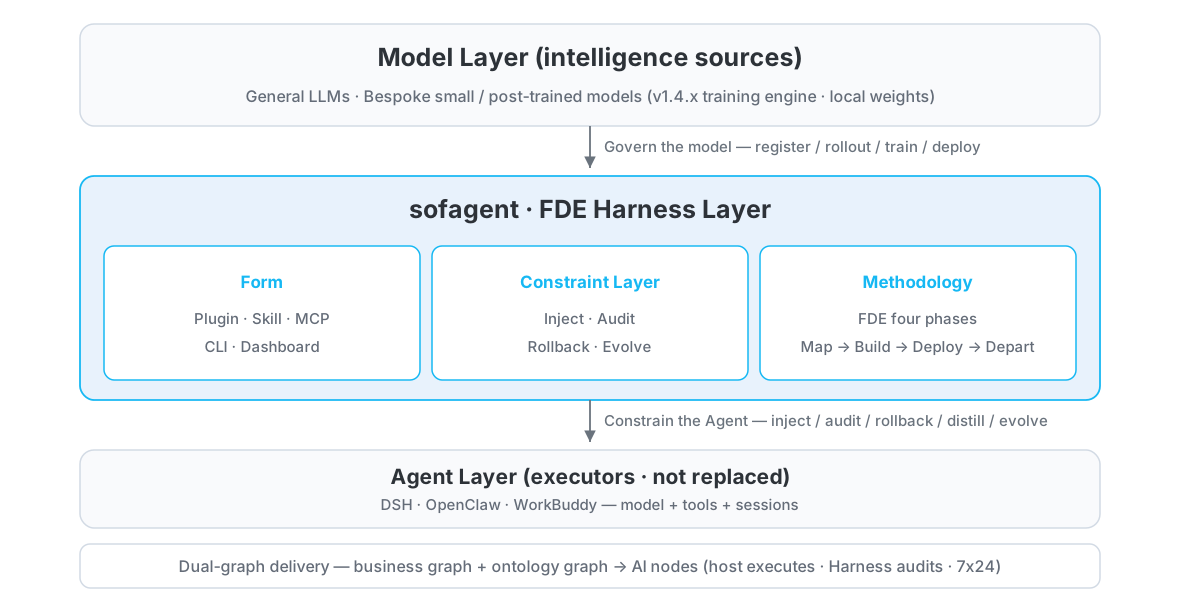
**Why the FDE Harness**
- **The bottleneck for enterprise AI is deployment, not the model**—mapping workflows, drawing system boundaries, and setting data rules is precisely the FDE's job. MIT NANDA's *The GenAI Divide*: 95% of enterprise GenAI projects failed to produce value worth a financial statement, while FDE job
postings surged 729% in a year (verification in [VALIDATION](./docs/VALIDATION.md))
- **Completeness comes from the union**—DSH solves "can work"; sofagent solves "keeps working"; only together do they make a complete FDE Harness (next chapter)
- **"Continuous optimization" only holds with a constraint layer**—backed by auditable, rollback-capable mechanisms, not promises in prompts. Independent external experiment (ARC-AGI-3, **capability-harness data**—it lifts task scores and token efficiency, a different dimension from the
reliability gains of a governance constraint layer—directional reference only): optimizing only the outer Harness around the same model significantly lifts task completion. Verification in
[VALIDATION](./docs/VALIDATION.md) · [THANKS](./docs/THANKS.md) (write-surface audit coverage: the weight and skill surfaces have
shipped; the prompt / memory surfaces shipped in v1.5.9)
- **Capabilities are portable, never dead-bound to a platform**—the constraint layer is platform-agnostic (what's portable is the constraint assets and the audit fallback; injection strength still varies by host tier: hard interception for DSH/OpenClaw, advisory injection + git-hook audit fallback elsewhere—see the tier table in "Multi-platform Mounting"); the methodology follows the business, not the platform
> 🔄 **Self-bootstrapping**: sofagent's first FDE engagement is sofagent itself—the project is a complete FDE workflow (map → build → deploy → depart), and this open-source repository is that deliverable.
## Multi-platform Mounting
Sits between the Agents you already use and the model layer—it doesn't replace the model, only adds reliable execution. **The FDE Harness layer is platform-agnostic** (five forms—plugin
/ Skill / MCP / CLI / Dashboard—distributed by host capability); the methodology follows the business, not
the platform:
| Tier | Platform | Constraint injection | Mounting method |
|---|---|---|---|
| **Deep integration** | DeepSeek Harness | ✅ **Per-tool-call interception** | 6 atomic `cordis-plugin-sofagent-*` plugins mounted into the runtime (see Note 1) |
| **Full mounting** | OpenClaw | ✅ **Once per session** | Hook-injected four-layer constraints + circuit breaker + 4 OpenClaw plugins |
| **Standard mounting** | Claude Code / Cursor | ⚠️ Skill self-load | Skills-directory symlink + platform rule file + interception config (content = commit-level 28 rules, not call-level interception) |
| **Thin mounting** | WorkBuddy / Codex / Gemini CLI / Hermes | ⚠️ Skill self-load | Skills-directory symlink (Codex uses the `AGENTS.md` mount point) + git-hook audit |
> Note 1: 1 optional aggregate plugin also available—see "Upstream & plugin entries" below—7 lifecycle events incl. `tools/pre-execute` (vocabulary table: `engine/dsh-plugins/SEAMS.md`)
- **Never assume capability parity—tiers differ in injection strength, not in "supported or not"**—DSH intercepts per tool call, OpenClaw injects once per session, and on every other host constraints ride along as Skill text (advisory). "Supports platform X" means the
constraint assets work there; it does **not** mean constraint strength matches other platforms. Before migrating hosts or writing integration docs, check which tier the target host falls
into—full matrix in the [load-chain HOOK](./engine/hooks/sofagent-load-chain/HOOK.md)
- **Audit fallback is platform-agnostic**—`sofagent audit --install-hook` runs as a git hook; at every tier, every commit's audited automatically (audits with the 17 default rules out of the box; the full 28 require enabling `extendedRulesEnabled: true` in `.sofagent/config.yml`), violations
hard-blocked. Constraints are advisory; auditing is mandatory (boundaries of that mandate: **not fail-closed by default**—`--no-verify` skips the first two defense layers, and
post-commit only leaves a trace without blocking; bypassed commits do leave traces—see [LIMITATIONS
§3](./docs/LIMITATIONS.md)).
One command selects your mounting tier: `bash install.sh --platform ` (all platforms and differences in [HANDBOOK](./docs/HANDBOOK.md))
## v1.7.0: Decision Substrate · Stage 2 (Model & Calibration)
🧪 **Making probabilities mean something** — stage two of the four-stage substrate: training uses strictly proper scoring rules (truthful probabilities score better than skewed ones), calibration makes output probabilities readable against reality, and discipline gates keep unjustified confidence off the decision path.
| Capability | One-liner | Reachable |
|---|---|---|
| **RLCD strictly-proper training** | Per-primitive losses (noul log-score / choice log+spherical / score RPS) + asymmetric penalty on extreme claims + RLOO / KL anchor / downweight defense lines; probability-target assertion (hard labels rejected) + three-tier weighting + reproducibility manifest | CLI: `sofagent train rlcd --data [--dryrun]` |
| **Bucketed temperature calibration** | Per-primitive fitting · score isotonicity · disjoint calibration set assertion (same criterion across sides refused; violations refuse to emit readouts) · calibration artifact is plain JSON, weight-free | SDK surface |
| **Calibration discipline gate** | Confidence/probability thresholds consumed on decision paths must carry calibration evidence or an explicit `uncalibrated` marker — unmarked ones cannot ship (check-calibration-claims wired into the release chain) | Gate · SDK surface |
| **Abstention as a fourth state** | Abstain stands beside pass/warn/fail (three-source evidence: low confidence / OOD / missing criteria) · per-primitive thresholds · cannot be disabled when ECE misses the line | SDK surface |
| **Three-state comparison & dual-threshold verdict** | Zero-shot / trained / calibrated side by side · agreement ≥0.70 (zh/en split) and ECE ≤0.10 (per primitive × language) judged independently; not-measured never counts as pass. Measured: ECE 17/18 cells pass, agreement misses ⇒ stage three deferred (honest verdict) | SDK surface · `sofagent audit --criteria` lists criteria via CLI |
## The Two FDE Harness Phases
**How the two phases divide the work** is covered in [What is the FDE Harness](#what-is-the-fde-harness) above—what this section adds is the **organizational reading**:
together they're onboarding a digital employee (the after-departure side runs daemon patrols 24/7 (daemon inspection is opt-in at install—off by default, auto-skipped under QUICK_MODE / non-interactive), every commit triggers the default 17
audit rules (the full 28 need `extendedRulesEnabled: true`), snapshots stay rollback-ready, and evolution writes promotion and distilled reflection back into the deliverable).
| Organizational act | sofagent equivalent |
|---|---|
| Job description | Frozen deliverables from the entry phase (merge_criteria / approver / trigger) |
| Performance review | Audit evidence + governance KPI dashboard (v1.5.0) |
| Organizational memory | Knowledge distillation (think.md reflection + knowledge/) |
| Training pipeline | Experience → exam → promotion self-evolution chain (shipped in v1.5.8) |
| Fault tolerance | Snapshot rollback + capability baseline timeline (delivered in v1.5.9) |
| Employment contract boundary | Pluggable contracts & core capability registry (delivered in v1.5.7; switch surface and gating in [ARCHITECTURE](./docs/ARCHITECTURE.md)) |
| Go deeper | Where |
|---|---|
| Four-phase twelve-step methodology (half-day read) | [FDE/GUIDE.md](./FDE/GUIDE.md) |
| Constraint layer's five capabilities · module layout | [ARCHITECTURE](./docs/ARCHITECTURE.md) |
| Why they must be one · design no-go zones | [PHILOSOPHY](./docs/PHILOSOPHY.md) |
| Skill system & knowledge pipeline | [FDE/Skill system](./FDE/README.md) |
## Installation
**Release stage (read before installing)**: sofagent is in its **Alpha construction period** (v1.x)—the feature surface moves fast and **no interface stability is promised**; read the
[CHANGELOG](./CHANGELOG.md) before upgrading across versions. From **v2.0.0** on it enters the **Beta stage**.
The matching npm release-channel policy: **no dist-tag split—`latest` is the newest version**—`npx -y -p sofagent sofagent audit` pulls the current latest by default, no tag needed (version numbers
carry the stage semantics: v1.x alpha construction period / beta from v2.0.0).
The `alpha` tag remains as a historical release trace and isn't maintained.
> ⚠️ **Enterprise users read first** [LIMITATIONS §3](./docs/LIMITATIONS.md)—`config.yml` is **non-fail-closed by default** (rules can be bypassed by Agent tampering), and **write-side** multi-tenant isolation isn't yet landed (v0 delivered query-side isolation: orgId filtering + the
>data// path foundation—see LIMITATIONS). For strict-compliance scenarios use CI fallback + file-permission lock (`chmod 400 .sofagent/config.yml`—an auxiliary layer, ineffective against same-user processes; see [LIMITATIONS §3](./docs/LIMITATIONS.md)); don't put the single-machine
>default config directly into production.
>
> 🔐 **Data sovereignty**: runtime data never leaves your machine (no network access except the npm package fetch at install time); the three opt-in exits (cloud sync / model inference endpoint / cloud VM execution surface) require your explicit configuration (note: opening the dashboard anonymously fetches the public GitHub star count—read-only, no user data sent, silent fallback on failure)—see [SECURITY](./SECURITY.md).
**30 seconds and up, zero setup** (first run includes the npx package fetch, ~30 seconds; reruns finish in seconds—the engine itself takes ~1.1s, measured basis above)—run an audit in any git repo:
```bash
npx -y -p sofagent sofagent audit
```
> 💡 The npm channel ships exactly one form — the umbrella package: `npm i -g sofagent` installs the **full dependency tree** (602-package basis below) — there is no smaller "lightweight" package. For a smaller footprint, use the ephemeral npx form (`npx -y -p sofagent sofagent audit`, nothing stays installed; capability boundary in [LIMITATIONS · package deps](./docs/LIMITATIONS.md)).
> 💡 quick runs the **17 default rules** (A3 task-scope / A9 commit-msg injection detection active—quick mode auto-reads the latest commit message; when no message is available, A9 is handled by the engine as no-input and marked skipped). `--init` installs the hook (still the same 17 default
>rules); the full 28 additionally require `extendedRulesEnabled: true` in `.sofagent/config.yml`—see [LIMITATIONS §3](./docs/LIMITATIONS.md).
> ⚠️ This step is a **one-off audit** (inside a single process)—it doesn't install a git hook, so later commits won't be auto-blocked. For continuous protection run `sofagent audit --init` (see Full install below).
Here is what it looks like when a known-format secret leak gets blocked (real output). A2 (rule numbers: see the [SECURITY rule list](./SECURITY.md#28-条审计规则完整清单文档级-ssot)) detects AWS AKIA/Secret, OpenAI sk-*, GitHub ghp_, Google AIza, Slack xox*-, JWT, and PEM private keys—other known formats too.
Length thresholds apply: generic sk- keys must be ≥29 characters total (≥27 after the sk- prefix; vendor-prefixed sk-ant-/sk-proj- etc. require ≥40), and Stripe sk_live_/sk_test_ require ≥24. Shorter or non-standard shapes are intentionally out of scope, a conservative design against false positives, see [LIMITATIONS §3 A2](./docs/LIMITATIONS.md#%E4%B8%89%E5%AE%89%E5%85%A8%E4%B8%8E%E4%BF%A1%E4%BB%BB%E6%A8%A1%E5%9E%8B%E5%B1%80%E9%99%90).
Real terminal output of an A2 hit (a hard-coded AWS `AKIA` access key in `app.py` gets blocked):
```text
$ npx -y -p sofagent sofagent audit
🔍 审计首个 commit(4573bb8)——首提交无父基线,对比空树审计全部新增内容。
❌ [sofagent] A2 不泄密钥 [底线]: 检测到疑似密钥/令牌泄漏: app.py: 检测到 AWS Access Key; app.py: 检测到 密钥赋值形态。密钥不应硬编码到源码中。
📊 [sofagent] 1 条违规 · 7 条通过 · ⚠️ 9 条本批未检查(critical 命中后 fail-fast)
```
A2 secret-format detection in action: the engine flags a hard-coded AWS access key and fails fast. Fix: move the key into `.env` (git-ignored) or read it from environment variables / a secrets manager. The Chinese terminal output is preserved verbatim from a real run; the first-screen screenshot above shows the sibling A1 scenario (.env sensitive-file commit blocked, exit 2).
**Full install** (Node.js ≥ 18, download and review before running)—**installed on the enterprise devices running the AI nodes**:
```bash
curl -fsSL https://raw.githubusercontent.com/KongFangXun/sofagent/refs/tags/v1.7.0/bootstrap.sh -o bootstrap.sh
less bootstrap.sh # review the script first, confirm it's safe
bash bootstrap.sh && rm bootstrap.sh
```
> 🔒 Supply-chain trust: tag pinning + sha256 verification + fail-closed + self-anchored hash re-verification (see [SECURITY.md](SECURITY.md), remote-install section); ⚠️ audit logs are plaintext on disk by default—enterprise deployments should enable encryption-at-rest.
```bash
sofagent audit --init # install the git hook—every commit's audited from now on
sofagent audit --doctor # verify the environment (optional)
```
> 🔧 **First `--doctor` on a fresh machine reports "no dist baseline"?** Run `sofagent audit --doctor --baseline` to establish it (the trust anchor = the moment you confirm the dist is trustworthy—never auto-recorded, to defend against shadow-auditor hijacking).
> 💡 Install scripts mainly write to `~/.sofagent/` (data) + `~/.local/bin` (CLI); **they write into a platform's integration directory only when `--platform ` is passed explicitly** (a default install probes and modifies no platform config); if npm permissions
>are insufficient, the CLI entry falls back to `/usr/local/bin`. No other system files are touched. `--init` installs the three-layer git hook defense (pre-commit blocks `.sofagent/` from entering the repo + commit-msg rule audit + post-commit reconciliation). `--no-verify` can skip **both
>pre-commit and commit-msg** (the first two layers); **post-commit reconciliation is unaffected** (the git-native switch doesn't apply to post-commit)—it guards honest Agents' carelessness, not malicious bypass; skipped commits are reconciled by the post-commit hook (flagged
>"suspected bypass") but not blocked. Personal fallbacks: CI-side `sofagent audit --diff`, periodic `--doctor`, and reviewing the audit records. See [LIMITATIONS](./docs/LIMITATIONS.md).
>
> 📌 **install.sh is the enterprise device installer**—install it on the enterprise devices running the AI nodes (constraint-layer engine + daemon inspection + single-machine dashboard); FDEs don't need to run it on their own machines—the FDE's tools are the [FDE
>Skill](https://clawhub.ai/kongfangxun/skills/sofagent) (methodology). See [deployment architecture](./docs/ARCHITECTURE.md#%E5%AE%89%E8%A3%85%E5%8C%85%E8%BE%B9%E7%95%8C%E4%B8%8E%E9%83%A8%E7%BD%B2%E6%9E%B6%E6%9E%84v132-%E5%AE%9A%E4%BD%8D%E6%A0%A1%E5%87%86).
>
> 📌 **How bootstrap.sh and install.sh relate**: bootstrap.sh is a one-line download wrapper around install.sh—`curl bootstrap.sh | bash` equals "download install.sh + run install.sh". Both install exactly the same thing; bootstrap just saves the manual clone/download step.
**To uninstall**: `bash ~/.sofagent/scripts/uninstall.sh` (installed layout) or `bash engine/scripts/uninstall.sh` (clone layout)—removes the Skill/constitution files, hook registrations
and the three git hooks (`pre-commit` / `commit-msg` / `post-commit`), while keeping your `~/.sofagent/` data.
Full install options (clone install / full npx install / minimal install / enterprise deployment), uninstall, and how to tell the single entry from the install-state layout apart (npm bare-name umbrella = sub-package forwarder, see the package-name warning in Usage; the install.sh state
exposes `status` / `web` / `dashboard`) → [HANDBOOK
· Installation](./docs/HANDBOOK.md).
Enterprise users who just want the FDE methodology for mapping business workflows, see [FDE/README.md](./FDE/README.md) (zero dependencies, no Node.js needed; for the 15-minute shortest path see its "15-minute shortest path" section).
## Usage
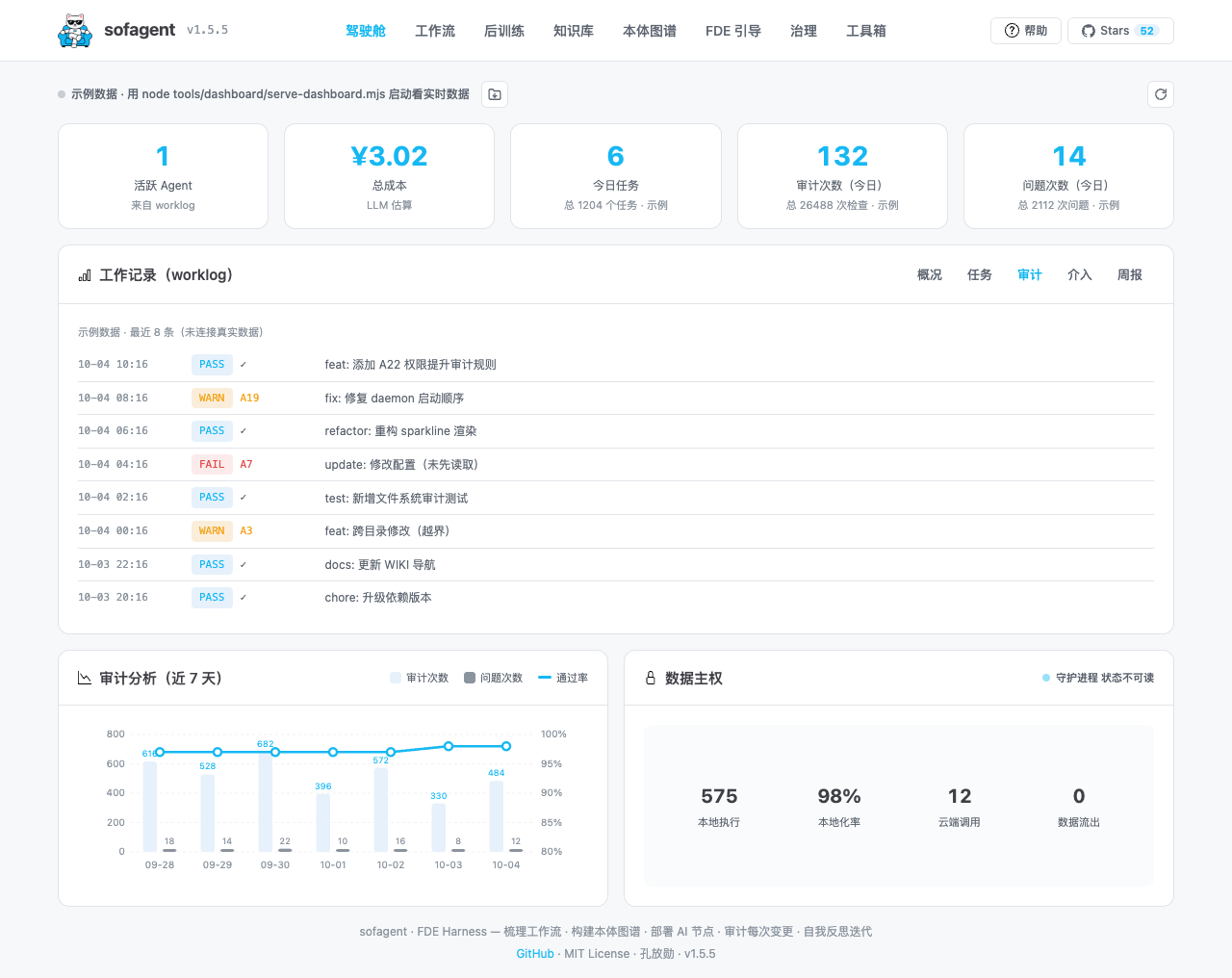
Dashboard cockpit (single-file HTML · sample data): rule pass
rate, audit tasks, violation trends—see at a glance what the AI is doing.
(See CHANGELOG for UI evolution;
the installed UI is the source of truth.)
> 📊 **The Dashboard has three entries, each in its place**:
>
> | Entry | Command | Form | Who it's for |
> |---|---|---|---|
> | **Terminal** | `sofagent dashboard --full` (legacy bin `sofagent-dashboard` retired) | Terminal ASCII three-pane (zero frontend dependencies) | Developers / FDE quick check |
> | **Web** | `sofagent web` (available in the install.sh-installed state) · repo-mode `node tools/dashboard/serve-dashboard.mjs` | Browser visualization (localhost:3780) | Boss / IT visual review |
> | **macOS double-click** | Double-click `start-dashboard.command` | macOS shortcut to the Web version (macOS double-click entry only) | macOS users |
>
> ⚠️ **Dashboard availability boundary**: all three entries ship with the **`install.sh`-installed state**; a package installed via `npm i sofagent` does **not** contain the dashboard static assets (`tools/dashboard/` isn't distributed—the root `files` list keeps only root-level
>essentials). npm-only installs get the CLI + MCP surface; **for the Dashboard use the full install** (bootstrap.sh / install.sh).
> 👁️ **Agent's view**: with hooks installed, every commit triggers an audit—PASS prints a short echo then passes (auto-snapshot), violations are printed directly into the terminal output and pushed via Webhook / IM per config; there's no separate GUI on the Agent side (see [PHILOSOPHY
>§2](./docs/PHILOSOPHY.md#%E7%B3%BB%E7%BB%9F%E6%9A%B4%E9%9C%B2%E7%9A%84%E8%83%BD%E5%8A%9Bagent-%E8%A7%86%E8%A7%92)).

| Entry | What it does | Where installed | Time needed |
|---|---|---|---|
| **`npx -y -p sofagent sofagent audit`** | Zero-setup audit of the last commit, results in seconds (first npx ~30s) | Any git repo (temporary) | 30 sec |
| **`--ruleset` rule marketplace** | Load rulesets like security, or custom JSON rules | Same as above | 1 min |
| **GitHub Action** | Auto-audit each PR, violations annotated on the diff lines | CI/CD | Set up once |
| **install.sh full suite** | inject · audit · rollback · distill · evolve + daemon inspection + dashboard—the Agent's complete constraint layer | **Enterprise device** (server/computer running the AI nodes) | FDE residency |
> 📌 daemon inspection requires explicit opt-in at install—off by default, auto-skipped under QUICK_MODE / non-interactive installs.
> 📌 **Single-entry CLI (since v1.5.6)**—the CLI converges on **`sofagent `**: `sofagent audit` (audit) · `sofagent train doctor` (training) · `sofagent team formation` (formations) · `sofagent daemon` (daemon) … run `sofagent help` for all domains.
>
> | Usage | Command |
> |---|---|
> | Zero-install trial | `npx -y -p sofagent sofagent audit` |
> | Global install | `npm i -g sofagent` → `sofagent audit` |
> | Full install (daemon / dashboard) | `bootstrap.sh` / `install.sh` (above) |
>
> - **Legacy commands retired**: the 12 old bins (`sofagent-audit` etc.) passed their compatibility window and **have been removed**; the former 13 bins are now served by the single entry.
> - ⚠️ **`npm i -g sofagent` pulls the full dependency tree** (orchestrator/mcp/train capability packages; transitive deps measured 602 packages (`npm ls --all --parseable`, measured at `npm i sofagent@1.5.8` time;
> basis: installed `npm i sofagent@1.5.8` · npm 11.19.0 / Node v24.21.0 / Darwin arm64 / 2026-10-10), 5 carry native modules and install scripts—new npm versions don't run unreviewed install scripts, so those native builds are **silently skipped**).
>**For the audit CLI only** (accepting the full dependency tree): `npm i -g sofagent`, then `sofagent audit`; to avoid a resident dependency tree, use the ephemeral `npx -y -p sofagent sofagent audit` form.
> - **Retired legacy proxy package**: the bare-name `sofagent-audit` (no scope) on npm is the old proxy package—**unpublished on 2026-09-26**; don't install it.
**Rule marketplace**—community rulesets are published as `sofagent-ruleset-*` npm packages and loaded manually via `--ruleset-path` (which also accepts your own JSON rules):
```bash
npx -y -p sofagent sofagent audit --list-rulesets # see available rulesets
npx -y -p sofagent sofagent audit --ruleset security # load the security ruleset
```
**FDE on-site deployment**—pick either of two paths:
- **Methodology path** (zero dependencies): read [FDE/GUIDE.md](./FDE/GUIDE.md) and map business workflows manually following the handbook—Excel + your own brain is enough
- **Tooling path** (Node.js ≥ 18): after the FDE installs the constraint layer on the enterprise device via install.sh, tell your own AI tool "run an FDE diagnosis for me"—the Agent guides you from entry onward
## FAQ
- **Is it production-ready?** Currently single-machine, single-user (tenancy on the [ROADMAP](./docs/ROADMAP.md); encryption-at-rest and boundaries in [LIMITATIONS](./docs/LIMITATIONS.md)—read [SECURITY](./SECURITY.md) before enterprise deployment).
- **Does it collect my data?** Fully local by default. Optional federation queries leave your machine only when you configure them yourself (see SECURITY).
## Ecosystem & Docs Index
> 🌏 Note: the linked docs (LIMITATIONS / ARCHITECTURE / PHILOSOPHY / WIKI / SECURITY …) are Chinese-first—English readers should rely on this README; full doc translation is tracked in issue #8.
**Featured in** (community listings · 7 listed):
[](https://glama.ai/mcp/servers/KongFangXun/sofagent)
[](https://github.com/awesome-dsh-plugin/awesome-dsh-plugin)
[](https://github.com/Jenqyang/Awesome-AI-Agents)
[](https://github.com/AdamPlatin123/dsh-plugin-radar/blob/main/PLUGINS.md)
[](https://github.com/0xsline/awesome-deepseek-harness)
[](https://github.com/Dominic789654/awesome-deepseek-harness)
[](https://github.com/punkpeye/awesome-mcp-servers)
**Pending submissions (PR open)**:
[](https://github.com/ai-boost/awesome-harness-engineering/pull/227)
[](https://github.com/e2b-dev/awesome-ai-agents/pull/1471)
**Upstream & plugin entries**:
- DeepSeek Harness (upstream repository):
- Cordis runtime:
- 7 `cordis-plugin-sofagent*` plugin sources (6 atomic + 1 aggregate): [`engine/dsh-plugins/`](./engine/dsh-plugins/)
| What you want to know | Where |
|---|---|
| **Full doc index** (by intent) | [WIKI](./docs/WIKI.md) |
| Install, use, troubleshoot | [HANDBOOK](./docs/HANDBOOK.md) |
| Architecture & the 28 rules | [ARCHITECTURE](./docs/ARCHITECTURE.md) |
| What each release did | [CHANGELOG](./CHANGELOG.md) |
| Security statement · known limits | [SECURITY](./SECURITY.md) · [LIMITATIONS](./docs/LIMITATIONS.md) |
> 🧪 **Engineering credibility** (current): 6512 tests / 13 module packages + 11 plugins (7 DSH + 4 OpenClaw) · 28 audit rules · fresh-eyes independent review (process and recent conclusions in [review-system](./docs/guides/review-system.md)).
> **Package-count standard** (disambiguation): workspace 27 = 13 module packages + load-chain + dsh-plugin-kit + umbrella + 7 DSH plugins + 4 OpenClaw plugins (see [WIKI §6](./docs/WIKI.md#六当前状态)); the **test-count standard** = 13 module packages (25 workspaces bear a test script; plugin packages,
>the load-chain utility package and dsh-plugin-kit are outside this counting standard)—they aren't the same set.
> There are two test-count figures: the **release-time value** (the `4805 → 4903` delta account—see each version's section) and the **current measured value** (the value in the engineering-credibility line above, rolling forward with fix batches); the current authoritative value is whatever
>`tools/check/check-test-count.sh` reports (`test-count.sh` produces the SSOT count, `check-test-count.sh` verifies doc-claimed figures for consistency)—counting standard in [WIKI package-count definition](./docs/WIKI.md#六当前状态). Review-environment notes in
>[docs/guides/review-system.md](./docs/guides/review-system.md); performance figures are single-machine reference values.
---
Issues and PRs welcome, especially the nitpicky kind · Contributing · Thanks
MIT License © Kong Fangxun · ⭐ If sofagent helps you, star it and help more
people find it