# talkthrough-mcp
[](https://github.com/korovin-aa97/talkthrough-mcp/actions/workflows/ci.yml)
[](LICENSE)
[](pyproject.toml)
[](https://pypi.org/project/talkthrough-mcp/)
[Quickstart](#quickstart) · [Tools](#tools) · [Benchmarks](benchmarks/) ·
[FAQ](#faq) · [Troubleshooting](docs/TROUBLESHOOTING.md) ·
[Changelog](CHANGELOG.md) · [Contributing](CONTRIBUTING.md)
# Don't write a bug report. Record it.
Give Claude Code or Codex a narrated `.mov`/`.mp4` — or a public video link —
and talkthrough turns it into searchable transcript, exact frames, OCR and
wall-clock timestamps, locally — so your agent writes an evidence-backed
issue draft or investigates the fix.
Also works for meetings, workshops, product demos, and production incidents.
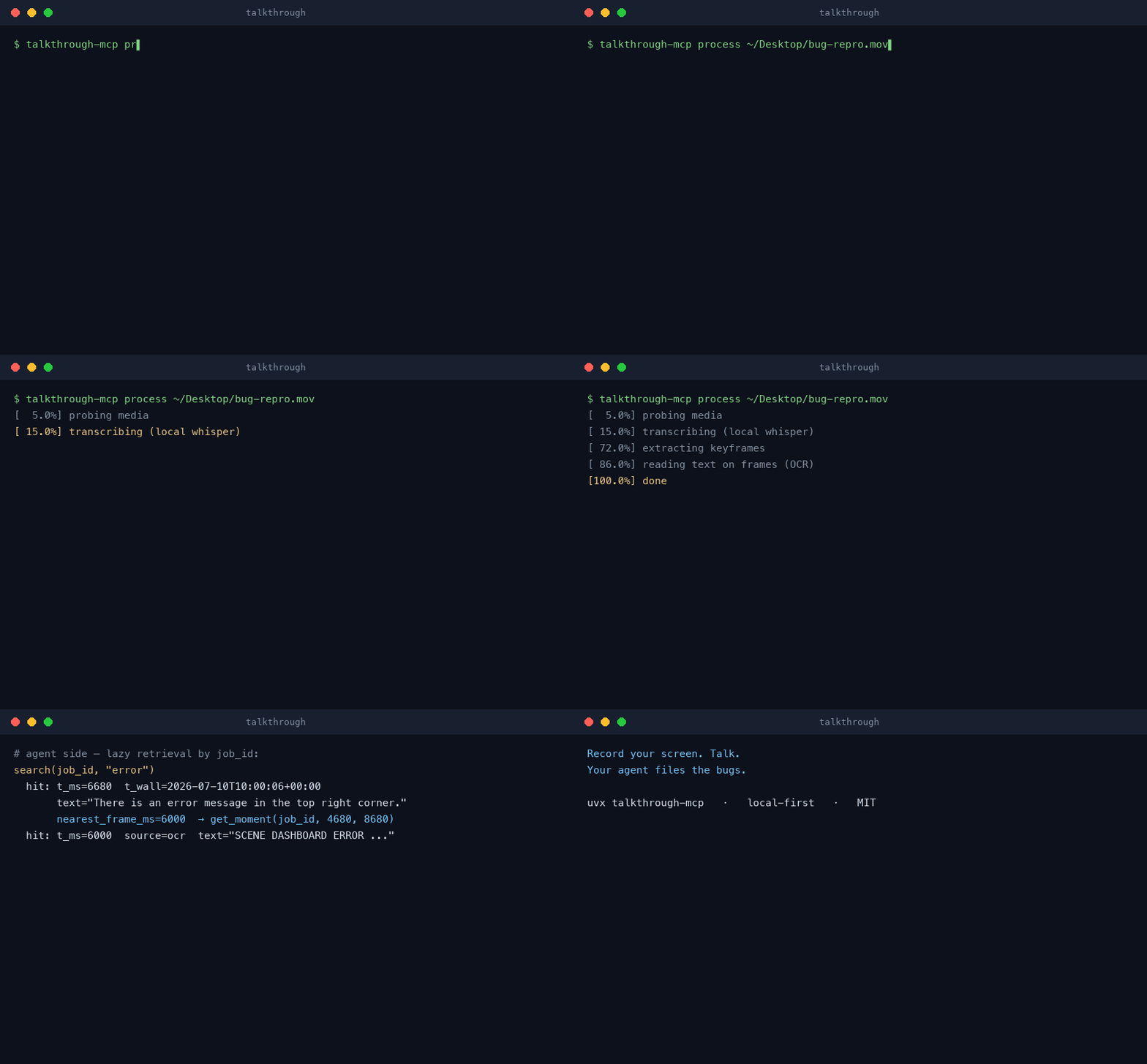
*Illustration — an animation of the `/talkthrough:bug` storyline, not a screen
capture: the recording is indexed locally (transcript · keyframes · OCR ·
wall-clock), the evidence checkpoint is assembled, and the draft is ready to
file with your own tracker tooling (`gh`, Jira, a GitHub MCP server —
talkthrough itself never leaves your machine and never posts anything).*
**Real runs, no animation:**
- **[▶ Watch the demo with sound (1:18)](https://youtu.be/nHfGfEiVdE8)** — an
unedited session: a narrated recording goes in, a ready-to-file
`bug-report.md` comes out.
- **[Silent recording → issue draft](examples/bug-from-silent-recording/)** —
the whole thing as files you can re-run: a Playwright-recorded, audio-free
`.mp4` and the unedited agent output. Every number is reproducible —
processing that file gives `job_id 8703a66bbe77a7d0` (the job id *is* the
sha256 prefix, so `shasum -a 256` predicts it), 17 keyframes / 4 unique, and
0 transcript segments because there is no audio track.
## Quickstart
One command, no system dependencies: ffmpeg falls back to a bundled build,
OCR is pip-only, and whisper models download themselves on first use. The
only prerequisite is [uv](https://docs.astral.sh/uv/) (`brew install uv` or
`curl -LsSf https://astral.sh/uv/install.sh | sh`).
Cold setup has two separate stages: `uvx` first resolves a compatible Python
and the pinned server environment, then the first `process_media` downloads
any missing media/model assets. A plugin update can create a new environment
and, without system ffmpeg, fetch the ~80 MB bundled ffmpeg again; shared
Whisper/OCR/diarization caches and warm, network-free jobs remain reusable.
See [Troubleshooting](docs/TROUBLESHOOTING.md#first-run-is-slow--downloads-a-lot).
[](https://cursor.com/en/install-mcp?name=talkthrough&config=eyJjb21tYW5kIjoidXZ4IiwiYXJncyI6WyItLXB5dGhvbiIsIj49My4xMSw8My4xNCIsInRhbGt0aHJvdWdoLW1jcFtkaWFyaXphdGlvbix1cmxdIl19)
[](https://vscode.dev/redirect/mcp/install?name=talkthrough&config=%7B%22command%22%3A%22uvx%22%2C%22args%22%3A%5B%22--python%22%2C%22%3E%3D3.11%2C%3C3.14%22%2C%22talkthrough-mcp%5Bdiarization%2Curl%5D%22%5D%2C%22type%22%3A%22stdio%22%7D)
[](https://insiders.vscode.dev/redirect/mcp/install?name=talkthrough&config=%7B%22command%22%3A%22uvx%22%2C%22args%22%3A%5B%22--python%22%2C%22%3E%3D3.11%2C%3C3.14%22%2C%22talkthrough-mcp%5Bdiarization%2Curl%5D%22%5D%2C%22type%22%3A%22stdio%22%7D&quality=insiders)
[](https://lmstudio.ai/install-mcp?name=talkthrough&config=eyJjb21tYW5kIjoidXZ4IiwiYXJncyI6WyItLXB5dGhvbiIsIj49My4xMSw8My4xNCIsInRhbGt0aHJvdWdoLW1jcFtkaWFyaXphdGlvbix1cmxdIl19)
[](https://kiro.dev/launch/mcp/add?name=talkthrough&config=%7B%22command%22%3A%22uvx%22%2C%22args%22%3A%5B%22--python%22%2C%22%3E%3D3.11%2C%3C3.14%22%2C%22talkthrough-mcp%5Bdiarization%2Curl%5D%22%5D%7D)
### Claude Code
Two install paths — **pick one**, not both (the plugin already includes
the server; installing both would register it twice):
**Server only** — the 9 tools + 6 prompts, and nothing else on your
system. Choose this for a minimal setup, or when you manage MCP servers
yourself across several clients:
```bash
claude mcp add -s user talkthrough -- uvx --python ">=3.11,<3.14" "talkthrough-mcp[diarization,url]"
```
**Full plugin** — the same server, plus native slash commands
(`/talkthrough:bug`, `/talkthrough:triage-recording`, …) that handle the
ceremony for you, a ready-made triage subagent, and an agent skill that
teaches Claude the workflow. Choose this for the best out-of-the-box
experience:
```
/plugin marketplace add korovin-aa97/talkthrough-mcp
/plugin install talkthrough@talkthrough
```
### Every other MCP client
Claude Desktop
`claude_desktop_config.json`:
```json
{
"mcpServers": {
"talkthrough": {
"command": "uvx",
"args": [
"--python",
">=3.11,<3.14",
"talkthrough-mcp[diarization,url]"
]
}
}
}
```
More: [`integrations/claude-desktop/`](integrations/claude-desktop/)
Cursor
`~/.cursor/mcp.json (or project .cursor/mcp.json)`:
```json
{
"mcpServers": {
"talkthrough": {
"command": "uvx",
"args": [
"--python",
">=3.11,<3.14",
"talkthrough-mcp[diarization,url]"
]
}
}
}
```
More: [`integrations/cursor/`](integrations/cursor/)
OpenAI Codex CLI
`~/.codex/config.toml (or project-scoped .codex/config.toml in trusted projects)`:
```toml
[mcp_servers.talkthrough]
command = "uvx"
args = ["--python", ">=3.11,<3.14", "talkthrough-mcp[diarization,url]"]
```
More: [`integrations/codex/`](integrations/codex/)
Gemini CLI
`~/.gemini/settings.json`:
```json
{
"mcpServers": {
"talkthrough": {
"command": "uvx",
"args": [
"--python",
">=3.11,<3.14",
"talkthrough-mcp[diarization,url]"
]
}
}
}
```
More: [`integrations/gemini-cli/`](integrations/gemini-cli/)
Cline / Roo Code
`cline_mcp_settings.json (via MCP Servers UI)`:
```json
{
"mcpServers": {
"talkthrough": {
"command": "uvx",
"args": [
"--python",
">=3.11,<3.14",
"talkthrough-mcp[diarization,url]"
]
}
}
}
```
More: [`integrations/cline/`](integrations/cline/)
OpenClaw
`~/.openclaw/openclaw.json`:
```json
{
"mcp": {
"servers": {
"talkthrough": {
"command": "uvx",
"args": [
"--python",
">=3.11,<3.14",
"talkthrough-mcp[diarization,url]"
]
}
}
}
}
```
More: [`integrations/openclaw/`](integrations/openclaw/)
OpenCode
`opencode.json (project) or ~/.config/opencode/opencode.json`:
```json
{
"mcp": {
"talkthrough": {
"type": "local",
"command": [
"uvx",
"--python",
">=3.11,<3.14",
"talkthrough-mcp[diarization,url]"
],
"enabled": true
}
}
}
```
More: [`integrations/opencode/`](integrations/opencode/)
Goose
`~/.config/goose/config.yaml`:
```yaml
extensions:
talkthrough:
enabled: true
type: stdio
cmd: uvx
args: ["--python", ">=3.11,<3.14", "talkthrough-mcp[diarization,url]"]
```
More: [`integrations/goose/`](integrations/goose/)
GitHub Copilot CLI
`~/.copilot/mcp-config.json`:
```json
{
"mcpServers": {
"talkthrough": {
"command": "uvx",
"args": [
"--python",
">=3.11,<3.14",
"talkthrough-mcp[diarization,url]"
]
}
}
}
```
More: [`integrations/copilot-cli/`](integrations/copilot-cli/)
Windsurf
`~/.codeium/windsurf/mcp_config.json`:
```json
{
"mcpServers": {
"talkthrough": {
"command": "uvx",
"args": [
"--python",
">=3.11,<3.14",
"talkthrough-mcp[diarization,url]"
]
}
}
}
```
More: [`integrations/windsurf/`](integrations/windsurf/)
Zed
`settings.json (Zed)`:
```json
{
"context_servers": {
"talkthrough": {
"source": "custom",
"command": {
"path": "uvx",
"args": [
"--python",
">=3.11,<3.14",
"talkthrough-mcp[diarization,url]"
]
}
}
}
}
```
More: [`integrations/zed/`](integrations/zed/)
Any other MCP stdio client uses the same server command: `uvx --python ">=3.11,<3.14" "talkthrough-mcp[diarization,url]"`.
Per-engine folders with exactly these snippets plus verification steps live
in [`integrations/`](integrations/); agents can self-install via
[`llms-install.md`](llms-install.md).
### Who said what (speaker diarization) — included in the configs above
Multi-person recordings (meetings, interviews, panels) can carry `S1`/`S2`/…
speaker labels. Every install button, snippet, and the plugin above already
ship the `[diarization]` engine, so asking your agent "who said what" just
works — diarization itself still runs only when requested per call
(`process_media(path=..., diarize=true, num_speakers=)`),
and its models download once on first use.
Prefer the minimal server without the diarization engine? Use
`uvx --python ">=3.11,<3.14" talkthrough-mcp` as the command instead (the MCP registry entry also
resolves to this lean form) — an explicit `diarize=true` will then answer
with the one-line install fix. Details in
[Speakers](#speakers-optional-diarization).
### Upgrading from 0.3.x
Regenerated configs and the plugin carry `[diarization,url]`. A config you
wrote by hand for 0.3.x — `uvx --python ">=3.11,<3.14" talkthrough-mcp`, or a
pin without the `url` extra — upgrades the server in place and lists the new
`process_url` tool,
but only direct `https://` media links work until the extra is there:
YouTube and video pages answer with the one-line install fix. Add `url` to
your command (`uvx --python ">=3.11,<3.14" "talkthrough-mcp[diarization,url]"`),
restart the client, and check with `talkthrough-mcp --version` (0.4.1+),
which names the extras the environment has; the server logs the same line
to stderr at every start, so your client's MCP log shows it too.
### Local checkout (development)
```bash
git clone https://github.com/korovin-aa97/talkthrough-mcp
claude mcp add talkthrough -- uv run --directory /path/to/talkthrough-mcp talkthrough-mcp
```
Then, in your agent:
> Process `~/Desktop/recording.mov` and triage it — or just invoke the
> `triage-recording` server prompt.
## Tools
| Tool | What it does |
|---|---|
| `process_media(path, recorded_at?, vocabulary?, language?, model?, diarize?, num_speakers?, force?)` | Ingest a video/audio file: local STT, keyframes, OCR, wall-clock, opt-in speaker labels. Returns a compact summary. Idempotent by content hash — re-calls are instant; `diarize=true` on a processed job adds speakers without re-transcribing. |
| `process_url(url, recorded_at?, vocabulary?, language?, model?, diarize?, num_speakers?, refresh?, force?)` | The one network tool: download one public video/audio URL once (a direct `https://` media link, one YouTube video, or any public video page yt-dlp can read — with the `[url]` extra), keep the source inside the job, then run the same local pipeline. Same-URL re-calls serve the stored job without network unless `refresh=true`; `force=true` rebuilds from the kept source; the raw URL is never stored. |
| `get_transcript(job_id, start_ms?, end_ms?, format?)` | Paginated transcript as `segments`, `text`, or `srt` (speaker-prefixed when diarized, plus a roster header); truncation returns `next_start_ms`. |
| `get_frames(job_id, at_ms? \| start_ms?+end_ms?, max_frames?, include_duplicates?)` | Keyframe images nearest a timestamp or evenly thinned across a range (unique frames by default, max 6/call); each frame names its absolute `path`. |
| `get_moment(job_id, start_ms, end_ms)` | The "one remark" bundle: transcript slice + up to 3 frames + their OCR text + wall-clock range (+ `speakers_in_range` when diarized). |
| `search(job_id, query, speaker?, match_mode?)` | Substring search over the transcript AND on-screen OCR text. `all_words` remains the default; `any_word` broadens lexical recall. Hits carry `t_ms`/`t_wall`, frame refs, and the speaker when diarized. The optional filter accepts a raw label or saved name. |
| `label_speakers(job_id, labels, evidence?)` | Atomically persist verified names for anonymous speaker labels. Raw `S1`/`S2` labels remain canonical; blank/null removes a name. |
| `extract_frame(job_id, at_ms, crop?)` | Exact-timestamp full-resolution re-extract from the source video (optional crop) when keyframes miss the instant; returns the file's absolute `path`. URL jobs decode their kept source — no network. |
| `list_jobs()` | Recent processed recordings with source paths, durations, wall-clock starts, counts, speaker counts when diarized, and the provider/id for URL jobs. |
Every tool description ships 10+ usage examples, so agents pick the right tool
without extra prompting.
## Server prompts (slash commands in MCP clients)
| Prompt | Workflow |
|---|---|
| `bug` | One recording → evidence-backed GitHub issue draft (silent, narration-free recordings work too) |
| `triage-recording` | Narrated screencast → precise findings JSON (bug/feature/question routing, frame evidence) |
| `spec-from-workshop` | Recorded workshop → structured spec with quoted decisions and open questions |
| `backlog-from-demo` | Product demo → prioritized backlog with timestamped evidence |
| `meeting-actions` | Meeting audio → action items, decisions, open questions |
| `correlate-with-logs` | Recording remarks ↔ system logs via wall-clock windows |
The same prompts live as plain files in [`examples/prompts/`](examples/prompts/)
if your client doesn't surface MCP prompts. The findings contract used by
`triage-recording` is [`examples/output-contract.schema.json`](examples/output-contract.schema.json).
## Works as a skill too (no MCP required)
The same workflow ships as a cross-engine [Agent Skill](https://agentskills.io)
at [`.agents/skills/talkthrough/`](.agents/skills/talkthrough/) — Claude Code,
Codex CLI (`$talkthrough`), Cursor, Copilot, Gemini CLI, Goose and other
SKILL.md-compatible tools read it. Agents without MCP wiring can drive the
[CLI](#cli) directly: `talkthrough-mcp process recording.mov --json` prints the
same summary the MCP tool returns, and the job store is shared either way.
## Wall-clock anchoring
Every timestamped result carries both `t_ms` (video-relative) and `t_wall`
(ISO 8601 real time) once the recording start is known. Resolution ladder:
1. `recorded_at` parameter (agent/user override) → confidence `exact`
2. QuickTime `com.apple.quicktime.creationdate` tag, carries the local
timezone (QuickTime Player recordings; ⌘⇧5 wrote it before macOS 26) → `high`
3. Container `creation_time` tag (UTC) → `medium` — macOS 26+ ⌘⇧5/ReplayKit
screen recordings land here (no `creationdate` tag anymore); pass
`recorded_at=` when local-tz `t_wall` matters
4. File mtime minus duration (recorders finalize files at recording END) → `low`
5. Nothing → tools still work with relative `t_ms` only
Why it matters: "the upload spinner froze *here*" becomes a ±30 s grep window
in your server logs.
## Speakers (optional diarization)
With the `[diarization]` extra installed (included in every generated config —
see [Quickstart](#who-said-what-speaker-diarization--included-in-the-configs-above)),
`process_media(diarize=true)` labels who said what — locally, like everything
else here ([sherpa-onnx](https://github.com/k2-fsa/sherpa-onnx) runtime, no
torch, no accounts, no GPU):
- Speakers become `S1`, `S2`, … **in order of first appearance**; new
diarized jobs split speaker changes at word boundaries, while old jobs
continue to report honest segment-level precision. Every
transcript segment gets a `speaker`, and the tools surface it everywhere —
roster with talk time in `get_transcript`, `speakers_in_range` in
`get_moment`, `speaker` on `search` hits, `S1:` prefixes in the text/SRT
formats, a speaker count in `list_jobs`.
- **Know the headcount? Pass `num_speakers`.** Clustering toward an exact k
removes the main failure mode of unknown-count mode (similar voices merging
or one voice splitting). It is a target, not a guarantee: the clusterer can
converge on fewer clusters than k, and a re-run that changed nothing says
so in the payload (`labels_changed: false`). Agents are instructed to pass
the headcount via the tool guidance; do the same in your own calls.
- **Already processed a recording?** Calling `process_media(diarize=true)` on
it re-runs *only* diarization — whisper is not re-run, and labels land in
the existing job. Same for changing `num_speakers`. The diarization stage
itself still re-scans the full audio: minutes on long recordings.
- **Full rebuilds keep named jobs safe.** If a job has active or pending names,
`force=true` also requires `diarize=true`; otherwise the call refuses before
changing stored data. A successful force rebuilds in staging and moves every
previous identity to pending review against the fresh roster. Any processing
or commit failure leaves the prior manifest and frames intact.
- Labels start anonymous. After checking self-introductions, vocatives, or
video evidence, call `label_speakers` to preserve a verified mapping such
as `S1` → "Alice" across sessions. The roster can expose bounded OCR
`name_candidates`, but those are raw hints and are never saved
automatically. The raw label remains present beside `speaker_name`. If a
later diarization amend changes the labels, verified names stop being
active and move to bounded `speaker_names_pending_review` evidence instead
of being silently lost. Re-check the current roster and explicitly confirm
or remove each affected label with `label_speakers`.
- Video jobs produced before 0.3.1 keep their original flat OCR and can return
`name_candidates_note` to explain why hints are absent. They remain fully
readable without migration; `force=true, diarize=true` regenerates line-aware
OCR while preserving saved identities for review.
Models download once (~47 MB total) from pinned, checksum-verified URLs into
`~/.talkthrough/models/`; warm runs are zero-network like the rest of the
pipeline. Speed on an M-series CPU (4 threads): a 26-minute meeting diarizes
in about 2 minutes (RTF ≈ 0.08), on top of the transcription time. Memory:
expect on the order of 1–1.5 GB peak RSS while an hour-plus meeting is being
diarized (measured on a real 73-minute recording); it is released when the
stage completes.
| Role | Model | Download | Weights license |
|---|---|---|---|
| Segmentation | [pyannote segmentation-3.0](https://huggingface.co/pyannote/segmentation-3.0) (ONNX export by k2-fsa) | 7 MB | MIT |
| Embedding (default) | [NeMo](https://github.com/NVIDIA/NeMo) `en_titanet_small` | 40 MB | Apache-2.0 (per its NGC model card, the NeMo Toolkit license) |
| Embedding (alt) | [WeSpeaker](https://github.com/wenet-e2e/wespeaker) `en_voxceleb_resnet34_LM` | 27 MB | CC-BY-4.0 |
| Embedding (alt) | [3D-Speaker](https://github.com/modelscope/3D-Speaker) `campplus_sv_en_voxceleb_16k` | 30 MB | Apache-2.0 |
The default won a real-meeting accept-eval (RU/EN/ES + a 3-speaker 26-minute
meeting): it was the only candidate to isolate all three real voices at
`num_speakers=3`, at 2× the speed of the runner-up.
Pick an alternate embedding model (or point at your own `.onnx` file for
offline machines) via `TALKTHROUGH_DIARIZATION_EMB_MODEL`; tune the
unknown-count sensitivity via `TALKTHROUGH_DIARIZATION_THRESHOLD` (see
[docs/TROUBLESHOOTING.md](docs/TROUBLESHOOTING.md)). Honest quality notes
live in [Limitations](#limitations).
## Privacy
Everything runs locally: your recordings never leave your machine, speech is
transcribed by a local whisper model, OCR and speaker diarization are local
ONNX inference, and there is no telemetry. For local files the only network
access is one-time tool/model downloads (ffmpeg build, whisper model, OCR
models, diarization models — the latter pinned by URL + sha256). The one
deliberate exception is `process_url`: it downloads the public source you
name from its provider or CDN, once, and nothing else — no media ever goes
*up*, no cloud STT or LLM is called, and after that download every tool on
the job is network-free again. The raw URL (which may carry signed tokens)
is not stored: the job keeps a hash, the public provider id or host and a
bounded title. Diarization keeps no voiceprint database: voice embeddings
live only in process memory, and only anonymous turn labels (`S1`/`S2`) land
on disk. Your agent sees only the payloads the MCP tools return (text and
selected frames) in your existing session; talkthrough itself makes no LLM
calls.
## Languages
Narration in any of Whisper's ~99 languages works: the language is
auto-detected per recording, and the summary reports both `language` and
`language_probability` so agents can tell a confident detection from a shaky
one (silence or music at the start can fool the detector — pin it with
`language="ru"` and `force=true` when that happens). Speaker diarization is
acoustic — it fingerprints voices, not words — so it is language-independent
and works across all of those languages unchanged.
Pick the model for your languages — per call (`model=` parameter, agents do
this themselves when a transcript comes back garbled) or as the server
default (`TALKTHROUGH_WHISPER_MODEL`):
| Model | Size | Best for |
|---|---|---|
| `small` (default) | 464 MB | English and major-language narration on CPU |
| `large-v3-turbo` | ~1.5 GB | **recommended for non-English** — near-large quality at near-small speed |
| `medium` | ~1.5 GB | conservative alternative to turbo |
| `tiny` / `base` | 75–145 MB | quick drafts, CI |
| `*.en` variants | — | English-only, slightly faster/better for EN |
Tips that work in every language: pass product names via
`vocabulary="Term1, Term2"` (biases the decoder so jargon survives), and note
that the workflow prompts instruct agents to write digests in the
**narrator's language** while keeping quotes verbatim — the server never
translates (exact quotes are evidence; translation is the agent's job).
On-screen text (OCR) defaults to RapidOCR's Latin + Chinese models. For other
scripts set `TALKTHROUGH_OCR_LANG` to your language — `ru`/`uk` (→ the
`eslav` pack), `ja`, `ko`, `ar`, `hi`, `el`, `th`, or any RapidOCR pack name
like `cyrillic` — and reprocess with `force=true`; the matching recognition
model downloads once. Spoken-language support is unaffected either way.
## Configuration
| Env var | Default | Meaning |
|---|---|---|
| `TALKTHROUGH_WHISPER_MODEL` | `small` | default whisper model (`tiny`/`base`/`small`/`medium`/`large-v3`/`large-v3-turbo`); the `model` tool param overrides per call |
| `TALKTHROUGH_OCR` | `on` | set `off` to skip OCR |
| `TALKTHROUGH_OCR_LANG` | Latin+Chinese | recognition script for on-screen text: a language code (`ru`, `ja`, `ko`, `ar`, `hi`, …) or a RapidOCR pack name (`eslav`, `cyrillic`, `latin`, …); the model downloads once |
| `TALKTHROUGH_OCR_PARAMS` | — | advanced: JSON object of raw RapidOCR params merged over the derived ones, e.g. `{"Rec.lang_type": "cyrillic"}` |
| `TALKTHROUGH_DIARIZE` | `off` | set `on` to diarize by default (needs the `[diarization]` extra; degrades with a warning without it); an explicit `diarize` tool param always wins |
| `TALKTHROUGH_DIARIZATION_THRESHOLD` | `0.5` | clustering sensitivity when `num_speakers` is unknown: fewer speakers than expected → lower it; more → raise it |
| `TALKTHROUGH_DIARIZATION_SEG_MODEL` | `pyannote-segmentation-3-0` | segmentation model: allowlist name or a path to a local `.onnx` (offline preseed) |
| `TALKTHROUGH_DIARIZATION_EMB_MODEL` | `nemo_en_titanet_small` | embedding model: allowlist name (see [Speakers](#speakers-optional-diarization)) or a local `.onnx` path |
| `TALKTHROUGH_DIARIZATION_THREADS` | `min(4, cpus)` | ONNX threads for both diarization models |
| `TALKTHROUGH_MAX_SECONDS` | `7200` | max media duration (also checked against provider metadata before a `process_url` download) |
| `TALKTHROUGH_MAX_FRAMES` | `600` | keyframe budget per job, spread across the whole duration (the 1 s selection floor auto-grows to `duration/budget` on long recordings) |
| `TALKTHROUGH_MAX_DOWNLOAD_BYTES` | `2147483648` (2 GiB) | hard cap for one `process_url` download, enforced before and during the transfer |
| `TALKTHROUGH_HOME` | `~/.talkthrough` | job store root (URL jobs keep their downloaded source under `jobs//source/`) |
## CLI
The pipeline is also a CLI — useful for pre-processing long recordings outside
an agent session (the store is content-addressed, so the agent then queries the
same job instantly):
```bash
talkthrough-mcp process ~/Videos/long-session.mov # prints the summary
talkthrough-mcp process demo.mov --json # machine-readable
talkthrough-mcp process sync.m4a --diarize --num-speakers 3 # who said what
talkthrough-mcp process-url "https://youtu.be/nHfGfEiVdE8" # one public URL, downloaded once
talkthrough-mcp gc --keep-days 30 # clean the job store (sources go with their jobs)
talkthrough-mcp serve # stdio MCP server (default)
talkthrough-mcp --version # package version + which extras this environment has
```
`--json` keeps stdout machine-readable on failure too (0.4.1), including a
missing argument or unknown option: the process exits with code 2, stderr
carries the human `error: …` line, and stdout
carries one JSON document, `{"error": {"type": "UnsupportedUrlError",
"message": "…"}}`. `--version` also says which optional extras the
environment has — the quickest check when a hand-written config launches
the minimal server (a launcher without the `url` extra) that advertises
`process_url` but can only read direct media links; the server logs the
same line to stderr at every start.
First run notes: missing system ffmpeg triggers a one-time `static-ffmpeg`
download; the first transcription downloads the whisper model (~460 MB for
`small`); both are cached. After that, expect roughly 3× faster than real time
on an Apple-Silicon CPU with the default model, OCR included (a 2-minute clip
processes in ~40 s) — and instant re-runs on the same file. Progress streams
as MCP progress notifications, and the CLI prints stage lines. More:
[docs/TROUBLESHOOTING.md](docs/TROUBLESHOOTING.md).
## Windows
CI runs lint, the unit suite, a full CLI smoke, and a diarize smoke on
`windows-latest` (static-ffmpeg Windows build, whisper `tiny` transcription,
OCR, the instant idempotent re-run, and a speaker-roster assert through the
native sherpa-onnx stack). Notes: the per-job lock always serializes threads;
POSIX also uses `fcntl` for cross-process locking. Quote paths with spaces
(`uv run talkthrough-mcp process "C:\Videos\Screen Recording.mp4"`).
If something breaks, please open an issue.
## Supported inputs
Video: `.mov` `.mp4` `.webm` `.mkv` `.ogv` — audio-only: `.m4a` `.mp3` `.wav` `.ogg`
`.flac` (transcript tools only; frame tools explain why they're unavailable).
URLs (via `process_url`, since 0.4.0): a direct `https://` link to one of
those media files; one public YouTube video (`watch`, `youtu.be`, `shorts`,
a completed live); or any public video **page** yt-dlp can read — public
Instagram reels, TikTok, Wikimedia Commons file pages (each verified on
release day), the rest of yt-dlp's ~1800 site extractors and pages with a
plain HTML5/HLS player (the `[url]` extra, which the generated configs above
already carry, brings yt-dlp). Always anonymous: a site that demands a
sign-in from anonymous clients (Vimeo does, with this yt-dlp) is refused
with the reason. The source is
downloaded once, kept inside the job, and never re-fetched for later
questions. Not supported: playlists, channels, active live streams,
private, members-only, age-restricted or DRM-protected videos, cookies or
logins — a site that hides a video behind a login or a bot wall answers
with a clear refusal, not a workaround (Instagram in particular rate-limits
anonymous access). You are responsible for having the right to download
and process what you point it at; talkthrough does not bypass any
restriction.
## Limitations
Honest edges, so you can decide fast:
- **Speaker labels are word-level and opt-in on new jobs.** Each Whisper word
is assigned by maximum overlap with the diarization turns, so fast exchanges
split without losing the raw label. Old jobs remain readable and honestly
report `attribution_precision="segment"`; reprocess with `force=true` to add
word timings. Sub-second interjections ("yeah", "mhm") can still be absorbed
when the diarization engine does not detect a separate turn, and heavy
crosstalk degrades clustering (the segmentation model tracks at most 2
simultaneous voices). Quality is
pyannote-3.x-generation. The comfort zone without hints is roughly 2–8
speakers; **pass `num_speakers` whenever the headcount is known** — it
removes the worst failure mode at any size, and it is the way to go for
large meetings (10+).
- **URL ingestion covers one public video at a time, without logins.**
Direct HTTPS media links, single public YouTube videos and public video
pages yt-dlp can read; playlists, channels, live streams, gated or DRM
content and anything behind a login or a bot wall are refused with a
reason. Sites change; a page that worked yesterday can need a newer yt-dlp
tomorrow. A provider's upload date is not a recording time, so URL jobs
have `wall_clock: null` unless you pass `recorded_at`.
- **Memory: budget about 2 GB for a cold run.** Whisper, the OCR models and
the frame pass live in one process. A 78-second video on `tiny` with OCR
peaked at 1.6 GB RSS during the 0.4.0 release QA (download included); the
default `small` model needs more, larger models proportionally so. An
8 GB laptop copes; on anything tighter keep the model small or run the
CLI ahead of the agent session.
- **Keyframes + transcript, not motion analysis.** A glitch *between* scene
changes can be invisible in the frame set; `extract_frame` re-checks any
instant, but frame-by-frame motion reasoning is your multimodal model's job.
- **STT quality tracks the model you pick.** The default `small` favors speed;
non-English narration wants `model="large-v3-turbo"` (see
[Languages](#languages)).
- **OCR reads crisp UI text well;** tiny or low-contrast print is best-effort.
- **Wall-clock confidence depends on recorder metadata** — worst case pass
`recorded_at=` (see the ladder above).
- **Windows caveats** — POSIX lock degrades to a no-op; see the Windows
section above.
## How it compares
| | talkthrough | cloud recorder SaaS | meeting notetakers | typical video-analyzer MCPs |
|---|---|---|---|---|
| Runs fully locally | ✅ | ❌ | ❌ | varies |
| Any local video/audio file | ✅ | browser/app captures | meetings only | ✅ |
| Public video URL: downloaded once, kept with the job, analyzed locally | ✅ | n/a | n/a | temp download, often cloud analysis |
| Wall-clock anchoring (log correlation) | ✅ | ❌ | ❌ | ❌ |
| Who-said-what speaker labels | ✅ local, opt-in | some | ✅ cloud | ❌ |
| Ships agent workflows (prompts, skill, findings contract) | ✅ | ❌ | ❌ | ❌ |
| OCR of on-screen text, searchable | ✅ | some | ❌ | rare |
## FAQ
**Why not just upload the video to a multimodal model (e.g. Gemini)?**
For a short, non-sensitive clip — do that. The trade-offs appear with length
and sensitivity: an hour of screen recording costs on the order of a million
tokens *per question*, the file leaves your machine, and you still can't map a
remark to `14:32:07 UTC` to grep your server logs. talkthrough indexes once,
locally, then answers any number of follow-ups from the index.
**Why not screenpipe?**
Different job. screenpipe is an always-on recorder of *your* machine going
forward (commercial license). It can't open the `.mov` a teammate or customer
just sent you. talkthrough analyzes any file it's handed — the two compose
fine.
**There are agent skills that "watch" videos. Why a server with an index?**
Watch-style skills push a budgeted frame dump into the context window (and go
sparse on long videos), often call cloud STT for the audio, and keep nothing.
talkthrough builds a persistent local index — transcript + OCR, full-text
searchable — retrieves exact frames lazily, anchors everything to wall-clock
time, and answers the next question without reprocessing.
**I use Jam for bug reports — do I need this?**
Keep Jam for browser bugs: console+network captured at record time is great
evidence. talkthrough covers what a browser extension can't — desktop apps,
mobile screencasts, ops incidents, meetings, any file — with no account, and
correlates with *server-side* logs via wall-clock time.
**Which agent model do I need to drive this?**
For v0.4.0 the six model configs below ran 61 isolated behaviour cells on
URL ingestion (YouTube, a TikTok page, a speechless Instagram reel,
playlist refusal, the missing wall clock) and the 0.3.2 integrity fixes;
every cell passes on every runner after two product fixes the first
attempts exposed (Codex needs a per-tool approval for the open-world
`process_url`, and the server now says itself when a URL job has no wall
clock). For v0.3.0 we ran 210 isolated agent cells across 6 model configs (Claude
haiku/sonnet/opus, Codex gpt-5.5 at two reasoning efforts, and gpt-5.4-mini)
and 35 logical scenarios on 5 real recordings plus safety and speaker-label
fixtures. All 102 LLM-judged full-grid results and every mechanical zero were
manually audited; the 30 new speaker behavior runs passed, and old-server
control left **0 release-caused regressions**. This is a model-drift snapshot,
not a leaderboard: see the current matrix in
[docs/MODEL-NOTES.md](docs/MODEL-NOTES.md). The chart and narrative in
[benchmarks/](benchmarks/) remain the historical v0.2.0 snapshot.
**Can't I just script ffmpeg + whisper myself?**
Yes — that's exactly this pipeline. What you'd be rebuilding: scene-change
detection with perceptual dedup, OCR, transcript+OCR search, the wall-clock
ladder, MCP tools with embedded usage examples, six workflow prompts, and a
findings contract. One `uvx` command instead of an afternoon of glue.
**Is it really local? What leaves my machine?**
Nothing goes up, ever. For local files the network is used only for one-time
downloads (ffmpeg build, whisper/OCR/diarization models). `process_url` is
the single tool that talks to the network at runtime, and only *down*: it
fetches the public source you named, once. No telemetry. See
[Privacy](#privacy) — and [SECURITY.md](SECURITY.md) treats a violation of
this promise as a vulnerability.
## For agents & tooling
Machine-readable entry points, so AI agents can install and use this server
without a human reading docs:
- [`llms-install.md`](llms-install.md) — step-by-step install instructions for agents
- [`llms.txt`](llms.txt) — index of the documentation
- [`.agents/skills/talkthrough/SKILL.md`](.agents/skills/talkthrough/SKILL.md) — an [Agent Skill](https://agentskills.io) teaching the tool workflow; discovered automatically inside a checkout by Codex CLI (`$talkthrough`) and readable by Claude Code, Cursor, Copilot, Gemini CLI and other SKILL.md-compatible tools
- [`AGENTS.md`](AGENTS.md) — instructions for coding agents contributing to this repo
- [`server.json`](server.json) — MCP registry manifest
- [`integrations/`](integrations/) — per-engine adapters, all generated from one source of truth and drift-tested (incl. the Claude Code plugin under [`integrations/claude-code/`](integrations/claude-code/))
- [`docs/URL_ACCEPTANCE_CORPUS.md`](docs/URL_ACCEPTANCE_CORPUS.md) — the live URL corpus behind the release QA of `process_url` (manual, needs the network; CI stays offline)
## Roadmap
cloud STT · embeddings/semantic search · hosted/remote mode · `.mcpb`
bundle · whisper.cpp backend
## License
MIT