# Random Attachment Model
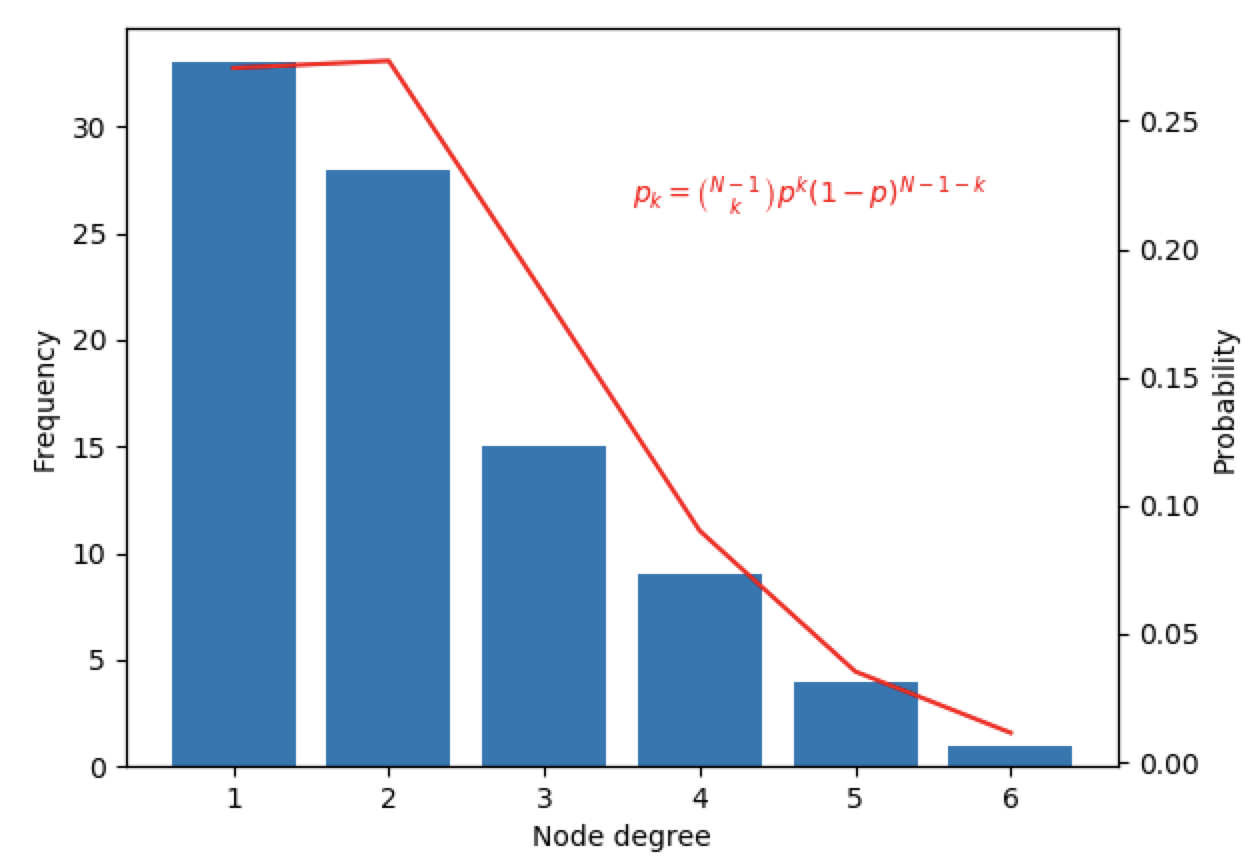
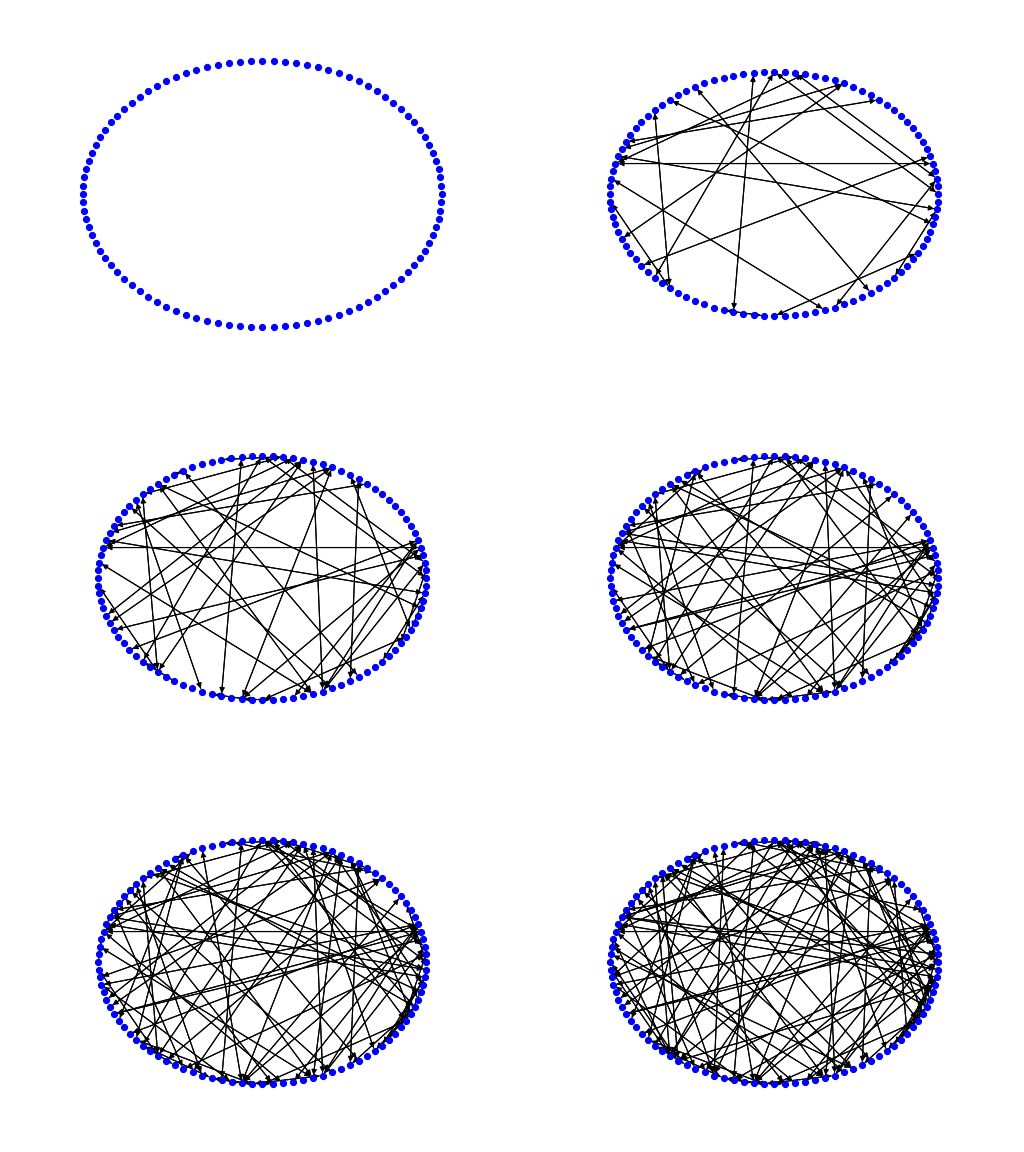
In a Random Attachment Model, we begin with a network of fully disconnected nodes, and then, at each timestep, we pick
two nodes randomly, and form a connection between them if they are not already connected. This is essentially the
Erdős–Rényi model.
An example of a Random Attachment Model implemented with Netomaton follows:
```python
import netomaton as ntm
import numpy as np
N = 100
network = ntm.topology.disconnected(N)
def topology_rule(ctx):
nodes = [int(i) for i in np.random.choice(list(ctx.network.nodes), size=2, replace=False)]
if not ctx.network.has_edge(nodes[1], nodes[0]) and not ctx.network.has_edge(nodes[0], nodes[1]):
ctx.network.add_edge(nodes[1], nodes[0])
ctx.network.add_edge(nodes[0], nodes[1])
return ctx.network
trajectory = ntm.evolve(network=network,
topology_rule=topology_rule, timesteps=N)
# plot degree distribution
p = 2 / (N - 1)
ntm.plot_degree_distribution(trajectory[-1].network, out_degree=True,
equation=lambda k: ntm.ncr(N-1, k)*(p**k)*((1-p)**(N-1-k)),
equation_text="$p_{k} = \\binom{N-1}{k} p^k (1-p)^{N-1-k}$")
ntm.animate_network(trajectory, interval=350, with_labels=False)
```
 The full source code for this example can be found [here](random_attachment_model_demo.py).
For more information, see:
> Newman, M. E., Strogatz, S. H., & Watts, D. J. (2001). Random graphs with arbitrary degree distributions and their applications. Physical Review E, 64(2), 026118.
The full source code for this example can be found [here](random_attachment_model_demo.py).
For more information, see:
> Newman, M. E., Strogatz, S. H., & Watts, D. J. (2001). Random graphs with arbitrary degree distributions and their applications. Physical Review E, 64(2), 026118.