# Randomly Growing Network
One can grow a network randomly by starting with a single disconnected node, and then at each timestep, we add a new
node and attach it randomly to the network. Nodes added earlier in the evolution have a greater probability of having a
larger degree.
The following implementation with the Netomaton framework demonstrates a randomly growing network:
```python
import netomaton as ntm
import numpy as np
network = ntm.topology.from_adjacency_matrix([[1]]) # begin with a single-node network
def topology_rule(ctx):
num_nodes = len(ctx.network.nodes)
new_label = num_nodes
ctx.network.add_node(new_label)
connect_to = int(np.random.choice(list(range(num_nodes))))
ctx.network.add_edge(new_label, connect_to)
ctx.network.add_edge(connect_to, new_label)
return ctx.network
trajectory = ntm.evolve(initial_conditions=[1], network=network,
topology_rule=topology_rule, timesteps=100)
# animate time evolution of the network (NOTE: node self-links are not rendered)
ntm.animate_network(trajectory, interval=350, layout="spring", with_labels=False)
```
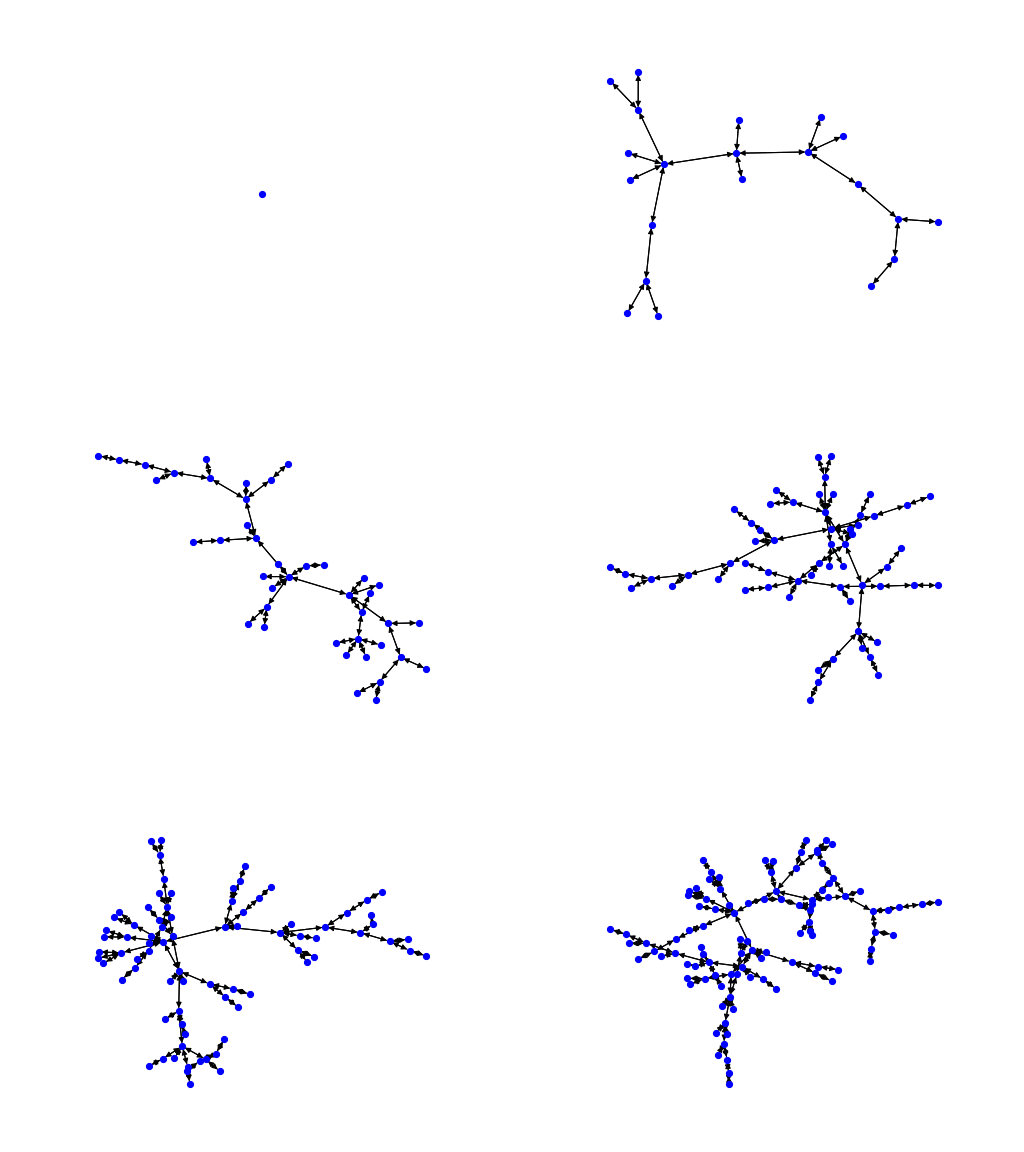 The full source code for this example can be found [here](randomly_growing_network_demo1.py).
In 2001, Callaway and colleagues analyzed the properties of a minimal model of a growing network. Much like the example
above, they begin with a network with a single disconnected node, and at each timestep a new node is added, and with
probability δ, two nodes are chosen uniformly at random and connected. If the probability of attaching two nodes
is δ, then the probability of a randomly chosen node have degree k is:
(2δ)k / (1 + 2δ)k+1. The following demonstrates an implementation of this model with the
Netomaton framework:
```python
import netomaton as ntm
import numpy as np
import random
# probability of attaching two nodes
delta = 1.0
network = ntm.topology.disconnected(1) # begin with a single-node network
def topology_rule(ctx):
num_nodes = len(ctx.network.nodes)
new_label = num_nodes
ctx.network.add_node(new_label)
if random.random() < delta:
# choose 2 nodes at random, without replacement
choices = [int(i) for i in np.random.choice(list(ctx.network.nodes), size=2, replace=False)]
ctx.network.add_edge(choices[1], choices[0])
ctx.network.add_edge(choices[0], choices[1])
return ctx.network
trajectory = ntm.evolve(network=network, topology_rule=topology_rule, timesteps=200)
# plot degree distribution
ntm.plot_degree_distribution(trajectory[-1].network, out_degree=True,
equation=lambda k: ((2*delta)**k)/((1 + 2*delta)**(k+1)),
equation_text="$p_k = \\frac{(2\\delta)^k}{(1 + 2\\delta)^{k+1}}$")
# animate time evolution of the network (NOTE: node self-links are not rendered)
ntm.animate_network(trajectory, interval=350, layout="spring", with_labels=False)
```
The full source code for this example can be found [here](randomly_growing_network_demo1.py).
In 2001, Callaway and colleagues analyzed the properties of a minimal model of a growing network. Much like the example
above, they begin with a network with a single disconnected node, and at each timestep a new node is added, and with
probability δ, two nodes are chosen uniformly at random and connected. If the probability of attaching two nodes
is δ, then the probability of a randomly chosen node have degree k is:
(2δ)k / (1 + 2δ)k+1. The following demonstrates an implementation of this model with the
Netomaton framework:
```python
import netomaton as ntm
import numpy as np
import random
# probability of attaching two nodes
delta = 1.0
network = ntm.topology.disconnected(1) # begin with a single-node network
def topology_rule(ctx):
num_nodes = len(ctx.network.nodes)
new_label = num_nodes
ctx.network.add_node(new_label)
if random.random() < delta:
# choose 2 nodes at random, without replacement
choices = [int(i) for i in np.random.choice(list(ctx.network.nodes), size=2, replace=False)]
ctx.network.add_edge(choices[1], choices[0])
ctx.network.add_edge(choices[0], choices[1])
return ctx.network
trajectory = ntm.evolve(network=network, topology_rule=topology_rule, timesteps=200)
# plot degree distribution
ntm.plot_degree_distribution(trajectory[-1].network, out_degree=True,
equation=lambda k: ((2*delta)**k)/((1 + 2*delta)**(k+1)),
equation_text="$p_k = \\frac{(2\\delta)^k}{(1 + 2\\delta)^{k+1}}$")
# animate time evolution of the network (NOTE: node self-links are not rendered)
ntm.animate_network(trajectory, interval=350, layout="spring", with_labels=False)
```
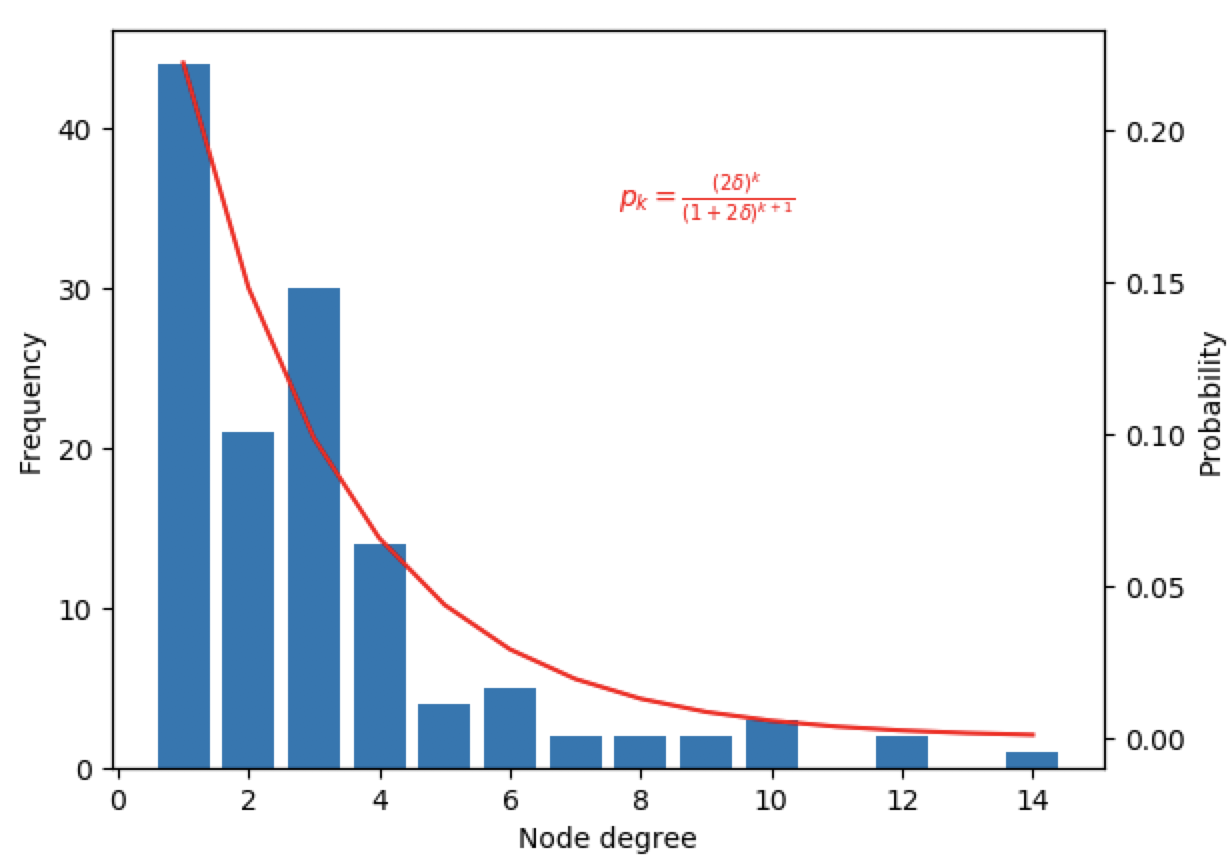
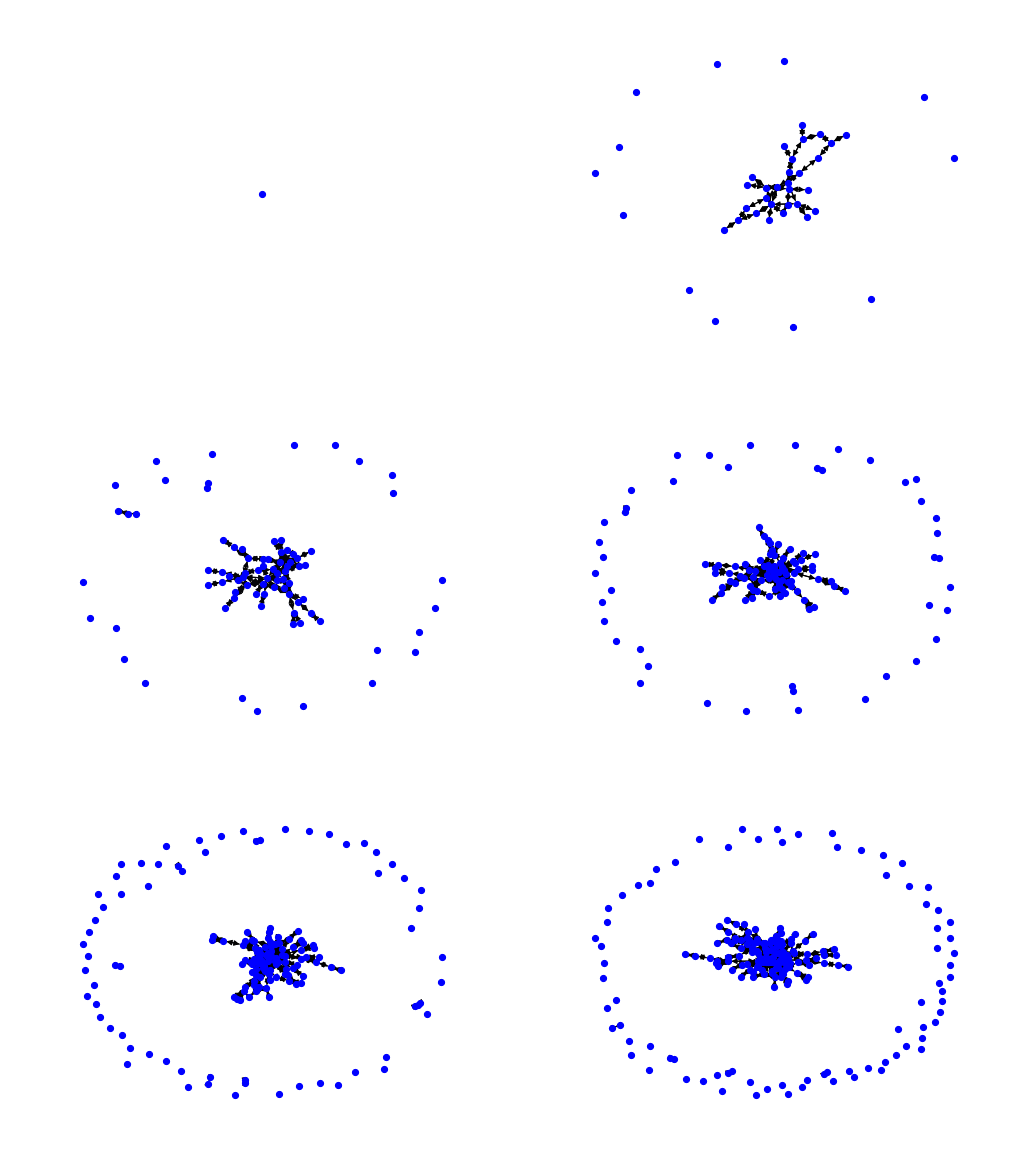 The full source code for this example can be found [here](randomly_growing_network_demo2.py).
For more information, see:
> Jackson, M. O. (2010). Social and economic networks. Princeton university press. Chapter 5, "Growing Random Networks"
> Callaway, D. S., Hopcroft, J. E., Kleinberg, J. M., Newman, M. E., & Strogatz, S. H. (2001). Are randomly grown graphs really random?. Physical Review E, 64(4), 041902.
The full source code for this example can be found [here](randomly_growing_network_demo2.py).
For more information, see:
> Jackson, M. O. (2010). Social and economic networks. Princeton university press. Chapter 5, "Growing Random Networks"
> Callaway, D. S., Hopcroft, J. E., Kleinberg, J. M., Newman, M. E., & Strogatz, S. H. (2001). Are randomly grown graphs really random?. Physical Review E, 64(4), 041902.