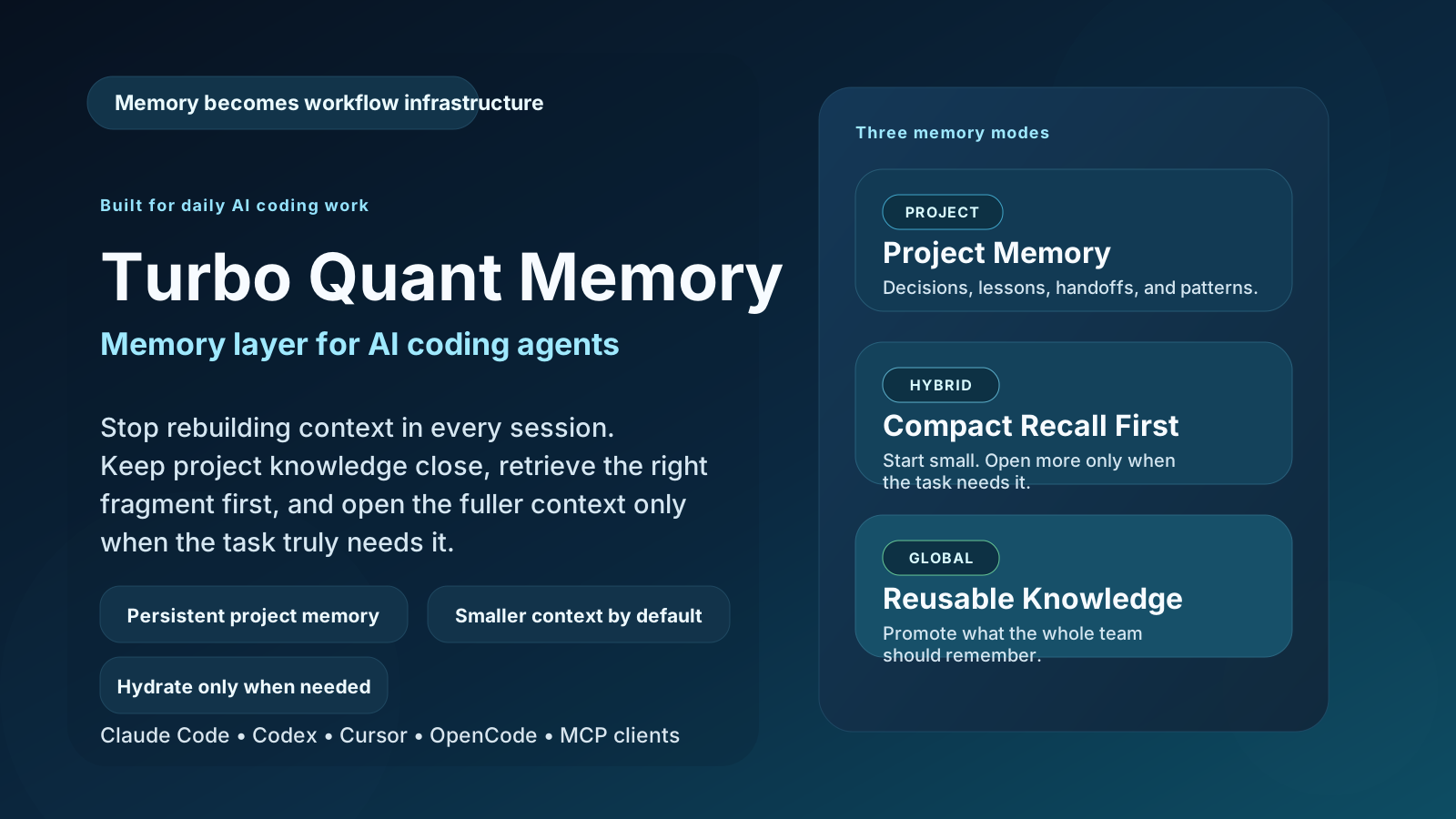
Local-first memory and knowledge graph for AI coding agents
Your agent stops re-reading files and re-deriving the same conclusions.
Your notes, code and secrets never leave your machine.







---
## The problem
A long session accumulates hard-won detail about why the code is the way it is. Then the context compacts and it is gone. Next session the agent re-reads the same files, re-derives the same conclusions, and bills you for the same tokens again.
`CLAUDE.md` does not scale past a few dozen lines, and it cannot answer *"what did we decide about X, and why?"*.
**Turbo Quant Memory** is an MCP server that gives the agent a persistent, searchable store it writes to while it works — decisions, lessons, patterns, session handoffs — plus a compact index of your Markdown. Retrieval returns ~220-character result cards rather than whole documents; the agent loads full content only when a card is not enough.
## Why this one
| | **Turbo Quant Memory** | mem0 / OpenMemory | MCP `memory` server |
| :----------------------- | :------------------------------------ | :----------------------- | :------------------ |
| Where your data lives | your disk, always | vendor cloud or self-host | your disk |
| Your data leaves the host | **never** | yes, unless self-hosted | never |
| Retrieval | hybrid BM25 + dense vector, RRF-fused | dense vector | exact graph lookup |
| What a search returns | compact cards, hydrate on demand | full memories | full nodes |
| Knowledge graph | yes — with lifecycle + linting | no | yes |
| Non-English content | Cyrillic exact-match out of the box | varies | n/a |
| Measures its own savings | **yes — `server_info()`** | no | no |
| Price | free, MIT | paid tiers | free |
No HTTP client, no telemetry, no phone-home. Verify it yourself — this returns nothing:
```bash
grep -rnE '^[[:space:]]*(import|from)[[:space:]]+(requests|httpx|aiohttp|urllib3)\b' src/
```
To be precise about the one exception: on first run `fastembed` downloads the embedding model (~0.22 GB) from Hugging Face. After that the server runs fully offline. Your notes, code and secrets are never transmitted anywhere — there is nothing in the package that could send them.
## Install
### Let your agent install it
Paste this into Claude Code, Codex, Gemini CLI, Cursor or Antigravity:
> Install and configure the Turbo Quant Memory MCP server for this workspace from
> https://github.com/Lexus2016/turbo_quant_memory — follow the README, register the
> `tqmemory` server, run `turbo-memory-mcp skill install`, run the health check, and
> index this project.
`skill install` copies an operating manual into every agent skill directory on the machine, so every future session already knows how to use the memory without being told.
### Or install it yourself
```bash
uv tool install turbo-quant-memory
```
Then register the server with your client:
```bash
claude mcp add --scope project tqmemory -- turbo-memory-mcp serve # Claude Code
codex mcp add tqmemory -- turbo-memory-mcp serve # Codex
gemini mcp add tqmemory turbo-memory-mcp serve # Gemini CLI
```
Cursor, OpenCode, Antigravity and other clients → [CLIENT_INTEGRATIONS.md](CLIENT_INTEGRATIONS.md).
Hermes runs MCP through a systemd gateway → [docs/hermes.md](docs/hermes.md).
### 📈 It measures its own savings — see for yourself
Turbo Quant Memory doesn't just *claim* to save tokens — every install keeps a running tally you can read anytime with `server_info()` (field `usage_stats.headline`). The savings are yours to verify, not ours to promise.
**Live snapshot from a real developer instance (v0.28.2):**
| What the memory did | Number |
| :--- | :--- |
| 🔢 Input tokens saved (cumulative) | **≈ 2,640,000** and counting |
| 🔁 Retrievals served | **2,280** searches + **280** deep hydrations |
| 📉 Average saved per retrieval | **≈ 1,200 tokens** |
| 📚 Knowledge under management | **237** active notes + **763** indexed code blocks |
| 🛡️ Integrity | **0** corrupted records · **0** pending migrations |
> These are one machine's cumulative numbers, not a synthetic benchmark — your own counter starts at zero and grows as your agent works. Run `server_info()` on your install to see your real figure.
## What it does
* **Typed notes.** `decision`, `lesson`, `pattern`, `handoff` — each stored with tags, provenance and a knowledge-graph link to the file or issue it is about.
* **Tiered memory.** `durable` (decisions, patterns) and `reference` (indexed docs) are searched by default; `episodic` (session handoffs) stays out of the way until you ask for it, so yesterday's noise never buries an architectural decision.
* **Hybrid retrieval.** A dense vector lane leads; a BM25 lane rescues exact terms — function names, file paths, IDs — fused with Reciprocal Rank Fusion. Cyrillic and other non-English terms match exactly, case- and accent-insensitive, with no configuration.
* **Knowledge graph.** Directed, timestamped relations between notes, files and issues. Search results carry the linked context inline, so the agent does not need a second lookup.
* **Human notes outrank agent notes.** Anything you explicitly asked to remember is flagged `human-explicit` and ranks above the agent's own observations at equal relevance.
* **Encrypted secrets vault.** Project-scoped, AES-256-GCM, structurally unreachable from search. → [docs/secrets-vault.md](docs/secrets-vault.md)
* **Runs on a small machine.** The default embedder is ONNX via fastembed — no PyTorch, ~0.22 GB model, comfortable on 2 GB of RAM.
Full technical detail → [docs/features.md](docs/features.md)
## The 19 MCP tools
| Group | Tools |
| :--- | :--- |
| Write | `remember_note` · `deprecate_note` · `promote_note` · `index_paths` |
| Read | `semantic_search` · `hydrate` · `recent_context` · `list_scopes` |
| Graph | `link_entities` · `unlink_entities` · `get_related_entities` |
| Hygiene | `lint_knowledge_base` · `health` · `self_test` · `server_info` |
| Vault | `set_secret` · `get_secret` · `list_secrets` · `delete_secret` |
## Documentation
| | |
| :--- | :--- |
| [MEMORY_STRATEGY.md](MEMORY_STRATEGY.md) | How to actually use the memory day to day |
| [CLIENT_INTEGRATIONS.md](CLIENT_INTEGRATIONS.md) | Per-client setup: Cursor, OpenCode, Antigravity, … |
| [TECHNICAL_SPEC.md](TECHNICAL_SPEC.md) | Architecture and storage format |
| [docs/features.md](docs/features.md) | Retrieval, graph, tiers, embedder, FTS language |
| [docs/secrets-vault.md](docs/secrets-vault.md) | Vault setup, threat model, FAQ |
| [docs/hermes.md](docs/hermes.md) | Hermes gateway setup and troubleshooting |
| [CHANGELOG.md](CHANGELOG.md) | Release history |
## License
[MIT](LICENSE). Copy it, modify it, fork it, ship it inside a closed-source product, sell it. Attribution is the only condition.
## Languages
🇺🇸 [English](README.md) · 🇺🇦 [Українська](README.uk.md) · 🇷🇺 [Русский](README.ru.md)