---
title: Rate Limiting
---
# Rate Limiting
Rate limiting protects workers from being overwhelmed by too many concurrent requests. SMG uses a token bucket algorithm with optional request queuing.
---
## Overview
### :material-bucket: Token Bucket
Smooth rate limiting with burst capacity using the token bucket algorithm.
### :material-tray-full: Request Queuing
Queue excess requests instead of rejecting them immediately.
### :material-timer-outline: Configurable Timeouts
Bound request and queue wait times to maintain system responsiveness.
### :material-chart-line: Observable
Full Prometheus metrics for queue depth, wait times, and rejection rates.
---
## Why Rate Limit?
Without rate limiting:
1. **Worker overload**: Too many concurrent requests degrade performance
2. **Memory exhaustion**: Workers run out of GPU memory
3. **Cascading timeouts**: Slow responses cause client timeouts
4. **Poor user experience**: Some users get fast responses, others wait forever
Rate limiting ensures **fair access** and **predictable performance**.
---
## How It Works
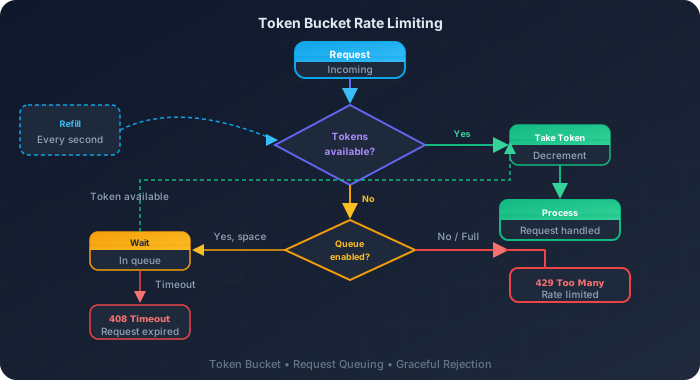
SMG uses a **token bucket** algorithm:
### Token Bucket
- **Bucket capacity**: Maximum concurrent requests (`--max-concurrent-requests`)
- **Refill rate**: Tokens added per second (`--rate-limit-tokens-per-second`)
- **Request cost**: Each request consumes one token
### Request Queue
When no tokens are available, requests can wait in a queue:
- **Queue size**: Maximum waiting requests (`--queue-size`)
- **Queue timeout**: Maximum wait time (`--queue-timeout-secs`)
---
## Configuration
```bash
smg \
--worker-urls http://w1:8000 http://w2:8000 \
--max-concurrent-requests 100 \
--rate-limit-tokens-per-second 50 \
--queue-size 200 \
--queue-timeout-secs 30
```
### Rate Limit Parameters
| Parameter | Default | Description |
|-----------|---------|-------------|
| `--max-concurrent-requests` | `-1` (disabled) | Token bucket capacity. When `<= 0` the limiter is disabled entirely and requests pass through. |
| `--rate-limit-tokens-per-second` | unset (refills at `max_concurrent_requests`) | Token bucket refill rate in tokens per second. |
| `--queue-size` | `100` | Maximum queued requests |
| `--queue-timeout-secs` | `60` | Maximum queue wait time |
### Timeout Parameters
| Parameter | Default | Description |
|-----------|---------|-------------|
| `--request-timeout-secs` | `1800` (30 min) | Maximum time for a request to complete |
| `--queue-timeout-secs` | `60` | Maximum time a request waits in queue |
| `--worker-startup-timeout-secs` | `1800` (30 min) | Timeout for worker startup/model loading |
!!! note "Concurrency vs. Rate Limiting"
Setting `--max-concurrent-requests` alone creates a token bucket whose capacity *and* refill rate both equal `max_concurrent_requests`, so it enforces both burst capacity and a sustained rate. Set `--rate-limit-tokens-per-second` when you want the sustained rate to differ from the burst capacity (for example, capacity `100` with refill `50` allows short bursts of 100 while sustaining 50 req/s).
---
## Response Codes
| Code | Meaning | When |
|------|---------|------|
| **429** | Too Many Requests | Queue is full, or queuing is disabled and no token is available |
| **408** | Request Timeout | Queue wait exceeded timeout |
The local rate limiter returns a status-only response with no JSON body (clients should read the HTTP status and `X-Request-Id` to distinguish cases). SMG does not currently emit a `Retry-After` header with the response.
When the mesh global rate limit is enabled and exceeded, the 429 response carries a JSON body:
```json
{
"error": "Rate limit exceeded",
"current_count": 123,
"limit": 100
}
```
---
## Sizing Guidelines
### Concurrent Requests
Base on worker capacity:
```
max_concurrent_requests = num_workers × requests_per_worker
```
| Worker Type | Requests per Worker |
|-------------|---------------------|
| Small GPU (16GB) | 4-8 |
| Medium GPU (40GB) | 8-16 |
| Large GPU (80GB) | 16-32 |
### Queue Size
Base on acceptable latency:
```
queue_size = max_concurrent_requests × queue_depth_factor
```
| Latency Tolerance | Queue Depth Factor |
|-------------------|-------------------|
| Low (interactive) | 0.5-1x |
| Medium (batch) | 2-4x |
| High (async) | 4-8x |
### Token Refill Rate
Base on sustainable throughput:
```
tokens_per_second = expected_requests_per_second × 1.2
```
The 1.2 factor provides headroom for bursts.
---
## Example Configurations
=== "Interactive API"
Low latency, reject excess traffic:
```bash
smg \
--max-concurrent-requests 50 \
--queue-size 25 \
--queue-timeout-secs 5
```
=== "Batch Processing"
Higher throughput, longer queues:
```bash
smg \
--max-concurrent-requests 200 \
--queue-size 500 \
--queue-timeout-secs 60
```
=== "No Rate Limiting"
Trust upstream rate limiting:
```bash
smg \
--max-concurrent-requests -1
```
---
## Monitoring
### Metrics
| Metric | Description |
|--------|-------------|
| `smg_http_rate_limit_total` | Rate limit decisions by result (allowed/rejected) |
| `smg_http_request_duration_seconds` | Request duration histogram |
### Useful PromQL Queries
#### Rate Limit Decisions
```promql
# Rate limit decisions per second
rate(smg_http_rate_limit_total[5m])
# By decision type (allowed/rejected)
sum by (result) (
rate(smg_http_rate_limit_total[5m])
)
```
#### Request Duration
```promql
# 99th percentile request duration
histogram_quantile(0.99,
rate(smg_http_request_duration_seconds_bucket[5m]))
```
### Alert Thresholds
| Metric | Warning | Critical | Action |
|--------|---------|----------|--------|
| Queue utilization | >70% | >90% | Increase queue size or capacity |
| Rejection rate | >5% | >20% | Increase limits or scale workers |
| Avg queue wait | >10s | >30s | Reduce load or increase capacity |
| Queue timeouts | >1/min | >10/min | Investigate bottlenecks |
---
## Client-Side Handling
### Retry Strategy
Clients should implement exponential backoff when receiving 429. SMG does not set a `Retry-After` header today, so clients must compute their own wait:
```python
import time
import requests
def request_with_retry(url, data, max_retries=5):
for attempt in range(max_retries):
response = requests.post(url, json=data)
if response.status_code == 429:
# SMG does not emit Retry-After; fall back to exponential backoff.
time.sleep(2 ** attempt)
continue
return response
raise Exception("Max retries exceeded")
```
### Adaptive Rate
Monitor 429 responses and adjust request rate:
```python
class AdaptiveClient:
def __init__(self, base_rate=10):
self.rate = base_rate
def on_success(self):
self.rate = min(self.rate * 1.1, 100) # Increase slowly
def on_rate_limit(self):
self.rate = self.rate * 0.5 # Decrease quickly
```
---
## What's Next?
### :material-electric-switch: Circuit Breakers
Isolate failing workers to prevent cascade failures.
[Circuit Breakers →](circuit-breakers.md)
### :material-refresh: Retries
Automatic retry with exponential backoff for transient failures.
[Retries →](retries.md)
### :material-heart-pulse: Health Checks
Proactive worker monitoring and failure detection.
[Health Checks →](health-checks.md)
### :material-chart-box: Metrics Reference
Complete list of rate limiting metrics.
[Metrics Reference →](../../reference/metrics.md)