# lcc — Local Context Compiler **Compact coding-agent context without summarizing it away.**
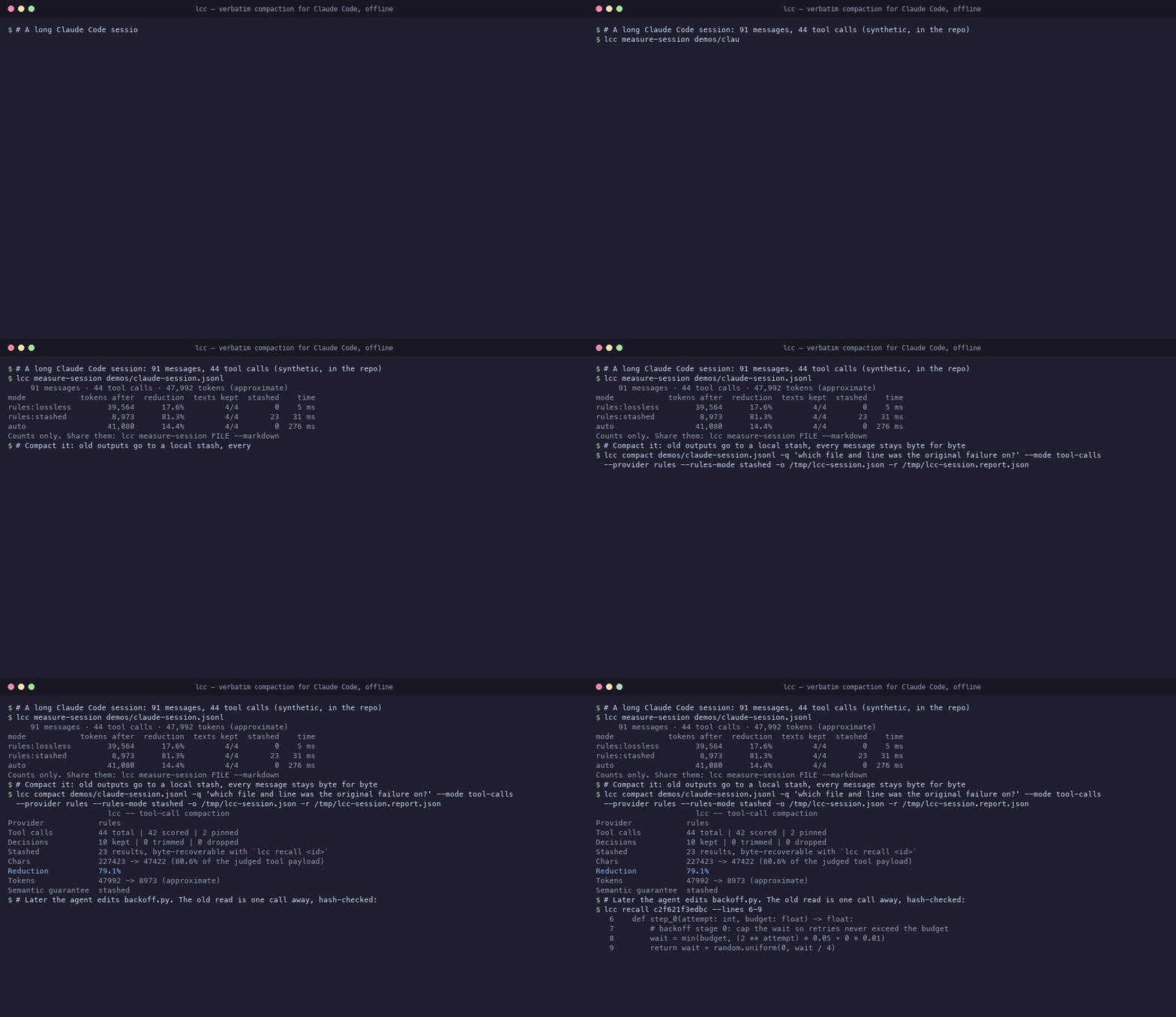
lcc cuts what the model does not need, keeps everything else byte for byte, and writes a receipt. [![PyPI](https://img.shields.io/pypi/v/local-context-compiler.svg)](https://pypi.org/project/local-context-compiler/) [![Python](https://img.shields.io/pypi/pyversions/local-context-compiler.svg)](https://pypi.org/project/local-context-compiler/) [![CI](https://github.com/lucasmartins-ai/lcc/actions/workflows/ci.yml/badge.svg)](https://github.com/lucasmartins-ai/lcc/actions/workflows/ci.yml) [![MIT](https://img.shields.io/badge/license-MIT-blue.svg)](LICENSE) [![GitHub stars](https://img.shields.io/github/stars/lucasmartins-ai/lcc?style=social)](https://github.com/lucasmartins-ai/lcc/stargazers) lcc measure-session on a 91-message Claude Code session, then lcc compact with the stashed mode, then lcc recall returning the exact lines of a removed file read

## `/compact` vs lcc Claude Code's `/compact` replaces your session with a summary written by a model. Summaries drop the exact error, path or line the agent needs two turns later. lcc does the opposite: old tool outputs leave the context but stay one `recall` away, and every user and assistant message is kept as it was. | One real Claude Code session (193 messages, 75 tool calls) | tokens | user and assistant messages | removed tool outputs | | --- | ---: | --- | --- | | before | 57,083 | 43, as written | — | | `/compact` | one summary | rewritten into the summary | gone | | **lcc** (`rules`, `stashed`) | **28,807 (−49.5%)** | **43 / 43 byte for byte** | 33, each one `recall` away | Measured with `lcc measure-session` (PyPI 1.2.0, offline, exact `o200k_base` token count; re-run 2026-10-23). On `main`, whose stash note now states lines and size, the same session gives 28,983 (−49.2%). That session is one of the best cases. **Across all 299 of my long sessions** (100+ messages each, 36.3 M tokens) the median cut was **21.8%** (middle half 15% to 31%, best 65%), with 0 messages lost (`python benchmarks/research/long_sessions.py`, 2026-10-23, `main`). These are all my sessions: [run it on yours](#send-us-your-numbers) and post the result. In a pre-registered test on 172 real requests ([evidence](docs/EVIDENCE.md)), an agent answering from the `stashed` context plus `recall` did as well as with the full context on file recall (+0.006, 95% CI −0.023 to +0.034) with 36.6% fewer tokens. It called `recall` for 90% of the questions about removed content. A `/compact`-style summary of the same sessions got 73% of exact values right (our reimplementation of `/compact`, written by Opus); full and verbatim context got 98%. ## Install ```sh pip install "local-context-compiler[tiktoken]" # the CLI is `lcc` lcc measure-session "$(ls -t ~/.claude/projects/*/*.jsonl | head -1)" # your latest session ``` The second line reads your most recent Claude Code session, runs every mode offline and prints counts only. Nothing is changed and nothing leaves the machine. **Claude Code plugin** (replaces the `/compact` summary). Function hooks are early access, so this needs **Claude Code 2.1.274+ and the flag below**: ```sh export CLAUDE_CODE_ENABLE_FUNCTION_HOOKS=1 claude plugin marketplace add lucasmartins-ai/lcc claude plugin install lcc@lcc --config provider=rules --config rulesMode=stashed ``` Allow `mcp__plugin_lcc_lcc__recall` so the agent can get removed outputs back. When a pass fails or removes too little, the plugin hands over to the built-in summary and says so in a toast. Details: [Claude Code guide](docs/CLAUDE_CODE.md). **MCP** (Claude Code, Cursor, Claude Desktop, any stdio client): ```json {"mcpServers": {"lcc": {"command": "lcc", "args": ["mcp"]}}} ``` Tools: `compact`, `compact_transcript`, `recall`, `inspect`, `prepare`, `explain`, `intake` ([MCP guide](docs/MCP.md)). **CLI**, on a session file or any document: ```sh lcc compact ~/.claude/projects//.jsonl -q "finish the parser fix" \ --mode tool-calls --provider rules --rules-mode stashed -o compacted.json -r report.json lcc recall # a removed output, hash-checked lcc compact notes.md -q "what is wrong with the booking flow?" \ --provider mechanical -o compacted.md -r report.json lcc explain report.json --source notes.md # why each block was kept or dropped ``` ## Send us your numbers ```sh lcc measure-session ~/.claude/projects//.jsonl --markdown # Codex CLI rollouts are auto-detected from their session_meta record: lcc measure-session /path/to/rollout.jsonl --markdown # or a whole project directory: per-mode median and p90 reduction over its sessions lcc measure-session ~/.claude/projects// --markdown ``` It runs every mode on one of your sessions, offline, and prints **counts only**: messages, tool calls, tokens before and after, messages kept, time. No text, path or tool output. For exact counts, install the `tiktoken` extra and cache its tokenizer once (lcc itself never downloads): `python -c "import tiktoken; tiktoken.get_encoding('o200k_base')"`. Otherwise the report says `approximate` and why. Paste it in [Discussions → Results](https://github.com/lucasmartins-ai/lcc/discussions/categories/results). Add `--input-map` to see where the session's billed input goes instead: cache reads and writes, and the share taken by tool results, tool-call inputs, injected instructions and the fixed system prompt and tool schemas (counts only, from the usage records in the file). Already compacting with lcc? `lcc share-stats` turns your local reports into the same kind of counts-only summary ([SHARE_STATS.md](docs/SHARE_STATS.md)), or use the [results issue form](https://github.com/lucasmartins-ai/lcc/issues/new?template=results.yml). Every number from someone other than me makes the claims above less mine and more true. ## Why lcc - **Verbatim.** Kept spans are byte-identical to the source. Nothing is summarized or rewritten. - **Recoverable.** `stashed` moves removed outputs to a local content-addressed store (`~/.cache/lcc/stash`); `recall` re-hashes on read. The placeholder, `[removed: 120 lines, 4.3 KB · lcc recall ]`, states lines and size, not tokens, so it is identical on every machine. - **Auditable.** Every pass writes a JSON report; `lcc explain` gives the reason for every drop. - **Local.** The default judges run on your CPU in plain Python. No API key, no network. ## Providers | Provider | Runs | When it is used | Report says | | --- | --- | --- | --- | | `specialist-v3` | local, CPU | default (`auto`) whenever transcript blocks are present: the Claude Code hook, `compact_transcript`, `--mode tool-calls` | `semantic_guarantee: none` (a rank, not a judgment) | | `mechanical` | local, CPU | `--provider mechanical`; plain text under `auto` (a configured TypeSafe key does not change that unless `LCC_AUTO_REMOTE=1`) | `semantic_guarantee: none` | | `rules` (`lossless`, `recoverable`, `stashed`) | local, no model | `provider: rules` for transcripts | `lossless`: only provable duplicates removed; `recoverable`: also outputs that can be re-read; `stashed` (recommended): removed outputs stay byte-recoverable through `recall` | | `jev` | remote (TypeSafe API) | opt-in: `--provider jev` / `provider: jev`, needs `TYPESAFE_API_KEY` | semantic judgment or explicit degradation | | `laya` | local model | deprecated; runs only when named | named model and fallback state | `specialist-v3` details and limits: [SPECIALIST.md](docs/SPECIALIST.md). Rules modes: [TOOL_CALLS.md](docs/TOOL_CALLS.md). Jev is an optional path you name explicitly (`--provider jev`); it sends the objective and context blocks to the TypeSafe API, and `LCC_DISABLE_NETWORK=1` disables it. `auto` never picks it on its own: having a key is not consent to send context off-machine, so plain text under `auto` stays on `mechanical` unless you set `LCC_AUTO_REMOTE=1`. `compact` writes a `relevance-compaction-1.2` report; check `provider_used` and `degraded` before trusting the output. ## Benchmarks **Real sessions (held-out, INFERIDO).** In plain words: when a ranker has to drop part of a session, how often does it keep what the agent actually used next? 1.0 would be always. A one-shot final test on 193 items from 36 of the maintainer's sessions that started after the training cutoff. Retention AUC over drop budgets of 0–60% of candidate tokens: | ranker | recall AUC | all-kept AUC | | --- | ---: | ---: | | specialist-v3 | **0.899** | **0.434** | | mechanical | 0.829 | 0.238 | | recency | 0.818 | 0.306 | | bm25 | 0.803 | 0.270 | | random | 0.689 | 0.138 | The labels are next-action evidence from one maintainer's Claude Code sessions, which favours v3's training target. The sessions are private; only aggregates are published ([SPECIALIST.md](docs/SPECIALIST.md)). **Synthetic, reproducible** (`python benchmarks/run_judge_bench.py`, about 20 s, no network). Nine hand-written edge cases: supersession, contradiction, config change, exception rule, pt/en mixed, prompt injection in a tool output, large git diff, old root cause, re-read. | raw ranking | specialist-v3 | mechanical | bm25 | recency | | --- | ---: | ---: | ---: | ---: | | cases with every must-keep block kept at a 30 / 50 / 70% cut (of 9) | 8 / 7 / 7 | 9 / 9 / 9 | 9 / 9 / 7 | 8 / 6 / 3 | | full pass, default settings | must-keep kept | 302 blocks | 1,138 blocks | peak RSS | | --- | ---: | ---: | ---: | ---: | | `specialist-v3`, tool-call mode | 9/9 | 181 ms | 3.4 s | 71 MB | | `rules` lossless | 9/9 | 2 ms | 16 ms | 55 MB | These cases are lexically easy, so the lexical baselines do well; v3 misses the Portuguese case. Timings are from macOS arm64 under heavy machine load. Method, every arm and the limits: [BENCHMARKS.md](docs/BENCHMARKS.md). Rules modes on real sessions: [REAL_SESSION_BENCHMARKS.md](docs/REAL_SESSION_BENCHMARKS.md). Reduction depends on how much of a context is noise. Below a 25% gain, the report marks the pass as not worth it, and the Claude Code plugin keeps the built-in summary. ## What it does not do - It does not check that a model will answer correctly. A structural `PASS` is not an answer quality result. - No RAG, embeddings or vector store. - Protection rules and bounded restoration reduce, but do not rule out, lost evidence; see the [safety model](docs/adr/0014-minimum-sufficient-context.md). - `specialist-v3` was trained on Claude Code transcripts. Other agents and plain documents are out of distribution; plain text uses `mechanical` unless you opt in to Jev. ## Docs | Topic | Link | | --- | --- | | Five-minute tour of the CLI | [QUICKSTART.md](docs/QUICKSTART.md) | | Claude Code plugin | [CLAUDE_CODE.md](docs/CLAUDE_CODE.md) | | MCP server | [MCP.md](docs/MCP.md) | | Tool-call compaction and rules modes | [TOOL_CALLS.md](docs/TOOL_CALLS.md) | | Aider chat history as input | [AIDER.md](docs/AIDER.md) | | The local ranker | [SPECIALIST.md](docs/SPECIALIST.md) | | Benchmarks | [BENCHMARKS.md](docs/BENCHMARKS.md), [REAL_SESSION_BENCHMARKS.md](docs/REAL_SESSION_BENCHMARKS.md), [benchmarks/](benchmarks/README.md) | | Python API (`lcc.msi.compile`) | [msi-api.md](docs/lcc/msi-api.md) | | Architecture and decisions | [architecture.md](docs/architecture.md), [ADR 0010](docs/adr/0010-deterministic-first-preparation-model-assistance.md), [ADR index](docs/adr/README.md) | | Opt-in and deprecated providers | [JEV.md](docs/JEV.md), [LAYA.md](docs/LAYA.md) | | Research archive | [paper.md](research/paper.md), [results-master.md](research/results-master.md), [TRANSCRIPT_AB.md](benchmarks/research/TRANSCRIPT_AB.md) | | Privacy | [PRIVACY_POLICY.md](docs/PRIVACY_POLICY.md) | ## Development Python 3.11+. ```sh python -m pip install -e '.[dev,tiktoken]' pytest -q && ruff check . && mypy npm test # Node API and hook tests python benchmarks/run_judge_bench.py --check --out /tmp/judge-bench ``` The PyPI package named `lcc` is unrelated; this one is `local-context-compiler`. Contributing: [CONTRIBUTING.md](CONTRIBUTING.md). Security: [SECURITY.md](SECURITY.md). Changes: [CHANGELOG.md](CHANGELOG.md). ## License [MIT](LICENSE). The optional Laya integration carries Apache-2.0 attribution in [NOTICE](NOTICE). Maintained by [LookADev](https://lookadev.com).