
**Declarative deep learning framework for LLMs, multimodal models, and tabular AI.**
[](https://badge.fury.io/py/ludwig)
[](https://discord.gg/CBgdrGnZjy)
[](https://hub.docker.com/r/ludwigai)
[](https://pepy.tech/project/ludwig)
[](https://github.com/ludwig-ai/ludwig/blob/main/LICENSE)
[](https://twitter.com/ludwig_ai)
[**Docs**](https://ludwig.ai) · [**Getting Started**](https://ludwig.ai/latest/getting_started/) · [**Examples**](https://ludwig.ai/latest/examples) · [**Discord**](https://discord.gg/CBgdrGnZjy)
______________________________________________________________________
## What is Ludwig?
Ludwig is a **declarative deep learning framework** that lets you train, fine-tune, and deploy AI models — from LLM fine-tuning to tabular classification — using a YAML config file and zero boilerplate Python.
```yaml
# Fine-tune Llama-3.1 with LoRA in one config file
model_type: llm
base_model: meta-llama/Llama-3.1-8B
adapter:
type: lora
trainer:
type: finetune
epochs: 3
input_features:
- name: instruction
type: text
output_features:
- name: response
type: text
```
```bash
ludwig train --config model.yaml --dataset my_data.csv
```
**Tech stack:** Python 3.12 · PyTorch 2.7+ · Pydantic 2 · Transformers 5 · Ray 2.54
Ludwig is hosted by the [Linux Foundation AI & Data](https://lfaidata.foundation/).
______________________________________________________________________
## What's New in Ludwig 0.16
| Feature | Description |
| ------------------------------- | ------------------------------------------------------------------------------------------------------ |
| **PatchTST & N-BEATS encoders** | State-of-the-art timeseries forecasting encoders with MASE/sMAPE metrics |
| **Advanced PEFT adapters** | PiSSA, EVA, CorDA/LoftQ initializers; TinyLoRA, OFT, HRA, WaveFT, LN-Tuning, VBLoRA, C3A adapter types |
| **VLM fine-tuning** | Train LLaVA, Qwen2-VL, InternVL via `is_multimodal: true` with gated cross-attention |
| **HyperNetwork combiner** | Conditioning-based feature fusion — one feature generates weights for others |
| **Nash-MTL & Pareto-MTL** | Game-theoretic and preference-based multi-task loss balancing |
| **LLM config generation** | `ludwig generate_config "describe your task"` — LLM writes the YAML for you |
| **ModelInspector** | Architecture analysis, weight collection, feature importance proxy |
| **Ray Serve & KServe** | Distributed and Kubernetes-native model deployment shims |
| **GRPO alignment** | Reward-model-free RLHF via Group Relative Policy Optimization |
| **torchao quantization + QAT** | PyTorch-native `int4/int8/float8` with Quantization-Aware Training |
| **Multi-adapter PEFT** | Multiple named LoRA adapters with weighted merging (TIES, DARE, SVD) |
| **Native Optuna executor** | GPT/TPE/CMA-ES samplers, pruning, resumable SQLite/PostgreSQL storage |
| **Timeseries forecasting** | `model.forecast(dataset, horizon=N)` API with `TimeseriesOutputFeature` |
| **Muon & ScheduleFreeAdamW** | New optimizers for large-scale pretraining and fine-tuning |
| **Image segmentation decoders** | UNet, SegFormer, FPN decoders for semantic segmentation |
______________________________________________________________________
## Installation
```bash
pip install ludwig # core
pip install ludwig[full] # all optional dependencies
pip install ludwig[llm] # LLM fine-tuning only
```
Requires Python 3.12+. See [contributing](https://github.com/ludwig-ai/ludwig/blob/main/CONTRIBUTING.md) for a full dependency matrix.
______________________________________________________________________
## Quick Start
### Fine-tune an LLM (instruction tuning)
[](https://colab.research.google.com/drive/1c3AO8l_H6V_x37RwQ8V7M6A-RmcBf2tG?usp=sharing)
Ludwig supports the full LLM fine-tuning spectrum:
| Technique | Config key |
| --------------------------------- | ------------------------------------------------------------------------ |
| Supervised fine-tuning (SFT) | `trainer.type: finetune` |
| DPO / KTO / ORPO / GRPO alignment | `trainer.type: dpo` (or `kto`, `orpo`, `grpo`) |
| LoRA / DoRA / VeRA / PiSSA | `adapter.type: lora` (or `dora`, `vera`, `lora` + `init_weights: pissa`) |
| 4-bit QLoRA (bitsandbytes) | `quantization.bits: 4` |
| torchao + QAT | `quantization.backend: torchao` |
| Multi-adapter with merging | `adapters:` dict + `merge:` block |
| VLM (vision-language) | `is_multimodal: true` |
```yaml
model_type: llm
base_model: meta-llama/Llama-3.1-8B
quantization:
bits: 4
adapter:
type: lora
prompt:
template: |
### Instruction: {instruction}
### Input: {input}
### Response:
input_features:
- name: prompt
type: text
output_features:
- name: output
type: text
trainer:
type: finetune
learning_rate: 0.0001
batch_size: 1
gradient_accumulation_steps: 16
epochs: 3
learning_rate_scheduler:
decay: cosine
warmup_fraction: 0.01
backend:
type: local
```
```bash
export HUGGING_FACE_HUB_TOKEN=""
ludwig train --config model.yaml --dataset "ludwig://alpaca"
```
### Train a multimodal classifier
```yaml
input_features:
- name: review_text
type: text
encoder:
type: bert
- name: star_rating
type: number
- name: product_image
type: image
encoder:
type: dinov2
output_features:
- name: recommended
type: binary
```
```bash
ludwig train --config model.yaml --dataset reviews.csv
```
### Generate a config from natural language
```bash
ludwig generate_config "I have a CSV with age, income, education level, and I want to predict loan default"
```
### Make predictions
```bash
ludwig predict --model_path results/experiment_run/model --dataset new_data.csv
```
### Launch a REST API
```bash
ludwig serve --model_path results/experiment_run/model
# POST http://localhost:8000/predict
```
______________________________________________________________________
## Capabilities
LLM Fine-Tuning
- **Supervised fine-tuning (SFT)** on instruction/response pairs
- **Alignment training**: DPO, KTO, ORPO, GRPO (reward-model-free RLHF)
- **PEFT adapters**: LoRA, DoRA, VeRA, LoRA+, TinyLoRA, OFT, HRA, WaveFT, LN-Tuning, VBLoRA, C3A
- **LoRA initializers**: PiSSA, EVA, CorDA, LoftQ for improved convergence
- **Multi-adapter PEFT**: multiple named adapters on one base model, switchable at runtime; merge with TIES, DARE, SVD, magnitude pruning
- **Quantization**: 4-bit/8-bit QLoRA (bitsandbytes), torchao int4/int8/float8 with QAT
- **VLM fine-tuning**: LLaVA, Qwen2-VL, InternVL via `is_multimodal: true`
- **Sequence packing** for efficient training on variable-length inputs
- **Paged and 8-bit optimizers** for memory-efficient training
Multimodal & Tabular Models
- **Input modalities**: text, numbers, categories, binary, sets, bags, sequences, images, audio, timeseries, vectors, dates
- **Text encoders**: any HuggingFace Transformer (BERT, RoBERTa, ModernBERT, Qwen3, Llama-3.1, etc.), plus Mamba-2, Jamba
- **Image encoders**: DINOv2, ConvNeXt, EfficientNet, ViT, CAFormer, ConvFormer, PoolFormer, TIMM (1000+ models)
- **Timeseries encoders**: PatchTST, N-BEATS, CNN, RNN, Transformer; MASE and sMAPE metrics; `model.forecast()` API
- **Combiners**: concat, transformer, tab_transformer, FT-Transformer, TabNet, TabPFN v2, HyperNetwork, ProjectAggregate, GatedFusion, Perceiver
- **Multi-task learning**: multiple output features in a single model; Nash-MTL, Pareto-MTL, FAMO, GradNorm, uncertainty loss balancing
- **Image segmentation**: UNet, SegFormer, FPN decoders
Training Infrastructure
- **Distributed training**: HuggingFace Accelerate with DDP, FSDP, DeepSpeed (zero-code changes)
- **Ray backend**: training across a Ray cluster, larger-than-memory datasets via Ray Data
- **Automatic batch size selection** and learning rate range test
- **Mixed precision** (fp16/bf16), gradient checkpointing, gradient accumulation
- **Optimizers**: AdamW, Adafactor, SGD, Muon, ScheduleFreeAdamW, Lion, paged/8-bit variants
- **Learning rate schedulers**: cosine, linear, polynomial, reduce-on-plateau, OneCycleLR
- **Model Soup**: uniform and greedy checkpoint averaging for better generalization at zero inference cost
- **Modality dropout** for robust multimodal models
Hyperparameter Optimization
- **Executors**: Ray Tune (ASHA, PBT, Bayesian) and native Optuna (auto/GP/TPE/CMA-ES)
- **Optuna persistence**: SQLite or PostgreSQL for resumable HPO runs
- **Pruning** with Optuna's MedianPruner and HyperbandPruner
- **Search spaces**: uniform, log-uniform, choice, randint, quantized
- **Full Ludwig config** is searchable — any nested parameter can be a hyperparameter
Production & Deployment
- **REST API**: FastAPI server with Prometheus metrics and structured logging (`ludwig serve`)
- **vLLM serving**: OpenAI-compatible API with PagedAttention and continuous batching
- **Ray Serve**: distributed deployment with auto-scaling and traffic splitting
- **KServe**: Kubernetes-native deployment with Open Inference Protocol v2
- **Model export**: SafeTensors (default), `torch.export` `.pt2` bundles, ONNX
- **HuggingFace Hub**: `ludwig upload hf_hub` — push model + auto-generated model card
- **Docker**: prebuilt containers at [ludwigai/ludwig](https://hub.docker.com/u/ludwigai)
Tooling & Integrations
- **Experiment tracking**: TensorBoard, Weights & Biases, Comet ML, MLflow, Aim Stack
- **Model inspection**: `ModelInspector` — weight enumeration, architecture summary, feature importance proxy
- **Visualizations**: learning curves, confusion matrices, calibration plots, ROC curves, hyperopt analysis
- **AutoML**: `ludwig.automl.auto_train()` — give it a dataset and a time budget; the YAML-driven search space samples encoder/combiner/decoder combinations and validates them before training
- **Dataset quality checks**: `from ludwig.utils.dataset_quality import check_dataset_quality` — validates a DataFrame before training (missing values, class imbalance, near-duplicate columns, ID leakage, …)
- **OpenML integration**: load any OpenML task directly — `OpenMLLoader` fetches by task ID and caches locally as Parquet
- **LLM config generation**: `ludwig generate_config "describe your task"` — LLM writes the YAML
- **K-fold cross-validation**: `ludwig experiment --k_fold N`
- **Dataset Zoo**: 70+ built-in benchmark datasets (`ludwig://mnist`, `ludwig://alpaca`, …)
______________________________________________________________________
## Examples
### LLM & Alignment
| Use Case | Link |
| ------------------------------------- | ----------------------------------------------------------------------------------- |
| LLM instruction tuning (LoRA + QLoRA) | [examples/llm](https://ludwig.ai/latest/examples/llm/llm_finetuning) |
| DPO / GRPO alignment | [examples/llm/alignment](https://ludwig.ai/latest/examples/llm/alignment) |
| Advanced PEFT (PiSSA, OFT, VBLoRA, …) | [examples/llms/peft_advanced](https://ludwig.ai/latest/examples/llms/peft_advanced) |
| VLM fine-tuning (LLaVA, Qwen2-VL) | [examples/vlm](https://github.com/ludwig-ai/ludwig/tree/main/examples/vlm) |
### Tabular & Multimodal
| Use Case | Link |
| -------------------------------------- | ------------------------------------------------------------------------------------------------- |
| Binary classification (Titanic) | [examples/titanic](https://ludwig.ai/latest/examples/titanic) |
| Tabular classification (census income) | [examples/adult_census_income](https://ludwig.ai/latest/examples/adult_census_income) |
| Multimodal classification | [examples/multimodal_classification](https://ludwig.ai/latest/examples/multimodal_classification) |
| Multi-task learning | [examples/multi_task](https://ludwig.ai/latest/examples/multi_task) |
### Timeseries & Vision
| Use Case | Link |
| ------------------------------------------ | ----------------------------------------------------------------------------------------- |
| Timeseries forecasting (PatchTST, N-BEATS) | [examples/forecasting](https://ludwig.ai/latest/examples/forecasting) |
| Weather forecasting | [examples/weather](https://ludwig.ai/latest/examples/weather) |
| Image classification (MNIST) | [examples/mnist](https://ludwig.ai/latest/examples/mnist) |
| Semantic segmentation | [examples/semantic_segmentation](https://ludwig.ai/latest/examples/semantic_segmentation) |
### NLP & Audio
| Use Case | Link |
| ------------------------ | --------------------------------------------------------------------------------------- |
| Text classification | [examples/text_classification](https://ludwig.ai/latest/examples/text_classification) |
| Named entity recognition | [examples/ner_tagging](https://ludwig.ai/latest/examples/ner_tagging) |
| Machine translation | [examples/machine_translation](https://ludwig.ai/latest/examples/machine_translation) |
| Speech recognition | [examples/speech_recognition](https://ludwig.ai/latest/examples/speech_recognition) |
| Speaker verification | [examples/speaker_verification](https://ludwig.ai/latest/examples/speaker_verification) |
______________________________________________________________________
## Why Ludwig?
- **Zero boilerplate** — no training loop, no data pipeline, no evaluation code. The YAML config is the entire program.
- **Best-in-class LLM support** — full spectrum from LoRA to GRPO alignment, torchao QAT, and VLM fine-tuning, all in config.
- **Multimodal out of the box** — mix text, images, numbers, audio, and timeseries with one config change.
- **Scale without code changes** — go from laptop → multi-GPU → Ray cluster by changing `backend.type`.
- **Expert control when you need it** — every activation function, scheduler, and optimizer is configurable.
- **Reproducible research** — every run is logged and the full config is saved. Compare experiments with `ludwig visualize`.
______________________________________________________________________
## Publications
- [Ludwig: A Type-Based Declarative Deep Learning Toolbox](https://arxiv.org/pdf/1909.07930.pdf) (2019)
- [Declarative Machine Learning Systems](https://arxiv.org/pdf/2107.08148.pdf) (2021)
- [Ludwig's State-of-the-Art Benchmarks](https://openreview.net/pdf?id=hwjnu6qW7E4)
______________________________________________________________________
## Community
[](https://discord.gg/CBgdrGnZjy)
- [Discord](https://discord.gg/CBgdrGnZjy) — ask questions, share what you've built
- [GitHub Issues](https://github.com/ludwig-ai/ludwig/issues) — bugs and feature requests
- [X / Twitter](https://twitter.com/ludwig_ai) — announcements
- [Medium](https://medium.com/ludwig-ai) — tutorials and deep-dives
 [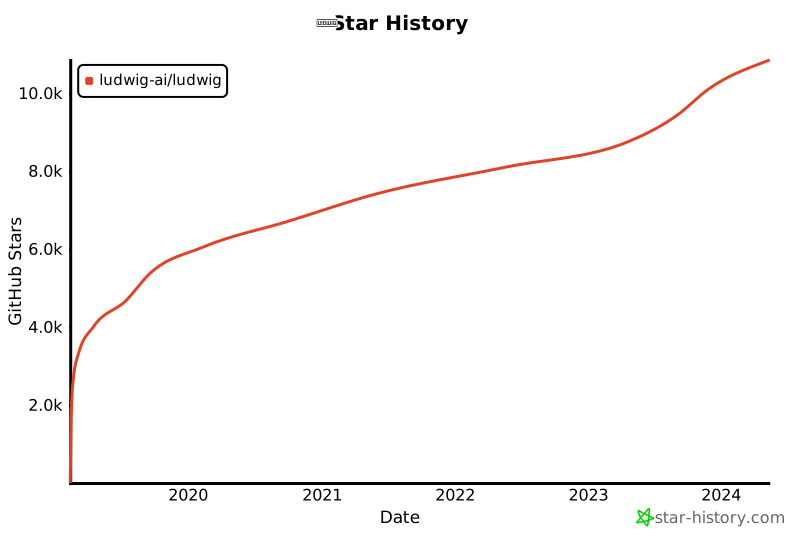](https://star-history.com/#ludwig-ai/ludwig&Date)
[](https://star-history.com/#ludwig-ai/ludwig&Date)