# LLMLL — v0.28.0
**An experiment in letting AI write the code: the compiler proves each function against its contract, and refutes a type-correct but wrong body before it merges.**
LLMLL (Large Language Model Logical Language) is a programming language and verification pipeline built for experiments in which AI agents write code under formal contracts. Its primary author is an LLM agent, not a human: contracts state what a function must do, agents fill typed holes, and the compiler proves each body against its contract with Z3 before the patch is applied. Agents coordinate through those contracts, not through conversation. An agent can *hallucinate* an implementation and that's fine, as long as it satisfies the contract: verification turns hallucination from a failure mode into a search strategy (generate a candidate, check it against the spec, accept or reject).
> **Current version:** see [`CHANGELOG.md § Latest`](CHANGELOG.md#Latest). Full release notes per version live in CHANGELOG; this README does not duplicate them.
> **Learn more:** [`docs/README.md`](docs/README.md) is the reading guide to the documentation · [`ROADMAP.md`](ROADMAP.md) says what has shipped and what is next · [`experiments/README.md`](experiments/README.md) indexes the experiments and their results.
---
## See it: money that can't be created, proven
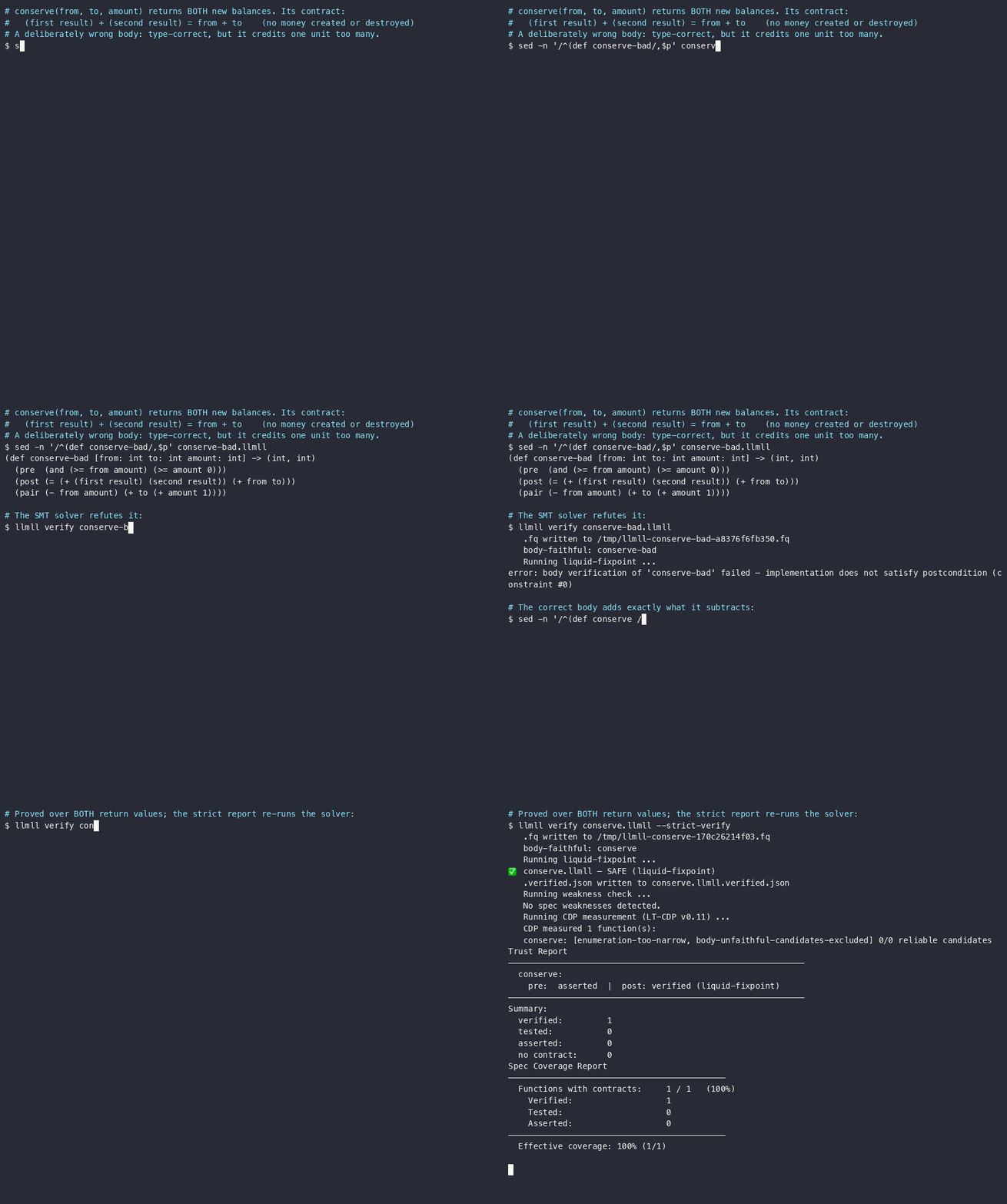
`conserve(from, to, amount)` returns **both** post-transfer balances, and its contract ties them together: `(first result) + (second result) = from + to`: the total is conserved, full stop. A deliberately wrong body that credits the destination one unit extra is **type-correct** and looks harmless on inspection, but it breaks conservation, and the SMT solver refutes it:
```text
# body: (pair (- from amount) (+ to (+ amount 1))) ← type-correct, creates money
$ llmll verify conserve-bad.llmll
error: body verification of 'conserve-bad' failed —
implementation does not satisfy postcondition (constraint #0)
# body: (pair (- from amount) (+ to amount)) ← correct, conserves the sum
$ llmll verify conserve.llmll
✅ conserve.llmll — SAFE (liquid-fixpoint)
```
The proof is over **both** return values at once: a relational invariant, not a bound on one number. The wrong body above is scripted to show the check firing; no agent produced it. Dafny, Liquid Haskell or F\* would refute it too; what LLMLL adds is the loop around the proof, [below](#why-not-have-an-agent-write-dafny-liquid-haskell-or-f).
The wrong body in this recording is scripted to show the check firing; no agent produced it. Regenerate with make demo-gifs. If an animation on this page shows a still frame, your browser or GitHub's Accessibility setting for animated images may be pausing it; click the image to open the GIF directly.
Full copy-pasteable walkthrough: [`payments-core/DEMO-RUNBOOK.md`](examples/payments-core/DEMO-RUNBOOK.md) — the composed `transfer`/`debit` call-chain beat and the single-constructor `settle` beat live there too. For the interactive **repair-loop protocol** — an agent checks out a typed `?hole`, submits a patch, and the compiler rejects or accepts it before anything merges — see [`withdraw-demo/DEMO-RUNBOOK.md`](examples/withdraw-demo/DEMO-RUNBOOK.md) (narrated: [`DemoPost.md`](examples/withdraw-demo/DemoPost.md)).
---
## Why not have an agent write Dafny, Liquid Haskell or F\*?
Those tools prove the same kind of property, and LLMLL's proof path (liquid-fixpoint over Z3) is the one Liquid Haskell uses. LLMLL does not claim a stronger verifier. It builds the loop around the verifier for the case where an agent writes the code:
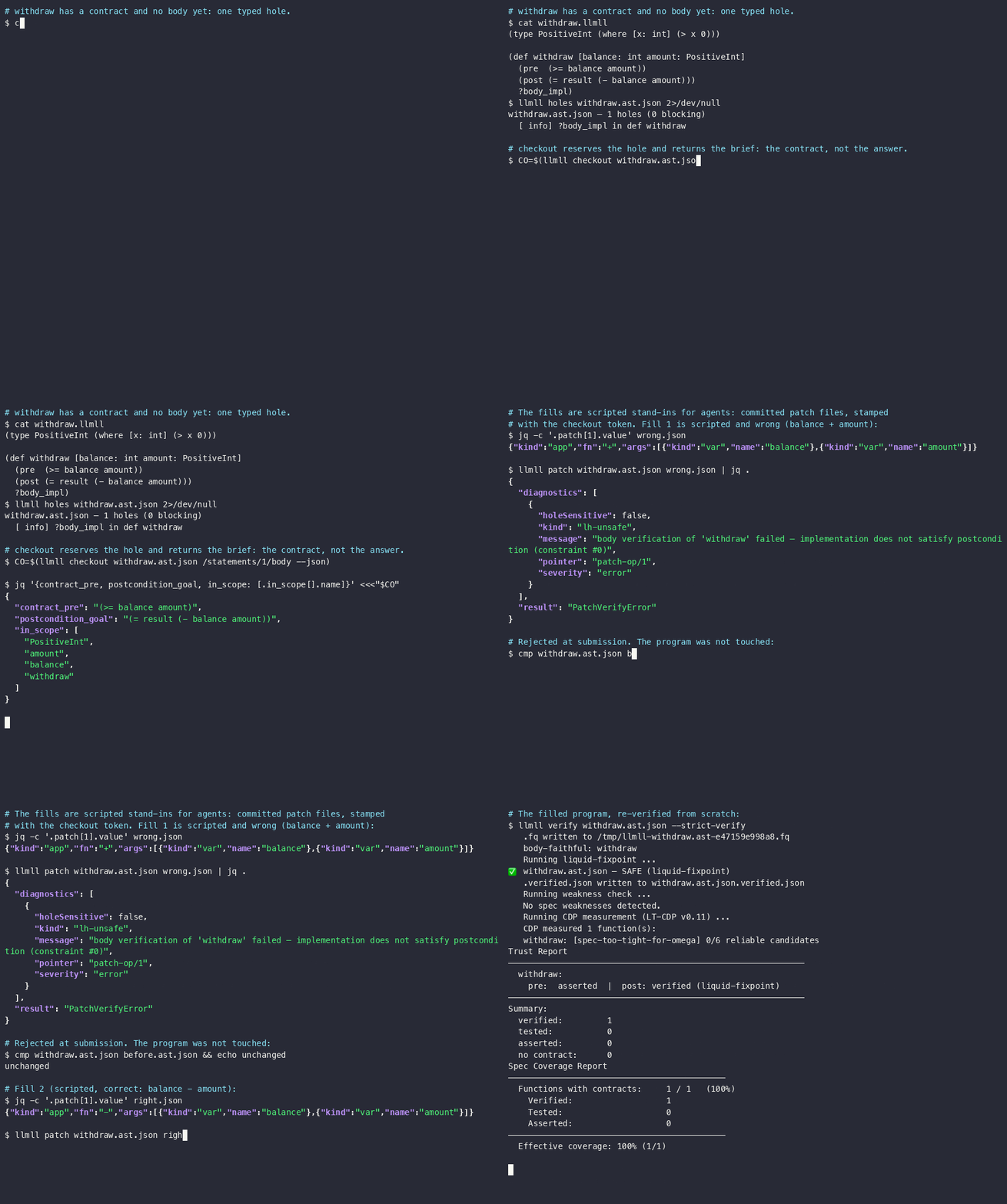
- **A hole is a contract.** `llmll checkout` gives an agent a typed `?hole` with its precondition, the postcondition it must meet and the names in scope, and not the answer. `llmll patch` applies the fill only if the program still type-checks and the solver does not refute it.
- **Weak contracts are flagged.** `--weakness-check` reports a contract so weak that a trivial body satisfies it; `--cdp` scores how sharply a contract rules out wrong bodies.
- **Every function carries a trust level.** The trust report marks each function `verified`, `asserted` and so on, and a `verified` claim never silently rests on an unproven callee.
- **Agents edit structure, not text.** Every program also has a JSON-AST form, and patches are RFC 6902 JSON-Patch against it, so there are no text merge conflicts.
- **Decomposition is checked.** `llmll refine` fills a hole and spawns contracted sub-holes in one step, and rejects a sub-contract that no body can meet or that says nothing.
**What the experiments show.** In [`experiments/minimal-agent/`](experiments/minimal-agent/SUMMARY.md), three frontier models wrote verified-correct bodies 30 of 30 times on fixtures built to trip them, with 0 wrong fills in 54 attempts. The evidence is for assurance: agent-written code, proved against a contract the agent did not write. The refutation demos in this README and on the blog use scripted wrong versions to show that the check works; the agents in these experiments did not produce them. Every experiment, with its result: [`experiments/README.md`](experiments/README.md).
---
## Prove what the solver can't — kernel-checked
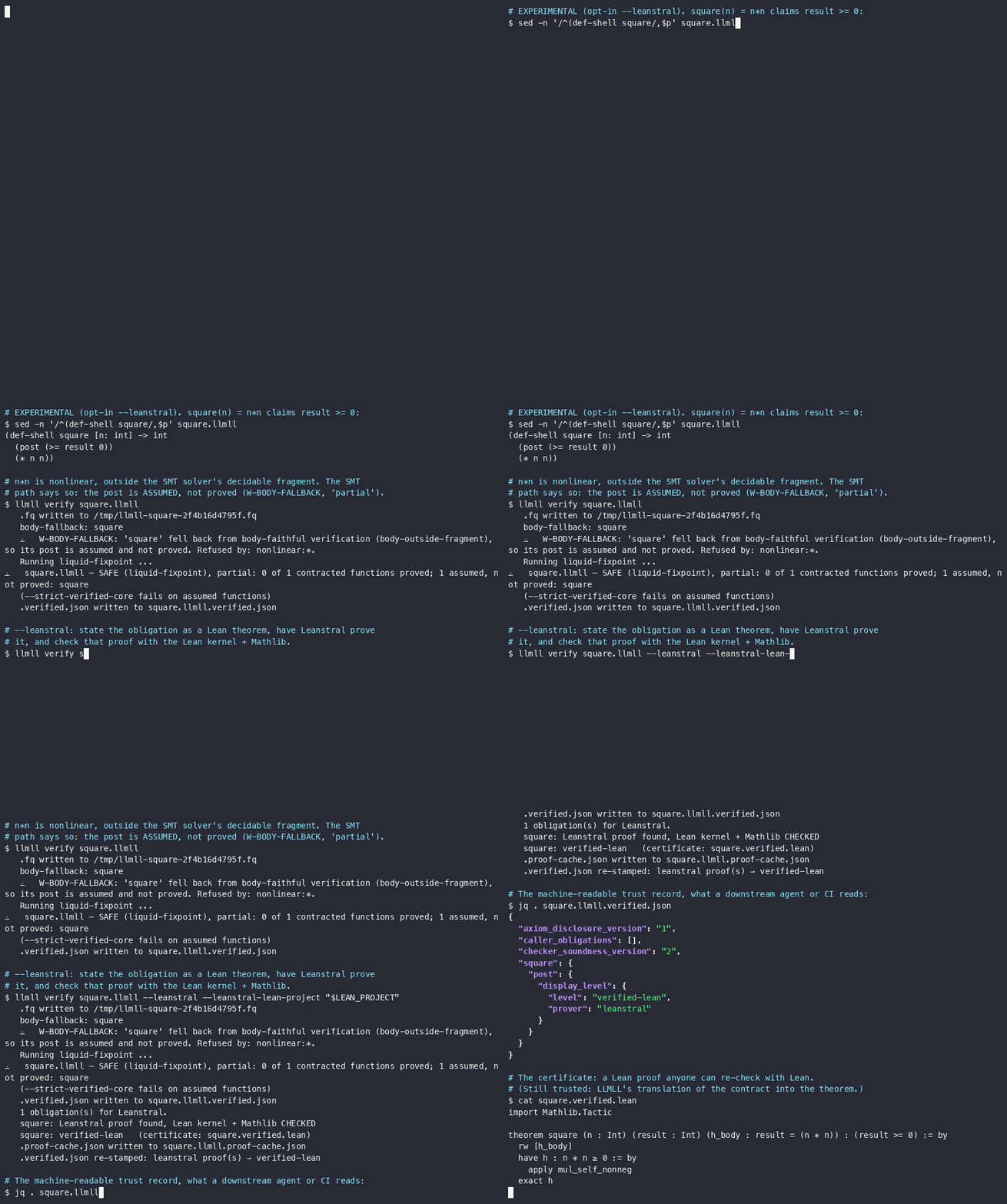
Not every property is decidable by SMT. `square(n) = n*n` claims `result ≥ 0` — but `n*n` is **nonlinear**, outside the linear-arithmetic fragment LLMLL sends to the solver, so the SMT verifier can only mark the postcondition `asserted` (an explicit "not proven"). With **`--leanstral`**, LLMLL states the obligation as a Lean theorem, has Leanstral prove it, and **checks that proof with the Lean kernel + Mathlib** — recording a `verified-lean` tier with an independently re-checkable `.lean` certificate.
Experimental. Recorded live on v0.26.3 against the Leanstral API; regenerate with examples/leanstral-demo/demo.sh (needs an API key and a Lean 4 + Mathlib project).
```text
$ llmll verify examples/leanstral-demo/square.llmll --trust-report
square: post: asserted # nonlinear: outside the SMT fragment, not proven
$ LLMLL_LEANSTRAL_API_KEY=… llmll verify examples/leanstral-demo/square.llmll \
--leanstral --leanstral-lean-project ~/proofcheck --trust-report
square: Leanstral proof found, Lean kernel + Mathlib CHECKED
square: post: verified-lean (certificate: square.verified.lean)
```
The certificate is a Lean proof term the kernel accepted, checkable by anyone with Lean without trusting Leanstral. What you still trust is LLMLL's translation of the contract into the Lean theorem statement. **An AI proved what the SMT solver couldn't, and you don't have to take its word for it.**
> **Experimental.** Opt-in demo; needs a Leanstral API key (`LLMLL_LEANSTRAL_API_KEY`) and a local Lean 4 + Mathlib project. Production Lean verification across all obligation classes is the deferred `LEAN-GA` rebuild. Reproduce: [`examples/leanstral-demo/`](examples/leanstral-demo/) (`demo.sh`) · design: [`docs/archive/shipped-design-specs/leanstral-demo-spec.md`](docs/archive/shipped-design-specs/leanstral-demo-spec.md).
---
## Try it
The full repair loop (hole → rejected bad fills → accepted fix → verified) is the copy-pasteable [`DEMO-RUNBOOK.md`](examples/withdraw-demo/DEMO-RUNBOOK.md).
The two fills are scripted stand-ins for agents: fixed patch files committed to the repo, not produced by an agent run. Script: examples/withdraw-demo/demo.sh.
**Zero-install (Docker).** No Haskell toolchain — the image bundles `llmll`, `z3`, and `liquid-fixpoint`:
```bash
# see the SMT refutation of a conservation-breaking fill (no local files needed):
docker run --rm ghcr.io/machunter/llmll verify /opt/llmll/examples/payments-core/conserve-bad.llmll
# verify your own file (mounts the current directory at /work):
docker run --rm -v "$PWD":/work ghcr.io/machunter/llmll verify myfile.llmll
```
**From source.** Build first:
```bash
cd compiler && stack build
stack exec llmll -- --help
```
Requires GHC ≥ 9.4 + Stack ≥ 2.9. The proof step also needs `z3` + `liquid-fixpoint`.
> **Nothing passes without the solver.** On the from-source path, with `z3`/`liquid-fixpoint` absent, `verify` prints a `SOLVER NOT FOUND -- NOTHING WAS PROVEN` banner and exits `3`, and `patch` / `refine` refuse to apply a contracted patch (`PatchVerifyUnavailable`, exit `3`). Install both to see the refutation. (The Docker image bundles both, so it never hits this.) See [`docs/getting-started.md`](docs/getting-started.md).
---
## What it is
LLMLL treats **verification as the coordination protocol**. A lead agent defines types and contracts (the *what*); specialist agents fill typed holes with the *how*; the compiler verifies each fill against its contract before merging. Agents trust each other's *contracts*, not each other's *code*. Merges are structured JSON-AST patches, not text diffs — so there are no structural merge conflicts, and every patch is re-verified before it lands.
**It does not claim program correctness.** It guarantees that all code is *consistent with its declared specifications*, and it tracks how strong each guarantee is: a `verified` contract was proven by the SMT solver; an `asserted` one was not. Trust propagates — no `verified` claim silently rests on an unproven dependency. The weakness checker (`--weakness-check`) even flags a contract so weak that a trivial implementation satisfies it. Its discriminative-power sibling (`--cdp`) scores how sharply a contract rules out wrong bodies. Both checks measure *non-vacuity, not spec fidelity*: a contract that is discriminative yet captures the wrong behavior still passes, and the code still verifies against it.
---
## What's proven vs. not — read this before believing the headline
The **shipped** proof path is SMT (Z3 via liquid-fixpoint) over a non-recursive **QF-LIA core** — integer linear arithmetic, let-bindings, conditionals, calls to contracted functions (assume-guarantee), and n-arm matches on admissible (non-recursive) sums (`Result` and user ADTs, nested and sequential) — **extended with three decidable theories**: the array class (`bytes[n]` memory safety, and `map[{int,string},{int,bool,string}]` get-after-put / key-presence / construction / read-modify-write), admissible datatype construction, and string **literals** (equality, distinctness, and code-point length). That covers numeric bounds, conservation invariants, length preservation, array/map bounds-and-presence safety, and string-tag discrimination. Everything else — string **structure** (concatenation, substring, regex), recursive-payload ADTs, non-linear arithmetic (`* / mod`), IO — **falls back** to contract-only checking, property tests, or runtime assertions, each carrying an explicit trust label (full matrix in [`LLMLL.md §5.3.5`](LLMLL.md)). Recursion is inside the fragment: with a `(decreases e)` measure the solver discharges, the proof is total; without one, it holds only if the recursion terminates, and the `verify` headline drops the `✅` and names the function.
Nonlinear obligations have an **experimental** Lean 4 path: the opt-in `--leanstral` flag shown above, which needs a Leanstral API key and a local Lean 4 + Mathlib project. Production Lean verification across all obligation classes is deferred. `--leanstral-mock` runs the same pipeline against a mock prover, for testing.
[`docs/one-pager.md`](docs/one-pager.md) carries the full **Claim-to-Evidence map** — every claim mapped to a shipped command or an explicit "Planned"/"Not shipped" label. The "Planned"/"Not shipped" labels are deliberate; read it before sharing.
---
## The repository runs on LLMLL
Six of this repository's CI gates are LLMLL programs, in `tools/`: `version-gate` (version banners and schema versions agree), `doc-archive` (each archived design document sits where its status says), `doc-claims` (what the docs say the compiler rejects, checked against the compiler), `doc-path-lint` (path citations in prose; advisory), `refute-crux` (96 frozen `verify` verdicts, so a lost refutation fails CI) and `build-smoke` (builds and runs the other five gates end to end). The [CI workflow](.github/workflows/version-gate.yml) builds and runs them on every push to `main` and every pull request against it. In the same run, each gate's decision core (`adjudicate.llmll`) must pass `llmll verify`, and a deliberately broken copy of that core (`crux-*.llmll`) must be refuted, or the run fails. Only the decision core is proved; the file and process handling around it is built and run, not proved.
The largest LLMLL program in the tree is not a CI gate. [`tools/llmll-driver/`](tools/llmll-driver/README.md) is the RFC-SWARM pipeline driver: 8522 lines across 39 modules, with 55 proved functions and 581 effectful `def-shell` functions that carry no proof by construction ([`docs/design/driver-ll-campaign-close.md`](docs/design/driver-ll-campaign-close.md)). Its README separates what is proved from what is only asserted.
---
## Compiler
The active compiler is a **Haskell stack project** in `compiler/`. It is the only supported backend.
| Command | What it does |
|---------|--------------|
| `llmll check [--strict]` | Parse + type-check; emit structured diagnostics. With `--strict`: unbound variables, unknown functions, unknown operators, and branch type mismatches are hard errors instead of warnings. Without `--strict`: text mode renders accumulated warnings on success. |
| `llmll holes [--deps] [--deps-out FILE]` | List all `?hole` expressions. With `--deps`: include dependency graph in `--json` output. With `--deps-out`: persist graph to file. |
| `llmll test ` | Run property-based tests (`check`/`for-all` blocks via QuickCheck) |
| `llmll build [-o ]` | Generate a Haskell package (`src/Lib.hs` + `package.yaml` + `stack.yaml`) and compile it with `stack build`, or `ghc --make` when Stack is absent. Accepts both `.llmll` S-expression and `.ast.json` JSON-AST sources. With neither `stack` nor `ghc` on PATH it fails (exit 1); `--emit-only` writes the package without compiling it. |
| `llmll build-json [-o ]` | Compile a JSON-AST source to a Haskell package: the `build` pipeline reading `.ast.json` input. `--emit-only` writes the Haskell sources but skips the internal stack build; `--contracts MODE` sets the runtime assertion mode (`full` default, `unproven`, `none`). |
| `llmll run [args...]` | Compile the program and run it immediately; requires a `def-main`. The program inherits this process's stdin, stdout and stderr, and `llmll run` exits with the program's own status. Trailing arguments are passed through to the running program, flags included; `--` is needed only before an argument that starts with `-` and must not be read as a flag. |
| `llmll verify [--fq-out FILE] [--leanstral] [--leanstral-lean-project DIR] [--leanstral-mock] [--trust-report] [--weakness-check] [--obligations] [--obligation-report] [--spec-coverage] [--strict-verified-core] [--cdp] [--strict-verify] [--proof-artifact FILE]` | Emit `.fq` constraint file and run `liquid-fixpoint` (if installed). With `--proof-artifact FILE`, also writes a unified, replayable verification record consolidating the trust/obligation/`.fq`/sidecar surfaces plus the determinism pins. With `--leanstral` (experimental), sends nonlinear obligations to a live Leanstral prover and checks the returned proof with the Lean kernel (see above); `--leanstral-mock` runs the same pipeline against a mock prover. With `--trust-report`, prints per-function trust summary with transitive closure, epistemic drift warnings, and `weakness-ok` suppressions (note: `--trust-report` reloads persisted evidence **instead of running fixpoint**, so a solver-refutable function renders as `asserted`, not `refuted`; use the default `verify` or `--strict-verified-core` to surface `refuted`). With `--weakness-check`, detects specs that admit trivial implementations. With `--obligations`, suggests postcondition strengthening when UNSAFE at cross-function boundaries. With `--obligation-report`, emits structured JSON obligation report for every hole, unproven contract, and failed call-site precondition. With `--spec-coverage`, classifies every function and computes effective specification coverage ratio. With `--strict-verified-core`, hard-errors if any function falls back from body-faithful verification, carries overflow-tainted verified evidence, or is refuted (body-faithful but disproved by the solver), transitively over the call graph, or reaches an imported contract that is not proved (fell back, never verified, or changed since). With `--cdp`, computes contract discriminative power per function: emits a paired `discriminative_axis` block in the trust-report JSON alongside the existing evidence axis. With `--strict-verify`, runs `--trust-report --weakness-check --spec-coverage --cdp` together: the recommended serious-verify path. |
| `llmll replay-artifact ` | Re-derive and check a recorded proof artifact: recompute the source hash, re-run the stored VC under the pinned solver, and **fail closed** on any source/solver-determinism mismatch or `unknown`/timeout. |
| `llmll typecheck --sketch ` | Partial-program type inference. Returns inferred type for every `?hole` plus `holeSensitive`-annotated errors and `invariant_suggestions` from the pattern registry. |
| `llmll serve [--host H] [--port P] [--token T]` | Expose `--sketch` as `POST /sketch` HTTP endpoint for agent swarms. Default: `127.0.0.1:7777`. |
| `llmll checkout [--multi N]` | Lock a `?hole` for exclusive agent editing. Returns a checkout token with the hole's contract context (`contract_pre`, `postcondition_goal`, `path_condition`) and typing context (`in_scope`, `type_definitions`). Use `--release` to abandon, `--status` to query TTL. With `--multi N`, opens or joins an R5 divergence session: N concurrent scratch-isolated tokens on one pointer. |
| `llmll diverge-report ` | R5: collect a divergence session's fills and emit the `divergence_witness` record. The session id is the one returned by `checkout --multi`. A fill the solver could not grade (no solver, or no verdict) is listed under `status_partition.unavailable`, the record carries `solver_available`, and the command exits 3. A fill whose body is outside the decidable fragment is listed under `status_partition.outside_fragment`, not `refuted`, and does not change the exit code. |
| `llmll patch ` | Apply an RFC 6902 JSON-Patch to a checked-out hole. Re-type-checks and re-verifies (SMT) the patched program before writing it. Exits 1 on a rejection, and 3 (`PatchVerifyUnavailable`, nothing written) when the solver is missing or returns no verdict. A success reports, per patched function, whether its body was proved (`verification[].body_faithful`); `--require-proof` refuses a fill whose postcondition passed only as an assumption (`PatchNotProved`). |
| `llmll refine ` | Fill a checked-out hole **and** spawn new contracted sub-holes its body calls, atomically (cascading decomposition). Spawned sub-contracts pass a feasibility (no-miracle) gate (a sub-contract no body can discharge is rejected with a witnessing input) and a CDP vacuity gate; in-scope defs whose contracts subsume a spawned sub-contract are surfaced as advisory `reuse_suggestions` (non-blocking `W-REUSE` on an exact contract-equivalent). |
| `llmll hub fetch --from-file ` | Install a local `.tar.gz` package into the hub cache (`~/.llmll/modules/`). Local tarballs only; there is no registry-by-name fetch. |
| `llmll hub scaffold [--output DIR]` | Generate a project from a `llmll-hub` skeleton template (`~/.llmll/templates/`). |
| `llmll hub query --signature ` | Search hub cache for functions matching a type signature (e.g. `"int -> int -> int"`). |
| `llmll replay ` | Rebuild program, replay event log inputs, compare outputs for determinism verification. |
| `llmll spec [--json]` | Emit agent prompt specification from compiler builtins. Text (default) or JSON output. |
| `llmll version` | Print compiler version and exit. Supports `--json` for `{"version":"…"}` output. Also available as `llmll --version`. |
| `llmll repl` | Start an interactive LLMLL REPL |
### Input formats
Both source formats compile to identical AST nodes:
| Format | Extension | Best for |
|--------|-----------|----------|
| S-expressions | `.llmll` | Human editing, concise iteration |
| JSON-AST | `.ast.json` | AI agents — schema-constrained, structurally valid by construction |
The JSON-AST schema is at `docs/llmll-ast.schema.json`.
### Build the compiler
Requires GHC ≥ 9.4 + Stack ≥ 2.9.
```bash
cd compiler
stack build
stack exec llmll -- --help
```
→ Full build guide and known-good patterns: [`docs/getting-started.md`](docs/getting-started.md)
---
## Quick start
```bash
cd compiler
# Check the example
stack exec llmll -- check ../examples/hangman_sexp/hangman.llmll
# Build a Haskell package in generated/hangman_sexp
stack exec llmll -- build ../examples/hangman_sexp/hangman.llmll -o ../generated/hangman_sexp
# Build from JSON-AST
stack exec llmll -- build ../examples/hangman_json/hangman.ast.json -o ../generated/hangman_json
# Run the generated game
cd ../generated/hangman_json && stack build && stack exec hangman
```
---
## Verification Boundary
LLMLL provides body-faithful SMT verification for a **non-recursive QF-LIA core** with **compositional call-chain reasoning**: integer and `bool` values, linear arithmetic and comparisons, let-bindings, conditionals, calls to contracted functions (assume-guarantee, same-file or imported), n-arm matches on non-recursive sums, pairs, non-recursive datatype construction, the array class (`bytes[n]` and `map` operations) and string literals. Programs outside that fragment fall back to contract-only verification, property-based testing, or runtime assertions, each with an explicit trust label.
| Construct | SMT body-faithful | Fallback |
|---|---|---|
| `ELit`, `EVar` (`int` / `bool`), linear ops (`+ - = < <= >= > !=`) | ✅ | n/a |
| `ELet` (PVar), `EIf` (≤4096 paths) | ✅ (path-split) | n/a |
| `EApp` (contracted callee, same-file or imported) | ✅ (assume-guarantee) | n/a |
| `EApp` (uncontracted callee) | ❌ | contract-only |
| `EApp` (recursive self / cycle) | ✅ partial; ✅ total with `(decreases e)` | no measure: `termination_unverified`; bad measure: `measure-not-decreasing` |
| `EMatch` on non-recursive sums (`Result` and user ADTs, nested and sequential) | ✅ (n-ary int-tag) | n/a |
| `EPair` / pair returns (`first`, `second`, `pair`) | ✅ (datatype selectors) | n/a |
| Non-recursive datatype construction | ✅ | n/a |
| `bytes[n]` and `map` operations (`bytes-get`/`-set`/`-length`/`-zero`, `map-has`/`-get`/`-put`/`-empty`) | ✅ (array theory; index-in-bounds and key-presence are proof obligations) | non-`{int,string}` keys, direct `(map-empty)` reads, whole-structure `=`: contract-only |
| String literals in `=` / `!=`, `string-length` of a literal | ✅ | string structure (concat, substring, regex): contract-only |
| `EMatch` (recursive-sum payload), `ELambda`, `EDo` | ❌ | contract-only / runtime |
| `letrec` (own body VC) | ❌ | runtime + `:decreases` |
| Non-linear ops (`*`, `/`, `mod`) | ❌ | runtime + `?proof-required` (experimental `--leanstral`) |
| **Int overflow** | ✅ no gap | `int` is unbounded (`Integer`) in both the verifier and the generated code |
Full verification matrix: [`LLMLL.md §5.3.5`](LLMLL.md).
---
## Examples
Start here: [`examples/README.md`](examples/README.md) is the tiered index to every example.
### Emergent & famous-bug flagships
| Example | What it proves |
|------|----------------|
| [`examples/secure-channel-emergent/`](examples/secure-channel-emergent/) | **Emergent flagship.** A Heartbleed-domain secure channel, 25 functions across 7 import-linked modules, where agents *invented the entire decomposition* via cascading `refine` with no reference solution; the spine composes six modules through cross-module assume-guarantee and declines an unsteered goto-fail bait |
| [`examples/token-revocation-emergent/`](examples/token-revocation-emergent/) | **Emergent data flagship.** An OAuth RFC 7662/7009 introspection/revocation service, 8 functions / 5 modules, where both the contracts (RFC `:source`-tagged) and the agent-invented bodies are machine-auditable; 5 famous-bug refute twins, CI-frozen |
| [`examples/heartbleed/`](examples/heartbleed/) | Heartbleed (CVE-2014-0160) + a full TLS record layer: the buggy heartbeat that echoes an unbounded `claimed` length is `refuted` at `copy-bytes`' bound; scales to a 163-function channel |
| [`examples/gotofail/`](examples/gotofail/) | Apple "goto fail" (CVE-2014-1266) modeled with real sum types: `Verified` only if the signature stage returned `Continue`; the bug (returning `Verified` on the `Abort` arm) is `refuted` |
### Verification demos (`llmll verify`)
| Demo | What it proves |
|------|----------------|
| [`examples/payments-core/`](examples/payments-core/) | **Flagship.** Two-account conservation over a pair return (`conserve`) — "money can't be created"; `transfer` verified over a `debit` call edge (no-overdraw); `settle` is a `Result`-match return |
| [`examples/tcp_rfc793/`](examples/tcp_rfc793/) | RFC 793 connection state machine reaches `verified` on legal-successor safety; `step-bad` is `refuted` |
| [`examples/session-pay/`](examples/session-pay/) | Connected demo: protocol state-safety + verified payment + bounded amount in one `verified` function |
| [`examples/nested-result/`](examples/nested-result/) | A nested `Result`-variable match (under `let`) reaches `verified` |
| [`examples/refined-payload/`](examples/refined-payload/) | A matched `Result[Pos,string]` arm uses its payload's `> 0` (`verified`); a caller forwarding a weaker `Result[int]` is refused |
| [`examples/outcome-totality/`](examples/outcome-totality/) | A payload-carrying `Accepted(n)`/`Rejected(n)` outcome with a verified legal→Accepted / illegal→Rejected totality |
| [`examples/banking_ledger/`](examples/banking_ledger/) | Three-level assume-guarantee chain (`transfer → withdraw → safe-subtract`), all verified; the twin that drops one guard is `refuted` at the call site |
| [`examples/withdraw-demo/`](examples/withdraw-demo/) | The repair loop (hole → rejected bad fills → accepted fix → verified) + the `return-refine` beat |
| [`examples/refine-demo/`](examples/refine-demo/) | Cascading `refine`: one hole decomposed top-down into a contracted sub-hole tree, every intermediate state `verified` via assume-guarantee; two guardrails reject a vacuous or orphan decomposition |
| [`examples/bytes-bounds/`](examples/bytes-bounds/) | `bytes[n]` memory safety: a correct bounds check verifies; the off-by-one (`<=` for `<`) and an out-of-range write are `refuted` at the call site |
| [`examples/total-recursion/`](examples/total-recursion/) | A recursive function with `(decreases n)` verifies **total** (termination discharged); a bad measure fails on the distinct `measure-not-decreasing` channel |
| [`examples/rfc1982_serial/`](examples/rfc1982_serial/) | RFC 1982 serial arithmetic via the spec-from-RFC pipeline: all three functions `verified` with per-clause `:source`; the historical naive-`<` DNS bug refutes |
### Language / runtime examples
| Example | Format | Description |
|---------|--------|-------------|
| `examples/hangman_sexp/` | S-expression | Full Hangman game with ASCII gallows art; uses `def-main :mode console` |
| `examples/hangman_json/` | JSON-AST | Same program, JSON-AST schema-constrained version |
| `examples/tictactoe_sexp/` | S-expression | Two-player Tic-Tac-Toe; demonstrates `:done?` + `:on-done` |
| `examples/life_sexp/` | S-expression | Conway's Game of Life; multi-module (`core`, `world`, `main`) |
| `examples/life_json/` | JSON-AST | Same Life program in JSON-AST format |
| `examples/withdraw.llmll` | S-expression | Simple withdraw with `pre`/`post` contracts; acceptance gate |
| `examples/hangman_json_verifier/` | JSON-AST | Hangman with `apply-guess` contracts (`llmll verify`; asserted, not solver-proven) |
| `examples/tictactoe_json_verifier/` | JSON-AST | Tic-Tac-Toe with `set-cell` contracts (asserted, not solver-proven) |
| `examples/conways_life_json_verifier/` | JSON-AST | Conway's Life — `next-cell`/`count-neighbors` contracts (see its `VERIFICATION_SCOPE.md`) |
| `examples/replay-demo/` | S-expression | The `llmll replay` demo: codegen + deterministic event-log replay (used by `docs/getting-started.md`) |
| `examples/proof_required_test/` | S-expression | Leanstral proof pipeline validation |
| `examples/erc20_token/` | JSON-AST | ERC-20 benchmark — frozen ground truth with verification-scope matrix |
| `examples/totp_rfc6238/` | JSON-AST | TOTP RFC 6238 benchmark — crypto builtins, RFC `:source` provenance |
---
## Repository layout
```
LLMLL.md ← canonical language specification
CHANGELOG.md ← release notes
compiler/ ← Haskell compiler (stack project)
src/LLMLL/
Parser.hs ← S-expression parser (Megaparsec)
Lexer.hs ← Megaparsec lexer (tokens, whitespace, layout)
ParserJSON.hs ← JSON-AST parser
Syntax.hs ← AST types (incl. ModulePath, ModuleEnv, ModuleCache, TPair)
TypeCheck.hs ← Bidirectional type checker
HoleAnalysis.hs ← Hole collector (?hole expressions)
CodegenHs.hs ← Haskell code emitter
AstEmit.hs ← JSON-AST emitter (--emit round-trip)
Contracts.hs ← Runtime contract assertion generator
PBT.hs ← QuickCheck property runner
Diagnostic.hs ← Structured error/warning types
Module.hs ← Multi-file module resolver, cycle detection, ModuleCache
Hub.hs ← llmll-hub local package cache (tarball install) and scaffold
Sketch.hs ← Partial-program type inference (--sketch)
Serve.hs ← HTTP endpoint for agent swarms (llmll serve)
FixpointIR.hs ← .fq constraint IR + text emitter
FixpointEmit.hs ← typed AST → .fq + ConstraintTable builder
DiagnosticFQ.hs ← liquid-fixpoint output → [Diagnostic] with JSON Pointers
Replay.hs ← JSONL event log parser + replay execution
LeanTranslate.hs ← LLMLL contracts → Lean 4 theorem obligations
MCPClient.hs ← Leanstral client (Mistral API over HTTPS; mock-first)
ProofCache.hs ← per-file .proof-cache.json sidecar (SHA-256)
TrustReport.hs ← transitive trust closure analysis (--trust-report)
VerifiedCache.hs ← .verified.json sidecar read/write
WeaknessCheck.hs ← trivial-body spec weakness detection
InvariantRegistry.hs ← pattern-based invariant suggestion database
ObligationMining.hs ← downstream postcondition strengthening suggestions
ObligationAssembly.hs ← structured obligation report assembly + JSON encoding
GuardClassifier.hs ← shared guard classification (verifier + obligations)
SpecCoverage.hs ← specification coverage metric + governance guardrails
JsonPointer.hs ← RFC 6901 pointer resolution + descendant hole search
Checkout.hs ← Hole checkout with per-file lock management (llmll checkout)
PatchApply.hs ← RFC 6902 JSON-Patch application with scope validation + re-verification (llmll patch)
AgentSpec.hs ← Compiler-emitted agent spec for LLM system prompts (llmll spec)
HubQuery.hs ← Query-by-signature: find hub modules matching a type signature (llmll hub query)
CDP.hs ← contract discriminative power evidence axis (--cdp)
ProofArtifact.hs ← unified, replayable verification record (--proof-artifact / replay-artifact)
package.yaml / stack.yaml
examples/
hangman_sexp/ ← Full Hangman (S-expression)
hangman_json/ ← Full Hangman (JSON-AST); getting-started.md's worked example
tictactoe_sexp/ ← Tic-Tac-Toe (S-expression)
life_sexp/ ← Conway's Life (S-expression, multi-module)
life_json/ ← Conway's Life (JSON-AST, multi-module)
withdraw.llmll ← Contract demo
hangman_json_verifier/ ← Hangman with contracts (asserted, not solver-proven)
tictactoe_json_verifier/ ← Tic-Tac-Toe with contracts (asserted, not solver-proven)
conways_life_json_verifier/ ← Life with contracts (see its VERIFICATION_SCOPE.md)
erc20_token/ ← ERC-20 benchmark (frozen ground truth)
totp_rfc6238/ ← TOTP RFC 6238 benchmark
benchmarks/ ← agent-fill benchmark seeds (B1/B3/B5)
secure-channel-emergent/ ← emergent flagship: 25 fns / 7 modules, agents invented the decomposition
token-revocation-emergent/ ← emergent data flagship: RFC 7662/7009, agent-invented bodies, 5 refute twins
heartbleed/ ← Heartbleed (CVE-2014-0160) + TLS record layer; scales to a 163-fn channel
gotofail/ ← Apple "goto fail" (CVE-2014-1266) with real sum types
payments-core/ ← flagship verified-payments demo: two-account conservation, transfer/debit call chain, settle (see "See it")
withdraw-demo/ ← repair-loop demo: holes → checkout/patch → two-axis trust + composition + CDP + proof-artifact
refine-demo/ ← cascading refine: one hole → contracted sub-hole tree, each state verified
tcp_rfc793/ ← RFC 793 connection state machine, legal-successor safety
session-pay/ ← Connected demo: protocol state-safety + verified payment + bounded amount in one verified function
nested-result/ ← Nested Result-variable match under let
refined-payload/ ← Matched Result payload refinement + weaker-forward refusal
outcome-totality/ ← Payload-carrying outcome sum, verified legal/illegal totality
banking_ledger/ ← Three-level assume-guarantee chain (transfer → withdraw → safe-subtract) + refuting twin
orchestrator_walkthrough/ ← Auth module orchestration exercise
docs/
UPDATE-PROTOCOL.md ← Doc canonical-sources + per-change update matrix
getting-started.md ← Build guide, known-good patterns, schema versioning
compiler-team-roadmap.md ← Engineering backlog and shipped-releases history
llmll-ast.schema.json ← JSON-AST schema (use with AI agents)
orchestrator-walkthrough.md ← End-to-end orchestration walkthrough
one-pager.md ← Project overview / pitch document
design/ ← Active design proposals (status in design/INDEX.md)
INDEX.md ← Reading guide for active design documents
archive/ ← Superseded design specs, shipped proposals, professor reviews, wasm investigations
tools/
llmll-orchestra/ ← Python orchestrator (pip package)
llmll_orchestra/
orchestrator.py ← Fill-mode orchestrator
lead_agent.py ← Lead Agent skeleton generation (plan/lead/auto modes)
quality.py ← Skeleton quality heuristics
agent.py ← LLM agent interface
compiler.py ← Compiler CLI wrapper
```
---
## Documentation
| Document | Purpose |
|----------|---------|
| [`LLMLL.md`](LLMLL.md) | Full language specification — types, syntax, FFI, grammar, builtins |
| [`docs/README.md`](docs/README.md) | Reading guide to `docs/`: what to read first, and what is working material |
| [`ROADMAP.md`](ROADMAP.md) | Public roadmap: what has shipped, what is next, deliberate boundaries |
| [`experiments/README.md`](experiments/README.md) | Index of the experiments and their headline results |
| [`docs/getting-started.md`](docs/getting-started.md) | Build guide + known-good patterns + schema versioning (single reference for agents) |
| [`docs/compiler-team-roadmap.md`](docs/compiler-team-roadmap.md) | Engineering backlog and shipped-releases history (current version in [CHANGELOG § Latest](CHANGELOG.md#Latest)) |
| [`docs/llmll-ast.schema.json`](docs/llmll-ast.schema.json) | Machine-readable JSON-AST schema |
| [`docs/UPDATE-PROTOCOL.md`](docs/UPDATE-PROTOCOL.md) | Doc canonical-sources table and per-change update matrix |
| [`docs/orchestrator-walkthrough.md`](docs/orchestrator-walkthrough.md) | End-to-end multi-agent orchestration walkthrough with auth module exercise |
| [`docs/one-pager.md`](docs/one-pager.md) | Project overview — problem, approach, status, related work |
| [`docs/design/INDEX.md`](docs/design/INDEX.md) | Reading guide for all active design documents |
| [`CHANGELOG.md`](CHANGELOG.md) | Release notes by version |
---
## License
GPLv3 with LLMLL Runtime Library Exception — see [`LICENSE`](LICENSE).