English · 简体中文



🌐 cindy.app · ⬇️ Download
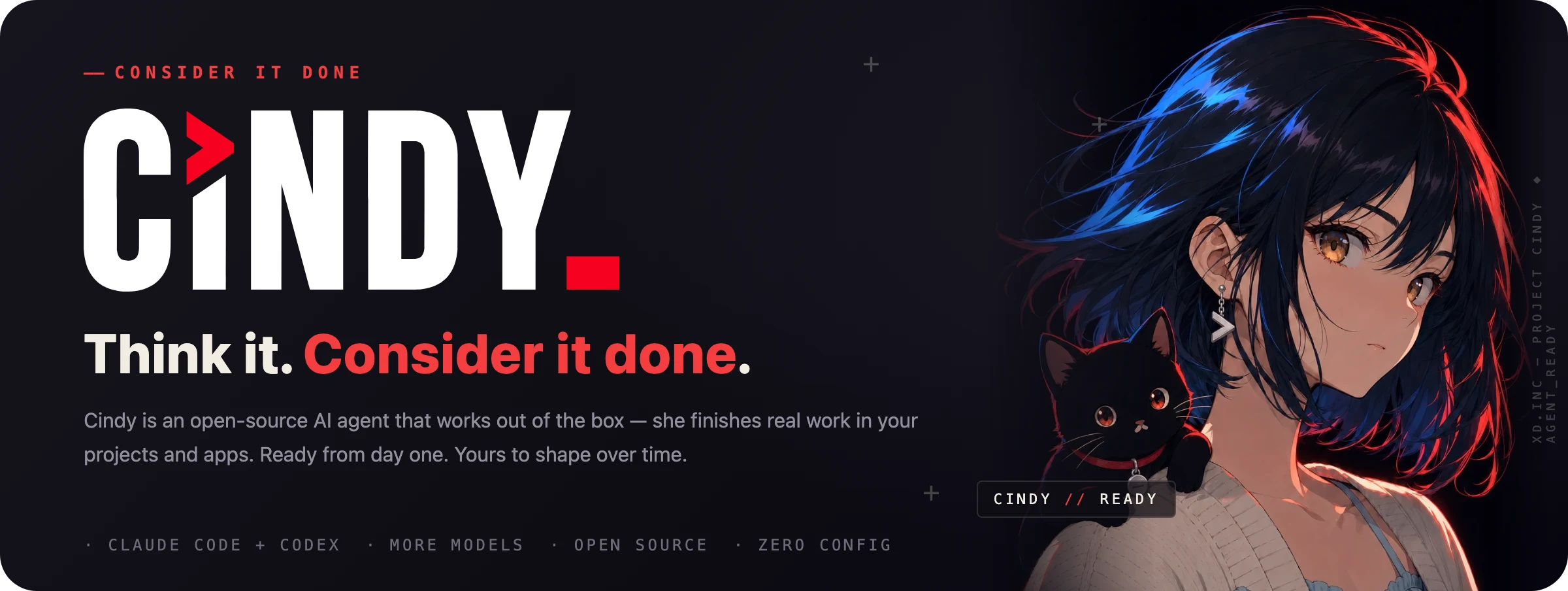
Cindy is an open-source AI agent that works out of the box. She brings multiple
harnesses, models and tools into one agent that finishes real work in your
projects and apps. Ready from day one, yours to shape over time.
Cindy runs locally on your own machine, using your real files and logged-in
apps. The first supported harnesses are **Claude Code** and **Codex** — more are
being added, and a native harness is in the works. Models and harnesses mix
freely and can switch mid-task while your workspace, memory, skills and tools
stay continuous; one task can even be planned, executed in parallel, and
reviewed by agents on different harness × model combos. She can drive your
browser, computer and phone, and take work from IM and schedules.
This repository is the open-source **client** for Cindy — the desktop and mobile
apps plus their shared packages, organized as a pnpm monorepo.
The client is free to use, and its source code is open under Apache-2.0. Bring
models your way: sign in to the official Cindy service (usage deducted
transparently), authorize the **Claude Code / Codex Coding Plan** you already
pay for and keep using it inside Cindy — no duplicate bill — connect your own
API keys, or use local models.
See [cindy.app](https://cindy.app) for service details,
[pricing](https://cindy.app/#pricing), and [downloads](https://cindy.app/download/).
## Yours to shape
Open source means more than visible — it means changeable:
- **Memory** — correct her once and she does it right from then on, shared across harnesses.
- **Skills** — teach a way of working once and reuse it everywhere; handing them to your team is in the making.
- **Automation** — recurring work schedules itself, runs itself, reports back.
- **MCP** — wire your internal tools and business systems into her reach.
- **Plugins** — reshape features, UI and interactions, shared through an open marketplace *(in the making)*.
- **Source** — audit, fork, extend, and contribute improvements back under Apache-2.0.
Ready out of the box, never boxed in — start with
[`CONTRIBUTING.en.md`](CONTRIBUTING.en.md) and build Cindy with us.
## What's in this repo
| Path | Description |
| --- | --- |
| `apps/desktop` | Electron desktop client |
| `apps/mobile` | Expo / React Native mobile client |
| `packages/*` | Shared client capabilities (auth, device-link, agent orchestration, model providers, …) |
| `apps/*-bin` | Tool binaries shipped with the desktop app; none are committed — claude-code, codex, and ripgrep are downloaded per platform by `pnpm install`, and the Android platform-tools binaries are fetched (pinned version, sha256-verified) before Windows packaging |
| `cindy-protocol/` | Wire protocol shared with the server (git submodule) |
**Not in this repo:** the backend service lives in a separate
repository and is not part of this monorepo.
| Mode | Account requirement | Availability |
| --- | --- | --- |
| Hosted service | Cindy cloud account | Use Cindy's full hosted service. See [pricing](https://cindy.app/#pricing). |
| Local mode | No Cindy sign-in required | Choose “Local mode” on the login screen to use local agents. Server-backed capabilities are unavailable in this mode. |
## Prerequisites
- **Node.js** 22.x
- **pnpm** 10.x (v11 is not yet supported)
- **Git LFS**
## Getting started
Contributor setup, public submodule initialization, Git LFS, dependency updates,
and access requirements are maintained in
[`CONTRIBUTING.en.md`](CONTRIBUTING.en.md).
The public checkout only needs the protocol submodule; plugins are installed through
SkillHub or manually.
Minimal entry point:
```bash
git clone https://github.com/makecindy/cindy.git
cd cindy
git submodule update --init --recursive cindy-protocol
git lfs pull
pnpm install
```
## Development entry points
```bash
# Mainland China Cindy account
pnpm restart:desktop:remote --region=cn
# Global Cindy account
pnpm restart:desktop:remote --region=global
```
Remote development uses your own Cindy cloud account and existing login state, so
you can continue existing sessions and work while developing the client. Use `cn`
for Mainland China accounts and `global` for everyone else; do not rely
on the internal default. Full desktop, mobile, data-isolation, and validation
workflows are in [`CONTRIBUTING.en.md`](CONTRIBUTING.en.md).
“Local mode” on the login screen is an unauthenticated local-agent mode, not a
connection to a local server. Server-backed capabilities are unavailable in this
mode.
**About the default servers:** the client connects to Cindy's official cloud
services by default (endpoint manifests in
[`config/endpoint.json`](config/endpoint.json) and
[`config/endpoint.global.json`](config/endpoint.global.json); desktop
auto-updates also come from the official CDN). This is intentional — external
developers don't need to self-host a server: sign in with your own Cindy
account in a dev build and develop / test directly against the official
servers.
## Architecture
- [`DESIGN.md`](DESIGN.md) — visual design system, color tokens, and UI conventions
- [`docs/README.md`](docs/README.md) — complete documentation and rules index
- [`CONTRIBUTING.en.md`](CONTRIBUTING.en.md) — contributor setup, validation, and submission workflow
- [`AGENTS.md`](AGENTS.md) — engineering rules, launch/runtime contracts, and module boundaries
- [`docs/dev-rules/`](docs/dev-rules/) — deep-dive architecture docs (e.g. Orca multi-agent orchestration)
## Contributing
Contributions go through pull requests into `main`. Read
[`CONTRIBUTING.en.md`](CONTRIBUTING.en.md) first, then use
[`.github/PULL_REQUEST_TEMPLATE.md`](.github/PULL_REQUEST_TEMPLATE.md).
Every commit needs a [Developer Certificate of Origin](DCO) sign-off
(`git commit -s`); a DCO check on each pull request enforces it, and no CLA is
required.
Please also follow [`CODE_OF_CONDUCT.en.md`](CODE_OF_CONDUCT.en.md). For ordinary
usage questions, see [`SUPPORT.en.md`](SUPPORT.en.md); report security issues
privately through [`SECURITY.en.md`](SECURITY.en.md).
## Security
Never commit credentials or authorization files to the working tree. If you
discover a security issue, follow [`SECURITY.en.md`](SECURITY.en.md) to report it
privately rather than opening a public issue.
## Privacy & telemetry
**Official distribution builds** include [TapDB](https://www.taptap.io/tapdb)
usage analytics for product-level aggregate statistics (device / OS / app-version
metadata; associated with your account ID after sign-in). It does **not** collect
chat content, file content, or working-directory data. In addition, while signed
in to a cloud account the client sends an online heartbeat to Cindy services
(account ID, platform, and version only). Crash dumps stay on the local machine
and are never uploaded automatically.
**Building from source?** You are not required to keep analytics:
- Mobile is off by default — without TapDB credentials (`clientId` /
`clientToken`) injected at build time, `apps/mobile/src/analytics/mobileTapdb.ts`
is a no-op;
- Desktop can be fully stripped by removing the `initTapdb()` call in
`apps/desktop/src/renderer/index.tsx` (implementation lives in
`apps/desktop/src/renderer/analytics/`).
## License / 许可证
Except as otherwise noted, the source code in this repository is licensed under
the [Apache License, Version 2.0](LICENSE). Individual source files do not
carry per-file license headers; the repository-root `LICENSE` governs.
Model weights, datasets, prompts, trademarks, and other separately identified
materials may be subject to their own license terms and are not automatically
covered by the repository-level Apache-2.0 grant. Third-party open-source
components retain their own copyright and license. Their attribution notices and
SPDX SBOMs are managed under [`docs/legal/`](docs/legal/), with artifact-specific
outputs in [`docs/legal/notices/`](docs/legal/notices/). See [`NOTICE`](NOTICE)
for this project's copyright and attribution information.