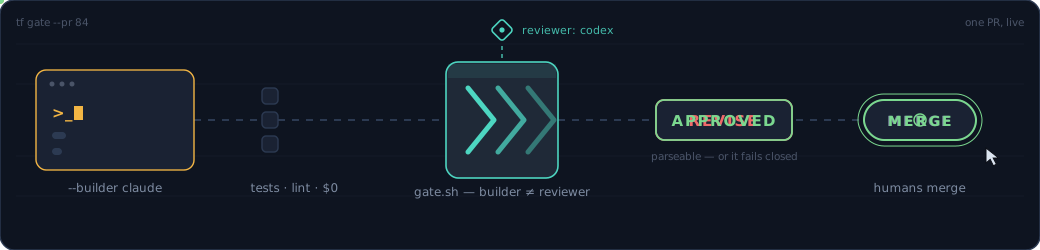
# gate before the PR (defaults to --base main)
# ... push, open the PR, gate it ...
tf digest # fleet health: merge queue × verdicts × site liveness
```
Detached and want back in? In a Codespace, every new terminal auto-attaches. Locally: run `bash workspace.sh` again.
## Harnesses — installed by the boot, menu on demand
The kit ships no harness, and the boot no longer asks: a fresh Codespace **auto-installs the default pair (Claude Code + Codex + the Ruflo wiring)** on the first shell, visibly, then drops you straight into the tmux rig. The interactive menu is still there on demand — [`setup-harness.sh`](setup-harness.sh) — for GLM, all-of-the-above, or skip:
| choice | what you get |
|---|---|
| **Claude Code** | Anthropic login · Ruflo installed as plugins (`marketplace add ruvnet/ruflo` + console/mods) |
| **Codex** | OpenAI login · Ruflo wired through **MCP** (`~/.codex/config.toml`) |
| **GLM** | Claude Code on your **GLM Coding Plan** key (docs.z.ai, Anthropic-protocol endpoint) via a dedicated `claude-glm` launcher — plain `claude` stays your Anthropic reviewer, so builder ≠ reviewer survives by construction |
When the install finishes, you land **inside a 5-window tmux rig**: `claude` (the Anthropic reviewer) · the **builder window** — `claude-glm` when you chose the GLM path (a genuine cross-family pair with window 1), otherwise plain `claude` honestly labeled same-family (wire it later: `./setup-harness.sh --glm`), with the ruflo plugins pre-loaded (the slash commands were executed at install time — verify any time with `/plugin`) · `codex` · the **tokens dashboard** live (`rig-lite/tokens.py --watch`) · a free shell. Detach any time; the session survives (every new terminal auto-attaches to the same rig — that's the design). `TF_NO_TMUX=1` is a total opt-out: no boot install, no auto-attach. Keys are read hidden and stored with `600` permissions, and everything installs user-space (nvm + npm global prefix). The GLM path is fail-closed: a missing or incomplete `glm.env` makes `claude-glm` refuse to run rather than silently fall back to an Anthropic session. One shared surface, stated plainly: Ruflo plugins installed via the Claude/GLM paths load in **both** `claude` and `claude-glm` (they're tooling, not model — the reviewer's model stays Anthropic, so builder ≠ reviewer holds). `--claude` / `--codex` / `--glm` flags run it non-interactively.
## Where the v4 environment went
Turbo Flow v4 packaged and wired a Claude Code + Ruflo environment. Ruflo grew its own onboarding (`npx ruflo@latest init wizard`, plugin marketplace, built-in memory and console), which retired the reason a wrapper repo existed. The v4 install chain lives on in the `v1.0.1 → v4.0` tags; the v5 line is governance-first and orchestration-agnostic.
## Join the private beta
The kit is the portable extract of **Turbo Rig** — gate + constitution + memory + automations running as one integrated system, on your machine, across your repos.
- **Apply / product page** → [turbo-rig.vercel.app](https://turbo-rig.vercel.app) (EN/ES)
- **Deep dive** → [turbo-rig-deep-dive.vercel.app](https://turbo-rig-deep-dive.vercel.app) · **3D scene** → [turbo-rig-deep-dive-3d.vercel.app](https://turbo-rig-deep-dive-3d.vercel.app)
**Beta feedback:** open an issue or start a discussion here — this repo is the beta's public tracker.
## Does builder ≠ reviewer actually matter?
The builder is never its own reviewer — a design choice, not something the audited week measured. What one recent week of building Turbo Rig with Turbo Rig measured is the gate's strictness: **141 PRs · 868 gate verdicts · 687 REVISE (79%) · 104 parallel lanes** — verdicts cover the gate-live window (Sept 16–21), merges the full week, and every merge was held by a human. Every number re-derived from the primary logs in the public verification dossier: https://www.turbo-rig.com/evidence (the 116-task figure previously cited here without attribution is a published external result — Xiang et al., “Cross-Model LLM Code Review,” Agentic SE @ KDD’26, arXiv:2607.21656 — not our data; cited as such now). The badge at the top is the receipt.
## About Adventure Wave Labs
**Adventure Wave Labs** builds Turbo Flow and Turbo Rig — packaging, setup automation, and the governance layer that holds when the agents get fast. The orchestration core referenced by v4 was [Ruflo](https://github.com/ruvnet/ruflo) by rUv; Turbo Flow integrates, and now points at it, rather than rebuilding it.
**Turbo Flow v5.2 — the rules layer. One kit, any harness, humans merge.**
## Ecosystem
Built with and powers these tools — star the ones you use:
| Repo | What it does |
|------|-------------|
| [**codescope**](https://github.com/adventurewave-labs/codescope) | Single-binary code-intelligence engine for AI agents — no cloud, no DB, no Python |
| [**secret-scan**](https://github.com/adventurewave-labs/secret-scan) | Rust secret scanner — obfuscation detection, up to ~1,200 files/sec measured |
| [**Sentinel**](https://github.com/marcuspat/Sentinel) | Deny-by-default agentic sysadmin: Investigate → Plan → Approve → Act in Rust |
| [**netrain**](https://github.com/marcuspat/netrain) | Matrix-style network monitor in Rust |
Orchestration, when you want it: [Ruflo](https://github.com/ruvnet/ruflo) as a Claude Code mod.
## Stay Connected
If Turbo Flow ships value for you, follow [@marcuspat](https://github.com/marcuspat) on GitHub — agentic tooling, Rust crates, and open-source infra drop regularly.
[](https://github.com/marcuspat)
## License
MIT — Copyright (c) 2025-2026 Adventure Wave Labs