[](https://cran.r-project.org/package=OpenRepGrid.ic)
[](https://codecov.io/gh/markheckmann/OpenRepGrid.ic?branch=master)
[](https://github.com/markheckmann/OpenRepGrid.ic/actions/workflows/R-CMD-check.yaml)
[](https://doi.org/10.5281/zenodo.7655618)
[](https://doi.org/10.21105/joss.03292)
# Interpretive Clustering
## Introduction
The [`OpenRepGrid.ic` R
package](https://cran.r-project.org/web/packages/OpenRepGrid.ic/index.html)
is a browser-based software to perform *Interpretive Clustering* (IC)
for repertory grid data. The [repertory
grid](https://en.wikipedia.org/wiki/Repertory_grid) (often abbreviated
as *grid* or *repgrid*) is a person-centered data collection method. It
is primarily used in clinical psychology and generates a mix of
qualitative and quantitative data. IC is a method for clustering the
attributes (so called constructs) resulting from a repertory grid
interview by finding relational patterns between them. The IC method is
described in more detail in our publication [Burr, King, and Heckmann
(2020)](https://doi.org/10.1080/14780887.2020.1794088). An introduction
to the software is also available on
[YouTube](https://youtu.be/f9oINYA22Rc). The package is part of the
[OpenRepgrid project](http://openrepgrid.org/), which contains several
software packages for the analysis of repertory grid data. In the
following, we will briefly explain, why the software was developed,
describe the repertory grid technique and provide a short example of how
a grid dataset can be analyzed and interpreted using our
[`OpenRepGrid.ic`](https://cran.r-project.org/web/packages/OpenRepGrid.ic/index.html)
software.
## Statement of need
Currently, the IC method is not implemented in any other existing
repertory grid software. While IC can also be conducted by hand, this is
very time consuming, error-prone and only feasible for small-sized
grids. Hence, a software solution to support the IC procedure is needed.
Without proper software support that facilitates the IC steps, the
method is too laborious and is thus likely to become a methodological
contribution which will rarely be used in research due to above
mentioned reasons.
## Repertory Grid Technique
The repertory grid technique (RGT) is a method which originated from
*Personal Construct Theory (PCT)* (Kelly 1955). It was originally
designed as an instrument for clinical psychology but quickly spread to
other disciplines like marketing, political, organizational, and
educational research in the decades after its inauguration (Fransella,
Bell, and Bannister 2004). The RGT is a person-centered method which
focuses on understanding how an individual sees, or in constructivist
terms *construes*, the world. The data collected by the RGT is both,
*qualitative* and *quantitative*. The qualitative part of the data
consists of a list of bipolar attributes (e.g. *light-hearted
vs. depressed*), which are elicited during the repertory grid interview.
These attributes are called *constructs* in PCT terminology. Each
construct consists of two *poles*, e.g. *light-hearted* and *depressed*,
with the poles usually being opposites. In PCT, the constructs
constitute the templates a person uses to construe a set of objects
under consideration. These objects are called *elements* in PCT
terminology and are, for example, persons, brands, countries, companies
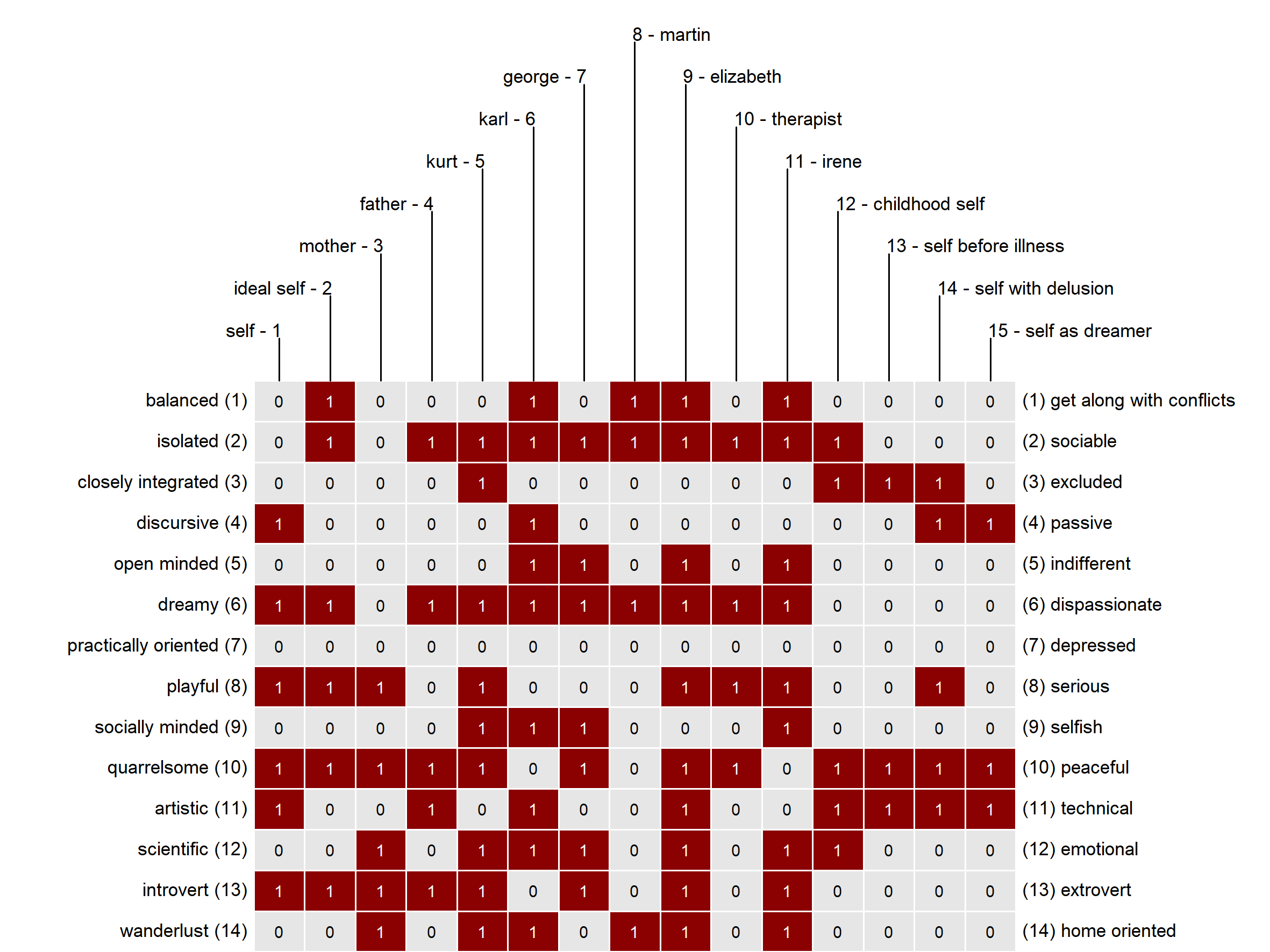
etc. In our example in Figure 1, the elements are a set of persons
relevant to the grid interviewee, for example, *father*, *mother*,
*self*, or *ideal self*. The quantitative part of a grid is generated by
letting the interviewee assign a score (e.g. 0/1, or 1 to 6) to each
element on each of his/her bipolar constructs. The result of the RGT is
usually displayed as a constructs *x* elements matrix with the cells
containing the ratings of each element on each construct. Figure 1 shows
a grid matrix where binary ratings (0/1) were used to assess the
elements. For example, the element *father* received a score of 1 on the
*isolated = 0 vs. sociable = 1* construct, indicating that the father is
construed as sociable. The *mother*, in contrast, received a score of 0
and is thus construed as isolated. The grid matrix is the central result
of the RGT and yields a) a set of bipolar constructs which are relevant
to the person and b) an assessment of each element (persons in Figure 1)
on these dimensions. The white/red color coding in Figure 1 additionally
indicates which construct poles (white = left, red = right) apply and
facilitates to identify similarities between elements. In its original
form (Kelly 1955) and in our example, grid ratings are binary (0/1),
i.e., each element is assigned to one construct pole. Nowadays, also
scales with more grades (e.g. 1 to 6) are common. A general and more
comprehensive introduction to the RGT can be found in Fransella, Bell,
and Bannister (2004).
Figure 1: Example of a binary
repertory grid dataset. The data is a binarized version of a grid from
Böker
(1996)
## Interpretive Clustering
IC is an idiographic method of interpretation which makes use of both,
the qualitative and the quantitative grid data. In contrast to thematic
analysis or content analysis, which could be used to identify themes in
person’s elicited constructs (see Braun and Clarke 2006), IC identifies
the relation between the constructs via quantitative assessment. By
assessing the quantitative construct relations, implications which
constructs hold for each other are identified. IC essentially identifies
clusters of constructs which hold implications for each other. These
clusters (or cliques) of constructs form the basis for a subsequent
qualitative interpretation. We will provide a brief interpretation
example below. The example builds on the analysis results the software
generates as shown next. However, for a more thorough introduction to
the IC method and comprehensive illustrations of interpretations, the
reader is referred to our publication [Burr, King, and Heckmann
(2020)](https://doi.org/10.1080/14780887.2020.1794088). Please note that
the IC method only allows for binary grid ratings.
## Installing and running the software
The package can be downloaded from the CRAN repository via the R command
`install.packages("OpenRepGrid.ic")`. The software is then started as
follows.
library(OpenRepGrid.ic)
ic()
Also, we provide a docker image under
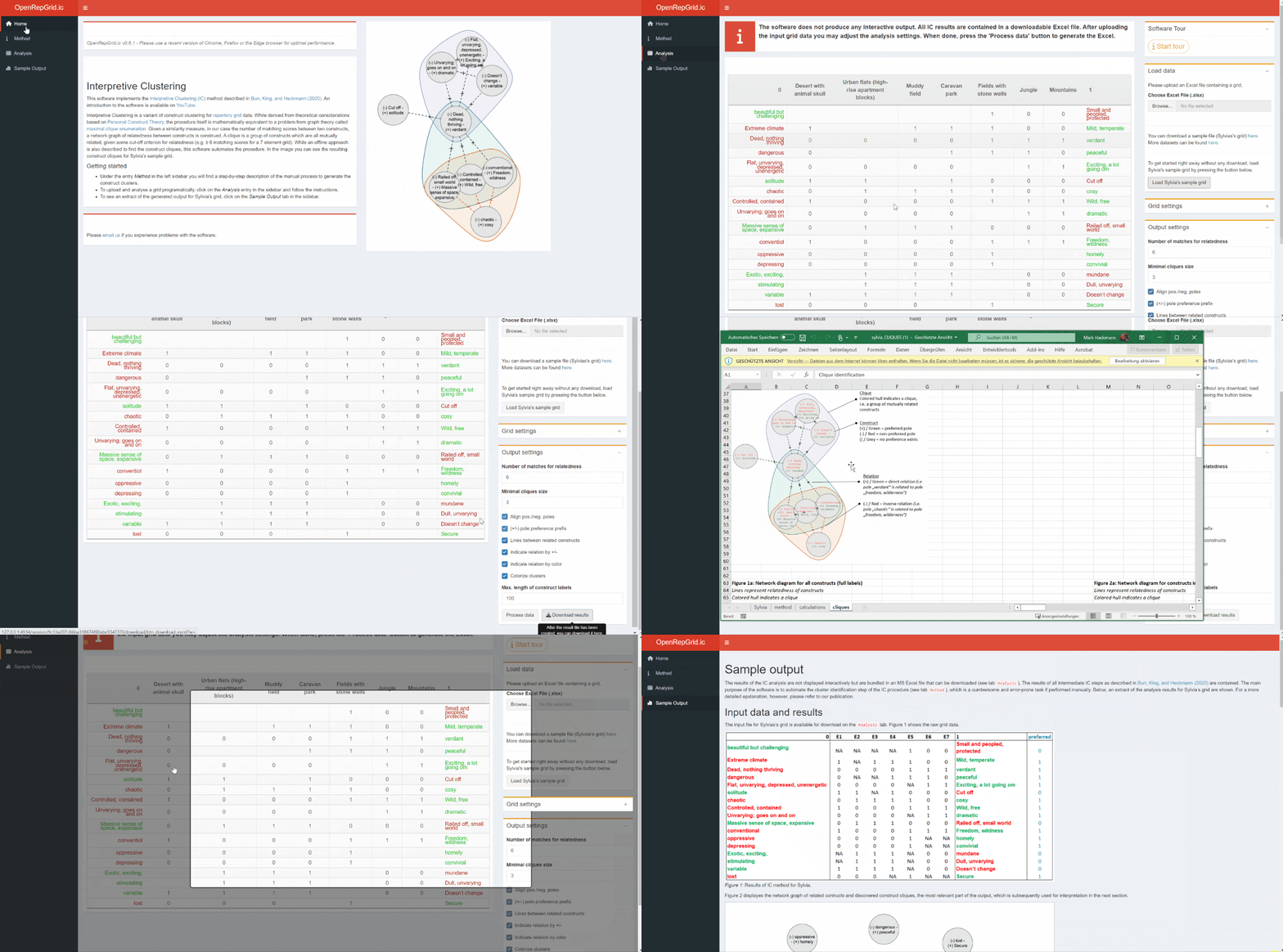
with a short instruction on how to run it locally. A video of the
software is displayed in Figure 2. It shows the various tabs and
processes a grid dataset from an interview with *Sylvia* which is also
contained in the package.
The results of the IC analysis are not displayed interactively but are
included in an MS Excel file that can be generated and downloaded. Also
the results of the intermediate IC steps as described in [Burr, King,
and Heckmann (2020)](https://doi.org/10.1080/14780887.2020.1794088) are
contained. The main purpose of the software is to automate the cluster
identification step of the IC procedure, which is a cumbersome and
error-prone task if performed manually. In Figure 3, an extract of the
analysis results for Sylvia’s grid and corresponding analysis settings
as shown in Figure 2 are displayed and subsequently discussed.
Figure 3: Results of IC method
for Sylvia.
## Interpretation
Psychologically relevant information can be obtained from the
interpretation of the network graphs. What follows is a shortened
example. More comprehensive examples are outlined in our publication.
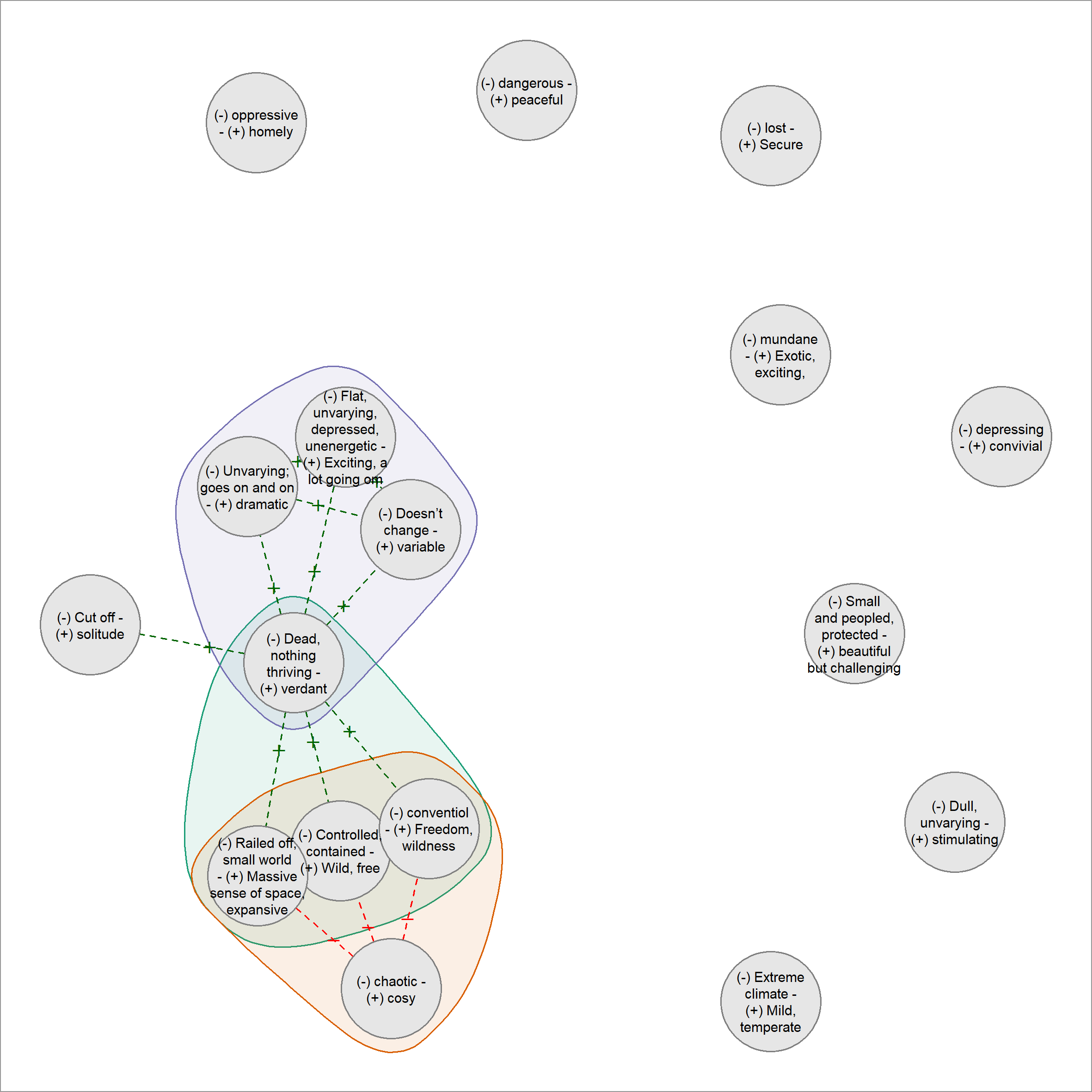
In the resulting diagram for Sylvia’s grid in Figure 3, a construct is
indicated by a circle, with (+) denoting the preferred and (-) the
non-preferred pole. The diagram shows three clusters (also called
cliques), indicated by the colored hulls around several constructs. In
Sylvia’s case, the three clusters are highly overlapping. Two of these
are of particular interest, sharing a ‘core’ of three constructs – ‘(+)
Wild, free *vs* (-) controlled, contained’, ‘(+) Massive sense of space,
expansive *vs* (-) railed-off, small world’ and ‘(+) Freedom, wildness
*vs* (-) conventional’, with (+) indicating the preferred and (-) the
non-preferred pole. In one cluster, these three constructs are strongly
associated with ‘(+) Verdant *vs* (-) dead, nothing thriving’; the
association between her preferred poles suggests that she is drawn to
places that are thriving and green, wild and expansive, as opposed to
those which lack life, are small-scale, controlled and conventional.
However, these three constructs share another cluster with the construct
‘(+) Cosy *vs* (-) Chaotic’, where ‘cosy’ is her preferred pole. In this
cluster, however, her desires for the wild, free and expansive appear to
be in tension with her desire for the ‘cosy’, as they are aligned with
her non-preferred pole ‘chaotic’. The attraction of wild, free spaces
for Sylvia is therefore not straightforward.
The third cluster includes the ‘(+) Verdant *vs* (-) dead, nothing
thriving’ construct, which is here associated with ‘(+) Exciting, a lot
going on *vs* (-) flat, unvarying, depressed, unenergetic’, ‘(+)
Dramatic *vs* (-) unvarying, goes on and on’ and ‘(+) Variable *vs* (-)
doesn’t change’. This suggests that to Sylvia ‘verdant’ spaces are also
full of excitement, drama and variability- they are full of life in
these ways. However, the fact that these three constructs do not cluster
with the wild/expansive/freedom constructs indicates that they
constitute a somewhat separate idea for her. A ‘wild’ space for her need
not be ‘exciting’, for example, although a ‘verdant’ space is likely to
be both exciting and wild. Interpretive clustering therefore gives us
insight into some of the complexity of Sylvia’s construing.
## Contributing
In order to maximize the package’s usefulness for the research
community, we welcome participation in the package’s development.
Experienced R programmers are asked to make pull requests to the
[`OpenRepGrid.ic` GitHub
repository](https://github.com/markheckmann/OpenRepGrid.ic), [report
issues](https://github.com/markheckmann/OpenRepGrid.ic/issues), or
commit code snippets. Non-technical oriented researchers are invited to
send us feature requests or suggestions for improvement.
## References
Böker, Heinz. 1996. “The Reconstruction of the Self in the Psychotherapy
of Chronic Schizophrenia: A Case Study with the Repertory Grid
Technique.” In *Empirical Constructivism in Europe: The Personal
Construct Approach*, edited by Jörn W. Scheer and Ana Catina, 160–67.
Giessen: Psychosozial-Verlag.
Braun, Virginia, and Victoria Clarke. 2006. “Using Thematic Analysis in
Psychology.” *Qualitative Research in Psychology* 3 (2): 77–101.
.
Burr, Viv, Nigel King, and Mark Heckmann. 2020. “The Qualitative
Analysis of Repertory Grid Data: Interpretive Clustering.” *Qualitative
Research in Psychology* 0 (0): 1–25.
.
Fransella, Fay, Richard C. Bell, and Donald Bannister. 2004. *A Manual
for Repertory Grid Technique*. 2nd ed. Chichester: John Wiley & Sons.
Kelly, George Alexander. 1955. *The Psychology of Personal Constructs*.
New York: Norton.