# OpenRepGrid: An R Package for the Analysis of Repertory Grid Data
[](https://CRAN.R-project.org/package=OpenRepGrid)
[](https://cran.rstudio.com/web/packages/OpenRepGrid/index.html)
[](https://cran.r-project.org/package=OpenRepGrid)
[](https://github.com/markheckmann/OpenRepGrid)
[](https://github.com/markheckmann/OpenRepGrid/actions/workflows/R-CMD-check.yaml)
[](https://ci.appveyor.com/project/markheckmann/OpenRepGrid)
[](https://codecov.io/gh/markheckmann/OpenRepGrid?branch=master)
[](https://www.repostatus.org/#active)
[](https://joss.theoj.org/papers/88b1ba29095623f416d9fe944afe5cd8)
[](https://github.com/sponsors/markheckmann)
> You love repertory grids? So do we! Find out about a powerful tool to
> analyze your grids!
## About
**OpenRepGrid** is an R package to analyze and visualize [repertory
grid](https://en.wikipedia.org/wiki/Repertory_grid) data. The repertory
grid (often abbreviated *grid* or *repgrid*) is a data collection method
which originated from [Personal Construct
Theory](https://en.wikipedia.org/wiki/Personal_construct_theory) (Kelly
1955). It was originally designed as an instrument for psychotherapy.
Nowadays, it is used in many other fields, including market,
organizational, political, educational and sensory research. See
[here](https://docs.openrepgrid.org/articles/web/intro) for a brief
introduction.
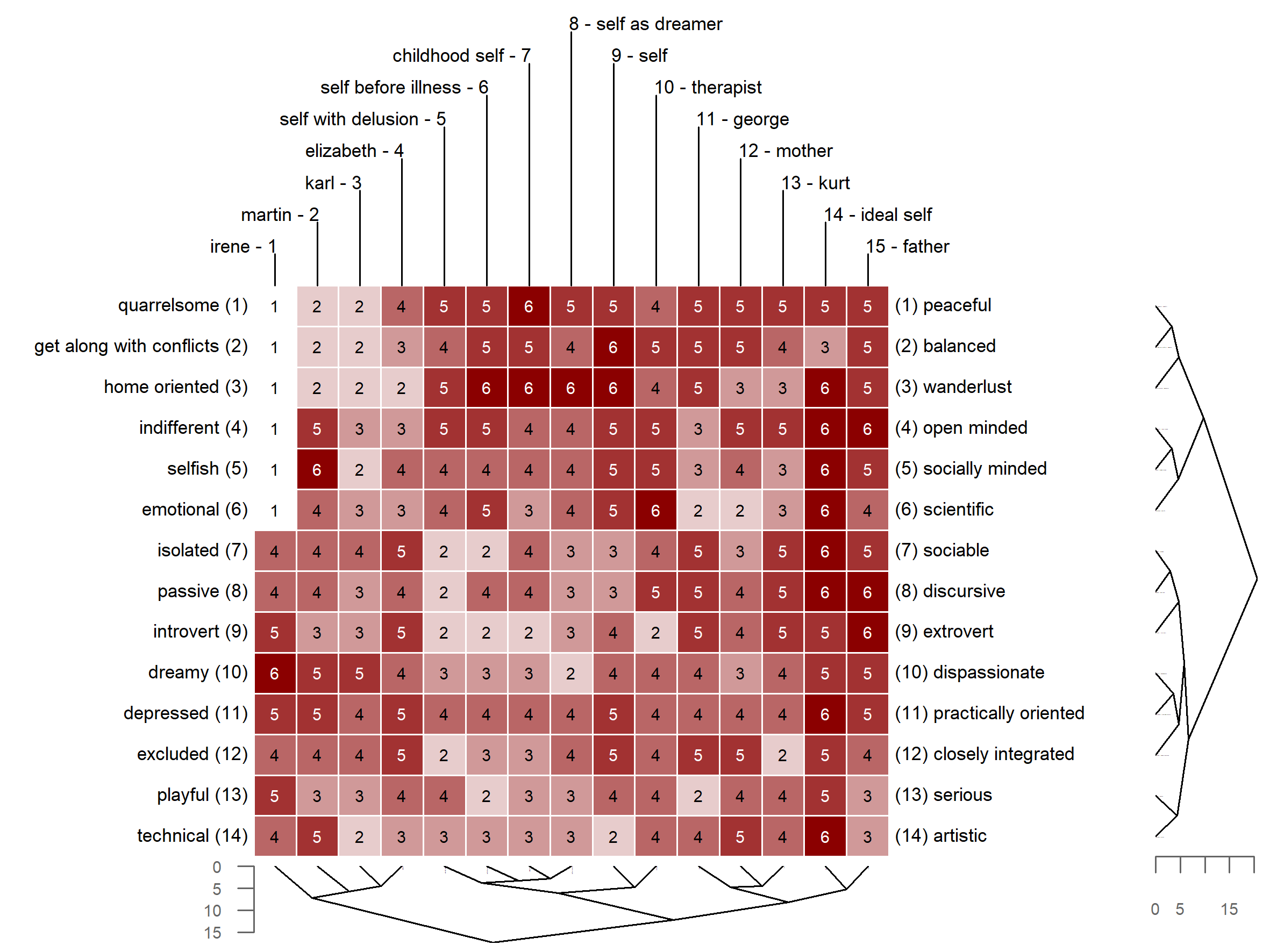
Figure 1. Example of a
repertory grid dataset (with rows and columns clustered by
similarity).
## Installation
Install the latest release version from
[CRAN](https://cran.r-project.org/web/packages/OpenRepGrid/index.html)
install.packages("OpenRepGrid", dep = TRUE)
Install a development version from github by referencing a the dev
branch (e.g., `0.1.19`):
library(devtools)
install_github("markheckmann/OpenRepGrid@01.1.19")
To load the OpenRepGrid package after installation type
library(OpenRepGrid)
And for a first impression of the package features type
demo(OpenRepGrid)
## Documentation
Visit the package documentation website:
## Questions
If you get stuck, you can get help on
[StackOverflow](https://stackoverflow.com/):
- Make sure to read [How to write a good R question with a reproducible
example](https://stackoverflow.com/collectives/r-language/articles/76995406/how-to-write-a-good-r-question-with-a-reproducible-example)
before posting your question
- Add the tags `R` and `openrepgrid` to your question
## Contributing to OpenRepGrid
You can contribute to OpenRepGrid in various ways. You can, for example,
file a bug report, help improve the documentation or write code. See the
our [contributing guide](https://docs.openrepgrid.org/CONTRIBUTING.html)
for detailed information.
Anyone getting involved in this package agrees to our [Code of
Conduct](https://github.com/markheckmann/OpenRepGrid/blob/master/CODE_OF_CONDUCT.md).
If our software makes your life easier, consider sponsoring us — think
of it as buying us a coffee while we keep hacking away!
[](https://github.com/sponsors/markheckmann)
#### Authors
- [Mark Heckmann](https://markheckmann.de) (package maintainer)
#### Contributors
- Richard C. Bell
- Alejandro García Gutiérrez ([@j4n7](https://github.com/j4n7))
- Diego Vitali ([@artoo-git](https://github.com/artoo-git))
- José Antonio González Del Puerto
([@MindCartographer](https://github.com/MindCartographer))
- Jonathan D. Raskin
## References
Kelly, George Alexander. 1955. *The Psychology of Personal Constructs*.
New York: Norton.