OpenMed README banner with the cat mascot, lowercase wordmark, Open Cross, and the text Open-source healthcare AI, 340M+ downloads, and 10M+ installs

Your Data. Your Model. Your Hardware.

Turn clinical text into structured, de-identified insight on hardware you control.
OpenMed's core local runtime performs extraction and de-identification after required model artifacts are available. Model downloads, remote-provider adapters, telemetry-enabled paths, and user-configured integrations may use a network; review each model and dataset's terms.

PyPI package · Python 3.11+ · Model catalog · Research paper · Apache-2.0 SDK source

OpenMedKit · Apple Silicon / MLX · Android / ONNX Runtime Mobile · Browser / Transformers.js · Documentation

2,266 manifest entries  ·  35 model-backed PII languages  ·  Apache-2.0 SDK

English · 简体中文 · Español · Français · Deutsch · Italiano · Português · Nederlands · العربية · हिन्दी · తెలుగు · 日本語 · Türkçe · فارسی · Kiswahili
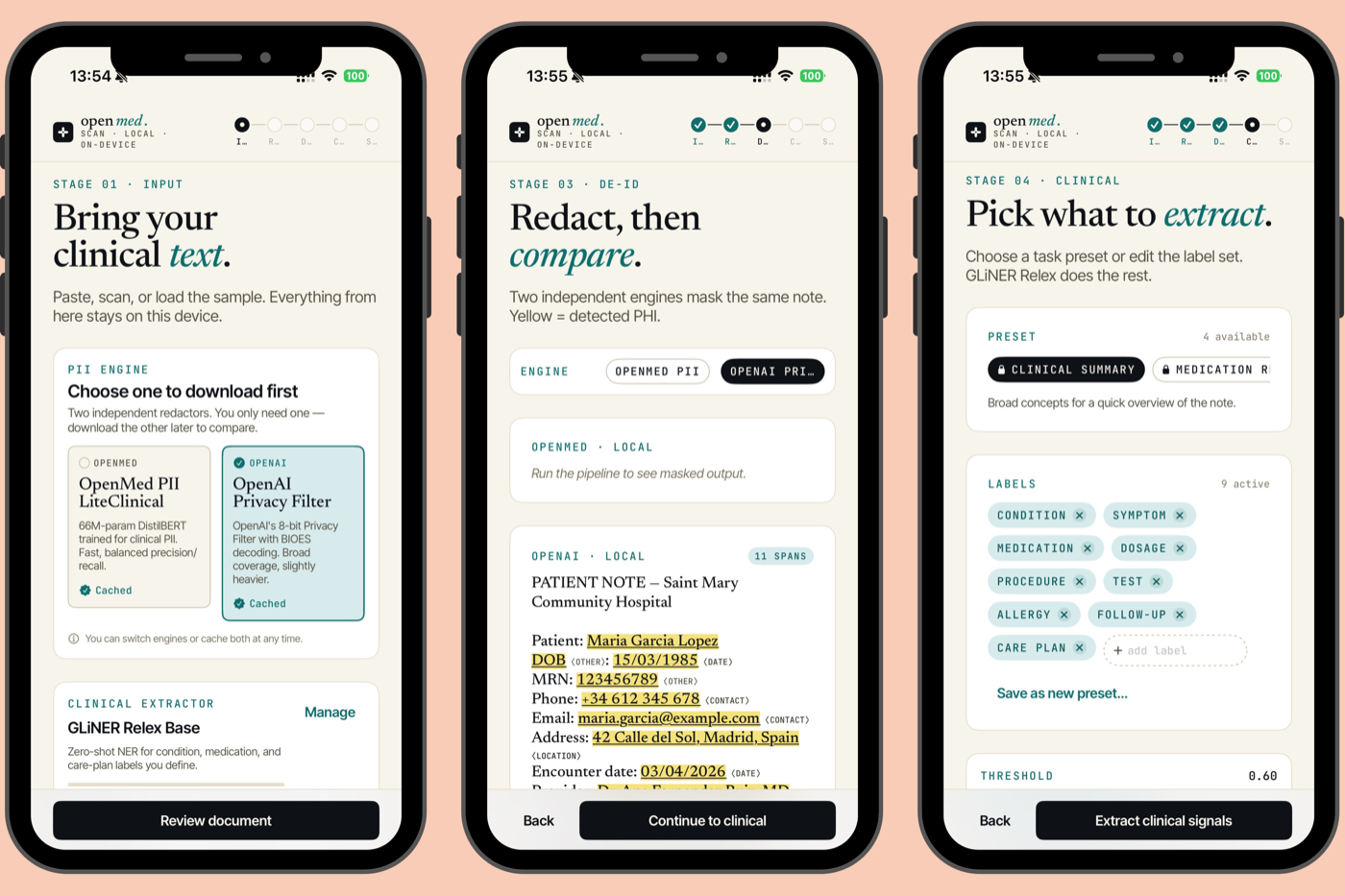
--- ## See it in action This iPhone example uses OpenMed's local runtime after the required model artifacts are available:
OpenMed Scan on iPhone · on-device PII de-identification and clinical extraction via OpenMedKit
On iPhone via OpenMedKit: scan a clinical note, de-identify it, and extract clinical signals with Apple MLX processing locally in this configuration.

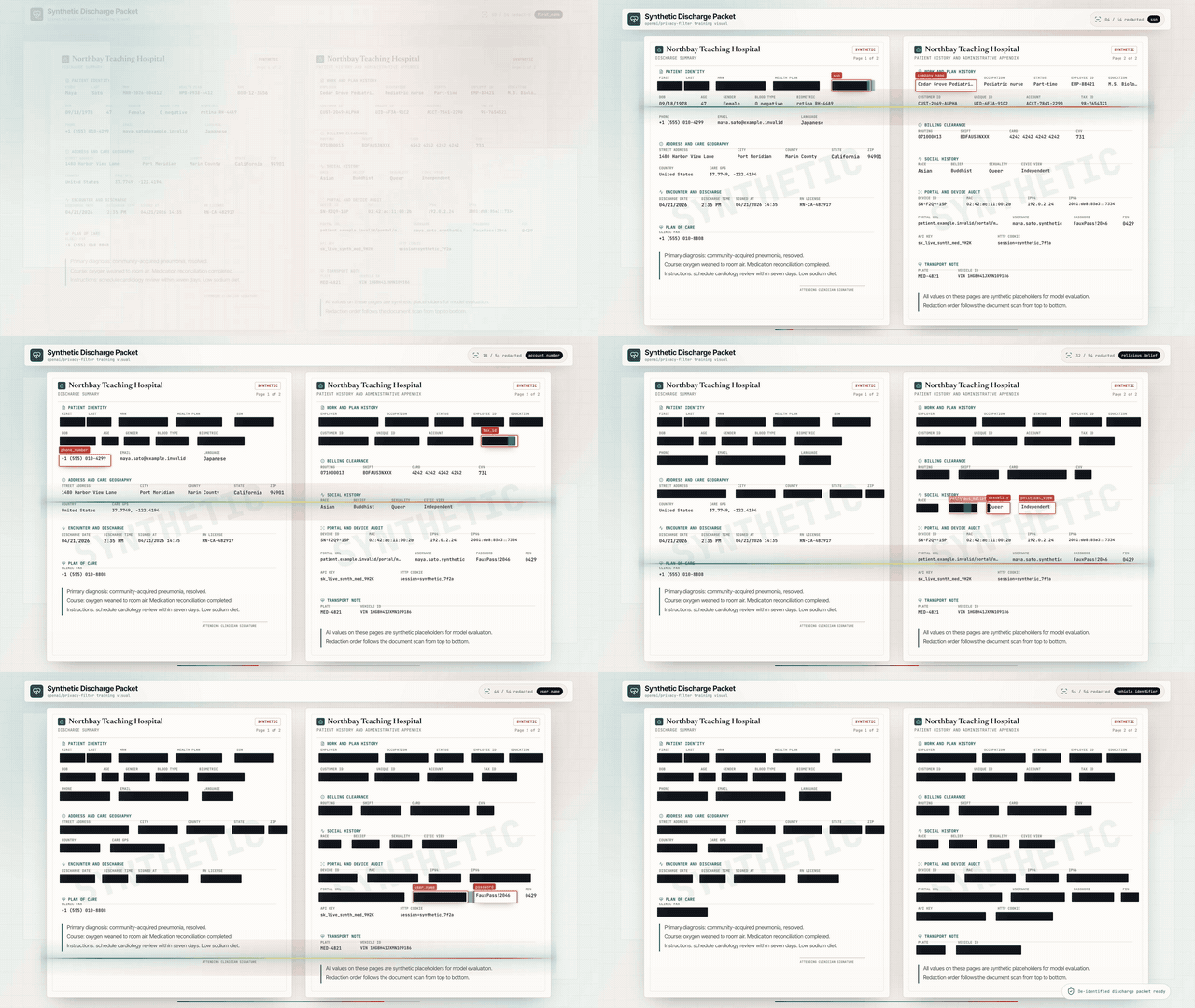
OpenMed redacting PII from a clinical discharge document in real time
Real-time PII de-identification: in this configured local workflow, the Nemotron Privacy Filter redacts names, addresses, IDs, and billing data from a synthetic clinical discharge packet. (All values shown are synthetic.)
--- ## 30-second example ```python from openmed import analyze_text result = analyze_text( "Patient started on imatinib for chronic myeloid leukemia.", model_name="disease_detection_superclinical", ) for entity in result.entities: print(f"{entity.label:<12} {entity.text:<28} {entity.confidence:.2f}") # DISEASE chronic myeloid leukemia 0.98 # DRUG imatinib 0.95 ``` A clinical NER model using the local runtime after its required artifacts are available. --- ## Clinical brief in 30 seconds From a source checkout, run the CPU-only synthetic contract demonstration: ```bash python examples/v30_clinical_brief.py # Optional: --model mlx, with the pinned model already cached on Apple silicon. ``` It de-identifies an embedded note, extracts and grounds a finding, then prints a cited brief, verdicts and a value-free review packet. **NER/NLI providers are explicit synthetic test doubles, not trained-model or clinical validation.** No external note input is accepted. The MLX option may refuse unsupported output; it never bypasses the guards. See the [brief guide](docs/clinical/clinical-brief.md) and [demo script](docs/demo/clinical-brief.md) for the boundaries and local setup. --- ## Building with an agent? Start with the [consumer agent-usage guide](docs/agent-usage.md), or load the curated [llms.txt](https://openmed.life/docs/llms.txt) documentation index. For callable local interfaces, use the [MCP server](docs/mcp-clients.md), the typed [tool registry](openmed/mcp/tool_registry.py), or the [command-line interface](docs/agent-usage.md#command-line-interface). Ready-made cross-tool procedures live in the [repository skills catalog](skills/README.md). --- ## Why OpenMed? | Deployment consideration | OpenMed SDK boundary | | --- | --- | | Core runtime | Processes locally after required artifacts are available | | Optional network paths | Downloads, remote adapters, telemetry-enabled paths, and user integrations may use a network | | Validation | Deployment owners validate model and dataset terms, privacy behavior, and clinical fitness | | Interfaces | Python, Swift, Android, browser, and service surfaces where supported | - **Curated model catalog**: validate each model, license, and dataset for your use case. - **Safe Harbor-aligned configuration**: can target the 18 identifier categories; expert deployment review remains required, and use of the SDK does not itself establish HIPAA compliance. - **Supported execution paths**: CPU, CUDA, MLX, mobile, service, and browser adapters vary by environment and artifact. - **Deployment interfaces**: Python, containers, services, and batch workflows require configuration and validation. - **SDK source**: released under the Apache-2.0 License; model and dataset terms vary. --- ## On-device on Apple: Swift, MLX & iOS On supported Apple hardware, OpenMed can use **MLX** and **[OpenMedKit](swift/OpenMedKit)** for local processing after required artifacts are available. Model acquisition and any user-configured remote integrations remain separate network boundaries. ```swift // Add OpenMedKit to your app dependencies: [ .package(url: "https://github.com/maziyarpanahi/openmed.git", from: "3.3.0"), ] ``` Expected result: Swift Package Manager resolves OpenMedKit and makes `import OpenMedKit` available to your app target. - **MLX runtime** for PII token classification, the Privacy Filter family, experimental GLiNER-family zero-shot tasks, and Python MLX-LM text generation with Laneformer; includes a CoreML fallback path for supported token-classification artifacts. - **Portable model naming where supported**: an MLX model name can fall back to a matching PyTorch checkpoint when that mapping and artifact are available on non-Apple hardware. - **Python on Apple Silicon** too: `pip install --upgrade "openmed[mlx]"`. Guides: [MLX backend](docs/mlx-backend.md) · [OpenMedKit (Swift)](docs/swift-openmedkit.md) · [CoreML export](docs/coreml-export.md)
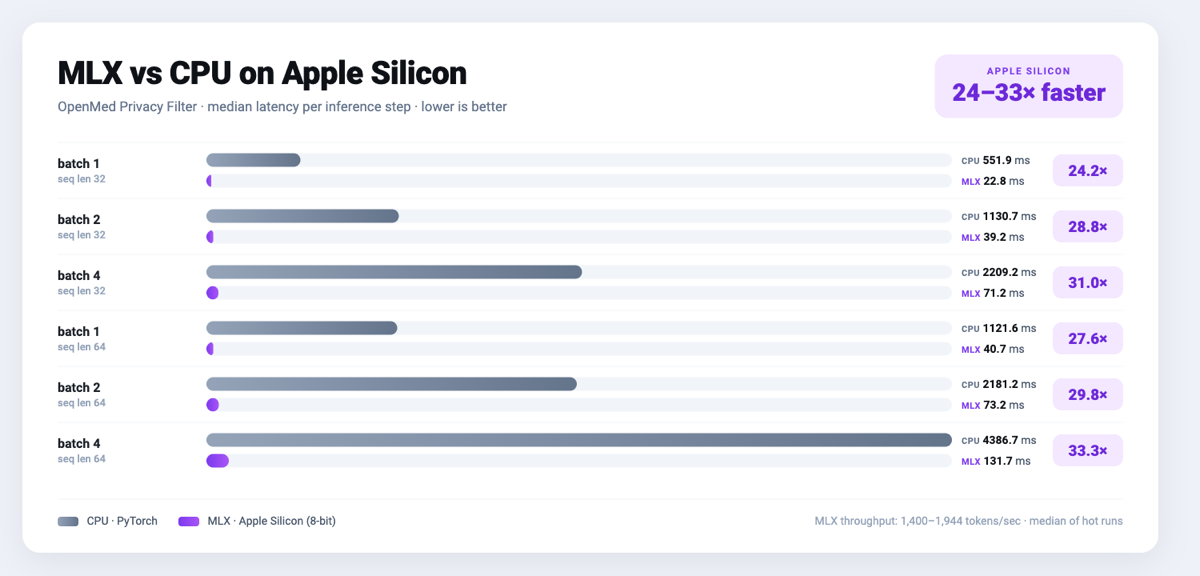
MLX vs CPU latency on Apple Silicon: 24 to 33 times faster
MLX on Apple Silicon: 24–33× faster than CPU PyTorch for the Privacy Filter: median latency per inference step, lower is better.
--- ## On-device on Android — Kotlin & ONNX Runtime Mobile OpenMedKit also ships as a native Android/Kotlin library for local document intake, OCR handoff, PII redaction, and token-classification inference through **ONNX Runtime Mobile**. Mobile model repositories include stable tensor names, dynamic sequence axes, tokenizer files, labels, and Android-ready fp32, fp16, INT8, and optional `.ort` outputs. Add the scoped JitPack repository in `settings.gradle.kts`: ```kotlin dependencyResolutionManagement { repositories { google() mavenCentral() maven { url = uri("https://jitpack.io") content { includeGroup("com.github.maziyarpanahi") } } } } ``` Then use the immutable OpenMed `v3.3.0` release: ```kotlin dependencies { implementation("com.github.maziyarpanahi:openmed:v3.3.0") } ``` See the [Android installation guide](android/README.md) for local builds and publishing details. ```kotlin val model = OpenMedKit.fromDirectory(modelDir) val entities = model.analyzeText("Patient Alice Nguyen was seen in cardiology.") ``` - **Android ONNX profile** emits `model.onnx`, `model_fp16.onnx`, `model_int8.onnx`, tokenizer assets, labels, and `openmed-onnx.json`. - **ORT Mobile support** records the minimal-build operator configuration when ONNX Runtime conversion tooling is installed. - **Kotlin parity tests** keep tokenizer offsets, span boundaries, and decoder output aligned with the Python runtime. Guides: [Android ONNX export](docs/export-onnx-android.md) · [Android span parity](docs/android-parity.md) · [OpenMedKit Android](android/openmedkit) ### The same ONNX model on Python CPU ```python from openmed import OnnxModel model = OnnxModel.from_pretrained( "OpenMed/OpenMed-PII-ClinicalE5-Small-33M-v1-onnx-android" ) entities = model("Patient Alice Nguyen was seen in cardiology.") ``` ### The same ONNX model in the browser ```bash npm install openmed @huggingface/transformers ``` ```typescript import { loadOnnxModel } from "openmed"; const model = await loadOnnxModel( "OpenMed/OpenMed-PII-ClinicalE5-Small-33M-v1-onnx-android", ); const entities = await model("Patient Alice Nguyen was seen in cardiology."); ``` --- ## How it works ```mermaid flowchart LR A["Clinical text"] --> B["OpenMed
(local-first)"] B --> C["Medical entities"] B --> D["PII detected"] B --> E["De-identified text"] style B fill:#0D6E6E,stroke:#0A5656,stroke-width:2px,color:#ffffff style C fill:#D6EBEB,stroke:#0D6E6E,color:#0E1116 style D fill:#F7DCD8,stroke:#C5453A,color:#0E1116 style E fill:#F5E27A,stroke:#A9A088,color:#0E1116 ``` Rendered result: a local clinical-text pipeline that returns medical entities, PII findings, and de-identified text without sending data to a cloud API. --- ## Agent Skills — build with OpenMed from your coding agent The [`skills/`](skills/) catalog ships portable [Agent Skills](https://agentskills.io) for on-device de-identification, clinical NER, FHIR export, evaluation, and the healthcare workflows around them. The same `SKILL.md` folders work in **Claude Code**, **OpenAI Codex**, **OpenCode**, and compatible agents; the installer uses each client's skills directory plus the cross-client `~/.agents/skills` convention. ```bash git clone https://github.com/maziyarpanahi/openmed && cd openmed ./install-skills.sh # installs for Claude Code, Codex, OpenCode, and ~/.agents/skills ``` Then ask your agent for the pipeline using synthetic placeholders: > Build a local OpenMed pipeline that de-identifies a synthetic discharge note and extracts medication entities. It loads the right skills and produces an on-device pipeline (`openmed.deidentify(...)` → `openmed.analyze_text(...)`). After the one-time model download, run that pipeline locally on real notes; do not paste real PHI into a cloud-hosted agent prompt. See the **[skills catalog and 30-second example](skills/README.md)**. --- ## Quick start ```bash # Core + Hugging Face runtime (Linux, macOS, Windows; CPU or CUDA) pip install --upgrade "openmed[hf]" # Add the REST service pip install --upgrade "openmed[hf,service]" # Apple Silicon acceleration (MLX) pip install --upgrade "openmed[mlx]" ``` Expected result: ```text Successfully installed openmed-... ```
**Python API** ```python from openmed import analyze_text result = analyze_text( "Patient received 75mg " "clopidogrel for NSTEMI.", model_name= "pharma_detection_superclinical", ) print([(e.label, e.text) for e in result.entities]) ``` Example output: ```text [('DRUG', 'clopidogrel'), ('CONDITION', 'NSTEMI')] ``` **REST service** ```bash python -m openmed.service.logging \ --host 0.0.0.0 --port 8080 ``` Example output: ```text INFO: Uvicorn running on http://0.0.0.0:8080 GET /health -> 200 OK ``` `GET /health` `POST /analyze` `POST /pii/extract` `POST /pii/deidentify` **Batch** ```python from openmed import BatchProcessor p = BatchProcessor( model_name= "disease_detection_superclinical", group_entities=True, ) results = p.process_texts([...]) print(len(results), sum(len(r.entities) for r in results)) print([(e.label, e.text) for e in results[0].entities[:1]]) ``` Example output: ```text 3 7 [('DISEASE', 'leukemia')] ```
**Browser / WebGPU** Package ONNX token-classification exports for in-browser inference through Transformers.js: ```bash python -m openmed.onnx.convert \ --model dslim/bert-base-NER \ --output dist/example-onnx \ --include-transformersjs ``` Example output: ```text Exported Transformers.js bundle to dist/example-onnx ``` ```javascript import { pipeline } from "@huggingface/transformers"; const detector = await pipeline( "token-classification", "/models/openmed-pii/transformersjs", { device: "webgpu" }, ); const entities = await detector("Patient Casey Example called 212-555-0198."); console.log(entities.slice(0, 2)); ``` Example output: ```javascript [ { entity: "NAME", word: "Casey Example", score: 0.99 }, { entity: "PHONE", word: "212-555-0198", score: 0.98 }, ] ``` [Transformers.js export guide](docs/export-transformersjs.md) **Offline / air-gapped?** Point `model_name` (or `model_id`) at a local directory and OpenMed loads it without contacting the Hugging Face Hub: ```python from openmed import OpenMedConfig, analyze_text result = analyze_text( "Patient presents with chronic myeloid leukemia and Type 2 diabetes.", model_id="./models/OpenMed-NER-DiseaseDetect-SuperClinical-434M", config=OpenMedConfig(device="cpu"), ) for entity in result.entities: print(f"{entity.label:<12} {entity.text:<28} {entity.confidence:.2f}") ``` Example output: ```text DISEASE chronic myeloid leukemia 0.98 DISEASE Type 2 diabetes 0.96 ``` Because `model_id` points to a local directory, this example does not contact the Hugging Face Hub or any external model provider. --- ## Models A curated registry of specialized medical NER models; browse the [full catalog](https://openmed.life/docs/model-registry). | Model | Specialization | Entity types | Size | |-------|----------------|--------------|------| | `disease_detection_superclinical` | Disease & conditions | DISEASE, CONDITION, DIAGNOSIS | 434M | | `pharma_detection_superclinical` | Drugs & medications | DRUG, MEDICATION, TREATMENT | 434M | | `pii_superclinical_large` | PII & de-identification | NAME, DATE, SSN, PHONE, EMAIL, ADDRESS | 434M | | `anatomy_detection_electramed` | Anatomy & body parts | ANATOMY, ORGAN, BODY_PART | 109M | | `gene_detection_genecorpus` | Genes & proteins | GENE, PROTEIN | 109M | --- ## Privacy: PII detection & de-identification ```python from openmed import extract_pii, deidentify text = "Patient: John Doe, DOB: 01/15/1970, SSN: 123-45-6789" # Extract PII with smart merging (prevents tokenization fragmentation) result = extract_pii(text, model_name="pii_superclinical_large", use_smart_merging=True) print([(e.label, e.text) for e in result.entities]) # De-identify with the method you need print(deidentify(text, method="mask").deidentified_text) print(deidentify(text, method="replace").deidentified_text) print(deidentify(text, method="hash").deidentified_text) print(deidentify(text, method="shift_dates", date_shift_days=180).deidentified_text) ``` Example output: ```text [('NAME', 'John Doe'), ('DATE', '01/15/1970'), ('SSN', '123-45-6789')] Patient: [NAME], DOB: [DATE], SSN: [SSN] Patient: Emily Chen, DOB: 03/22/1985, SSN: 456-78-9012 Patient: 6b8f...c4a1, DOB: 48b1...91de, SSN: 3f13...e912 Patient: John Doe, DOB: 07/14/1970, SSN: 123-45-6789 ``` - **Smart entity merging** keeps `01/15/1970` whole instead of fragmenting it. - **Policy-aware pipelines** add HIPAA/GDPR/research profiles, calibrated thresholds, signed audit reports, redaction previews, and minimum-necessary action selection. - **Faker-backed obfuscation** with custom clinical-ID providers (CPF, CNPJ, BSN, NIR, Codice Fiscale, NIE, Aadhaar, Steuer-ID, NPI). - **HIPAA boundary**: Safe Harbor-aligned categories and configurable thresholds are implementation aids; expert deployment review remains required, and SDK use alone does not establish compliance. - **Batch and streaming PII**: extract or de-identify across many documents with `BatchProcessor(operation="extract_pii" | "deidentify", batch_size=16)` or incremental streaming helpers.
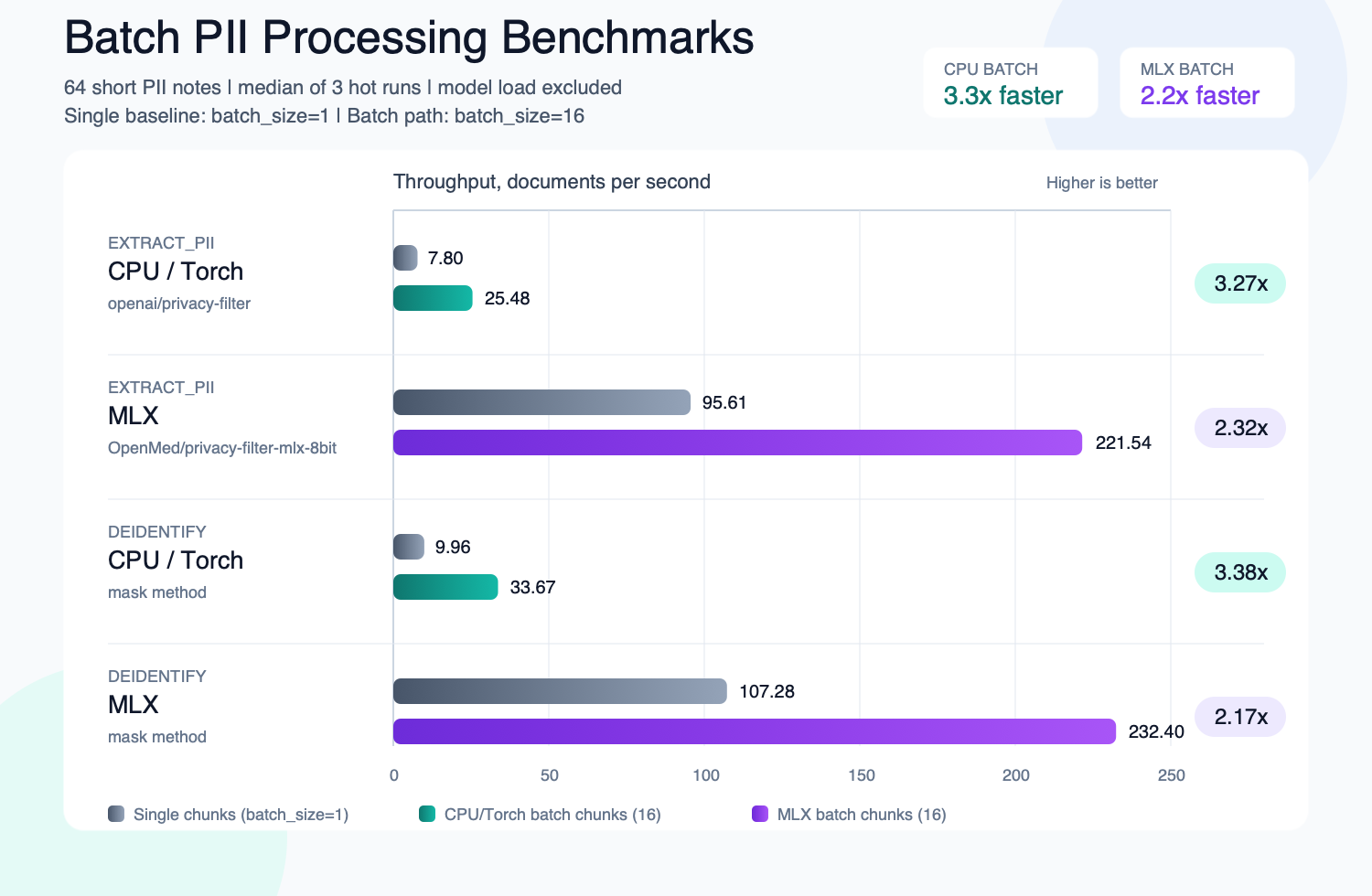
Batch PII processing throughput: up to 3.3x on CPU and 2.2x on MLX
Batch processing: up to 3.3× higher throughput on CPU and 2.2× on MLX vs. one document at a time.
[Complete PII notebook](examples/notebooks/PII_Detection_Complete_Guide.ipynb) · [Smart merging](docs/pii-smart-merging.md) · [Anonymization quickstart](docs/anonymization.md#quickstart-choosing-a-method)
Privacy Filter family: three model families on the OpenAI Privacy Filter architecture
Same model code (gpt-oss-style sparse-MoE transformer with local attention, sink tokens, RoPE+YaRN, tiktoken `o200k_base`), different training data. All route through the **same** `extract_pii()` / `deidentify()` API; only `model_name=` changes. `openai/privacy-filter` is a Hugging Face model identifier for local weights; using it here does not call the OpenAI API. | Variant | PyTorch (CPU + CUDA) | MLX (Apple Silicon) | MLX 8-bit | | --- | --- | --- | --- | | **OpenAI Privacy Filter** | [`openai/privacy-filter`](https://huggingface.co/openai/privacy-filter) | [`OpenMed/privacy-filter-mlx`](https://huggingface.co/OpenMed/privacy-filter-mlx) | [`…-mlx-8bit`](https://huggingface.co/OpenMed/privacy-filter-mlx-8bit) | | **Nemotron-PII fine-tune** | [`OpenMed/privacy-filter-nemotron`](https://huggingface.co/OpenMed/privacy-filter-nemotron) | [`…-nemotron-mlx`](https://huggingface.co/OpenMed/privacy-filter-nemotron-mlx) | [`…-nemotron-mlx-8bit`](https://huggingface.co/OpenMed/privacy-filter-nemotron-mlx-8bit) | | **OpenMed Multilingual** | [`OpenMed/privacy-filter-multilingual`](https://huggingface.co/OpenMed/privacy-filter-multilingual) | [`…-multilingual-mlx`](https://huggingface.co/OpenMed/privacy-filter-multilingual-mlx) | [`…-multilingual-mlx-8bit`](https://huggingface.co/OpenMed/privacy-filter-multilingual-mlx-8bit) | ```python from openmed import extract_pii text = "Patient Sarah Connor (DOB: 03/15/1985) at MRN 4471882." variants = { "baseline": extract_pii(text, model_name="openai/privacy-filter"), "nemotron": extract_pii(text, model_name="OpenMed/privacy-filter-nemotron"), "mlx": extract_pii(text, model_name="OpenMed/privacy-filter-mlx"), } print([(e.label, e.text) for e in variants["baseline"].entities]) ``` Example output: ```text [('NAME', 'Sarah Connor'), ('DATE', '03/15/1985'), ('ID', '4471882')] ``` On non-Apple-Silicon hosts, MLX model names are automatically substituted with the matching PyTorch checkpoint (with a one-time warning): reuse one model name where a matching backend artifact is available. See [Privacy Filter architecture & backend routing](docs/anonymization.md#privacy-filter-family).
--- ## Multilingual PII (42 supported routes; 35 model-backed) Extraction and de-identification support **42 supported PII language codes**: `am`, `ar`, `as`, `bn`, `cs`, `da`, `de`, `el`, `en`, `es`, `fa`, `fr`, `gu`, `he`, `hi`, `id`, `it`, `ja`, `kn`, `ko`, `ml`, `mr`, `nl`, `no`, `or`, `pa`, `pl`, `pt`, `ro`, `ru`, `sv`, `sw`, `ta`, `te`, `th`, `tr`, `uk`, `ur`, `vi`, `xh`, `zh`, and `zu`, with **the registry-backed PII model catalog** in total. Russian routing currently uses a documented multilingual default-model placeholder. Bengali, Chinese, and Tamil have dedicated registry entries. An optional, user-configured Indic NER family can serve Assamese, Bengali, Gujarati, Hindi, Kannada, Malayalam, Marathi, Odia, Punjabi, Tamil, and Telugu. Set `OPENMED_INDIC_NER_MODEL`; OpenMed never bundles or automatically selects those optional weights. OpenMed also includes validator-backed national-ID coverage for additional ID-only locales such as Latvian, Slovak, Malay, Filipino, and Finnish. See the [per-language guide](docs/languages.md) for each code's default PII model, Faker locale, and a before/after de-identification example. ```bash python -c "from openmed import extract_pii; print([(e.label, e.text) for e in extract_pii('Dr. Pedro Almeida, CPF: 123.456.789-09, email: pedro@hospital.pt', lang='pt').entities])" ``` Example output: ```text [('NAME', 'Pedro Almeida'), ('ID', '123.456.789-09'), ('EMAIL', 'pedro@hospital.pt')] ```
Show per-language examples (Portuguese, Dutch, Hindi, Arabic, Japanese, Turkish)
```python from openmed import extract_pii portuguese = extract_pii("Paciente: Pedro Almeida, CPF: 123.456.789-09, telefone: +351 912 345 678", lang="pt", use_smart_merging=True) dutch = extract_pii("Patiënt: Eva de Vries, BSN: 123456782, telefoon: +31 6 12345678", lang="nl", use_smart_merging=True) hindi = extract_pii("रोगी: अनीता शर्मा, फोन: +91 9876543210, पता: नई दिल्ली 110001", lang="hi", use_smart_merging=True) arabic = extract_pii("المريضة ليلى حسن، الهاتف +20 10 1234 5678، الرقم القومي 29801011234567.", lang="ar", use_smart_merging=True) japanese = extract_pii("患者 佐藤 花子、電話 +81 90 1234 5678、マイナンバー 1234 5678 9012.", lang="ja", use_smart_merging=True) turkish = extract_pii("Hasta Ayşe Yılmaz, telefon +90 532 123 45 67, TCKN 10000000146.", lang="tr", use_smart_merging=True) for r in (portuguese, dutch, hindi, arabic, japanese, turkish): print([(e.label, e.text) for e in r.entities]) ``` Example output: ```text [('NAME', 'Pedro Almeida'), ('ID', '123.456.789-09'), ('PHONE', '+351 912 345 678')] [('NAME', 'Eva de Vries'), ('ID', '123456782'), ('PHONE', '+31 6 12345678')] [('NAME', 'अनीता शर्मा'), ('PHONE', '+91 9876543210'), ('ADDRESS', 'नई दिल्ली 110001')] [('NAME', 'ليلى حسن'), ('PHONE', '+20 10 1234 5678'), ('ID', '29801011234567')] [('NAME', '佐藤 花子'), ('PHONE', '+81 90 1234 5678'), ('ID', '1234 5678 9012')] [('NAME', 'Ayşe Yılmaz'), ('PHONE', '+90 532 123 45 67'), ('ID', '10000000146')] ```
--- ## REST API A Docker-friendly FastAPI service with request validation, shared pipeline preload, and unified error envelopes. ```bash pip install --upgrade "openmed[hf,service]" python -m openmed.service.logging --host 0.0.0.0 --port 8080 # or with Docker docker build -t openmed:local . docker run --rm -p 8080:8080 -e OPENMED_PROFILE=prod openmed:local ``` Example output: ```text INFO: Uvicorn running on http://0.0.0.0:8080 ``` ```bash curl -X POST http://127.0.0.1:8080/pii/extract \ -H "Content-Type: application/json" \ -d '{"text":"Paciente: Maria Garcia, DNI: 12345678Z","lang":"es"}' ``` Abbreviated example response: ```json { "text": "Paciente: Maria Garcia, DNI: 12345678Z", "entities": [ {"text": "Maria Garcia", "label": "NAME", "confidence": 0.99, "start": 10, "end": 22}, {"text": "12345678Z", "label": "ID", "confidence": 0.98, "start": 29, "end": 38} ], "model_name": "OpenMed/privacy-filter-multilingual" } ``` **Model lifecycle and service controls:** free memory on demand with `GET /models/loaded`, `POST /models/unload`, and a `keep_alive` idle window; v1.8 also includes API-key/JWT auth, no-PHI request logging, tracing, gRPC, async jobs, webhooks, warm pools, dynamic batching, request coalescing, rate and concurrency limits, `/livez`, `/readyz`, and opt-in metrics: ```bash OPENMED_SERVICE_KEEP_ALIVE=10m python -m openmed.service.logging --host 0.0.0.0 --port 8080 curl -X POST http://127.0.0.1:8080/models/unload -H "Content-Type: application/json" -d '{"all":true}' ``` Example response: ```json { "unloaded": true, "released": {"models": 1, "tokenizers": 1, "pipelines": 1}, "active_models": {} } ``` See the full [REST service guide](docs/rest-service.md). --- ## Documentation Full guides at **[openmed.life/docs](https://openmed.life/docs/)**. AI agents can load the curated [llms.txt](https://openmed.life/docs/llms.txt) index or the inlined [llms-full.txt](https://openmed.life/docs/llms-full.txt) feed. Both are regenerated from the current documentation during every strict MkDocs build. | | | | |---|---|---| | [Getting Started](https://openmed.life/docs/) | [Analyze Text](https://openmed.life/docs/analyze-text) | [Model Registry](https://openmed.life/docs/model-registry) | | [FAQ](docs/faq.md) | [Anonymization](docs/anonymization.md) | [Batch Processing](https://openmed.life/docs/batch-processing) | | [Configuration Profiles](https://openmed.life/docs/profiles) | [REST Service](docs/rest-service.md) | [MLX Backend](docs/mlx-backend.md) | | [Transformers.js Export](docs/export-transformersjs.md) | [FHIR Interop](docs/fhir-interop.md) | [HL7 v2 De-identification](docs/hl7v2-deidentification.md) | | [OpenMed 3.3.0 Migration Guide](docs/migration/3.2-to-3.3.md) | [OpenMed 2.2.0 Release Notes](docs/release/v2.2.0.md) | [Examples](docs/examples.md) | | [Release Streams](docs/release/semver-and-channels.md) | [Generative Model Policy](docs/generative-model-policy.md) | [Contributing](docs/contributing.md) | | [Security Policy](SECURITY.md) | [Compliance Posture](docs/compliance.md) | [Extension Plugin SDK](docs/plugin-sdk.md) | | [v1 to v2 Migration](docs/migration.md) | [MCP Client Connections](docs/mcp-clients.md) | [African Developer Onboarding](docs/africa-onboarding.md) | --- ## Meet the mascot OpenMed mascot OpenMed's guardian is a fluffy Persian cat styled as a tiny **Avicenna (Ibn Sina)**: the great Persian physician whose *Canon of Medicine* was the world's standard medical text for some 600 years. He keeps watch over the open book of medical knowledge, in a palette built around Persian turquoise (*fīrūza*): a local-first guardian for your most private data.
--- ## Contributing Contributions welcome: bug reports, feature requests, and PRs alike. Please read the [Contributing guide](CONTRIBUTING.md) and our [Code of Conduct](CODE_OF_CONDUCT.md) first. - [Open an issue](https://github.com/maziyarpanahi/openmed/issues) - [Contributing guide](CONTRIBUTING.md) · [Code of Conduct](CODE_OF_CONDUCT.md) · [Maintainers](MAINTAINERS.md) · [Security policy](SECURITY.md) - **Translations welcome**: help complete the other-language READMEs linked in the switcher at the top. --- ## Security Found a vulnerability? OpenMed redacts PHI, so a **redaction bypass or PHI/PII leak is a security issue**: please report it **privately**, never as a public issue. See **[SECURITY.md](SECURITY.md)** for the responsible-disclosure policy and the [private reporting form](https://github.com/maziyarpanahi/openmed/security/advisories/new). Never include real patient data in a report. --- ## Credits OpenMed builds on excellent open-source work: particular thanks to **OpenAI** (the [Privacy Filter](https://huggingface.co/openai/privacy-filter) architecture), **NVIDIA** (the [Nemotron PII dataset](https://huggingface.co/datasets/nvidia/Nemotron-PII-v1)), **Hugging Face** (`transformers`, Transformers.js & the model ecosystem), **Apple** ([MLX](https://github.com/ml-explore/mlx)), and the **[Faker](https://faker.readthedocs.io/)** maintainers. ## License The OpenMed SDK source is released under the [Apache-2.0 License](LICENSE). Third-party asset notices are recorded in [NOTICE](NOTICE). ## Citation ```bibtex @misc{panahi2025openmedneropensourcedomainadapted, title={OpenMed NER: Open-Source, Domain-Adapted State-of-the-Art Transformers for Biomedical NER Across 12 Public Datasets}, author={Maziyar Panahi}, year={2025}, eprint={2508.01630}, archivePrefix={arXiv}, primaryClass={cs.CL}, url={https://arxiv.org/abs/2508.01630}, } ``` Expected result: BibTeX-compatible citation metadata for referencing OpenMed in papers, posters, and derived documentation. --- ## Star History If OpenMed is useful to you, a star helps others discover it. [5,700+ GitHub stars · 11 Nov 2026 snapshot](https://github.com/maziyarpanahi/openmed/stargazers) ---
Built by the OpenMed team Website · Docs · X / Twitter · LinkedIn