OpenMed — local-first healthcare AI

Local-first healthcare AI that never leaves the device

Turn clinical text into structured insight with one line of code.
Entity extraction, PII de-identification, and 1,000+ specialized medical models that run entirely on your own hardware — from a one-liner in Python to a native Swift app on iPhone, powered by Apple MLX. No cloud. No vendor lock-in. No patient data leaving your network.

PyPI Python Models arXiv License Stars

Swift — OpenMedKit Apple Silicon — MLX Platforms Docs

1,000+ models  ·  12 languages  ·  247 PII checkpoints  ·  100% on-device  ·  Apache-2.0

English · 简体中文 · Español · Français · Deutsch · Italiano · Português · Nederlands · العربية · हिन्दी · తెలుగు · 日本語 · Türkçe · فارسی
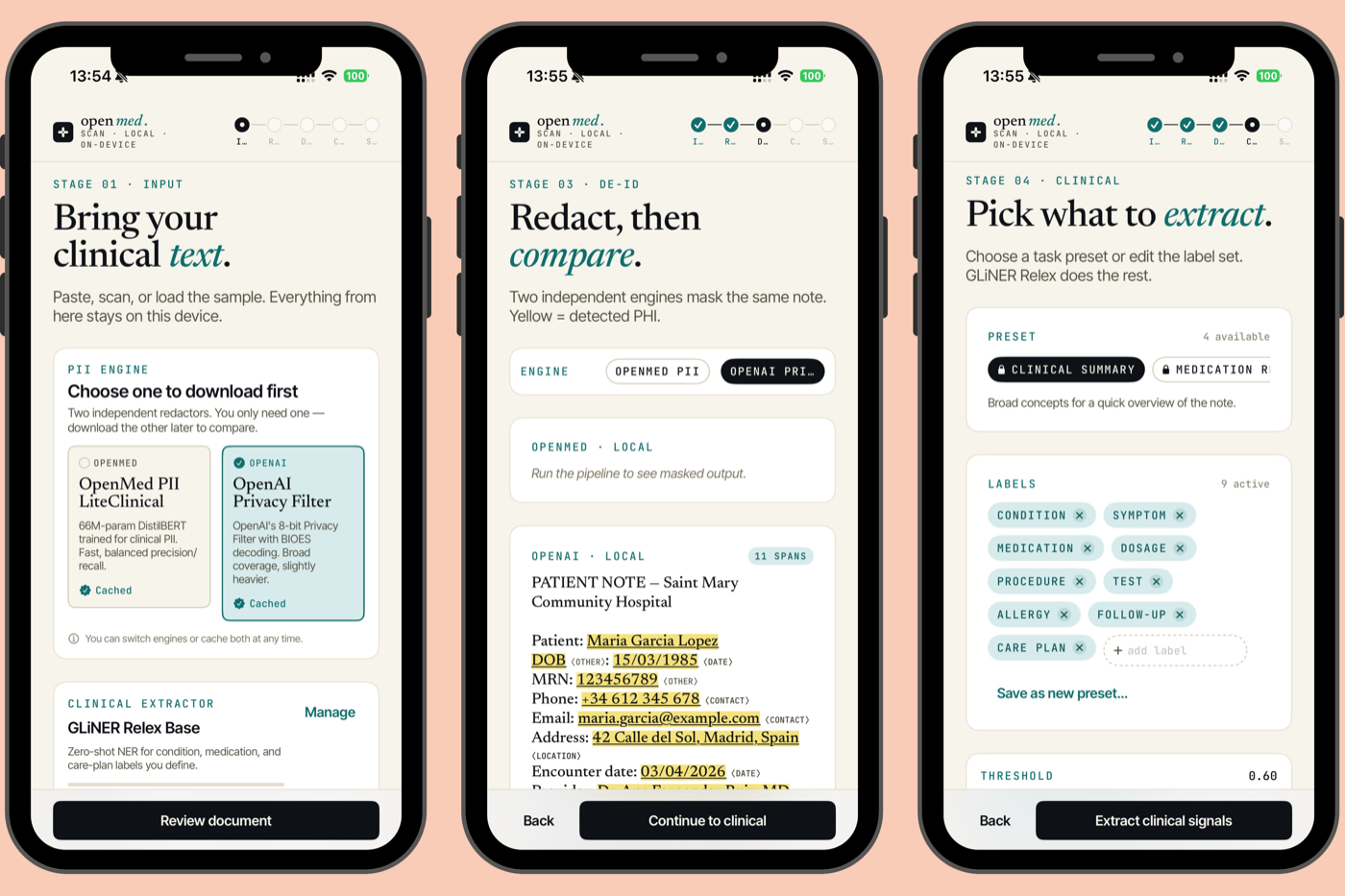
--- ## See it in action OpenMed runs **entirely on the device** — clinical text never leaves it. Here it is on iPhone, fully offline:
OpenMed Scan on iPhone — on-device PII de-identification and clinical extraction via OpenMedKit
On iPhone via OpenMedKit — scan a clinical note, de-identify it, and extract clinical signals, all locally with Apple MLX. Nothing is uploaded.

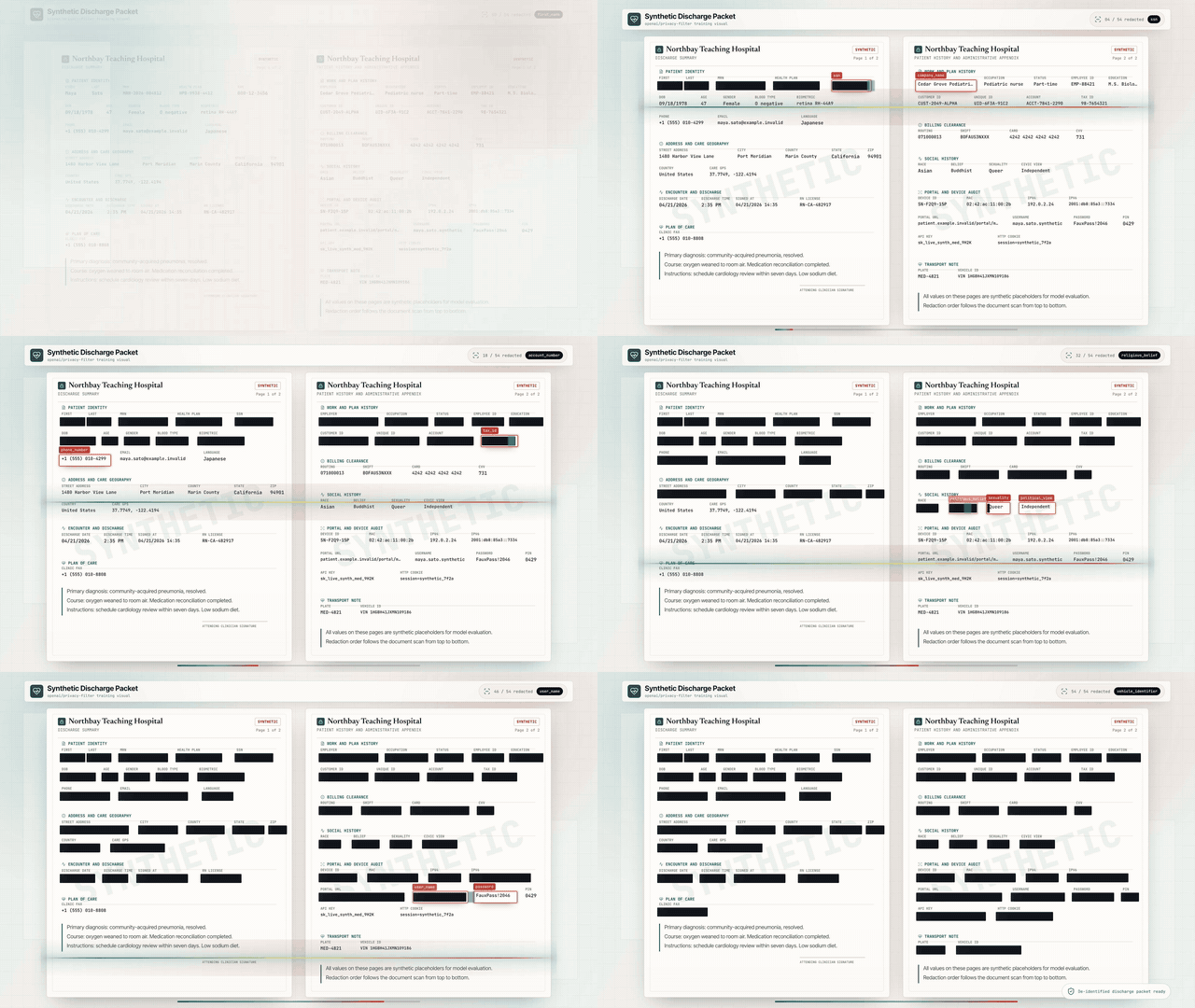
OpenMed redacting PII from a clinical discharge document in real time
Real-time PII de-identification — the Nemotron Privacy Filter redacting names, addresses, IDs, and billing data from a clinical discharge packet, entirely on-device. (All values shown are synthetic.)
--- ## 30-second example ```python from openmed import analyze_text result = analyze_text( "Patient started on imatinib for chronic myeloid leukemia.", model_name="disease_detection_superclinical", ) for entity in result.entities: print(f"{entity.label:<12} {entity.text:<28} {entity.confidence:.2f}") # DISEASE chronic myeloid leukemia 0.98 # DRUG imatinib 0.95 ``` A state-of-the-art clinical NER model running locally — no API key, no network call. --- ## Why OpenMed? | | **OpenMed** | Cloud medical APIs | | ------------------------------------- | :----------------------: | :--------------------: | | Runs on your device / servers | ✅ | ❌ | | Patient data leaves your network | **Never** | Sent to the vendor | | Cost | Free & open-source | Per-call pricing | | Specialized medical models | 1,000+ | Limited | | Languages | 12+ | Varies | | Offline / air-gapped | ✅ | ❌ | | Apple Silicon (MLX) acceleration | ✅ | n/a | | Native iOS / macOS apps | ✅ via OpenMedKit | ❌ | | Vendor lock-in | None — Apache-2.0 | Yes | - **Specialized models** — 1,000+ curated biomedical & clinical models, many outperforming proprietary stacks. - **HIPAA-aware de-identification** — all 18 Safe Harbor identifiers, smart entity merging, format-preserving fakes. - **Runs everywhere** — CPU, CUDA, Apple Silicon (MLX), and natively in iOS/macOS apps via OpenMedKit. - **One-line deployment** — Python API, Dockerized REST service, or batch pipelines. - **Zero lock-in** — Apache-2.0, your infrastructure, your data. --- ## On-device on Apple — Swift, MLX & iOS OpenMed is built to run where your data already lives. On Apple hardware it accelerates with **MLX**, and it ships straight into iPhone, iPad, and Mac apps through **[OpenMedKit](swift/OpenMedKit)** — so PII detection and clinical extraction happen fully offline, on the device. ```swift // Add OpenMedKit to your app dependencies: [ .package(url: "https://github.com/maziyarpanahi/openmed.git", from: "1.5.5"), ] ``` - **MLX runtime** for PII token classification, the Privacy Filter family, and experimental GLiNER-family zero-shot tasks — with a CoreML fallback path. - **One model name, every platform** — MLX model names automatically fall back to the matching PyTorch checkpoint on non-Apple hardware. - **Python on Apple Silicon** too: `pip install "openmed[mlx]"`. Guides: [MLX backend](docs/mlx-backend.md) · [OpenMedKit (Swift)](docs/swift-openmedkit.md) · [CoreML export](docs/coreml-export.md)
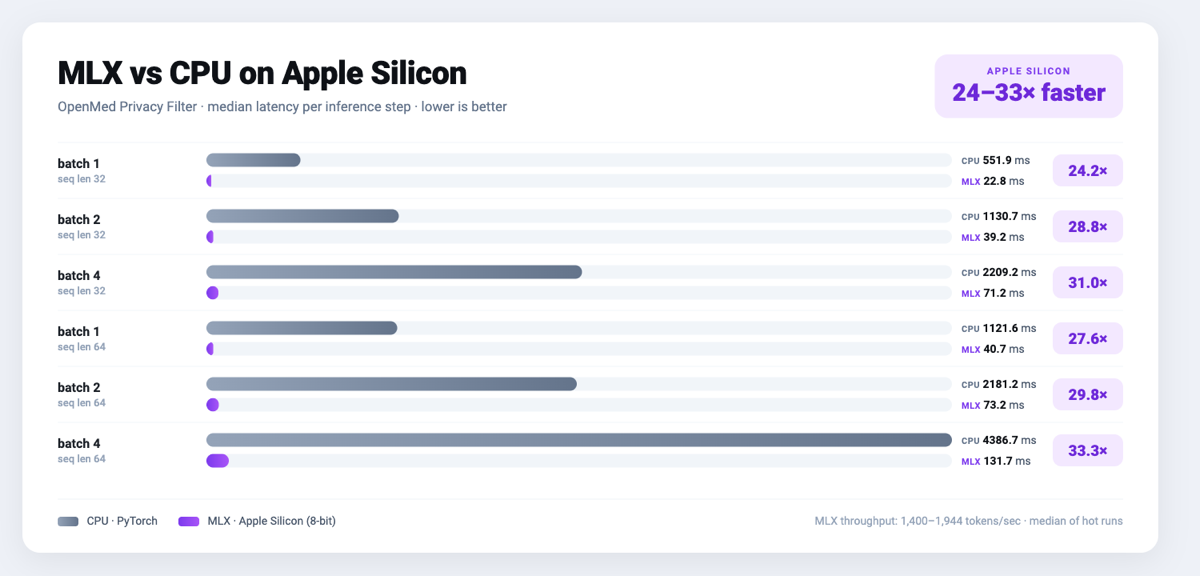
MLX vs CPU latency on Apple Silicon — 24 to 33 times faster
MLX on Apple Silicon: 24–33× faster than CPU PyTorch for the Privacy Filter — median latency per inference step, lower is better.
--- ## How it works ```mermaid flowchart LR A["Clinical text"] --> B["OpenMed
(100% on-device)"] B --> C["Medical entities"] B --> D["PII detected"] B --> E["De-identified text"] style B fill:#0D6E6E,stroke:#0A5656,stroke-width:2px,color:#ffffff style C fill:#D6EBEB,stroke:#0D6E6E,color:#0E1116 style D fill:#F7DCD8,stroke:#C5453A,color:#0E1116 style E fill:#F5E27A,stroke:#A9A088,color:#0E1116 ``` --- ## Quick start ```bash # Core + Hugging Face runtime (Linux, macOS, Windows; CPU or CUDA) pip install "openmed[hf]" # Add the REST service pip install "openmed[hf,service]" # Apple Silicon acceleration (MLX) pip install "openmed[mlx]" ```
**Python API** ```python from openmed import analyze_text analyze_text( "Patient received 75mg " "clopidogrel for NSTEMI.", model_name= "pharma_detection_superclinical", ) ``` **REST service** ```bash uvicorn openmed.service.app:app \ --host 0.0.0.0 --port 8080 ``` `GET /health` `POST /analyze` `POST /pii/extract` `POST /pii/deidentify` **Batch** ```python from openmed import BatchProcessor p = BatchProcessor( model_name= "disease_detection_superclinical", group_entities=True, ) p.process_texts([...]) ```
**Offline / air-gapped?** Point `model_name` (or `model_id`) at a local directory and OpenMed loads it without contacting the Hugging Face Hub: ```python from openmed import OpenMedConfig, analyze_text result = analyze_text( "Patient presents with chronic myeloid leukemia and Type 2 diabetes.", model_id="./models/OpenMed-NER-DiseaseDetect-SuperClinical-434M", config=OpenMedConfig(device="cpu"), ) ``` --- ## Models A curated registry of specialized medical NER models — browse the [full catalog](https://openmed.life/docs/model-registry). | Model | Specialization | Entity types | Size | |-------|----------------|--------------|------| | `disease_detection_superclinical` | Disease & conditions | DISEASE, CONDITION, DIAGNOSIS | 434M | | `pharma_detection_superclinical` | Drugs & medications | DRUG, MEDICATION, TREATMENT | 434M | | `pii_superclinical_large` | PII & de-identification | NAME, DATE, SSN, PHONE, EMAIL, ADDRESS | 434M | | `anatomy_detection_electramed` | Anatomy & body parts | ANATOMY, ORGAN, BODY_PART | 109M | | `gene_detection_genecorpus` | Genes & proteins | GENE, PROTEIN | 109M | --- ## Privacy: PII detection & de-identification ```python from openmed import extract_pii, deidentify text = "Patient: John Doe, DOB: 01/15/1970, SSN: 123-45-6789" # Extract PII with smart merging (prevents tokenization fragmentation) result = extract_pii(text, model_name="pii_superclinical_large", use_smart_merging=True) # De-identify with the method you need deidentify(text, method="mask") # [NAME], [DATE] deidentify(text, method="replace") # Faker-backed, locale-aware, format-preserving fakes deidentify(text, method="hash") # Cryptographic hashing deidentify(text, method="shift_dates", date_shift_days=180) ``` - **Smart entity merging** keeps `01/15/1970` whole instead of fragmenting it. - **Faker-backed obfuscation** with custom clinical-ID providers (CPF, CNPJ, BSN, NIR, Codice Fiscale, NIE, Aadhaar, Steuer-ID, NPI). - **HIPAA**: all 18 Safe Harbor identifiers, configurable confidence thresholds. - **Batch PII** (v1.5.5): extract or de-identify across many documents with `BatchProcessor(operation="extract_pii" | "deidentify", batch_size=16)`.
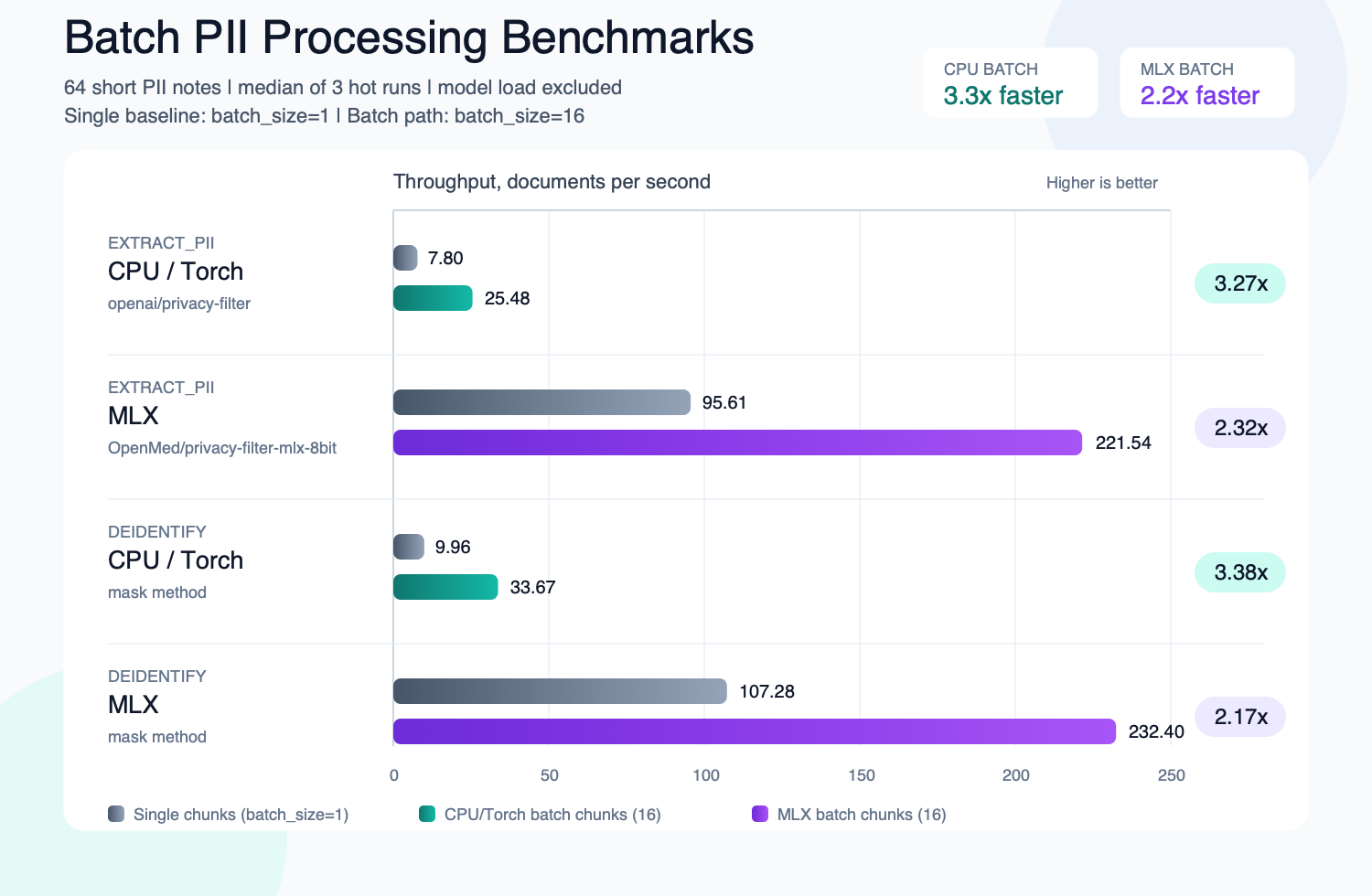
Batch PII processing throughput — up to 3.3x on CPU and 2.2x on MLX
Batch processing — up to 3.3× higher throughput on CPU and 2.2× on MLX vs. one document at a time.
[Complete PII notebook](examples/notebooks/PII_Detection_Complete_Guide.ipynb) · [Smart merging](docs/pii-smart-merging.md) · [Anonymization](docs/anonymization.md)
Privacy Filter family — three model families on the OpenAI Privacy Filter architecture
Same model code (gpt-oss-style sparse-MoE transformer with local attention, sink tokens, RoPE+YaRN, tiktoken `o200k_base`), different training data. All route through the **same** `extract_pii()` / `deidentify()` API — only `model_name=` changes. | Variant | PyTorch (CPU + CUDA) | MLX (Apple Silicon) | MLX 8-bit | | --- | --- | --- | --- | | **OpenAI Privacy Filter** | [`openai/privacy-filter`](https://huggingface.co/openai/privacy-filter) | [`OpenMed/privacy-filter-mlx`](https://huggingface.co/OpenMed/privacy-filter-mlx) | [`…-mlx-8bit`](https://huggingface.co/OpenMed/privacy-filter-mlx-8bit) | | **Nemotron-PII fine-tune** | [`OpenMed/privacy-filter-nemotron`](https://huggingface.co/OpenMed/privacy-filter-nemotron) | [`…-nemotron-mlx`](https://huggingface.co/OpenMed/privacy-filter-nemotron-mlx) | [`…-nemotron-mlx-8bit`](https://huggingface.co/OpenMed/privacy-filter-nemotron-mlx-8bit) | | **OpenMed Multilingual** | [`OpenMed/privacy-filter-multilingual`](https://huggingface.co/OpenMed/privacy-filter-multilingual) | [`…-multilingual-mlx`](https://huggingface.co/OpenMed/privacy-filter-multilingual-mlx) | [`…-multilingual-mlx-8bit`](https://huggingface.co/OpenMed/privacy-filter-multilingual-mlx-8bit) | ```python from openmed import extract_pii text = "Patient Sarah Connor (DOB: 03/15/1985) at MRN 4471882." extract_pii(text, model_name="openai/privacy-filter") # PyTorch baseline extract_pii(text, model_name="OpenMed/privacy-filter-nemotron") # same code, different weights extract_pii(text, model_name="OpenMed/privacy-filter-mlx") # Apple Silicon (MLX) ``` On non-Apple-Silicon hosts, MLX model names are automatically substituted with the matching PyTorch checkpoint (with a one-time warning) — ship one model name, run anywhere. See [Privacy Filter architecture & backend routing](docs/anonymization.md#privacy-filter-family).
--- ## Multilingual PII (12 languages) Extraction and de-identification across `en`, `fr`, `de`, `it`, `es`, `nl`, `hi`, `te`, `pt`, `ar`, `ja`, and `tr` — **247 PII checkpoints** total. ```bash python -c "from openmed import extract_pii; print([(e.label, e.text) for e in extract_pii('Dr. Pedro Almeida, CPF: 123.456.789-09, email: pedro@hospital.pt', lang='pt').entities])" ```
Show per-language examples (Portuguese, Dutch, Hindi, Arabic, Japanese, Turkish)
```python from openmed import extract_pii portuguese = extract_pii("Paciente: Pedro Almeida, CPF: 123.456.789-09, telefone: +351 912 345 678", lang="pt", use_smart_merging=True) dutch = extract_pii("Patiënt: Eva de Vries, BSN: 123456782, telefoon: +31 6 12345678", lang="nl", use_smart_merging=True) hindi = extract_pii("रोगी: अनीता शर्मा, फोन: +91 9876543210, पता: नई दिल्ली 110001", lang="hi", use_smart_merging=True) arabic = extract_pii("المريضة ليلى حسن، الهاتف +20 10 1234 5678، الرقم القومي 29801011234567.", lang="ar", use_smart_merging=True) japanese = extract_pii("患者 佐藤 花子、電話 +81 90 1234 5678、マイナンバー 1234 5678 9012.", lang="ja", use_smart_merging=True) turkish = extract_pii("Hasta Ayşe Yılmaz, telefon +90 532 123 45 67, TCKN 10000000146.", lang="tr", use_smart_merging=True) for r in (portuguese, dutch, hindi, arabic, japanese, turkish): print([(e.label, e.text) for e in r.entities]) ```
--- ## REST API A Docker-friendly FastAPI service with request validation, shared pipeline preload, and unified error envelopes. ```bash pip install "openmed[hf,service]" uvicorn openmed.service.app:app --host 0.0.0.0 --port 8080 # or with Docker docker build -t openmed:1.5.5 . docker run --rm -p 8080:8080 -e OPENMED_PROFILE=prod openmed:1.5.5 ``` ```bash curl -X POST http://127.0.0.1:8080/pii/extract \ -H "Content-Type: application/json" \ -d '{"text":"Paciente: Maria Garcia, DNI: 12345678Z","lang":"es"}' ``` **Model lifecycle (v1.5.5):** free memory on demand with `GET /models/loaded`, `POST /models/unload`, and a `keep_alive` idle window: ```bash OPENMED_SERVICE_KEEP_ALIVE=10m uvicorn openmed.service.app:app --host 0.0.0.0 --port 8080 curl -X POST http://127.0.0.1:8080/models/unload -H "Content-Type: application/json" -d '{"all":true}' ``` See the full [REST service guide](docs/rest-service.md). --- ## Documentation Full guides at **[openmed.life/docs](https://openmed.life/docs/)**. | | | | |---|---|---| | [Getting Started](https://openmed.life/docs/) | [Analyze Text](https://openmed.life/docs/analyze-text) | [Model Registry](https://openmed.life/docs/model-registry) | | [PII Detection Guide](examples/notebooks/PII_Detection_Complete_Guide.ipynb) | [Anonymization](docs/anonymization.md) | [Batch Processing](https://openmed.life/docs/batch-processing) | | [Configuration Profiles](https://openmed.life/docs/profiles) | [REST Service](docs/rest-service.md) | [MLX Backend](docs/mlx-backend.md) | --- ## Meet the mascot OpenMed mascot OpenMed's guardian is a fluffy Persian cat styled as a tiny **Avicenna (Ibn Sina)** — the great Persian physician whose *Canon of Medicine* was the world's standard medical text for some 600 years. He keeps watch over the open book of medical knowledge, in a palette built around Persian turquoise (*fīrūza*): a local-first guardian for your most private data.
--- ## Contributing Contributions welcome — bug reports, feature requests, and PRs alike. - [Open an issue](https://github.com/maziyarpanahi/openmed/issues) - **Translations welcome** — help complete the other-language READMEs linked in the switcher at the top. --- ## Credits OpenMed builds on excellent open-source work — particular thanks to **OpenAI** (the [Privacy Filter](https://huggingface.co/openai/privacy-filter) architecture), **NVIDIA** (the [Nemotron PII dataset](https://huggingface.co/datasets/nvidia/Nemotron-PII-v1)), **Hugging Face** (`transformers` & the model ecosystem), **Apple** ([MLX](https://github.com/ml-explore/mlx)), and the **[Faker](https://faker.readthedocs.io/)** maintainers. ## License Released under the [Apache-2.0 License](LICENSE). ## Citation ```bibtex @misc{panahi2025openmedneropensourcedomainadapted, title={OpenMed NER: Open-Source, Domain-Adapted State-of-the-Art Transformers for Biomedical NER Across 12 Public Datasets}, author={Maziyar Panahi}, year={2025}, eprint={2508.01630}, archivePrefix={arXiv}, primaryClass={cs.CL}, url={https://arxiv.org/abs/2508.01630}, } ``` --- ## Star History If OpenMed is useful to you, a star helps others discover it. Star History Chart ---
Built by the OpenMed team Website · Docs · X / Twitter · LinkedIn