# CUAWright
> **Webwright is now CUAWright.** Alongside browser automation, you can now run
> desktop tasks in an Ubuntu VM. Use `cuawright web` for browser tasks and
> `cuawright desktop` for desktop tasks. Existing `webwright` commands and Python
> imports still work.
Turn coding models into browser and desktop agents



- 📄 **Paper:** [CUAWright: A Minimal Unified Interface for Digital Agents](https://arxiv.org/abs/2610.04116)
- 📝 **Blog:** [Webwright: A Terminal Is All You Need For Web Agents](https://www.microsoft.com/en-us/research/articles/webwright-a-terminal-is-all-you-need-for-web-agents/)
- 🌐 **Project Page:** [microsoft.github.io/CUAWright](https://microsoft.github.io/CUAWright/)
CUAWright gives coding models a terminal to automate browsers and desktop applications.
Use Webwright to browse the web and build reusable Playwright scripts, or run your
own desktop task and reproduce OSWorld-V2 benchmarks in an Ubuntu VM.
Start with the [browser quick start](#-browser-quick-start) or
[desktop quick start](#desktop-quick-start).
Already got your favorite agents, and wonder how to make Claude Code, Codex, Hermes more capable in browser tasks? Consider adding [CUAWright browser plugin/skill](#-use-as-a-plugin)!
---
## 📰 News
- **2026-10-03** — **Webwright → CUAWright:** renamed the project to bring browser and desktop agents together. The Webwright browser runtime is now `cuawright.webwright`, and OSWorld desktop support lives at `cuawright.desktop`. Existing `webwright` commands and imports remain compatible. See [desktop setup](docs/desktop.md).
- **2026-09-01** — Persistent step-by-step browsing and native `run_command` tool calls improve performance to **88.1% on Online-Mind2Web** and **77.5% on Odysseys**.
- **2026-07-21** — Skill Factory: every solve leaves a script behind, distilled into reusable, verified, parameterized code skills that rerun standalone with no model (~40 s, zero tokens). On WebArena, reuse lifts held-out accuracy 55% → 70% (+15 pp). See the optional [Skill Factory](#-skill-factory-turn-solved-tasks-into-runnable-code-skills).
- **2026-05-11** — Support Task2UI mode: Webwright completes the task and renders task results into an HTML-based web app you can easily view and reuse.
- **2026-05-06** — Codex and Claude Code plugin manifests added; install via `/plugin install cuawright@cuawright`. Hermes Agent integration shipped; the same `skills/cuawright-web/` folder now loads across Claude Code, Codex, and Hermes.
- **2026-05-04** — Initial public release: ~1.5k LoC, OpenAI / Anthropic / OpenRouter backends, Playwright environment.
---
💡 Motivation: Beyond Step-by-Step Web Interaction in a Stateful Browser
Most web agents today treat the browser session itself as the workspace: at each step the model receives the current page state and predicts a single next operation — a click, a type, a DOM selector, or a short tool call. Whatever the format, the agent is locked into predicting one web action at a time inside a predefined interaction loop. That harness was useful when LLMs were weaker. As models get stronger at writing and debugging code, the same harness becomes a bottleneck.
Webwright takes a different stance: **separate the agent from the browser**, and treat the browser as something the agent can launch, inspect, and discard while developing a program. The persistent artifact is not the browser session — it's the **code and logs in the local workspace**.
- 🧱 **Robust, reusable interaction with web environments** — instead of fragile pixel-level actions, a coding agent with a terminal queries elements, waits for conditions, and handles dynamic behaviors like lazy loading or re-rendering. The resulting scripts can be rerun, adapted, and shared across tasks rather than rediscovered from scratch.
- ⚡ **Efficient composition of complex workflows** — multi-step interactions like selecting a date or filling a form become a compact program. Loops, functions, and abstractions let the agent generalize across similar tasks (e.g. different dates) without re-predicting the same low-level sequences. Fewer interaction rounds, faster execution, less error accumulation on long horizons.
- 🧪 **Workspace-as-state, not browser-as-state** — the agent can write exploratory scripts, spawn fresh browser sessions, and decide for itself when to capture screenshots and inspect failures, much like a human engineer iterating on an RPA script.
- 🪄 **Surprisingly effective despite being minimal** — this stripped-down setup turns out to handle complex and especially long-horizon web tasks well (see [Performance](#-performance)).
---
🌟 Why Webwright
Most web agent frameworks bury the actual agent loop under layers of abstractions. Webwright takes the opposite stance:
- 🪶 **Readable core** — browser agent loop, environments, models, and CLI are separate modules under `src/cuawright/webwright/`.
- 🧩 **Pluggable model backends** — OpenAI, Anthropic, and OpenRouter, each ~150–200 lines.
- 🔍 **Zero hidden frameworks** — just `httpx`, `pydantic`, `playwright`, and `typer`.
- 🔁 **Flat prompt → observe → execute script loop** — readable end-to-end, easy to debug, easy to fork.
- 🧪 **Run-artifact first** — every run writes trajectories and screenshots to disk for inspection.
If you want a minimal, easy-to-debug starting point for browser-using agents instead of another heavyweight platform, this is it.
---
🆚 How Webwright Differs From Other Browser-Agent Repos
How they differ at the architectural level:
| | **Stagehand (Browserbase)** | **agent-browser (Vercel)** | **browser-use** | **Webwright** |
| ------------------- | ------------------------------------------------------------ | ------------------------------------------------------------------------- | ----------------------------------------------------- | ------------------------------------------------------------------------- |
| **Paradigm** | Hybrid: code + NL primitives (`act` / `extract` / `agent`) | CLI tool that *another* agent (Claude Code, Codex, etc.) calls | Autonomous LLM agent loop over DOM/AX snapshots | **Coding agent with a terminal**; browser is just an environment it spawns |
| **Action space** | Playwright code, or NL → LLM-translated Playwright | Discrete subcommands (`open`, `click @e2`, `snapshot`, `eval`) | Indexed click/type actions selected by the LLM | **Free-form Python (writes Playwright scripts itself)** |
| **What is "state"?**| The browser session | The browser session (held by daemon across CLI calls) | The browser session | **The local workspace — code, screenshots, logs.** Browser is disposable. |
| **Loop shape** | Imperative; `agent()` does multi-step when needed | One CLI invocation per micro-step | observe → predict next action → execute → repeat | write code → execute → inspect screenshots → repair (code-as-action) |
---
## 🎥 Demo
**CUAWright demo**
https://github.com/user-attachments/assets/2063be64-4d0a-40a2-9d1f-7906be43f2c9
Webwright demo
https://github.com/user-attachments/assets/4ed94cd5-11be-4daa-b2d7-1260a803baca
---
## 📊 Performance
CUAWright beats the same model running in a different harness on every benchmark
below, from desktop and CAD to long-horizon web tasks. See the
[paper](https://arxiv.org/abs/2610.04116) for full details.
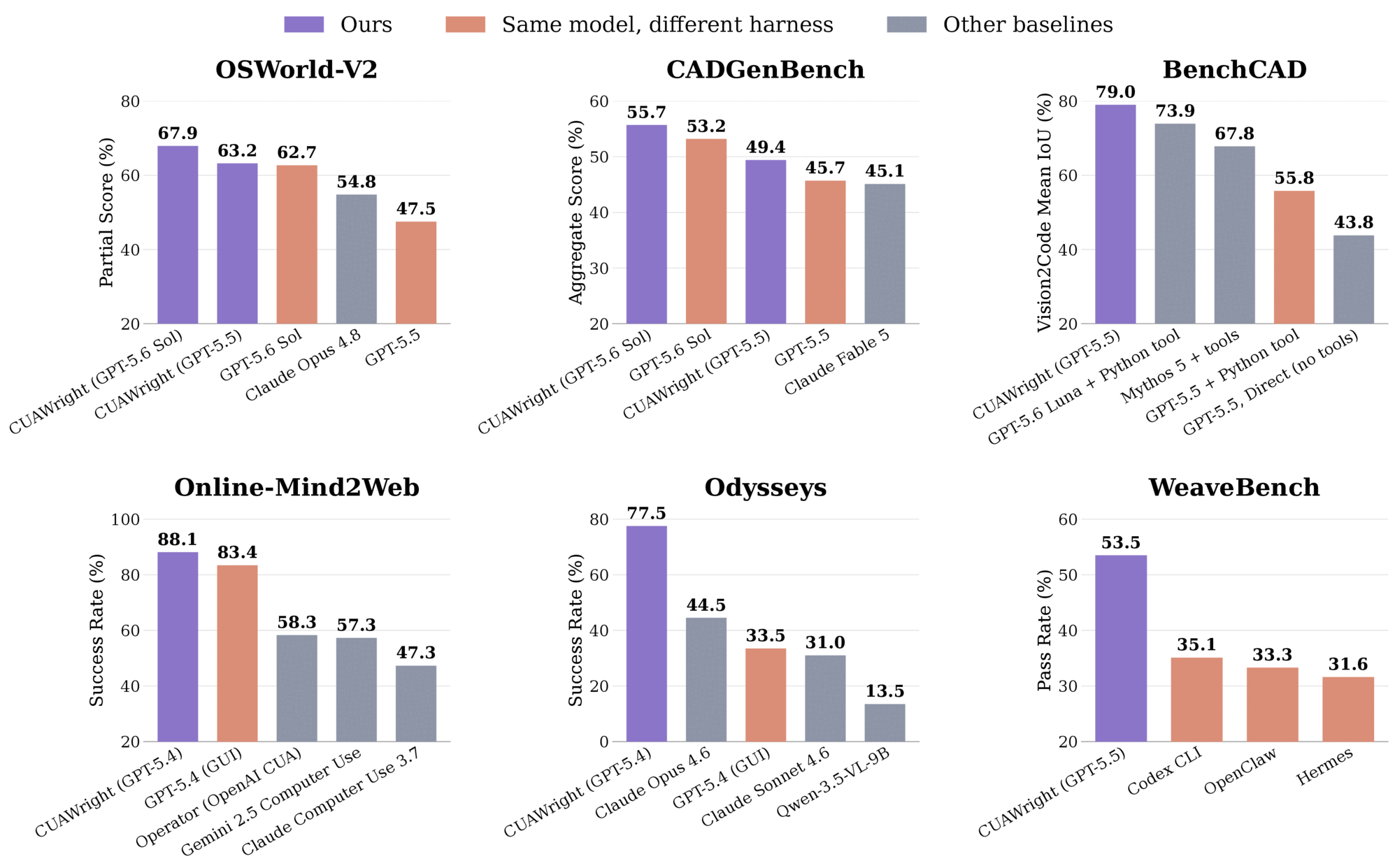
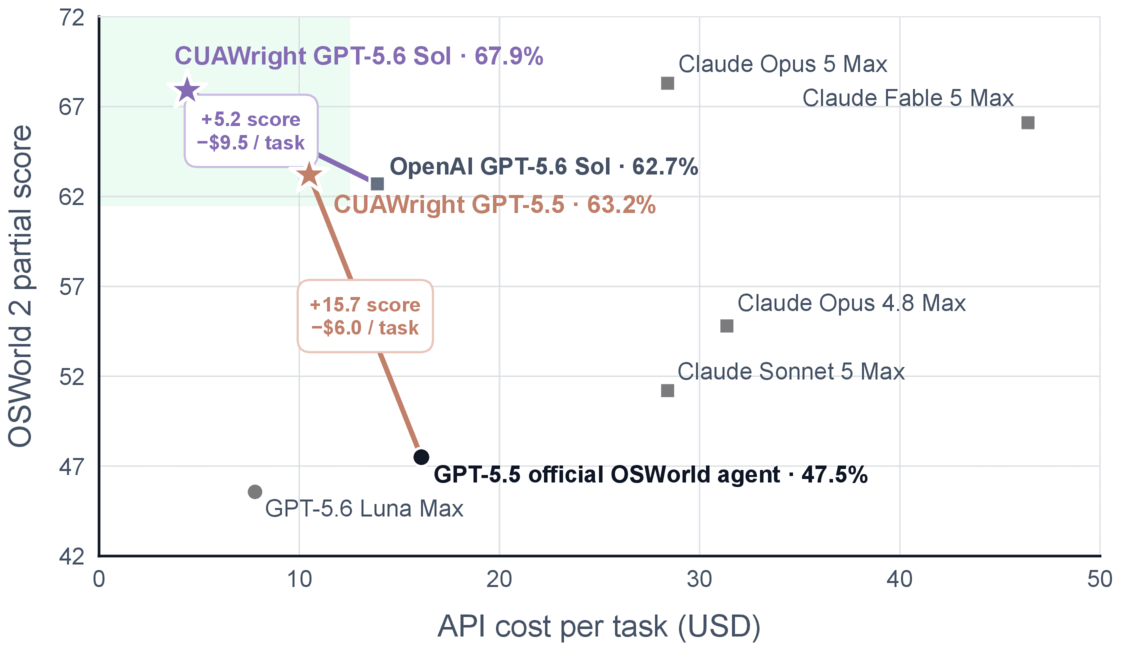
- 🖥️ **OSWorld-V2:** **67.9%** partial score with GPT-5.6 Sol (+5.2 over GPT-5.6 Sol alone) and **63.2%** with GPT-5.5 (+15.7 over the official GPT-5.5 OSWorld agent).
- 🌐 **Web:** **88.1%** on Online-Mind2Web and **77.5%** on Odysseys with GPT-5.4, against 83.4% and 33.5% for a GPT-5.4 GUI agent.
- 📐 **CAD:** **79.0%** Vision2Code mean IoU on BenchCAD with GPT-5.5, and **55.7%** aggregate score on CADGenBench with GPT-5.6 Sol.
- 💰 **Cost:** on OSWorld-V2, CUAWright raises the score while cutting API cost by $9.5 per task with GPT-5.6 Sol and $6.0 per task with GPT-5.5.
---
## 🗺️ Project Map
```text
CUAWright/
├── pyproject.toml # package, dependency extras, CLI commands
├── setup.py # desktop provenance in wheels and source archives
├── src/
│ ├── cuawright/
│ │ ├── core/ # shared API helpers
│ │ ├── webwright/ # browser runtime
│ │ │ ├── agents/ # browser agent loop
│ │ │ ├── environments/ # browser and terminal workspaces
│ │ │ ├── models/ # OpenAI, Anthropic, OpenRouter backends
│ │ │ ├── tools/ # browser sessions, images, self-reflection
│ │ │ ├── config/ # stackable browser YAML configs
│ │ │ ├── run/ # cuawright-web CLI and doctor
│ │ │ └── utils/ # evidence, logging, serialization
│ │ └── desktop/ # persistent desktop runtime
│ │ ├── agents/ # desktop agent loop and call budget
│ │ ├── environments/osworld/ # VM commands, screenshots, and submission
│ │ ├── models/ # standard Responses API transport and tools
│ │ ├── config/prompts.py # desktop prompts
│ │ ├── setup.py # pinned OSWorld setup and verification
│ │ ├── run/cli.py # custom and official desktop workflows
│ │ ├── run/benchmarks/ # official task setup and evaluation
│ │ └── utils/ # artifacts and provenance
│ └── webwright/__init__.py # legacy Python import compatibility
├── extensions/skill-factory/ # optional cuawright-skill-factory distribution
│ ├── pyproject.toml # separate wheel; depends on the base package
│ └── src/cuawright/webwright/ # skill_factory/ and tools/skill_use.py
├── skills/cuawright-web/ # browser skill, commands, reference guides
├── .claude-plugin/ # Claude Code plugin and marketplace manifests
├── .codex-plugin/ # Codex plugin manifest
├── docs/ # desktop setup and Skill Factory guides
├── tests/ # browser, Skill Factory, compatibility tests
├── release/osworld/tests/ # desktop request, lifecycle, privacy tests
├── .github/workflows/ # runtime and Skill Factory CI
├── assets/ # showcase, trajectory viewer, figures, logos
├── LICENSE # MIT browser license
├── licenses/ # Apache-2.0 desktop runtime license
└── NOTICE # imported runtime attribution
```
---
## 🚀 Browser Quick Start
Webwright lets a coding model launch browsers, inspect pages, and debug its work
from a terminal. Script-based runs produce a reusable Python script. Live-browser
mode keeps a page open across steps and returns an answer without creating a script.
### Prerequisites
- Python 3.10+
- Chromium installed through Playwright
- An API key for your chosen backend (OpenAI, Anthropic, or OpenRouter)
### Install
```bash
pip install -e .
playwright install chromium
```
### Script-based run
Export credentials for the configured backend (for example, `OPENAI_API_KEY`
with `model_openai.yaml` or `ANTHROPIC_API_KEY` with `model_claude.yaml`). Then:
```bash
python -m cuawright.webwright.run.cli main \
-c base.yaml -c model_openai.yaml \
-t "Report the page title and the destination of its main link." \
--start-url https://example.com \
--task-id demo_openai \
-o outputs/default
```
The `image_qa` and `self_reflection` tools use the run's configured model.
When running a tool separately, pass `--model-config` with an absolute path to a
private YAML file containing your `model:` settings. Keep that file outside the
checkout and results directory.
### Live-browser mode
For incremental browsing with native OpenAI `run_command` tool calls, use:
```bash
cuawright-web main -c best_default_judge_json_persistent_cli.yaml -c model_openai.yaml \
-t "" --start-url "" --task-id example -o outputs/example
```
This config keeps a Browserbase cloud session across commands. Set
`OPENAI_API_KEY`, `BROWSERBASE_API_KEY`, and `BROWSERBASE_PROJECT_ID` before running.
The agent runs shell commands, inspects the results, and checks its work before
finishing. See the [browser workflow guide](docs/browser.md) for image reading and
trajectory verification.
### 🚩 Flags
| Flag | Description |
|------|-------------|
| `-c` | Config file(s) from `src/cuawright/webwright/config/` (stackable). |
| `-t` | Task instruction. |
| `--start-url` | Initial page. |
| `--task-id` | Output subfolder name. |
| `-o` | Output directory. |
---
## 🖥️ Desktop Quick Start
`cuawright desktop` runs tasks in an OSWorld-V2 Ubuntu VM. The agent uses a
terminal to inspect applications, run commands, view screenshots, and save its work.
You can give it your own task or run an official benchmark task with a score.
### Requirements and installation
- **Python 3.12+** and a Responses-compatible model API key.
- Docker and access to the gated official task and asset snapshots.
```bash
pip install -e ".[desktop]"
```
Before setup, accept access to the [tasks](https://huggingface.co/datasets/xlangai/osworld_v2_tasks)
and [assets](https://huggingface.co/datasets/xlangai/osworld_v2_assets_gated) on
Hugging Face, then log in:
```bash
pip install huggingface_hub
hf auth login
cuawright setup osworld --root ~/.cache/cuawright/osworld-v2-2026.08.08
cuawright verify osworld \
--setup ~/.cache/cuawright/osworld-v2-2026.08.08/setup.json
```
Setup downloads the pinned source, task classes, assets, and VM by default; existing
resources can be registered without copying. Put the API key in a
user-owned file with mode `0600`, outside source, task, asset, and result directories.
Choose a new result directory whose parent already exists.
### Run an arbitrary desktop task
```bash
cuawright desktop run \
--setup /absolute/path/to/setup.json \
--credentials /absolute/path/to/api-key \
--results /absolute/path/to/results/custom \
--model YOUR_MODEL \
--instruction ""
```
This workflow has no evaluator or score. For an official scored task:
```bash
cuawright desktop reproduce osworld \
--setup /absolute/path/to/setup.json \
--credentials /absolute/path/to/api-key \
--results /absolute/path/to/results/task-001 \
--task-id 001 --model YOUR_MODEL --reasoning xhigh
```
For another Responses-compatible provider, pass its full API URL with
`--responses-url`. See [task selection and proxies](REPRODUCE.md#choose-an-official-task)
for official task IDs and `--proxy-config` setup.
Each run saves its settings in `manifest.json`, the agent's actions in `trace.jsonl`,
and the outcome in `result.json`. Images viewed by the agent are embedded in the
trace; desktop runs do not export separate screenshot files. Official benchmark
runs also include the evaluator score. Files created in the VM are not automatically
copied to the host; see [custom tasks](REPRODUCE.md#smoke-and-custom-task).
See [REPRODUCE.md](REPRODUCE.md) for setup, smoke tests, and reproduction commands,
or [desktop setup and execution](docs/desktop.md) for more detail.
---
## 🔌 Use as a Plugin
CUAWright ships plugin manifests for both [Claude Code](https://docs.claude.com/en/docs/claude-code/plugins) ([`.claude-plugin/plugin.json`](.claude-plugin/plugin.json)) and [OpenAI Codex](https://developers.openai.com/codex/plugins) ([`.codex-plugin/plugin.json`](.codex-plugin/plugin.json)), with the shared skill at [`skills/cuawright-web/`](skills/cuawright-web/) and slash commands at [`skills/cuawright-web/commands/`](skills/cuawright-web/commands/). The host agent drives the Webwright loop natively — no extra LLM API key or cost beyond your host subscription. Hosts that read PNG screenshots natively skip the `image_qa` / `self_reflection` tools.
The bundled `cuawright-web` skill handles browser tasks. Desktop tasks use
`cuawright-desktop`; see [desktop setup](docs/desktop.md).
Common runtime deps (install once after either path):
```bash
pip install -e .
playwright install chromium
```
Claude Code
### Install
Install through the bundled marketplace inside Claude Code:
```text
# 1. Add this repo as a Claude Code plugin marketplace
/plugin marketplace add microsoft/Webwright
# 2. Install the plugin from that marketplace
/plugin install cuawright@cuawright
```
Prefer a local checkout? Point the marketplace command at the cloned repo instead:
```text
/plugin marketplace add /absolute/path/to/Webwright
/plugin install cuawright@cuawright
```
### Use
**Start a new Claude Code session** after installing — plugins are loaded at session start and won't appear until you restart.
You can either ask Claude Code in plain English (the skill auto-activates from its description), or use one of the slash commands:
```
/cuawright:run search Google Flights for flights from SEA to JFK on 2026-08-15 to 2026-08-20
/cuawright:craft search a ticket on Google Flights from LAX to SFO depart June 7 return June 14
```
- `/cuawright:run` (or any plain prompt) produces a **one-shot** `final_script.py` for the literal task values.
- `/cuawright:craft` produces a **reusable CLI tool**: `final_script.py` becomes one parameterized function with a Google-style `Args:` docstring and an `argparse` wrapper whose flags default to the concrete task values, so you can rerun it later with different arguments — e.g. `python final_script.py --origin JFK --destination LAX --depart-date 2026-07-01`.
In both modes Claude Code scaffolds a workspace with `plan.md`, runs instrumented Playwright scripts under `final_runs/run_/`, and visually self-verifies each critical point against the saved screenshots.
OpenAI Codex
### Install
Codex reads Claude-style marketplaces, so the same repo works as a Codex plugin marketplace. From the Codex CLI:
```bash
# 1. Add this repo as a Codex plugin marketplace
codex plugin marketplace add microsoft/Webwright
# 2. Open the plugin browser and install CUAWright
codex
/plugins
```
Prefer a local checkout?
```bash
codex plugin marketplace add /absolute/path/to/Webwright
```
Then restart Codex so the new marketplace and plugin are picked up.
### Use
In a new Codex thread, either ask in plain English (the skill auto-activates from its description) or invoke the bundled skill explicitly with `@cuawright-web`:
```
@cuawright-web search Google Flights for flights from SEA to JFK on 2026-08-15 to 2026-08-20
```
Codex scaffolds a workspace with `plan.md`, runs instrumented Playwright scripts under `final_runs/run_/`, and visually self-verifies each critical point against the saved screenshots.
To turn the plugin off without uninstalling, set its entry in `~/.codex/config.toml` to `enabled = false` and restart Codex.
Hermes Agent
### Install
[Hermes Agent](https://github.com/NousResearch/hermes-agent) is a [skills-compatible client](https://agentskills.io), so the same `skills/cuawright-web/` folder loads as a Hermes skill. Symlink it into your Hermes user-skills directory:
```bash
mkdir -p ~/.hermes/skills
ln -sfn /absolute/path/to/Webwright/skills/cuawright-web ~/.hermes/skills/cuawright-web
```
No Hermes-specific manifest is needed; only `SKILL.md` is loaded.
### Use
Start Hermes (`hermes`) and ask it to drive a web task in natural language — the skill auto-activates from its description. You can also invoke it explicitly with `/cuawright-web`.
Note: the named subcommands shipped under [`skills/cuawright-web/commands/`](skills/cuawright-web/commands/) (`/cuawright:run`, `/cuawright:craft`) are a Claude Code / Codex convention and are inert in Hermes; the skill itself still works end-to-end.
📰 Task Showcase (repeatable runs as a dashboard)
A tiny Flask app under [`assets/task_showcase/`](assets/task_showcase/README.md) consolidates
Webwright runs for **repeatable** odyssey tasks (deals, inventory, listings,
job boards, weather, etc.) into a single dashboard. Each task ships only two
files — `task.json` (metadata) and `report.json` (curated, structured output:
sources + result sections like tables, lists, summaries) — and the templates
render them generically, so adding a new task is just dropping a new folder
in `assets/task_showcase/tasks/`.
```bash
pip install flask
python assets/task_showcase/app.py # http://127.0.0.1:5005
```
To have Webwright produce a renderer-ready task folder at runtime, stack the
Task Showcase overlay:
```bash
python -m cuawright.webwright.run.cli main \
-c base.yaml -c model_openai.yaml -c task_showcase.yaml \
-t "" \
--task-id my_repeatable_task \
-o outputs/default
```
> **Note:** `report.json` is only generated when `-c task_showcase.yaml` is
> included. A plain `base.yaml` run produces `trajectory.json` and debug
> artifacts but no `report.json`.
The run writes `task_showcase/tasks//task.json` and `report.json`
inside the output workspace. Render those generated files without copying them
back into the repo:
```bash
python assets/task_showcase/app.py \
--tasks-dir outputs/default//task_showcase/tasks
```
🧠 Skill Factory (turn solved tasks into runnable code skills)
Skill Factory is an optional extension for learning and reusing browser automation
scripts. Install it from this checkout:
```bash
pip install -e ".[skill-factory]" -e extensions/skill-factory
cuawright-skill-factory --help
```
For desktop execution and Skill Factory together, use
`pip install -e ".[desktop,skill-factory]" -e extensions/skill-factory`.
**Most agent skills are context the model reads. Ours are programs.**
[`cuawright.webwright.skill_factory`](extensions/skill-factory/src/cuawright/webwright/skill_factory/) distills the script every solve leaves
behind into a growing library of **reusable, verified, parameterized skills** — code you can run
without a model and compose into the next task instead of re-exploring the site. Plugs in with
**no change to the agent loop**:
- **Reuse** — before a solve starts, the library is checked *out of the agent loop* (`recommend`):
`route` either runs a matching skill directly (no model) or injects it into the prompt as a prior
(`{verdict: run|adapt|skip, skill_id, source_path}`); the agent reuses the hint without ever
querying the library itself.
- **Grow** — afterwards, `python -m cuawright.webwright.skill_factory learn outputs/ --library ./library`
groups solves of the same template and distills one parameterized skill (`build` does solve→learn
in one shot; `update` is manual-manifest mode).
Before adding a skill, the input gate compares the result with gold answers when
available. Otherwise it checks the output's shape and the agent's reported success;
this fallback can admit an incorrect answer. The generated script is then replayed
without a model, and updates are checked against previous examples.
Once learned, a skill **runs standalone in ~40 s with zero tokens**. On WebArena (10 retrieve-type
templates, 3 self-hosted sites, gpt-5.4) reuse lifts held-out accuracy **55% → 70% (+15 pp)** while
cutting steps. See [`extensions/skill-factory/src/cuawright/webwright/skill_factory/README.md`](extensions/skill-factory/src/cuawright/webwright/skill_factory/README.md).
📃 Trajectory Comparison & Viewer
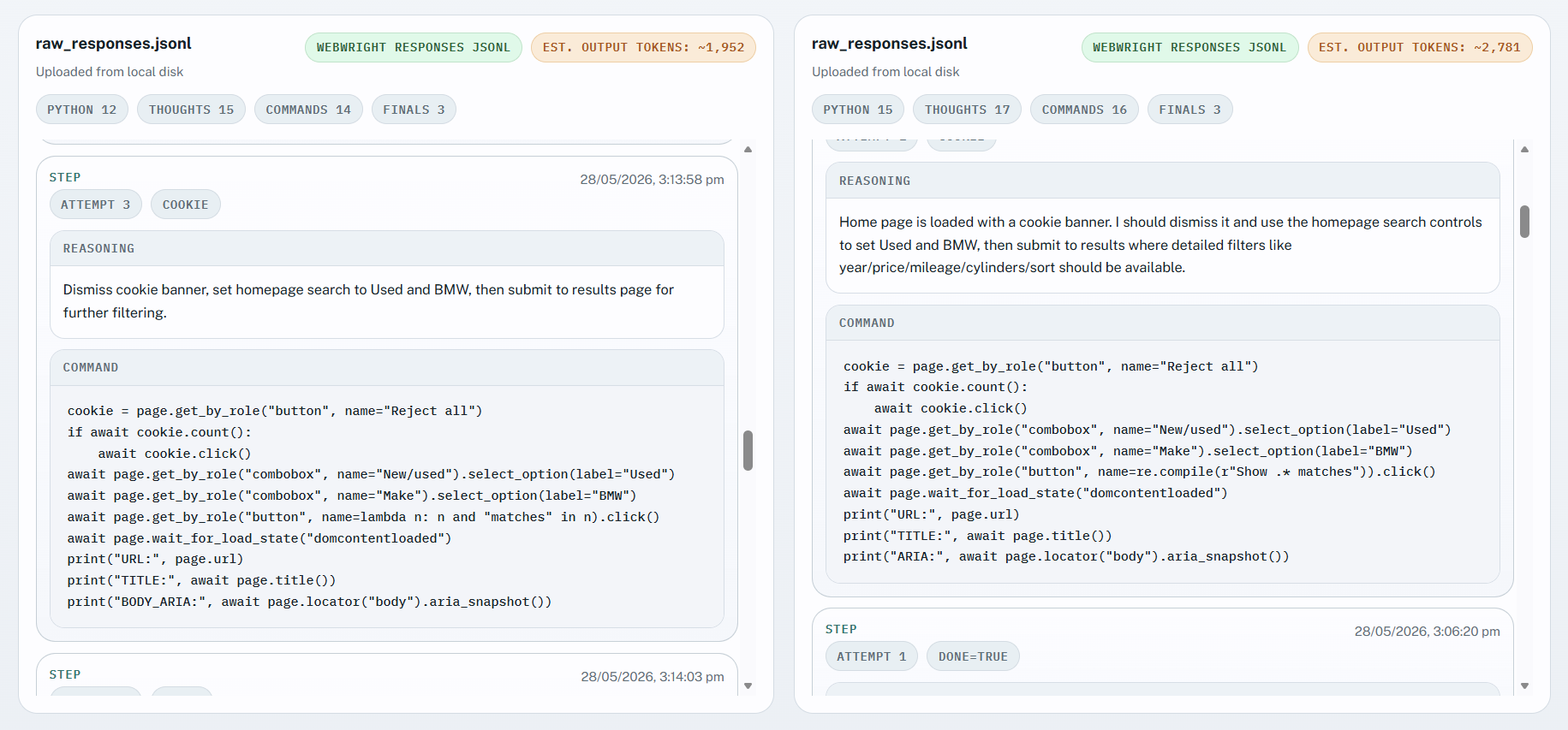
You can run the same tasks using the Webwright harness and its Codex / GitHub Copilot skill variant, and see how token usage and trajectories stack up between different harnesses. The trajectory viewer supports Codex, GitHub Copilot and Webwright harness traces.
### How to use
```bash
cd assets/compare_trajectory/
python3 -m http.server
```
Open the webpage in your browser and upload the Webwright `raw_responses.jsonl` and attach `trajectory.json` to view. Then on the other side you can upload your Codex or GitHub Copilot trace.
### Obtaining Codex traces:
```
ls ~/.codex/sessions/2026/MONTH/DAY/SESSION_ID.jsonl
```
### Obtaining GitHub Copilot traces:
```
/export file session
-> session.md is the uploadable trace
```
### Quick Comparison
#### "Find the cheapest used 8-cylinder bmw made between 2005-2015 and priced from 25,000 to 50,000 dollars with mileage less than 50,000 miles or less."
| Tokens | Webwright Harness (Local Browser Mode) | Codex Webwright Skill |
| --- | ---: | ---: |
| Input | 420,433 | 3,271,143 |
| Output | 3,593 | 20,040 |
| Reasoning | 0 | 4,410 |
| Cached | 217,216 | — |
| Total | 424,026 | 3,291,183 |
The Codex cached-token count is omitted because the recorded figure needs verification.
Individual runs and results may vary.
---
## Credits
- [SWE-agent/mini-swe-agent](https://github.com/SWE-agent/mini-swe-agent/tree/main) — design inspiration for the minimal agent loop.
- [Playwright](https://playwright.dev/) — browser automation.
## Citation
If you use CUAWright or Webwright in your research or build on it, please cite:
```bibtex
@misc{lu2026cuawright,
title = {CUAWright: A Minimal Unified Interface for Digital Agents},
author = {Lu, Yadong and Lee, Theodore and Li, Yifei and Jang, Lawrence Keunho and Xue, Tianci and Su, Yu and Sun, Huan and Awadallah, Ahmed Hassan},
year = {2026},
eprint = {2610.04116},
archivePrefix = {arXiv},
primaryClass = {cs.AI},
url = {https://arxiv.org/abs/2610.04116}
}
@misc{webwright2026,
title = {Webwright: A terminal is all you need for web agents},
author = {Lu, Yadong and Xu, Lingrui and Huang, Chao and Awadallah, Ahmed},
year = {2026},
howpublished = {\url{https://github.com/microsoft/Webwright}},
note = {GitHub repository}
}
```