Mage-VL-Cowork
A Full Training Recipe to Learn Hybrid Computer Use from Evolved Harnesses







 OSWorld-Verified performance versus model size. Click the figure to open the PDF.
---
> **One compact 4B policy that knows when to click — and when to code.**
Computer-use agents (CUAs) that confine themselves to pixels pay a heavy tax: a single screenshot consumes thousands of tokens, and re-deriving structured file edits through dozens of mouse clicks discards the fastest, most verifiable channel on the machine. Conversely, giving a frontier model naive access to both GUI and terminal tools does not automatically produce hybrid competence — without an optimized execution scaffold, even frontier teachers exhibit suboptimal channel habits that transfer directly to distilled students. Worse, existing CUA post-training pipelines rely on checkpoints already heavily specialized for GUI grounding and coding.
**Mage-VL-Cowork** bridges this gap. Trained end-to-end from an intermediate **4B [`Mage-VL`](https://huggingface.co/microsoft/Mage-VL)** checkpoint through a progressive **five-stage specialize-then-unify curriculum**, it combines screenshot-grounded GUI interaction (`computer_use`) and persistent code/terminal execution (`bash`) inside a **single vision-language policy** — with no external orchestrator. Upstream of training, we **evolve the teacher harness** (pruning redundant action routes and equipping domain libraries) and build **Mage-CUA-Forge**, a workflow-first synthesis engine that generates **293,806 tasks** across **6,915 atomic skills** while cutting recurring per-task generation cost by **82.6%**.
At **4B parameters**, **Mage-VL-Cowork** reaches **66.0% on OSWorld-Verified** under a 50-step budget — achieving the **best performance among 4B models** and demonstrating that an **efficient small VLM can excel at complex computer use**, pushing the frontier of **on-device intelligence**. Across training stages, online reinforcement learning adds **+10.16 percentage points** over Hybrid SFT while simultaneously cutting mean model calls by **13.0%** and output tokens by **25.4%**.
## ✨ Highlights
- **Best-in-class 4B hybrid computer use (66.0% OSWorld-Verified).** Achieving the highest score at the 4B scale, `Mage-VL-Cowork` proves that an efficient small VLM can master end-to-end computer use — leading on **Operating System tasks at 87.5%**, reaching **62.7% on Multi-Application Workflows**, and advancing the frontier of **on-device intelligence**.
- **Internalized turn-level channel routing.** Without an external multi-agent router, the policy dynamically selects `computer_use` for visual layouts, canvas editing, and live in-memory application state, and switches to `bash` for structured programmatic edits (spreadsheets, documents, presentations) and deterministic ground-truth verification.
- **Evolved teacher harnesses amplify student distillation (+12.5 pp).** Evolving and pruning the teacher scaffold before rollout (removing overlapping tools like `xdotool` and accessibility trees while pre-installing domain Python libraries) lifts the GPT-5.4 teacher to **92.0%** with **29.2% fewer steps**, which expands into a **+12.5 pp student gain** (37.6% vs. 25.1%) at the 4B scale.
- **Workflow-first synthesis at −82.6% recurring cost.** **Mage-CUA-Forge** authors reusable, skill-conditioned generation workflows and application-specific preparers once per skill rather than running open-ended agent loops per task — reducing token consumption by **93.3%** (1,276K → 85K tokens/task) and expenditure from **$0.906 to $0.158 per task**.
- **Specialize-then-unify five-stage curriculum (+20.44 pp).** Starting from an intermediate 4B `Mage-VL` checkpoint, the model builds standalone visual grounding (**30.6% → 56.9%** on OSWorld-G; **78.8% → 87.2%** on ScreenSpot-v2), GUI execution, and coding/terminal competence before unifying them via Hybrid SFT and asynchronous Online Hybrid RL (**45.56% → 55.84% → 66.0%**).
- **Stronger *and* more compact after Online RL.** Online GRPO with verifiable task rewards improves task accuracy by **+10.16 pp** over Hybrid SFT while compressing interaction length from **21.57 to 18.77 model calls** (−13.0%) and output tokens from **7,374 to 5,499 per task** (−25.4%).
## 📥 Model Overview
A single unified checkpoint, [`microsoft/Mage-VL-Cowork`](https://huggingface.co/microsoft/Mage-VL-Cowork), handles visual grounding, multi-step GUI manipulation, programmatic file/system operations, and dynamic GUI-to-CLI channel switching.
| Property | Specification |
| :--- | :--- |
| **Developer** | Microsoft Mage Team |
| **Model Type** | Multimodal hybrid computer-use agent (`llava_onevision2` architecture; image + text → text) |
| **Parameters** | 4B (9.48 GB in `bfloat16` across 2 safetensors shards) |
| **Backbone** | Mage-ViT (`16×16` patch grid, `spatial_merge_size=2`, 3D RoPE) + Qwen3-4B (`Qwen3-4B-Instruct-2507`) |
| **Context Length** | 32,768 tokens (active training & inference window; architecture supports up to 262,144) |
| **Working Memory** | Asymmetric sliding window: **3 most recent screenshots** + **4 full responses** + folded `Action:` history |
| **Action Channels** | `computer_use` (11 GUI primitives in `[0, 999]` normalized coordinates) + `bash` (persistent shell & Python env) |
| **Outputs** | 3-part structured turn: `...` rationale + `Action:` summary + `...` |
| **Training Compute** | 7.79 ZFLOPs nominal LM compute across 5 stages (32 × NVIDIA B200 + 1,120 CPU sandbox slots for RL) |
| **License** | [Apache-2.0](https://www.apache.org/licenses/LICENSE-2.0) |
| Model | Role | Backbone | Hugging Face |
| :--- | :--- | :--- | :--- |
| `Mage-VL-Cowork` | 4B hybrid computer-use agent (GUI + code & terminal) | Mage-VL-4B | [🤗 microsoft/Mage-VL-Cowork](https://huggingface.co/microsoft/Mage-VL-Cowork) |
| `Mage-VL` | 4B codec-native streaming multimodal foundation model | Mage-ViT + Qwen3-4B | [🤗 microsoft/Mage-VL](https://huggingface.co/microsoft/Mage-VL) |
| `Mage-ViT` | From-scratch visual encoder | Codec-ViT | [🤗 microsoft/Mage-ViT](https://huggingface.co/microsoft/Mage-ViT) |
## 🏗️ Architecture & Training Recipe
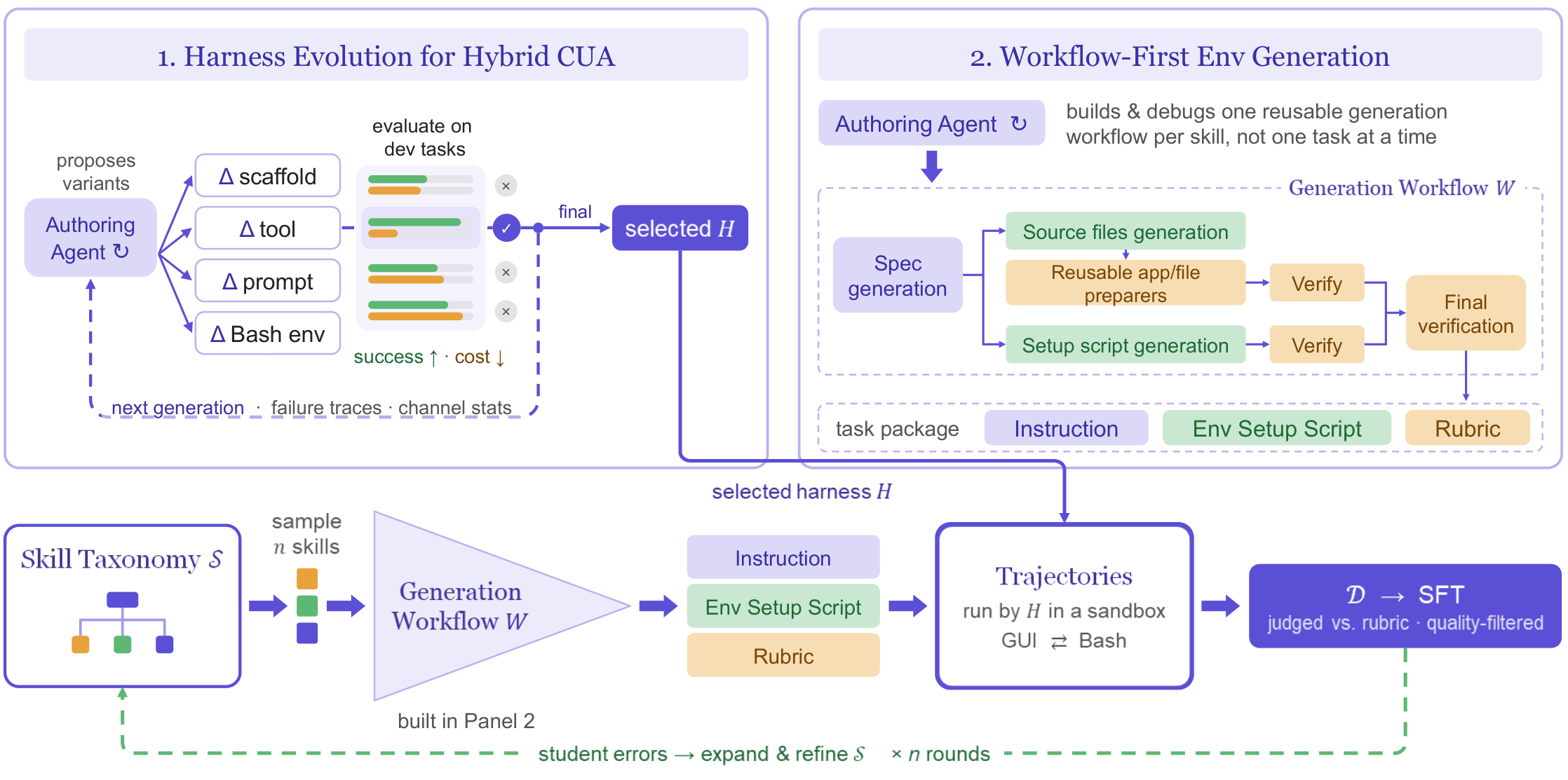 Overview of Mage-VL-Cowork: upstream teacher-harness evolution, reusable skill-conditioned task workflows (Mage-CUA-Forge), rubric judging, and student-feedback-driven skill expansion.
### 1. Evolved Hybrid CUA Harness
A strong teacher model does not automatically produce clean hybrid supervision. Before large-scale trajectory collection, an authoring agent evolves the external harness $\mathcal{H} = (\mathcal{F}, \mathcal{T}, \mathcal{P}, \mathcal{E})$ — refining the execution scaffold $\mathcal{F}$, tool interfaces $\mathcal{T}$, system prompt $\mathcal{P}$, and pre-installed terminal environment $\mathcal{E}$ (equipping domain packages such as `python-pptx`, `openpyxl`, `pandas`, `pypdf`, and `pillow` while removing redundant tools like `xdotool` and verbose accessibility dumps). We instantiate specialized **GUI**, **Terminal**, and **Hybrid** harnesses to roll out the same synthesized tasks across training stages.
### 2. Workflow-First Environment Synthesis (`Mage-CUA-Forge`)
Instead of spending open-ended agent tokens to construct one task at a time, **Mage-CUA-Forge** invests authoring effort **once per atomic skill** to build reusable generation workflows and application-specific preparers. Shared specification branches coordinate input artifact creation, executable environment setup scripts, user instructions, and evaluation rubrics. For web and cross-application tasks, we pair desktop preparers with synthesized **InfiniteWeb** sites and deterministic, SQLite-backed **WebHarbor** replicas that reset cleanly before every episode. Across three student-feedback-guided rounds, the pipeline synthesizes **293,806 distinct tasks** (**38.24% multi-application**, **877,608 file references** across 278 file categories) and retains **318,837 verified hybrid trajectories** (68.19% GUI tool calls, 31.81% terminal tool calls).
### 3. Five-Stage Specialize-Then-Unify Curriculum
Rather than learning hybrid routing as a workaround for weak visual grounding, **Mage-VL-Cowork** builds two strong standalone channels first and then unifies them:
| Stage | Training Focus | Supervision Scale | Compute Share | Nominal Compute |
| :--- | :--- | :---: | :---: | :---: |
| **1. GUI-Oriented Midtraining** | Visual grounding, chain-of-thought reasoning, and schema-compliant tool calling (with prompt decoupling, same-image target deduplication, and selective ``-body masking) | 24.6B tokens / epoch (751K packed 32K bins) | 15.2% | 1.18 ZFLOPs |
| **2. GUI Agent SFT** | Multi-step desktop & web workflows through screenshots, mouse, and keyboard | 156.7K trajectories (32.2B tokens / epoch) | 33.6% | 1.55 ZFLOPs |
| **3. Coding & Terminal SFT** | Repository software engineering + programmatic desktop file/state manipulation | 563.7K trajectories (5.7B tokens / epoch) | 19.9% | 0.27 ZFLOPs |
| **4. Hybrid CUA SFT** | Turn-level channel routing and verification between `computer_use` and `bash` | 318.8K trajectories (45.1B tokens / epoch) | 27.8% | 2.17 ZFLOPs |
| **5. Online Hybrid RL** | Asynchronous GRPO with verifiable task rewards, frontier task sampling, bounded policy lag ($\le 3$ updates), and truncated importance sampling ($\text{TIS} \le 2.0$) | 1,988 verifiable tasks (768 episode slots / update) | 3.5% | 2.62 ZFLOPs |
### 4. Asymmetric Working Memory
Long-horizon desktop tasks face a tension between context budget and visual state awareness. At step $t$, **Mage-VL-Cowork** conditions on an asymmetric sliding window:
- **Folded long-horizon memory ($1 \dots t-4$):** Earlier turns are compressed into single-line imperative `Action:` summaries placed immediately after the system prompt.
- **Active visual window ($t-3, t-2, t-1$):** The **3 most recent screenshots** and **4 complete assistant responses** are retained in full so the model can directly inspect before-and-after UI transitions and recover from no-op clicks.
## 📊 Performance & Experimental Evidence
Every evaluation below validates a core pillar of the **Mage-VL-Cowork** design.
### 1. Main Desktop Results: OSWorld-Verified (66.0% at 4B)
**Evaluation Protocol:** Evaluated on **361 held-out OSWorld-Verified tasks** (excluding Google Drive) under a **50-step budget** using the `MAGEHybridAgent` harness (`history_n=3`, `images_to_keep=3`, `1920×1080` desktop resolution). Following our rigorous multi-run standard, the headline **66.0%** (`66.04%`) is the **two-run average** across two independent full-benchmark passes (`65.33%` on Run 1 and `66.75%` on Run 2).
| Model | Params | Steps | OS | Office | Daily | Professional | Workflow | **Overall** |
| :--- | :---: | :---: | :---: | :---: | :---: | :---: | :---: | :---: |
| *Human reference* | — | — | — | — | — | — | — | 72.4 |
| *Frontier proprietary models* | | | | | | | | |
| GPT-5.5 | — | — | — | — | — | — | — | 78.7 |
| Claude Opus 4.7 | — | — | — | — | — | — | — | 78.0 |
| GPT-5.4 | — | — | — | — | — | — | — | 75.0 |
| Kimi-K2.6 | — | — | — | — | — | — | — | 73.1 |
| GPT-5.4-mini† | — | 50 | 79.2 | 68.0 | **76.6** | 69.4 | **63.3** | 69.6 |
| Claude Sonnet 4.5 | — | 100 | 70.8 | **72.6** | 61.4 | 63.2 | 49.5 | 62.9 |
| Seed-1.8 | — | 100 | 66.7 | 68.8 | 67.1 | 71.4 | 42.4 | 61.9 |
| Agent S2.5 w/ o3 | — | 50 | 75.0 | 53.8 | 54.0 | **75.5** | 39.5 | 54.2 |
| UI-TARS-2 | — | 100 | 41.7 | 61.1 | 62.1 | 61.2 | 34.1 | 53.1 |
| Claude Sonnet 4 | — | 50 | 45.8 | 43.5 | 55.1 | 55.1 | 28.5 | 43.9 |
| OpenAI CUA | — | 50 | 70.8 | 23.0 | 37.2 | 51.0 | 15.8 | 31.3 |
| *Open-weights & reported-scale models* | | | | | | | | |
| ScaleCUA-Qwen3.5-9B | 9B | 50 | 79.2 | **70.6** | **74.3** | **89.5** | 48.1 | **68.7** |
| **Mage-VL-Cowork-4B (Ours)** | **4B** | **50** | **87.5** | 64.9 | 65.0 | 66.3 | **62.7** | **66.0** |
| Muse Glimmer-30B | 30B | — | — | — | — | — | — | 65.9 |
| Qwen3.6-27B | 27B | — | — | — | — | — | — | 63.9 |
| EvoCUA-32B | 32B | — | — | — | — | — | — | 56.7 |
| Qwen3.5-27B | 27B | — | — | — | — | — | — | 56.2 |
| ComputerRL-9B | 9B | 50 | 75.0 | 45.8 | 52.5 | 71.4 | 27.9 | 48.0 |
| ProCUA-SFT | — | — | — | — | — | — | — | 45.0 |
| OpenCUA-72B | 72B | 50 | 45.8 | 42.7 | 53.8 | 75.5 | 22.3 | 44.9 |
| DART-GUI-7B | 7B | 30 | 62.5 | 39.3 | 50.8 | 73.5 | 16.7 | 42.1 |
| Qwen3.5-9B | 9B | — | — | — | — | — | — | 41.8 |
| OpenCUA-32B | 32B | 50 | 60.9 | 29.9 | 41.0 | 65.3 | 14.6 | 35.1 |
| Fara1.5-4B | 4B | 50 | 25.0 | 7.6 | 29.5 | 12.2 | 6.6 | 13.9 |
† Evaluated in one run on the same 361 tasks excluding Google Drive.
**Key Takeaways:**
- **Best-in-class at the 4B scale & a leap for on-device intelligence:** At just 4B parameters, `Mage-VL-Cowork` achieves **66.0% on OSWorld-Verified** — the highest performance among 4B models — proving that an efficient small VLM can master complex computer use and pushing the frontier of on-device intelligence.
- **Strong OS & Multi-Application Workflow execution:** `Mage-VL-Cowork` reaches **87.5% on OS tasks** and **62.7% on Multi-Application Workflows**, demonstrating how unified GUI + terminal execution turns complex cross-application desktop tasks into compact, reliable trajectories.
2. Stage-Wise Progression & Inference Efficiency (+20.44 pp & −25.4% tokens) — click to expand
Across the downstream curriculum, **Mage-VL-Cowork** climbs by **+20.44 percentage points** from GUI SFT to Online Hybrid RL while simultaneously becoming faster and more concise. In Stage 1 (GUI-oriented midtraining), grounding accuracy rises from **30.6% → 56.9%** on OSWorld-G (surpassing Qwen3.5-4B at 54.5%) and **78.8% → 87.2%** on ScreenSpot-v2 (surpassing Qwen3-VL-4B at 85.3%).
| Model / Stage | OSWorld-Verified (%) ↑ | Mean Model Calls / Task ↓ | Mean Output Tokens / Task ↓ | Mean `` Tokens / Task ↓ |
| :--- | :---: | :---: | :---: | :---: |
| **Stage 2: GUI Agent SFT** | 45.56 | 25.36 | 6,401 | 4,549 |
| **Stage 4: Hybrid CUA SFT** | 55.84 (+10.28 pp) | 21.57 (−14.9%) | 7,374 | 3,328 |
| **Stage 5: Online Hybrid RL (`Mage-VL-Cowork`)** | **66.04 (+20.48 pp)** | **18.77 (−26.0%)** | **5,499 (−25.4% vs. SFT)** | **2,482 (−25.4% vs. SFT)** |
| *Reference: GPT-5.4-mini (xhigh)* | *69.57* | *18.24* | *12,397* | *11,631* |
- **RL sharpens both accuracy and token economy:** Relative to Hybrid SFT, Online Hybrid RL adds **+10.16 pp** while cutting mean model calls by **13.0%** (21.57 → 18.77) and output tokens by **25.4%** (7,374 → 5,499).
- **2.25× more token-efficient than GPT-5.4-mini:** `Mage-VL-Cowork` matches `GPT-5.4-mini` in interaction turns (18.77 vs. 18.24 calls/task) while consuming **55.6% fewer output tokens** (5,499 vs. 12,397 tokens/task).
3. Why Evolving the Teacher Harness Matters (+12.5 pp Student Gain) — click to expand
More tools do not automatically make a better agent. Holding the teacher model fixed (`GPT-5.4`) and evaluating on **672 held-out multi-application tasks**, we compare a clean **GUI + Coding ($\beta_1$)** harness against an **Accessibility-augmented GUI + Coding + AX ($\beta_2$)** harness, and train a 4B student on each teacher's trajectories:
| Harness Configuration | Teacher Success (%) ↑ | Teacher Mean Steps ↓ | **4B Student Success (%) ↑** | **4B Student Mean Steps ↓** |
| :--- | :---: | :---: | :---: | :---: |
| **$\beta_1$ · Evolved GUI + Coding (Adopted)** | **92.0** | **25.00** | **37.6** | **30.91** |
| $\beta_2$ · GUI + Coding + Accessibility (AX) | 89.6 | 35.33 | 25.1 | 39.40 |
| **Advantage of Evolved Pruning ($\beta_1$ vs. $\beta_2$)** | **+2.4 pp** | **−29.2% steps** | **+12.5 pp** | **−21.5% steps** |
While a frontier teacher can partially absorb a redundant tool channel by taking extra steps, a compact 4B student is highly sensitive to split supervision. Pruning overlapping action routes upstream yields a **+12.5 percentage-point student jump** and **21.5% shorter trajectories**.
4. Workflow-First Data Synthesis Efficiency (−82.6% Cost) — click to expand
Using the exact same generation model (`gpt-5.6-terra`), **Mage-CUA-Forge** replaces per-task agentic construction loops with reusable skill-conditioned workflows and shared application preparers:
| Environment Synthesis Paradigm | Tokens / Task ↓ | Recurring Cost (USD / Task) ↓ | Relative Reduction |
| :--- | :---: | :---: | :---: |
| Standard Agent-First Construction | 1,276K | $0.906 | Baseline |
| **Mage-CUA-Forge (Workflow-First)** | **85K** | **$0.158** | **−93.3% tokens / −82.6% cost** |
5. Browser Transfer & Deterministic Verification: WebVoyager-Static (58.6%) — click to expand
Live web evaluations suffer from content drift, anti-bot blocks, and screenshot-only VLM judges that reward fluent guessing without backend state verification (causing 12.8 to 33.1 pp of score inflation across published web agents). We evaluate browser transfer on **WebVoyager-Static** — a deterministic offline benchmark reconstructing all **643 tasks across 15 websites** on resettable self-hosted replicas, grading **both required UI navigation traces and backend SQLite database state**:
| Model | Params | Agent Scope | WebVoyager-Static (%) ↑ | Self-Reported Live (%) | Live → Static Inflation ($\Delta$ pp) |
| :--- | :---: | :--- | :---: | :---: | :---: |
| Fara1.5-4B | 4B | Browser-only specialist | **68.0** | 80.8 | −12.8 |
| **Mage-VL-Cowork-SFT (Ours)** | **4B** | **General Desktop + Browser** | **58.6** | — | — |
| Qwen3-VL-8B-Thinking | 8B | General VLM | 53.7 | — | — |
| Qwen3.5-9B | 9B | General VLM | 53.3 | — | — |
| Qwen3-VL-4B-Thinking | 4B | General VLM | 49.6 | — | — |
| OpenWebRL-4B | 4B | Browser-only specialist | 47.1 | 74.1 | −27.0 |
| MolmoWeb-8B | 8B | Browser-only specialist | 46.8 | 78.2 | −31.4 |
| MolmoWeb-4B | 4B | Browser-only specialist | 42.6 | 75.2 | −32.6 |
| Fara-7B | 7B | Browser-only specialist | 40.4 | 73.5 | −33.1 |
| Qwen3.5-4B | 4B | General VLM | 37.3 | — | — |
Even before Stage 5 RL, our generalist desktop-and-browser SFT policy (**58.6%**) leads among 4B general-purpose models on deterministic offline web evaluation. Whereas `Fara1.5-4B` is specialized exclusively for browser DOM/screenshot workflows (scoring 13.9% on full-desktop OSWorld-Verified), `Mage-VL-Cowork` delivers unified competence across both full Linux desktops (**66.0%**) and multi-step web environments (**58.6%**) within a single compact 4B model.
## 🎬 Real-Time Side-by-Side Speedups (4B Hybrid vs. 27B GUI-Only)
Same task, same desktop, same wall-clock timer against `Qwen3.6-27B` (GUI-only, thinking mode):
| Task Scenario | **Mage-VL-Cowork (4B · Hybrid GUI + CLI)** | Qwen3.6-27B (27B · GUI-Only) | Advantage |
| :--- | :--- | :--- | :--- |
| **LibreOffice Calc:** Merge two banner ranges, label them, add a column chart, and save `.xlsx` | **Done in 0:39 (6 steps)** — manipulates the workbook programmatically via Python in the terminal | Done in 9:56 (39 steps) — clicks and drags cell-by-cell through the GUI | **15.3× faster wall-clock · 6.5× fewer steps** |
| **GIMP Image Editing:** Add alpha channel, clear solid teal background, scale layer to `280×210`, and save `.xcf` | **Done in 1:58 (15 steps)** — edits visually in GIMP GUI, then verifies file dimensions & alpha state via terminal | Stops at 7:02 (29 steps) — saved file fails the task verification check | **3.6× faster · Verified completion** |
Watch the real-time videos on our **[Project Page](https://microsoft.github.io/Mage/cowork/#demos)**.
## 🚀 Quick Start
> [!IMPORTANT]
> **Custom Architecture Notice:** `microsoft/Mage-VL-Cowork` uses a custom multimodal architecture (`model_type: "llava_onevision2"`, defined in the bundled `configuration_llava_onevision2.py` and `modeling_llava_onevision2.py` with a `Qwen2_5_VLProcessor` image processor). Always pass `trust_remote_code=True` when loading with `transformers` or `SGLang`, and do not assume drop-in weight compatibility with standard `Qwen3-VL` classes.
### 1. Installation
```bash
pip install "transformers>=4.57.3" accelerate pillow torch torchvision qwen-vl-utils
```
### 2. Serve with SGLang (Docker Runtime Recommended)
We provide a pre-built, dependency-pinned GPU inference container (`docker.io/xiaoyizhang/mage-vl-cowork:0.1.0`, featuring SGLang `0.5.2`, PyTorch `2.8.0+cu128`, Transformers `5.7.0`, and FlashInfer `0.3.1` with native `llava_onevision2` multimodal support):
```bash
export MODEL_DIR=/path/to/Mage-VL-Cowork
docker pull xiaoyizhang/mage-vl-cowork:0.1.0
docker run --rm --name mage-vl-cowork \
--gpus 'device=0' --shm-size=8g \
-p 127.0.0.1:30001:30001 \
--mount "type=bind,src=${MODEL_DIR},dst=/models/Mage-VL-Cowork,readonly" \
xiaoyizhang/mage-vl-cowork:0.1.0
```
Alternatively, if launching SGLang directly from a custom environment (`bfloat16`, `32,768` context window, and `SGLANG_MAX_PIXELS=4000000` to preserve full `1920×1080` desktop fidelity):
```bash
export SGLANG_MAX_PIXELS=4000000
python -m sglang.launch_server \
--model-path microsoft/Mage-VL-Cowork \
--served-model-name Mage-VL-Cowork \
--host 0.0.0.0 \
--port 30001 \
--trust-remote-code \
--dtype bfloat16 \
--context-length 32768 \
--mem-fraction-static 0.82 \
--tool-call-parser qwen25 \
--attention-backend flashinfer \
--mm-attention-backend triton_attn
```
> [!TIP]
> **Multimodal Request Protocol (`/generate`):** When querying the SGLang server with desktop screenshots, render prompts via `AutoProcessor.apply_chat_template` (or explicit `<|vision_start|><|image_pad|><|vision_end|>` vision placeholders) and send base64 image payloads to SGLang's native **`POST /generate`** endpoint (`image_data`). Our bundled `MAGEHybridAgent` uses this native `/generate` pipeline by default.
**Recommended Sampling Parameters (OSWorld-Verified 66.0% Configuration):**
- `temperature`: `0.7` (or `0.0` for deterministic single-run deployment)
- `top_p`: `0.8`
- `max_new_tokens`: `4096` (shared budget across ``, `Action:`, and ``)
### 3. System Prompt & Tool Schema
`Mage-VL-Cowork` is trained against a unified two-channel contract (`computer_use` and `bash`). Use the exact system prompt below for best performance:
Click to expand the verbatim MAGE_HYBRID_SYSTEM_PROMPT
```text
You are a multi-purpose intelligent assistant. Based on my requests, you can use tools to help me complete various tasks.
# Tools
You have access to the following functions:
{"type": "function", "function": {"name": "computer_use", "description": "Use a mouse and keyboard to interact with a computer screen.", "parameters": {"properties": {"action": {"description": "* `click`: Click at (x,y). Use `button` for left/right/middle.\n* `double_click`: Double click at (x,y).\n* `triple_click`: Triple click at (x,y) to select line/paragraph.\n* `move`: Move cursor to (x,y) without clicking.\n* `drag`: Drag from `start` to `end` coordinates.\n* `type`: Type text string.\n* `keypress`: Press key(s). Single key or combo.\n* `scroll`: Scroll at optional (x,y) position. scroll_x/scroll_y in [-999,999], |999|=full screen. Negative scroll_y=down, negative scroll_x=left.\n* `wait`: Wait specified seconds.\n* `screenshot`: Capture the current screen without changing anything.\n* `terminate`: End the task.", "enum": ["click", "double_click", "triple_click", "move", "drag", "type", "keypress", "scroll", "wait", "screenshot", "terminate"], "type": "string"}, "coordinate": {"description": "(x,y) in [0,999].", "type": "array"}, "button": {"description": "Mouse button for click: left/right/middle.", "type": "string", "enum": ["left", "right", "middle"]}, "start": {"description": "(x,y) drag start in [0,999].", "type": "array"}, "end": {"description": "(x,y) drag end in [0,999].", "type": "array"}, "keys": {"description": "Key list for keypress.", "type": "array"}, "text": {"description": "Text for action=type.", "type": "string"}, "scroll_x": {"description": "Horizontal scroll [-999,999]. Negative=left.", "type": "number"}, "scroll_y": {"description": "Vertical scroll [-999,999]. Negative=down.", "type": "number"}, "time": {"description": "Seconds for wait.", "type": "number"}, "status": {"description": "success/failure for terminate.", "type": "string", "enum": ["success", "failure"]}, "msg_to_user": {"description": "Optional message for terminate.", "type": "string"}}, "required": ["action"], "type": "object"}}}
{"type": "function", "function": {"name": "bash", "description": "Run a shell command on the machine and read its output. Use it for file inspection and edits, and for anything the shell does more reliably than the GUI; the result comes back as text, not as a screenshot.", "parameters": {"properties": {"command": {"description": "The shell command to run.", "type": "string"}}, "required": ["command"], "type": "object"}}}
For every step, reply in EXACTLY this format with NO suffix:
your reasoning paragraph describing the current screen state, how it connects to the task goal, and the rationale for the chosen action
Action: one short imperative sentence describing the next move.
{"name": "example_function_name", "arguments": {"example_parameter_1": "value_1"}}
Reminder:
- Function calls MUST follow the specified format
- Required parameters MUST be specified
- Reasoning goes inside ... BEFORE the Action line; nothing after the last tool_call
- You may output at most 15 blocks per response
- Use `type` for text input, `keypress` for shortcuts and special keys
- Every tool_call in one response must use the same function
# Response format
For every step:
1) ... block with your reasoning.
2) Action: a short imperative sentence.
3) One or more ... blocks (max 15).
Rules:
- The screen's resolution is 1000x1000. Coordinates are in [0, 999] range.
- Scroll amounts are normalized: |999| = one full screen width/height.
- For scroll, you may include coordinate to scroll at that position.
- For drag, specify start and end coordinates.
- Choose `bash` when the shell is the reliable way to do or check something, and `computer_use` when the work has to happen in the interface on screen.
- A `bash` call is answered with the command's text output; a `computer_use` call is answered with a new screenshot.
- Be brief: one sentence for Action.
- Do not output anything after the last tool call.
- If finishing, use action=terminate.
```
| Channel | Tool Name | Supported Operations & Return Contract |
| :--- | :--- | :--- |
| **GUI Channel** | `computer_use` | `click`, `double_click`, `triple_click`, `move`, `drag`, `type`, `keypress`, `scroll`, `wait`, `screenshot`, `terminate`. Coordinates are normalized to `[0, 999]` (`x = round(coord_x * width / 1000)`). Returns the post-action **desktop screenshot**. |
| **Terminal Channel** | `bash` | Executes shell commands, Python scripts, and CLI utilities in `/tmp_workspace`. Returns **merged `stdout`/`stderr` text** inside `` without consuming an image slot. |
### 4. Offline Transformers Inference Example
```python
import torch
from PIL import Image
from transformers import AutoModelForCausalLM, AutoProcessor
model_path = "microsoft/Mage-VL-Cowork"
processor = AutoProcessor.from_pretrained(model_path, trust_remote_code=True)
model = AutoModelForCausalLM.from_pretrained(
model_path,
trust_remote_code=True,
torch_dtype=torch.bfloat16,
device_map="auto",
).eval()
screenshot = Image.open("desktop_screenshot.png").convert("RGB")
task_instruction = (
"Merge cells A1:D1 in /home/user/Desktop/budget.xlsx, "
"set the title to 'Q4 Summary', and save the file."
)
messages = [
{"role": "system", "content": MAGE_HYBRID_SYSTEM_PROMPT},
{
"role": "user",
"content": [
{"type": "image"},
{"type": "text", "text": f"Task: {task_instruction}"},
],
},
]
prompt = processor.apply_chat_template(
messages, tokenize=False, add_generation_prompt=True
)
inputs = processor(text=[prompt], images=[screenshot], return_tensors="pt").to(model.device)
if "pixel_values" in inputs:
inputs["pixel_values"] = inputs["pixel_values"].to(model.dtype)
with torch.inference_mode():
output_ids = model.generate(
**inputs,
max_new_tokens=4096,
temperature=0.7,
top_p=0.8,
do_sample=True,
)
response = processor.tokenizer.decode(
output_ids[0, inputs["input_ids"].shape[1]:], skip_special_tokens=True
)
print(response)
```
Example model output:
```xml
The user wants to merge cells A1:D1 in `/home/user/Desktop/budget.xlsx` and set the banner text to 'Q4 Summary'. Currently the desktop is open, and LibreOffice Calc is not running. Since this is a structured spreadsheet manipulation on an existing `.xlsx` file, editing it directly with `openpyxl` in `bash` is much faster and more reliable than opening Calc and clicking through cell menus.
Action: Use Python with openpyxl in bash to merge A1:D1, set the title to 'Q4 Summary', and save `/home/user/Desktop/budget.xlsx`.
{"name": "bash", "arguments": {"command": "python3 -c \"\nimport openpyxl\nwb = openpyxl.load_workbook('/home/user/Desktop/budget.xlsx')\nws = wb.active\nws.merge_cells('A1:D1')\nws['A1'] = 'Q4 Summary'\nwb.save('/home/user/Desktop/budget.xlsx')\nprint('Saved successfully')\n\""}}
```
### 5. Complete OSWorld-Verified Evaluation Suite (`osworld_eval/`)
This repository includes the **complete, drop-in OSWorld-Verified reproduction suite** in [`osworld_eval/`](osworld_eval/), aligned 100% with the 66.0% evaluation pipeline (`test_nogdrive.json`, 361 tasks, 50-step budget), including the **Evolved Harness** guest Python dependency bundler (`pydeps_bundle.py`), the hybrid GUI + Bash multi-environment runner (`run_multienv_mage_cowork.py`), and one-command evaluation scripts:
```text
osworld_eval/
├── README.md
├── desktop_env/
│ └── pydeps_bundle.py # Guest Python dependency bundle builder & installer (Evolved Harness)
├── evaluation_examples/
│ └── test_nogdrive.json # 361 OSWorld-Verified benchmark tasks (excluding Google Drive)
├── mm_agents/
│ ├── mage_gui_agent.py # Base GUI computer_use agent & normalized [0, 999] action parser
│ └── mage_hybrid_agent.py # Hybrid GUI (computer_use) + Bash agent & SGLang /generate client
├── run/
│ └── run_multienv_mage_cowork.py # Multi-environment OSWorld evaluation runner (GUI + Bash routing)
└── scripts/
├── serve_sglang_docker.sh # SGLang Docker inference server launcher
└── run_osworld_eval.sh # One-command overlay & 361-task evaluation launcher
```
#### Step 1: Launch the SGLang Inference Runtime
Start the GPU inference server using the pre-built container (`docker.io/xiaoyizhang/mage-vl-cowork:0.1.0`):
```bash
export MODEL_DIR=/path/to/Mage-VL-Cowork # local clone of microsoft/Mage-VL-Cowork
bash osworld_eval/scripts/serve_sglang_docker.sh
```
Verify that the server is ready on `http://127.0.0.1:30001/health`:
```bash
curl --fail http://127.0.0.1:30001/health
```
#### Step 2: Prepare OSWorld & Host Environment
1. Clone the official [OSWorld](https://github.com/xlang-ai/OSWorld) repository and set up the Ubuntu desktop VM environment (`docker` provider recommended).
2. *(Recommended — Evolved Harness Python Dependency Bundle)* To inject the 15 office/PDF/data/vision Python distributions (`numpy`, `openpyxl`, `et_xmlfile`, `XlsxWriter`, `python-docx`, `python-pptx`, `defusedxml`, `typing_extensions`, `pypdf`, `pandas`, `python-dateutil`, `six`, `pytz`, `tzdata`, `opencv-python`) into `/opt/mage-hybrid-pydeps` inside the Ubuntu guest VM before task execution, run the evaluation host under **CPython 3.10** (matching the Ubuntu guest ABI) with those packages installed. If running under another Python version, `MAGEHybridAgent` automatically logs a warning and falls back to workspace-only initialization (or pass `--no_bootstrap_python_deps`).
#### Step 3: Run the 361-Task OSWorld-Verified Evaluation
`osworld_eval/scripts/run_osworld_eval.sh` automatically overlays `pydeps_bundle.py`, `mage_gui_agent.py`, `mage_hybrid_agent.py`, `run_multienv_mage_cowork.py`, and `test_nogdrive.json` into your `OSWORLD_ROOT` checkout and launches the full evaluation:
```bash
export MODEL_DIR=/path/to/Mage-VL-Cowork
export OSWORLD_ROOT=/path/to/OSWorld
export SGLANG_BASE_URL=http://127.0.0.1:30001
export NUM_ENVS=4
bash osworld_eval/scripts/run_osworld_eval.sh
```
#### Standard Evaluation Hyperparameters (66.0% Pipeline)
| Parameter | Setting | Role in Hybrid Execution |
| :--- | :--- | :--- |
| `--api_backend` | `sglang_generate` | Renders chat turns via `AutoProcessor.apply_chat_template(..., enable_thinking=True)` and passes JPEG (`quality=95`) `image_data` to SGLang native `POST /generate` |
| `--test_all_meta_path` | `evaluation_examples/test_nogdrive.json` | 361 OSWorld-Verified tasks excluding Google Drive |
| `--max_steps` | `50` | Maximum interaction turns per task |
| `--history_n` / `--images_to_keep` | `3` / `3` | Retains the 3 most recent full turns and up to 3 screenshots (`1920×1080`), with pairwise action-summary folding for earlier steps |
| `--temperature` / `--top_p` | `0.7` / `0.8` | Standard sampling parameters (reported 66.0% is the two-run average across two full passes) |
| `--max_tokens` | `4096` | Max new tokens per step (`` + `Action:` + ``) |
| `--sleep_after_execution` | `3.0` | Seconds to wait after each `pyautogui` GUI action |
| `--bash_timeout` | `300` | Timeout in seconds per `bash` tool execution |
| `--empty_action_retries` | `2` | Automatic resamples when a step parses 0 executable actions |
| `--bootstrap_guest` | `True` | Prepares `/tmp_workspace`, injects guest Python dependencies (`pydeps_bundle.py`), disables GNOME idle screen lock, and logs `bash` commands to `~/.bash_history` |
See [`osworld_eval/README.md`](osworld_eval/README.md) for detailed component documentation.
## 🛡️ Responsible AI & Safe Deployment
**Mage-VL-Cowork** is an autonomous hybrid agent capable of executing arbitrary shell commands (`bash`) and GUI interactions (`computer_use`). It is designed and evaluated for **isolated, disposable sandbox environments** (such as Docker containers or snapshot-reverted virtual machines). When deploying `Mage-VL-Cowork`, follow these operational best practices:
- **Mandatory Sandbox Isolation:** Always run the agent inside an isolated container or VM with no access to host filesystems, local networks, or personal environment variables.
- **Scoped Authorization & Human-in-the-Loop:** Require explicit human confirmation before permitting irreversible actions (e.g., external network submissions, account authentication, financial transactions, or privilege modifications).
- **Zero Credential Exposure:** Do not mount personal SSH keys, cloud tokens, browser cookies, or password stores inside the agent's workspace unless explicitly required and scoped to the sandbox.
- **Network Allow-Listing:** Restrict outbound network access when evaluating untrusted web content to mitigate indirect prompt injection embedded in external web pages or documents.
## 🏁 Summary
**Mage-VL-Cowork** demonstrates that an **efficient 4B small vision-language model** can master hybrid computer use when paired with **upstream teacher-harness evolution**, **workflow-first environment synthesis (`Mage-CUA-Forge`)**, and a **five-stage specialize-then-unify curriculum**. Achieving the **best performance at the 4B scale (66.0% on OSWorld-Verified)** while using **13.0% fewer model calls** and **25.4% fewer output tokens** after online RL, **Mage-VL-Cowork** pushes the frontier of **on-device intelligence** for autonomous desktop agents.
## 📝 Citation
```bibtex
@article{zhang2026magecowork,
title={Mage-VL-Cowork: A Full Training Recipe to Learn Hybrid Computer Use from Evolved Harnesses},
author={Zhang, Xiaoyi and Wang, Haoqing and Zhang, Xinjie and Ming, Xiang and Wang, Xing and Yang, Senqiao and Zhang, Kaichen and Jia, Zhaoyang and Tan, Andong and Wang, Xinjiang and Guo, Jinghao and Shen, Yifei and Li, Xiao and Zhang, Peng and Guo, Xun and Li, Jiahao and Zheng, Shicheng and Wang, Jinglu and Guo, Zongyu and Xie, Wenxuan and Li, Bin and Lu, Yan},
journal={arXiv preprint},
year={2026}
}
```
## 📄 License
Mage-VL-Cowork is released under the [Apache-2.0 License](https://www.apache.org/licenses/LICENSE-2.0).