
# Cheaplane 🛣️
> **Keep your premium subscription on the main thread. Offload the grunt work to cheap models — Cheaplane even picks the right one for you. Stop burning premium tokens on boilerplate.**
[](https://pypi.org/project/cheaplane/)





Cheaplane is a tiny single-file MCP server (~250 lines, stdlib + `mcp` only) that gives your main agent — e.g. **Claude Code on a Max subscription** — one extra tool: **`delegate`**. Your agent keeps doing the thinking (planning, architecture, final review) and hands *replaceable grunt work* — boilerplate code, formatting, translation, summarizing long docs — to cheap models behind a local [LiteLLM](https://github.com/BerriAI/litellm) proxy (DeepSeek, Kimi, Qwen, …). Think of it as **a cheap intern for your premium agent** — it churns out the boring parts while you keep thinking.
The trick that makes it *safe*: **the delegated calls and your subscription live in physically separate processes and never share credentials.** ([why that matters ⬇️](#billing-isolation-the-whole-point))
The trick that makes it *effortless*: **auto-routing.** `delegate(task)` picks the right cheap model from the task itself — code → DeepSeek, long docs → Kimi, Chinese → Qwen. ([how ⬇️](#using-delegate))
The trick that makes it *stick*: **a per-turn reminder hook so your agent doesn't forget the tool exists** — [the part most "delegate" tools skip](#make-your-agent-actually-use-it). And a **savings ledger** shows you [what it kept off your quota](#see-what-you-saved).
**See it in action** — your agent hands a chore over; auto-routing sends it to the cheap code model:
```text
delegate("convert to a TypeScript interface: {id, name, email, isAdmin, roles[]}")
```
```ts
interface User {
id: number;
name: string;
email: string;
isAdmin: boolean;
roles: string[];
}
```
↑ a real call's output — not a mockup, and no model picked by hand. That token cost **~90× less** than your premium model, and your subscription quota never moved.
## The problem
Premium models earn their price on hard problems — but every token counts against your plan, and you burn through quota on *churn*: reformatting JSON, translating UI strings, summarizing a doc you'll read once. The usual "just use a cheap model" setups force an ugly choice:
- **Downgrade the whole agent** → you lose main-thread quality on the work that actually matters.
- **Route everything through an API key** → you stop using the subscription you're already paying for.
Cheaplane keeps the sweet spot: **premium main thread for judgment + cheap models for the churn + billing that physically can't cross.**
## How Cheaplane compares
The popular 2026 move is to swap your *whole* agent onto a cheap model (DeepClaude-style). Great for raw cost — but it downgrades the thread you actually think with, **breaks your other MCP tools**, and doesn't even apply if you're on a Pro/Max subscription. Cheaplane takes the opposite bet:
| | Swap whole agent → cheap model *(DeepClaude-style)* | Everything via one API key | **Cheaplane** |
|---|:---:|:---:|:---:|
| Main thread | ⬇️ downgraded | ⬇️ no more subscription | ✅ stays premium |
| Your other MCP tools | ❌ break | ✅ | ✅ *(it **is** an MCP server)* |
| Works on a Pro/Max subscription | ❌ API-key only | ❌ replaces it | ✅ built for it |
| Picks the cheap model for you | ❌ one model for everything | ❌ | ✅ `auto` routing |
| Shows what you saved | ❌ | ❌ | ✅ `savings` ledger |
| Billing | merged into one | one per-token bill | 🔒 subscription + cheap, **isolated** |
Comparison reflects how backend-swap setups (DeepClaude-style) behaved per public reports in mid-2026; specifics vary by tool and can change.
## How cheap is "cheap"?
The grunt work is the *easy* part — paying premium rates for it is pure waste. Per **million tokens** (public list prices, mid-2026):
| Model | Input | Output | Best for |
|---|--:|--:|---|
| Claude Opus *(API, for reference)* | $5.00 | **$25.00** | the judgment work you keep |
| DeepSeek V4 Flash | $0.14 | **$0.28** | code / formatting |
| Kimi K2 | $0.60–0.95 | $2.50–4.00 | long docs (very large context) |
| Qwen | $0.05–0.40 | $0.20–1.20 | Chinese copy |
That's an output token costing **~$25 on Opus vs ~$0.28 on DeepSeek — about 90× more for work that doesn't need the smarts.** You're on a *subscription*, so you don't pay that $25 directly — your main thread spends *quota*, not dollars. That's the whole point: every routine task you offload is premium quota you keep for the hard problems. *(Summarizing a 40-page doc on DeepSeek Flash runs ~$0.005 — your quota never even notices.)*
Prices are public list rates, mid-2026, and vary by tier/caching — check each provider. The stable takeaway is the order-of-magnitude gap, not an exact dollar saving.
## Billing isolation (the whole point)
Most "save money" hacks blur your bills together. Cheaplane keeps them physically apart:
```mermaid
flowchart LR
A["Main agent
premium subscription"] -->|"delegate(task)"| B["Cheaplane MCP
own process, own key"]
B -->|HTTP| C["LiteLLM proxy
localhost:4000"]
C --> D["DeepSeek / Kimi / Qwen
cheap, pay-per-use"]
```
The Cheaplane process **never imports your subscription provider's SDK, never reads its auth, never touches its OAuth token.** It knows exactly one thing: an HTTP endpoint (your proxy) and its key. Your main thread bills to your subscription; delegated calls bill to your cheap proxy. **The two can't cross — not by policy, by architecture.**
## Quick start
**Fastest path** — Claude Code, one script:
```bash
git clone https://github.com/millennialdreamer/cheaplane && cd cheaplane
cp litellm.yaml.example litellm.yaml # then: export DEEPSEEK_API_KEY=sk-...
litellm --config litellm.yaml & # start the cheap-model proxy on :4000
bash setup.sh # deps + register MCP + reminder hook + verify
```
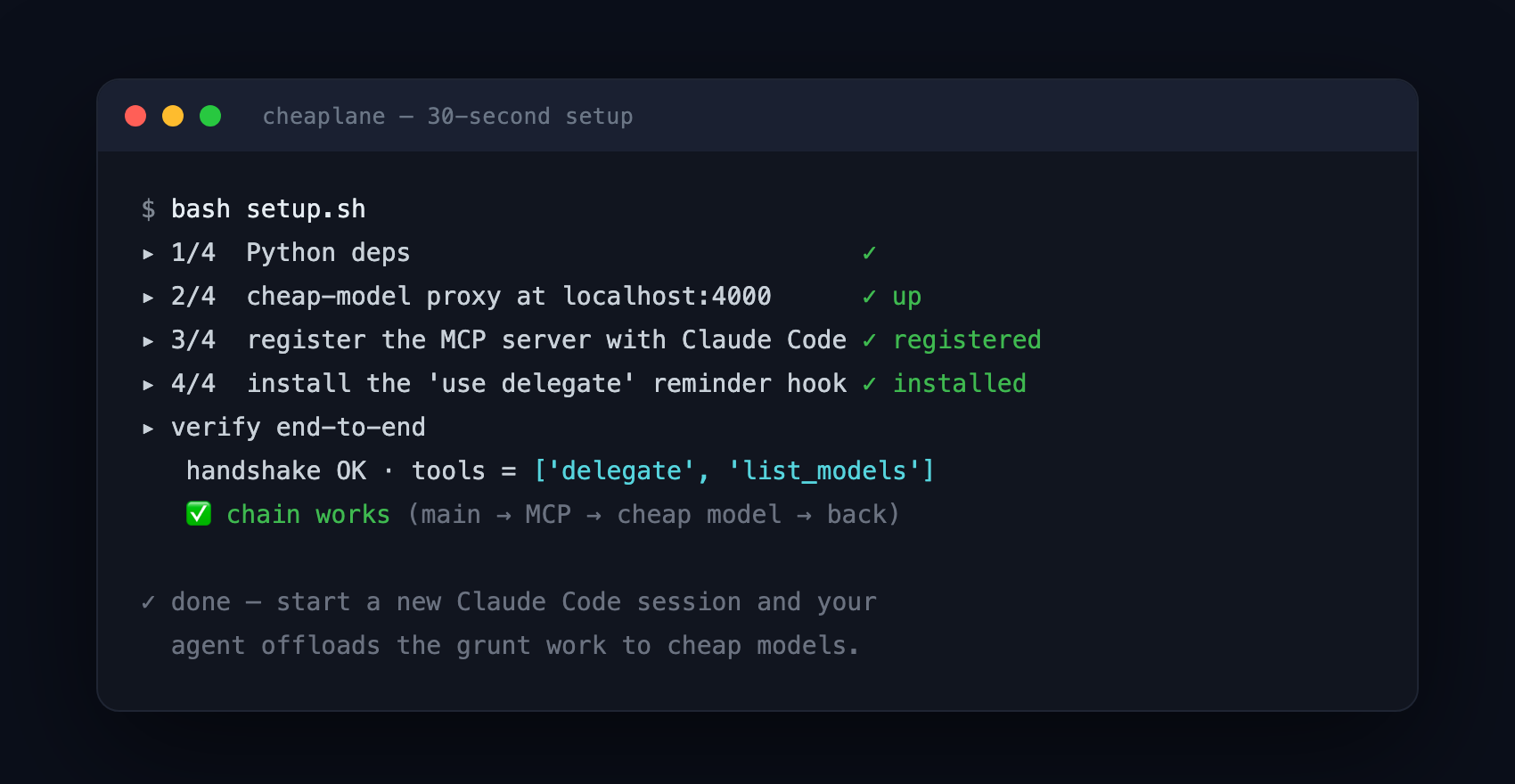
`setup.sh` is idempotent (safe to re-run): it installs deps, registers the `delegate` MCP server with Claude Code, installs the per-turn reminder hook, and verifies the chain end-to-end. Then start a fresh Claude Code session — done.
**Prefer a package?** Cheaplane is on PyPI — no clone, no path to hard-code:
```bash
pip install cheaplane # or: uvx cheaplane / pipx install cheaplane
claude mcp add delegate cheaplane
```
You still want the proxy from step 1 below, and the [reminder hook](#make-your-agent-actually-use-it) is worth it — that part needs the repo.
Manual setup / what setup.sh does under the hood
**1. Get an OpenAI-compatible endpoint for the cheap models.** Most people run [LiteLLM](https://github.com/BerriAI/litellm) locally as a proxy in front of DeepSeek / Kimi / Qwen. A minimal config is ~5 lines:
```yaml
# litellm.yaml — exposes DeepSeek under the model_name "deepseek"
model_list:
- model_name: deepseek
litellm_params:
model: deepseek/deepseek-chat # swap for any provider/model LiteLLM supports
api_key: os.environ/DEEPSEEK_API_KEY
```
```bash
pip install 'litellm[proxy]'
litellm --config litellm.yaml # serves http://localhost:4000
```
That `model_name: deepseek` lines up with Cheaplane's default alias, so it works out of the box. (`deepseek` is a built-in LiteLLM provider — no `api_base` needed; you'd add one only for a custom or self-hosted endpoint.) Already have an OpenAI-compatible endpoint (LiteLLM, OpenRouter, Ollama, vLLM…)? Skip this and just point `DELEGATE_BASE_URL` at it.
**2. Install Cheaplane** — from PyPI, or from a clone if you also want the reminder hook and `probe.py`:
```bash
pip install cheaplane # installs a `cheaplane` command; that's the whole install
```
```bash
git clone https://github.com/millennialdreamer/cheaplane && cd cheaplane
uv sync # or: python -m venv .venv && .venv/bin/pip install mcp
```
**3. Register it with your MCP client.** Installed from PyPI — the command is already on your `PATH`:
```json
{
"mcpServers": {
"delegate": { "command": "cheaplane" }
}
}
```
From a clone — copy `.mcp.json.example` to `.mcp.json` in the repo root and fix the path (or use `claude mcp add`):
```json
{
"mcpServers": {
"delegate": {
"command": "uv",
"args": ["run", "--directory", "/ABSOLUTE/PATH/TO/cheaplane", "python", "server.py"]
}
}
}
```
**4. Verify it end-to-end** — with your proxy from step 1 running (handshake → list tools → a real delegated call):
```bash
uv run python probe.py
# ✅ chain works (main → MCP → cheap model → back)
```
## Using `delegate`
Your agent now has `delegate(task)` — **routing is automatic**; override only when you want to:
```text
delegate("convert this JSON to a TypeScript interface: …") # auto → deepseek (code)
delegate("summarize this 40-page contract: …") # auto → kimi (very long input)
delegate("…Chinese text in the task auto-routes here…") # auto → qwen (Chinese copy)
delegate("translate these UI strings to Japanese", "flash") # explicit alias still wins
```
| alias | good for |
|---|---|
| `auto` | **default** — picks one of the below from the task itself |
| `deepseek` | code / balanced |
| `mimo` | reasoning / multi-step |
| `flash` | fast / formatting / translation |
| `kimi` | long documents (very large context) |
| `qwen` | Chinese copywriting |
Aliases map to your LiteLLM `model_name`s. Point them at your proxy **without editing code** — set the `DELEGATE_MODEL_MAP` env var (a JSON object), or drop a `~/.claude/delegate-model-map.json` (hot-reloaded — no restart needed); editing `MODEL_ALIASES` in `server.py` also works.
What to delegate vs keep (rule of thumb)
**Delegate** (let the cheap model do it):
- boilerplate / scaffolding from a clear spec
- mechanical refactors, formatting, lint fixes
- translation; summarizing or extracting facts from long docs
- routine prose: changelogs, docstrings, commit messages
**Keep** (you do it yourself):
- planning, architecture, technical trade-offs
- **final review of delegated output — always you**
- talking to the user; judgment calls
- anything where being subtly wrong is expensive
The delegated model sees **only your `task` string** — it has no access to your conversation. Make each task self-contained: spec + the actual input + the exact output format you want.
## See what you saved
Every delegated call appends one line of **metadata only — never the task content** — to `~/.cheaplane/usage.jsonl`. Ask your agent for `savings` any time (sample output):
```text
Cheaplane savings — all time
delegated calls : 184
tokens offloaded: ~412,300 in / ~365,800 out
premium cost avoided (Opus list): ~$11.21
actually spent (DeepSeek-class) : ~$0.16 (≈70× cheaper, in+out blended)
last 7 days : 31 calls, ~$2.04 avoided
```
Numbers are estimates at public list prices — the real win is the premium **quota** that never left your subscription. The ledger records token counts and model names only; delete the file any time, or set `DELEGATE_NO_LOG=1` to turn logging off entirely.
## Make your agent actually use it
Here's the dirty secret of every "delegate to a cheap model" tool: **installing it isn't the hard part — getting your agent to actually *use* it is.** Drop a tool into an agent and, a few turns into a real task, it forgets the tool exists and grinds through the grunt work itself on premium tokens. The instruction sinks down the context; attention moves on.
Cheaplane ships the fix in the box — three layers you can stack:
1. **Skill** (`SKILL.md`) — teaches the agent *when* to delegate. Works on any client; passive, so treat it as the baseline.
2. **A one-line default** in your `CLAUDE.md` / system prompt: *"Before doing replaceable grunt work yourself, delegate it."* Stronger — but a static instruction still drifts down a long conversation.
3. **A per-turn reminder hook** — the reliable one (Claude Code). It re-injects the nudge on **every** prompt, so the habit never sinks out of view. This is what turns an *installed* tool into a *used* one.
**On other MCP clients** (no `UserPromptSubmit` hook system), use layers 1–2 — wire the one-liner into whatever system prompt your client supports.
Install the hook — safe and idempotent (backs up your settings, **merges** instead of overwriting, de-dupes on re-run):
```bash
bash install-hook.sh # registers hooks/delegate-reminder.sh as a UserPromptSubmit hook
# verify it's wired up:
python3 -c "import json,os;s=json.load(open(os.path.expanduser('~/.claude/settings.json')));print([h['command'] for e in s.get('hooks',{}).get('UserPromptSubmit',[]) for h in e.get('hooks',[])])"
```
Start a fresh session, and your agent self-checks every turn: *"is this replaceable grunt work? → delegate it."*
The reminder costs ~60 tokens per turn — trivially less than the hundreds of premium tokens a single forgotten delegation burns. The hook uses Claude Code's UserPromptSubmit mechanism.
## Config
| Env var | Default | Meaning |
|---|---|---|
| `DELEGATE_BASE_URL` | `http://localhost:4000` | OpenAI-compatible endpoint (your proxy) |
| `DELEGATE_API_KEY` | `sk-litellm` | key for that endpoint |
| `DELEGATE_TIMEOUT` | `120` | per-call timeout (seconds) |
| `DELEGATE_MODEL_MAP` | *(none)* | JSON remapping aliases, e.g. `{"deepseek":"deepseek-v4-flash"}` — overrides defaults, no code edit |
| `DELEGATE_LOG` | `~/.cheaplane/usage.jsonl` | where the savings ledger lives |
| `DELEGATE_NO_LOG` | *(unset)* | set to `1` to disable the ledger entirely |
## FAQ
**Will this leak my subscription credentials?**
No. The `delegate` tool runs in its own process and only ever makes a plain HTTP call to the endpoint *you* configure. It never imports your subscription SDK and never sees its auth — see [Billing isolation](#billing-isolation-the-whole-point).
**What exactly does the savings ledger record?**
One JSON line per call: timestamp, alias, model name, and token/character counts. **Never the task text, never the model's output.** Delete `~/.cheaplane/usage.jsonl` any time, or set `DELEGATE_NO_LOG=1`.
**How does `auto` decide which model to use?**
A small deterministic heuristic in `server.py` (`_pick_model`, ~20 lines you can read and tweak): code signals → `deepseek`, very long input → `kimi`, Chinese-heavy → `qwen`, multi-step language → `mimo`, short mechanical chores → `flash`. An explicit alias always overrides it.
**How is this different from just using one API key for everything?**
With a single API key you stop using your subscription entirely and pay per token for *all* work — including the hard parts. Cheaplane keeps your subscription as the premium main thread and sends only the cheap, replaceable churn elsewhere.
**Does it work with anything besides Claude Code?**
Yes — any MCP-compatible client (Cursor, Cline, Windsurf, …). The main agent just needs to support MCP tools; see Manual setup for the generic JSON config.
**Do I have to use DeepSeek / Kimi / Qwen?**
No. Anything reachable through an OpenAI-compatible endpoint works; the aliases are just convenience labels you can remap with `DELEGATE_MODEL_MAP`.
**Why a proxy instead of calling providers directly?**
One endpoint, one key, usage logging, and easy model swaps — and it keeps provider keys out of the MCP server entirely.
## Roadmap & ideas (help wanted)
Cheaplane's core stays deliberately tiny — but the surface it opens up is big. Shipped so far: ✅ auto-routing (v0.2), ✅ savings ledger (v0.2). Still worth building — proposals and PRs welcome, and most are small enough to be good first issues:
- **Smarter routing** — the current router is a readable heuristic; better signals (or a learned router) are an open playground.
- **Richer savings dashboard** — the ledger is plain JSONL; a `cheaplane stats` HTML view would be lovely.
- **Result cache** — skip re-delegating identical tasks.
- **Auto-review** — lint/test code that comes back before you trust it.
- **Batch / parallel delegate** — hand off several chores in one call.
- **More client adoption recipes** — the reminder hook targets Claude Code's `UserPromptSubmit`; Cursor / Cline / others want their own nudge.
> Design rule: **keep the core single-file and dependency-light — that's the whole point.** Build extensions as opt-in, so the 5-minute read stays a 5-minute read.
## Contributing
Issues and PRs welcome — it's ~250 lines of single-file Python with no heavy deps, easy to hack on. Add a useful model alias, a routing signal, or a client recipe and send it over.
## License
MIT — see [LICENSE](LICENSE).