
CommitLore
Stop re-reviewing the same bad idea.
Decision authority for coding agents, owned by Git.
Keep constraints, rejected alternatives, and warnings in Git — then deliver
only what is still in force, so an agent is not handed a decision the
repository already reversed.
No hosted memory. The repository owns the record.





English ·
한국어 ·
日本語 ·
简体中文
Install once. Then initialise each repository where you want it to work.
```bash
curl -fsSL https://raw.githubusercontent.com/MongLong0214/commitlore/v1.7.5/install.sh | sh -s v1.7.5
```
Prefer to read the installer first?
```bash
curl -fsSLO https://raw.githubusercontent.com/MongLong0214/commitlore/v1.7.5/install.sh
sh install.sh v1.7.5
# Or skip the script: the checkout it makes is one you can make yourself.
git clone --depth 1 --branch v1.7.5 https://github.com/MongLong0214/commitlore
node commitlore/dist/commitlore.mjs --version
```
It installs a pinned source checkout and a wrapper that runs
`node /dist/commitlore.mjs` — no compiled download, no build step.

---
> **The code survives. The judgment doesn't.**
An agent proposes an approach. Your team rejects it because of a non-obvious
constraint. The final code preserves the outcome, but usually not why the
alternative was rejected. A later agent sees only the code and proposes the
same idea again.
CommitLore keeps that judgment beside the code.
## What CommitLore does
| | Behavior | Product path |
|---|---|---|
| **Captures** | Preserves constraints, rejected alternatives, and warnings that a diff cannot show. Candidates are checked against the session transcript and the staged diff. | `commitlore capture` |
| **Preserves** | Stores accepted records in Git trailers or notes instead of a hosted memory database. | commit hooks · `refs/notes/commitlore` |
| **Tracks lifecycle** | Keeps active, superseded, and expired decisions distinct. | `commitlore stale` |
| **Scopes** | Selects decisions for the path an agent is about to edit. | `commitlore context` |
| **Grades trust** | Delivers records as directives, claims, or withheld content. | default / signed mode |
| **Delivers** | Gives supported agents current context before an edit. | plugin hook · MCP |
Most commits should carry no record. CommitLore is for judgment the code cannot
preserve, not for narrating every change.
## 60 seconds to decision-aware agents
### 1. Install the CLI
macOS and Linux:
```bash
curl -fsSL https://raw.githubusercontent.com/MongLong0214/commitlore/v1.7.5/install.sh | sh -s v1.7.5
```
Windows:
```powershell
& ([scriptblock]::Create((irm https://raw.githubusercontent.com/MongLong0214/commitlore/v1.7.5/install.ps1))) v1.7.5
```
Requires Node.js 22.23.2+ and Git. The script checks both before it writes anything.
### 2. Connect your agent
Claude Code:
```text
/plugin marketplace add MongLong0214/commitlore
/plugin install commitlore@commitlore
```
Codex:
```bash
commitlore plugin install-codex
```
The plugin puts no `commitlore` on `PATH`, so the commands below need the CLI
install as well. The installers also detect and wire supported MCP hosts where
they can do so safely; the exact matrix is below.
### 3. Initialize a repository
```bash
cd your-repository
commitlore init
commitlore context .
```
Start a new agent session after installing or updating a plugin: a running
session keeps the runtime it loaded.
Then work and commit normally. On supported skill integrations, CommitLore is
considered during ordinary commit requests and stays silent when there is
nothing worth preserving. You do not need to name CommitLore on every commit.
Want accepted records to stage without a per-record prompt? The repository can
opt in once with `commitlore auto on`. That policy is repository-owned and
applies to the team, so it is not silently enabled by this page.
## What the agent receives
Before editing `src/pricing.ts`:
```text
commitlore: active records for src/pricing.ts
Limit
[claim] r-price01 a1b2c3d4 calculatePrice owns final checkout pricing only
Ruled-out
[claim] r-price01 a1b2c3d4 Reuse it for admin quotes | eligibility and rounding semantics differ
```
`[claim]` means "weigh this as information." A repository can opt into the
stronger signed-authority mode. Delivery gives the agent context; it does not
block the edit.
[Security model →](SECURITY.md)
## Why Git?
**The repository should own the judgment behind its code.**
CommitLore stores records in ordinary Git trailers and notes, so they branch,
merge, clone, review, and survive provider changes with the code they explain.
SQLite is only a rebuildable index. Delete it and Git still holds the record.
## Finding an old decision is not enough
A general memory or retrieval system asks:
> Which old text looks related?
CommitLore asks:
> Which recorded decisions still apply to this path now?
A superseded decision can be highly relevant and still be wrong as current
guidance. Relevance and authority are different questions.
## How it works
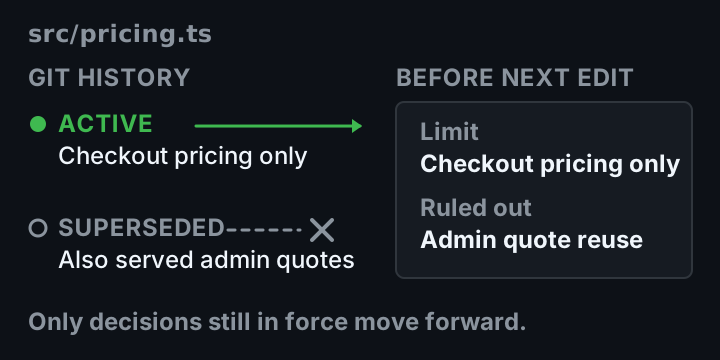
1. **Capture** — an agent drafts only decision context the diff cannot show.
2. **Verify** — CommitLore checks the draft against the session and staged diff.
3. **Preserve** — the accepted record lives in Git with identity and lifecycle.
4. **Deliver** — before a later edit, only active records for that path are returned.
Most commits carry no record. The commit hook validates a record when one is
present; it does not invent one.
An existing hook is not overwritten. `commitlore init` honours `core.hooksPath`,
moves any hook already installed to `.commitlore-chained`, and calls it
first; `commitlore hooks uninstall` puts it back.
## What happens automatically
| Host | Pre-edit delivery | Verified capture workflow | Deterministic every-commit capture |
|---|---|---|---|
| Claude Code | Automatic through the plugin | Available through the plugin skill | **Not certified** |
| Codex | Automatic through the plugin | Available through the plugin skill | **Not certified** |
| Hermes | Available after `commitlore hermes install` | Available after host install | **Not certified** |
| Gemini CLI, Cursor, Windsurf, opencode | MCP delivery where the host uses the registration | Procedure exposed over MCP | No |
| `AGENTS.md` hosts | Procedure only | Procedure only | No |
"Available" means the prepare → verify → stage workflow exists. It does not mean
every eligible commit is assessed automatically.
Users on supported skill hosts do not need to say "record this in CommitLore" on
every commit. The remaining limitation is host initiation, not a required
per-record user command.
## Squash-merge repositories
A squash merge replaces a branch's commits with one new commit, and that commit
does not carry the branch's trailers. If your repository merges with the squash
button, a record made on a branch is dropped by the merge unless something
carries it onto the commit that squashed it.
Two paths cover that, and one of them needs a one-time setup:
| How the squash happens | What carries the record | Setup |
|---|---|---|
| `git merge --squash` locally | The installed `prepare-commit-msg` hook, from `SQUASH_MSG` | None — `commitlore init` already did it |
| GitHub's **Squash and merge** button | The `action/preserve` GitHub Action | The workflow below |
GitHub performs that merge on its own servers, where no local git hook runs at
all, so the local hook cannot see it. The Action is the only place that has what
it needs at that moment: the pull request, its commits, and the commit they were
squashed into.
Add `.github/workflows/commitlore-preserve.yml`:
```yaml
name: CommitLore squash inheritance
# pull_request_target, not pull_request: a pull request from a fork gets a
# read-only token on pull_request, so the job would build the record and then
# fail to publish it.
on:
pull_request_target:
types: [closed]
permissions:
contents: write # the one push to refs/notes/commitlore
concurrency:
group: commitlore-notes
cancel-in-progress: false
jobs:
preserve:
if: github.event.pull_request.merged == true
runs-on: ubuntu-latest
steps:
- uses: actions/checkout@v4
with:
# the merge commit is on the base branch, and a closed pull request
# has no merge ref left to check out
ref: ${{ github.event.pull_request.base.ref }}
fetch-depth: 0
# the mirror this action writes; publishing from a checkout that never
# read it would fork the notes history
- run: git fetch --no-tags origin '+refs/notes/commitlore:refs/notes/commitlore'
# a squash merge usually deletes the branch, and then the pull request's
# own ref is the only one still reaching the commits that carry records
- run: git fetch --no-tags --force origin
'+refs/pull/${{ github.event.pull_request.number }}/head:refs/commitlore/pr-head'
# The action runs CommitLore from a checkout of this repository: the
# package is private, so there is no published npm name to fall back to.
# `dist/` is committed (ADR-0011), so nothing needs building.
- uses: actions/checkout@v4
with:
repository: MongLong0214/commitlore
ref: v1.7.5
path: .commitlore-cli
persist-credentials: false
- uses: MongLong0214/commitlore/action/preserve@v1.7.5
with:
cli-path: .commitlore-cli/dist/cli.js
```
Two rules for whoever edits this next, because `pull_request_target` runs with a
writable token: never check out the pull request's head here, and never execute
anything reachable from `refs/commitlore/pr-head`. The fork's commits arrive as
data to read trailers from, not as code to run.
`commitlore doctor` reports whether this is switched on, under
`squash inheritance`. It says so **before** a record is lost;
`squash conservation` is the row that reports records already gone.
If you merge with merge commits or rebase, records survive on their own and this
setup is unnecessary.
## A field report, not a measurement
One run, on an unrelated repository, by someone installing v1.2.1 for the first
time. Nothing here was measured and none of it is in the evidence logs. It is on
this page because the paragraph above asserts a loop that no table here covers.
They asked an agent to fix a rounding bug, mentioned in passing that a decimal
library had already been considered and dropped, and ended with "commit it".
CommitLore was never named. Part of what the commit carried:
```
Ruled-out: adopting a decimal library such as Decimal.js | the backend is a
number contract, so it is meaningless
Warn: do not revert the test file to console.assert: it exits 0 even on
failure, so CI passes silently
Provenance: drafted
```
The `Warn` was not dictated to the agent. It hit the trap while working and left
it for whoever came next. `Provenance: drafted` records that no human read the
record, which grades it `claim` — delivered as a report to weigh, not an order.
A later session with no shared history was asked to adopt the decimal library
after all. It did not, and named the record as its reason. It also read the
grade: a `claim` is not an instruction, so it checked the stated reason against
the code before agreeing with it.
## Unlike memory storage
| | General memory / RAG | **CommitLore** |
|---|---|---|
| Primary question | What old text is related? | Which decisions still apply here now? |
| Authority | Memory store or provider | Git |
| Scope | Semantic similarity | Repository paths |
| Lifecycle | Often append-first | Active · superseded · expired |
| Trust | Retrieved text | Directive · claim · blocked |
| Capture | Transcript or note storage | Evidence-checked decision record |
| Portability | Backend-dependent | Ordinary Git |
CommitLore is intentionally narrower. It is not a general user-memory system,
conversation archive, or vector database replacement.
## Evidence
| Question | Measured result | Boundary |
|---|---|---|
| Did claim-grade context change re-proposal in the registered study? | **2.8%** (16/580) with CommitLore vs **18.8%** (109/579) without | one model, one harness, constructed tasks |
| Did lifecycle filtering deliver retired records in the measured active projection? | **0 retired records** | superseded records were present; expiry was not |
| Does indexed lookup scale? | **496 ms p50 at 100k commits** | the no-index fallback is much slower |
Index build time follows the number of *records*, not the number of commits: the
expensive pass runs once per record, so a long history that has recorded little
builds faster than a short one dense with records.
Path scope is what keeps a large history from reaching the model. On the #167
corpus, only 2 of 10,002 records did:
| route | model-visible records | relevant records | model-visible tokens |
|---|---:|---:|---:|
| inject everything | 10,002 | 2/2 | 1,004,554 |
| top-k lexical | 2 | 1/2 | 190 |
| CommitLore path scope | 2 | 2/2 | 335 |
That measures exposure and recall at a fixed two-record budget — not token cost,
billed cost, accuracy, or agent behaviour. One corpus, one query, one pinned
embedding model.
The agent study does not establish a universal model effect. Delivery is not
proof that a model read or followed a record.
[Methods, full tables, exclusions, and negative results →](docs/evidence.md)
## Limits, trust and privacy
- **Capture is assisted, not deterministic.** Supported skills consider ordinary
commit requests, but no host is certified to assess every eligible commit.
- **Default directive mode is not authentication.** It matches the commit
author header, and anyone who can write a commit can set that header — so a
`[directive]` in default mode is policy metadata, not proof of identity.
Signature mode additionally requires Git's own verified status and a match in
the repository-local `commitlore.trustedSigner` allowlist; an absent, empty, or unreadable signer allowlist authorizes nobody, so the mode fails closed.
- **Guard is an experimental advisory**, not a safety net: precision 44.8% (95% Wilson CI 32.7%–57.5%), recall 22.0% on the 417-decision corpus. An empty guard result is not a safety verdict.
- **Delivery spends tokens on every matching tool call.** The pre-edit hook
fires on `Read` as well as `Edit`, `Write`, `MultiEdit` and `NotebookEdit`, so
it runs far more often than an editing agent commits. Each fire spends up to
the payload budget — 800 tokens by default, changed with `--budget`. A
repository with no records spends nothing, which means this is a cost that
arrives with adoption rather than with installation.
- **An answer may be partial.** Coverage is disclosed; absence from a partial
result is not proof that no record exists. `commitlore coverage` reports what a
scan reached.
- **Commit trailers travel with a clone; notes do not.** Git does not fetch
`refs/notes/*` by default, so a record in `refs/notes/commitlore` is absent
from an ordinary clone until `commitlore init` configures that mirror.
- **There is no hosted backend.** But once the server or hook returns context,
the host handles that context under its own policy; CommitLore does not
control that data flow.
[Security](SECURITY.md) ·
[Compatibility](docs/COMPATIBILITY.md) ·
[Evidence](docs/evidence.md)
Security and trust model
Records are untrusted until graded. Default author matching is policy metadata,
not authentication. Signed directive mode requires Git verification and a
repository-local signer allowlist; an absent or unreadable allowlist authorizes
nobody. Injection-shaped payload is withheld from model-readable routes.
[Full security model →](SECURITY.md)
Installation, upgrades, and old hook generations
The CLI installer cannot rewrite hooks inside repositories it does not know
about, and running host sessions retain the runtime they loaded. `commitlore
doctor` names both states and their repair, and `commitlore upgrade` reports
whether a newer release exists.
[Installation and upgrades →](docs/install.md)
Protocol and Git storage
Records are ordinary Git trailers or notes. Protocol 2.0 defines lifecycle,
trust grades, validation, and compatibility.
[Human guide →](docs/protocol.md) ·
[Normative specification →](spec/SPEC.md)
Evidence and negative results
The repository publishes the methods, exclusions, unsuccessful measurements,
and the cases where the original benchmark or diagnosis was wrong.
[Evidence →](docs/evidence.md) ·
[Self-audit →](docs/SELF-AUDIT.md)
Try it on a repository with history.
Tell us where path scope, lifecycle, capture, or installation breaks.
Report a failure case
·
Read the self-audit
## Documentation
- [Install, upgrade, and uninstall](docs/install.md)
- [CLI reference](docs/cli.md)
- [Capture workflow](docs/capture.md)
- [Record protocol](docs/protocol.md)
- [Security model](SECURITY.md)
- [Evidence and limitations](docs/evidence.md)
- [Production contract](docs/PRODUCTION-READINESS-SSOT.md)
## Contributing
[CONTRIBUTING.md](CONTRIBUTING.md) covers the record protocol this repository
holds itself to, the release gate, and how to reproduce the evidence.
## License
MIT — see [LICENSE](LICENSE).