English · 简体中文



## One prompt. A working team.
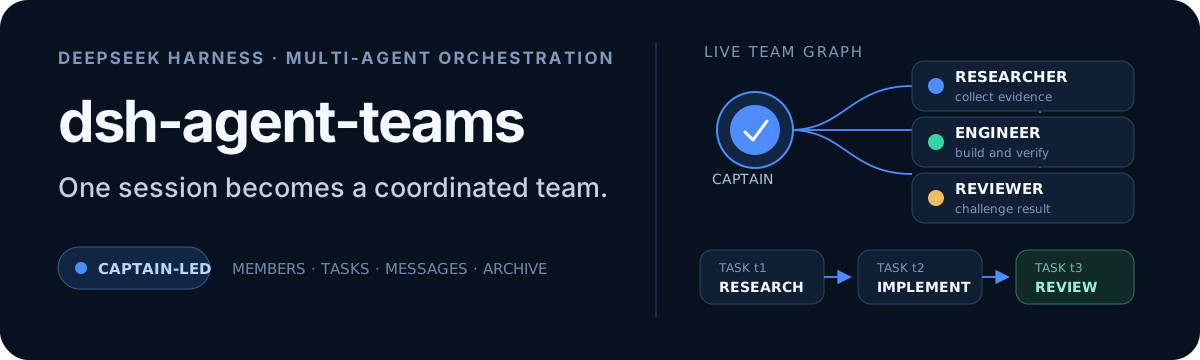
`dsh-agent-teams` turns the current DeepSeek Harness session into a captain that can assemble durable sub-agents, split a goal into dependency-aware tasks, and coordinate work through direct messages.
Ask in natural language. The plugin provides the team protocol, ten coordination tools, persistent state, an automatic shared-task scheduler, and a live Web UI—without requiring a separate workflow engine.
## Why AgentTeams?
| Capability | What it changes |
| --- | --- |
| **Captain-led delegation** | The current session creates the team, assigns roles, and consolidates the final result. |
| **Durable members** | Members are continuable DSH sub-agents that can be woken for focused follow-up turns. |
| **Dependency-aware tasks** | Tasks move through explicit states and cannot be claimed before their dependencies finish. |
| **Automatic reuse and safe takeover** | Idle members claim the next ready task; reassignment revokes stale attempts before new work starts, and cold recovery retries stranded open attempts. |
| **Direct messaging** | Members send durable mailbox messages directly to teammates or the captain—no relay required. |
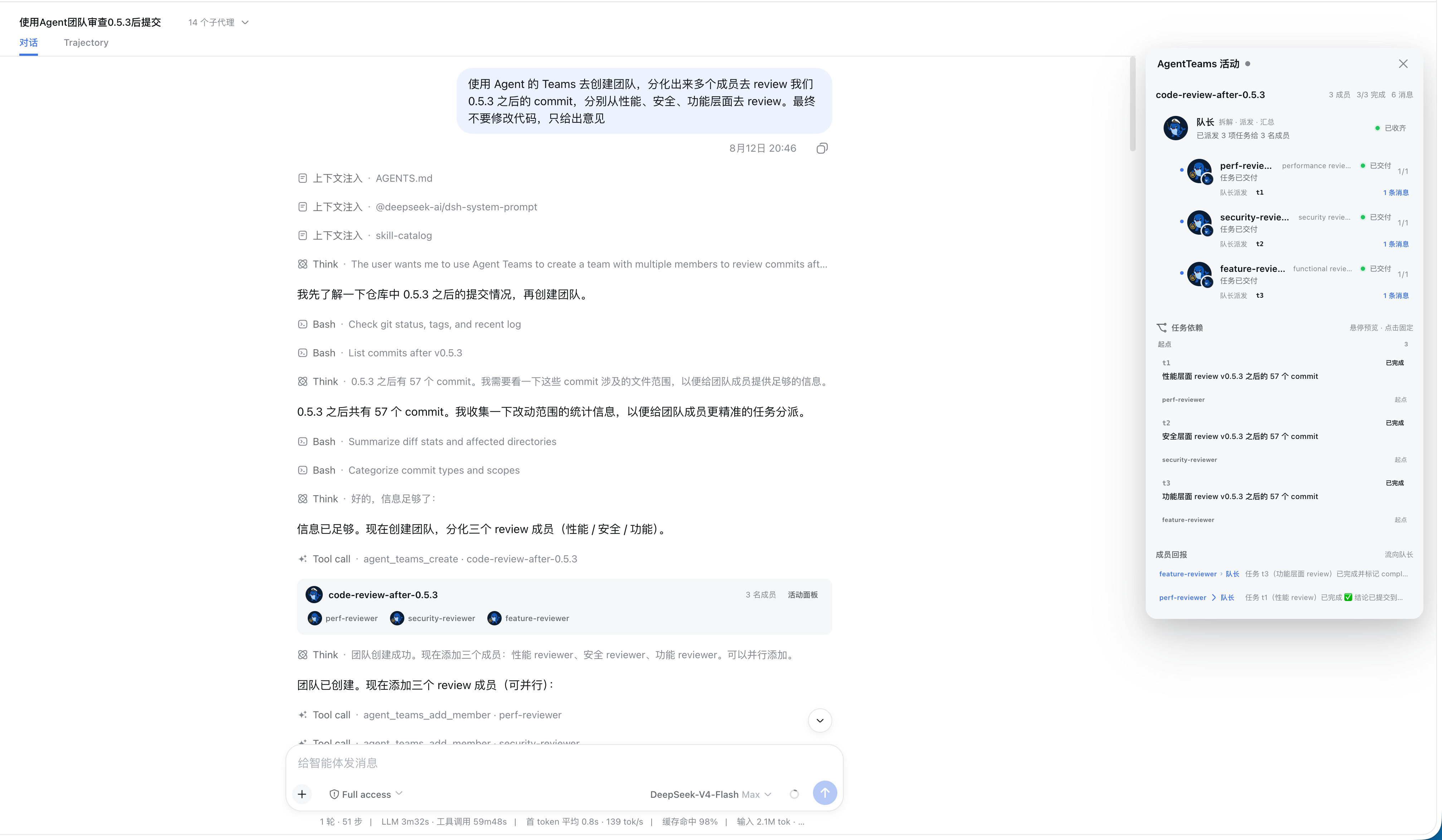
| **Live activity panel** | The Web UI combines segmented progress, a collapsible roster, and an interactive task DAG; completed archives retain their full member and task history. |
## Install
> [!NOTE]
> Requires an existing [DeepSeek Harness](https://github.com/deepseek-ai/deepseek-harness) installation.
### npm
```sh
dsh plugin --profile web add @nanmicoder/dsh-agent-teams
```
### Build from source
```sh
git clone https://github.com/NanmiCoder/dsh-agent-teams.git
cd dsh-agent-teams
pnpm install
pnpm build
dsh plugin --profile web add .
```
Run `pnpm build` again after changing the source. The local plugin install remains linked to this checkout.
Validate the composed profile, restart DSH, and refresh the Web UI:
```sh
dsh --profile web --dump-config
dsh web
```
Then ask for a team directly:
> Use AgentTeams to review the commits after v0.5.3 from performance, security, and product perspectives. Return one consolidated report.
## How it works
1. The current session creates a team and becomes its captain.
2. The captain adds role-specific members backed by continuable sub-agents.
3. The goal becomes tasks with owners and explicit dependencies.
4. The shared scheduler uses real `running / idle / ready` state to atomically claim one ready task per idle member and wake it. If an idle/ready member still owns an open task after an interrupted turn or process restart, the scheduler retries it with a fresh attempt.
5. Members update with the current `attempt_id`; reassignment or captain takeover revokes the old attempt and waits for the old worker to quiesce before a new attempt starts.
6. The captain presents the combined result, then archives the complete team record.
Team state is stored under `/.agent-teams/`; the Web panel reads that disk truth and combines it with live sub-agent activity.
Member creation is zero-interaction by default: a member on the captain's current LLM route snapshots that provider, model, and reasoning effort, while a member on a requested alternative route snapshots the target model's default effort; later continuations restore the resolved snapshot. Only an explicit heterogeneous-team request (for example, “backend on provider A/model X, frontend on provider B/model Y”) supplies a member-specific `provider` + `model`; there is no per-member model or reasoning prompt.
## Slash command
No “use AgentTeams” phrasing required. The plugin registers the
closed-namespace `/agent-teams` host command, so the Web GUI slash menu shows
an `agent-teams` placeholder with an input hint: pick it (or type the
command), describe the goal, and press Enter.
```
/agent-teams research the pricing pages of three competitors
```
The line is claimed by the command pipeline and never reaches the model as
plain text — the handler queues one deterministic activation message as an
ordinary follow-up turn, so the captain protocol starts immediately. The
invocation is durably logged (`command/run` / `command/done`).
Surfaces without command adjudication (for example the headless CLI) get the
same deterministic activation through a gesture boundary: any genuine user
message starting with `/agent-teams` activates the protocol for the rest of
the text. Mid-sentence mentions stay ordinary prose.
## Configuration
Defaults work without extra setup. A trusted profile can override member behavior:
```yaml
- id: agent-teams
config:
stateDir: .agent-teams
memberProvider: spawn
memberModel: deepseek-v4
memberMaxDepth: 1
maxMembers: 8
```
`memberProvider` is the sub-agent runtime backend (`spawn` / `fork`), not an LLM provider. Cross-LLM-provider routing uses the optional `provider` + `model` fields of `agent_teams_add_member`; `memberModel` is only a model default for all members. A member on the captain's current provider/model inherits the captain's reasoning effort, while a changed provider or model automatically uses the target model's default. To request a particular effort, pass the optional `reasoning_effort` field — one of the target model's supported effort ids, or `"default"` to force the model's own default.
`slashCommand: false` disables the deterministic `/agent-teams` activation surfaces (slash command and gesture boundary), leaving the natural-language trigger as the only entry point.
## Boundaries
- One captain leads one active team at a time.
- Idle members are automatically reused for ready work; messages that cannot be delivered live remain durable and are retried at a later status boundary.
- State is file-backed and serialized within one DSH process; concurrent processes editing the same team are not coordinated.
- The activity panel reports persisted state as-is. Models may occasionally finish work without performing the expected task-state update.
See [docs/usage.md](./docs/usage.md) for the full tool reference, state model, Web UI behavior, configuration, and known limits.
## Plugin development Skill
The repository also ships the open Agent Skills package [`dsh-plugin-development`](./skills/dsh-plugin-development/SKILL.md):
```sh
npx skills add NanmiCoder/dsh-agent-teams --skill dsh-plugin-development
```
## Documentation
| Guide | Covers |
| --- | --- |
| [Usage](./docs/usage.md) | Architecture, UI behavior, tools, configuration, limits, and validation |
| [Verification](./docs/verification-guide.md) | Offline, composition, real e2e, and GUI verification |
| [Plugin development](./docs/developing-dsh-plugins.md) | Human-readable guide built from this plugin |
| [README writing](./docs/readme-writing-guide.md) | Repository documentation conventions |
## Development
```sh
pnpm install
pnpm build
pnpm verify
```
## License
[MIT](./LICENSE)