# Nemori Memory System
**📄 [Paper](https://arxiv.org/abs/2508.03341)**
> Important: This release is a complete rewrite aligned with the paper and is not compatible with the previous MVP. The legacy MVP is available here: [legacy-mvp branch](https://github.com/nemori-ai/nemori/tree/legacy-mvp)
 Nemori is a self-organising long-term memory substrate for agentic LLM workflows. It ingests multi-turn conversations, segments them into topic-consistent episodes, distils durable semantic knowledge, and exposes a unified search surface for downstream reasoning. The implementation combines insights from Event Segmentation Theory and Predictive Processing with production-ready concurrency, caching, and pluggable storage.
- **🐍 Language:** Python 3.10+
- **📜 License:** MIT
- **📦 Key dependencies:** asyncpg, Qdrant, OpenAI SDK, Pillow
---
## 1. ❓ Why Nemori
Large language models rapidly forget long-horizon context. Nemori counters this with two coupled control loops:
1. **🔄 Two-Step Alignment**
- *🎯 Boundary Alignment* – LLM-powered boundary detection with transitional masking heuristics keeps episodes semantically coherent.
- *📝 Representation Alignment* – the episode generator converts each segment into rich narratives with precise temporal anchors and provenance.
2. **🔮 Predict–Calibrate Learning**
- *💭 Predict* – hypothesise new episodes from existing semantic knowledge to surface gaps early.
- *🎯 Calibrate* – extract high-value facts from discrepancies and fold them into the semantic knowledge base.
The result is a compact, queryable memory fabric that stays faithful to the source dialogue while remaining efficient to traverse.
---
## 2. 🚀 Quick Start
### 2.1 🐳 Infrastructure (Docker Compose)
Nemori uses PostgreSQL for metadata and text search, and Qdrant for vector storage. Start both with a single command:
```bash
docker compose up -d
```
This launches PostgreSQL 16 (port 5432) and Qdrant (ports 6333/6334) with persistent volumes.
### 2.2 📥 Install Nemori
Using [uv](https://github.com/astral-sh/uv) is the easiest way to manage the environment:
```bash
brew install uv # or curl -LsSf https://astral.sh/uv/install.sh | sh
git clone https://github.com/nemori-ai/nemori.git
cd nemori
uv venv
source .venv/bin/activate # Windows: .venv\Scripts\activate
uv sync
```
Alternatively, install in editable mode:
```bash
pip install -e .
```
### 2.3 🔑 Credentials
Create a `.env` file in the repo root:
```bash
# OpenRouter (recommended — single key for both LLM and embeddings)
LLM_API_KEY=sk-or-...
LLM_BASE_URL=https://openrouter.ai/api/v1
EMBEDDING_API_KEY=sk-or-...
EMBEDDING_BASE_URL=https://openrouter.ai/api/v1
# Or use direct OpenAI
# LLM_API_KEY=sk-...
# EMBEDDING_API_KEY=sk-...
```
Nemori only reads these variables; it never writes secrets to disk. 🔒
### 2.4 💡 Minimal usage
```python
import asyncio
from nemori import NemoriMemory, MemoryConfig
async def main():
# DSN, API keys, and base URLs are resolved from environment variables.
# Only model names need to be specified explicitly.
config = MemoryConfig(
llm_model="openai/gpt-4.1-mini",
embedding_model="google/gemini-embedding-001",
)
async with NemoriMemory(config) as memory:
await memory.add_messages("user123", [
{"role": "user", "content": "I started training for a marathon in Seattle."},
{"role": "assistant", "content": "Great! When is the race?"},
{"role": "user", "content": "It is in October."},
])
await memory.flush("user123")
results = await memory.search("user123", "marathon training")
print(results)
asyncio.run(main())
```
---
## 3. 🏗️ System Architecture
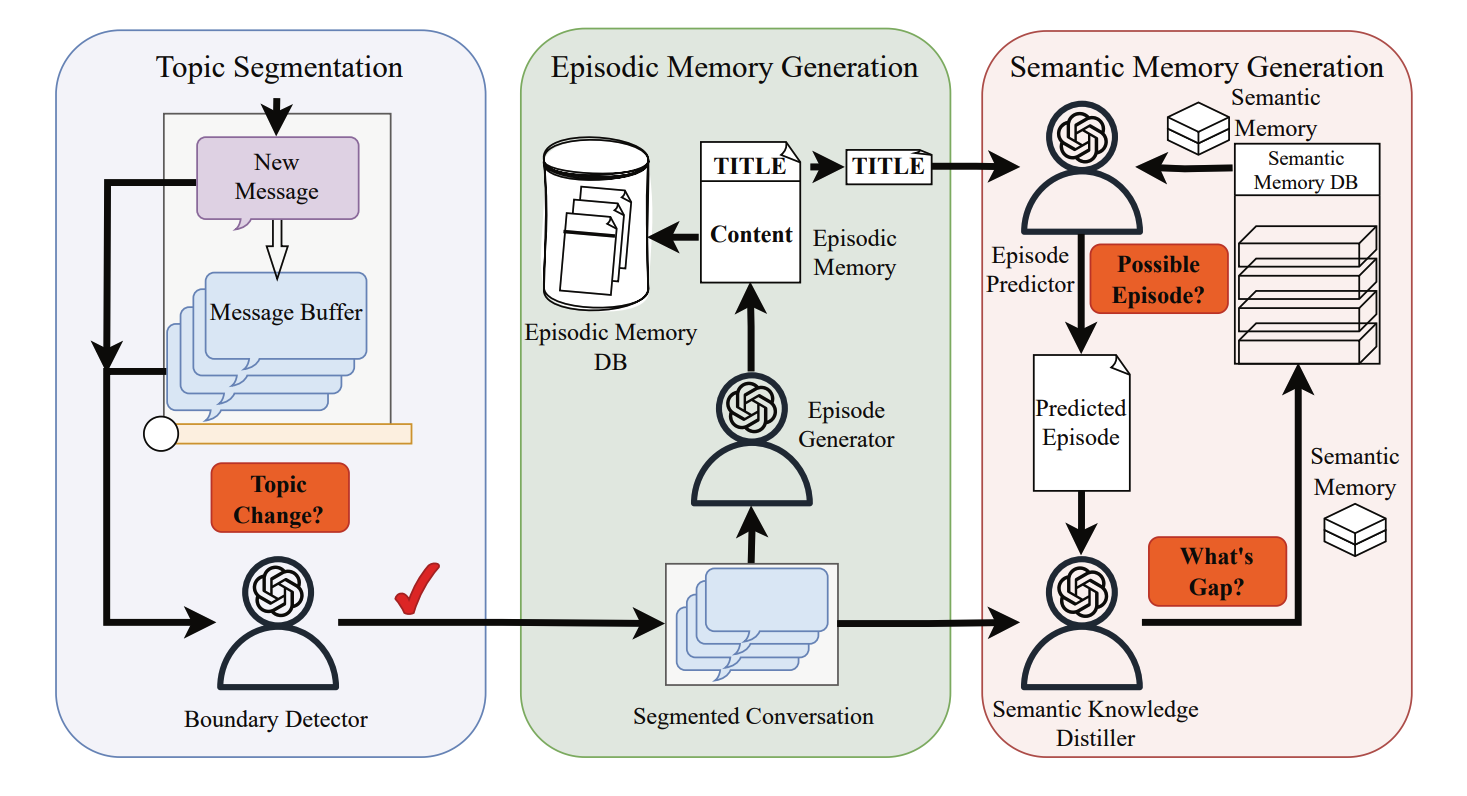
Nemori uses a **dual-backend** storage architecture:
- **PostgreSQL** – metadata, text search (tsvector/GIN indexes), and message buffering.
- **Qdrant** – all vector storage and similarity search with automatic embedding dimension adaptation.
Both backends are fully async via `asyncpg` and the Qdrant gRPC client.
---
## 4. 📂 Repository Layout
```
nemori/
├── api/ # Async facade (NemoriMemory)
├── core/ # MemorySystem orchestrator
├── db/ # PostgreSQL stores + Qdrant vector store
├── domain/ # Models, interfaces, exceptions
├── llm/ # LLM client, orchestrator, generators
├── search/ # Unified search (vector + text + hybrid)
├── services/ # Embedding client, event bus
└── utils/ # Image compression utilities
evaluation/
├── locomo/ # LoCoMo benchmark scripts
├── longmemeval/ # Long-context evaluation suite
└── readme.md # Dataset instructions
docker/
└── init-extensions.sql # PostgreSQL extension setup
```
---
## 5. 📊 Running Evaluations
### 5.1 🔧 LoCoMo pipeline
```bash
PYTHONPATH=. python evaluation/locomo/add.py
PYTHONPATH=. python evaluation/locomo/search.py
PYTHONPATH=. python evaluation/locomo/evals.py
PYTHONPATH=. python evaluation/locomo/generate_scores.py
```
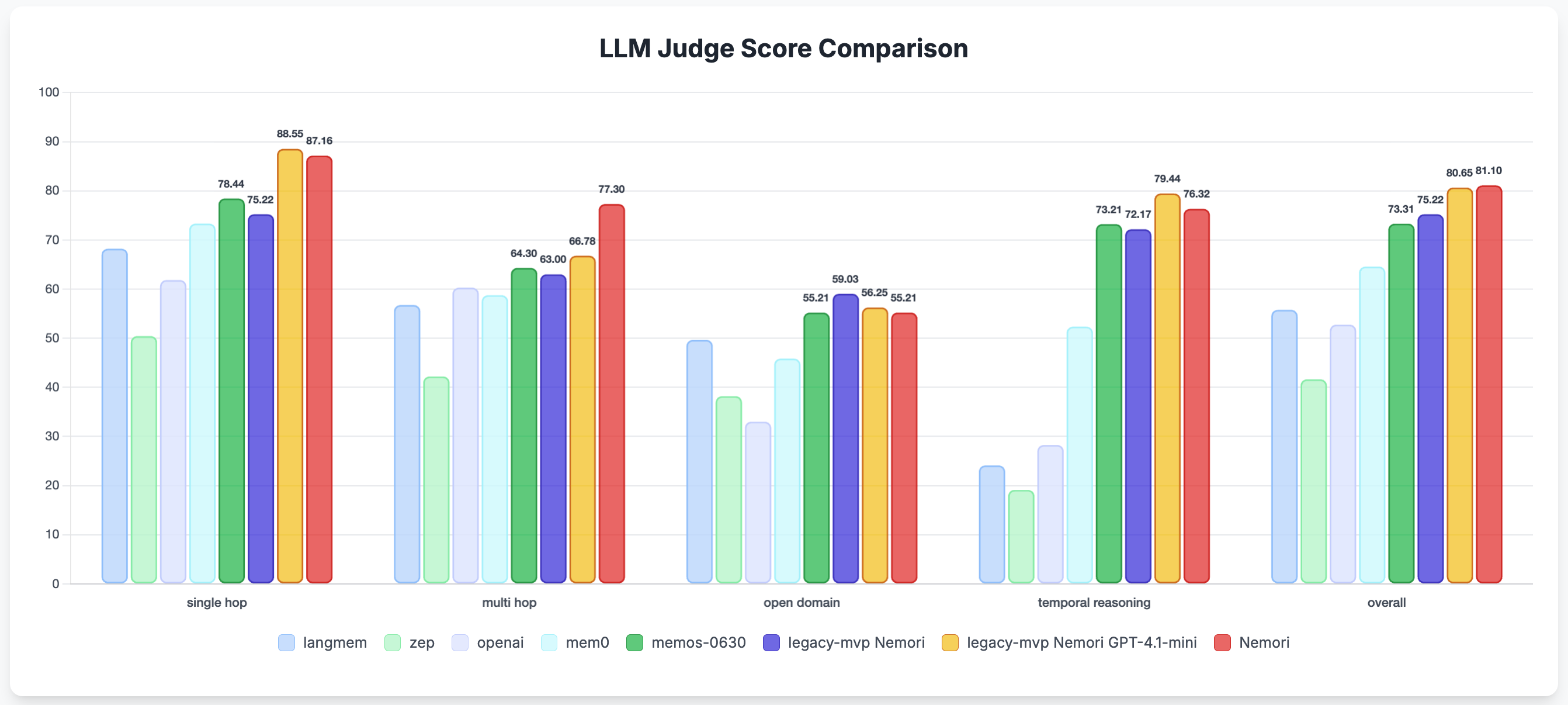
### 5.2 🏆 Latest LoCoMo scores (V5)
| Category | BLEU | F1 | LLM | Count |
|----------|------|----|-----|-------|
| Multi-Hop | 0.3432 | 0.4338 | 0.7943 | 282 |
| Temporal | 0.5109 | 0.5913 | 0.7882 | 321 |
| Open-Domain | 0.2224 | 0.2736 | 0.5938 | 96 |
| Single-Hop | 0.5046 | 0.5664 | 0.8859 | 841 |
✨ Overall LLM alignment: **0.8305**
### 5.3 📚 LongMemEval
See `evaluation/longmemeval/readme.md` for running the 100k-token context benchmark.
---
## 6. 🐳 Docker Deployment
Start the infrastructure services:
```bash
docker compose up -d
```
This brings up:
- **PostgreSQL 16** on port `5432` (user: `nemori`, password: `nemori`, db: `nemori`)
- **Qdrant** on ports `6333` (HTTP) and `6334` (gRPC)
Data is persisted in Docker volumes (`nemori_pg_data`, `nemori_qdrant_data`).
To stop:
```bash
docker compose down # keep data
docker compose down -v # remove data volumes
```
---
## 7. 🏢 Multi-Tenant Support
Nemori supports workspace isolation via `agent_id`. Each agent gets its own namespace for episodes, semantic memories, and vector collections, enabling safe multi-tenant deployments.
---
## 8. 🖼️ Multimodal Support
Nemori supports image inputs via `add_multimodal_message()`. Images are automatically compressed and stored alongside text content, enabling memory formation from visual conversations.
---
## 9. 🛠️ Developing with Nemori
- 🧪 Tests: `pytest tests/`
- 🔍 Linting: `ruff check nemori`
- 📝 Type checking: `mypy nemori`
- 📊 Benchmark helpers live in `scripts/`
Use the `NemoriMemory` facade for experiments and inject custom storage or LLM clients when integrating into larger systems.
---
## 10. 🔧 Troubleshooting
| 🚨 Symptom | 🔍 Likely cause | 💡 Mitigation |
|---------|--------------|------------|
| `asyncpg.ConnectionError` on startup | PostgreSQL not running | Run `docker compose up -d` and wait for healthcheck |
| Qdrant connection refused | Qdrant container not ready | Check `docker compose ps`; wait for healthy status |
| Embedding dimension mismatch | Model changed without recreating collection | Delete the Qdrant collection and re-ingest |
---
## 11. 🤝 Contributing
1. 🍴 Fork the repository and create a feature branch.
2. ✅ Add or update tests (`pytest`, `ruff`, `mypy`).
3. 🚀 Open a PR explaining architectural impact (boundary logic, storage schema, etc.).
Nemori is evolving toward multi-agent deployments. Feedback and collaboration are welcome! 💬
---
## 12. 📰 News
- **🎉 2026-03-24** — Complete async refactoring: PostgreSQL + Qdrant dual backend, OpenRouter LLM support, multimodal messages, Docker Compose deployment.
- **🎉 2025-10-28** — Upgraded the segmenter component and added token counting functionality for evaluation.
- **🎉 2025-09-26** — Released Nemori as fully open source, covering episodic and semantic memory implementations end-to-end.
- **🏁 2025-07-10** — Delivered the MVP of episodic memory generation.