# Groundwork
**Deployment-readiness harnesses for AI deployment patterns.**
Redaction · evals from your real failures · a CI gate that fails fabrication
[](https://www.npmjs.com/package/@pharmatools/groundwork)
[](https://github.com/nickjlamb/groundwork/actions)
[](package.json)
[](LICENSE)
[](https://glama.ai/mcp/servers/nickjlamb/groundwork)
[](https://mcpservers.org/servers/nickjlamb/groundwork)
[Website](https://www.pharmatools.ai/groundwork) · [Getting started](docs/GETTING-STARTED.md) · [Examples](#examples) · [Roadmap](ROADMAP.md) · [Contributing](CONTRIBUTING.md) · [Changelog](CHANGELOG.md)
---
You have a prototype: your documents, a model, useful output. What you don't have is the apparatus that makes it responsible to ship — a privacy pre-step, an evaluation built from your own failures, and a gate that stops a quiet prompt tweak from deploying a system that fabricates. That apparatus usually requires an ML engineer. **Groundwork scaffolds it instead.**
Groundwork's units are **deployment patterns**, not products — think Terraform modules for trustworthy AI deployments. `groundwork init ` scaffolds the whole harness for a pattern:
| Archetype | The pattern | Status |
|---|---|---|
| `document-qa` | documents → retrieval → grounded answers → human review | ✅ shipped |
| `extraction` | documents → structured fields → schema validation → human review | ✅ shipped |
| research synthesis | questions → evidence → synthesis → human review | planned — see the [roadmap](ROADMAP.md) |
Every check is deterministic: same inputs, same result, every time — no LLM judge, and no API key for the checks themselves.
## Quick start — 60 seconds, no API key
```bash
git clone https://github.com/nickjlamb/groundwork.git && cd groundwork
npm install && npm run build
npm run demo # document QA: the whole loop passes, fully offline
npm run demo:break # the system starts fabricating — watch the gate go red
```
```
✗ GROUNDING demo-savings: ungrounded number "14" — not in the provided context
✗ GROUNDING demo-unanswerable-appeals: unanswerable question — the answer did not abstain
```
The same loop for structured extraction:
```bash
npm run demo:extraction # documents → fields, every check green
npm run demo:extraction:break # a guessed date of birth, a dropped field — red, by name
```
```
✗ EXTRACTION demo-referral: SCHEMA: /referral_date must be string
✗ EXTRACTION demo-referral: FABRICATED field "date_of_birth": document does not state it (got "12 April 1988")
```
That red build is the product: a fabricated figure, a guessed field, or a failed abstention becomes a CI failure, not a user complaint.
Ready for your own system?
```bash
npm install -D @pharmatools/groundwork
npx groundwork init # document QA
npx groundwork init extraction # structured extraction
```
## How it works
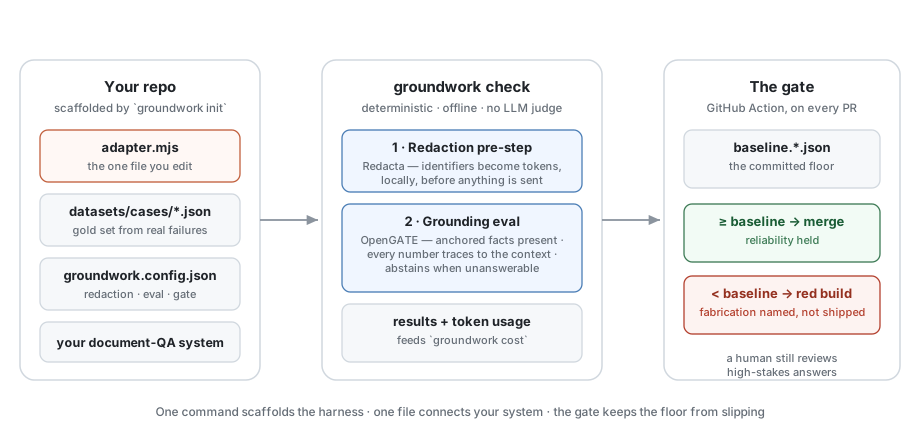
| You edit | Groundwork runs | The gate enforces |
|---|---|---|
| `adapter.mjs` — one file: `answer()` for document QA, `extract()` for extraction | **Redaction pre-step** ([Redacta](https://www.npmjs.com/package/@pharmatools/redacta)) — identifiers become labelled tokens locally, before anything is sent | `check --baseline` freezes a good run as the floor |
| `datasets/cases/*.json` — gold cases from real questions and real documents, labelled by hand | **The archetype's eval** ([OpenGATE](https://www.npmjs.com/package/@pharmatools/opengate)) — document QA: anchored facts · numbers trace to context · abstention. Extraction: schema validity · field accuracy vs gold · no fabricated fields | `check --ci` in the scaffolded GitHub Action fails any PR below it |
| `groundwork.config.json` — archetype, redaction, eval, and gate settings | **Cost profiling** — measured token usage, savings in leverage order (caching → batching → trimming → routing) | A human still reviews high-stakes outputs — the gate is a floor, not a certification |
For extraction, one schema choice does most of the safety work: **nullability is the abstention contract**. A field the system must always find is non-nullable; a field the document may not state is nullable, and the system returns null for it — unknown → null, never guessed. A guessed value in a null-gold field fails by name: `FABRICATED field "date_of_birth": document does not state it`.
## Examples
| Example | What it shows | Run |
|---|---|---|
| [`demo/`](demo/) | Document QA: the full loop on a tiny local system — and the gate catching fabrication by name. Zero network. | `npm run demo` / `npm run demo:break` |
| [`demo-extraction/`](demo-extraction/) | Structured extraction: schema validation, field accuracy, and the gate naming a guessed date of birth and a dropped required field. Zero network. | `npm run demo:extraction` / `npm run demo:extraction:break` |
| [`examples/claude-doc-qa/`](examples/claude-doc-qa/) | A real Claude-backed system: answer-from-document-only prompting, prompt caching, key-gated evals, measured usage feeding `groundwork cost` — plus a mock API so the whole loop runs offline in CI. | `npm run example:mock` (offline) / `npm run example:check` (live) |
| [`examples/claude-extraction/`](examples/claude-extraction/) | Claude filling a schema from fictional referral letters: unknown → null in the prompt contract, the schema as the cached prefix, and the gate catching a guessed date of birth — plus a mock API for offline CI. | `npm run example:extraction:mock` (offline) / `npm run example:extraction:check` (live) |
## Commands
```
groundwork init [archetype] scaffold the harness for a pattern (document-qa, extraction)
groundwork check redaction self-test + the archetype's eval
groundwork check --baseline freeze this run as the regression floor
groundwork check --ci exit non-zero on failure or regression vs baseline
groundwork cost measured token usage + savings, in leverage order
```
Two ways to learn it: [`docs/GETTING-STARTED.md`](docs/GETTING-STARTED.md) is the reference walkthrough (about half an hour), and [**the course**](docs/course/) covers the same ground as checkpoint-driven lessons — including the sabotage test, where you deliberately break your own system to prove the gate catches it, and a lesson on the extraction archetype. The scaffolded playbook (`GROUNDWORK.md`) lives inside your repo, where your team will actually read it.
## Use from Claude
The same checks ship as an **MCP server** (`groundwork-mcp`, stdio) so Claude Code, Cowork, or Claude Desktop can run them conversationally — `check_readiness` on a repo, `check_answer_grounding` on a single answer, `check_extraction` on a single record (no repo needed), `scaffold_harness`, `cost_summary`:
```json
{ "mcpServers": { "groundwork": { "command": "npx", "args": ["-y", "@pharmatools/groundwork", "mcp"] } } }
```
There's also an **Agent Skill** ([`skills/groundwork-readiness/`](skills/groundwork-readiness/)) that teaches an agent to run the gate and report results honestly — including refusing to present a green check as a safety certification.
## What Groundwork is not
Groundwork is a strong **floor**, not a guarantee. Deterministic checks catch the failures that can be caught deterministically; they cannot certify an AI system safe. For high-stakes outputs — anything touching health, money, legal standing, or safety — a human must review before the output reaches the person it affects. Extraction raises the stakes quietly: the record feeds decisions, so a wrong field is a wrong decision. The scaffolded playbook says this too, on purpose.
## Project
- **Status** — two archetypes shipped (document QA, structured extraction) of a planned three. Depth before breadth: each pattern gets finished properly before the next starts. See the [roadmap](ROADMAP.md).
- **Contributing** — bug reports, gold-case patterns, and examples are especially welcome: [CONTRIBUTING.md](CONTRIBUTING.md).
- **Releases** — tagged on [GitHub](https://github.com/nickjlamb/groundwork/releases), versions on [npm](https://www.npmjs.com/package/@pharmatools/groundwork), history in [CHANGELOG.md](CHANGELOG.md).
- **Built on** — [OpenGATE](https://www.npmjs.com/package/@pharmatools/opengate) (evaluation) and [Redacta](https://www.npmjs.com/package/@pharmatools/redacta) (privacy), both open source.
## Licence
MIT. Everything `init` scaffolds into **your** repo is MIT-0 — yours, no attribution needed.