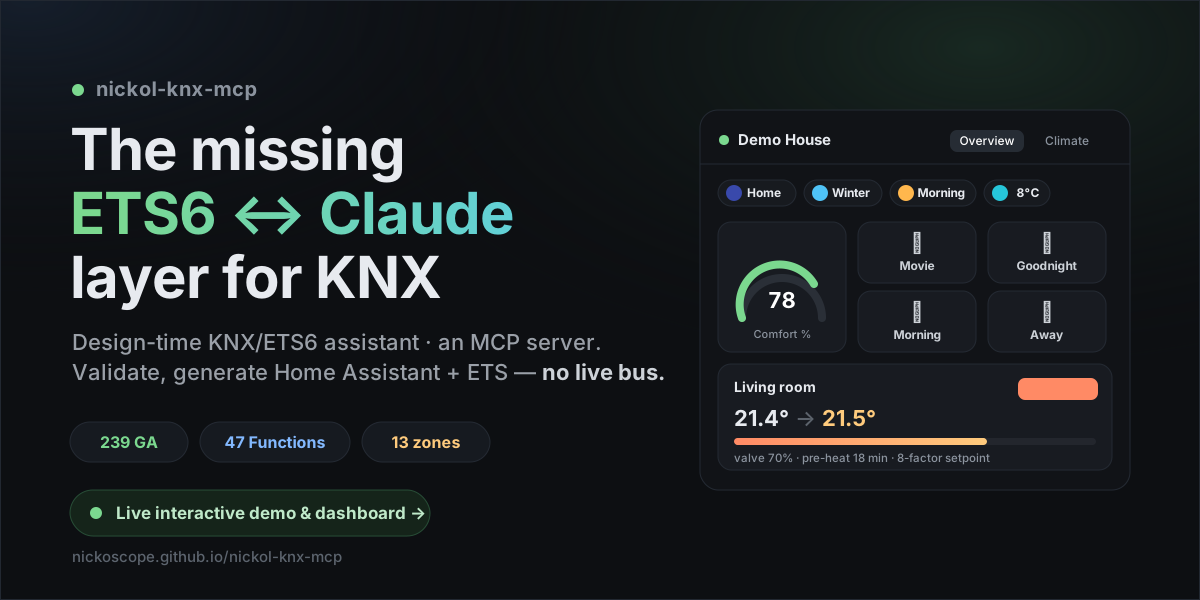
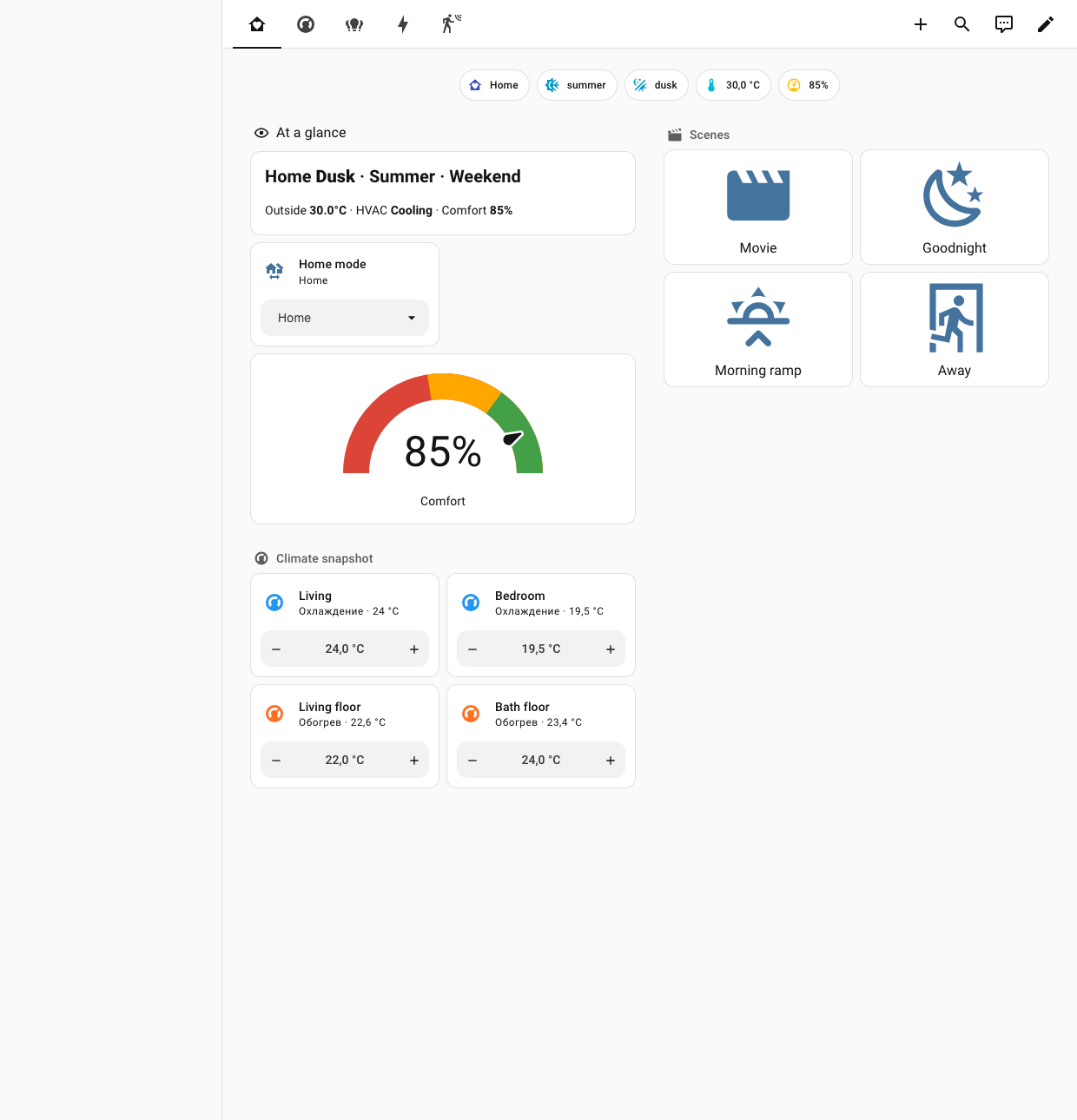
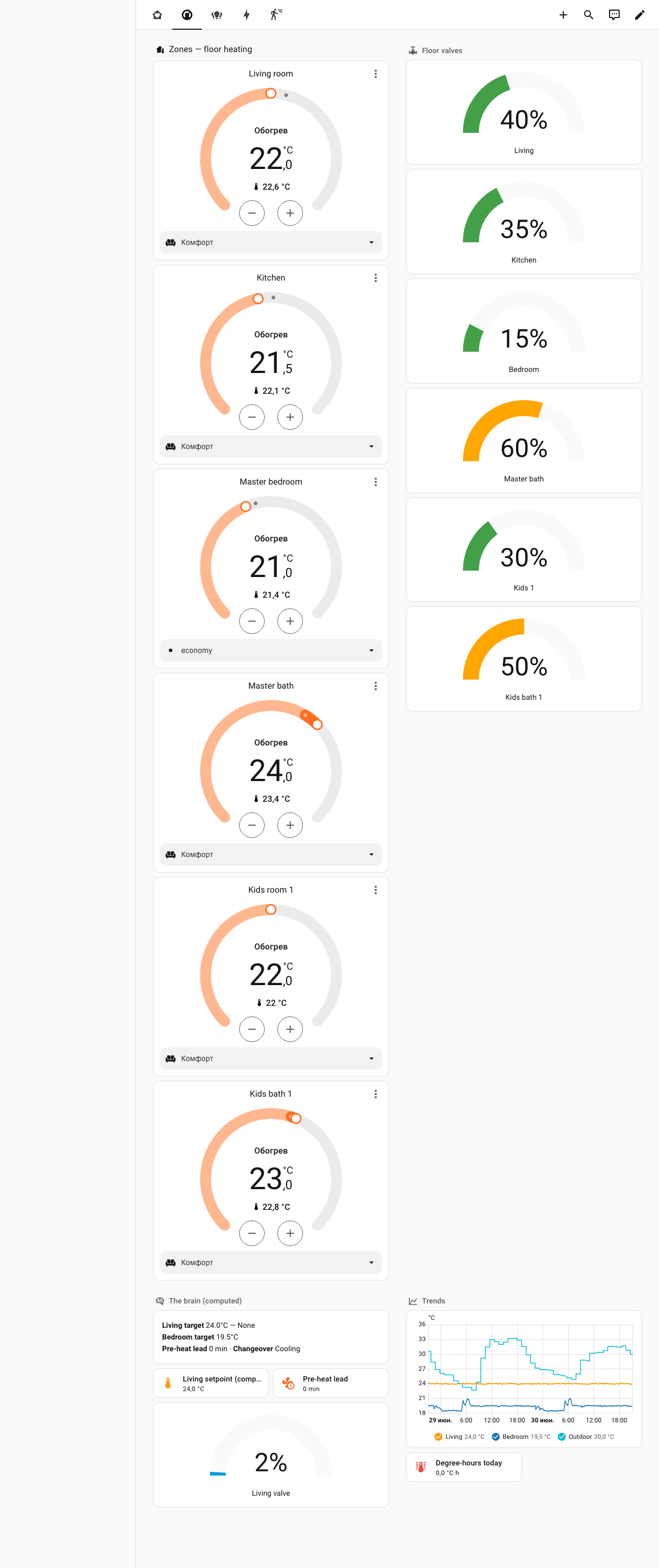
 ](docs/assets/screenshots/climate.png) | [
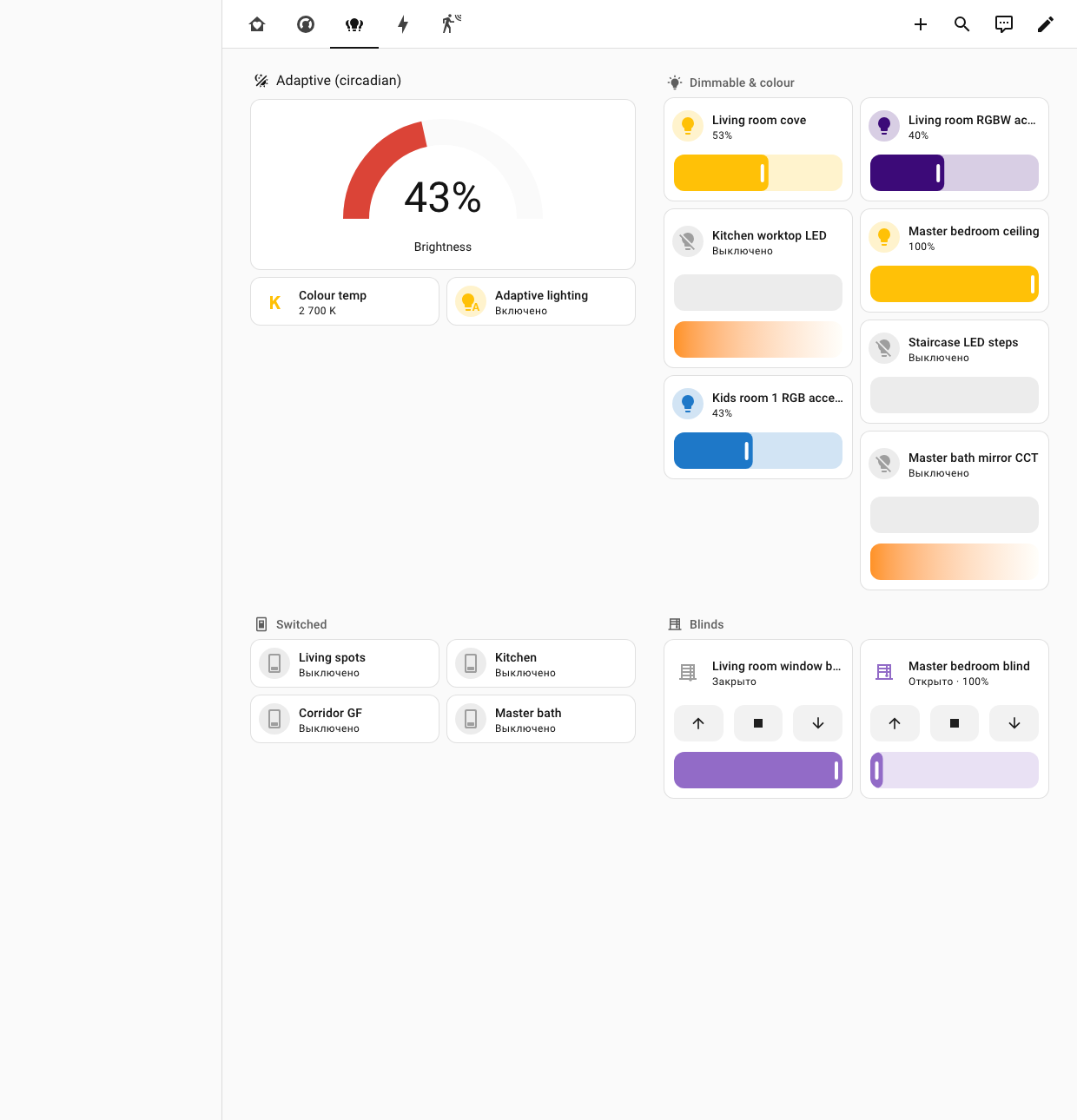 ](docs/assets/screenshots/lighting.png) |
| **Energy & stats** | **Presence** |
| [
](docs/assets/screenshots/lighting.png) |
| **Energy & stats** | **Presence** |
| [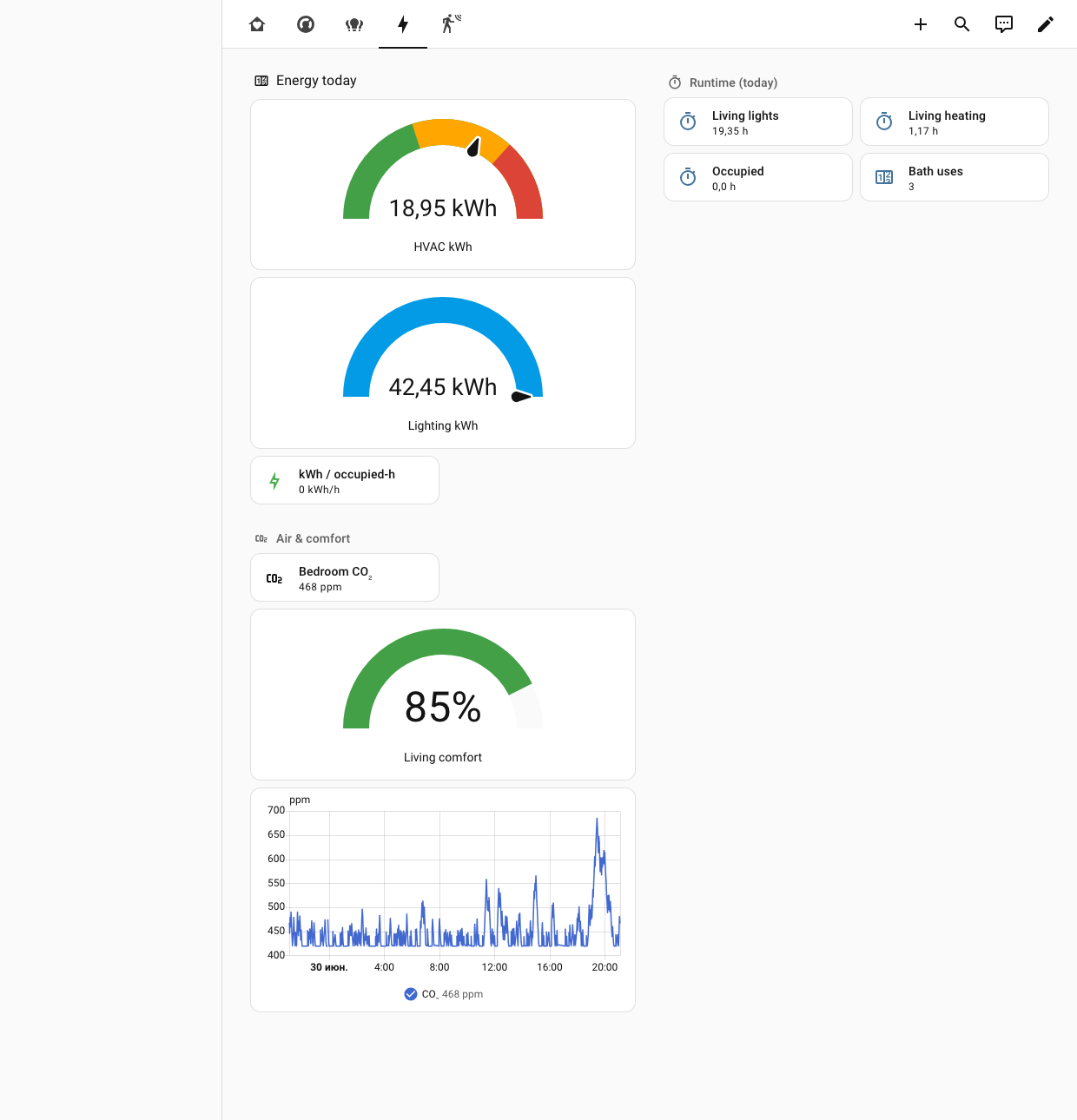 ](docs/assets/screenshots/energy.png) | [
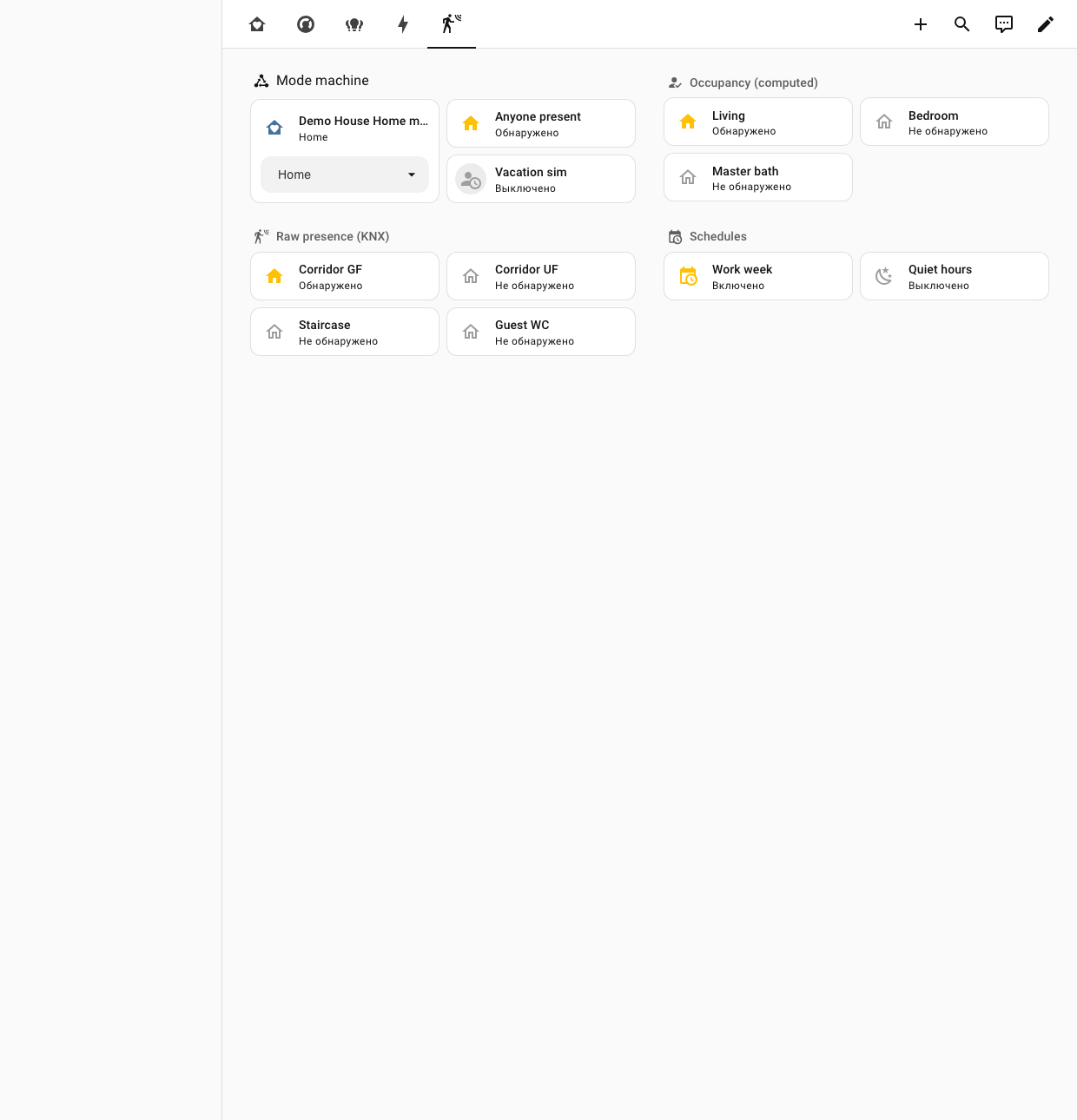 ](docs/assets/screenshots/presence.png) |
▶ **[Explore it interactively on the live site →](https://nickoscope.github.io/nickol-knx-mcp/)** · config in [`examples/demo-home/ha-brain`](examples/demo-home/ha-brain)
---
## 🧪 Status & call for testers
This is a **public beta**. The full pipeline passes an end-to-end smoke test on a synthetic
project and has been validated against **real multi-thousand-GA ETS5/ETS6 projects** (anonymised) —
but real ETS projects are wonderfully messy and diverse, and more field reports make it better.
**👉 If you have an ETS5/ETS6 project, please try it and tell us what happens.** Open a
[Real-project test report](https://github.com/NickoScope/nickol-knx-mcp/issues/new?template=real_project_test.yml)
issue. The tool is read-only and never connects to a bus, so testing is safe (see
[Safety model](#-safety-model)). See [CONTRIBUTING.md](CONTRIBUTING.md) for details.
💬 **[Join the discussion →](https://github.com/NickoScope/nickol-knx-mcp/discussions/1)** — say hi, ask anything, or share what the tool found on your project.
---
## 🗺️ Roadmap — shaped by real integrators
Recent reviews from practising KNX integrators (in [Discussions](https://github.com/NickoScope/nickol-knx-mcp/discussions)) are steering what comes next:
- **Cross-device parameter consistency** *(shipped — `check_device_parameters`)* — flag the one device whose ETS **parameter** settings differ from its N identical siblings: a thermostat with a different setpoint/hysteresis, a presence detector with a different detection time. Extracts per-device parameters straight from the `.knxproj` and finds the odd one out on real 42–275-device projects — read-only, no ETS, no bus — and correctly reports **nothing** on a clean project (no false positives across a different vendor / integrator school).
- **Project Policy Profile** *(shipped — `check_policy`)* — validate a project against *your own* agreed rules (naming, GA taxonomy, command/status exemptions) instead of one universal "professional standard", since conventions differ per integrator; with no profile it validates against the taxonomy inferred from the project itself.
- **Room Template Library** — compose a **new** project from parametrised room templates. **R1 shipped** (`compose_rooms` + `validate_room_template`: new projects, dry-run, allocation manifest + ETS XML/CSV + device BOM). **R2 planned**: docking into an existing project + exact device selection.
- **Logic Machine support** *(coming — in research)* — bring the same read-only, design-time model to **Logic Machine** (Embedded Systems) installations: parse an LM-based KNX project and run the same naming / DPT / status / topology audits and produce the same handover output, so LM integrators get the same evidential project model they already get from a raw `.knxproj`. Currently scoping against a real Logic Machine 5 unit.
- On **in-ETS group-address linking** we deliberately *don't* reinvent the wheel: for linking GAs to communication objects inside ETS there are already ETS App-Store add-ins today, and native **Smart Linking** is coming in ETS7 — we point you to those and keep our focus on read-only **audit** and an **evidential project model**.
Have a project to test, a workflow that breaks, or a feature to shape? → **[Discussions](https://github.com/NickoScope/nickol-knx-mcp/discussions)**.
---
## Why this exists
As of mid-2026 there is **no off-the-shelf ETS6 ↔ Claude / MCP tool**. The KNX community has
been explicitly asking for an integration that can inspect and help modify projects (adding /
renaming devices and group addresses) through an AI/CLI workflow. This package fills exactly the
**design-time** layer — the missing one.
The recommended full setup is four layers; only one needs to be built from scratch:
| Layer | Purpose | What to use | Build it? |
|-------|---------|-------------|-----------|
| 1. Live | states, control, debugging a running house | **official Home Assistant MCP Server** + KNX (XKNX) integration | No, already exists |
| 2. **Design-time** | parse `.knxproj`, validate DPT/naming/status + GA-intent de-noise, generate HA YAML (colour lights + climate assembled) & ETS XML/CSV | **`nickol-knx-mcp` (this package)** | **YES — this is the gap** |
| 3. Files + Git | YAML/CSV/XML, versioning the address schema | standard filesystem + git MCP servers | No, already exists |
| 4. Playbook (optional) | written design rules your AI client reads (GA structure, naming, DPT, scenes) + an HA backup routine | plain files: `CLAUDE.md` + [`skills/ha-git-backup`](skills/ha-git-backup). Not served by the MCP server, which works without them | No, included |
> **Safety by design:** layer 2 (this server) **physically cannot** connect to a bus. It has no
> network/bus dependency at all — it only reads `.knxproj` and writes files into a confined
> workspace. The "never write to a live bus" requirement is enforced **structurally**, not by
> promise. Any real interaction with the house goes only through layer 1 (Home Assistant).
---
## What you can do with it
### 📐 Scenario 1 — Design a project from a spec (spec → implementation kit)
Turn a project specification (equipment schedules, cable journals, a device list) into a complete,
validated group-address structure — and the **full document set to implement it**:
1. **Device list → object model.** Each device expands into its real communication objects via the
device library (`decompose_device`): a dimmer channel is on/off + status + relative dim (3.007) +
absolute value (5.001) + brightness status — not "one GA"; a floor-heating zone is 8 objects; a
pulse meter is 6.
2. **The professional logic layer.** A bare spec never mentions what makes a project *complete*:
central & zone macros, scenes, presence logic, climate-control scaffolding, sun/wind shutter
logic, leak→shut-off chains, astro/meteo and date-time sources, reserves in every range. The
methodology encodes these completeness patterns — distilled from the KNX Association standard,
public manufacturer documentation and the study of real professional as-built ETS projects
(anonymised).
3. **Structure & discipline.** 3-level addressing, zone+function naming, command↔status pairing,
a DPT on every address.
4. **Deliverables** (one command each): ETS-importable **XML/CSV** · Markdown **report** ·
**Home Assistant YAML** · functional **acceptance test protocol** · as-built **handover pack**
(inventory, GA map, coverage %, Secure posture, QA findings, topology SVG).
Full methodology: [`docs/spec-to-structure.md`](docs/spec-to-structure.md). Field-checked by
reconstructing a real 14-room as-built ETS project from its 42-page specification alone:
**96 % structural match** (662 vs 687 GA), 10 / 10 domain taxonomy, at **zero validation errors** —
full write-up in the **[case study](docs/case-study.md)**. The remaining delta is the integrator's
per-device parameterisation, which no spec encodes.
### 🔍 Scenario 2 — Audit, repair & finish an existing project
- **Read & classify.** Parses password-protected ETS5/ETS6 `.knxproj` via
[`xknxproject`](https://github.com/XKNX/xknxproject); classifies every GA by category
(lighting / shutter / hvac / sensor / scene / energy / diagnostics) and kind (command / status /
sensor) from the DPT + multilingual (EN/DE/RU) name keywords. GA **purpose tagging**
(`functional` / `reserve` / `logic` / `scratch`) keeps intentional placeholders out of the error
lists, so the report doesn't cry wolf (on a real 685-GA project: false errors 29 → 6).
- **Validate** (`analyze_all` runs everything): naming & structure · missing status objects
(ETS-Function roles first, then name-token pairing, **positional pairing** — parallel status middles with 1:1 names — and self-reporting R+T objects) · missing/inconsistent DPTs **+
sub-DPT sanity** (a "temperature" GA carrying 5.001 gets flagged) · relative-only dimmers ·
KNX Secure posture (secured vs plaintext, mixed groups, keyring checklist — key material is
never read) · Matter-readiness · energy-domain coverage.
- **Repair, not just flag** (`suggest_repairs`): infer a DPT from the name, correct a suspect
sub-DPT, synthesise a missing status GA in a free address slot, add an absolute-brightness GA.
Suggestions only — a human reviews, accepted GAs feed the ETS export. On a real 3,646-GA
project: **145 concrete proposals** (32 DPT inferences, 112 synthesised status GAs).
- **Finish the job**: `grade_completeness` (bare skeleton → as-built score), `suggest_names`,
`diff_projects` (semantic diff of two `.knxproj` revisions: added / removed / DPT-changed /
renamed / secure-changed), then regenerate the report, handover pack and test protocol.
### 🏠 Scenario 3 — Generate the smart-home layer (Home Assistant)
- **Assembled entities, conservatively**: covers → **colour / dimmable lights** (on/off +
brightness + RGBW/RGB/colour-temperature + statuses) → switches → **climate** (current temp,
target-temp status, operation/controller mode, valve value) → sensors/binary. Every entity gets
a `state_address` wherever the device can report — HA reads *real state*, never assumes.
- **Review-first**: anything ambiguous (DPT 5.001 — brightness or blind position?) is **not
guessed** — it goes to a `review` list with an explanation (including actuator-dependent cover
flags like `invert_position` / travel times, which no `.knxproj` encodes).
- **Extras**: `expose` block for date/time broadcast (DPT 19.001), Matter-readiness lint,
KNX IoT (Turtle/RDF) semantic export.
- Live control of the house stays in the official Home Assistant integration (layer 1) — this
server only prepares its configuration.
- **Ops companion**: [`skills/ha-git-backup`](skills/ha-git-backup) — the life of your config
*after* deploy: a real git history of `/config` (deploy key + pre-commit secret scanner) plus
encrypted offsite backups in GitHub Releases, with a monthly restore drill.
### 🧱 Scenario 4 — Compose a new project from room templates
- **From rooms, not a blank sheet**: pick from six built-in **parametrised room templates** (bedroom,
children, living, kitchen, bathroom, corridor), choose a `basic` / `comfort` preset **per slot** (a house
can mix comfort climate with basic lighting), and `compose_rooms` assembles a **new** project.
- **Out comes**: an allocation `manifest` (main = domain, middle = role, sub sequential), ETS-importable
**GA XML/CSV** via the existing generators, and a **device BOM** proposal from the device library.
- **Validated by the real reader**: the generated `.knxproj` is re-read through the standard `load_project`
— the same path used for third-party projects — and passes all four linters (naming / missing-status /
DPT / policy) with **0 errors / 0 warnings**.
- **Dry-run by default, new projects only.** The template format is a public contract (`room_templates/SCHEMA.md`):
identity is a locale-neutral `slot_id`, never a human name.
- R2: docking into an existing project + exact device selection — planned.
### 🧩 The foundation — a growing device library
- `parse_devices_from_project` extracts **exact vendor object models** — including **ref-level** (`ComObjectRef`) publishers like HDL/Ekinex — from the manufacturer
application programs inside any `.knxproj` / `.knxprod`: object numbers, names, sizes, DPTs,
C/R/W/T/U flags, per-channel block strides — deterministically, and PII-safe (vendor catalog
data only; the client project part of the file is never read).
- Point `NICKOL_KNX_CATALOG` at your catalog and `decompose_device` answers with the **exact
model** (`catalog-exact`) instead of a generic recipe — the catalog grows on demand, from the
projects and product databases *you* feed it.
- Objects the vendor ships without a declared DPT stay honestly `unverified` — never guessed.
All writes go only into the workspace directory (`NICKOL_KNX_WORKSPACE`, default `./knx-workspace`);
writes outside it are rejected.
---
## Installation
Requires **Python 3.10+**.
```bash
git clone https://github.com/NickoScope/nickol-knx-mcp.git
cd nickol-knx-mcp
python3 -m venv .venv && source .venv/bin/activate
pip install -e .
```
Dependencies: `mcp>=1.10`, `xknxproject>=3.8`, `PyYAML>=6.0`.
> On Debian/Ubuntu, if pip complains about an externally-managed environment, use a venv (as above)
> or `pip install -e . --break-system-packages`. If `PyJWT` conflicts, run
> `pip install mcp --ignore-installed PyJWT` first.
Verify:
```bash
python tests/test_pipeline.py # synthetic 16-GA project, end-to-end smoke test
nickol-knx-mcp # start the MCP server (stdio)
```
---
## Connecting to Claude
### Claude Desktop
`examples/claude_desktop_config.json` wires up nickol-knx + filesystem + git + home-assistant.
Minimal fragment (macOS config path: `~/Library/Application Support/Claude/claude_desktop_config.json`):
```json
{
"mcpServers": {
"nickol-knx": {
"command": "nickol-knx-mcp",
"env": { "NICKOL_KNX_WORKSPACE": "/path/to/your/knx-workspace" }
}
}
}
```
### Claude Code
```bash
claude mcp add nickol-knx \
-e NICKOL_KNX_WORKSPACE="$HOME/knx-workspace" \
-- /absolute/path/to/.venv/bin/nickol-knx-mcp
```
Optionally, drop `CLAUDE.md` into your project root. It is a plain playbook your AI client reads (design
rules, safety rules, 3-level GA structure, command/status pairing, DPT discipline, naming, KNX Secure
keyring handling, and the recommended workflow). The server does not need it: parsing, checks and
generation all run as code inside the MCP server.
---
## MCP tools (32)
**Read**
| Tool | Purpose |
|------|---------|
| `load_project(path, password?, language?)` | parse a `.knxproj` (read-only) and cache it |
| `load_ga_export(path)` | load an ETS group-address export (ga-export/01 XML, e.g. from ETS or TapPlan) as a project without devices |
| `list_group_addresses(category?, kind?)` | list GAs with classification and filters |
| `get_devices()` | devices + their communication objects |
| `get_topology()` | topology (areas / lines / devices) |
| `explain_ga(address)` | **provenance** for one GA: why it's classified this way — evidence per decision with a confidence tier (**authoritative** ETS Function > **structural** DPT > **heuristic** name), how its status was paired, and **conflicts** (name says "AC", DPT says lighting → `contested`) |
**Validate**
| Tool | Purpose |
|------|---------|
| `check_naming(name_regex?)` | validate naming / 3-level structure |
| `check_missing_status()` | actuators lacking a status object |
| `check_dpt()` | missing / inconsistent DPTs **+ sub-DPT sanity** (temp→9.001, power→14.056…) |
| `check_topology()` | topology capacity + individual-address validity (TP1 64/segment, 256/line, valid & unique `A.L.D`, coupler presence — KNX Handbook) |
| `check_secure()` | KNX Data Secure posture + keyring handover checklist |
| `check_matter()` | Matter-readiness lint (which functions round-trip to a Matter cluster) |
| `check_energy()` | metering/energy DPT check + PV/battery/EVSE scaffold |
| `analyze_all(name_regex?)` | run every check at once |
| `check_policy(profile_path?, write_example_to?)` | validate against a **Project Policy Profile** (your main-group taxonomy, naming, pairing) — or, with no profile, against the taxonomy **inferred from the project itself**; flags GAs that deviate from *your* convention, not a universal standard. `write_example_to` writes an example profile **seeded from the loaded project's own main groups** (mains the project doesn't have are never listed) |
**Repair & design**
| Tool | Purpose |
|------|---------|
| `suggest_repairs()` | **propose fixes, not just flag** — infer DPTs, synthesise status/brightness GAs |
| `suggest_names()` | naming-hygiene suggestions |
| `decompose_device(order_number, channels?)` | device → GA decomposition: **exact vendor model** from a local catalog (`NICKOL_KNX_CATALOG`), or generic recipe |
| `list_device_recipes()` | the built-in device library (Zennio + ABB families) |
| `parse_devices_from_project(path, output_path?, password?)` | extract **exact device object models** from the app-programs inside a `.knxproj`/`.knxprod` → device-library YAML (feeds the local catalog) |
| `check_device_parameters(path, password?, min_group?)` | **cross-device parameter QA**: find the device whose ETS parameters differ from its N identical siblings (the odd thermostat/sensor out) — `clear_outliers` (likely mistake) + `split_configs` (balanced variants, review) |
| `grade_completeness()` | grade a project: bare skeleton vs as-built |
| `diff_projects(path_a, path_b, …)` | semantic diff between two `.knxproj` versions |
**Generate**
| Tool | Purpose |
|------|---------|
| `generate_ha_package(output_path?)` | HA KNX YAML (colour + climate + expose) + review list |
| `generate_ets_group_addresses(fmt="xml"\|"csv", output_path?)` | ETS-importable GAs |
| `generate_handover_pack(output_dir?)` | as-built handover: inventory, GA map, coverage, Secure, QA, topology.svg |
| `generate_test_protocol(output_path?)` | functional acceptance protocol (command → expected status) |
| `generate_knx_iot(output_path?)` | KNX IoT semantic export (Turtle/RDF) |
| `project_report(output_path?, name_regex?)` | Markdown report |
| `workspace_info()` | workspace path + safety guarantees |
**Room Library** (R1 — compose a new project from room templates)
| Tool | Purpose |
|------|---------|
| `validate_room_template(template?, path?)` | validate a room template (built-in slot_id or a custom YAML) against the R1 schema |
| `compose_rooms(rooms, language="ru", project_name?, output_dir?, dry_run=true)` | build a **new** project from a list of rooms → allocation `manifest`, ETS GA XML/CSV, device `bom` proposal; generated `.knxproj` is re-read by the standard loader and linted (0 errors / 0 warnings). New projects only, dry-run by default. |
---
## Typical workflow
1. `load_project` → point it at your `.knxproj` (+ password if protected).
2. `analyze_all` or `project_report` → read the findings; **human review first**.
3. Fix naming/DPT/status in ETS (by importing generated GAs or manually).
4. `generate_ets_group_addresses(fmt="xml")` → import the missing GAs into ETS.
5. `generate_ha_package` → place the YAML into Home Assistant; resolve `review` items by hand.
6. Keep everything (`.knxproj` export, HA configs, address schema) in Git.
7. Touch the live house only through the Home Assistant MCP (layer 1).
---
## Limitations (honest)
- command/status and category classification is a **heuristic** (DPT + names + ETS Functions). On
messy projects with no Functions and non-standard names, false negatives/positives are possible —
which is why the report is always for human review, and ambiguity goes to `review`, not into config.
- DPT 5.001 is structurally ambiguous (brightness vs position); it's disambiguated by keywords —
double-check with non-standard naming.
- The HA generator is conservative: it would rather defer an item to `review` than emit a wrong entity.
- The server never writes to the bus and never talks to ETS directly — ETS exchange is file
import/export of GAs only.
- **Validated on a synthetic demo project and on real multi-thousand-GA ETS5/ETS6 projects**
(anonymised) — but real `.knxproj` files vary enormously, and it is still a beta. Hence the
[call for testers](#-status--call-for-testers).
---
## 🔒 Safety model
- **No bus access, structurally.** There is no networking or bus library in the dependency tree.
`workspace_info()` reports `bus_access: false`.
- **Read-only on your project.** `project.py` is the only module that touches `.knxproj`, and it
only reads.
- **Confined writes.** All output is constrained to `NICKOL_KNX_WORKSPACE`; paths outside it are rejected.
- **Hardened against hostile project files.** A `.knxproj` is an untrusted ZIP-of-XML, so parsing runs
through `safexml.py`: DTD/entity XML is refused (billion-laughs / XXE), and archives are pre-flighted
against size / entry / decompression-ratio caps with path-traversal names rejected (zip-bomb defense).
- **Human-in-the-loop.** Generate a `project_report` and review it **before** importing into ETS or
deploying into Home Assistant.
Found a security issue? See [SECURITY.md](SECURITY.md).
---
## Package layout
```
nickol-knx-mcp/
├── nickol_knx_mcp/
│ ├── dpt_map.py # DPT → category / kind / HA platform / value_type
│ ├── project.py # the ONLY module that reads .knxproj (read-only)
│ ├── safexml.py # hardened ZIP/XML parsing of untrusted .knxproj (zip-bomb / XXE defense)
│ ├── pairing.py # command↔status pairing by name tokens
│ ├── analyze.py # naming / missing-status / DPT checks
│ ├── generate_ha.py # Home Assistant KNX YAML generation
│ ├── generate_ets.py # ETS XML + CSV generation
│ ├── report.py # Markdown report
│ ├── room_library.py # Room Library R1 — compose a new project from templates
│ ├── room_templates/ # built-in room YAML templates + SCHEMA.md (public contract)
│ └── server.py # FastMCP server, 32 tools, confined writes
├── tests/test_pipeline.py
├── examples/claude_desktop_config.json
├── skills/
│ └── ha-git-backup/ # optional ops skill for your AI client: HA backup (git history + encrypted offsite)
├── CLAUDE.md # optional playbook for your AI client (not part of the server)
├── pyproject.toml
└── README.md
```
---
## Contributing
Testers and contributors are very welcome — especially **real-project test reports**. See
[CONTRIBUTING.md](CONTRIBUTING.md) and the [issue templates](.github/ISSUE_TEMPLATE).
## License
[MIT](LICENSE) © 2026 Nikolay Miroshnichenko
> Not affiliated with or endorsed by the KNX Association. "KNX" and "ETS" are trademarks of the
> KNX Association cc. This is an independent, community tool.
](docs/assets/screenshots/presence.png) |
▶ **[Explore it interactively on the live site →](https://nickoscope.github.io/nickol-knx-mcp/)** · config in [`examples/demo-home/ha-brain`](examples/demo-home/ha-brain)
---
## 🧪 Status & call for testers
This is a **public beta**. The full pipeline passes an end-to-end smoke test on a synthetic
project and has been validated against **real multi-thousand-GA ETS5/ETS6 projects** (anonymised) —
but real ETS projects are wonderfully messy and diverse, and more field reports make it better.
**👉 If you have an ETS5/ETS6 project, please try it and tell us what happens.** Open a
[Real-project test report](https://github.com/NickoScope/nickol-knx-mcp/issues/new?template=real_project_test.yml)
issue. The tool is read-only and never connects to a bus, so testing is safe (see
[Safety model](#-safety-model)). See [CONTRIBUTING.md](CONTRIBUTING.md) for details.
💬 **[Join the discussion →](https://github.com/NickoScope/nickol-knx-mcp/discussions/1)** — say hi, ask anything, or share what the tool found on your project.
---
## 🗺️ Roadmap — shaped by real integrators
Recent reviews from practising KNX integrators (in [Discussions](https://github.com/NickoScope/nickol-knx-mcp/discussions)) are steering what comes next:
- **Cross-device parameter consistency** *(shipped — `check_device_parameters`)* — flag the one device whose ETS **parameter** settings differ from its N identical siblings: a thermostat with a different setpoint/hysteresis, a presence detector with a different detection time. Extracts per-device parameters straight from the `.knxproj` and finds the odd one out on real 42–275-device projects — read-only, no ETS, no bus — and correctly reports **nothing** on a clean project (no false positives across a different vendor / integrator school).
- **Project Policy Profile** *(shipped — `check_policy`)* — validate a project against *your own* agreed rules (naming, GA taxonomy, command/status exemptions) instead of one universal "professional standard", since conventions differ per integrator; with no profile it validates against the taxonomy inferred from the project itself.
- **Room Template Library** — compose a **new** project from parametrised room templates. **R1 shipped** (`compose_rooms` + `validate_room_template`: new projects, dry-run, allocation manifest + ETS XML/CSV + device BOM). **R2 planned**: docking into an existing project + exact device selection.
- **Logic Machine support** *(coming — in research)* — bring the same read-only, design-time model to **Logic Machine** (Embedded Systems) installations: parse an LM-based KNX project and run the same naming / DPT / status / topology audits and produce the same handover output, so LM integrators get the same evidential project model they already get from a raw `.knxproj`. Currently scoping against a real Logic Machine 5 unit.
- On **in-ETS group-address linking** we deliberately *don't* reinvent the wheel: for linking GAs to communication objects inside ETS there are already ETS App-Store add-ins today, and native **Smart Linking** is coming in ETS7 — we point you to those and keep our focus on read-only **audit** and an **evidential project model**.
Have a project to test, a workflow that breaks, or a feature to shape? → **[Discussions](https://github.com/NickoScope/nickol-knx-mcp/discussions)**.
---
## Why this exists
As of mid-2026 there is **no off-the-shelf ETS6 ↔ Claude / MCP tool**. The KNX community has
been explicitly asking for an integration that can inspect and help modify projects (adding /
renaming devices and group addresses) through an AI/CLI workflow. This package fills exactly the
**design-time** layer — the missing one.
The recommended full setup is four layers; only one needs to be built from scratch:
| Layer | Purpose | What to use | Build it? |
|-------|---------|-------------|-----------|
| 1. Live | states, control, debugging a running house | **official Home Assistant MCP Server** + KNX (XKNX) integration | No, already exists |
| 2. **Design-time** | parse `.knxproj`, validate DPT/naming/status + GA-intent de-noise, generate HA YAML (colour lights + climate assembled) & ETS XML/CSV | **`nickol-knx-mcp` (this package)** | **YES — this is the gap** |
| 3. Files + Git | YAML/CSV/XML, versioning the address schema | standard filesystem + git MCP servers | No, already exists |
| 4. Playbook (optional) | written design rules your AI client reads (GA structure, naming, DPT, scenes) + an HA backup routine | plain files: `CLAUDE.md` + [`skills/ha-git-backup`](skills/ha-git-backup). Not served by the MCP server, which works without them | No, included |
> **Safety by design:** layer 2 (this server) **physically cannot** connect to a bus. It has no
> network/bus dependency at all — it only reads `.knxproj` and writes files into a confined
> workspace. The "never write to a live bus" requirement is enforced **structurally**, not by
> promise. Any real interaction with the house goes only through layer 1 (Home Assistant).
---
## What you can do with it
### 📐 Scenario 1 — Design a project from a spec (spec → implementation kit)
Turn a project specification (equipment schedules, cable journals, a device list) into a complete,
validated group-address structure — and the **full document set to implement it**:
1. **Device list → object model.** Each device expands into its real communication objects via the
device library (`decompose_device`): a dimmer channel is on/off + status + relative dim (3.007) +
absolute value (5.001) + brightness status — not "one GA"; a floor-heating zone is 8 objects; a
pulse meter is 6.
2. **The professional logic layer.** A bare spec never mentions what makes a project *complete*:
central & zone macros, scenes, presence logic, climate-control scaffolding, sun/wind shutter
logic, leak→shut-off chains, astro/meteo and date-time sources, reserves in every range. The
methodology encodes these completeness patterns — distilled from the KNX Association standard,
public manufacturer documentation and the study of real professional as-built ETS projects
(anonymised).
3. **Structure & discipline.** 3-level addressing, zone+function naming, command↔status pairing,
a DPT on every address.
4. **Deliverables** (one command each): ETS-importable **XML/CSV** · Markdown **report** ·
**Home Assistant YAML** · functional **acceptance test protocol** · as-built **handover pack**
(inventory, GA map, coverage %, Secure posture, QA findings, topology SVG).
Full methodology: [`docs/spec-to-structure.md`](docs/spec-to-structure.md). Field-checked by
reconstructing a real 14-room as-built ETS project from its 42-page specification alone:
**96 % structural match** (662 vs 687 GA), 10 / 10 domain taxonomy, at **zero validation errors** —
full write-up in the **[case study](docs/case-study.md)**. The remaining delta is the integrator's
per-device parameterisation, which no spec encodes.
### 🔍 Scenario 2 — Audit, repair & finish an existing project
- **Read & classify.** Parses password-protected ETS5/ETS6 `.knxproj` via
[`xknxproject`](https://github.com/XKNX/xknxproject); classifies every GA by category
(lighting / shutter / hvac / sensor / scene / energy / diagnostics) and kind (command / status /
sensor) from the DPT + multilingual (EN/DE/RU) name keywords. GA **purpose tagging**
(`functional` / `reserve` / `logic` / `scratch`) keeps intentional placeholders out of the error
lists, so the report doesn't cry wolf (on a real 685-GA project: false errors 29 → 6).
- **Validate** (`analyze_all` runs everything): naming & structure · missing status objects
(ETS-Function roles first, then name-token pairing, **positional pairing** — parallel status middles with 1:1 names — and self-reporting R+T objects) · missing/inconsistent DPTs **+
sub-DPT sanity** (a "temperature" GA carrying 5.001 gets flagged) · relative-only dimmers ·
KNX Secure posture (secured vs plaintext, mixed groups, keyring checklist — key material is
never read) · Matter-readiness · energy-domain coverage.
- **Repair, not just flag** (`suggest_repairs`): infer a DPT from the name, correct a suspect
sub-DPT, synthesise a missing status GA in a free address slot, add an absolute-brightness GA.
Suggestions only — a human reviews, accepted GAs feed the ETS export. On a real 3,646-GA
project: **145 concrete proposals** (32 DPT inferences, 112 synthesised status GAs).
- **Finish the job**: `grade_completeness` (bare skeleton → as-built score), `suggest_names`,
`diff_projects` (semantic diff of two `.knxproj` revisions: added / removed / DPT-changed /
renamed / secure-changed), then regenerate the report, handover pack and test protocol.
### 🏠 Scenario 3 — Generate the smart-home layer (Home Assistant)
- **Assembled entities, conservatively**: covers → **colour / dimmable lights** (on/off +
brightness + RGBW/RGB/colour-temperature + statuses) → switches → **climate** (current temp,
target-temp status, operation/controller mode, valve value) → sensors/binary. Every entity gets
a `state_address` wherever the device can report — HA reads *real state*, never assumes.
- **Review-first**: anything ambiguous (DPT 5.001 — brightness or blind position?) is **not
guessed** — it goes to a `review` list with an explanation (including actuator-dependent cover
flags like `invert_position` / travel times, which no `.knxproj` encodes).
- **Extras**: `expose` block for date/time broadcast (DPT 19.001), Matter-readiness lint,
KNX IoT (Turtle/RDF) semantic export.
- Live control of the house stays in the official Home Assistant integration (layer 1) — this
server only prepares its configuration.
- **Ops companion**: [`skills/ha-git-backup`](skills/ha-git-backup) — the life of your config
*after* deploy: a real git history of `/config` (deploy key + pre-commit secret scanner) plus
encrypted offsite backups in GitHub Releases, with a monthly restore drill.
### 🧱 Scenario 4 — Compose a new project from room templates
- **From rooms, not a blank sheet**: pick from six built-in **parametrised room templates** (bedroom,
children, living, kitchen, bathroom, corridor), choose a `basic` / `comfort` preset **per slot** (a house
can mix comfort climate with basic lighting), and `compose_rooms` assembles a **new** project.
- **Out comes**: an allocation `manifest` (main = domain, middle = role, sub sequential), ETS-importable
**GA XML/CSV** via the existing generators, and a **device BOM** proposal from the device library.
- **Validated by the real reader**: the generated `.knxproj` is re-read through the standard `load_project`
— the same path used for third-party projects — and passes all four linters (naming / missing-status /
DPT / policy) with **0 errors / 0 warnings**.
- **Dry-run by default, new projects only.** The template format is a public contract (`room_templates/SCHEMA.md`):
identity is a locale-neutral `slot_id`, never a human name.
- R2: docking into an existing project + exact device selection — planned.
### 🧩 The foundation — a growing device library
- `parse_devices_from_project` extracts **exact vendor object models** — including **ref-level** (`ComObjectRef`) publishers like HDL/Ekinex — from the manufacturer
application programs inside any `.knxproj` / `.knxprod`: object numbers, names, sizes, DPTs,
C/R/W/T/U flags, per-channel block strides — deterministically, and PII-safe (vendor catalog
data only; the client project part of the file is never read).
- Point `NICKOL_KNX_CATALOG` at your catalog and `decompose_device` answers with the **exact
model** (`catalog-exact`) instead of a generic recipe — the catalog grows on demand, from the
projects and product databases *you* feed it.
- Objects the vendor ships without a declared DPT stay honestly `unverified` — never guessed.
All writes go only into the workspace directory (`NICKOL_KNX_WORKSPACE`, default `./knx-workspace`);
writes outside it are rejected.
---
## Installation
Requires **Python 3.10+**.
```bash
git clone https://github.com/NickoScope/nickol-knx-mcp.git
cd nickol-knx-mcp
python3 -m venv .venv && source .venv/bin/activate
pip install -e .
```
Dependencies: `mcp>=1.10`, `xknxproject>=3.8`, `PyYAML>=6.0`.
> On Debian/Ubuntu, if pip complains about an externally-managed environment, use a venv (as above)
> or `pip install -e . --break-system-packages`. If `PyJWT` conflicts, run
> `pip install mcp --ignore-installed PyJWT` first.
Verify:
```bash
python tests/test_pipeline.py # synthetic 16-GA project, end-to-end smoke test
nickol-knx-mcp # start the MCP server (stdio)
```
---
## Connecting to Claude
### Claude Desktop
`examples/claude_desktop_config.json` wires up nickol-knx + filesystem + git + home-assistant.
Minimal fragment (macOS config path: `~/Library/Application Support/Claude/claude_desktop_config.json`):
```json
{
"mcpServers": {
"nickol-knx": {
"command": "nickol-knx-mcp",
"env": { "NICKOL_KNX_WORKSPACE": "/path/to/your/knx-workspace" }
}
}
}
```
### Claude Code
```bash
claude mcp add nickol-knx \
-e NICKOL_KNX_WORKSPACE="$HOME/knx-workspace" \
-- /absolute/path/to/.venv/bin/nickol-knx-mcp
```
Optionally, drop `CLAUDE.md` into your project root. It is a plain playbook your AI client reads (design
rules, safety rules, 3-level GA structure, command/status pairing, DPT discipline, naming, KNX Secure
keyring handling, and the recommended workflow). The server does not need it: parsing, checks and
generation all run as code inside the MCP server.
---
## MCP tools (32)
**Read**
| Tool | Purpose |
|------|---------|
| `load_project(path, password?, language?)` | parse a `.knxproj` (read-only) and cache it |
| `load_ga_export(path)` | load an ETS group-address export (ga-export/01 XML, e.g. from ETS or TapPlan) as a project without devices |
| `list_group_addresses(category?, kind?)` | list GAs with classification and filters |
| `get_devices()` | devices + their communication objects |
| `get_topology()` | topology (areas / lines / devices) |
| `explain_ga(address)` | **provenance** for one GA: why it's classified this way — evidence per decision with a confidence tier (**authoritative** ETS Function > **structural** DPT > **heuristic** name), how its status was paired, and **conflicts** (name says "AC", DPT says lighting → `contested`) |
**Validate**
| Tool | Purpose |
|------|---------|
| `check_naming(name_regex?)` | validate naming / 3-level structure |
| `check_missing_status()` | actuators lacking a status object |
| `check_dpt()` | missing / inconsistent DPTs **+ sub-DPT sanity** (temp→9.001, power→14.056…) |
| `check_topology()` | topology capacity + individual-address validity (TP1 64/segment, 256/line, valid & unique `A.L.D`, coupler presence — KNX Handbook) |
| `check_secure()` | KNX Data Secure posture + keyring handover checklist |
| `check_matter()` | Matter-readiness lint (which functions round-trip to a Matter cluster) |
| `check_energy()` | metering/energy DPT check + PV/battery/EVSE scaffold |
| `analyze_all(name_regex?)` | run every check at once |
| `check_policy(profile_path?, write_example_to?)` | validate against a **Project Policy Profile** (your main-group taxonomy, naming, pairing) — or, with no profile, against the taxonomy **inferred from the project itself**; flags GAs that deviate from *your* convention, not a universal standard. `write_example_to` writes an example profile **seeded from the loaded project's own main groups** (mains the project doesn't have are never listed) |
**Repair & design**
| Tool | Purpose |
|------|---------|
| `suggest_repairs()` | **propose fixes, not just flag** — infer DPTs, synthesise status/brightness GAs |
| `suggest_names()` | naming-hygiene suggestions |
| `decompose_device(order_number, channels?)` | device → GA decomposition: **exact vendor model** from a local catalog (`NICKOL_KNX_CATALOG`), or generic recipe |
| `list_device_recipes()` | the built-in device library (Zennio + ABB families) |
| `parse_devices_from_project(path, output_path?, password?)` | extract **exact device object models** from the app-programs inside a `.knxproj`/`.knxprod` → device-library YAML (feeds the local catalog) |
| `check_device_parameters(path, password?, min_group?)` | **cross-device parameter QA**: find the device whose ETS parameters differ from its N identical siblings (the odd thermostat/sensor out) — `clear_outliers` (likely mistake) + `split_configs` (balanced variants, review) |
| `grade_completeness()` | grade a project: bare skeleton vs as-built |
| `diff_projects(path_a, path_b, …)` | semantic diff between two `.knxproj` versions |
**Generate**
| Tool | Purpose |
|------|---------|
| `generate_ha_package(output_path?)` | HA KNX YAML (colour + climate + expose) + review list |
| `generate_ets_group_addresses(fmt="xml"\|"csv", output_path?)` | ETS-importable GAs |
| `generate_handover_pack(output_dir?)` | as-built handover: inventory, GA map, coverage, Secure, QA, topology.svg |
| `generate_test_protocol(output_path?)` | functional acceptance protocol (command → expected status) |
| `generate_knx_iot(output_path?)` | KNX IoT semantic export (Turtle/RDF) |
| `project_report(output_path?, name_regex?)` | Markdown report |
| `workspace_info()` | workspace path + safety guarantees |
**Room Library** (R1 — compose a new project from room templates)
| Tool | Purpose |
|------|---------|
| `validate_room_template(template?, path?)` | validate a room template (built-in slot_id or a custom YAML) against the R1 schema |
| `compose_rooms(rooms, language="ru", project_name?, output_dir?, dry_run=true)` | build a **new** project from a list of rooms → allocation `manifest`, ETS GA XML/CSV, device `bom` proposal; generated `.knxproj` is re-read by the standard loader and linted (0 errors / 0 warnings). New projects only, dry-run by default. |
---
## Typical workflow
1. `load_project` → point it at your `.knxproj` (+ password if protected).
2. `analyze_all` or `project_report` → read the findings; **human review first**.
3. Fix naming/DPT/status in ETS (by importing generated GAs or manually).
4. `generate_ets_group_addresses(fmt="xml")` → import the missing GAs into ETS.
5. `generate_ha_package` → place the YAML into Home Assistant; resolve `review` items by hand.
6. Keep everything (`.knxproj` export, HA configs, address schema) in Git.
7. Touch the live house only through the Home Assistant MCP (layer 1).
---
## Limitations (honest)
- command/status and category classification is a **heuristic** (DPT + names + ETS Functions). On
messy projects with no Functions and non-standard names, false negatives/positives are possible —
which is why the report is always for human review, and ambiguity goes to `review`, not into config.
- DPT 5.001 is structurally ambiguous (brightness vs position); it's disambiguated by keywords —
double-check with non-standard naming.
- The HA generator is conservative: it would rather defer an item to `review` than emit a wrong entity.
- The server never writes to the bus and never talks to ETS directly — ETS exchange is file
import/export of GAs only.
- **Validated on a synthetic demo project and on real multi-thousand-GA ETS5/ETS6 projects**
(anonymised) — but real `.knxproj` files vary enormously, and it is still a beta. Hence the
[call for testers](#-status--call-for-testers).
---
## 🔒 Safety model
- **No bus access, structurally.** There is no networking or bus library in the dependency tree.
`workspace_info()` reports `bus_access: false`.
- **Read-only on your project.** `project.py` is the only module that touches `.knxproj`, and it
only reads.
- **Confined writes.** All output is constrained to `NICKOL_KNX_WORKSPACE`; paths outside it are rejected.
- **Hardened against hostile project files.** A `.knxproj` is an untrusted ZIP-of-XML, so parsing runs
through `safexml.py`: DTD/entity XML is refused (billion-laughs / XXE), and archives are pre-flighted
against size / entry / decompression-ratio caps with path-traversal names rejected (zip-bomb defense).
- **Human-in-the-loop.** Generate a `project_report` and review it **before** importing into ETS or
deploying into Home Assistant.
Found a security issue? See [SECURITY.md](SECURITY.md).
---
## Package layout
```
nickol-knx-mcp/
├── nickol_knx_mcp/
│ ├── dpt_map.py # DPT → category / kind / HA platform / value_type
│ ├── project.py # the ONLY module that reads .knxproj (read-only)
│ ├── safexml.py # hardened ZIP/XML parsing of untrusted .knxproj (zip-bomb / XXE defense)
│ ├── pairing.py # command↔status pairing by name tokens
│ ├── analyze.py # naming / missing-status / DPT checks
│ ├── generate_ha.py # Home Assistant KNX YAML generation
│ ├── generate_ets.py # ETS XML + CSV generation
│ ├── report.py # Markdown report
│ ├── room_library.py # Room Library R1 — compose a new project from templates
│ ├── room_templates/ # built-in room YAML templates + SCHEMA.md (public contract)
│ └── server.py # FastMCP server, 32 tools, confined writes
├── tests/test_pipeline.py
├── examples/claude_desktop_config.json
├── skills/
│ └── ha-git-backup/ # optional ops skill for your AI client: HA backup (git history + encrypted offsite)
├── CLAUDE.md # optional playbook for your AI client (not part of the server)
├── pyproject.toml
└── README.md
```
---
## Contributing
Testers and contributors are very welcome — especially **real-project test reports**. See
[CONTRIBUTING.md](CONTRIBUTING.md) and the [issue templates](.github/ISSUE_TEMPLATE).
## License
[MIT](LICENSE) © 2026 Nikolay Miroshnichenko
> Not affiliated with or endorsed by the KNX Association. "KNX" and "ETS" are trademarks of the
> KNX Association cc. This is an independent, community tool.