# Open Targets MCP Server
[](https://github.com/nickzren/opentargets-mcp/actions/workflows/ci.yml)
[](https://pypi.org/project/opentargets-mcp/)
[](https://www.python.org/)
[](https://registry.modelcontextprotocol.io/v0/servers?search=nickzren/opentargets&version=latest)
[](https://platform.opentargets.org/)
[](LICENSE)
A Model Context Protocol (MCP) server that exposes the Open Targets Platform GraphQL API as a set of tools for use with Claude Desktop and other MCP-compatible clients.
## Quick Install
### Option 1: Run once with `uvx` (no install)
```bash
uvx --from git+https://github.com/nickzren/opentargets-mcp opentargets-mcp
```
### Option 2: Claude Desktop (MCPM)
```bash
# Install mcpm package manager
pip install mcpm
# Install the server
mcpm install opentargets
```
### Option 3: Local install (dev or self-host)
```bash
git clone https://github.com/nickzren/opentargets-mcp
cd opentargets-mcp
pip install uv
uv sync
# Run (stdio transport by default)
uv run python -m opentargets_mcp.server
```
### Option 4: Docker
```bash
git clone https://github.com/nickzren/opentargets-mcp
cd opentargets-mcp
# Build and run with Docker Compose
docker-compose up -d --build
```
Note: the default transport is `http` for docker deployments.
See the configuration section below for details and how to set ports and other environment variables.
### Claude Desktop Manual Import (optional)
```bash
mcpm import stdio opentargets \
--command "$(uv run which python)" \
--args "-m opentargets_mcp.server --transport stdio"
```
Then restart Claude Desktop to start using the Open Targets tools.
## Features
### Core Capabilities
- **Target Analysis**: Search genes/proteins by Ensembl ID or symbol. Access expression data, genetic constraints, pathways, protein interactions, safety profiles, and mouse phenotypes
- **Disease Analysis**: Query diseases by EFO ID. Find associated targets, phenotypes (HPO), and research projects
- **Drug Discovery**: Search drugs by ChEMBL ID. Access safety data, adverse events, indications, and mechanism of action
- **Evidence Mining**: Explore target-disease associations with scored evidence from multiple sources
- **Variant Analysis**: Query genetic variants, GWAS credible sets, and pharmacogenomics data
- **Study Exploration**: Access GWAS studies with L2G predictions and fine-mapped loci
- **Smart Search**: Entity resolution with synonym handling, autocomplete, and ID mapping
- **Cross-Entity Workflows**: Multi-hop tools that chain disease, target, and drug evidence for prioritization
- **Raw GraphQL Power Tools**: Run single and batch raw GraphQL operations with structured status envelopes
## Why This Server
This implementation is designed for practical Open Targets workflows:
- **Curated breadth**: 65 curated tools plus 3 advanced GraphQL tools (68 total), spanning target, disease, drug, evidence, variant, study, metadata, and cross-entity workflow tasks.
- **Safer automation**: strict ID resolution, typed parameter handling, and resilient retry behavior.
- **Lower token overhead**: optional `fields` filters on core domain tools to return only what you need.
- **Flexible power mode**: raw GraphQL tools are available for edge cases.
### Data Sources
The Open Targets Platform integrates evidence from 22+ primary data sources:
- **Genetics**: Open Targets Genetics, ClinVar, UK Biobank, FinnGen, Gene2Phenotype, Orphanet, COSMIC
- **Functional**: CRISPR screens, DepMap, GeneBass
- **Drugs**: ChEMBL, FDA/EMA approvals, chemical probes
- **Expression**: GTEx, Human Protein Atlas, Expression Atlas
- **Pathways**: Reactome, Signor, IntAct
- **Literature**: Europe PMC text mining
- **Safety**: FAERS, pharmacogenomics data
- **Models**: Mouse (MGI, IMPC) phenotypes
## Architecture
```mermaid
graph LR
subgraph "Clients"
A[Claude Desktop]
B[Python Scripts]
C[AI Agents]
end
subgraph "MCP Server"
D[Open Targets
MCP Server]
E[Tool Categories
Target • Disease • Drug
Evidence • Search • Variant • Study]
end
subgraph "Open Targets"
F[GraphQL API]
G[22+ Data Sources]
end
A <-->|MCP Protocol| D
B <-->|Direct API| D
C <-->|Function Calls| D
D <-->|GraphQL| F
F <--> G
E --> D
style D fill:#e1f5fe
style F fill:#fff3e0
```
The MCP server acts as a bridge between client applications and the Open Targets Platform. It translates tool calls into GraphQL queries and provides structured access to biomedical data from 22+ integrated sources.
## Prerequisites
- Python 3.10+ with pip
## Usage
### Running the Server Standalone
```bash
# Using the convenience script (installs uv if missing, then syncs dependencies)
./run.sh
# Or run directly with uv (stdio transport by default)
uv run python -m opentargets_mcp.server
# Installed entrypoints
opentargets-mcp --help
# Specify transport explicitly
uv run python -m opentargets_mcp.server --transport [stdio|sse|http]
```
### Configuration
- **Environment variables**: Transport/bind use `MCP_TRANSPORT`, `FASTMCP_SERVER_HOST`, and `FASTMCP_SERVER_PORT` (defaults: `stdio`, `0.0.0.0`, `8000`). API endpoint uses `OPEN_TARGETS_API_URL` (default: `https://api.platform.opentargets.org/api/v4/graphql`). For local-only development, prefer `FASTMCP_SERVER_HOST=127.0.0.1`.
- **Validated settings**: environment configuration is parsed with a typed settings model at startup (`src/opentargets_mcp/settings.py`), so invalid values fail fast.
- **Name resolution**: strict; unresolved names raise a clear error (use `search_entities` to find canonical IDs).
- **Tool selection guidance**: the server sends a short policy to clients to prefer curated tools, use `fields` to trim output, and reserve raw GraphQL for edge cases.
- **Pagination guardrails**: tool wrappers enforce `page_index >= 0`, `page_size >= 1`, and a global `page_size <= 500`.
- **Command line**: `opentargets-mcp --transport [stdio|sse|http] --host 0.0.0.0 --port 8000 --api ` provides flexible transport and endpoint selection.
- **Verbose logging**: add `--verbose` to elevate the global log level to DEBUG when troubleshooting.
- **CLI helpers**: `--list-tools` prints all registered tools, and `--version` prints the package version.
- **Rate limiting**: `OPEN_TARGETS_RATE_LIMIT_RPS` and `OPEN_TARGETS_RATE_LIMIT_BURST` can enable global server-side rate limiting. `--rate-limiting` and `OPEN_TARGETS_RATE_LIMIT_ENABLED=true` are also supported.
### Transport Modes
The server supports multiple transport protocols powered by FastMCP:
#### **stdio transport** (default)
```bash
# For Claude Desktop (via mcpm) and local CLI tools
opentargets-mcp --transport stdio
```
#### **SSE transport**
```bash
# For web-based MCP clients with Server-Sent Events
opentargets-mcp --transport sse --host 0.0.0.0 --port 8000
```
#### **HTTP transport**
```bash
# For streamable HTTP MCP clients
opentargets-mcp --transport http --host 0.0.0.0 --port 8000
```
### Using with MCP Clients
- **Claude Desktop**: Use mcpm installation (stdio) or direct server connection (sse)
- **Web MCP clients**: Use SSE or HTTP transports with public URL (tunnel required)
- **Custom integrations**: Any transport mode depending on your client implementation
### Example Scripts
```bash
uv run python examples/target_validation_profile.py EGFR
uv run python examples/disease_to_drug.py "schizophrenia"
uv run python examples/drug_safety_profile.py "osimertinib"
uv run python examples/genetic_target_prioritization.py "inflammatory bowel disease"
```
### AI Agent Example
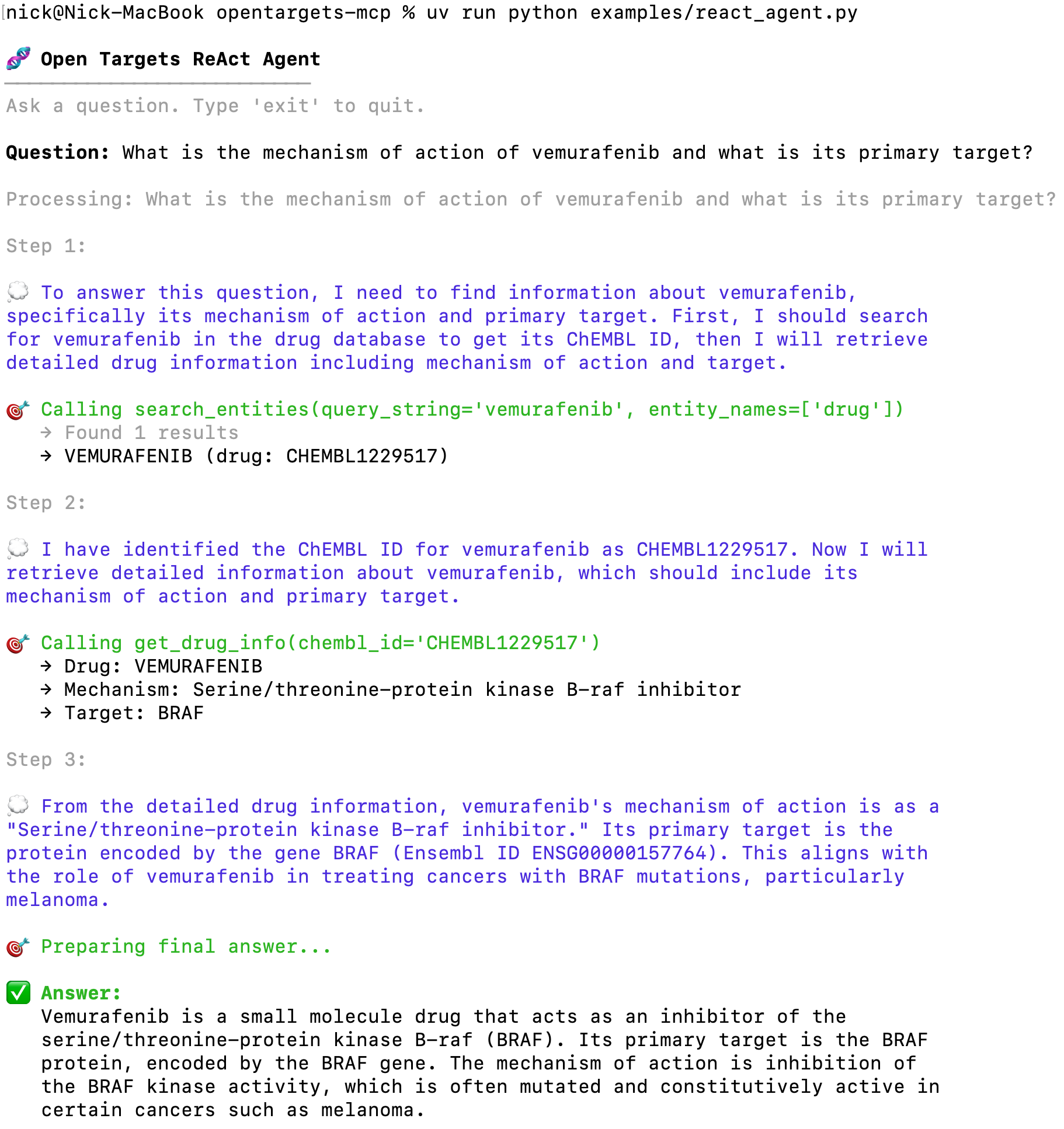
The ReAct Agent provides an interactive terminal interface for exploring Open Targets data:
```bash
# Copy the example .env file and add your OpenAI API key
cp .env.example .env
# Then edit .env and set your OPENAI_API_KEY
# Run agent
uv run python examples/react_agent.py
```
The agent uses a ReAct (Reasoning and Acting) pattern to break down complex biomedical queries into steps, making it easy to explore drug targets, diseases, and their relationships.
## Available Tools
The server wraps **68** operations from the [Open Targets Platform](https://platform-docs.opentargets.org/): **65 curated tools** plus **3 advanced GraphQL tools**. Every tool returns structured JSON that mirrors the Open Targets GraphQL schema, and you can inspect the full machine-readable list with the MCP `list_tools` request.
Most domain tools accept either a canonical identifier (e.g., `ENSG...`, `EFO_...`, `CHEMBL...`) or a human-readable name/symbol. When a name is provided, the server automatically resolves it to the best matching Open Targets ID.
Many core tools accept an optional `fields` list (dot-paths) to filter the response payload.
`search_entities` also returns `search.triples` for compact `{id, entity, name}` consumption.
For edge cases, prefer curated tools + `fields` first; use raw GraphQL only when no curated tool fits.
### Quick-start shortcuts
- `get_target_info` – Core target identity record (Ensembl IDs, synonyms, genomic coordinates)
- `get_disease_info` – Disease/EFO summary with therapeutic area context
- `get_drug_info` – ChEMBL-backed drug profile and mechanism data
- `search_entities` – Unified entity search with synonym handling
- `get_target_associated_diseases` – High-confidence target-disease links with scores
- `get_disease_associated_targets` – Prioritised target list for an EFO disease
- `get_target_known_drugs` – Approved and investigational agents for a target
- `get_target_disease_evidence` – Evidence details across genetics, expression, and literature
- `get_drug_repurposing_candidates` – Multi-hop disease -> target -> drug candidate prioritization
- `graphql_batch_query` – Run one GraphQL query across many variable sets
### Full catalog by category
- **Target identity & biology (20 tools)** — `get_target_info`, `get_target_class`, `get_target_alternative_genes`, `get_target_associated_diseases`, `get_target_known_drugs`, `get_target_literature_occurrences`, `get_target_expression`, `get_target_pathways_and_go_terms`, `get_target_homologues`, `get_target_subcellular_locations`, `get_target_genetic_constraint`, `get_target_mouse_phenotypes`, `get_target_hallmarks`, `get_target_depmap_essentiality`, `get_target_interactions`, `get_target_safety_information`, `get_target_tractability`, `get_target_chemical_probes`, `get_target_tep`, `get_target_prioritization`.
- **Disease analytics (8 tools)** — `get_disease_info`, `get_disease_associated_targets`, `get_disease_phenotypes`, `get_disease_otar_projects`, `get_disease_known_drugs`, `get_disease_ontology`, `get_disease_literature_occurrences`, `get_disease_similar_entities`.
- **Drug profiling (10 tools)** — `get_drug_info`, `get_drug_cross_references`, `get_drug_linked_diseases`, `get_drug_linked_targets`, `get_drug_adverse_events`, `get_drug_pharmacovigilance`, `get_drug_warnings`, `get_drug_pharmacogenomics`, `get_drug_literature_occurrences`, `get_drug_similar_entities`.
- **Evidence synthesis (2 tools)** — `get_target_disease_evidence`, `get_target_disease_biomarkers`.
- **Search & discovery (4 tools)** — `search_entities`, `search_suggestions`, `get_similar_targets`, `search_facets`.
- **Metadata & ontology utilities (5 tools)** — `get_api_metadata`, `get_association_datasources`, `get_gene_ontology_terms`, `get_interaction_resources`, `map_ids`.
- **Workflow tools (1 tool)** — `get_drug_repurposing_candidates`.
- **Batch lookups (3 tools)** — `get_targets_batch`, `get_diseases_batch`, `get_drugs_batch`.
- **Variant interpretation (6 tools)** — `get_variant_info`, `get_variant_credible_sets`, `get_variant_pharmacogenomics`, `get_variant_evidences`, `get_variant_intervals`, `get_variant_protein_coordinates`.
- **Study exploration (6 tools)** — `get_study_info`, `get_studies_by_disease`, `get_study_credible_sets`, `get_credible_set_by_id`, `get_credible_set_colocalisation`, `get_credible_sets`.
- **Advanced GraphQL (3 tools)** — `graphql_schema`, `graphql_query`, `graphql_batch_query`.
Each grouping matches the data domains described in the Open Targets docs (targets, diseases, drugs, evidence, variants, and studies). For high-volume workloads, respect the platform's throttling guidance from the Open Targets API FAQ and cache downstream where possible.
## Development
```bash
# Run lint checks (same as CI/release)
uv run ruff check src tests
# Run tests
uv run pytest tests/ -v
# Inspect registered tools from CLI
uv run opentargets-mcp --list-tools
```