
@three-ws/audio-mcp
Give a 3D AI agent a voice and a face — text-to-speech, speech-to-text, audio-to-face lipsync, and the motion-capture clip library, from any MCP client.




---
> A [Model Context Protocol](https://modelcontextprotocol.io) server that exposes the three.ws **voice and animation pipeline** over stdio. Make an avatar speak, let users talk back, turn that speech into a per-frame lipsync track, and browse the recorded motion-capture library — everything you need to drive a 3D agent's mouth and movement.
The speech, recognition, and lipsync lanes run on **free NVIDIA NIM** models (Magpie TTS, Riva ASR, Audio2Face-3D), with OpenAI as the paid TTS backstop — the same provider policy as the three.ws platform. No key required to start; point `THREE_WS_BASE` at a deployment and go.
## Install
```bash
npm install @three-ws/audio-mcp
```
Or run with `npx` (no install):
```bash
npx @three-ws/audio-mcp
```
## Quick start
**Claude Code**, one line:
```bash
claude mcp add audio -- npx -y @three-ws/audio-mcp
```
**Claude Desktop / Cursor** (`claude_desktop_config.json` or `mcp.json`):
```json
{
"mcpServers": {
"audio": {
"command": "npx",
"args": ["-y", "@three-ws/audio-mcp"]
}
}
}
```
Inspect the surface with the MCP Inspector:
```bash
npx -y @modelcontextprotocol/inspector npx @three-ws/audio-mcp
```
## Tools
| Tool | Type | What it does |
| ---------------------- | --------- | ---------------------------------------------------------------------------------------------------------------------------- |
| `text_to_speech` | read-only | Synthesize spoken audio from text; returns a base64 audio data URL plus the real voice/format/mime. Free Magpie, OpenAI backstop. |
| `speech_to_text` | read-only | Transcribe spoken audio (base64 wav/pcm/flac/ogg) with the free NVIDIA Riva recognizer; returns text, confidence, duration. |
| `audio_to_face` | read-only | Turn speech (text you pass, or audio you have) into a per-frame ARKit blendshape lipsync track via Audio2Face-3D. |
| `motion_capture_clips` | read-only | Browse the motion-capture clip library — recorded face/pose/hand/VMC tracks — with kind filter and cursor pagination. |
| `motion_capture_clip` | read-only | Fetch one clip by id including its full per-frame animation track to play back on an avatar. |
All five tools are read-only: they transform input (synthesize/recognize/animate) or read live library data, never mutating platform state. None are idempotent — the audio bytes, transcript, and catalog move between calls.
### Input parameters
**`text_to_speech`** — `text` (required, 1–4096 chars), `voice` (default `nova`), `format` (`mp3`|`opus`|`aac`|`flac`|`wav`|`pcm`, default `mp3`), `model` (OpenAI backstop only), `language` (BCP-47, default `en-US`), `speed` (0.5–2.0, OpenAI lane only).
**`speech_to_text`** — `audio` (required, base64 or `data:` URL), `format` (`wav`|`pcm`|`flac`|`ogg`, default `wav`), `language` (BCP-47, default `en-US`), `sampleRate` (Hz, PCM only), `words` (bool), `model` (advanced).
**`audio_to_face`** — `text` **or** `audio` (one required), `format` (`wav`|`pcm`, audio path), `sampleRate` (PCM only), `voice` / `language` (text path).
**`motion_capture_clips`** — `kind` (`face`|`pose`|`hand`|`vmc`), `include_public` (bool, authenticated only), `limit` (1–100, default 50), `cursor`.
**`motion_capture_clip`** — `id` (required, clip UUID).
## Examples
```jsonc
// text_to_speech
> { "text": "Hello, I'm your three.ws agent.", "voice": "nova" }
{
"ok": true,
"voice": "Magpie-Multilingual.EN-US.Aria",
"model": "magpie-tts-multilingual",
"format": "wav",
"mime": "audio/wav",
"sizeBytes": 274476,
"audio": "data:audio/wav;base64,UklGR…"
}
```
```jsonc
// audio_to_face (text path — returns audio + the lipsync track together)
> { "text": "Watch my lips move." }
{
"ok": true,
"audio": { "base64": "UklGR…", "contentType": "audio/wav", "format": "wav" },
"animation": {
"fps": 30,
"blendShapeNames": ["jawOpen", "mouthClose", "…"],
"durationSec": 1.9,
"frames": [ { "t": 0.0, "w": [0.0, 0.1, /* … */] } ]
}
}
```
A face frame is `{ t, w }`: `t` = seconds from clip start, `w` = weights in the order of `blendShapeNames` (ARKit-52 naming). Play the audio and sample the track by the audio element's `currentTime`.
## Notes on payloads
Audio crosses the wire as base64 (TTS returns it, ASR/A2F accept it). Both the synthesis input (`text`) and the recognition input (`audio`, ~8 MB cap) are bounded by the platform — keep clips to a spoken utterance rather than long recordings. For lipsync on audio you already have, pass `wav`/`pcm` directly; browser-recorded WebM/Opus must be decoded to WAV or PCM first (Riva and Audio2Face do not accept the WebM container).
## Requirements
- **Node.js >= 20.**
- Network access to `https://three.ws` (or your own `THREE_WS_BASE`).
### Environment variables
| Variable | Required | Default | Purpose |
| --------------------- | -------- | ------------------ | ------------------------------------------------------------------------------------------------ |
| `THREE_WS_BASE` | no | `https://three.ws` | Which deployment to talk to. |
| `THREE_WS_API_KEY` | no | — | Bearer token. Raises the metered TTS/ASR/A2F rate limits and unlocks your own private mocap clips. |
| `THREE_WS_TIMEOUT_MS` | no | `60000` | Per-request timeout for the live model calls. |
## Links
- Homepage: https://three.ws
- Changelog: https://three.ws/changelog
- Issues: https://github.com/nirholas/three.ws/issues
- License: Apache-2.0, see [LICENSE](./LICENSE)
---
Part of the three.ws SDK suite — 3D AI agents, on-chain identity, and agent payments.
Website · Changelog · GitHub
## Support the project
If audio-mcp saves you time, **[star it on GitHub](https://github.com/nirholas/audio-mcp)**. Stars are how other developers and AI agents find the repositories worth trusting, and they cost you one click.
Know someone who would use it? [Post on X](https://twitter.com/intent/tweet?text=audio-mcp%3A%20Give%203D%20AI%20agents%20a%20voice%20and%20a%20face%20from%20any%20MCP%20client%3A%20text-to-speech%2C%20speech-to-text&url=https%3A%2F%2Fgithub.com%2Fnirholas%2Faudio-mcp) · [Share on Bluesky](https://bsky.app/intent/compose?text=audio-mcp%3A%20Give%203D%20AI%20agents%20a%20voice%20and%20a%20face%20from%20any%20MCP%20client%3A%20text-to-speech%2C%20speech-to-text%20https%3A%2F%2Fgithub.com%2Fnirholas%2Faudio-mcp) · [Share on LinkedIn](https://www.linkedin.com/sharing/share-offsite/?url=https%3A%2F%2Fgithub.com%2Fnirholas%2Faudio-mcp) · [Submit to Hacker News](https://news.ycombinator.com/submitlink?u=https%3A%2F%2Fgithub.com%2Fnirholas%2Faudio-mcp&t=audio-mcp%3A%20Give%203D%20AI%20agents%20a%20voice%20and%20a%20face%20from%20any%20MCP%20client%3A%20text-to-speech%2C%20speech-to-text) · [Share on Reddit](https://www.reddit.com/submit?url=https%3A%2F%2Fgithub.com%2Fnirholas%2Faudio-mcp&title=audio-mcp%3A%20Give%203D%20AI%20agents%20a%20voice%20and%20a%20face%20from%20any%20MCP%20client%3A%20text-to-speech%2C%20speech-to-text)
## Built for AI agents too
Coding agents and LLM tooling can read this repo directly: [AGENTS.md](./AGENTS.md), [llms.txt](./llms.txt), [llms-full.txt](./llms-full.txt). Point an agent at `https://github.com/nirholas/audio-mcp` and it has the context it needs.
## More from the same author
- [All repositories by nirholas](https://github.com/nirholas/nirholas#readme): the full catalog, grouped by topic
- [three.ws](https://three.ws): the platform for 3D AI agents with Solana wallets, a skill marketplace and x402 payments
- Questions or ideas: [open an issue](https://github.com/nirholas/audio-mcp/issues) or [start a discussion](https://github.com/nirholas/audio-mcp/discussions)
## Contributors
[](https://github.com/nirholas/audio-mcp/graphs/contributors)
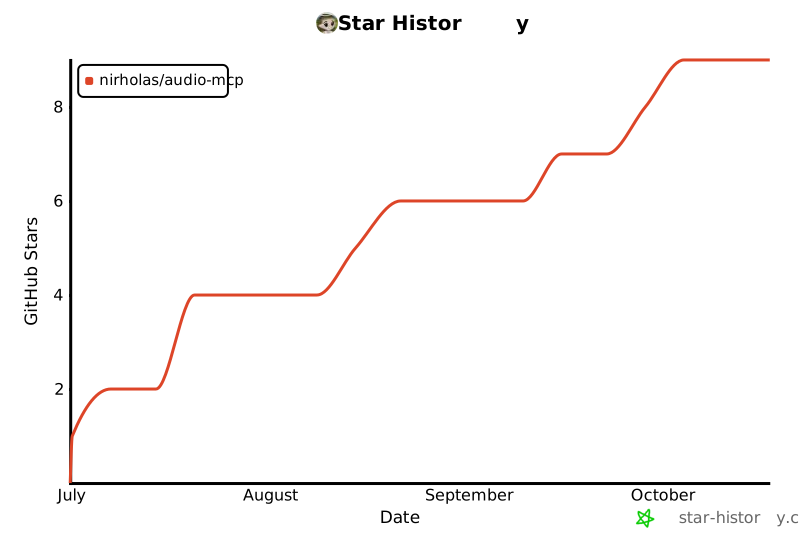
## Star history
[](https://www.star-history.com/#nirholas/audio-mcp&Date)
## Part of three.ws
[three.ws](https://three.ws) is a platform for 3D AI agents with Solana wallets: avatars, a skill marketplace, x402 payments and more than seventy MCP servers. `@three-ws/audio-mcp` is one package from it.
- Documentation site: https://nirholas.github.io/audio-mcp/
- npm: https://www.npmjs.com/package/@three-ws/audio-mcp
- Canonical source: https://github.com/nirholas/three.ws (this repository is a generated mirror of `packages/audio-mcp`)
- Agent-readable summary: [llms.txt](./llms.txt) and [AGENTS.md](./AGENTS.md)
- Issues and ideas: https://github.com/nirholas/audio-mcp/issues