# 🐙 Claude Octopus Every AI model has blind spots. Claude Octopus puts up to nine of them on every task, so blind spots surface before you ship — not after. It orchestrates Codex, Gemini, Antigravity CLI, Copilot, Qwen, Ollama, Perplexity, OpenRouter, and OpenCode alongside Claude Code, with consensus gates that flag any disagreements. **Claude-native first, Octopus for escalation.** Use Claude-native `/init`, `/review`, and `/security-review` when Claude is enough. Use Octopus when you want multiple model opinions, adversarial review, or stricter multi-LLM workflows.

Claude Octopus Demo — debate and research with multiple AI providers

Built with Claude Tests 117 suites passing Version 9.44.1 Requires Claude Code v2.1.14+ MIT License

🐙 **Research, build, review, and ship — with nine AI providers checking each other's work.** Say what you need, and the right workflow runs. Claude-native handles the ordinary path; Octopus handles the escalated path. A 75% consensus gate catches disagreements before they reach production. No single model's blind spots slip through. 🧠 **Remembers across sessions.** Integrates with [claude-mem](https://github.com/thedotmack/claude-mem) for persistent memory — past decisions, research, and context survive session boundaries. ⚡ **Spec in, software out.** Dark Factory mode takes a spec and autonomously runs the full pipeline — research, define, develop, deliver. You review the output, not every step. 🔄 **Four-phase methodology, not just tools.** Every task moves through Discover → Define → Develop → Deliver, with quality gates between phases. Other orchestrators give you infrastructure. Octopus gives you the workflows. 🐙 **32 specialized personas** (role-specific AI agents like security-auditor, backend-architect), **49 commands** (slash commands you type), **54 skills** (reusable workflow modules). Say "audit my API" and the right expert activates. Don't know the command? The smart router figures it out. 🐙 **Works with just Claude. Scales to nine.** Zero providers needed to start. Add them one at a time — each activates automatically when detected. 💰 **Five providers cost nothing extra when you already have access.** Codex, Gemini, Antigravity CLI, and Copilot use existing subscriptions or local auth. Ollama runs locally for free. Qwen now requires API-key or Coding-Plan auth; its free OAuth tier ended on 2026-04-15. --- ## What's New > 🆕 **v9.41 — Multi-LLM Council.** `/octo:council` runs a structured 3/5/7-persona deliberation across Claude, Codex, Gemini, and OpenCode with goal modes (`advice`, `decision`, `plan`, `implement`, `review`), styles (`balanced`, `adversarial`, `red-team`, `executive`, `implementation`), benchmark-aware role routing, quorum + critical-veto gates, budget caps, and gated worktree handoff for approved plans. Use it when one model's opinion isn't enough. > > ```bash > /octo:council --goal decision --style adversarial "Should this service stay monolithic?" > /octo:council --goal implement --implement plan-only "Refactor the auth flow" > ``` | Version | Best Features | |---------|--------------| | **v9.41** (new) | **`/octo:council`** promoted to first-class workflow — structured multi-LLM deliberation with goal modes, adversarial/red-team styles, benchmark-aware persona routing, quorum and critical-veto gates, budget preflight, and gated worktree handoff for approved implementation plans. | | **v9** (current) | Up to 9 providers (Codex, Gemini, Antigravity CLI, Copilot, Qwen, Ollama, Perplexity, OpenRouter, OpenCode). Structured provider debates and configurable multi-LLM councils. Smart router — just say what you need. Agent summary tables show which providers actually contributed. Provider-aware prompt preflight prevents silent oversize failures. Research breadth modes fan out light, standard, or exhaustive investigations. Setup aliases and fuzzy `/octo:*` corrections reduce command friction. Discipline mode with 8 auto-invoke gates. Two-stage review. Circuit breakers with automatic provider recovery. Cursor + OpenCode + Codex cross-compatibility. Token compression: `bin/octo-compress` pipe + auto PostToolUse hook save ~7,300 tokens/session. PostCompact context recovery. `bin/octopus` CLI. 175+ CC feature flags through v2.1.157, including Opus 4.8 and dynamic workflow awareness. | | **v8** | Multi-LLM code review with inline PR comments. Parallel workstreams in isolated git worktrees. Reaction engine — auto-responds to CI failures. 32 specialized personas. Dark Factory autonomous pipeline. | | **v7** | Double Diamond workflow. Multi-provider dispatch. Quality gates and consensus scoring. Configurable sandbox modes. | [Full changelog →](CHANGELOG.md) ## Quickstart ```bash # Terminal (not inside a Claude Code session): claude plugin marketplace add https://github.com/nyldn/plugins.git claude plugin install octo@nyldn-plugins # Then inside Claude Code: /octo:setup ``` That's it. Setup detects installed providers, shows what's missing, and walks you through configuration. You need **zero** external providers to start — Claude is built in. Claude Code **v2.1.14+** is the minimum supported runtime. Newer Claude Code releases unlock additional Octopus diagnostics and release checks automatically; the current plugin tracks feature flags through **Claude Code v2.1.157**.
Install for Codex CLI ```bash git clone --depth 1 https://github.com/nyldn/claude-octopus.git ~/.codex/claude-octopus && mkdir -p ~/.agents/skills && ln -sf ~/.codex/claude-octopus/skills ~/.agents/skills/claude-octopus ``` Restart Codex. Skills appear automatically — invoke with `$skill-doctor`, `$skill-debug`, etc.
Install for Cursor IDE Cursor uses Octopus as an **MCP server** (not a plugin — Cursor doesn't have Claude Code's plugin system). You get MCP tools like `octopus_discover`, `octopus_review`, etc. instead of `/octo:*` slash commands. > **Important:** Just cloning the repo is not enough. You must complete all three steps below — install dependencies and configure the MCP server — for Cursor to pick up Octopus tools. ```bash # 1. Clone the repo git clone --depth 1 https://github.com/nyldn/claude-octopus.git ~/.cursor/claude-octopus # 2. Install MCP server dependencies cd ~/.cursor/claude-octopus/mcp-server && npm install # 3. Configure Cursor — add to ~/.cursor/mcp.json (global) or .cursor/mcp.json (per-project): ``` ```json { "mcpServers": { "claude-octopus": { "command": "npx", "args": ["tsx", "${userHome}/.cursor/claude-octopus/mcp-server/src/index.ts"], "env": { "OCTO_CLAW_ENABLED": "true", "OPENAI_API_KEY": "${env:OPENAI_API_KEY}", "GEMINI_API_KEY": "${env:GEMINI_API_KEY}" } } } } ``` Restart Cursor. Tools appear in Cursor's AI chat — invoke by asking e.g. "use octopus_discover to research X".
Using Cursor on WSL? If you're running Cursor on Windows with WSL, clone the repo inside WSL and point the MCP config through `wsl.exe`: ```json { "mcpServers": { "claude-octopus": { "command": "wsl", "args": ["npx", "tsx", "/home//.cursor/claude-octopus/mcp-server/src/index.ts"], "env": { "OPENAI_API_KEY": "${env:OPENAI_API_KEY}", "GEMINI_API_KEY": "${env:GEMINI_API_KEY}" } } } } ``` Replace `` with your WSL username. Make sure `node` and `npm` are installed inside WSL.
See [docs/IDE-INTEGRATION.md](docs/IDE-INTEGRATION.md) for the full guide including `ide-attach.sh` auto-setup.
Install for OpenCode ```bash git clone --depth 1 https://github.com/nyldn/claude-octopus.git ~/.opencode/claude-octopus mkdir -p ~/.agents/skills ln -s ~/.opencode/claude-octopus/skills ~/.agents/skills/claude-octopus ```
Other install methods (Claude Code) **From the Claude Code UI:** Type `/plugin` in a session → **Marketplace** tab → install **octo**. **Factory AI (Droid):** ```bash droid plugin marketplace add https://github.com/nyldn/claude-octopus.git droid plugin install octo@nyldn-plugins ```
Update / Troubleshooting ```bash # Update claude plugin marketplace update nyldn-plugins claude plugin update octo@nyldn-plugins # Clean reinstall (if update fails) claude plugin uninstall claude-octopus 2>/dev/null claude plugin uninstall octo 2>/dev/null rm -rf ~/.claude/plugins/cache/nyldn-plugins/octo claude plugin marketplace remove nyldn-plugins claude plugin marketplace add https://github.com/nyldn/plugins.git claude plugin install octo@nyldn-plugins ``` Run focused diagnostics after updating: ```bash /octo:doctor config # install path, version, manifest, Claude Code feature flags /octo:doctor skills # skill loading, skillOverrides, plugin zip/URL capability notes ``` For Anthropic-compatible gateways, Claude Code v2.1.129+ requires an explicit opt-in before `/model` discovers models from `/v1/models`: ```bash export ANTHROPIC_BASE_URL=https://your-gateway.example/v1 export CLAUDE_CODE_ENABLE_GATEWAY_MODEL_DISCOVERY=1 ``` Claude Code v2.1.129+ also supports `skillOverrides` in Claude settings. Use it to keep rarely used Octopus skills installable while reducing context load, for example by setting niche skills to `name-only` or `user-invocable-only`.
--- ## Claude Code Web and Remote Sessions When Claude Code is running in a hosted, web, or remote-control environment, set `OCTOPUS_REMOTE_SESSION=true` in that environment. If Claude Code itself exports `CLAUDE_CODE_REMOTE=true` or `CLAUDE_CODE_WEB=true`, Octopus detects that automatically. Remote sessions are treated as unattended by default: - `CLAUDE_OCTOPUS_AUTONOMY=autonomous` / `OCTOPUS_AUTONOMY=autonomous` unless already set - provider smoke tests and Codex tier probes are skipped - the statusline uses a lightweight remote-safe display Set `OCTOPUS_REMOTE_STATUSLINE=full` to opt back into the full local HUD, or `OCTOPUS_REMOTE_STATUSLINE=off` to suppress statusline output entirely. Cloud environment setup should install provider CLIs and expose only the credentials required for the workflow. Paste this into the cloud environment setup script: ```bash #!/usr/bin/env bash set -e npm install -g @openai/codex @google/gemini-cli @qwen-code/qwen-code 2>/dev/null || true echo "Octopus cloud setup:" command -v codex >/dev/null 2>&1 && echo " Codex CLI: installed" || echo " Codex CLI: missing" command -v gemini >/dev/null 2>&1 && echo " Gemini CLI: installed" || echo " Gemini CLI: missing" command -v agy >/dev/null 2>&1 && echo " Antigravity CLI: installed" || echo " Antigravity CLI: missing" command -v qwen >/dev/null 2>&1 && echo " Qwen CLI: installed" || echo " Qwen CLI: missing" command -v gh >/dev/null 2>&1 && echo " GitHub CLI: installed" || echo " GitHub CLI: optional, install if Sentinel needs GitHub" ``` Set environment variables in the cloud environment, not in the script: ```bash OPENAI_API_KEY=... GEMINI_API_KEY=... PERPLEXITY_API_KEY=... # optional OPENROUTER_API_KEY=... # optional ``` Provider API calls require internet access from the hosted environment. For scheduled Claude Code tasks, run `/octo:sentinel` for triage and `/octo:security` for recurring audits. Keep jobs read-only by default and route fixes through `/octo:debug`, `/octo:review`, or `/octo:embrace` after triage. Set `OCTO_TIER=prototype|mvp|production` as a project hint. It does not hard-block behavior; it helps setup, doctor, and workflow prompts recommend the right amount of verification and provider spend. --- ## 9 Commands That Matter Most Nine high-traffic commands cover the common Octopus workflows: lifecycle execution, councils, debate, research, design, quality, and specs. ```bash /octo:embrace build stripe integration # Full lifecycle: research → define → develop → deliver /octo:factory "build a CLI that converts CSV to JSON" # Autonomous pipeline — spec in, software out /octo:council --goal decision "Should we keep this service monolithic?" # Persona council with budget/veto gates /octo:debate monorepo vs microservices # Structured provider debate with consensus /octo:research --breadth=standard htmx vs react in 2026 # Attributed multi-provider research /octo:design mobile checkout redesign # UI/UX design with BM25 style intelligence /octo:tdd create user auth # Red-green-refactor with test discipline /octo:security # OWASP vulnerability scan + remediation /octo:prd mobile checkout redesign # AI-optimized PRD with 100-point scoring ``` `/octo:council` uses the real runner by default. Single-model simulation is only used when explicitly requested with `--simulate` or `--single-model`; `--research-first` writes a research artifact before fanout, and `--corpus-mode append|require` preserves synthesis and plans in project corpus workflows. Plus 40+ more: review, debug, extract, deck, docs, schedule, parallel, sentinel, optimize, brainstorm, claw, doctor, and [the full set](docs/COMMAND-REFERENCE.md). Don't remember the command name? Just describe what you need: ``` /octo:auto research microservices patterns -> routes to discover phase /octo:auto build user authentication -> routes to develop phase /octo:auto compare Redis vs DynamoDB -> routes to debate ``` The smart router parses your intent and selects the right workflow. Multi-provider runs also write an agent status ledger. Use `octopus agent-summary` to see which providers contributed, which ran degraded, and which failed before synthesis. --- ## Pick a Command by Goal Not sure which command to use? Pick by goal: | I want to... | Use | |--------------|-----| | Research a topic thoroughly | `/octo:research` or `/octo:discover` | | Get a panel recommendation or gated implementation plan | `/octo:council` | | Debate two approaches | `/octo:debate` | | Build a feature end-to-end | `/octo:embrace` | | Design a UI or style system | `/octo:design` | | Review existing code | `/octo:review` | | Write tests first, then code | `/octo:tdd` | | Scan for vulnerabilities | `/octo:security` | | Write a product spec | `/octo:prd` | | Go from spec to shipping code | `/octo:factory` | | Debug a tricky issue | `/octo:debug` | | Reduce token usage | `/octo:doctor` (includes RTK install + token tips) | | Just run something quick | `/octo:quick` | Or skip the table — type `/octo:auto ` or just say `octo `, and the smart router picks for you. 🔍
How does this compare to Superpowers or plain Claude Code? | | Claude Code alone | [Superpowers](https://github.com/obra/superpowers) | Claude Octopus | |---|---|---|---| | **Core idea** | One model, your prompts | Structured methodology for one agent | Up to 9 providers cross-checking each other | | **Providers** | Claude only | Claude only | Codex, Gemini, Antigravity CLI, Copilot, Qwen, Ollama, Perplexity, OpenRouter, OpenCode | | **Workflow** | Ad-hoc | Spec → plan → subagent-driven dev | Discover → Define → Develop → Deliver (Double Diamond) | | **Strength** | Simple, no setup | Long autonomous runs with discipline | Multiple perspectives catching blind spots | | **Consensus gates** | No | No | Yes — 75% agreement threshold | | **Best for** | Quick tasks, simple features | Large builds with clear specs | Research, review, debates, multi-provider validation | | **Setup** | Nothing | Install plugin | Install plugin, optionally add providers | **tl;dr:** Superpowers makes one agent work really well for hours. Octopus makes multiple agents check each other's work. They solve different problems.
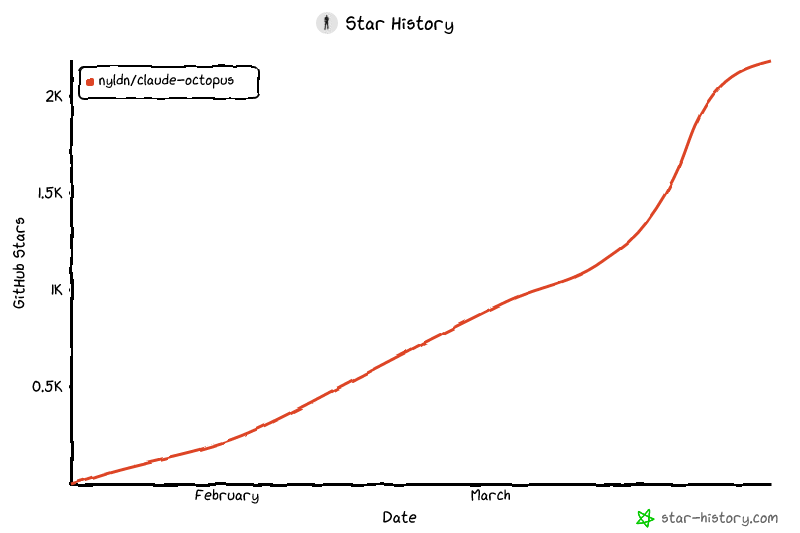
--- ## How It Works ### How 9 Providers Work Together Claude Octopus coordinates up to nine AI providers: | Provider | Role | |----------|------| | 🔴 Codex (OpenAI, GPT-5.4) | Code review + implementation — edge-case hunting, terminal-heavy execution, patch/test loops | | 🟡 Gemini (Google) | Ecosystem breadth — alternatives, research synthesis | | 🧭 Antigravity CLI (`agy`) | Google Antigravity perspective via native stdin print-mode dispatch | | 🟣 Perplexity | Live web search — CVE lookups, dependency research, current docs | | 🌐 OpenRouter | Alternative model routing — access 100+ models via single API | | 🟢 Copilot (GitHub) | Zero-cost research — uses existing GitHub Copilot subscription | | 🟤 Qwen (Alibaba) | Qwen3-Coder research via API-key or Coding-Plan auth | | ⚫ Ollama (Local) | Zero-cost local LLM — offline, privacy-sensitive, fallback | | 🔵 Claude (Anthropic, Opus 4.8 + Sonnet 4.6) | Architecture, strategy, security review, orchestration, consensus, final synthesis | Providers run in parallel for research, sequentially for problem scoping, and adversarially for review. A 75% consensus quality gate prevents questionable work from shipping. Only Claude is required — all others are optional and auto-detected. **Premium Claude routing** defaults `architect`, `strategist`, `security-reviewer`, and opt-in `implementer-heavy` to the current Opus family. On Claude Code v2.1.154+ that is Opus 4.8; older supported hosts fall back to Opus 4.7 and then 4.6. `code-reviewer` and `implementer` default to GPT-5.4 (Terminal-Bench and edge-case review). Opt out with `OCTOPUS_LEGACY_ROLES=1` to restore the v9.28 mapping. See [CHANGELOG](CHANGELOG.md) and [GPT-5.4 prompting guide](docs/GPT-5.4-PROMPTING.md). **Native dynamic workflows:** Claude Code v2.1.154+ can run native dynamic workflows for huge single-Claude migrations. Use that path when one Claude workflow is enough; use Octopus when you need multi-provider disagreement, councils, adversarial review, external model validation, or blind-spot coverage. ### Four Phases: Discover, Define, Develop, Deliver Four structured phases adapted from the UK Design Council's methodology: | Phase | Command | What happens | |-------|---------|-------------| | Discover | `/octo:discover` | Multi-AI research and broad exploration | | Define | `/octo:define` | Requirements clarification with consensus | | Develop | `/octo:develop` | Implementation with quality gates | | Deliver | `/octo:deliver` | Adversarial review and go/no-go scoring | Run phases individually or all four with `/octo:embrace`. Configure autonomy: supervised (approve each phase), semi-autonomous (intervene on failures), or autonomous (run all four). ### 32 Specialist Personas Specialized agents that activate automatically based on your request. When you say "audit my API for vulnerabilities," security-auditor activates. When you say "design a dashboard," ui-ux-designer takes over. Categories: Software Engineering (11), Specialized Development (6), Documentation & Communication (5), Research & Strategy (3), Business & Compliance (3), Creative & Design (4). [Full persona reference](docs/AGENTS.md) | [All 54 skills](docs/COMMAND-REFERENCE.md) ### Built-in Reaction Engine When agents create PRs, the reaction engine monitors what happens next — CI failures, review comments, stale agents — and responds automatically. No new commands to learn. It fires transparently inside workflows you already use: | Integration Point | When It Fires | |-------------------|---------------| | `/octo:parallel` | Between poll cycles while monitoring work packages | | `/octo:sentinel` | After triage scan completes | | `agent-registry.sh health --react` | On-demand health check | **What it auto-handles:** | Event | Reaction | Limits | |-------|----------|--------| | CI failure | Collects failure logs into agent inbox | 3 retries, escalates after 30m | | Changes requested | Collects review comments into agent inbox | 2 retries, escalates after 60m | | Agent stuck | Escalates to human | After 15m with no progress | | PR approved + CI green | Notifies you it's ready to merge | — | | PR merged | Marks agent complete | — | **Override defaults per project** by creating `.octo/reactions.conf`: ``` # EVENT|ACTION|MAX_RETRIES|ESCALATE_AFTER_MIN|ENABLED ci_failed|forward_logs|5|45|true changes_requested|forward_comments|3|90|true stuck|escalate|0|10|true ``` Reactions track 13 agent lifecycle states: `running` → `pr_open` → `ci_pending` → `ci_failed` / `review_pending` → `changes_requested` / `approved` → `mergeable` → `merged` → `done`. --- ## Providers and What They Cost ### Authentication | Method | Codex | Gemini | Antigravity | Claude | |--------|-------|--------|-------------|--------| | OAuth/subscription (recommended) | `codex login` — included in ChatGPT subscription | Google account — included in AI subscription | `agy` auth — included with Antigravity access | Built into Claude Code | | API key | `OPENAI_API_KEY` — per-token billing | `GEMINI_API_KEY` — per-token billing | n/a | Built into Claude Code | OAuth users pay nothing beyond their existing subscriptions. Qwen is the exception: its free OAuth tier ended on 2026-04-15, so use `QWEN_API_KEY` or Coding-Plan (`OPENAI_API_KEY` + `OPENAI_BASE_URL`). ### What You Get With Just Claude Everything except multi-AI features. You get all 32 personas, structured workflows, smart routing, context detection, and every skill. Multi-AI orchestration (parallel analysis, debate, consensus) activates when external providers are configured. --- ## Trust, Safety, and Limits **Command namespace** — Slash commands are namespaced under `/octo:*` and the `octo` natural-language prefix routes through the plugin's intent detection. Lifecycle hooks (session start/end, prompt submit, tool use, compaction, plan mode, worktrees, task lifecycle, idle, config change, permission events) also attach to Claude Code so multi-provider routing, freeze/discipline modes, and the work-queue watcher can function. See `.claude-plugin/hooks.json` for the full list. Uninstall removes every hook. **Data locations** — Results in `~/.claude-octopus/results/`, logs in `~/.claude-octopus/logs/`, project state in `.octo/`. Nothing hidden. **Provider transparency** — Every command shows a 🐙 activation indicator on launch. Provider markers such as 🔴 🟡 🧭 🟣 🔵 show exactly which providers are running and when external APIs are called. You always know what's happening. **Session provider controls** — Temporarily disable exhausted providers without uninstalling them. For example, `/octo:model-config disable codex --session` keeps Codex out of provider detection and multi-LLM fanout for the current session; `/octo:model-config clear-allowlist --session` restores the default. **Clean uninstall** — Run `claude plugin uninstall octo` from your terminal. If you see a scope error, add `--scope project`. No residual config changes. --- ## Works With OpenClaw Claude Octopus ships with a compatibility layer for [OpenClaw](https://github.com/openclaw/openclaw), the open-source AI assistant framework. This lets you expose Octopus workflows to messaging platforms (Telegram, Discord, Signal, WhatsApp) without modifying the Claude Code plugin. ### Architecture ``` Claude Code Plugin (unchanged) └── .mcp.json ─── MCP Server ─── orchestrate.sh ↑ OpenClaw Extension ─────────────────────┘ ``` Three components, zero changes to the core plugin: | Component | Location | Purpose | |-----------|----------|---------| | MCP Server | `mcp-server/` | Exposes 10 Octopus tools via Model Context Protocol | | OpenClaw Extension | `openclaw/` | Wraps workflows for OpenClaw's extension API | | Skill Schema | `mcp-server/src/schema/skill-schema.json` | Universal skill metadata format | ### MCP Server The MCP server is **opt-in** — it does not start automatically. This prevents a permanent `✘ failed` status in Claude Code's `/mcp` panel for users who don't need it. To enable it, add the server to your project's `.mcp.json` or global Claude Code settings: ```json { "mcpServers": { "octo-claw": { "command": "node", "args": ["--require", "./mcp-server/check-node-version.js", "./mcp-server/dist/index.js"], "cwd": "", "env": { "OCTO_CLAW_ENABLED": "true" } } } } ``` Once enabled, it exposes: - `octopus_discover`, `octopus_define`, `octopus_develop`, `octopus_deliver` — Individual phases - `octopus_embrace` — Full Double Diamond workflow - `octopus_debate`, `octopus_council`, `octopus_review`, `octopus_security` — Specialized workflows - `octopus_list_skills`, `octopus_status` — Introspection Any MCP-compatible client can connect to the server. ### OpenClaw Extension Install in an OpenClaw instance from git: ```bash npm install github:nyldn/claude-octopus#main --prefix openclaw ``` Or clone and link locally: ```bash cd openclaw && npm install && npm run build ``` The extension registers as an OpenClaw plugin with configurable workflows, autonomy modes, and Claude Code path resolution. ### Build & Validate ```bash ./scripts/build-openclaw.sh # Regenerate skill registry from frontmatter ./scripts/build-openclaw.sh --check # CI mode — exits non-zero if out of sync ./tests/validate-openclaw.sh # 13-check validation suite ``` --- ## FAQ **Do I need every AI provider?** No. One external provider plus Claude gives you multi-AI features. No external providers still gives you personas, workflows, and skills. **Will this break my existing Claude Code setup?** No. Activates only with the `octo` prefix. Results stored separately. Uninstalls cleanly. **What happens if a provider times out?** The workflow continues with available providers. You'll see the status in the visual indicators. **Why "octopus"?** 🐙 *Fun fact: a real octopus has three hearts, blue blood, and 500 million neurons — two-thirds of which live in its eight arms.* Each arm can taste, touch, and act independently. Claude Octopus works the same way: each tentacle (command) operates autonomously with its own squeeze of logic, then ink flows back as the final deliverable. The crossfire review? That's the squeeze — adversarial pressure that untangles everything before it ships. **How do I debug when something goes wrong?** Run commands with the `--verbose` flag to get detailed debugging output. Logs are stored in `~/.claude-octopus/logs/` for inspection. You can also use `/octo:doctor` to run diagnostics and identify potential issues. --- ## Community Join [r/ClaudeOctopus](https://www.reddit.com/r/ClaudeOctopus/) for help, workflow tips, showcases, and updates. [![Star History Chart](https://api.star-history.com/image?repos=nyldn/claude-octopus&type=date&legend=top-left)](https://www.star-history.com/?repos=nyldn%2Fclaude-octopus&type=date&legend=top-left) ### Contributing 1. [Report issues](https://github.com/nyldn/claude-octopus/issues) 2. Submit PRs following existing code style 3. `git clone https://github.com/nyldn/claude-octopus.git && make test` See [CONTRIBUTING.md](docs/CONTRIBUTING.md) for details. --- ## Documentation - [Documentation Guide](docs/README.md) — Start here - [Command Reference](docs/COMMAND-REFERENCE.md) — Commands, triggers, and provider indicators - [Feature Gap Analysis](docs/FEATURE-GAP.md) — CC feature adoption tracker - [Architecture](docs/ARCHITECTURE.md) — Provider flow and execution model - [Plugin Architecture](docs/PLUGIN-ARCHITECTURE.md) — Internal plugin structure - [Agents & Personas](docs/AGENTS.md) — All 32 personas - [CLI Reference](docs/CLI-REFERENCE.md) — Direct CLI usage, debug mode, async, and tmux - [Changelog](CHANGELOG.md) --- ## Attribution - **[wolverin0/claude-skills](https://github.com/wolverin0/claude-skills)** — AI Debate Hub. MIT License. - **[obra/superpowers](https://github.com/obra/superpowers)** — Discipline skills patterns, verification-before-completion philosophy, two-stage review approach, and review response patterns. MIT License. - **[nextlevelbuilder/ui-ux-pro-max-skill](https://github.com/nextlevelbuilder/ui-ux-pro-max-skill)** — BM25 design intelligence databases. MIT License. - **[UK Design Council](https://www.designcouncil.org.uk/our-resources/the-double-diamond/)** — Double Diamond methodology. --- ## License MIT — see [LICENSE](LICENSE)
nyldn | MIT License | r/ClaudeOctopus | Report Issues