
Mine the messages you typed to your coding agents into a you.md profile, every rule with dated receipts, and install it where your agent can read it.







| 🡒 agent | 🡒 agent + emulo |
|---|---|
| Here's how I'd play it. **Subreddits:** r/ClaudeAI and r/ChatGPTCoding are your core audience. r/LocalLLaMA fits the local angle. r/cursor, r/SideProject, r/opensource for reach. Don't blast all at once — post to one, tune the title, repost over a few days. **Title:** I built a local tool that reads your AI coding logs and writes a "you.md" your agents read before every task | the insight first: the mining number is your whole post. "i read 1,656 of my own sessions" is a confession, not a pitch, and nobody scrolls past a confession. lead with the mirror, not the mechanism. one sub, not five — a skills sub, where people come looking for this instead of arguing about it. **Title:** I built a Claude skill from 8 months of my own Claude Code sessions |

200 upvotes · 32 comments · 102K views
One post, so it says nothing about whether the profile caused any of that.
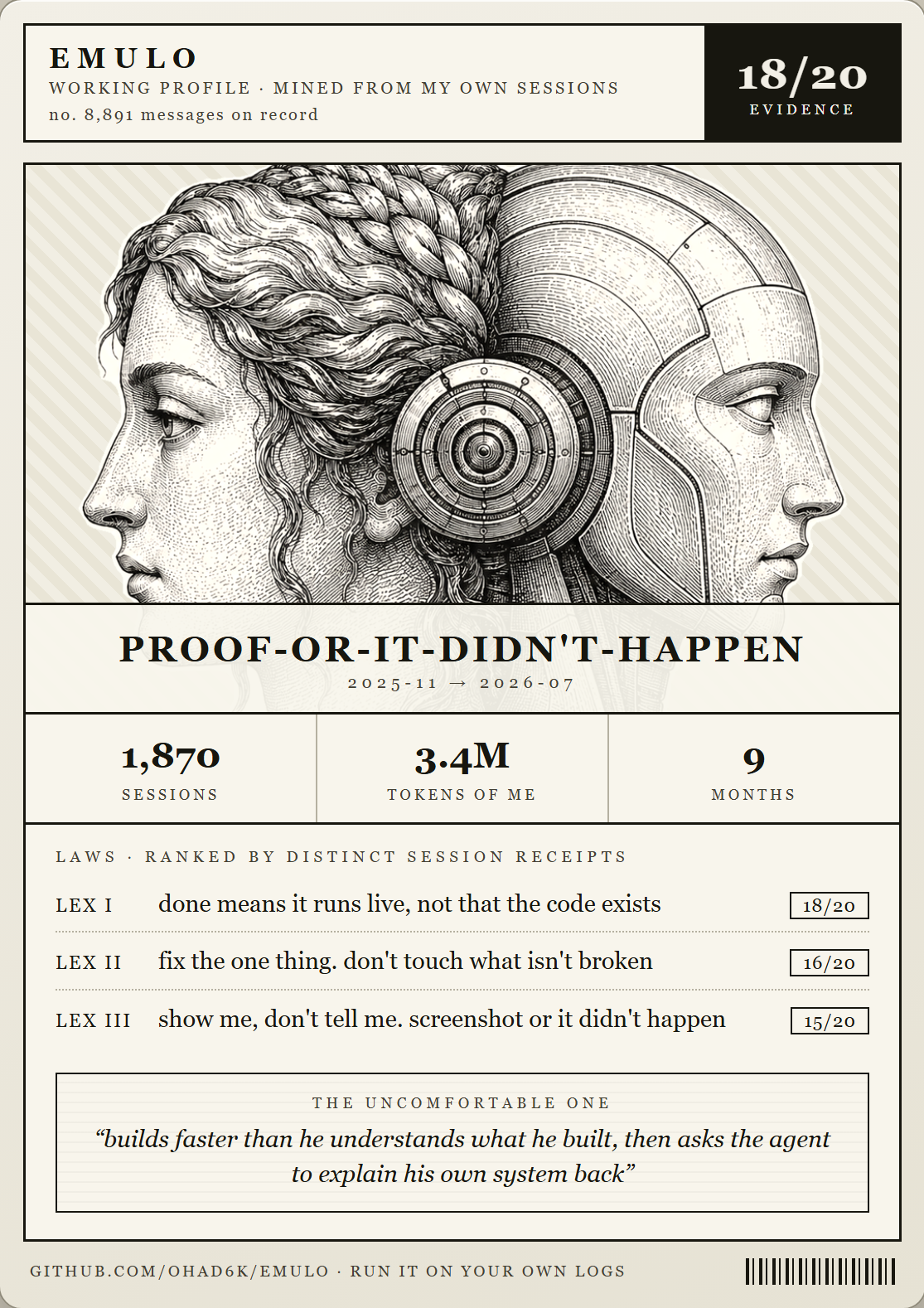
This card is from a different run of the miner than the early July 2026 profile quoted elsewhere in this README, so its session and token counts differ from it.
Share the card or one short trait, never your full profile. ## Quickstart Step by step, with what each command reads and writes, what reaches a model, and how to remove it: [docs/PROFILE-FLOW.md](docs/PROFILE-FLOW.md). Install the cross-agent bootstrap. It runs the mining flow in Claude Code and Codex: ```bash npx skills add ohad6k/emulo@emulo ``` Then tell your agent: ```text run emulo ``` That installs the bootstrap and creates a read-only full-history mining plan. Your agent must show the cost and wait for approval before model work. Once your profile exists, the bootstrap offers the native plugin so you also get the namespaced `emulo:` skills. It asks first and takes a no. In Codex it can run the install itself; in Claude Code `/plugin` is typed by you, so it hands you the two exact lines to paste. ### Install the CLI If you'd rather run Emulo yourself instead of through an agent: ```bash pip install emulo ``` That puts `emulo` on your path. `emulo --dry-run` writes nothing and prints what it found: sessions, your messages, approximate tokens, how many messages had something redacted, and the paths it would write. `emulo` then extracts and writes the corpus, the chunks and `RUN_ME.md` to `emulo-out/` straight away. There is no plan or approval step on this path, because it makes no model calls; the model work starts when you hand `RUN_ME.md` to your agent. `emulo mcp` runs the MCP server below. `uv tool install emulo` works the same way, and `uvx emulo` runs it without installing. `emulo` writes `RUN_ME.md` next to your chunks. It is self-contained, so the whole remaining step is one line to your agent: ```text read emulo-out/RUN_ME.md and follow it ``` Your agent makes one pass per chunk, merges them, writes `you.md`, and prints the install commands. Nothing to paste and nothing else to download. Which install to pick. For Codex and OpenCode, `emulo --install you.md --target agents --repo .` in the project you work in adds the profile to its `AGENTS.md`, and that is the route a host-by-host test on 2026-09-25 saw reach the model. It writes the whole profile, including verbatim quotes from your sessions, into that folder's AGENTS.md, which is usually committed and shared, so keep that file out of version control or install to a personal folder that is not committed. For Claude Code, `emulo --install you.md --target claude` installs a skill named `you`, and Claude Code does not reliably open it on its own, so type `/you` (or `/you